Jarvis Jaybird

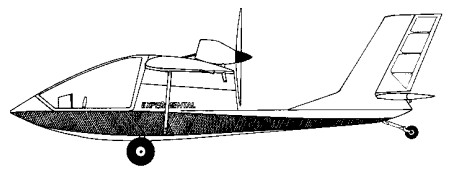
The design was originally by the Jarvis Manufacturing Co (as Jaybird) and first flew on 1 February 1946 with a 65hp Lycoming O-145-B engine and fixed tricycle gear. The Jaybird features a pod nacelle with a pusher engine.

The Jarvis Jaybird design was acquired by Volmer Jensen as homebuilt project soon after World War II and became the VJ-21 Jaybird with retractable wheels and 75hp Continental A75 engine.

Engine: 65hp Lycoming O-145-B
Cruise speed: 110 mph
Top speed: 125 mph
Landing speed: 40 mph
Range: 400 mi
Seats: 2 side-by-side
Wingspan: 45 ft
Length: 24 ft
ROC: 700 fpm
TO to 50ft: 960 ft
Price: $2500

Jaritz 1912 monoplane

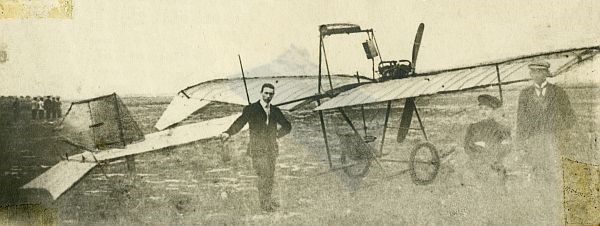
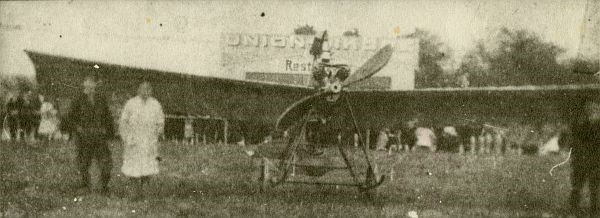
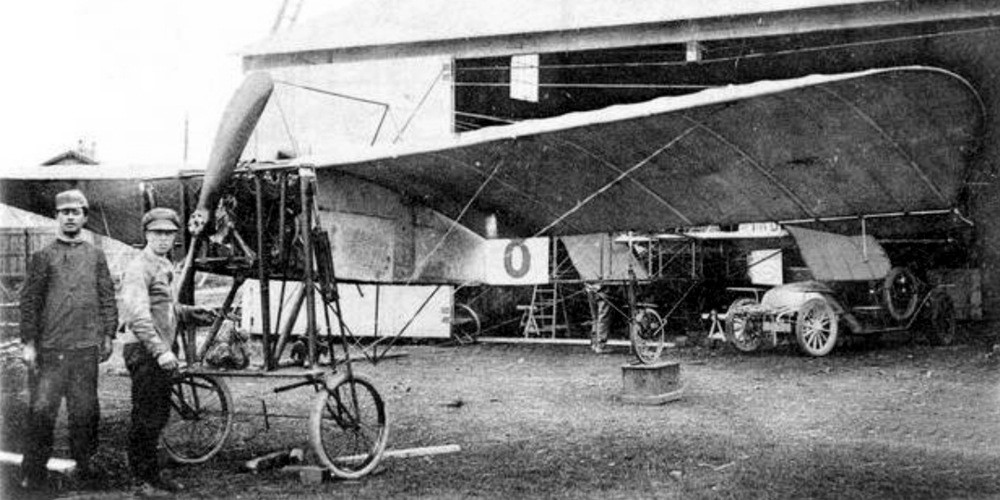
Austrian Paul Jaritz after finishing his engineering studies in 1911 went to Leipzig, where he met Wilhelm Weidenauer, who was in the bicycle and motorcycle business and wanted to enter the field of aviation. So Jaritz built a steel-tube monoplane and Weidenauer constructed the 30 hp 4-cylinder engine, composed from two pacemaker engines. The Lindenthal airfield offered a shed for free.

The aircraft was ready in spring 1912 and test flying continued until summer. A couple of flights were accomplished, but the engine proved quite troublesome. It quickly overheated and lacked in power.

Weidenauer then built another engine, this time a 50 hp with 5-cylinders, probably a radial or fan-type. But before that was completed Jaritz was ordered home for his military service and the liaison came to an abrupt end.

Janox

USA
Manufacturer of reflector landing systems which, in about 1970, acquired Navion Aircraft Corporation. Intended to continue production of Navion Model H in new factory at Coshocton, Ohio; instead, Navion Aircraft Corporation was purchased in late 1972 by Mr Cedric Kotowicz, who moved all assets to a new plant at Wharton, Texas, subsequently setting up the Navion Rangemaster Aircraft Company.

Janowski J-3 Eagle

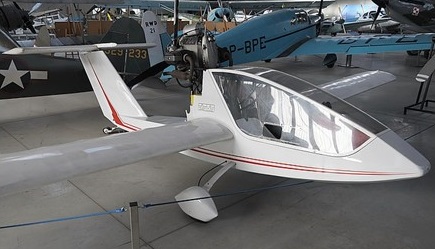
J-3 Eagle was the third, after Prząśniczka J-1 and J-2 Polonaise amateur single-seat aircraft, designed by Jaroslaw Janowski.

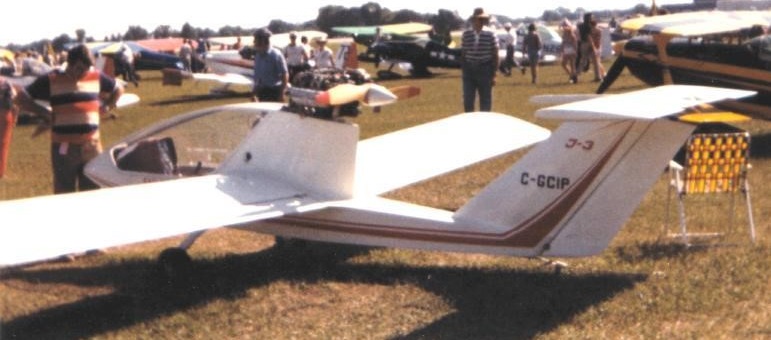
The aircraft of wooden construction featured Wortmann airfoil with flaperons all along the trailing edge, wingtip fuel tanks and composite landing gear legs. The aircraft was powered in succession by a modified Porsche car engine, a Rotax and a BMW R100 engines. The J-3 Eagle (Orzel) was produced using the pod-and-boom pusher arrangement, with a top-mounted engine and conventional landing gear similar to the J-1, and a T-tail stabilator and shoulder-mounted cantilever wings similar to the J-2. The wings used a 19% thick laminar airfoil and could be easily detached for ground transport.

A single example was built by Witold Kalita, J. Janowski and Marian Smith, for whom the aircraft was the intended. The J-3 Eagle was built from sketches, and no blueprints or plans of any sort were ever produced.

When Marian Nowak emigrated from Poland to Canada he took the J-3 with him. He flew the aircraft for 250 trouble-free hours, regularly making 375 mile commutes. However, he decided to take advantage of the detachable wings and transport it by trailer when he exhibited it at the EAA convention at Oshkosh in 1980 as the first amateur construction from the Eastern Bloc.

The Eagle initially flew with a 35 HP converted Porsche automobile engine, but Mr. Nowak also flew it with a Rotax 503, a Rotax 447, a 69 hp BMW motorcycle engine, and finally a water-cooled 3 cylinder Suzuki auto engine. Eventually Mr. Nowak sold the airplane, and the new owner tied it down outdoors where it unfortunately deteriorated beyond airworthy condition. The Transport Canada database listed it as last registered to Wieslaw Pawelkiewicz in April 2002, operating at Burlington, Ontario. It was donated to the Polish Aviation Museum in 2003 by the last owner, Wieslaw Pawełkiewicz of Canada.

J-3 Eagle (Orzel)
Serial Number: MN-1
Registration: C-GCIP
Engine: Porsche, 35 hp
Airfoil: Wortmann NACA 23015
Wingspan: 6.7 m / 22 ft 11 in
Wing area: 6.8 sq m /73 sq ft
Length: 4.8 m (15 ft 9 in)
Gross Weight: 699-721 lb
Empty Weight: 231-320 lb
Max Speed: 155 mph
Cruise Speed: 100 mph
Landing Speed: 45 mph
Takeoff run: 328 ft
First Flight: 1976 / 1977 / 1978 / 1980
Janowski J-1 Don Quixote / Przasniczka

J-1

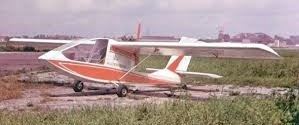
The prototype Don Quixote designed and built by MR. Janowski in 1974 was powered by a 23-hp two-stroke Saturn engine, also designed by Janowski. De¬veloping 23 hp from 500 cc, the J 1 features a fully enclosed cockpit with access via a lift up windscreen. The J 1’s construction uses tradi¬tional materials.
Single seat single engined high wing mono¬plane with conventional three axis control. Wing has unswept leading and trailing edges, and constant chord; conventional tail. Pitch control by elevator on tail; yaw control by fin mounted rudder; roll control by ailerons. Wing braced from below by struts; wing profile Clark Y; double¬-surface. Undercarriage has three wheels in tail dragger formation. Fuselage, totally enclosed. Engine mounted above wing driving pusher propeller.
However, several problems were inherent in the two-stroke engine, so the more readily available Volkswagen engine was settled on. The heavier engine called for strengthening the airplane’s structure. To over the widest range of homebuilders in various coun¬tries, it was decided that the Don Quixote would make use of conven¬tional wood an fabric along with more modern polyurethane foam and epoxy/fiberglass. The J-1 B can withstand loading of + 4G and – 2.3, but in the foam /fiberglass version of the plane, + 6.3 and —3.3 are possible. Construction of the plane follows conventional building rules, with spruce wood, birch plywood and flat sheets of plexiglass as basic materials.

J-1
Length overall 16.0ft, 4.88m.
Height overall 4.6ft, 1.40m.
Wing span: 24.9ft, 7.60m.
Constant chord 3.2 ft, 0.99 m.
Sweepback 0 deg.
Total wing area 81 sq.ft, 7.5 sq.m.
Wing aspect ratio 7.74.
Engine: Saturn, 25 hp.
Max take off weight 595 lb, 270 kg.
Max wing loading 7.37 lb/sq.ft, 36.0kg/sq.m.
Max power loading 23.8 lb/hp, 10.8 kg/hp.
Max level speed 81mph, 130kph.
Cruising speed 68mph, 110 kph.
Stalling speed 37 mph, 60 kph.
Max climb rate at sea level 590ft/min, 3.0m/s.
Range at average cruising speed 171 mile, 275 km.

J-1B
Engine 25-50 hp.
Wingspan: 24 ft 7.25in.
Wing Chord: 3 ft 3 in.
Length: 16 ft 4.75 in.
Height: 4 ft 5.75 in.
Empty Weight: 286 lbs.
Maximum Weight: 551 lbs.
Maximum Speed, Level Flight: 103 mph.
Cruise speed: 75 mph.
Stall speed: 41 mph.
Take-off Run: 328 ft.
Landing Roll: 164 ft.
Fuel Capacity: 4.4 Imp gal.
Nominal Range: 248 miles.

Engine: Volkswagen, 23 hp
Top speed 84 mph.
Cruise 77 mph.
Stall 39 mph.
Climb rate 244 fpm.
Ceiling 6820 ft.
Range 310 mile
Takeoff run 761 ft.
Land¬ing run (50ft) 1256 ft

Jannus 1915 Flying Boat

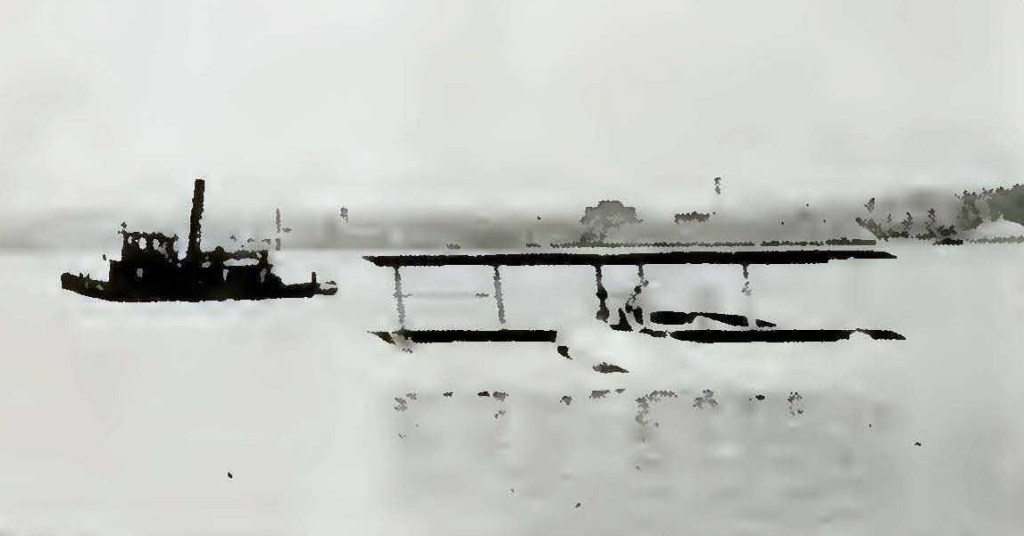
A new and efficient design for rough water, ready assembly and disassembly, inherent stability, wide range of flying speed, waterproof construction of wings, enormous margin of safety, comfort for pilot and three passengers, and a dry, clean place for them to sit, this 1915 model is ideal.
The rough water ability is obtained in two principal ways: first, all the wing attachments are independent of the motor and propeller shaft; and. second, the low centre of gravity. Of special interest are the tapering end floats that never pound or jerk the wings. These taper from three inches wide across the bottom to a foot across the top. The taper has the advantage of reducing the planing surface, which at high speed would be sufficient to pound the wings badly, but when called upon as floats are quickly displacing water at an increased rate, easily combating the heaviest side lurching or listing or yawing tendency.
The removability of the tail for shipment has many advantages in construction and in simplicity of shipment for compactness. The motor remains in the front half of the hull with all controls intact. The control cables going to the tail and rudder all pass through individual leads in a conduit that is made of heavy steel as a protection against the propeller breaking or throwing anything with sufficient force to sever them.
Between the conduit and the controls the cables are supplied with the Jannus type sister hook, which locks the cables together in a permanent fashion quickly, and without additional safety wire or other auxiliary being necessary.
The wings are assembled in their entirety before being attached to the hull and, when on, cannot fail to align properly if reasonable care is taken. Where desirable they can he put on half at a time. To April 1915 the best record showed a total load of 2.200 lbs. carried in flight at 22-55 mph with an indicated 60 h.p.
Tests in the lee of large vessels, along windward shores and in other extreme conditions of gusty wind and treacherous obstacles prove that the new struts and the staggered planes are serious contenders for the inherent stability honors. The pilots reported that in no case was there any rapid inequality developed nor did the machine make any appreciable variation from its course due to these unfavourable conditions.
The tests have been conducted by Mr. Fritz G. Ericson and Mr. Antony Jannus.
The designers did not stagger the planes in this model for other than structural advantage.
The internal construction of the wing is free from ordinary glue and is amply strong without any adhesives, although liquid marine glue is used in all joints to maintain rigidity under severe stress and to prevent rotting. All bolts go on each side of the beams, through end grain blocks that are brass covered outside of the fabric.
The pilot is seated in front, leaving a seat behind for three large passengers. The ample foot space is well above the ribs of the bottom and made in the form of a grating that is removable for cleaning the bilge scuppers or any other purpose.
The motor compartment is segregated from all other parts of the boat, so that no oil or grease can be distributed.

Janka Gyongyos 33

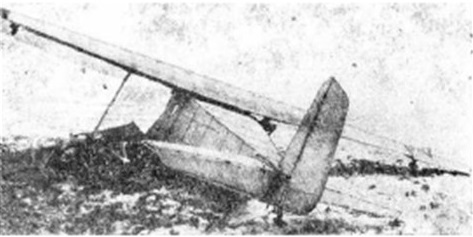
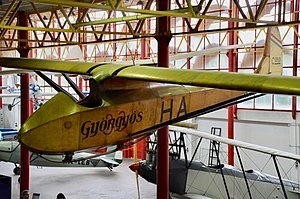
The Gyöngyös 33 was the first Hungarian designed sailplane and was named after its place and year of manufacture. It was designed by Zoltán Janka and built in the MOVERO (Aviation Section of Hungarian National Defence Association) workshops at Gyöngyös. His design target was to produce an aircraft that would out-perform the 1928 RRG Professor.

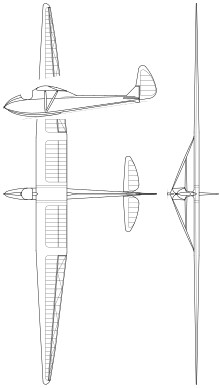
It was an all wood monoplane with a two-part wing built around a forward main spar and a rear false spar. The inner area of each part was rectangular in plan, tapering strongly outboard. The leading edges ahead of the main spar were plywood-covered, as was the whole wing at the inner-outer junction; the rest was fabric-covered. An aileron filled the whole trailing edge of each outer section. The two parts joined at a narrow centre-section on a raised fuselage pylon and were braced on each side with a V-strut from the fuselage bottom to the wing spars at the inner-outer junctions.

The Gyöngyös 33’s six-sided fuselage was formed by a wooden frame and was plywood-covered. The pilot had an open cockpit ahead of the wing leading edge with the wing pylon immediately behind him. A rubber-sprung landing skid below him ran from the nose almost to the trailing edge. The fuselage tapered rearwards to a cantilever empennage. The fin was small and ply-covered with a tall rudder which, like the all-moving tailplane apart from its leading edge, was fabric covered.

The first flight took place on 11 June 1933. A fortnight later the Gyöngyös 33 slope-soared for 5 h 43 m, gaining 1,140 m (3,740 ft) of altitude, a Hungarian record. On 27 June it set a national duration record of 10 h 7 m. In 1934 it made a 64 km (40 mi; 35 nmi) flight.

The Gyöngyös 33 is now on display in the Hungarian Technical and Transportation Museum, Budapest.

Length: 7.37 m (24 ft 2 in)
Wingspan: 18.55 m (60 ft 10 in)
Wing area: 19.3 sq.m (208 sq ft)
Aspect ratio: 17.8
Airfoil: Göttingen 549
Empty weight: 179 kg (395 lb)
Gross weight: 250 kg (551 lb)
Maximum glide ratio: >20 at 55 km/h (34 mph; 30 kn)
Rate of sink: 0.6 m/s (120 ft/min) minimum