Four cylinder, single & double ignition, four stroke engines for light & ultralight aircraft & motorgliders.
Author: Terry
Limbach Flugmotoren
Limbach Flugmotoren (Limbach Flightmotors) is a German company that produces aircraft engines. The company is named after Peter Limbach who expanded his father’s engine repair business in the 1970s in Königswinter.

By May 2006, Limbach had produced more than 6000 engines for light aircraft, ultralight aircraft and airships. Many Limbach engines are based on the Volkswagen flat-4 boxer unit with displacement of up to 2.4 litres, and up to 160 BHP in the turbocharged model.
In a letter dated 25th August 2011, the company announced that it would be closing by late 2011, saying “Years of ever increasing regulations and requirements have been choking us. Our efforts to operate in that environment were not successful because we cannot provide the necessary resources. Additionally there are government activities that hinder our current business and we cannot make plans for the future.”
In late 2012 it was announced that the Limbach assets had been sold to Mr. Chen Shuide.
1998-2012: Kotthausener Str. 5, Konigswinter, Germany, D-53639
Limbach produce 2-stroke and 4-stroke engines from 15 to 125 kW for paragliders to cruising aircraft.
The engines have electronic engine management with electronic fuel injection, no mixture control, no choke, and no carburettor preheating. With an electrically adjustable propeller, you only need to preselect the speed and accelerate.
Limb Aeronautics Lapwing
Limb Aeronautic of London, UK, register the Limb Aeronautics Lapwing G-BAUX c/n 01.
It is not known what type it was.
Lilium Jet
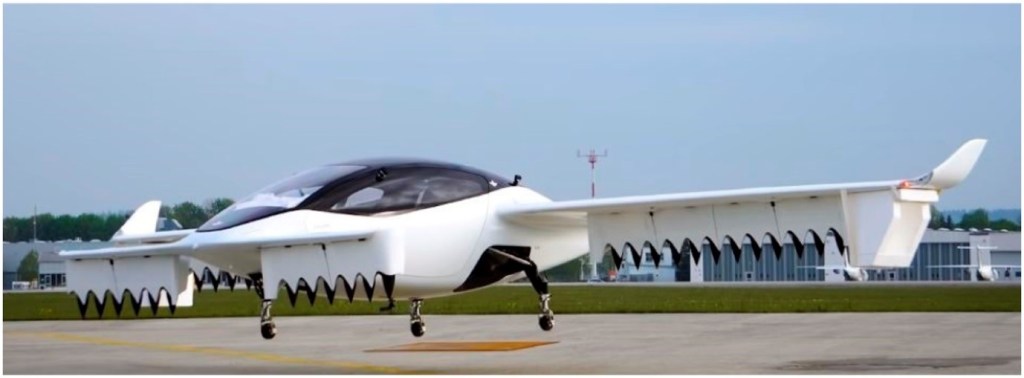
On 4 May 2019, Lilium flew its first flight of an untethered and unmanned five seat Lilium Jet at the Special Airport Oberpfaffenhofen in Munich, Germany. The full-scale prototype was powered by 36 electric ducted fans in configuration inspired by the Eagle prototype aircraft. After the first flight, which consisted primarily of hover, the Lilium Jet has expanded its flight envelope to include conversion to forward flight using the wing for lift, and several safety tests.
Lilium Eagle

In April 2017, Lilium GmbH, a Germany-based start-up founded in 2015, flew the first flight of the Eagle prototype aircraft. This aircraft was unique in that it used 36 powered fans (12 in each wing and 6 in each forward canard) for lift and propulsion.
Lilienthal Bekas X-32 / X-34 / Jordan Aerospace Industries / JAI RumBird X-32 / GulfBird X-34

The Lilienthal Bekas (Lilienthal Snipe in English, Лиленталь Х-32 Беҝас in Russian) is a 2/3 seat, high wing single engine pusher ultralight from Ukraine.
The Lilienthal Bekas is a pod and boom, multi-purpose, pusher configuration ultralight with a high wing and low-set boom carrying a T-tail. The well glazed pod seats two in tandem and carries the constant chord wing at its top. The wing is braced to the lower fuselage by two pairs of cross braced struts and is fitted with flaps, which have a maximum deflection of 40°. A fixed, tricycle undercarriage with a castoring nosewheel is mounted on the pod.
The engine is mounted at the rear top of the pod, behind the cabin; types in the 60-100 hp (45-75 kW) range may be fitted, most commonly Rotax two or four cylinder models such as the Rotax 582 or 912UL and 912ULS. The engine is cowled on some aircraft but not all. Much of the slim boom is occupied by a broad chord fin with a straight swept leading edge. On some aircraft it is extended forwards with a fillet. The rudder hinge, also slightly swept, is at the end of the boom. The tailplane is of constant chord and braced to the end of the boom by a strut on each side.
The X-32 Bekas first flew in March 1993 and received its Ukrainian certification in 1995. The Rotax 582 and 912 variants were certified in 2003 and 2005 respectively. The aircraft has JAR-VLA certification.

Between 2003 and 2006, the X-32 and X-34 were marketed by JAI (Jordan Aerospace Industries) as the RumBird X-32 and GulfBird X-34. By 2009, more than 400 X-32s had been sold.
Variants:
X-32AT Bekas
Sports version, certified for limited aerobatics.
X-32UT Bekas
Dual control trainer version.
X-32CK Bekas
Agricultural version, which may be fitted with spraybars fed from tank replacing rear seat.
X-32A Bekas
Ski undercarriage.
X-32H Bekas
Float undercarriage.
X-34 Bekas
Widened cabin for three, with the two passengers side-by-side on a rear bench seat; 500 mm greater span and either Rotax 912S or Rotax 914 engine.
Specifications:
X-32
Engine: 1 × Rotax 912, 60 kW (80 hp)
Propeller: 3-bladed VPSH 2 Donchak variable pitch pusher
Length: 6.55 m (21 ft 6 in)
Wingspan: 9.00 m (29 ft 6 in)
Height: 2.00 m (6 ft 7 in)
Wing area: 12.33 m2 (132.7 sq ft)
Airfoil: NACA 4412
Empty weight: 300 kg (661 lb)
Max takeoff weight: 495 kg (1,091 lb)
Cruising speed: 120 km/h (75 mph; 65 kn)
Stall speed: 55 km/h (34 mph; 30 kn) power off, flaps down
Never exceed speed: 158 km/h (98 mph; 85 kn)
Endurance: 3 hrs 20 min on normal fuel load
g limits: +3.8/-1.9
Rate of climb: 5.0 m/s (980 ft/min)
Crew: one
Capacity: one passenger
Lilienthal JSC
USSR
Formed 1975 and marketing hang gliders, motorgliders and the X-32 Bekas tandem two-seat ultralight suited to recreational, training and agricultural uses (first flown 1993).
Lilienthal Glider Gallery


Lilienthal Glider / Dart Aircraft Lilienthal Glider
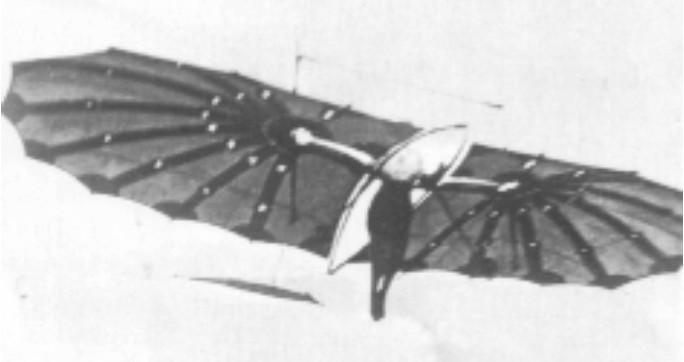
In five years between 1891 and 1896 Otto constructed seven gliders (five monoplanes and two biplanes) and made over 2000 ever-improving flights from hill sites at Stieglitz and in the Rhinow Mountains near Stöllen. He flew distances up to 400 m (1312 ft) and reached heights of 25 m (82 ft). He dis¬covered and made use of up-currents of air for soaring flight.
His first means of launching was a spring board, but this he soon abandoned in favour of hill launching. Some of his tests were made from the Rhinower Hills, near Stollen, but he also had constructed an artificial hill near Berlin.
In 1891 Lilienthal completed glider no.3, a monoplane glider constructed from peeled willow wands with a covering of waxed cotton. Its wings spanned 7 m (23 ft), with Lilienthal supporting himself within its centre section on parallel bars — literally a hang-glider — and controlling his flight path by shifting his body mass and thus altering the craft’s centre of gravity.
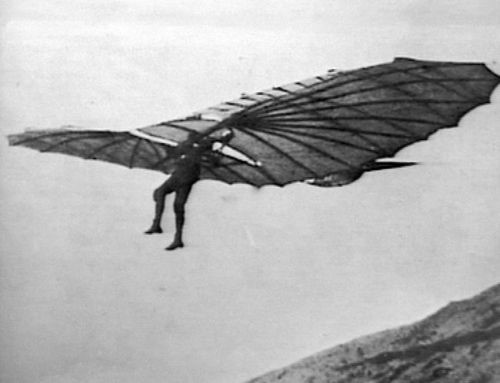
Lilienthal’s first tentative hops were made with the aid of a springboard launcher, but soon flew from a specially constructed 15-m (49-ft) hill on the outskirts of Berlin.
Between 1891 and 1896 Lilienthal constructed five types of monoplane glider and two biplane types (1891 and 1892).
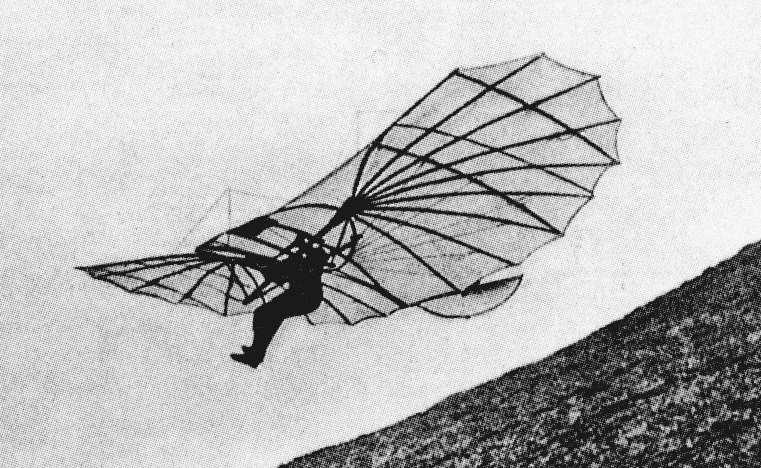
Lilienthal supported himself in his gliders by his arms, so that after a running take off his hips and legs dangled below the aircraft, allowing him to swing his body in any desired direction to achieve stability and control. After 1893 he was achieving glides of 300-750 ft (90-230 m), with remarkable ease of control.
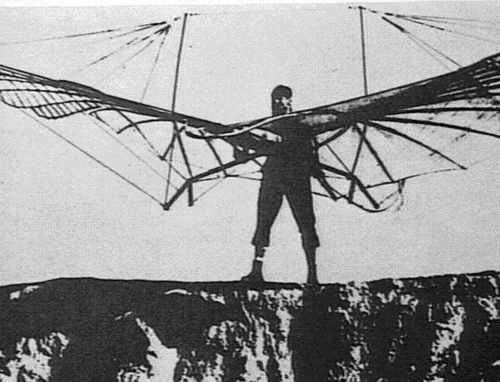
The 1894 monoplane hang glider was a single surface fabric covering over exposed framework. Wings fold for storage. Natural fabric finish; no sealant or paint of any kind.
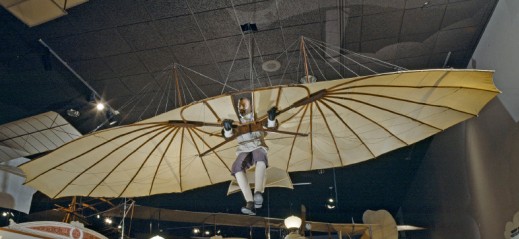
In 1895 he was developing a type of body harness to work a rear elevator. The purpose of this was to give better control in rising or descending by increasing the effect of the occupant swinging his body forwards or backwards and thus altering the centre of gravity. Lilienthal also tested a glider which had flapping wing tips, driven by a small carbonic acid gas engine. This system could never have equalled in efficiency the new petrol engines and propellers which were soon to come into being; but the great German inventor/ pilot was never to become aware of this, for he crashed in one of his gliders in the Rhinower Hills on 9 August 1896, and died in a Berlin clinic on the following day. His last words were ‘Opfer mussen gebracht werden’ (‘Sacrifices must be made’).
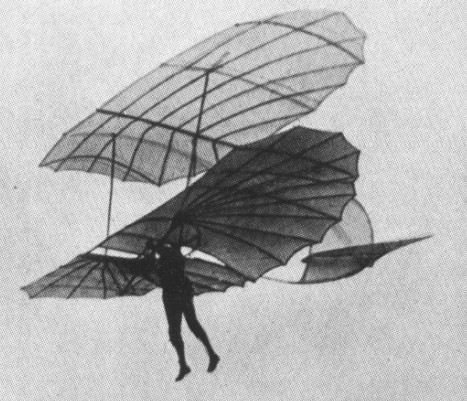
In 1895 produced his thirteenth design, a biplane. On the evening of 9 August 1896, Otto was at Stöllen testing a new kind of head-movement control arrangement when a sudden gust upturned his No. 11 monoplane glider and he crashed heavily from 15 m (49 ft) breaking his spine. He died the next day.
Otto Lilienthal (1848 1896) made approximately 2,500 successful glides in 1893 96, mostly in monoplane ‘hang gliders’ types, in which he flew distances of up to 985 ft (300 m).
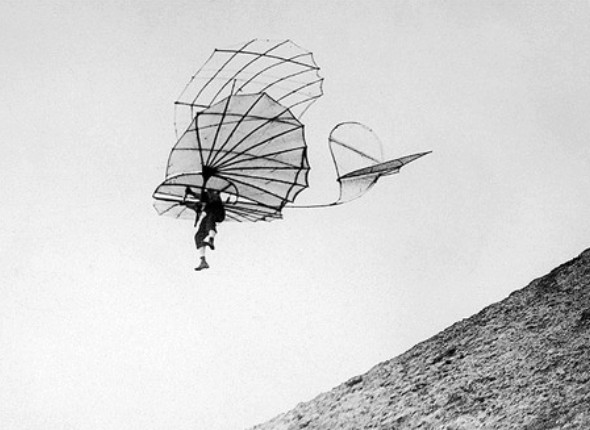
In 1937 Dart Aircraft built for Alexanda Korda’s film production, Conquest of the Air, two Lilienthal biplane glider replicas. They ‘flew’ suspended by piano wire. In the end the film was never completed.
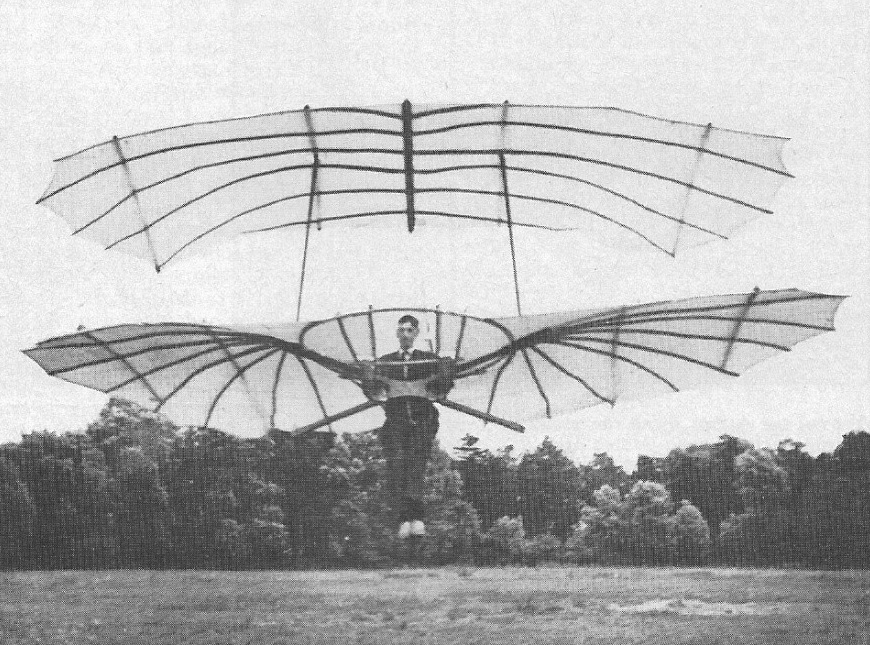
Replica: Platzer Doppeldecker
1893 monoplane glider
Wing span: 22 ft 11.5 in (7.00 m)
Wing area: 150.7 sq ft (14.0 sq.m)
Wing chord (max): 8 ft 21 in (2.50 m)
Length: 16 ft 4.75 in (5.00 m)
Weight without pilot: 44 lb (20 kg)
Accommodation: Crew of 1.
1894 Glider
Wingspan: 7.9 m (26 ft)
Length: 4.2 m (13 ft 9 in)
Height: 1.5 m (5 ft)
Weight: 20 kg (44 lb)
Materials:
Airframe: Wood
Fabric Covering: Cotton-twill


