Martin XB-51

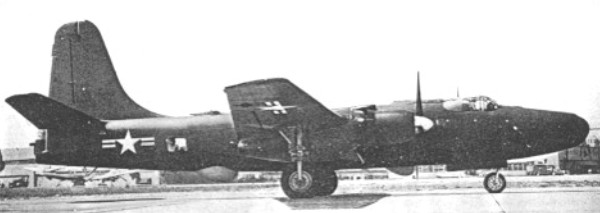
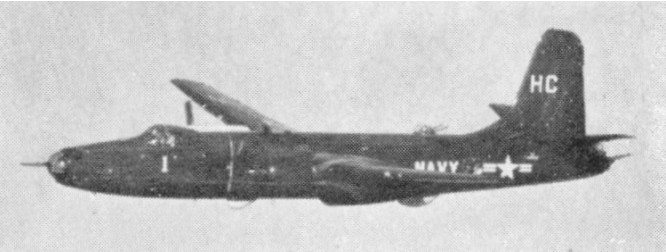
In World War lithe USAAF made widespread and effective use of the attack bomber for battlefield tasks. For post¬war service the USAAF wanted a higher-speed successor, and the specification produced two types in the Douglas XB-43 and Martin Model 234 XB-51.

The Martin was designed originally to meet a US Army Air Force requirement for a close-support bomber, being allocated the designation XA-45. However, it was developed instead as a medium bomber with turbojet power-plant and two prototypes were ordered under the designation XB-51.

The XB-51 featured a tandem-unit landing gear arrangement, a thin variable ¬incidence wing whose leading edges were swept at 35 degrees, a swept T-tail. It was powered by three 2640kg thrust General Electric J47-GE-7 or -13 turbo-jets, one pylon-mounted low on each side of the forward fuselage and the third within the rear fuselage.

Other features included pressurised accommodation for the two-man crew, provisisions for JATO (jet-assisted take-off) units, and a braking parachute.

The first of two aircraft flew in October 1949, Martin’s Director of Flight O.E. (Pat) Tibbs making the first flight, taking off from Baltimore and lading at Naval Air Test Centre at Patuxent, in a flight of 35 minutes.
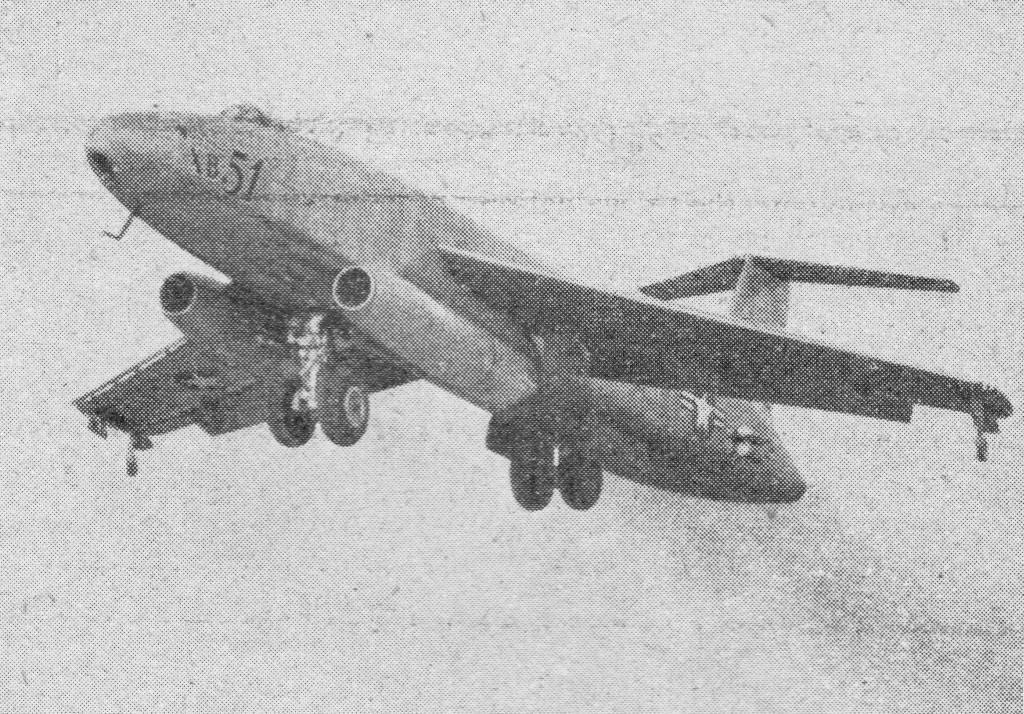
XB-51 first take off

Although flight trials confirmed that the XB-51 had very good performance, they revealed that the type had poor handling qualities in the air. The XB-51 did not proceed past the prototype stage and the USAF opted instead for licence-production of the English Electric Canberra as the Martin B-57.

Engines: 3 x 2360kg General Electric J47-GE-13
Max take-off weight: 25393 kg / 55982 lb
Empty weight: 13431 kg / 29610 lb
Wingspan: 16.18 m / 53 ft 1 in
Length: 25.93 m / 85 ft 1 in
Height: 5.28 m / 17 ft 4 in
Wing area: 50.91 sq.m / 547.99 sq ft
Max. speed: 1038 km/h / 645 mph
Cruise speed: 857 km/h / 533 mph
Ceiling: 12344 m / 40500 ft
Range: 2576 km / 1601 miles

Martin XB-48

During 1944 the US Army Air Force issued its first specification for a large jet bomber. By December 1944 proposals had been received from Boeing, Convair, Martin and North American for medium bomber for tactical- and operational-level use. The Martin Model 223 XB-48 being one of the contenders to meet this requirement.

Two XB-48 prototypes were ordered, the first of them flying on 14 June 1947 as a large shoulder mounted, straight wing monoplane with the capability of carrying up to 9072kg of bombs. Power was provided by six 1701kg thrust Allison J35-A-5 turbo-jets, three mounted beneath each wing. The landing gear was of the new bicycle form with main units ahead of and behind the bomb bay. The 33.02m span Model 223 failed to achieve the performance required and failed to win a production contract.

Engines: 6 x General Electric J35-C-7, 16.7kN
Wingspan: 33.02 m / 108 ft 4 in
Length: 26.14 m / 85 ft 9 in
Wing area: 120.77 sq.m / 1299.96 sq ft
Max take-off weight: 46539 kg / 102601 lb
Empty weight: 26578 kg / 58595 lb
Max. speed: 830 km/h / 516 mph
Armament: 9000kg of bombs

Martin 4-0-4

The prototype of an improved Martin 3-0-3 had been flown on 20 June 1947, but with it was decided instead to develop a new Martin 4-0-4. This incorporated the wing structural revisions and introduced a pressurised and slightly lengthened fuselage, accommodating as standard a crew of three or four and 40 passengers.

The airliner was unveiled in 1949 and immediately ordered by a variety of air carriers, gaining 101 orders from TWA and Eastern. The subsequent 4-0-4 was introduced in 1950 with a fuselage 39 inches longer, slightly more powerful engines than the 202, and pressurization.

The onset of the Korean War suddenly made airplane materials significantly more expensive, and Martin found itself filling orders at a loss and stopped production.

Two or these 40-passenger transports were in service with the U.S. Coast Guard in 1955 as the RM-1, similar to the civil Martin 4-0-4 airliner.

Martin RM-1

A total of 148 of the 2-0-2, 3-0-3, and 4-0-4 types were built until 1952. Examples served well into the 1980s with commuter airlines.

RM-1
Engines: two 2,400 h.p. Pratt & Whitney R2800-34W
Span: 93 ft. 3 in.
Weight: 44,900 lb.
Max. Speed: 312 m.p.h.

4-0-4
Engines: 2 x 2400hp Pratt Whitney R-2800 CB-16
Max take-off weight: 20366 kg / 44900 lb
Empty weight: 13211 kg / 29125 lb
Wingspan: 28.42 m / 93 ft 3 in
Length: 22.73 m / 74 ft 7 in
Height: 8.66 m / 28 ft 5 in
Wing area: 80.27 sq.m / 864.02 sq ft
Cruise speed: 502 km/h / 312 mph
Ceiling: 8840 m / 29000 ft
Range: 3058 km / 1900 miles
Seats: 52

Martin 4-0-4

Martin 303

Along with the unpressurized Model 202, Martin offered a companion pressurized model, known as the Model 303. United Air Lines was the primary sponsor of the 303, having invested one million dollars of its own money in the development. In addition to the 50 slated for delivery to United, Martin also had orders from Northwest Airlines, Braniff Airways, and Pan American-Grace Airways (PANAGRA) for 59 more.

Apart from cabin pressurization, the 303 differed from the 202 in that the wing span was shortened by about 4ft (1.2m) in an attempt to gain cruise performance at the expense of takeoff and climb performance. The 303 made its first flight on July 3, 1947; however, United canceled its large order a short time later.

Because of prevailing market conditions and serious stability problems encountered with the 202 and a need to redesign the wing structure, Martin dropped the 303 program the following December with a reported loss of more than $15 million. The prototype and almost all records were then scrapped for tax purposes.

A total of 148 of the 2-0-2, 3-0-3, and 4-0-4 types were built until 1952.

Martin 2-0-2 / RM-1 / VC-3A

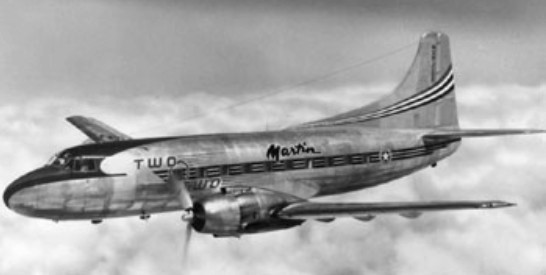
Attempting to gain a share of the post-World War II demand for civil airliners, the Glenn L. Martin Company flew on 22 November 1946 the prototype of a twin-engine 36/40-seat unpressurised transport designated Martin 2-0-2.

Martin 2-0-2 Article

Power was provided by twin Pratt & Whitney 18-cylinder air cooled radial engines capable of developing a normal output of 1,800 hp, 2,100 hp for takeoff or 2,400 hp with water injection. The engines turned Hamilton Standard three-blade reversible-pitch airscrews.

The “Two- O-Two” was the first twin-engine airliner of postwar design to receive certification for airline use. Accommodations provided for a crew of three or four plus 36 to 40 passengers. A version of the 202 was outfitted with larger fuel tanks to increase its range to 2,365.

The first of these entered service in October 1947, but the loss of a 2-0-2 in 1948 as a result of wing structural failure led to modification of other in-service aircraft and production of this version was brought to an end.

When production ended in early 1953 a total of 103 had been built, this number including two supplied to the Coast Guard as staff transports under the designation RM-1G (later RM-1Z and finally VC-3A); they were subsequently transferred to the US Navy.

A total of 148 of the 2-0-2, 3-0-3, and 4-0-4 types were built until 1952.

Martin 202
Engines two 2,100-hp Pratt & Whitney R-2800 CB-16.
Wingspan: 28.42 m / 93 ft 3 in
Length: 21.74 m / 71 ft 4 in
Height: 8.66 m / 28 ft 5 in
Wing area: 80.27 sq.m / 864.02 sq ft
MTOW 19504 kg / 42999 lb
Empty wt. 26,930 lb
Top speed 311 mph.
Cruise 286 mph.
Stall 76 mph.
Initial climb rate 2,200 fpm
Range 3220 km / 2001 miles
Ceiling 33,000 ft
Takeoff distance (50′) 1,565 ft
Landing distance (50′) 1,720 ft
Seats 40.

Martin 2-0-2

Martin 219 / P4M Mercator

The US Navy made several attempts to gain the benefit of high over-target performance combined with long range by introducing mixed powerplant. The Martin Model 219 patrol bomber represented one of the results of such a specification, two XP4M-1 prototypes being ordered on 6 July 1944. The first was flown on 20 September 1946 as a cantilever shoulder-wing monoplane with retractable tricycle landing gear. Its powerplant comprised two 2218kW Pratt & Whitney R-4360-4 Wasp Major radial engines, but each nacelle also incorporated a 17,350kg thrust Allison J33-A-17 turbojet. After a protracted development programme 19 P4M-1 production aircraft were built, the first being delivered to US Navy Squadron VP-21 on 28 June 1950, and all served with this unit. Most of them were converted into P4M-1Q Elint aircraft, one being shot down.

Martin P4M Mercator Article

P4M-1 Mercator

P4M-1
Engines: 2 x Pratt Whitney R-4360-20A piston engines, 2424kW + 2 x Allison J33-A-10A, 2087kg
Max take-off weight: 40000 kg / 88185 lb
Wingspan: 34.75 m / 114 ft 0 in
Length: 25.50 m / 83 ft 8 in
Height: 7.95 m / 26 ft 1 in
Wing area: 121.79 sq.m / 1310.94 sq ft
Max. speed: 660 km/h / 410 mph
Ceiling: 10545 m / 34600 ft
Range: 4570 km / 2840 miles
Armament: 2 x 20mm cannons, 4 x 12.7mm machine-guns, 2700kg of bombs

Martin XBTM-1 / AM-1 Mauler

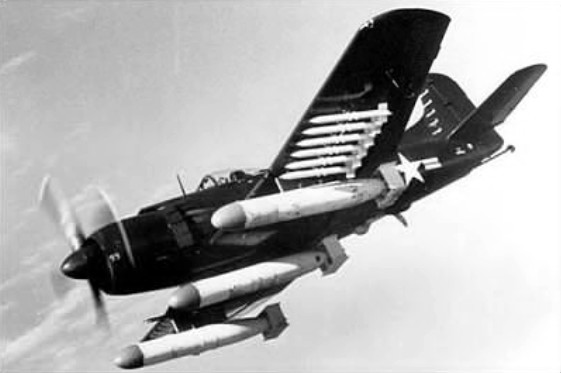
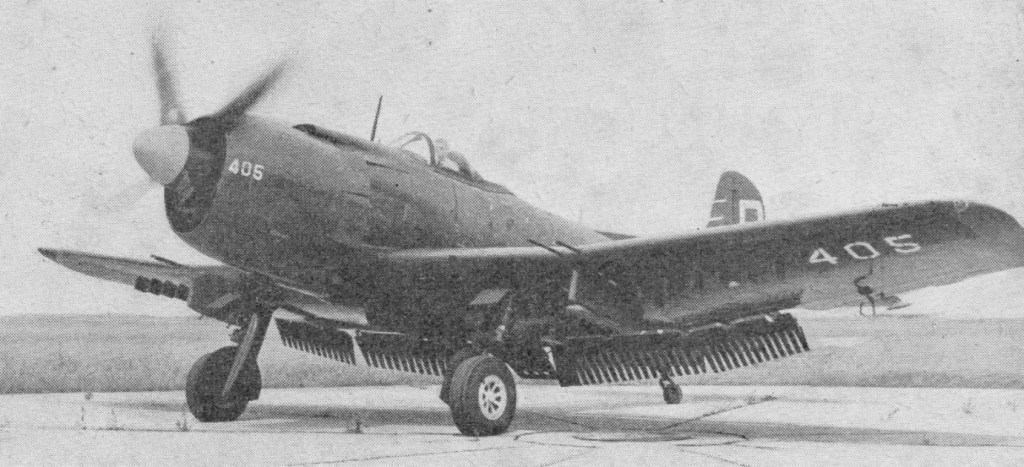
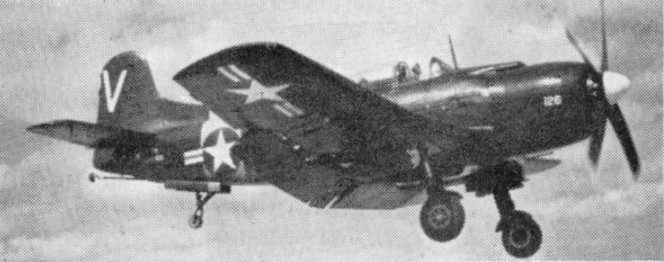
Benefiting from early combat experience in World War II, the US Navy drew up a specification for a new single-seat carrier-based attack aircraft. The Martin Model 210 design proposal gained a contract for two XBTM-1 prototypes, the first being flown initially on 26 August 1944.

A cantilever low-wing monoplane with retractable tail-wheel landing gear, powered by a 2237kW Pratt & Whitney XR-4360-4 radial engine, the XBTM-1 was tested successfully and gained a contract for 750 BTM-1 series aircraft. By the time that the first of these was flown, on 16 December 1946, the designation had been changed to AM-1 and the name Mauler selected.

World War II had also ended, and instead of the planned procurement only 149 AM-1s (excluding prototypes) had been completed when production ended in October 1949.

Initial deliveries to an active unit went to Attack Squadron VA-17A on 1 March 1948, but these aircraft saw little first-line service, being transferred to US Navy Reserve squadrons when production ended by 1955.

1948

The total of 149 built included 17 AM-1Q aircraft completed as ECM (electronic counter-measures) aircraft.

Martin AM1 Mauler
Engine: Pratt&Whitney R-3350-4 Cyclone 18, 2934 hp / 2218kW
Length: 41.175 ft / 12.55 m
Height: 16.831 ft / 5.13 m
Wingspan: 50.0 ft / 15.24 m
Wing area: 496.005 sq.ft / 46.08 sq.m
Max take off weight: 23390.6 lb / 10608.0 kg
Weight empty: 14502.3 lb / 6577.0 kg
Max. speed: 319 kts / 591 km/h / 367 mph
Cruising speed: 164 kts / 304 km/h
Service ceiling: 30495 ft / 9295 m
Wing load: 47.15 lb/sq.ft / 230.0 kg/sq.m
Range: 1564 nm / 2897 km / 1802 miles
Crew: 1
Armament: 4x MG 20mm, 2041kg Bomb./Rockets

Martin AM-1 Mauler

Martin 170 Mars / JRM-1

On 23 August 1938 the US Navy ordered from Martin a single prototype of the Martin 170 design for a patrol bomber of flying-boat configuration.

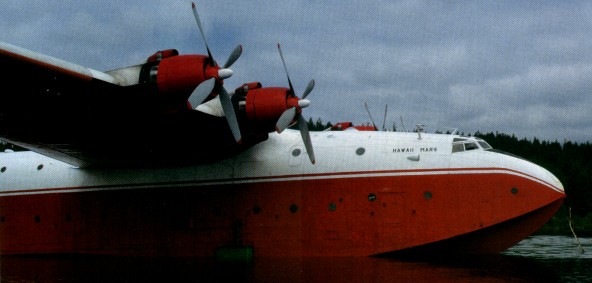
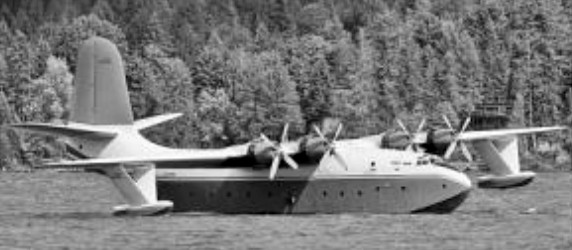
The tip of the tail is almost 50 feet above water level while the wing span is 200 feet, greater than a Boeing 747, and the two level interior is as big as a 15 room house with a long circular staircase connecting the two decks. The control surfaces are all fabric covered.

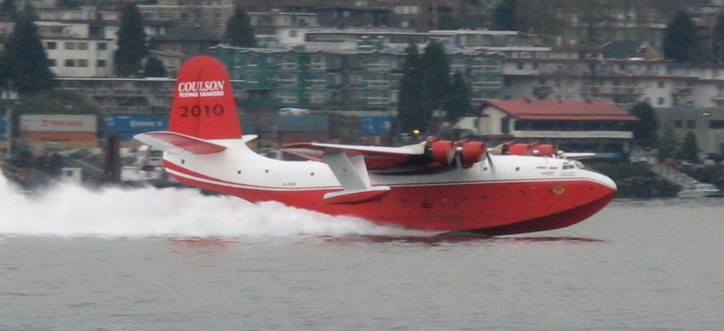
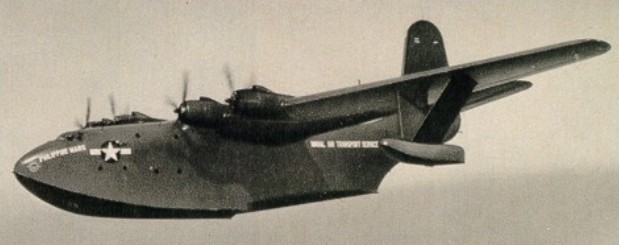
Designated XPB2M-1, it was the world’s largest flying-boat when flown for the first time on 3 July 1942, but by then the United States had become involved in World War II and it was decided not to proceed with procurement of the type as a patrol bomber. Instead, the boat was modified for use in a transport role, becoming re-designated XPB2M-1R and entering service in December 1943. It remains the largest flying-boat to have been operated by the US Navy and an early demonstration of its capability came in 1944, when a 9299kg cargo was delivered to Hawaii in a 7564km round trip completed in only 27 hours 36 minutes, resulting in a US Navy order for a production version under the designation JRM-1 Mars. This covered 20 aircraft to be completed specially for the transport role, but the end of World War II brought contract cancellations and only five were built, plus a single JRM-2 for operation at a higher gross weight. When the five JRM-1s were later modified to this latter standard they became redesignated JRM-3. These 60.96m span aircraft were powered by four 1715kW Wright R-3350-8 engines, and an appreciation of their capacity can be gained from the fact that on 19 May one of them, Marshall Mars, carried a total of 301 passengers, plus its crew of seven.

In 1948, carrying a load of 25 passengers, 17 crew, and 22,000 lb of freight, JRM ‘Carolina Mars’ flew from Hawaii to Chicago non-stop. This 4000-mile flight was the longest made by a flying boat.

In ten years of military service between 1946 and 1956 and the five logged some 87,000 accident free hours. They established the world flying boat lift record of 30,992 kg (68,327 pounds) and carried a record 350 troops.
The propeller driven Mars were declared obsolete in 1956 and Forest Industries Flying Tankers Ltd, Canada, purchased four, the other having been lost in a fire.

With a fibre glassed Douglas Fir plywood 6.000 gallon tank installed in the cargo area it could scoop up the 32 tons of water within 22 seconds while the flying boat skimmed the surface at about 70 knots.

Martin 170 / JRM Mars
Engines: 4 x Wright R-3350-18 Cyclone, 1620kW / 2170 hp
Max take-off weight: 67130 kg / 147997 lb
Empty weight: 34300 kg / 75619 lb
Wingspan: 61.0 m / 200 ft 2 in
Length: 36.6 m / 120 ft 1 in
Height: 13.6 m / 44 ft 7 in
Wing area: 242.0 sq.m / 2604.86 sq ft
Max. speed: 380 km/h / 236 mph
Cruise speed: 300 km/h / 186 mph
Ceiling: 5200 m / 17050 ft
Range w/max.fuel: 9300 km / 5779 miles
Crew: 7
Passengers: 40

Martin P5M Marlin / SP-5

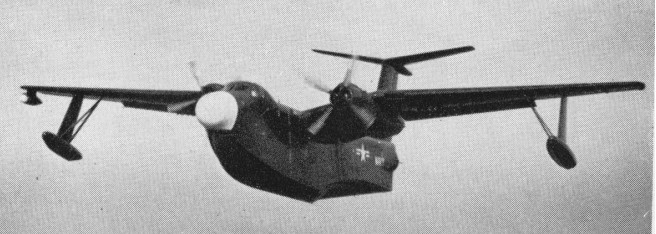
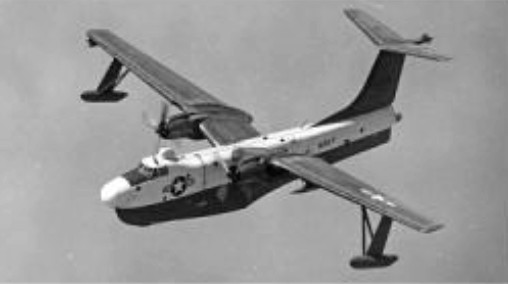
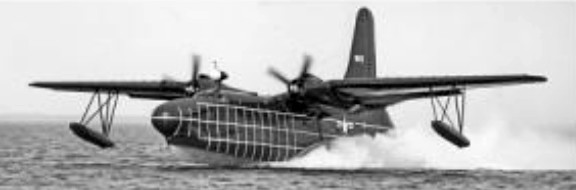
As a new US Navy patrol flying-boat, Martin developed the Model 237 design, combining the wing and upper hull of the Mariner with the new lower hull structure. A PBM-5 Mariner served as the prototype XP5M-1 which, when ordered into production, was given the name Marlin.

The modified hull of the XP5M-1 incorporated radar-directed nose and tail turrets, as well as a power-operated dorsal turret, and power was provided by two 2424kW Wright R-3350 radial engines.

This prototype flew for the first time on 30 May 1948, but it was not until two years later that the P5M-1 was ordered into production, the first of these series aircraft being flown on 22 June 1951.

Initial deliveries, to US Navy Squadron VP-44, began on 23 April 1952 and the type remained in service until the mid-1960s.

Martin P5M-1

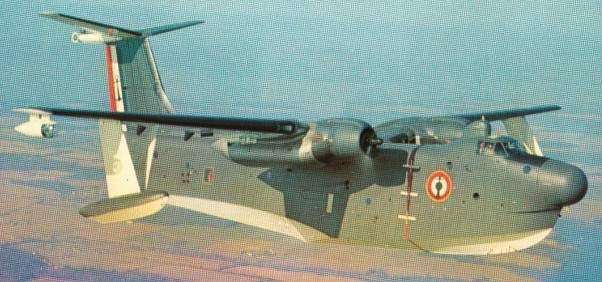
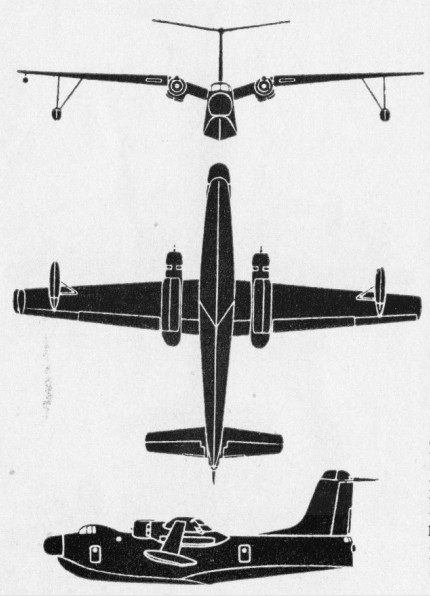
In addition to those operated by the US Navy, 12 of the later P5M-2 version were supplied to France under the American MAP for use by the Aeronavale in 1959. In the French Aeronavale, where they were used for maritime patrol out of Dakar, West Africa, until 1964, after which they were returned to the Navy. The P5M 2 Marlin could carry up to 8,000 lb (3,629 kg) of assorted weapons. The P5M-1 has a low mounted ” dihedral ” tailplane, different hull shape and lower-powered engines, compared to the P5M-2.

The first of 28 P5M-2 Marlins to undertake a modernisation program was delivered to the US Navy in 1959.

Martin aircraft production ceased December 20,1960 when the last P5M- 2 Marlin was handed over to U.S. Navy.

Claiming high operational costs, the Coast Guard turned over all of its P5Ms to the Navy in 1961. Lacking most military equipment, they were used as crew trainers as P5M-1T and P5M-2Ts.

In September 1962, when all American military forces adopted the tri-service designation scheme, the P5M-1 became the P-5A, the P5M-1S the SP-5A, the P5M-1T the TP-5A, the P5M-2 the P-5B, the P5M-2S and P5M-2T the PT-2B.

SP-5B / P5M2

In 1964, in an attempt to boost take-off power, one SP-3B was tested with a tail mounted 3000 lb.st Pratt & Whitney J60 turbojet engine. They were not adopted for service.

No Marlins went to the reserves. As they were retired, they were stored until sold as scrap. A Navy SP-5B of VP-40 made the last operational flight on 6 November 1967.

Model 270

The XP5M-1 prototype was later used (as the model 270) to test the 15:1 hull configuration for the P4M SeaMaster.

Gallery

P5M
Engines: 2 x Wright R-3350-32WA Turbo-Compound, 2573kW
Max take-off weight: 38555 kg / 85000 lb
Empty weight: 22900 kg / 50486 lb
Wingspan: 36.02 m / 118 ft 2 in
Length: 30.66 m / 100 ft 7 in
Wing area: 130.62 sq.m / 1405.98 sq ft
Max. speed: 404 km/h / 251 mph
Ceiling: 7300 m / 23950 ft
Range: 3300 km / 2051 miles
Armament: 3600kg of weapons
Crew: 11

P5M-2 Marlin
Naval patrol bomber flying boat
Engines: 2 x Wright R3350-32W Turbo-Cyclone, 3450 h.p
Wingspan: 118 ft. 2in (36.02 m)
Wing area: 1406.3 sq.ft
Length: 100 ft. 7in (30.66 m)
Height: 32 ft 8.5 in (9.97 m)
Empty weight: 50,485 lb
Max TO wt: 85,000 lb (38,555 kg).
Loaded weight: 73,055 lb
MTOW: 76,635 lb
Fuel capacity: 4410 gal
Max speed: 251 mph at SL
Ceiling: 22,400 ft
Normal range: 2050 mi
Max range: 3,600 miles
Armament: 2 x 20mm tail mounted guns
Bombload: 16,000 lb
Crew: 7

P5M-2 Marlin