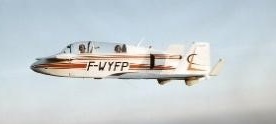
Microstar Variviggen

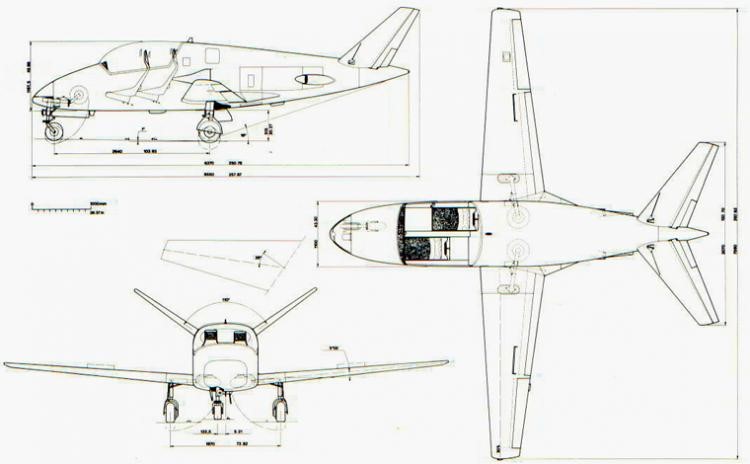
Burt Rutan design VariViggen started when he was a student at Cal Poly (California Polytechnic State University) in the early 1960s. He started building the prototype in his garage in 1968. After four years of work, the aircraft made its first flight 27 February 1972.

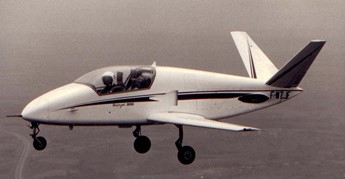
Leo Chagnes built the MicroStar based on plans of the VariViggen over four years.
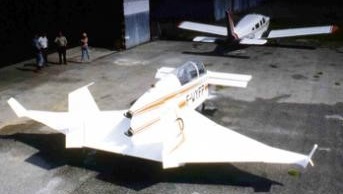
The wing is styrofoam foam with epoxy coating and the fuselage is spruce and birch plywood. It is powered with 2 TRS18 Microturbo turbojet engines. Microturbo was responsible for the engine, with the completion of the frame, the calculation of the implementation and the centering of the two engines. This installation required a modification of the rear. The increase in surface area required a 20 cm increase.

The air inlets are fiberglass, and the cowling is made of sheet aluminium. The electronics are located just outside the engines, and is accessed by doors. The power units are separated from the airframe by three fire partitions.

The wheels are derived from a Cesna150 and the assembly is retractable via an electric servo coupled with a manual override. The luggage compartment behind the rear seat has been replaced by a 200 lt kerosene fuel tank, additional to two 35 lt tanks housed in the wings.

After more than 4 hours running and jumps, Leo Chagnes made the first flight on July 20, 1979.

Burt Rutan flew with Jacques Costes aboard MicroStar on December 19, 1981.

Speed max: 400 km / h
Speed cruise: 320 km / h
ROC: 6 m / s
Stall: 85 km / h
TO dist (15 m): 320 m
Ceiling: 8000 m
Empty weight: 545 kg
Max weight: 889 kg
Fuel capacity: 271 lt
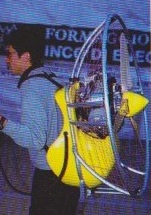
Prodelta Pulsar

Pulsar 100
Empty weight: 19.8 kg
Engine: Solo, 14 hp
Reduction: yes
Fuel capacity: 5.8-8 lt
Price (1998): L 4 700 000

Pulsar 100K
Empty weight: 19.8 kg
Engine: König, 21 hp
Reduction: direct
Fuel capacity: 8-10 lt
Price (1998): L 7 500 000

Pulsar 120
Empty weight: 20.5 kg
Engine: Solo, 14 hp
Reduction: yes
Fuel capacity: 5.8-8 lt
Price (1998): L 4 700 000

Pulsar 120K
Empty weight: 20.6 kg
Engine: König, 21 hp
Reduction: direct
Fuel capacity: 8-10 lt
Price (1998): L 7 500 000

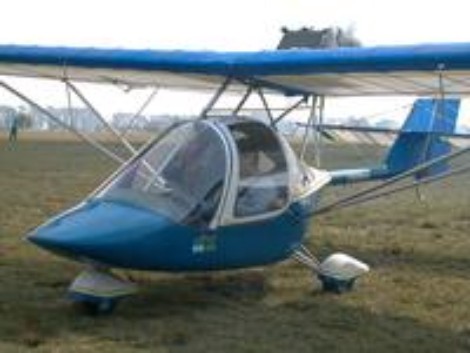
Microleve ML500

Basic ultralight, tricycle landing gear, with rigid wing. Now with a full closed cabin.

Stall: 26 kt / 30 mph / 48 kmh
Cruise: 78 kt / 90 mph / 145 kmh
VNE: 96 kt / 110 mph / 177 kmh
Empty Weight: 220 kg / 485 lbs
MTOW Weight: 500 kg / 1102 lbs
Climb Ratio: 1000 ft/min / 5 m/s
Glide Ratio: 12:1
Take-off distance (50ft obstacle): 330 ft / 100 m
Landing distance (50ft obstacle): 330 ft / 100 m

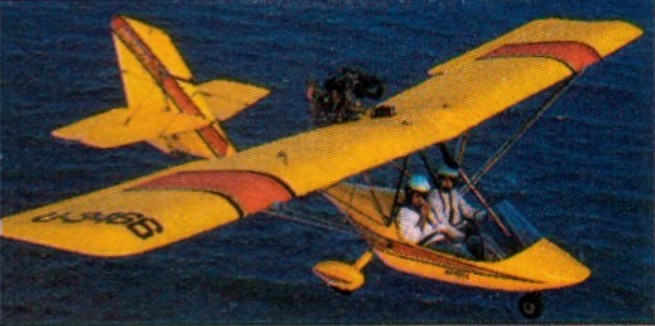
Microleve ML450

A two place, side by side with trigear or tail wheel. First flown in 1989.

Engine: Rotax 582, 65 hp
HP range: 55-74
Height: 6.9 ft
Length: 22.4 ft
Wing span: 33.8 ft
Wing area: 177.4 sq.ft
Empty weight: 484 lb
Gross weight: 980 lb
Fuel capacity: 17 USG
Top speed: 100 mph
Cruise: 70 mph
Stall: 20 mph
Range: 289 sm
Rate of climb: 1000 fpm
Takeoff dist: 200 ft
Landing dist: 100 ft
Service ceiling: 10,000 ft
Seats: 2
Landing gear: nose or tail

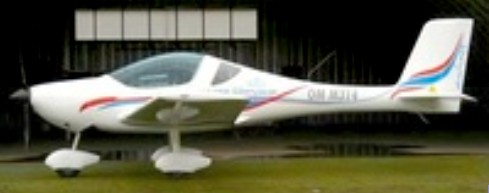
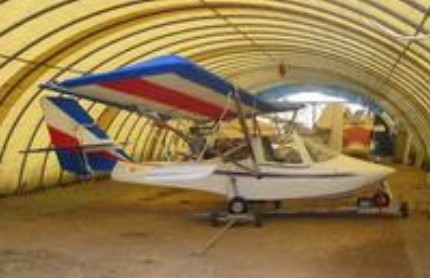
Microleve Corsario

Mk.V

A two place, side by side LSA amphibian with retractable trigear or tail wheel. First flown in 1989.

Mk.III
Engine: Rotax, 74 hp
HP range: 66-80
Height: 6.9 ft
Length: 22.4 ft
Wing span: 33.8 ft
Wing area: 177.4 sq.ft
Empty weight: 540 lb
Gross weight: 1100 lb
Fuel capacity: 17 USG
Top speed: 100 mph
Cruise: 75 mph
Range: 289 sm
Rate of climb: 800 fpm
Takeoff dist land: 260 ft
Takeoff dist water: 330 ft
Landing dist land: 220 ft
Landing dist water: 250 ft
Service ceiling: 10,000 ft
Seats: 2
Landing gear: nose or tail wheel

Mk.5
Engine: Rotax 912, 80 hp
HP range: 80-100
Length: 22.6 ft
Wing span: 33 ft
Wing area: 175 sq.ft
Empty weight: 685 lb
Gross weight: 600 kg / 1320 lb
Cruise: 85 mph
Stall: 42 mph
Fuel capacity: 20 USG
VNE: 120 kt / 138 mph / 222 kmh
Range: 460 sm
Rate of climb: 900 fpm
Glide Ratio: 10:1
Seats: 2
Cockpit width: 44 in
Landing gear: nose or tail wheel
2009 Price: US$17000

Microjet 200

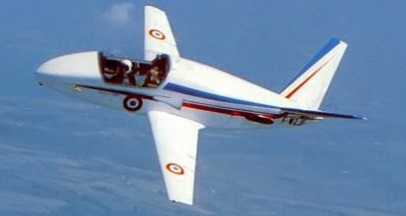
The aim of the Microjet 200 program was to offer economies in military pilot training by use of very small high-performance jet aircraft with comparatively low initial and operating costs.

Microjet 200 Article

A team was employed by Société Microturbo to developed this aircraft. The team included Jacques Grangette who was both leader of the team and in charge of development, Claude Fimbel, who conducted the study work and Jules Bernard, in charge of fabrication. Wind tunnel testing was executed at CEAT, Institut de Mécanique des Fluides de Lille (IMFL) for spin, and ONERA for flutter analysis.
Microjet was founded to develop and assemble Microjet 200 B two-seat very light trainer powered by two Microturbo turbojet engines (first flown 1980). Many components built by Marmande Aeronautique, later building complete pre-production aircraft.

The Microjet 200 is a side-by-side two-seater, initialy powered by two Microturbo TRS18-046, each rated at 1.08 kN (243 lb st.).

The Microjet 200 made its first flight from Toulouse-Blagnac on 24 June 1980. The aircraft flew for 40 minutes without problem, at an altitude of 1000 metres and a speed of 220 km/hr. Jacques Grangette was at the controls.

Propotype # 1 – FWZJF
Built entirely of wood. Only a few parts require special forming were made out of resin.

It still exists, and is kept in reserve a hangar flying club Marmande.

Prototype
Wingspan: 7.38 m
Length: 6.05 m
Height: 1.80 m
Wing area: 6.12 m²
Empty weight: 600 kg
Max weight 930/1050 kg
Stall: 118 Km / h
Max cruise: 463 km / h

Microjet 200b – N ° 01
F- WDMT, it was the first copy of pre-series, any metal . This aircraft was damaged by Wed, March 13th, 1985 in the Bay of Saint- Brieuc, killing its pilot Domnique Monguillot.
A trawler at the time had recovered some pieces of the plane’s body. Dominique has never been found.

Microjet 200b – No. 02
F- WDMX, Second pre-series made its first flight January 5, 1985. Built by Marmande Aerospace. It was characterized by the presence of hardpoint on the wings for the carriage of weapons.

Microjet 200b – N ° 03
F- WDMT, Third pre-series aircraft, which carried the registration of the first 200b. Made its first flight Nov. 4, 1986. This unit was also built by Marmande Aerospace.