Used by the French military for surveillance. By 1998, 130 had been sold, including 25 to the French Army.
Mignet Aviation HM 1000 Balerit
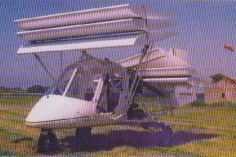
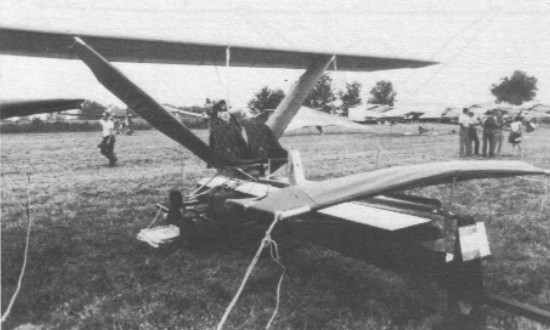
Mignet Aviation produced the HM 1000 Balerit two seat side-by-side pusher entirely in dural, with the fuselage of welded tube and the wings in riveted sheet. The wings fold up for transport.
Mignet Aviation HM 1000 Balerit Empty weight: 174 kg Wing span: 8.55 m Wing area: 19.25 sq.m Fuel capacity: 42 lt Certification: BCAR S Engine: Rotax 582, 64 hp MAUW: 450 kg Seats: 2 Max speed: 150 kph Cruise speed: 110 kph Minimum speed: 60 kph Climb rate: 4 m/s Fuel consumption: 14 lt/hr Price (1998): £23,265
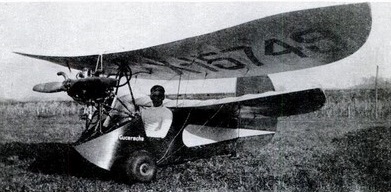
Mignet Do Brasil was formed early 1950s to build Mignet H.M.310 Estafette two-seat modernised version of the designer’s earlier Pou-du- Ciel light aircraft. A new development flown 1951 with Continental A90 engine.
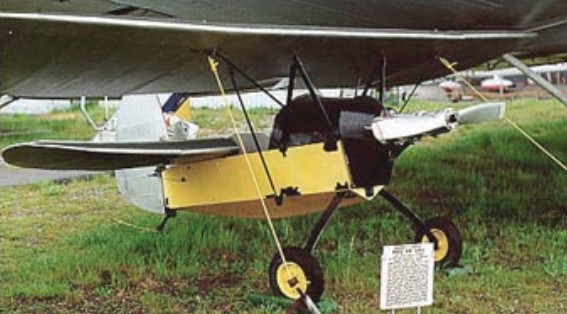
The HM 360 is a single seater with very detailed plans in French, and English translation manuals supplied. The HM 380 is a two seater side-by-side, with a wood fuselage. It is supplemental to the HM 360 set, redrawn in English, with added detail.
Options include Cosandey flap, ailerons, swept fin & rudder, tricycle gear and HIPEC® covering.
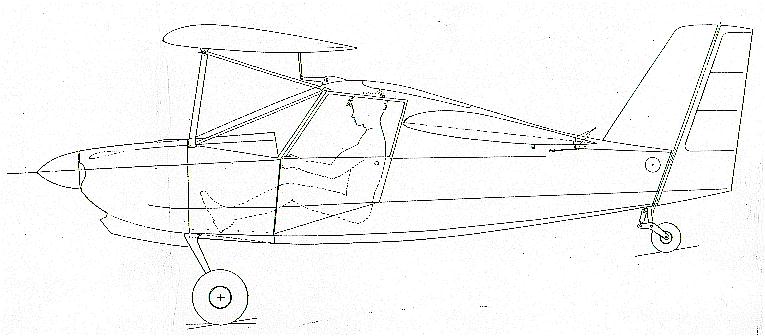
The HM380L is a set of plans in English for a steel tube fuselage version of the 380. Instructions are on plans. Flap plans included (Cosandey flap not required). Set is very complete showing engine installation, fuel system, wiring diagram, exhausts, engine mount, full size wing ribs, tailwheel, main undercarriage (Wittman type), etc. Hardware is AN standard. Materials are SAE and US standard. The Ladybug 380L ia a 2 seat side by side tandem wing aircraft that is great for training and familiarization for these type of aircraft.
The two seaters are flown from the front.
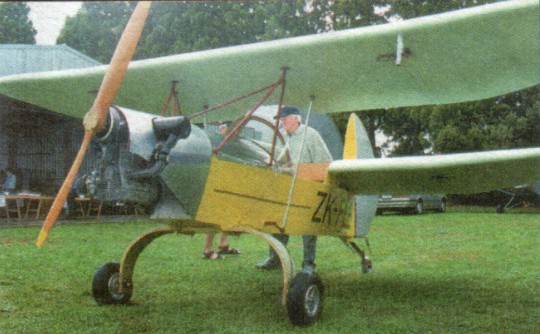
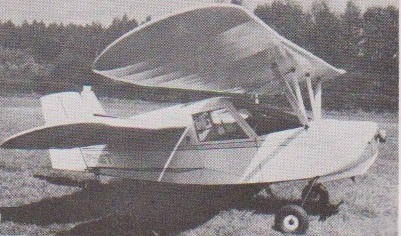
A considerably modified version of the two-seat HM.380 was developed by Mr Lederlin in France as the Lederlin HM.380L Ladybug. The prototype of this version on 14 September 1965, powered by a Continental C90.
Prototype Lederlin HM.380L Ladybug, Old Warden 1973.
Falconar Mignet HM 360 plans cost US$150 in 2010, with the 380 supplemental plans and additional US$50. Falconar 380L Ladybug plans sold for US$175 in 2010.
On June 30, 2019, Falconar Avia Inc closed for business and assets dissolved. The Master Sets (Original Drawings, Plans, Info Kits, Documentation) were available for sale and full transfer of rights included the MIGNET HM 360, HM 380, and 380 L for $2500 USD.
Mignet HM 360 Engine: 60 hp Continental or similar Cruise speed: 80mph Empty weight: 390 lbs Wing Span: 21 feet Gross weight: 700 lbs Wing span folded: 8 feet
HM 360 Engine: Continental, 65 hp. HP range: 65-100. Length: 13 ft. Wing span: 21 ft. Wing area: 138 sq.ft. Weight empty: 390 lbs. Gross: 700 lbs. Fuel cap: 14 USG. Cruise: 95 mph. Range: 330 sm. Stall: 28 mph. ROC: 1500 fpm. Take-off dist: 130 ft. Landing dist: 130 ft. Seats: 1. Landing gear: nose or tail wheel.
HM360 Engine: Continental C-65, 65 hp HP range: 65-100 Height: 6 ft Length: 13 ft Wing span: 21 ft Wing area: 138 sq.ft Empty weight: 390 lb Gross weight: 700 lb Fuel capacity: 14 USG Top speed: 124 mph Cruise: 95 mph Stall: 28 mph Range: 330 sm Rate of climb: 1000 fpm Takeoff dist: 130 ft Landing dist: 130 ft Seats: 1-2 Landing gear: nose or tail
Mignet HM 360 Engine: 100 hp Continental or similar Cruise speed: 100 mph Empty weight: 390 lbs Wing Span: 21 feet Gross weight: 700 lbs Wing span folded: 8 feet
Mignet HM 380 Engine: 60 hp Continental or similar Cruise speed: 80mph Empty weight: 580 lbs Wing Span: 27 feet Gross weight: 1100 lbs Wing span folded: 10 feet
HM380 Engine: Continental C-65, 65 hp HP range: 65-100 Height: 6 ft Length: 13 ft Wing span: 21 ft Wing area: 138 sq.ft Empty weight: 390 lb Gross weight: 700 lb Fuel capacity: 14 USG Top speed: 124 mph Cruise: 95 mph Stall: 28 mph Range: 330 sm Rate of climb: 1000 fpm Takeoff dist: 130 ft Landing dist: 130 ft Seats: 1-2 Landing gear: nose or tail
HM 380 Engine: Continental C-90, 90hp.
Mignet HM 380 Engine: 100 hp Continental or similar Cruise speed: 100 mph Empty weight: 580 lbs Wing Span: 27 feet Gross weight: 1100 lbs Wing span folded: 10 feet
Development has continued since World War 2, the basic post war single seat version being the HM-290 with a 25 hp Poinsard engine.
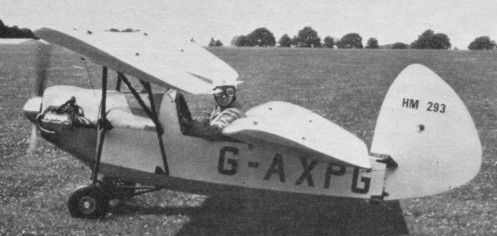
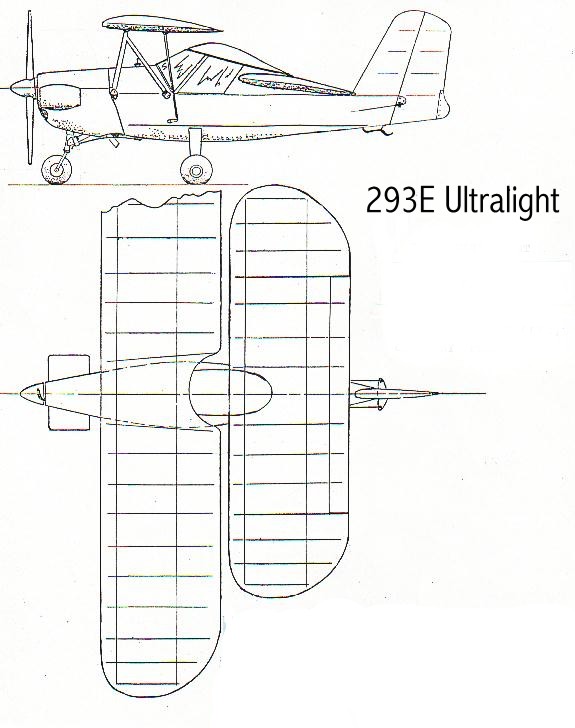
The HM 290 Series included: F293E ultralight model- for medium size pilot F295E ultralight model- for medium size pilot (with simplifications) HM290 amateur built model – for small pilot HM293 amateur built model – for medium size pilot
HM293
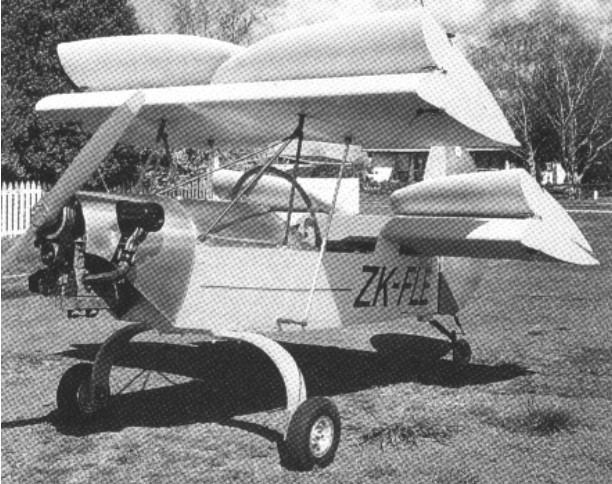
These tandem wing aircraft feature a large speed range, stall resistant, and spin proof. Both wings lift and being small size, minimal space is needed to build. Landing gear arrangement: tail dragger or tri-gear. Options include swept fin and rudder.
Falconar devised design changes for easier construction, modern materials, Delrin bearings, tri-gear and HIPEC® covering.
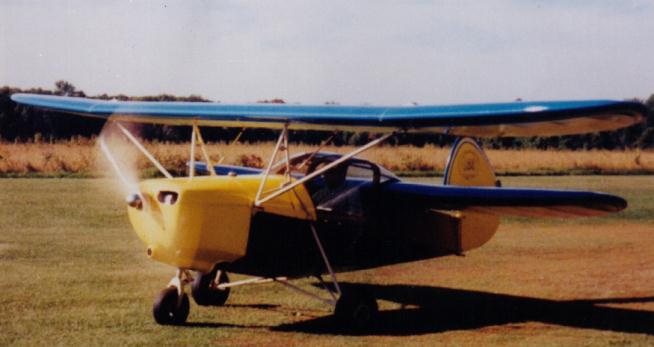
Rodolphe Grunberg has redrawn the 1940s HM.293 plans, updated them for 1990s materials, and fitted new light weight engines. Over 40 Grunberg HM.293s were reported either flying or close to completition in France in 1998.
Rodolphe Grunberg HM 293
In 2010 Falconar MIGNET “Flying Flea” plans cost: HM290E, HM293E, HM290, HM293 cost US$65. Falconar Avia produced kits as an LSA.
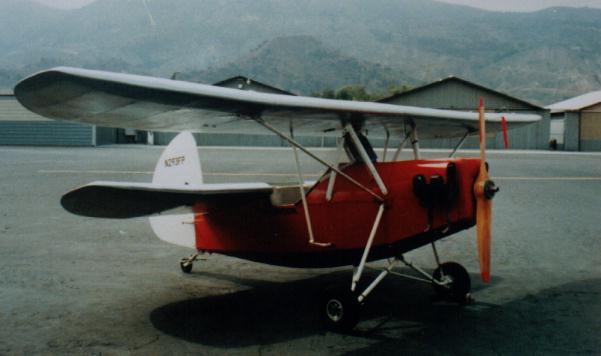
HM 293
On June 30, 2019, Falconar Avia Inc closed for business and assets dissolved. The Master Sets (Original Drawings, Plans, Info Kits, Documentation) were available for sale and full transfer of rights included the MIGNET “Flying Flea” HM 290/293, 290/293 E, F295 E, and 295 F for $4500 USD.
“Flying Flea” HM 290E/293E ULTRA LIGHT Engine: 25/30 hp Hirth or Rotax Cruise speed: 60 mph Length: 13 ft Empty weight: 246 lb Gross weight: 476 lb Wing span: 20 ft
HM290/HM293 amateur built Engine: 50/60 hp Little Demon (VW) or similar Cruise speed: 90 mph Length: 12-13 ft Empty weight: 360 lb Gross weight: 580 lb Wing span: 18-20 ft
HM290/293 Engine: VW, 60 hp HP range: 50-60 Height: 5.5 ft Length: 13 ft Wing span: 20 ft Wing area: 113 sq.ft Cruise: 90 mph Stall: 28 mph Range: 300 sm Rate of climb: 800 fpm Takeoff dist: 150 ft Landing dist: 150 ft Fuel capacity: 10 USG Empty weight: 350 lb Gross weight: 600 lb Seats: 1 Landing gear: nose or tail
HM 293 Engine: VW, 60 hp Speed max: 110 mph Cruise: 90 mph Range: 300 sm Stall: 28 mph ROC: 1400 fpm Take-off dist: 150 ft Landing dist: 150 ft Fuel cap: 10 USG Weight empty: 350 lbs Gross: 600 lbs Height: 5.5 ft Length: 13 ft Wing span: 20 ft Wing area: 113 sq.ft Seats: 1 Landing gear: nose or tail wheel.
Falconar Avia 290E/293E Engine: Kawasaki, 30 hp HP range: 25-35 Length: 13 ft Wing span: 20 ft Wing area: 117 sq.ft Empty weight: 246 lb Gross weight: 476 lb Fuel capacity: 5 USG Cruise: 55 mph Stall: 28 mph Range: 290 sm Rate of climb: 500 fpm Takeoff dist: 180 ft Landing dist: 150 ft Cockpit width: 23 in Landing gear: nose or tail
Rodolphe Grunberg HM 293 Engine: 30-40 hp Wing span: 6.10 m Wing area: 12 sq.m MAUW: 250 kg Empty weight: 117 kg Fuel capacity: 30 lt Max speed: 130 kph Cruise speed: 90 kph Minimum speed: 30 kph Seats: 1 Plan price (1998): 295 Fnc
Brian Park’s G-ADYO under construction at Clarington Forge in Wigan, UK
Dobson and Caunce’s under construction at Ledsham, in the Worral, Merseyside, UK. Later G-ADZV
Dobson and Caunce’s G-ADZV
French built Flea
D.C.Burgoyne’s G-AECN
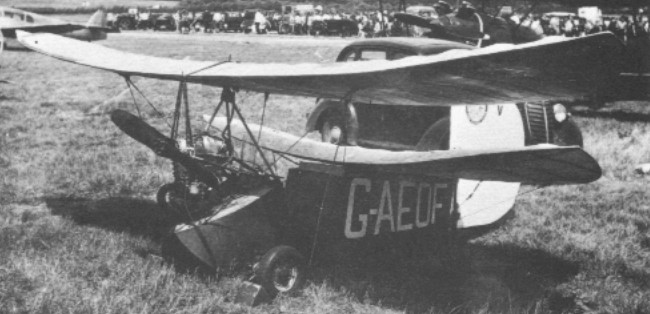
G-AEFK
The first ‘Cantilever Pou’ G-AEGD using modification designed by L.F.Baynes and built by E.D.Abbott Ltd at Wrecclesham. Braced forward wing, faired in Carden-Ford engine, and access flap for the pilot.
Dr. Armour’s G-AEOJ with conventional undercarriage
The first Flying Flea took to the air back in 1933 and quickly earned a reputation for being temperamental. Mignet was a furniture manufacturer, and named his creation “Le Pou de del,” or Louse of the Sky. It started out to be Everyman’s Airplane, something you could build for $500, complete, in the Depression years. Mignet’s Flea carried a 17-hp engine and had a speed range from 25 to 62 mph.
The Pou de Ciel (Flying Flea) was introduced to the public during the Paris Aero Salon in 1935.
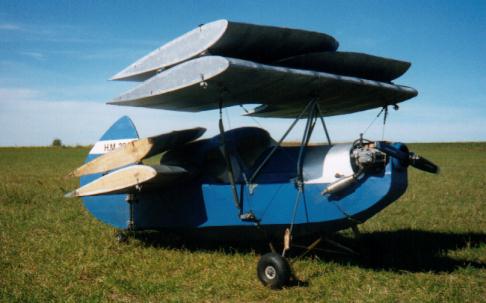
For simplicity the top wing pivoted about the front spar and was tilted up and down for longitudinal control. There were no ailerons, turns being made by the rudder alone. Mignet’s Pou and his book Le Sport de l’Air started a craze for do it yourself aircraft in the 1930s. Translated to English by the British Air League which did not include a true and correct C of G situation. This resulted in numerous crashes. Flea fever swept France, Britain and America. In 1935 some 600 Flying Fleas were under construction in the British Isles alone. Most stayed firmly on the ground. Ignorant of the ways of aircraft, they built their Fleas too heavy, or used unsuitable engines, so that the machines would do little more than tear around re¬fusing even to hop like their namesakes. Most were fitted with the 25 hp Scott or Douglas engine. It was a blessing in disguise, for the Pou du Ciel had an inherent design fault. The trouble lay in Mignet’s tan-dem wing configuration: the rear wing was fixed while the incidence of front surface could be varied to give control in pitch. If the front wing was allowed to stall, the nose would drop and because of an obscure inter¬ference effect between the two wings the aircraft would dive ever steeper until it either became stabilized in an inverted posi¬tion from which recovery was impossible, or struck the ground. Accidents showed that the aircraft became uncontrollable if the wing incidence exceeded 15 degrees, and British Fleas were promptly grounded. It became illegal to fly unmodified Flying Fleas after June 1937.
Mignet fixed the problem and continued to build and develop Poux until his death in 1965.
Douglas developed an engine model specifically for aircraft, with longitudinal finning; the Scott company brought out their 750cc inline model A.25; and Sir John Carden set up in production with a modified version of the reliable Ford 10 engine.
E.D.Abbott Ltd coachbuilders of Wrecclesham, Farnham, Surrey, UK, set up production of kits (at £90) and complete aircraft (at £198). Flight test took place at Heston.
G-AEGD cn CP.1 was modified to ‘Cantilever Pou’ design of L.E.Baynes with strut-braced wings and fitted with an enclosed Carden-Ford engine. It was registered on 15 April 1936, sold in January 1936, and cancelled in February 1943. Following G-AEGD were G-AEJC cn CP.3 and G-AEJD cn CP.4. G-AEJC was registered on 27 July 1936 and cancelled in December 1937. G-AEJD was used for stall investigation.
Mignet HM 14 Pou de Ciel / Flying Flea Engine : Bristol, 35 hp Length : 11.483 ft / 3.5 m Height : 6.562 ft / 2.0 m Wingspan : 16.732 ft / 5.1 m Max take off weight : 441.0 lb / 200.0 kg Weight empty : 242.6 lb / 110.0 kg Max. speed : 65 kt / 120 km/h Crew : 1
Mignet Pou-du-Ciel (Flying Flea) Engine: 75 hp McCulloch horizontally opposed Maximum speed: 91 mph (146 km/h) Empty weight: 421 lb (191 kg) Maximum weight: 643 lb (292 kg) Span: 18 ft 2 in (5.5 m) Length: 12 ft 6 in (3.8 m) Height: 5 ft 8 in (1.7 m) Wing area: 108 sq ft (10 sq m)
Engine 22-38 hp. Gross Wt. 700 lb Weight empty 350 lb (160 kg.) Fuel capacity 12 USG Top speed 56 mph Stall 35 mph Climb rate 500-600 fpm Ceiling 16,400 ft Seats: 1 Length 13 ft. (3.96 m) Wing span 22 ft. (6.7 m) Max cruise 60 mph (96 kph) Range 200 miles (320 km)
Engine: ABC Scorpion, 35 hp Top speed: 80+ mph Cruise speed: 70 mph Landing /TO speed: 30 mph Landing dist: 150 ft TO dist: 200 ft Fuel capacity: 7 USG Range: 280 mi Empty wt: 316 lb
Avions Henry Mignet Societe D’exploitation Des Aeronefs Henri Mignet Mignet do Brasil
Early aircraft from Henri Mignet was HM.14, popularly known as the Flying Flea (first flown 1933). Founded Mignet do Brasil postwar, but later returned to native France to produce series of new aircraft. or kit form is HM.1000 Balerit microlight, a tandem-wing two-seat Pou-du-Ciel type; customers include the French Armee de I’Air, for surveillance.
1998: Aviona Henri Mignet, 17600 St.Romain de Benet, France.
Available in assembled or kit form is HM.1000 Balerit microlight, a tandem-wing two-seat Pou-du-Ciel type; customers include the French Armee de I’Air, for surveillance.
1998: Aviona Henri Mignet, 17600 St.Romain de Benet, France.
This side by side two¬-seater version of the HM 81 Tomcat was announced at the finish of the 1981 and appeared early in 1982.
Engine: Cuyuna 430R, 30 hp at 5500 rpm. Propeller diameter and pitch 54 x 36 inch, 1.37 x 0. 91 m. V belt reduction, ratio 2.0/1. Max static thrust 250 lb, 113 kg. Power per unit area 0.17 hp/sq.ft, 1.8hp/sq.m. Fuel capacity 5.0 US gal, 4.2 Imp gal, 18.9 litre. Length overall 12.0 ft, 3.66 m. Height overall 10.0ft, 3.05m. Wing span 30.0ft, 9.14m. Chord at root 4.0ft, 1.22 m. Chord at tip 3.0 ft, 0.91 m. Main wing dihedral 0 deg. Main¬ wing sweep back 0 deg. Canard span 8.0ft, 2.43m. Canard chord 3.0ft, 0.91m. Total wing area 175 sq.ft, 16.3sq.m. Main wing area 125 sq.ft, 11.6 sq.m. Canard area 25 sq.ft, 2.3 sq.m. Total dihedral wing area 25 sq.ft, 2.3 sq.m. Main wing aspect ratio 7.2/1. Wheelbase 7.0ft, 2.13 m. Nosewheel diameter overall 10 inch, 25 cm. Main wheels diameter overall 10 inch, 25 cm. Empty weight 245 lb, 111 kg. Max take off weight 605 lb, 274kg. Payload 360 lb, 163 kg. Max wing loading 3.46 lb/sq.ft, 16.8kg/sq.m. Max power loading 20.2 lb/hp, 9.1 kg/hp. Load factors +5.0, 3.0 design. Max level speed 60 mph, 97 kph. Cruising speed 45mph, 72kph. Stalling speed 24mph, 38kph. Max climb rate at sea level 350 ft/min, 1.8 m/s. Best glide ratio with power off 7/1. Take off distance 180 ft, 55 m.