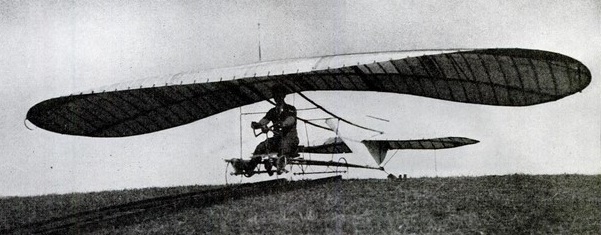
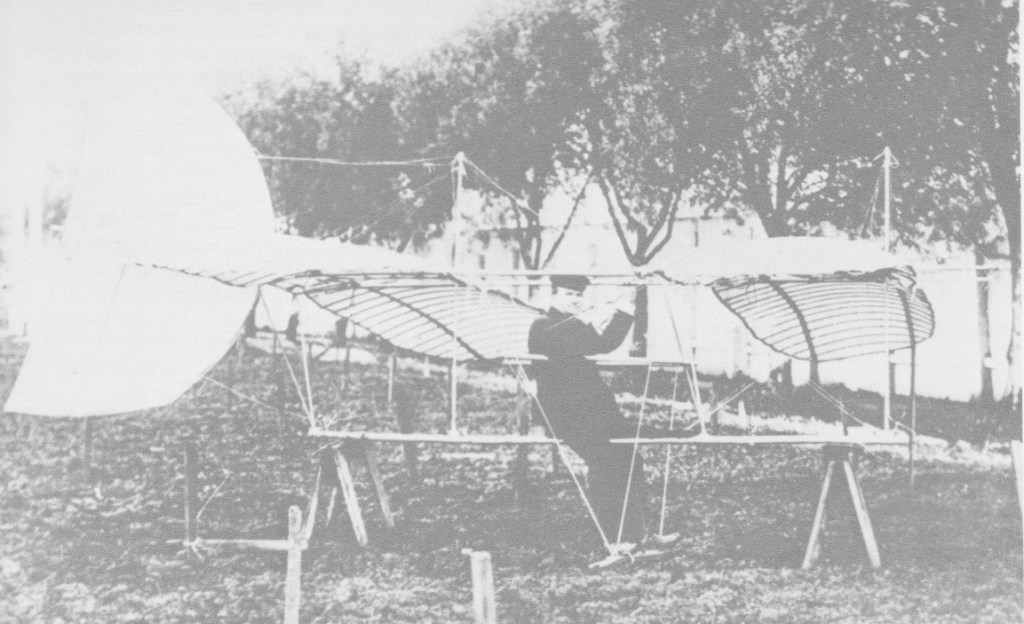
Edwin Rowland Moon (8 June 1886 – 29 April 1920), possibly inspired by the 1903 Wright brothers flight, took a corner of the workshop of the Moon family owned a boat-building business to realise his dream of constructing and flying an aircraft of his own design.
He tested his first plane, Moonbeam I, in the Fawley area, near the home of his future bride. His first short “hop” took place on Websters Field at Ower Farm, near Calshot and at Moulands Field, Regents Park. Following these test flights on the prototype plane, he built a second plane, Moonbeam II.
He made the first successful flight; the precise date of the first flight is not known, although researchers believe that it was between 12 April 1910 and 11 June 1910.
Following the start of World War I, Moon soon enlisted in the Royal Naval Air Service. On 29 April 1920, Moon was at the controls of a flying boat on an instructional cruise when it crashed into the sea. Moon and three other crew members were killed.
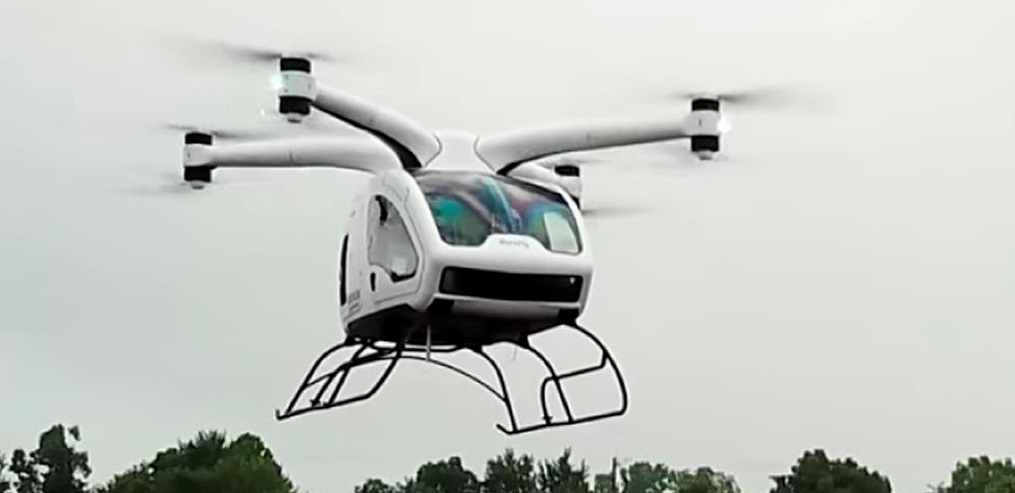
On 30 April 2018 the Moog Surefly flew its first flight. The configuration of the Surefly is four arms with the counterrotating propellers are mounted above the aircraft instead of close to the ground.
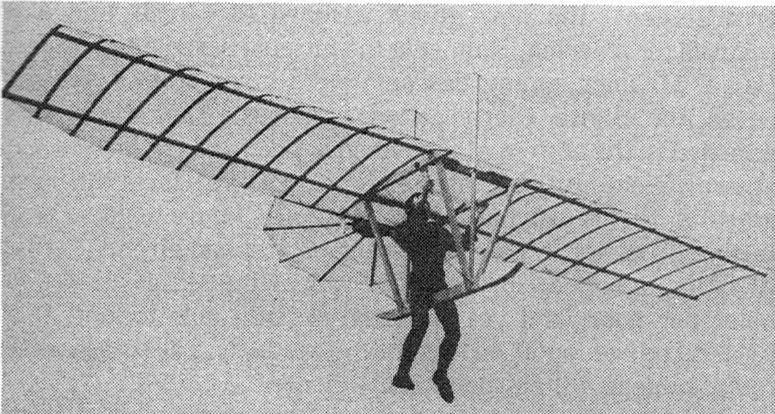
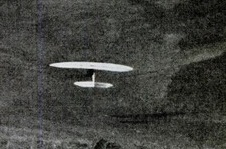
John J Montgomery, a science teacher at Santa Clara College, in California, experimented with gliders as early as 1883. Montgomery’s 1883 glider had a short, 23 foot wing span with a moveable horizontal tail. A keel-like bar (longeron) was suspended three feet below the wing longerons. The pilot ran to launch the ship by holding the upper bars, and once in flight he straddled the centre bar. He could then swing his body from side to side for lateral control and manipulate the horizontal elevator plane for lift. The craft is reported to have flown consistently well.
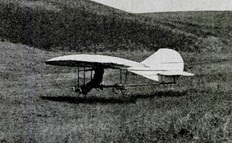
The first glider proved the value of the cured wing which he copied from a seagull and with it he flew 600 ft.
His second hang glider used flat wing surfaces, and proved to be totally useless. In 1905, Montgomery added a second, tandem wing to his basic design, and Daniel Maloney, a parachute jumper, made numerous exhibition flights with his plane, performing sharp turns and even barrel rolls.
His third hang glider incorporated wing warping for lateral control.
1883 hang glider
Montgomery’s first models were tested from aa cable suspended between two hill tops in California, and the gliders were dropped from them. He was able to give them such stability that they could even even themselves after being launched upside down, and glider smoothly to the ground.
Montgomery made a number of flights himself but stopped when he put his foot in a squirrel hole on one landing and hurt his leg.
He also dropped from a balloon at 4000 feet and glided gently back to a stand-up landing at his take-off point.
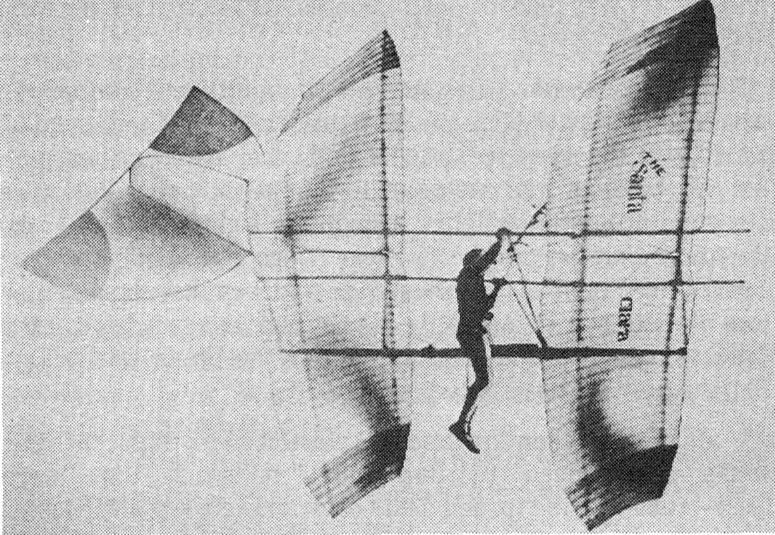
In 1905 Montgomery returned with an improved hang glider with two main wings: one placed behind the other in a tandem arrangement.
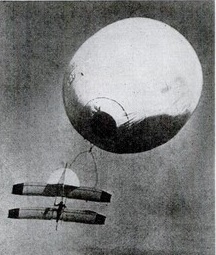
His new glider weighed 45 lb and had controls for steering. Engaging parachute jumper Daniel Maloney, many descents were made from 4000 ft above the Santa Clara college grounds. The glider was attached to the bottom of a manned balloon cut loose when at sufficient altitude. Montgomery was able to perform figure eights, dives and stalls, spiral and circling turns. At times the speed of the glider was estimated at almost 70 mph, and yet Montgomery was still able to land at a predetermined spot on his own two feet. Montgomery also employed two other glider pilots, Wilkie and Defolco. Maloney was killed in an accident and the act was discontinued. Montgomery describes the fatal accident as follows; “The ascension was given to entertain a military company in which were many of Maloney’s friends, and he told them he would give the most sensational flight they had ever heard of. As the balloon was rising with the aeroplane, a guy-rope dropping switched around the right wing and broke the tower that braced the rear wings and which also gave control over the tail. We shouted to Maloney that the machine was broken, but he probably did not hear us, as at the time he was saying ‘Harrah airship’ and as the break was behind him, he may not have detected it. When the machine started on its flight, the rear wings commenced to flap – indicating they were loose – the machine turned on its back and settled faster than a parachute. When we reached Maloney he was unconscious and lived only 30 minutes. The only mark of any kind on him was a scratch from a wire on the side of his neck, the six attending physicians were puzzled at the cause of his death”.
Montgomery and his double-winged glider. Note both foot and hand operated controls
Montgomery did quite a bit of research in the use of curved lifting surfaces and the movement of air around them. He had intended to carry out more experimentation, but the great San Francisco Earthquake prevented it. It wasn’t until 1911 that he again started gliding, but unfortunately h was soon killed in a fall in one of his gliders. In October, while in the air, he was struck by an unexpectedly violent gust of wind which sent his glider crashing to the ground. He hit fairly hard and injured his head and hip. At the time he did not think he was severely hurt, but later on complained of severe pains. These continued to get worse, and stayed with him until death.
A hot air balloon hauled Carnival Parachutist Dan Maloney in a Montgomery glider to 400 feet. Maloney flew eight-mile course during the glider’s descent.
John Joseph Montgomery was born in Yuba City, California, USA, on 15 February 1858. After graduating from St.Ignatius College (now the University of San Francisco) as a lawyer he entered the law profession but failed. He tried storekeeping but failed.
Montgomery graduated from St. Ignatius College in San Francisco in 1879. He is often referred to as a Professor, though it is believed he didn’t have a Ph.D. He was the son of a former assistant attorney-general of the US. Two of his college classmates were James D. Phelar, mayor of San Francisco (1896-1902) and Rev. R.H. Bell, well known for his work in wireless telegraphy.
At his family ranch near San Diego he studied the flight of birds. He tried building three ornithopters with flapping wings, which failed.
At 25, he built a fixed wing glider with his sisters and younger brother assisting with the fabric. With this glider, on 20 August 1883, he soared 602 feet.
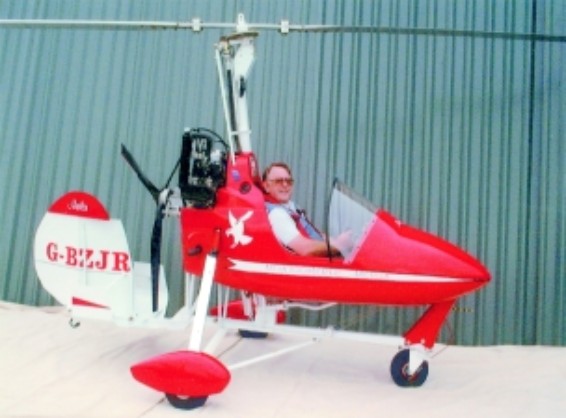
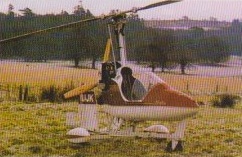
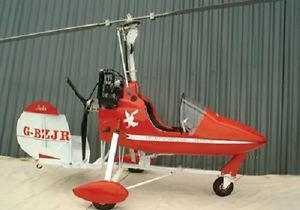
Bensen’s Gyrocopter is the design-ancestor to the Merlin’s bolted 2×2 aluminum tube frame and streamlining is the modern Merlin’s anthem. Two fuel tanks are foamed in place behind the pilot and together hold 11 US gal. Partially enclosed, it has capacity for one. Sprung main wheel suspension struts w/intergral gas shock absorbers.
2001 Kit price without engine, rotors, propeller or instruments: approximately $5338.98 (U.S. dollars). Kits were supplied to the US market less rotors, gimbal head, engine, propeller and instruments.
Jim Montgomery’s design was produced by Layzell Gyroplanes of Quedgeley, Gloucester. The aircraft was supplied as a kit for amateur construction. After taking over Montgomery’s design, company owner Gary Layzell expressed an interest in further developing the Merlin, but initially produced it unchanged.
The aircraft fuselage is made from bolted-together square aluminum tubing. Its 7.01 m (23.0 ft) diameter Rotor Flight Dynamics rotor has a chord of 18 cm (7.1 in).
The type remained in production by Layzell through 2011, although by July 2012 the company website had been removed from the internet. The unit cost in 2011 was £12,761.
By January 2013, 28 examples had been registered in the United Kingdom with the CAA as Montgomerie-Bensen B8MR.
Rozier took part in a further flight on 23 June 1784, in a modified version of the Montgolfiers’ first balloon christened La Marie-Antoinette after the Queen, which took off in front of the King of France and King Gustav III of Sweden. Together with Joseph Proust, the balloon flew north at an altitude of approximately 3,000 metres, above the clouds. They travelled 52 km in 45 minutes before cold and turbulence forced them to descend past Luzarches, between Coye et Orry-la-Ville, near the Chantilly forest. They set records for speed, altitude and distance travelled.
Along with Joseph Montgolfier, he was one of six passengers on a second flight on 19 January 1784, with a huge Montgolfier balloon Le Flesselles launched from Lyon. Four French nobles paid for the trip, including a prince. Several difficulties had to be overcome. The wallpaper used to cover the balloon’s envelope became wet because of extreme weather conditions. The top of the balloon was made of sheep- or buckskin. The air was heated by wood in an iron stove: to start, the straw was set on fire with brandy. (In other tests charcoal or potatoes were used). The balloon had a volume of approximately 23,000 m³, over 10 times that of the first flight, but it only flew a short distance. The spectators kneeled down when the balloon came down too quickly. That evening the aeronauts were celebrated after listening to Gluck’s opera, Iphigénie en Tauride.
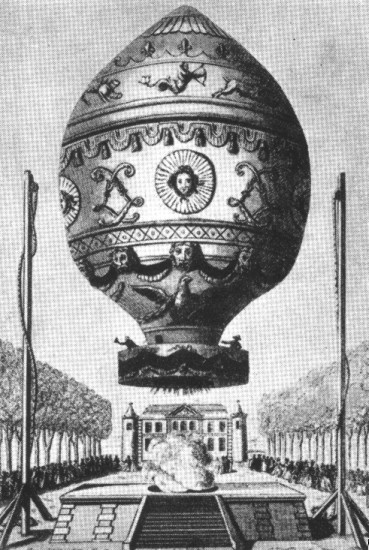
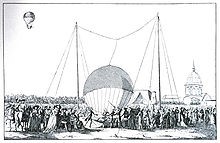
On 19th September the first living creatures ever to leave the ground in an aircraft — a sheep, a cock and a duck — travelled almost two miles in a wicker basket slung under a Montgolfière released at Versailles and it was planned to carry under the next balloon a criminal who would receive a free pardon if he alighted safely. But a young scientist named Pilâtre de Rozier, considering it unthinkable that a criminal should gain the honour of being the first airman, volunteered to make the ascent himself; and on 15th October 1783 he rose to about 80 feet in a captive balloon with a capacity of 60,000cu. ft. Pilatre de Rozier made a 4 minute 24 second tethered flight. The second ascent was done with Pilâtre de Rozier, and André Giroud de Villette, to 105m.
The first tethered balloon ascent on 15 October 1783 by Rozier.
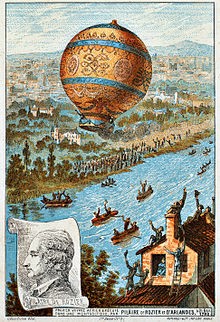
After several tethered tests to gain some experience of controlling the balloon, de Rozier and d’Arlandes made their first untethered flight in a Montgolfier hot air balloon on 21 November 1783, taking off at around 2 p.m. from the garden of the Château de la Muette in the Bois de Boulogne, in the presence of the King. Their 25-minute flight travelled slowly about 5½ miles (some 9 km) to the southeast, attaining an altitude of 3,000 feet, before returning to the ground at the Butte-aux-Cailles, then on the outskirts of Paris.
The 25-minute flight was not without hazard, for the balloon was kept inflated with hot air by means of a brazier slung under its neck, and the airman had a hectic time putting out fires on the fabric with a sponge and water which they had wisely decided to take with them.
The first untethered balloon flight, by Rozier and the Marquis d’Arlandes on 21 November 1783.
The first woman aeronaut, Mine Tible, ascended from Lyons as passenger in a Montgolfière in June 1784.
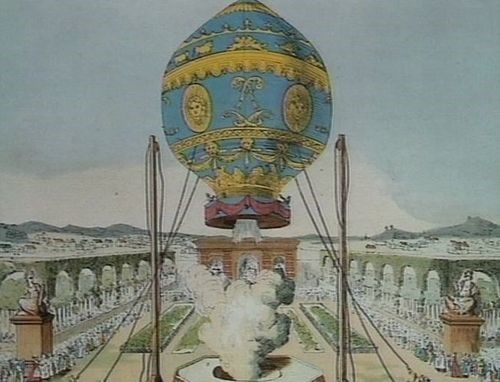
Montgolfière Le Réveillon
Replica: HAS Woodford Montgolfier
Capacity: approx 77,700 cu.ft / 2200 cu.m Diameter: approx 49 ft / 14.95m Height: approx 75 ft / 22.75m