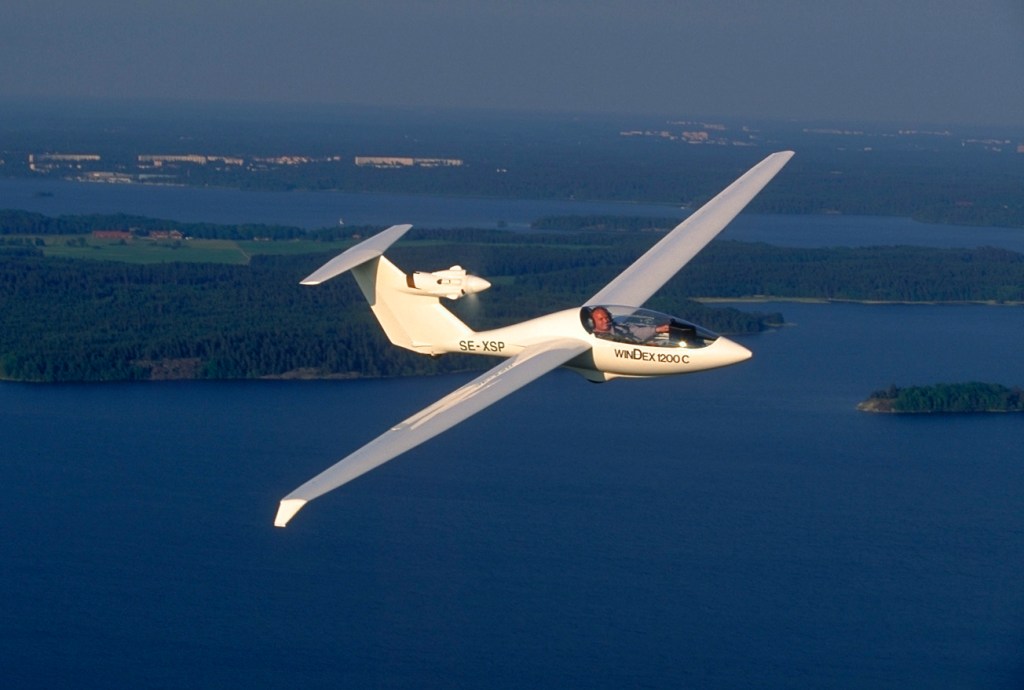
In 1980 Sven-Olof Ridder and Harald Undén start a hobby project which was intended to become a very light self-launching glider. During 1983 the Windex wing section developed and tested in wind tunnel. During 1985 Windex 1100 (unpowered) flies and work have started on moulds for powered version with 12 m. span, Windex 1200 C.
In 1986 all Windex 1200 C moulds burn in a factory fire after only 2 sets of laminates have been produced but during 1987 the Windex 1200 C prototype was shown at the Paris Air show.
During 1990 new moulds were being produced for kit production model, Windex 1200 C, fully aerobatic, with carbon fibre spars.
The Windex 1200 C prototype took part in Aerobatic World Championships 1991 for Gliders in Poland. Bronze medal in 2 categories.
10 “pilot-builders” in Sweden and abroad tested kit parts, drawing, manual etc during 1993. During 1992-1995, intensive kit development work, product testing took place with 2 factory prototypes under construction.
The first amateur-constructed kit Windex 1200C flew in 1996.
In 1999 Windexair AB took over the Windex 1200C project from RADAB.
Windex 1200 C is primarily a high-performance sailplane, but has a low-drag fin-mounted engine installation and a variable-pitch propeller turning it into an efficient touring aircraft with a cruising speed of 210 km/h (130 mph) and self-launching capability.
The airframe of Windex 1200 C is stressed for aerobatic manoeuvres and designed to JAR 22 (A). It’s a powered high-performance sailplane that can be easily handled on the ground by one person. Even with engine nacelle, propeller and a 20% smaller span it has a soaring performance equal to or better then a 15-metre Standard Cirrus glider. It also has a climb rate of approximately 2.5 metre/sec (685 fpm), under power.
The specially designed 17% thick airfoil section has comparatively low drag and a wide low drag bucket that is further expanded by a 22.5% chord trailing edge flap. The basic airfoil has very docile stall characteristics in both smooth and rough condition.
The carbon fibre spar has been successfully proof tested at 2175 kgs each side. That gives a useable load factor of +9 g and -7 g (with added safety factor of x 1.725). The König SC-430 3-cylinder engine, used in the Windex 1200C is manufactured in Canada. A displacement of 430 cc gives a take off power of 20 hp at 4200 rpm. Weight of the König engine is 13.8 kg (30.4 lbs). Starting is electric and it uses gasoline of types 100LL, 80UL and mogas98.
The variable-pitch propeller unit for the König engine has been built and
successfully tested to JAR 22 standards. The pilot control pitch from the cockpit, fine pitch to fully feathered.
The JAR tests include 50 hours running and 500 control movements
with engine running. After that the propeller unit is dismantled, searched
for damage, tolerances checked and finally function checked again.
The unit has come through bench testing without problems.
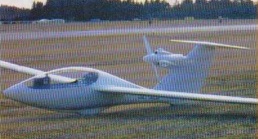
The Windex 1200 C Fuselage kit consist the following:
Laminate parts:
Upper and lower fuselage shells, vertical tail with engine nacelle, left and right, spar for vertical tail, upper and lower stabiliser shells, including spar caps moulded-in, spar web stabiliser, reinforcement module including seat and backrest, cockpit frame left and right, wheel housings for main- and tail wheel fairings, housing, ventilation channel with mechanism mounted, stick mechanism cover, fwd push rod cover aft rudder line covers and rudder pedal assembly.
Plexiglas canopy cut to size with ventilation window (Mecaplex). Main wheel with tire. Tail wheel, complete. Miscellaneous tubing, electrical wiring, switches, fuel lines, etc.
All metal parts are pre made.
All hardware, bolts etc., is AN-quality.
(With a few stainless steel exceptions)
5-Point (aerobatic) harness. Tow hook. Full scale templates for bulkheads, etc. All necessary drawings. Building manual (English language)
Epoxy, fibreglass, adhesives.
NOT INCLUDED: Instrument, paint, abrasive paper and similar materials. Wood, chipboard etc. for building cradle and jigs.
Wing kit
All internal wing fittings, hinges, spoilers, push rods, fuel tanks and wing spars are fitted. Wing is closed to eliminate wing jig and to considerably save building time
Metal parts:
All metal parts are pre-made.
Wing spar pin bolts, bolts for rear and fwd attachment. AN aircraft hardware. Push rods for ailerons and spoiler. 2 x aluminium fuel tanks each 17 litres. Associated couplings and hardware.
All necessary drawings and templates. Building manual. Epoxy, fibreglass, adhesives,
NOT INCLUDED: Paint. Abrasive paper and similar materials. Wood, chipboard etc. for jigs.
The span is 39′ 8″ and best L/D is 38:1. They also offered a fast build kit version for $5l,890 that saves approximately 300 hours from the normal 1000 hour build time. The glider is stressed for aerobatics and has enough fuel capacity and a variable pitch propeller for efficient powered cruising up to 3 hours. The Windex uses preimpregnated composite materials and an autoclave cure process for high strength to weight ratio in the structures. No other current sailplane uses this fairly expensive process. The prize of the kit was US$39,000 in 1997. Windex also offered a building assistance program in Sarasota, Florida for $870 per month and will provide qualified helpers for $40 per hour.
ARACO were the US agents for the Windex.
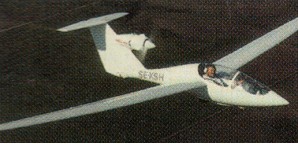
Windex 1200C
Engine: Konig 2 cycle, 24 hp.
HP range: 18-24.
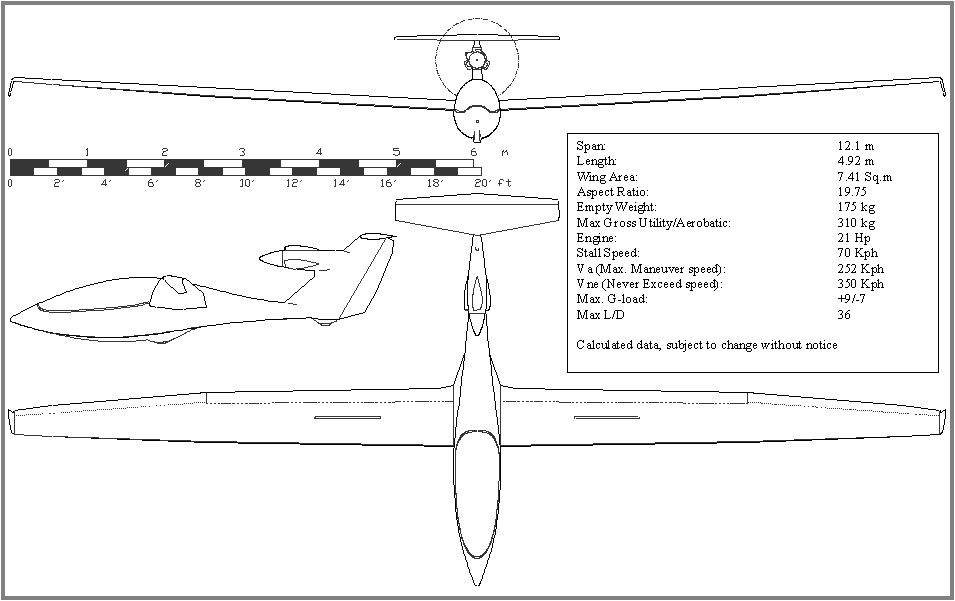
Wing span: 12.1m / 39.7ft
Wing area: 7.41 sq.m / 79.8 sq.ft
Aspect ratio: 19:8.
Height: 3.7 ft.
Length: 16.1 ft.
Empty Weight: 150 kg/331 lb
Payload: 160 kg/352 lb.
Gross Weight: 310 kg/683 lb
Wing Load: 41.83 kg/sq.m / 8.56 lb/sq.ft
Stall: 45 mph.
Seats: 1
L/D max: 38 at 100 kph / 62 kt / 71 mph
Aspect ratio: 19.75
Min sink: 0.70 m/s / 2.3 fps / 1.36 kt
Airfoil: Radab
Structure: CFRP/GFRP
Load limit: +9/ -6g
Landing gear: fixed single wheel and tail.
AB Radab Windex 1200
Engine: Konig 430, 24 hp
Wing span: 12 m
Wing area: 7.34 sq.m
MAUW: 310 kg
Empty weight: 150 kg
Fuel capacity: 34 lt
Max speed: 240 kph
Cruise speed: 200 kph
Minimum speed: 71 kph
Climb rate: 3 m/s
Seats: 1
Kit price (1998): $39,000
 All Aero
Is this kit still available?
LikeLike
Research returned
After some further investigation I found the URL revived at
http://www.radab.se/
An email to them received the following reply:
BEGINING OF QUOTE
Thank you for your letter.
I will try to update you in what is happening in the Windex project.
WINDEXAIR AB took over the Windex 1200C project from Radab summer of 99 and
has further developed the kit to reduce the building time dramatically. We
do not have any US distributors. The Florida based Windex Corporation was a
free standing company that was closed down when the owner wanted to
concentrate on his other businesses.
We will start deliver kits this winter and delivery time right now is 120
days. Unfortunately we will not be able to deliver any engine kit until
later next spring. When it comes to the engine we do recommend our
customers to wait for the newly developed Zanzottera/König engine even if
it is delayed and will not be ready for delivery until this winter/spring.
We do have a few engine of the old König model.
Delivery time is defined as time from written contract with down payment of
30% until kit leaves the factory.
We are waiting with the marketing of the Windex until we have all parts for
the first 7 kits, excluding wing laminates and wing-spar. We have made this
decision to avoid delivery problems to our customers.
There are 10 Windex that has flown up until this moment + one WindExtrem,
four of them in the US, one in France and the rest in Sweden. WindExtrem is
special reinforced Windex 1200C without engine and has been flown in speeds
around 500 kph. At this moment there is three near completion, one in
Sweden, one in the US and one in Germany. The one in Germany is ungoing
“einstuck” JAR22 Aerobatic certification. There is four more under
construction, one in England, one in France and two in Sweden.
We have been using the last year and the knowledge from these aeroplanes to
improve the Windex kit and we can deliver a full Windex kits to you this
winter, (except for the engine kit), if you are interested. Exact delivery
date of the engine kit depends on when Zanzottera can deliver the engine.
If there is several orders the delivery time will become slightly longer.
The price from factory
Fuselage kit with ready made fittings 130 000 SEK
Wing kit, “fast build” 145 000 SEK
Engine/propeller kit 75 000 SEK
Tot. Price 350 000 SEK
Prices are excluding taxes, national fees and transport.
Shipping and crating is about 20 000 SEK to a major port in Canada.
The price of the Windex kit has been changed due to the decreased value of
the SEK.
The kit includes essentially every thing except instrument, paint, tools
and wood for the jigs.
All laminates that are not flat parts are pre made, all fitting are
ready-made and should only require trimming in and drilling at the most.
Fast build wing means that the wing is closed with all internal mechanisms
and spars mounted, but the customers need to cut out the control surfaces,
build the nose of the control surfaces, build root ribs and all things that
can be build after the wing is closed.
Windexair does not have a finish demonstrator at this moment. It might be
possible for us to borrow a Windex 1200C from Stockholm but we have to
arrange that with the private owner of the glider.
The Windex 1200C kits built in the USA has not had any problems with the
EAA inspections but it does not exist any official approval in the USA due
to the small numbers of Windex kits in the USA. The kit is design to EAA
51% rule and there have not been any problems in the countries that follow
the 51% rule, (so far France, Switzerland, Sweden and USA). In Germany you
need to do a “einstuck” JAR 22A certification to get the arobatic approval.
Changes made
Canopy frame
Changed from side hinged to fwd. Hinged to make more convenient to enter
and exit the cockpit.
Improved canopy jettison function with pins and a spring to control the
canopy movement under jettison.
Pre-made canopy frame to save building time (about 80 hours) and to get a
better finish.
Rudder pedal assembly
Changed from welded steel construction to prepreg autoclaved carbon
construction to save weight and to keep tighter tolerances.
Changed geometry to get more room for the feet and to improve the overall
ergonomics.
New pedal track system to minimises irritating play in the assembly.
Air intake – dynamic pressure probe assembly
Changed from welded steel and hand laminated fibreglass construction to
one-piece prepreg autoclaved carbon construction to make it easier to line
up build in to the fuselage and to minimise corrosion problems in the
dynamic pressure tube.
Battery
The battery is changed from a one-piece battery to 6 12V-2.5AH-battery
packs that can be moved individually between a position in the nose to a
position in the fin; this arrangement makes the system with balance weight
of lead absolute. The battery packs are easier to mount then the one-piece
battery.
We are using Hawker/gates Cyclone batteries for the battery packs, these
batteries has a guarantied lifetime of 15 years in standby mode.
Crash safety
A new bulkhead in front of the feet to protect the feet in moderate crash
loads.
New improved cockpit safety frame to increase the likelihood to survive
severe crashes even above 35G.
Cockpit
New control stick to improve ergonomics.
New throttle-and choke-control to improve ergonomics and to make it easier
builder to mount.
The wheel-brake actuator is moved from the rudder pedals to a bicycle type
brake-handle on the spoiler handle, this is to make it easier to control
the brake action when you are taxing on the ground.
Wheel-brake
Wheel brake is changed to Tost drum-brake to improve the function and make
it easier for the builder to mount.
Control system
New aileron idle-arms and bell-cranks to minimise the friction in the
system due to bending in the push rods and to get the correct aileron
movement.
New aileron push-rod guide in the right wing to minimise the problem of
lack of space between the guide and the spoiler push rod.
New side rudder horn to increase the force on the rudder pedals and to
improve the rudder feeling.
A new upper rudder hinge to give the builder the opportunity to make the
rudder a little bit taller. This operation takes a couple of more day to do
but improves the rudder efficiency almost 10% which is important for the
pilots that want to do a lot of high end aerobatics.
Wing
New spoiler-box in one-piece to improve the tolerances and function, the
boxes also becomes stronger and lighter.
New autoclaved false-, aileron- and flap-spars to make the wing lighter and
stronger, it also saves about 2 to 4 days of building time for the
homebuilder.
New one-piece wing-lets with built in roller blade wheels, saves about 2 to
4 days of building time for the home builder and it saves weight in the
wing tip which improves the initial roll rate.
New stronger fwd and aft wing fitting.
New easier locking of the main wing pin.
LikeLike