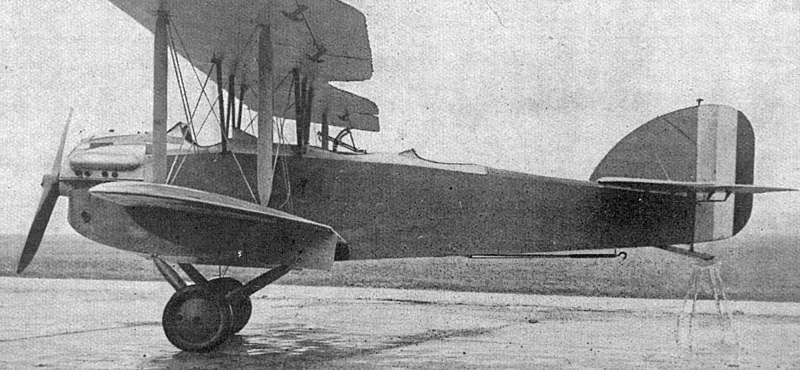
The Levasseur PL.4, aka Levasseur Marin, was a carrier-based reconnaissance aircraft produced in France in the 1920s.
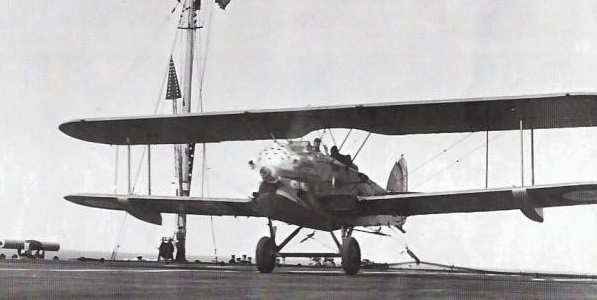
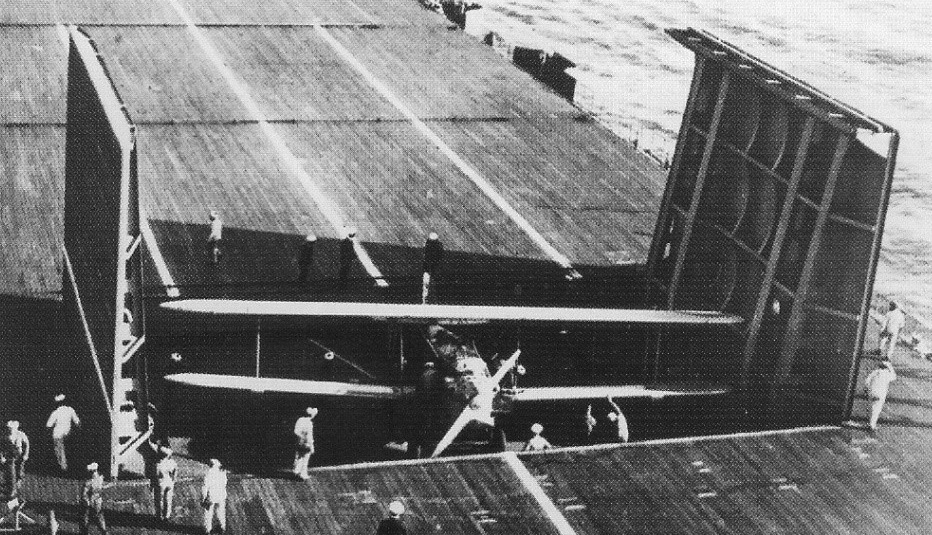
The PL.4 was a conventional, single-bay biplane that carried a crew of three in tandem, open cockpits. Purchased by the Aéronavale to operate from the aircraft carrier Béarn, it incorporated several safety features in case of ditching at sea. Apart from small floats attached directly to the undersides of the lower wing, the main units of the fixed, tailskid undercarriage could be jettisoned in flight, and the underside of the fuselage was given a boat-like shape and made watertight.
To meet the 1924 A.3/R.3b (three seat observation and gunnery spotter aircraft) specification from the Service technique de l’aéronautique (STAé), one PL.4 A3 R3b was built.
Forty PL.4 were built, first flying in 1926.
PL.4
Powerplant: 1 × Lorraine-Dietrich 12Eb W-12 340 kW (450 hp)
Propeller: 2-bladed fixed-pitch
Wingspan: 14.6 m (47 ft 11 in)
Wing area: 60 m2 (650 sq ft)
Width: 5.67 m (18 ft 7 in) wings folded
Length: 9.7 m (31 ft 10 in)
Height: 3.915 m (12 ft 10 in)
Empty weight: 1,650 kg (3,638 lb)
Gross weight: 2,550 kg (5,622 lb)
Maximum speed sea level: 175 km/h (109 mph, 94 kn)
Maximum speed 3,000 m (9,800 ft): 170 km/h (110 mph; 92 kn)
Range: 900 km (560 mi, 490 nmi)
Endurance: 5 hours
Service ceiling: 5,000 m (16,000 ft)
Time to 3,000 m (9,800 ft): 20 minutes
Wing loading: 43 kg/m2 (8.8 lb/sq ft)
Power/mass: 0.1337 kW/kg (0.0813 hp/lb)
Crew: 3

