In 1937 a group of engineers from the Civil Air Fleet scheme under the leadership of Anatoli Georgevich Bedunkovich began the development of a new multipurpose aircraft model. This aircraft was designed primarily as an agricultural model, hence its designation SJ-1 (Sielkojozyaisvenni or Agricultural). The projection of the model was carried out in correspondence with the resolution of the GVF of the 26 of August of 1935.
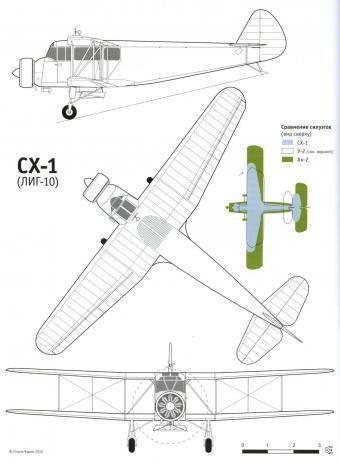
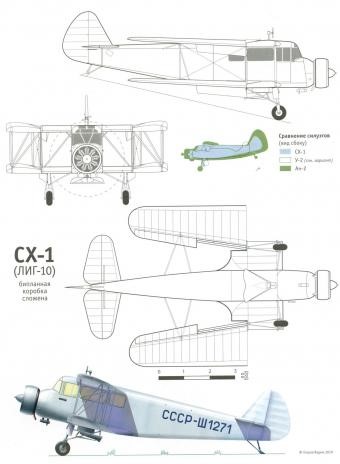
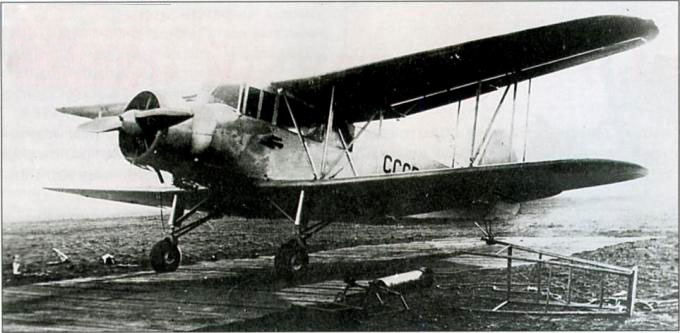
The SJ-1, also known as LIG-10 (Russian: Бедункович СХ-1 (ЛИГ-10)) according to the internal numbering of the Leningrad Civil Aviation Fleet Institute, was designed as a biplane with N-braces and wings without offset. The planes presented a similar configuration with a trapezoidal shape in the constant chord plane. The model was characterized by its good aerodynamics.
The construction of the airplane was mixed, with the use of steel, wood and fabric and it was conceived with all the simplicity that could be tolerated to achieve a cheap and mass-use airplane.
The wings, measuring 41.17 m² in area, had a 12% R-II profile and were made of wood, with a double-spar structure. The shape of the planes was trapezoidal, with a straight leading edge and a trailing edge with a slight inverted arrow. At the trailing edge all half planes had similar ailerons and flaps. The covering of both the wing and the ailerons and flaps was made of fabric.
The wing consoles could be folded back to allow the aircraft to be stored in small hangars or medium-sized barns.
The ample fuselage featured a heavily glazed crew cabin in the position behind the engine. The fuselage structure was skeletal, constructed of lightweight fabric-coated welded steel tubes. The wing bracing tubes were metallic and had a drop-like profile.
The tail unit was made of wood, covered with fabric. The stabilizer could modify its angle of incidence in flight.
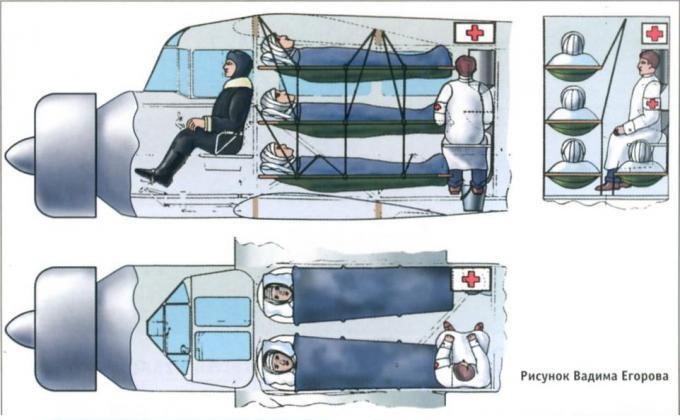
A mechanic or a nurse (in ambulance version) could sit next to the pilot in the flight deck. The cargo cabin, with a capacity of 4.25 cu.m, could be configured in different ways depending on the mission. In the agricultural version, the fuselage housed a 1.8 m3 tank for chemicals or fertilizers. In passenger transport configuration it could accommodate 6 people in two rows of seats. In an ambulance configuration, the possibility of transporting four stretchers and a nurse was foreseen. Depending on the mission, the takeoff weight of the SJ-1 reached 1975 kg (passenger version) or 2150 kg (agricultural version).
The landing gear was of the conventional and fixed type, with single units on the main pyramidal landers and tail skid. In winter the wheels could be replaced by skis. These units were characterized by the wide path of the shock absorbers, which allowed operation on unprepared fields.
The powerplant consisted of a MG-31F piston engine carefully enclosed by a ring-type bonnet. The fuel system consisted of aluminum tanks located in the upper wing centerplane and on both sides of the fuselage.
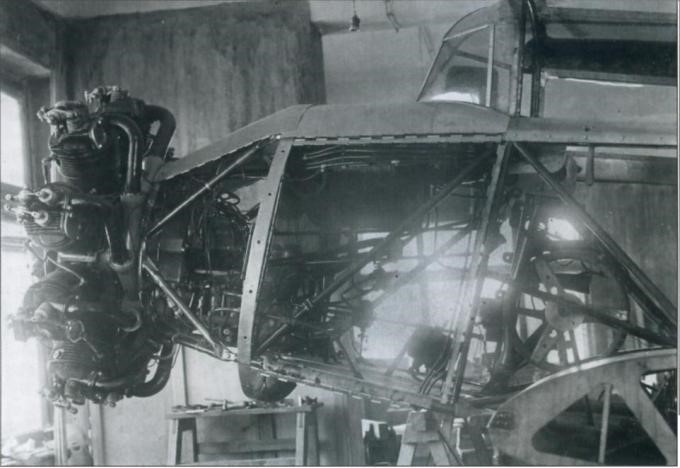
The aircraft featured a fairly complete set of instrumentation and a well-crafted distribution system for chemicals for fumigation.
Built at the Leningrad Aviation Repair Shops, three experimental prototypes were built, which were tested between 1937 and 1938, demonstrating the validity of the concept. Upon completion of the tests, the SJ-1 was handed over to the civil aviation system for testing of the spray systems, as well as the cargo and ambulance variants.
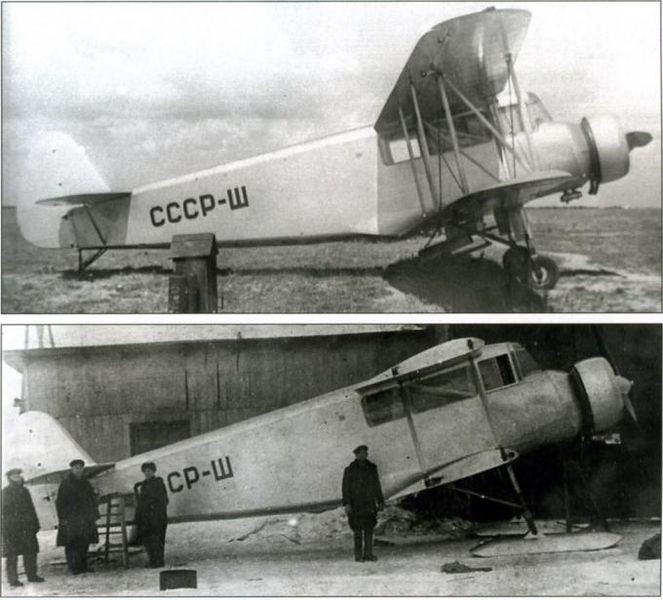
With full load the speed of the SJ-1 exceeded 180 km / h, while the landing speed was only 60 km / h. The model could take off and land on small runways as its run did not exceed 200 meters. With an auxiliary fuel tank the flight range could be extended to 1000 km.
For about a year the position towards the SJ-1 did not change. Only 21 of November of 1939 the President of the Defense Committee VM Molotov received a letter (registered with 04628 no.) Of the NKO substitute AD Loktionov and the head of the GUGVF VS Molokov in which he excelled:
“ The SJ-1 aircraft has been designed, built and tested in the Aeroflot system.
This aircraft is a biplane of simple construction, made of wood and with a 330 hp MG-31 engine.
The SJ-1 is capable of lifting a ton of payload. The results obtained during the state tests show a positive assessment of the aircraft in the different directions of its use.
Maximum speed: 210 km / h
Landing speed: 62 km / h
Take-off run: 150-200 m
Landing stroke: 135-180 m
Practical ceiling: 3000 m
Range with normal fuel: 600 km
These results ensure a wide use in the following variants:
Liaison plane on short lines for 6 passengers;
Ambulance plane – 2 injured on stretchers, two sitting, a doctor and a nurse;
Aircraft specialized in agricultural tasks (fight against harmful species, soil enrichment, fire fighting);
Aerial photography plane;
Thanks to its high load capacity and ability to take off and land in unprepared conditions, the SJ-1 can be used as:
Plane for supplying fuel to aviation and mechanized units.
Technical support plane (transfer of engines, wheels, propellers, etc.
Chemical warfare plane.
The series production of the SJ-1 does not require complex or specialized equipment and can be organized in any aeronautical factory that works with wood or mixed constructions, allowing the S-1, AP and SP models to be taken out of production.
The MG-31 engine installed in the SJ-1 has been extensively tested in the Putilov Stal-2 and according to the special government decision No. 203ss of June 16, 1939 its series production is guaranteed at Factory No. 16.
Taking into account the great need and the wide possibilities of use of the SJ-1 in both the VVS and Aeroflot, the NKO and the GUGVF request to include the SJ-1 in the construction plan for 1940 in one of the factories. “
Unfortunately, this letter was of no consequence. No one specifically can be blamed for this decision. Among the causes we could place that the MG-31 engine was not available, the aeronautical industry management was no longer interested in the biplane scheme and the SJ-1’s performance, despite being good, no longer corresponded to the requirements. of the moment.
In ambulance configuration the SJ-1 was used during the Winter War with Finland in 1940.
Ten years later and using this same scheme, the Antonov An-2 would see the light, one of the most successful biplanes in the history of aviation, with an operating record of almost 70 years. The design of the An-2 prototype drew on the experience accumulated with Bedunkovich’s design.
Bedunkovich SJ-1 (LIG-10)
Powerplant: 330-hp MG-31F
Wingspan: 12.80 m
Wing area: 41.10 m²
Length: 10.70 m
Height: 3.70 m
Empty weight: 1215 kg
Maximum takeoff weight: 2150 kg
Fuel + oil weight: 175 kg
Maximum load capacity: 935 kg
Wing loading: 51.5 kg / m²
Power load: 7.17kg / hp
Delivery weight: 43.5%
Maximum speed: 182 km / h
Landing speed 65 km / h
Practical range: km 350
Practical ceiling: 3,800 m
Take-off run: 210 m
Landing run: 180 m