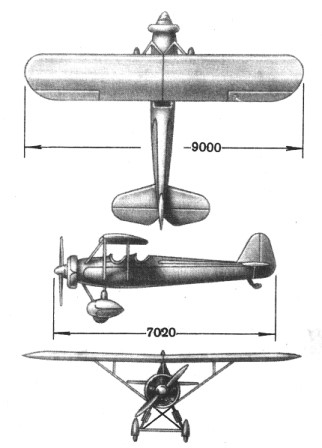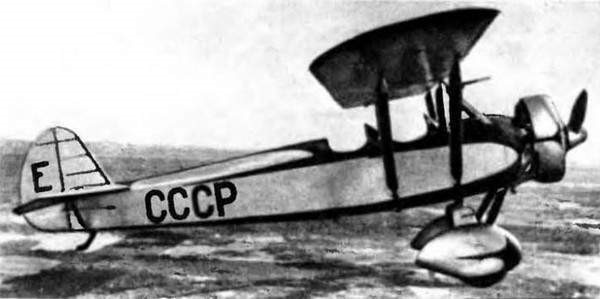
Among the light aircraft created in the early years of the Second Five Year Plan of the USSR stands a small airplane built by a group of engineers from the Fleet Civil Aviation of Leningrad. The Bedunkovich LK-4 (Leningrad Combined – 4) / NIAI-4 (Russian: Бедункович ЛК-4 (НИАИ-4)) training aircraft designed and built in Leningrad in 1934 at the GVF Air Science-Research Institute in Leningrad (later Academy of Civil Aviation).
The aircraft could, depending on its wing configuration, be used for the different stages of pilot training, lowering production and operating costs.
The designer was the 30-year-old engineer Anatoli Georgevich Bedunkovich and, by keeping the same fuselage and exchanging the wing configuration, the LK-4 could be converted into four aircraft with different performance and behaviour. This made it an ideal model for the preparation of pilots, since with a single aircraft the entire course program could be covered, thus saving not only the number of aircraft, but also the costs related to maintenance.
The LK-4 was designed as a tandem two-seater with basically wood construction with fabric covering in the rear region of the fuselage, wings and tail.
The wings were conceived in the form of easily removable individual fixed rope consoles, with a double wooden stringer structure. The upper wing was supported by a cabin-like structure located in the forward part of the fuselage, in front of the cockpit and featured two rigid struts located parallel to each side. The upper plane featured louvered ailerons. Removable plywood flaps designed to reduce landing speed were included in the basic version. A little later on the lower planes, adjustable louver flaps were installed.
The tail unit was of the conventional monoplane type with the horizontal stabilizers braced by struts.
The LK-4 was powered by a 100 hp M-11 radial engine fitted with a Townend ring and driving a two-bladed propeller.
The landing gear was of a fixed type with rubber shock absorbers. The main landers were linked by a bar and featured single wheels with aerodynamic drop-shaped fairings. A fixed skid was located in the tail.
The crew members were in tandem, with the student in the front seat. The cabin equipment was similar to that of the U-21 training aircraft.
LK-4 / LK-4-1
The main or basic version was known simply as LK-4, although in many sources it is named LK-4-1. This sesquiplane device was extremely easy to pilot and was designed for basic training. The upper wing featured large offset and the addition of flaps. This wing was located in a sunshade composition on a cabin-type structure and was braced to the fuselage structure by a pair of parallel rigid struts. The lower wing had a cantilever configuration.
The LK-4-1 was characterized by its great stability in the air and did not go into a spin or stall even in the face of the grossest errors of the students. The empty weight reached 565 kg, while the take-off weight was 790 kg.
Version LK-4-2
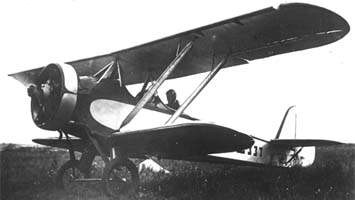
This version was also conceived for basic training, but its piloting was slightly more demanding than that of the LK-4-1 model. The model maintained the sesquiplan configuration but the upper plane lacked offset and did not present the flaps. To achieve this, the upper plane was moved backwards and the lower plane was fixed in an advanced position.
This model was characterized by the ease in the exit of the bit and was able to carry out almost all the high school piloting figures, except the Inmelman due to the lack of motor power
Version LK-4-3
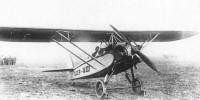
This third version was configured in the form of a high-wing monoplane with a sunshade braced by uprights. The lower wing was removed.
This model was much more demanding in piloting and only those students who had passed the basic preparation stages qualified for its flight. Cruising speed was also higher as a result of decreased aerodynamic drag.
Version LK-4-4
The fourth version was designed for advanced training and featured a monoplane configuration with a low-set wing. In this configuration, the aircraft, both visually and due to its behaviour, was close to the new models of monoplane fighters. This version was quite demanding in the flight technique and for this reason it was only intended for the final stage of the preparation program.
All the transformations were designed to be carried out by the technical personnel of operational aerodromes.
The LK-4 was a collaboration between the LARM (Leningradskie Avioremontnie Masterskie or Leningrad Aviation Repair Shops) and the NIAI. The model was built and successfully tested in 1934 at the NII GVF facilities. During the tests in which 40,000 km were covered, a maximum speed between 150 and 180 km / h was obtained depending on the configuration and a ceiling between 3300 and 4500 meters. These results led the GVF to request serial production of the model.
The LK-4 in a parasol wing monoplane version successfully participated in two competitive flights for light aircraft. Between 1934 and 1936 the aircraft was widely used in the GVF system but the long-awaited series production never materialized.
LK-4-1 – Basic Training Version
Powerplant: 100 hp М-11
Upper plane span: 9.0 m
Lower plane span: 5.7 m
Length: 7.0 m
Wing area: 20.0 m²
Empty weight: 565 kg
Maximum takeoff weight: 790 kg
Fuel + oil weight: 45 kg
Maximum load capacity: 225 kg
Wing loading: 39.5 kg / m²
Power load: 7.9 kg / hp
Weight delivery: 28.45%
Maximum speed: 157 km / h
Landing speed 60 km / h
Ascent time to 1000 m: 6 min
Ascent time to 2000 m: 15.1 min
Ascent time to 3000 m: 30 min
Practical ceiling: 3300 m
Endurance: 2 h
Range: 250 km
Spin time: 21s
Take-off run: 70 m
Landing run: 100 m
Accommodation: 2
LK-4-2 – Sesquiplan version
Powerplant: 100 hp М-11
Upper plane span: 9.0 m
Lower plane span: 5.7 m
Length: 7.0 m
Wing area: 20.0 m²
Empty weight: 558 kg
Maximum takeoff weight: 783 kg
Fuel + oil weight: 45 kg
Maximum load capacity: 225 kg
Wing loading: 39.2 kg / m²
Power load: 7.83 kg / hp
Weight delivery: 28.72%
Maximum speed: 168 km / h
Landing speed 70 km / h
Ascent time to 1000 m: 6 min
Ascent time to 2000 m: 15.3 min
Ascent time to 3000 m: 30 min
Practical ceiling: 3300 m
Endurance: 2 h
Range: 280 km
Spin time: 20s
Take-off run: 80 m
Landing run: 150 m
Accommodation: 2
LK-4-3 – High wing version
Powerplant: 100 hp М-11
Wingspan: 9 m
Wing area: 13 m²
Length: 7 m
Empty weight: 517 kg
Maximum takeoff weight: 742 kg
Fuel + oil weight: 45 kg
Maximum load capacity: 225 kg
Wing loading: 57 kg / m²
Power load: 7.42 kg / hp
Delivery weight:% 30.3
Maximum speed: 177 km / h
Landing speed 80 km / h
Ascent time to 1000 m: 5 min
Ascent time to 2000 m: 13 min
Ascent time to 3000 m: 21.5 min
Practical ceiling: 4500 m
Endurance: 2 h
Range: 300 km
Spin time: 18s
Take-off run: 90 m
Landing run: 170 m
Accommodation: 2
LK-4-4 – Low wing version
Powerplant: 100 hp М-11
Wingspan: 9.7 m
Wing area: 13 m
Length: 7 m
Empty weight: 510 kg
Maximum takeoff weight: 735 kg
Fuel + oil weight 45 kg
Maximum load capacity: 225 kg
Wing loading: 56.6 kg / m²
Power load: 7.35 kg / hp
Delivery weight: 30.6%
Maximum speed: 180 km / h
Landing speed: 90 km / h
Ascent time to: 1000 m: 4.6 min
Ascent time to: 2000 m: 10 min
Ascent time to: 3000 m: 20.2 min
Practical ceiling: 3,815 m
Endurance: 2 h
Range: 300 km
Spin time: 24s
Take-off run: 130 m
Landing run: 220 m
Accommodation: 2