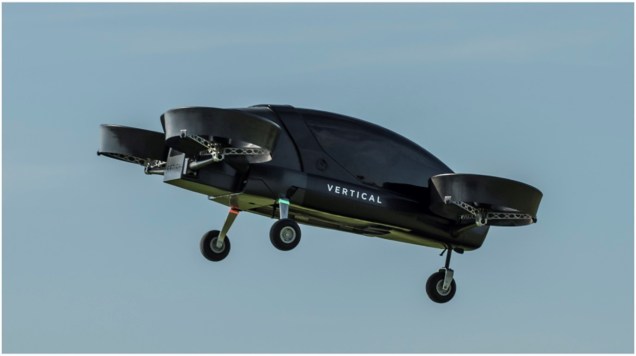
On 25 August 2017, Vertical Aerospace flew the VA-X1 demonstrator indoors for its first flight. The VA-X1 demonstrator used 4 shrouded 3-bladed propellers for lift and propulsion.
On 25 August 2017, Vertical Aerospace flew the VA-X1 demonstrator indoors for its first flight. The VA-X1 demonstrator used 4 shrouded 3-bladed propellers for lift and propulsion.
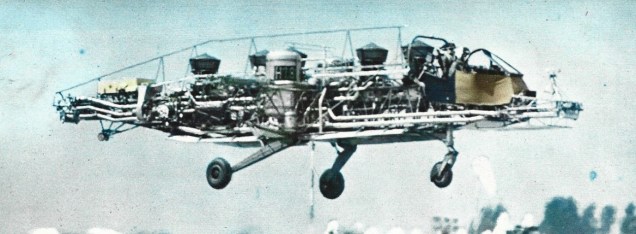
The German VFW SG 1262 Schwebegestell (hover rig) was designed and built in 1965 by Vereinigte Flugtechnische Werke (VFW) as an experimental aircraft to assist with the development of several vertical takeoff and landing (VTOL) military aircraft types that included the VFW VAK 191B, the EWR VJ 101 and the Dornier Do 31 transport. The 1262 designation relates to the initial numbering of the VAK 191B project by Focke-Wulf.
As part of the development of the VFW-Fokker VAK 191B vertical take-off aircraft, it was necessary to configure and test the monitoring of its flight control system. In order to minimise costs and risks during the development of the 191B the SG 1262 rig was designed and built in 1966 to simulate essential functions. Of high importance was the necessity to test the fly-by-wire flight control system, a redundant flight controller and a self-diagnosis system. A total of approximately 650 hours of simulation time, 2,000 hours of test runs on system test benches and 6,900 hours of wind tunnel tests were documented during the design phase of the project.
The aircraft was based on a trapezoidal frame without any skin panels. Deviating from the vectored thrust engine concept of the VAK 191B, five Rolls-Royce RB.108 turbojet lift engines with 9 kN (2,000 lbf) thrust each were mounted vertically. In addition to extensive sensor equipment, the rig used an auxiliary gas turbine for autonomous electrical power supply supply, it was also fitted with a Martin-Baker ejection seat.
The aircraft was based on a trapezoidal frame without any skin panels. Deviating from the vectored thrust engine concept of the VAK 191B, five Rolls-Royce RB.108 turbojet lift engines with 9 kN (2,000 lbf) thrust each were mounted vertically. In addition to extensive sensor equipment, the rig used an auxiliary gas turbine for autonomous electrical power supply supply, it was also fitted with a Martin-Baker ejection seat.
The control commands were transmitted via an electrical control (fly-by-wire) system with mechanical feedback. The flight control system had triple redundancy and double electro-hydraulic servo units with integrated self-monitoring. The control commands for the three axes were accomplished with compressed air nozzles that were actuated by a 280 bar (4,000 psi) high-pressure hydraulic system, movement of the main engines for control purposes was deliberately omitted. A direct mechanical back up of the compressed air control system was provided for emergencies.
40 tethered flights were initially carried out using a fixed telescopic apparatus before the aircraft flew in free flight for the first time on 5 August 1966. 150 free flights were made during the 18-month test program, including a demonstration flight at the 1968 Hanover Air Show at Hanover-Langenhagen.
Despite the discontinuation of all German vertical take-off programs the findings from experiments with the SG 1262 and experience gained from the VAK 191B project were used by German engineers during the development of the Multi Role Combat Aircraft (MRCA) project which became the Panavia Tornado.
The SG 1262 is preserved and on display at the Bundeswehr Museum of German Defense Technology in Koblenz.
Powerplant: 5 × Rolls-Royce RB.108 turbojet, 9 kN (2,000 lbf) thrust each
Gross weight: 3,900 kg (8,598 lb)
Fuel capacity: 800 kg
Maximum speed: 75 km/h (47 mph, 40 kn)
Endurance: 12 minutes
Service ceiling: 200 m (660 ft)
Thrust/weight: 1.15
Crew: 1

The VAK concept of NATO and the German Armed Forces required an aircraft that was able to take off from unprepared airfields without runways. Its mission was close air support. In addition it had to be able to fly long distances in extreme-low-altitude in order to prevent attacks of antiaircraft weapons and radar detection. Because of this the VAK was designed with short wings and a minor extension so it would provide its pilots a tolerable flight and bear aerodynamically difficult extreme low altitude flights.
The first prototype flew on September 10, 1971, powered by one 10,150-lb (4604-kg) thrust Rolls-Royce/MTU RB.193 vectored-thrust turbojet and two 5577-lb (2530-kg) thrust RB.162 lift turbojets. It had small, vertically mounted jets in the front and rear of the fuselage for direct lift, plus a third engine of the vectored ¬thrust type for forward propulsion and transitions between horizontal and vertical flight. It uses “puffer jets” at the nose, tail and wingtips to stabilise it during low speed and hovering man¬oeuvres. In terms of design, it is intended for experimental work only.
The first transition – the transfer of vertical flight in horizontal and vice versa as well as turning off and on the lift-engines – was achieved on October 26, 1972 in Manching, Bavaria, at a speed of 400 km/h.
All three VAK 191B experimental aircraft completed a total of 91 flights that lasted all together 12 hours.
Despite successful flight trials it was not ordered into production as the Harriers of RAF Germany were already fulfilling the need for which the VAK-191B had been conceived.
VAK 191B
Engines: 1 x Rolls-Royce/MTU RB 193-12, 45.2kN + 2 x Rolls-Royce RB 162-81 F 08, 26.5kN
Max take-off weight: 8507 kg / 18755 lb
Empty weight: 5562 kg / 12262 lb
Wingspan: 6.16 m / 20 ft 3 in
Length: 14.72 m / 48 ft 4 in
Height: 4.30 m / 14 ft 1 in
Wing area: 12.5 sq.m / 134.55 sq ft
Max. speed: 1100 km/h / 684 mph
Cruise speed: 740 km/h / 460 mph
Range: 400 km / 249 miles
Payload: 2945kg
Crew: 1
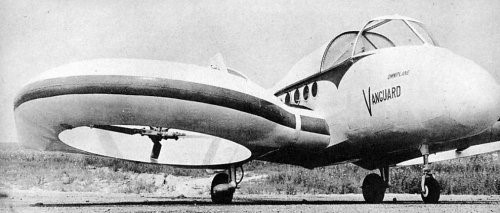
The Vanguard Omniplane was an American approach to vertical operation and high cruise speed. The ducts contained vertical thrust propellers that could be closed by venetian blind shutters to form small wings in forward flight. In forward flight, covers above the rotors and louvers below sealed the wing for aerodynamic lift.
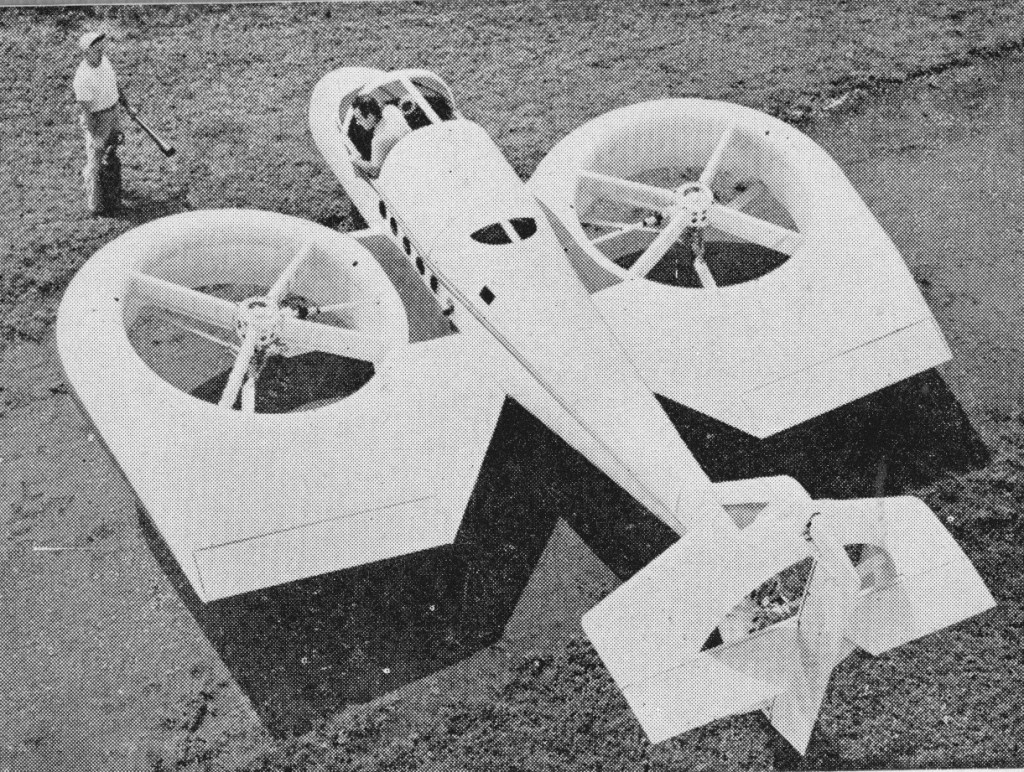
The design, apparently not registered, used a 25-ft long Ercoupe light plane fuselage and weighed 2,600 lb. The round wings each housed a 6 ft diameter three-bladed propeller that was mechanically driven for vertical flight by a 265 hp Lycoming O-540-A1A six cylinder piston engine.

Thrust was produced by a 5′ shrouded prop in the tail, elevator and rudder behind the rear fan-controlled pitch and yaw, while differential propeller blade pitch affected roll in hover.
Ground tests, starting in Aug 1959 and including tethered hover trials, were followed by NASA full-scale wind tunnel testing.

Modifications in 1961, including a 860hp Lycoming YT53-L-1 turboshaft, improved control system, and 5′ nose extension to house a third lifting prop, led to the redesignation 2D. The nose prop improved control in pitch, as well as in yaw through the use of movable exit vanes. 2D completed tethered hover tests, but was damaged by a mechanical failure and discontinued in early 1962.
Engine: Lycoming O-540-A1A, 265hp
Wingspan: 22’0″
Length: 25’6″
Useful load: 500 lb
Max speed: 190 mph
Range: 150 mi
Seats: 2
Israeli company, Urban Aeronautics, has been working on a next-generation follow-on to the Piasecki AirGeep, the “X-Hawk”. The company has developed a prototype and got it off the ground.

The Transcendental Aircraft Corporation of Glen Riddle, Pennsylvania, was the first company to claim flying a successful Tilt Rotor aircraft. The Model 1-G was a small, high-wing experimental aircraft with a fuselage-mounted engine and fixed tricycle landing gear designed and built by Mario A. Guerierri. The single pilot sat forward of the wing in a semi-enclosed fuselage. The clear plastic nose gave the pilot helicopter-like visibility. A single Lycoming 0-290-A six cylinder engine produced 160 horsepower. The fuselage measured 7.9m long, and the aluminum wing measured 6.4m. The ailerons were fabric covered. Empty weight was 655kg and take-off weight was 790kg. The projected maximum speed in helicopter mode was 190km/h, and 260km/h in airplane mode.
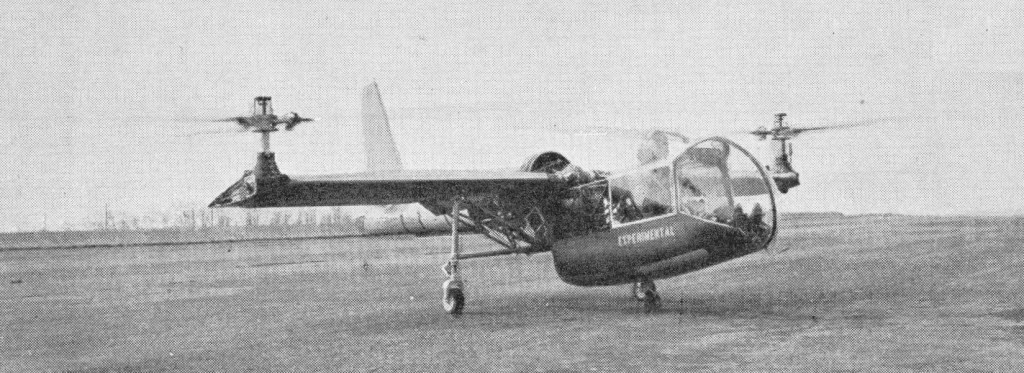
A 5.2-meter diameter, three-bladed, fully articulated rotor was mounted at each wing tip. The rotor shafts tilted from pointing vertically for hover down to 6 degrees up from horizontal for forward flight. Electric motors controlled the tilt of the rotor shafts.
Interconnecting shafts ensured that both rotors maintained the same tilt angle. Each rotor was driven through a two-speed gearbox. This allowed the pilot to lower the rotor rotation speed for more efficient cruise in forward flight.
Although the Model 1-G was a private development, the Wright Air Development Center at Wright-Patterson AFB issued contracts to study many of the Tilt Rotor’s unique peculiarities.
The first was awarded in 1952 to investigate the dynamics and structural characteristics of the rotor system. The Air Force awarded a second contract in 1953 to investigate mechanical instability problems associated with tilting the rotors.
The first hover flight was either on June 15 or July 6, 1954 (references vary). The first forward flight in hover mode occurred on December 13, 1954, and the first forward flight with rotors tilted occurred only four days later. By April 1955, conversions with the rotors tilted up to 35 degrees from vertical were completed. Eventually, the Model 1-G completed numerous transitions up to 70 degrees of tilt with the wings sustaining over 90 percent of the weight.
The engine reduction was been replaced by a two-gear reduction box, at the exit of which a gearing system has been attached which enables the rotors to be put into auto-rotation. At the engine’s maximum output of 3000 r.p.m. the rotors rotate at 633 r.p.m. as airscrews, and at 240 r.p.m. as helicopter rotors.
Three concentric tubes start from the swivelling device, the first of which moves the rotor, the second controls cyclic variation and the third variation of collective pitch. The time needed to move from the helicopter to the aircraft position is roughly three minutes. In this change-over, the rotors swivel through an angle of 82 degrees.
The Model 1-G was destroyed during a test flight on July 20, 1955. After performing a virtually complete conversion, the friction lock on the collective pitch controller slipped, throwing the aircraft into an abrupt, steep dive. The pilot initiated a recovery, but there was not enough altitude to complete the pull-up before contacting the Delaware River. The aircraft flipped on its back, resulting in irreparable damage.
During the Model 1-G’s brief career, it made over 100 flights, achieved 90% conversion (about 70 degrees forward rotor tilt), and flew 60 hours. It demonstrated excellent controllability without vibration, and reached an altitude of 1060m and an airspeed of 185km/h in helicopter mode.
A second aircraft, called the Model 2, N546A, was to fly in late 1956. Transcendental received an Air Force contract in March 1956 and completed the Model 2 in October. Compared to the Model 1-G, it was stronger and more aerodynamic, but had the same basic configuration. The enclosed cockpit had side-by-side seating. Power was by one 250 horsepower Lycoming O-435-23 six cylinder engine. The wing was a 0.3m longer, but the fuselage was 1.2m shorter. Empty and gross weights were 708kg and 1015kg. Development ended when funding from Wright Air Development Center stopped. It could not be determined if the aircraft ever flew, and eventually it was dismantled.
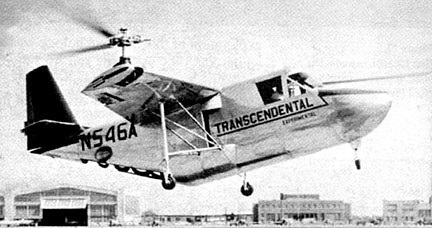
The Model 3 of 1957 was also a convertible, and an extrapolation of Model 1G, it is intended to be powered by two gas turbines, and to accommodate a crew of two and also six passengers or alternatively four stretchers. It is expected that this model will have a cruising speed comparable to that of a traditional aircraft and also the special take-off and landing properties of a helicopter.
Model 1G
Engine: 1 x Lycoming G0-290-A, 160hp
Rotor diameter: 5.18m / 17 ft
Width (rotor tip to rotor tip): 11.58m
Rotors: 2 x 3-blade on outriggers
Max rotor speed: 633rpm
Wing span: 21 ft
Length: 7.93m / 26′ 0″
Height: 2.13m
Weight fully loaded: 794kg / 1,640 lb
Empty weight: 658kg
Maximum speed (as helicopter): 196km/h
Maximum speed (as aircraft): 256km/h / 150 mph
Absolute ceiling (as aircraft): 1525m
Endurance: 90 minutes
Seats: 1
Model 2
Engine: Lycoming O-435-23, 250hp
Wingspan: 22’9″
Length: 22’1″
Rotor dia: 18’0″
Useful load: 670 lb
Seats: 2
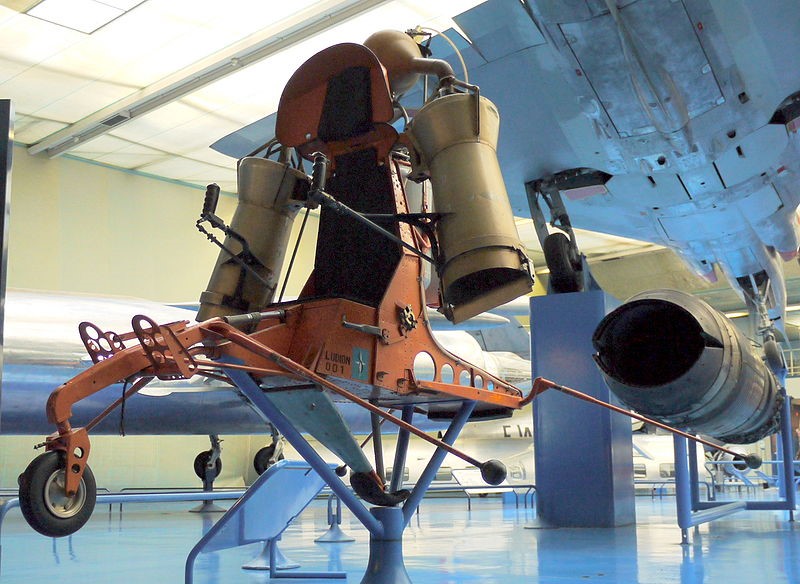
The Sud Aviation/Aérospatiale SA-610 Ludion (Ludion – Cadet) was a tiny, unorthodox VTOL aircraft demonstrated at the 1967 Paris Air Show. It consisted of little more than a chair, behind which were mounted two downward-pointing augmented rocket engines with control provided by thrust vectoring. The Ludion was intended to carry its pilot and 30 kg (66 lb) of equipment up to 700 m (2,300 ft) at an altitude of up to 200 m (600 ft).
The unusual powerplant consisted of a monofuel de-composition chamber fed with pressurised isopropyl nitrate (AVPIN), ignited by a catalyst. The high pressure gasses produced in the de-composition chamber were fed to two augmentor tubes, built by Bertin, either side of the pilots seat, angled slightly outwards. As the gasses entered the augmentor tubes through rocket nozzles, thrust was augmented by inducing airflow through the ducts which acted as aero-thermo-dynamic ducts, due to the heat and kinetic energy added to the flow through the ducts, and the carefully shaped exhaust nozzles.
SA-610 Ludion
Powerplant: 1 × SEPR S178 isopropyl nitrate (AVPIN) decomposition gas generator with augmentor tubes
Length: 1.95 m (6 ft 5 in)
Width: 1.485 m (4 ft 10 in)
Height: 1.6 m (5 ft 3 in)
Empty weight: 90 kg (198 lb)
Gross weight: 170 kg (375 lb) approx
Capacity: payload 30 kg (66 lb)
Crew: 1
Ceiling: 700 m (2,297 ft)
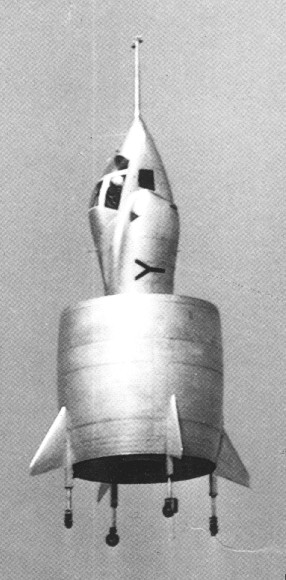
The C.450 Coleoptere was a VTOL research aeroplane, designed by von Zborowski,,that rose vertically on the power of its SNECMA Atar 101 turbojet before translating into forward flight supported by its annular wing.
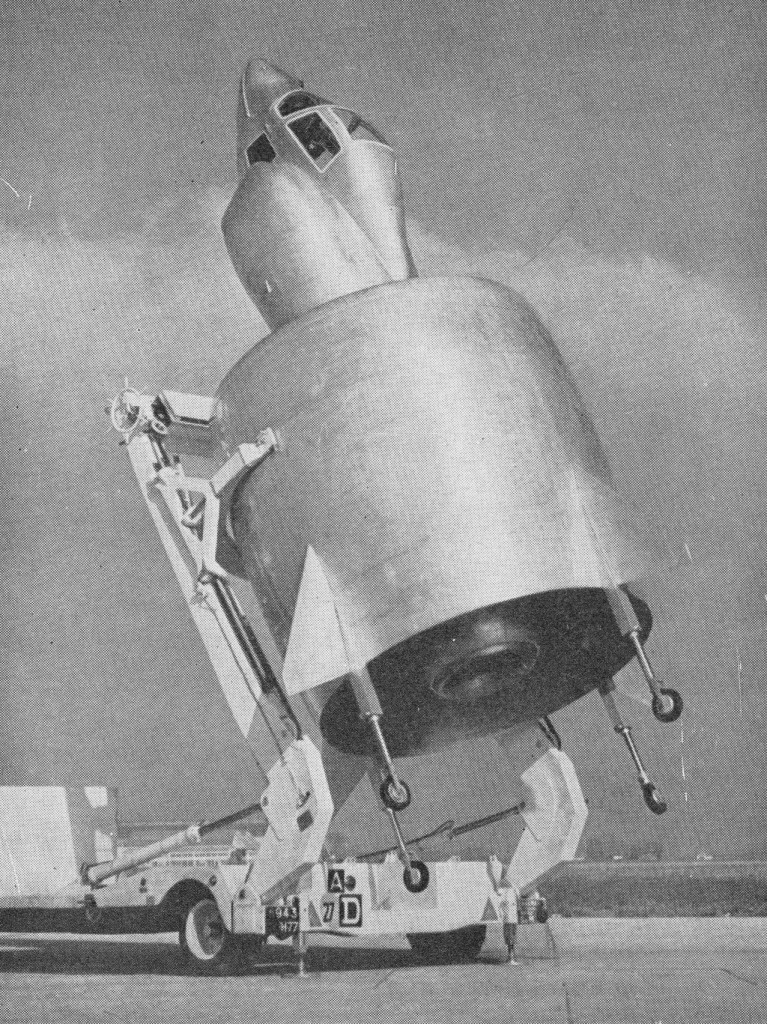
The C.450 Coleoptere was derived from the Atar Volant test vehicle, and combined the concept of tail-sitting vertical take-off and an annular wing. Powered by an 8157-lb (3700-kg) thrust SNECMA Atar 101EX, the Coleoptere first flew in May 1959 and completed a limited test programme before the aeroplane was lost in an accident.
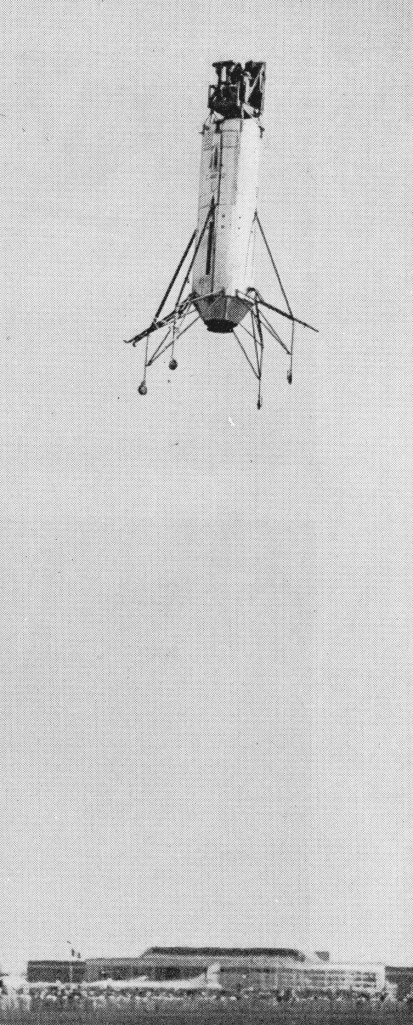
The SNECMA Atar Volant of 1954 looked like a tail sitter but actually was a flat riser.
The Atar-Volant performed at the 1975 Paris Salon de l’Aernautique. It had flown to 1500 ft.
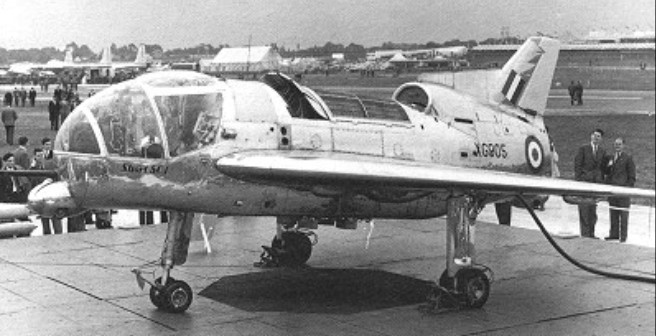
In 1953, the Ministry of Supply issued Specification ER.143 for a research aircraft which could take off vertically by jet lift, then accelerate forward into normal cruising flight.
The SC. 1 was designed to study hover, transition and low-speed flight, and had a fixed landing gear. The Short SC. 1 was powered by four RB.108 lift engines vertically mounted on gimbals in the centre fuselage and one RB.108 cruise engine in the rear for forward flight. Bleeds from the four lift engines powered nose, tail and wing-tip reaction jets for control at low speeds.
The first conventional flight was made on 2 April 1957, first tethered vertical flight was on 26 May 1958, and first free vertical flight was on 25 October 1958. The first transition was on 6 April 1960.
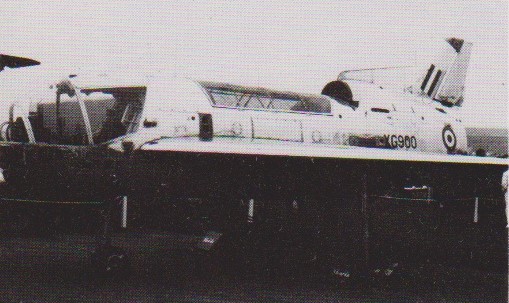
The SC.1 appeared at the Farnborough air show in 1960 and Paris air show in 1961 (for the latter it flew the English Channel both ways).
After first flying May 1958, the second Short SC.1 VTOL research aircraft (XG905) crashed at Sydenham airfield, Belfast, on October 2nd, 1960, the pilot, John R. Green, being killed. Equipped with a new auto stabiliser system with which it had begun tests on August 2nd, the SC.1 was hovering at an altitude of 50 ft (15.2 m) when control was lost, the aircraft turning over on hitting the ground. It was rebuilt and the two aircraft continued to fly.

James M. Patton, Jr was a research pilot at NASA Langley, and a guest of the Royal Aircraft Establishment at Bedford in August & September, 1971. He conducted 10 flights in SC-1 XG905 to obtain data pertinent to NASA VTOL research.
One was on display at the Ulster Folk and Transport Museum.
Engines: 4 x 965kg Rolls-Royce RB.108 lift engines and 1 x RB.108 cruise engine
Max take-off weight: 3650 kg / 8047 lb
Wingspan: 7.16 m / 24 ft 6 in
Length: 9.10 m / 30 ft 10 in
Max. speed: 396 km/h / 246 mph
Range: 240 km / 149 miles
Crew: 1

 All Aero