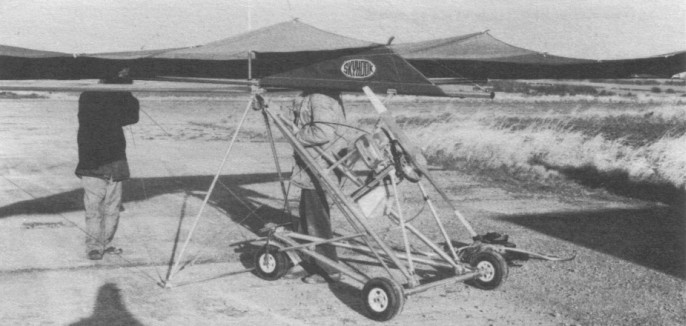
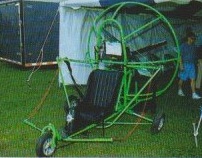
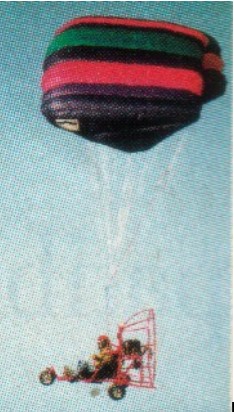
The TRI Mk.I / Sabre C is a single seat single engined flex wing aircraft with weight shift control. Rogallo wing with keel pocket. Pilot suspended below wing in trike unit, using bar to control pitch and yaw/roll by altering relative positions of trike unit and wing. Wing braced from above by kingpost and cables, from below by cables; floating cross tube construction with 55% double surface enclosing cross tube; preformed ribs. Undercarriage has three wheels in tricycle formation; no suspension on any wheels. Push right go left nosewheel steering independent from yaw control. No brakes. Aluminium tube trike unit, without pod. Engine mounted below wing driving pusher propeller. Trike unit and wing use aluminium tube to British HT30TF specification, bright polished and sleeved at stress points. Wing leading edge stiffened with Mylar sheet. Wing material is Bainbridge Dacron. Wheels run on taper roller bearings.
The TR1 Mk.I represented the first venture of Len Gabriels’ Skyhook Sailwings company into triking after ten years of hang glider and powered hang glider manufacture but went out of production in mid 1982. The design of the trike frame is common to all the company’s trikes. A double pole design, this trike unit used a twist grip throttle in front of the B bar, controlling a 210cc Solo engine which, though reliable, gave a fairly low climb rate, especially with a pilot of above average weight. Typically, it was fitted with a Sabre C wing, largest of the company’s solo wings. This wing is often used with the Mk.II version of the TR1. Like all Skyhook’s wings, the Sabre C features Len Gabriels’ own patented folding control frame, which has no loose or removable parts to get lost during transportation.
The trike frame is stressed for two people and the seat frame is not a structural component, allowing it to be unbolted and replaced by a dual seat. With the original 12 hp engine and the solo only Sabre C wing, this potential was academic, but by ordering the TR l MkI with a Cutlass CD, which can be flown solo or dual, a customer could buy a single seat machine and re engine it later to turn it into a two seater. The company itself later produced a suitable two seater power pack, which allowed various permutations of wing, trike unit and seating arrangement to be produced entirely from in house components.
The TR1 Mk.I was available without wing, for customers who wished to supply their own, a facility which is still available with current models.
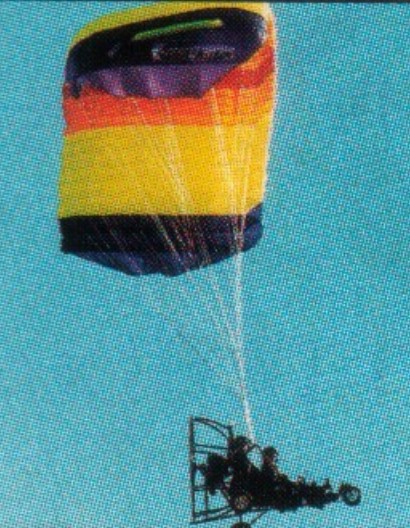
The TRI Mk.II/Sabre C is a single seat single engined flex wing aircraft with weight shift control. Rogallo wing with keel pocket. Pilot suspended below wing in trike unit, using bar to control pitch and yaw/roll by altering relative positions of trike unit and wing. Wing braced from above by kingpost and cables, from below by cables; floating cross tube construction with 55% double surface enclosing cross tube; preformed ribs. Undercarriage has three wheels in tricycle formation; no suspension on any wheels. Push right go left nosewheel steering independent from yaw control. No ground steering. No brakes. Aluminium tube trike unit, with optional pod. Engine mounted below wing driving pusher propeller. Trike unit and wing use aluminium tube to British HT3OTF specification, bright polished and sleeved at stress points. Wing leading edge stiffened with Mylar sheet. Wing material is Bainbridge Dacron. Wheels run on taper-¬roller bearings.
The TR1 Mk.II is identical to the Mk.I in all except the engine. Realising that customers were demanding more power than the Solo engine could produce, designer Len Gabriels fitted the single cylinder Hunting engine in 1982 and promptly transformed the performance of the aircraft.
The Sabre C wing remains the typical fitment, and in this guise the aircraft competed successfully, with Len as pilot, in the 1982 London Paris microlight competition. Extra instruments, extra fuel capacity, and minor switchgear modifications were made, but otherwise the only change to the standard specification was the addition of the optional pod.
For 1983 the aircraft has been further improved with the option of fabric fairings for the bottom tubes of the trike unit.
TRI Mk.I Sabre C
Engine: Solo 210 cc, 12 hp at 5500 rpm
Propeller diameter 50 inch, 1.28m
V belt reduction, ratio 2.5/1
Max static thrust > 100 lb, 45 kg
Power per unit area 0.06 hp/sq.ft, 0.7 hp/sq.m
Fuel capacity 2.2 US gal, 1.8 Imp gal, 8.2 litre
Length overall 12.7 ft, 3.87 m
Total wing area 195 sq.ft, 18.1 sq.m
Nosewheel diameter overall 12 inch, 305 mm. Main wheels diameter overall 12 inch, 305 mm. Empty weight 155 lb, 70 kg
Load factors, 3 design; >+4 ultimate
TRI Mk.II/Sabre C
Engine: Hunting HS260A 260 cc, 25 hp at 7000 rpm
Propeller diameter and pitch 50 x 30 inch, 1.28 x 0.76 m
V belt reduction, ratio 2.7/1
Max static thrust 156 lb, 71 kg
Power per unit area 0.13hp/sq.ft, 1.4 hp/sq.m
Fuel capacity 2.2 US gal, 1.8 Imp gal, 8.2 litre
Length overall 12.7 ft, 3.87 m
Total wing area 195 sq.ft, 18.1 sq.m
Nosewheel diameter overall 12 inch, 305 mm
Main wheels diameter overall 12 inch, 305 mm
Empty weight 215 lb, 98kg
Max take off weight 455 lb, 206 kg
Payload 224 lb, 102 kg
Max wing loading 2.33 lb/sq.ft, 11.4kg/sq.m
Max power loading 18.2 lb/hp, 8.1 kg/hp
Load factors, 3 design; >+4 ultimate
Max level speed 45 mph, 72 kph
Economic cruising speed 35 mph, 56 kph
Stalling speed 26 mph, 42 kph
Max climb rate at sea level 300 ft/min, 1.5m/s
Min sink rate 270ft/min at 28mph, 1.4 m/s at 45 kph
Best glide ratio with power off 9/1 at 28 mph, 45 kph
Take off distance 105 ft, 30 m

 All Aero