1998:
Boregass 4
D-56288 Hundheim
Germany
Trike builder
1998:
Boregass 4
D-56288 Hundheim
Germany
Trike builder
A two seat trike developed from the Rogallo sailwing.
Quantum 15
XL-R
Flash II
Photon
The 1980 Storm was the first offering of Solar Wings, the new company, based at Marlborough, Wilts. The directors of the company are Mark Southall, Dave Raymond, Cliff Ingram, Roland Lewis-Evans.
1998: Elm Tree Park Manton, Marlbrough, SN8 1PS Wilts, United Kingdom
Since ceasing production of the Scandal (King post and XK) gliders, Solar has concentrated on manufacturing micro-lights.
Single seat single engined flex wing aircraft with weight shift control. Rogallo wing. Pilot suspended below wing in trike unit, using bar to control pitch and yaw/roll by altering relative positions of trike unit and wing. Undercarriage has three wheels in tricycle formation. Nosewheel steer¬ing independent from yaw control. Aluminium tube trike unit, without pod. Engine mounted below wing driving pusher propeller.
The main activity for Soarmaster is trike unit manufacture, its product being simply known as the Trike.
The company is proud of the fact that the trike unit has withstood a static load of 1145 lb (519 kg) applied to the seat, though it has to be said that there are other trike units around which could comfortably exceed this figure. What this translates to in terms of load factors does of course depend on the wing used, which can be any suitable Rogallo.
Various engines are available, ranging from Chrysler units to a 15hp Solo single (with or without a tuned exhaust) and a twin cylinder Lloyd producing 23hp. The Lloyd has the unusual feature of being provided with both manual and electric start, and all three use belt reduction drives and Soarmaster’s own propeller, made from 6061T6 aluminium and featuring replaceable blades. Main wheels diameter overall 20 inch, 51 cm.
Price for the Lloyd engined trike unit in October 1982 was $1595.
Engines:
Lloyd LS400, 23 hp
Solo, 15 hp
Chrysler
Belt reduction
Fuel capacity 1.2 US gal, 1.0 Imp gal, 4.5 litre in main tank
Optional res fuel: 1.2 US gal, 1.0 Imp gal, 4.5 litre
The Soarmaster company’s early power packs for hang gliders paved the way for the trike.
In 1983 the company still made these power packs for prone flyers (the latest version of the unit was the PP 106).
1982: Soarmaster Inc, PO Box 4207, Scottsdale, Arizona 85261, USA.
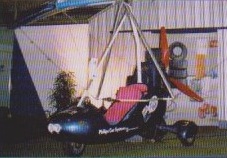
Based on the ASO’s Viper trike, this machine is fully road legal in Germany. After removing the wings an auxiliary engine drives through a fourth wheel at the rear.
Viper 582 Street
Empty weight: 165 kg
Wing span: 10.38 m
Wing area: 10 sq.m
Fuel capacity: 50 lt
Engine: Rotax 582, 64 hp
MAUW: 400 kg
Seats: 2
Max speed: 140 kph
Cruise speed: 110 kph
Minimum speed: 65 kph
Climb rate: 4 m/s
Fuel consumption: 12 lt/hr
Price (1998): 79 000 DM
1998:
Falltorstrasse 20
D-35398 Glessen Lüzelinden
Germany
Trike builder
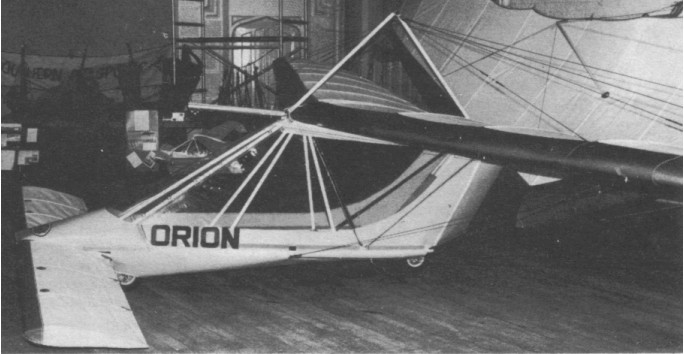
Single seat single engined high wing mono¬plane with two axis control. Wing has swept back leading and trailing edges, and tapering chord; no tail, canard wing. Pitch control by fully flying canard; yaw/roll control by angled ¬pivot tip rudders; control inputs through stick for pitch and yaw/roll. Wing braced from above by kingpost and cables, from below by cables; wing profile Clark Y derived; 100% double surface. Undercarriage has three wheels in tricycle formation; no suspension on nosewheel and suspension (type to be decided) on main wheels. Push right go right nose¬wheel steering independent from yaw control. Brakes on main wheels.
Aluminium tube and fabric fuselage, totally enclosed. Engine mounted below wing driving pusher propeller. Windscreen made from rigid plastic sheet, side windows from Mylar film. Bainbridge Dacron used for flying surfaces.
Designer Len Gabriels has aimed to create a machine which will appeal to hang gliding and sailplane enthusiasts as well as microlighters, and in its initial form the machine is unpowered.
As first shown at the British Hang Gliding Association’s annual general meeting in March 1983, the Orion is a fully enclosed hang glider/sailplane with pitch control by weight shift moving a fully flying canard. Combined roll and yaw control is provided by tip rudders mounted under the ends of the wing and with their pivots angled at 45O to the vertical, so that they provide roll at the same time as yaw. Both may be deployed simul¬taneously, to provide air braking.
This unpowered version of the Orion uses two wheels in tandem without suspension or brakes and is basically intended as a foot¬-launched aircraft. Powered versions, howev¬er, will have a tricycle layout with the weight shift pitch control being replaced by a stick. Pedals will steer the nosewheel but will not be connected to the yaw/roll control. Retention of the weight shift pitch control will be an option.
The wing is based on a Clark Y section, though as it is to some degree a flex wing, it will probably not behave entirely as a Clark Y in the air.
As a hang glider, in April 1983, test flights in unpowered form were about to begin.
Length overall 12.0 ft, 3.66 m
Wing span 42.0 ft, 12.80 m
Chord at root 5.0ft, 1.52m
Chord at tip 3.0ft, 0.91m
Canard span 12.0 ft, 3.66 m
Canard chord 2.0 ft, 0.61 m
Total wing area 176 sq.ft, 16.4 sq.m
Main wing area 152 sq.ft, 14.1 sq.m
Canard area 24sq.ft, 2.2sq.m
Wing aspect ratio 9.5/1
Empty weight 154 lb, 70 kg
A single seat single engined flex wing aircraft with conventional three axis control. Rogallo wing. Undercarriage has three wheels in tricycle formation; no suspension on any wheels. Push right go right nosewheel steer¬ing connected to yaw control. No brakes. Aluminium tube trike unit, without pod. Engine mounted below wing driving pusher propeller.
This experimental machine is an attempt to mate three axis controls to a Rogallo wing. It uses the same power pack as the TR1 MkII trike unit, plus a modified Sabre wing. The trike unit is fixed to the wing structure rather than being sus¬pended from it, and the wing is mounted much lower than the normal hang point of a trike.
No test flights have been carried out on this aircraft by 1982.
Engine: Engine: Solo 210 cc, 12 hp at 5500 rpm
Propeller diameter 50 inch, 1.28m
V belt reduction, ratio 2.5/1
Max static thrust > 100 lb, 45 kg
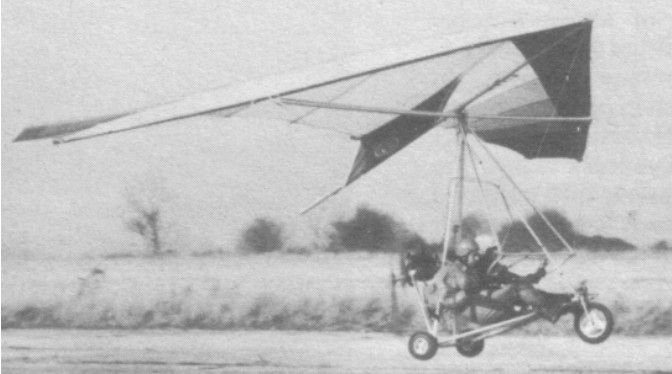
The Skyhook Sailwings TR2 Mk.I/Cutlass CD is a side by side two seat twin engined flex wing aircraft with weight shift control. Rogallo wing with keel pocket. Pilot suspended below wing in trike unit, using bar to control pitch and yaw/roll by altering relative positions of trike unit and wing. Wing braced from above by kingpost and cables, from below by cables, fixed cross tube construction with 30% dou-ble surface not enclosing cross tube; pre¬formed ribs. Undercarriage has three wheels in tricycle formation; no suspension on any wheels. Push right go left nosewheel steering independent from yaw control. Brake on nosewheel. Aluminium tube trike unit, with¬out pod. Engines mounted below wing driving pusher propellers. Trike unit and wing use aluminium tube to British HT30TF specifica¬tion, bright polished and sleeved at stress points. Wing rigged with plastic coated stain¬less steel wires; wing material is Bainbridge Dacron.
At the beginning of 1981, Len Gabriels was seeking an engine powerful enough to turn his TR1 Mk.I trike unit into a two seater. He was not satisfied with the reliability of any of the larger engines then available, so he decided instead to build a power pack using two of the 210cc Solo engines.
Rather than use two engines to drive one large propeller, he doubled up the drive system as well, creating a power pack with two contra rotating propellers driven from concentric shafts, each by its own engine an reduction drive. The safety attractions of such duplication are obvious, as the aircraft can at least maintain height after an engine failure.
The rest of the trike unit needed little alteration beyond the inclusion of a dual seat and a nosewheel brake. Allied to the Cutlass CD wing, the TR2 proved itself to be a viable training machine, but was dropped from production at the end of 1982 in favour of the TR2 Mk.II.
The Skyhook Sailwings TR2 Mk.I (Single Seat Special)/Cutlass CD is a single seat twin engined flex wing aircraft with weight shift control. Rogallo wing with keel pocket. Pilot suspended below wing in trike unit, using bar to control pitch and yaw/roll by altering relative positions of trike unit and wing. Wing braced from above by kingpost and cables, from below by cables; fixed cross tube construction with 30% double surface not enclosing cross tube; pre¬formed ribs. Undercarriage has three wheels in tricycle formation; no suspension on any wheels. Push right go left nosewheel steering independent from yaw control. Optional brake on nosewheel. Aluminium tube trike unit, with optional pod. Engines mounted below wing driving pusher propellers. Trike unit and wing use aluminium tube to British HT30TF specification, bright polished and sleeved at stress points. Wing rigged with plastic coated stainless steel wires; wing mate¬rial is Bainbridge Dacron.
Although the TR2 Mk I was intended as a two seater trike unit, it was also offered in single seat form a simple conversion, as with the TRI Mk.l. Like the TR2 Mk 1 from which it is derived, this variant is now discontinued.
The Skyhook Sailwings TR2 Mk.II/Cutlass CD is a side by side two seat single engined flex wing aircraft with weight shift control. Rogallo wing with keel pocket. Pilot suspended below wing in trike unit, using bar to control pitch and yaw/roll by altering relative positions of trike unit and wing. Wing braced from above by kingpost and cables, from below by cables; fixed cross tube construction with 30% dou-ble surface not enclosing cross tube; pre¬formed ribs. Undercarriage has three wheels in tricycle formation; no suspension on any wheels. Push right go left nosewheel steering independent from yaw control. Brake on nosewheel. Aluminium tube trike unit without pod. Engine mounted below wing driving pusher propeller. Trike unit and wing use aluminium tube to British HT30TF specifica¬tion, bright polished and sleeved at stress points. Wing rigged with plastic coated stain¬less steel wires; wing material is Bainbridge Dacron.
The TR2 Mk.II was the 1982 two seat trike unit from Skyhook Sailwings and is identical in all respects to the Mk.I except that the twin engined power pack is replaced by a Hunting HS525A twin-¬cylinder engine, with conventional reduction drive and propeller.
TR2 Mk.I/Cutlass CD
Engines: 2 x Solo 210 cc, 12 hp each at 5500 rpm
Two propellers diameter and pitch 50 x 30 inch, 1.28 x 0.76 m
V belt reduc¬tion, ratio 2.7/1
Max static thrust 200 lb, 91 kg
Power per unit area 0.12 hp/sq.ft, 1.3hp/sq.m
Fuel capacity 3.6 US gal, 3.0 Imp gal, 13.6 litre
Length overall 12.7 ft, 3.87 m
Total wing area 198 sq.ft, 18.4 sq.m
Nosewheel diameter overall 12 inch, 305 mm
Main wheels diameter overall 12 inch, 305 mm
Empty weight 2251b, 102kg
Max take off weight 640 lb, 290kg
Payload 392 lb, 178kg
Max wing loading 3.23 lb/sq.ft, 15.8 kg/sq.m
Max power loading 26.7 lb/hp, 11.9kg/hp
Load factors; >+3.75 ultimate
Max level speed >60mph, >97kph
Economic cruising speed 40 mph, 64 kph
Stalling speed 32 mph, 51 kph
Max climb rate at sea level 200 ft/min, 1.0m/s
Min sink rate 500ft/min at 32mph, 2.5 m/s at 51 kph
Take off distance 150 ft, 45 m
TR2 Mk.I (Single Seat Special)/Cutlass CD
Engines: 2 x Solo 210 cc, 12 hp each at 5500 rpm
Two propellers diameter and pitch 50 x 30 inch, 1.28 x 0.76 m
V belt reduc¬tion, ratio 2.7/1
Max static thrust 200 lb, 91 kg
Power per unit area 0.12 hp/sq.ft, 1.3hp/sq.m
Fuel capacity 3.6 US gal, 3.0 Imp gal, 13.6 litre
Length overall 12.7 ft, 3.87 m
Total wing area 198 sq.ft, 18.4 sq.m
Nosewheel diameter overall 12 inch, 305 mm
Main wheels diameter overall 12 inch, 305 mm
Empty weight 220 lb, 100kg
Max take off weight 640 lb, 290kg
Payload 392 lb, 178kg
Max wing loading 3.23 lb/sq.ft, 15.8 kg/sq.m
Max power loading 26.7 lb/hp, 11.9kg/hp
Load factors; >+3.75 ultimate
Skyhook Sailwings TR2 Mk.II/Cutlass CD
Engine: Hunting HS525A
Propeller diameter and pitch 54 x 36 inch, 1.37 x 0.91 m
Length overall 12.7 ft, 3.87 m
Total wing area 198 sq.ft, 18.4 sq.m
Nosewheel diameter overall 12 inch, 305 mm
Main wheels diameter overall 12 inch, 305 mm
 All Aero