Summit SS

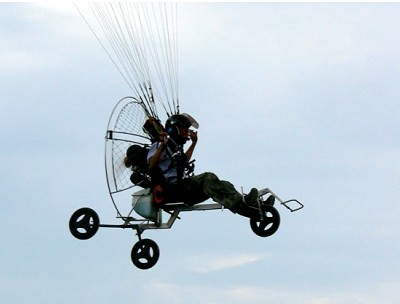
In 1999, at the Sun n Fun airshow in Florida, the Summit II made its debut.

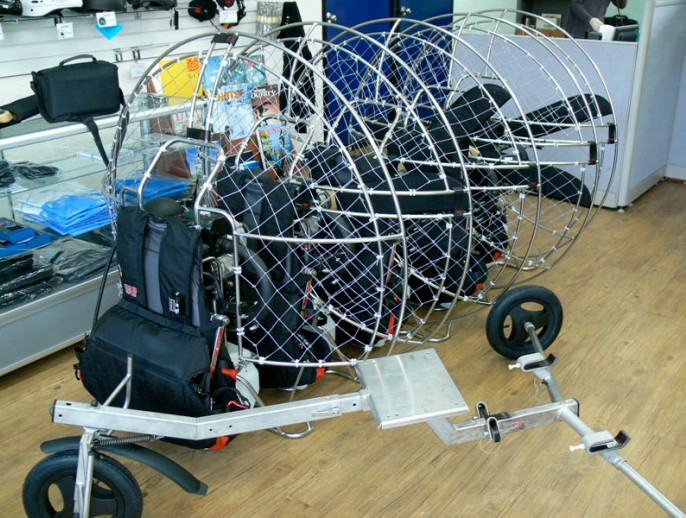
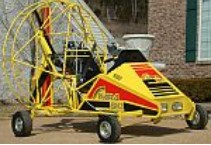
The two seat placement has separate seats and a single fuselage tube had every attach point triangulated. A slider foot control system is for canopy steering, and stainless steel rails around the pilot and passenger provide protection. A four point pick up system for the risers provides control against any pendulum affect. All the kits were anodized.

The landing gear was designed to be back under the engine so that in the event of a hard landing, the wheels would touch first, not the protective propeller guard.

Summit SS (single seat)
Cruise: 30 kt / 35 mph / 56 kmh
Empty Weight: 106 kg / 233 lbs
MTOW Weight: 249 kg / 550 lbs
Take-off distance (50ft obstacle): 200 ft / 61 m
Landing distance (50ft obstacle): 100 ft / 30 m

Steel Breeze Mini Breeze

In 2005 ASAP introduced another member of the PPC family, the Steel Breeze and Mini Breeze conforming to the FAR 103 regulations.

The Standard 103 Mini Breeze airframe is a powder coated 1 ½ inch 4130 .049 chrome molly aircraft quality TIG welded frame cage, with a black anodized 6061T6 1 ¼ inch Aluminum Prop guard. The seat fuel cell holds 12 US gal, (limited to 5 gal for USA 103) with a deluxe black seat covers and 4 Point Safety harness for both seats.

Fitted with a GSC fixed pitch propeller (std prop is a 2 blade 64″), or a ground adjustable is optional.
Features are, 6” spun AL rim with CNC machined hub and high speed bearing (13” OD), Butterfly Steering wheel with u-joint controls, Dyno-focal motor mount, Stainless Steel cable and clamp with 4 point riser attach system, Mustang 380 Sq. Ft. high performance canopy with canopy bag and line socks included, Long handle Throttle Quadrant, Foot bars canopy steering system, and Unique bungee control shock dampening system. Used on many certified aircraft.

Width Standard wheels: 72 in
Overall width at prop guard: 72 in
Length: 101 in
Height top of prop guard Standard wheels: 85 in
Airframe weight, w/Parachute Wing: 140 – 145 lbs

Steel Breeze Powered Parachutes Steel Breeze

In 2005 ASAP introduced the two place Steel Breeze powered parachute and Mini Breeze conforming to the FAR 103 regulations.

The main fuselage of the Steel Breeze airframe is constructed of 1.5 inch diameter chromolly steel fabricated and aircraft welded. Tabs are welded onto the airframe to attach the anodized aluminum components used to complete the PPC structure.

The Steel Breeze has a roll bar frame, frontal bars, wide center of gravity attach points and true seat separation. The 4 point riser attach system gives this aircraft a solid platform and with directional input that stays solid in the turn with no twisting or bobbing. The higher than center thrust line lateral attach gives a comfortable rate of climb. This also provides smoother throttle transition during landing as the aircraft has less tendency to oscillate with throttle setting changes.

Rear Seat tank, comfortable and lots of leg room. Front Pilot seat is a full highback seat in a comfortable seating position. Both seats come standard with 4 point safety harness. Full roll cage protection and frontal bars are standard. Full action bungee suspension is simple, works well and is very easily maintained. A Dyno-focal motor mount keeps engine vibration to a minimum. Cable system risers and stainless steel attach points make the strength to handle in excess of 5 G’s in load testing.

The Steel Breeze Powered Parachute may be the first new PPC to enter the market with the SPORT PILOT Manufacturers standards already in place. Steel Breeze is in compliance with Sport Pilot LSA.

The Steel Breeze airframe allows a variety of engine options that will fit the airframe. The basic airframe was available less the engine and canopy. The Steel Breeze can come ready to fly or ready to assemble. Factory built Steel Breeze is ready to fly, just uncrate it, put the wheels on, put gas in and fly. Factory built Steel Breeze is completely set up and test flown before it is packaged. Freight cost is higher due to size of finished package.

The welded main frame makes the Steel Breeze Kit assembly simple and fool proof. Kit comes with everything you need to complete the aircraft.

Standard Steel Breeze Airframe consists of:
Main airframe (Powder coated 1 ½ inch chrome molly aircraft quality TIG welded frame cage), Black anodized 6061T6 1 ¼ inch Aluminum Prop guard.
Dual deluxe seating, rear seat fuel cell 14 US gal., deluxe black seat covers.
4 Point Safety harness for both seats.
64 inch GSC Tech 3 propeller ground adjustable
8” Azusa Aluminum Mag Wheels
Butterfly Steering wheel with u-joint controls.
Dyno-focal motor mount
Stainless Steel cable and clamp with 4 point riser attach system
Mustang 500 sq.ft canopy with canopy bag and line socks included.
Long handle Throttle Quadrant
Foot bars canopy steering system
Unique bungee control shock dampening system. Used on many certified aircraft.

Construction Materials:
Aircraft quality TIG welded frame 1 ½” 4130 .063 Chrome Molly
1 ¼” 6061 T6 Aluminum Aircraft Grade
Quality AN aircraft hardware.
Stainless Steel bracketing.

Width at main gear wheels Standard wheels: 70 inches
Width at main gear wheels Jumbo wheels: 74 inches
Overall width at prop guard : 76 inches
Length: 123 inches
Height top of prop guard Standard wheels: 83 inches
Height top of prop guard Jumbo wheels: 85 inches

Airframe only weight, including Parachute Wing and Propeller less engine: 227 lbs

Steel Breeze airframe with:
Rotax 503 DCDI, B-Box with Pull Start: 323 lbs
Rotax 503 DCDI, B-Box w/Electric Start & Mag End: 343 lbs
Rotax 503 DCDI, C-Box (dampener) w/ Pull Start: 331 lbs
Rotax 503 DCDI, E-Box w/ Electric Start: 347 lbs
Rotax 582 Liquid cooled B-Box w/Pull Start : 342 lbs
Rotax 582 Liquid cooled B-Box w/Electric Start and Mag End: 361 lbs
Rotax 582 Liquid cooled E-Box w/Electric Start: 363 lbs
Hirth 3503 Liquid cooled with gear box and Electric Start: 350 lbs
HKS 700E 4 stroke with Electric Start: 376 lbs

Maximum Gross Weights:
These posted weights are based on Parachute Wing size and type.
Mustang S-500 (Rectangular): 850 lbs
Mustang S-550 (Rectangular): 950 lbs
Thunderbolt E-340 (Elliptical): 900 lbs

Glide Ratio: Between 4 to 1 up to 6 to 1.
Rate of Climb: Between 400 to 800 feet per minute.
Take off Roll: 50 to 300 feet
Landing Roll: 50 to 100 feet.
Cruise Airspeed: 25 to 35 mph. (Elliptical wings 31-45 mph)

Stellar Astra / Albatross Flying Systems Cruiser

The Stellar Astra is an American ultralight trike that was designed by Allistair Wilson and produced by Stellar Aircraft of Bloomfield, Indiana. When it was available the aircraft was supplied as a complete ready-to-fly-aircraft. As of 2013 the company appears to be out of business and production complete.

The Astra was derived from a P&M Aviation trike design and intended to comply with the US light-sport aircraft category.

The Astra features a cable-braced hang glider-style high-wing, weight-shift controls, a two-seats-in-tandem open cockpit with a cockpit fairing, tricycle landing gear with wheel pants and a single engine in pusher configuration.

The aircraft is made from bolted-together aluminum tubing, with its double surface wing covered in Dacron sailcloth. Its 34.4 ft (10.5 m) span wing is supported by a single tube-type kingpost and uses an “A” frame weight-shift control bar. Powerplants that were factory available were the twin cylinder, air-cooled, two-stroke, dual-ignition 50 hp (37 kW) Rotax 503, the four cylinder, air and liquid-cooled, four-stroke, dual-ignition 80 hp (60 kW) Rotax 912UL and 100 hp (75 kW) Rotax 912ULS and the twin cylinder, air-cooled, four-stroke, dual-ignition 60 hp (45 kW) HKS 700E engine.

With the HKS powerplant the aircraft has an empty weight of 485 lb (220 kg) and a gross weight of 960 lb (435 kg), giving a useful load of 475 lb (215 kg).

The aircraft was produced under contract for Stellar Aircraft in India by Albatross Flying Systems, who also marketed the design in Asia as the Cruiser. In 2011, The Astra sold for US$23,495 with the HKS 700E engine.

Astra
Engine: 1 × HKS 700E, 60 hp (45 kW)
Propeller: 3-bladed composite
Wingspan: 34 ft 5 in (10.5 m)
Wing area: 168 sq ft (15.6 sq.m)
Empty weight: 485 lb (220 kg)
Gross weight: 959 lb (435 kg)
Maximum speed: 78 mph; 67 kn (125 km/h)
Cruise speed: 62 mph; 54 kn (100 km/h)
Stall speed: 37 mph; 32 kn (60 km/h)
Rate of climb: 450 ft/min (2.3 m/s)
Wing loading: 5.7 lb/sq ft (27.9 kg/sq.m)
Crew: one
Capacity: one passenger

St. Andrews Viking / Viking Aircraft Viking

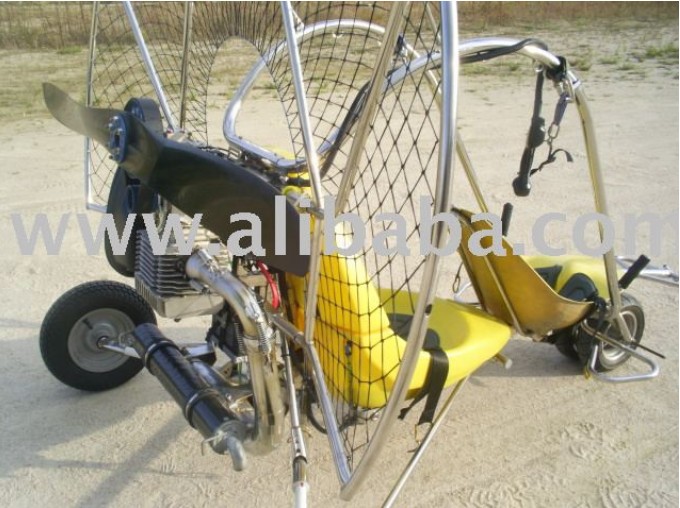
The St Andrews Viking is a family of American powered parachutes that was designed and manufactured by St Andrews Aviation of Panama City, Florida and later produced by Viking Aircraft, also of Panama City.

Introduction in 1998, the two-seat Viking II was designed to comply with the US FAR 103 Ultralight Vehicles two-seat trainer rules. It features a parachute-style high-wing, two-seats-in-side-by-side configuration, tricycle landing gear and a single 50 hp (37 kW) Rotax 503 engine in pusher configuration. The 70 hp (52 kW) 2si 690-L70 engine was a factory option.

The aircraft is built from tubing and includes a partial cockpit fairing. The side-by-side seating configuration is unusual in powered parachutes, but was intended to make dual instruction easier. In flight steering is accomplished via dual foot pedals that actuate the canopy brakes, creating roll and yaw. On the ground the aircraft has a center-mounted bicycle handlebar that controls the nosewheel steering. The main landing gear incorporates steel spring rod suspension. The aircraft was factory supplied in the form of an assembly kit or could be delivered ready-to-fly.

Variants

Viking I
Single seat version introduced in March 2000, that sold for US$10,900 complete and ready-to-fly in 2001.

Viking II
Two-seats-in-side-by-side configuration version introduced in 1998, that sold for US$12,000 (2001) complete and ready-to-fly, US$10,000 complete but unassembled or US$4,300 for the carriage kit only, less engine and canopy, in 2001. Production has since ended.

Viking II
Engine: 1 × Rotax 503 twin cylinder, two-stroke, 50 hp (37 kW)
Propeller: 3-bladed composite propeller
Wing area: 520 sq ft (48 m2)
Empty weight: 270 lb (122 kg)
Fuel capacity: 10 U.S. gallons (38 L; 8.3 imp gal)
Cruise speed: 30 mph (26 kn; 48 km/h)
Rate of climb: 600 ft/min (3.0 m/s)
Crew: one
Capacity: one passenger