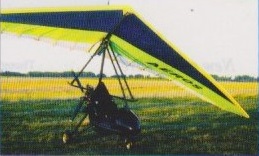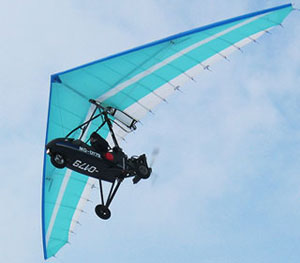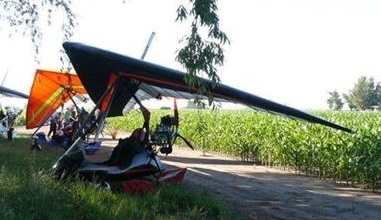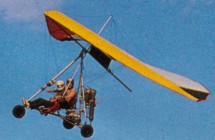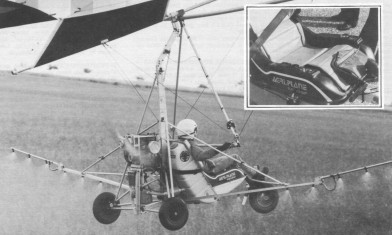
Agriplane Condor 2090

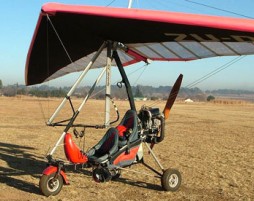
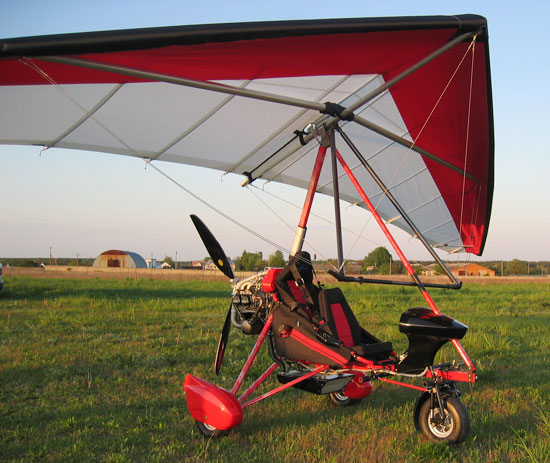
Single seat single engined flex wing aircraft with weight shift control. Rogallo wing with keel pocket. Pilot suspended below wing in trike unit, using bar to control pitch and yaw/roll by altering relative positions of trike unit and wing. Wing braced from above by kingpost and cables, from below by cables; rigid cross tube construction with single surface (33% double surface optional); not enclosing cross tube; pre formed ribs. Undercarriage has three wheels in tricycle formation; rubber suspension on all wheels. Push-right go left nosewheel steering independent from yaw control. Brake on nosewheel. Aluminium tube trike unit, without pod. Engine mounted below wing driving pusher propeller.
Designed by Patrice Renaud with the assistance of M Michelot and C Cardineau, the prototype Agriplane flew for the first time in February 1981, which makes it the first agricultural weight shift microlight in the world. Patrice was the victim of an accident in the course of a flight on another machine which laid him up for a long time, which explains why the machine was shown at the aeronautical and space salon at Le Bourget in June 1981, even though the first Agriplane Condors were not sold until March 1982.
Essentially intended for use as an agricultural tool, this microlight can nevertheless be fitted with a second seat and used as a tandem two seater dual control machine. A kit allows for this dual control adaption. The Condor is supplied with a glass fibre seat with a foam covering which forms the 23.8 US gal (19.8 Imp gal, 90.0 litre) tank for the spray medium. An autonomous hand controlled electric pump supplies the medium to the two spray booms mounted either side of the trike. Three lengths of boom were offered 19.8, 26.6 and 39.5ft (6.0, 9.0 and 12.0 m) fitted together with quick release couplings, which allows their fitment in 3 min. Interchangeable atomisers allow the amount of product sprayed to be varied between 1.0 and 2.0 US gal/acre (0.84.6 Imp gal/acre, 15.30 litre/ hectare).

Engine: Hirth, 46 hp at 7800 rpm.
Toothed¬ belt reduction.
Power per unit area 0.19hp/sq.ft, 2.0hp/sq.m.
Fuel capacity 5.8 US gal, 4.8 Imp gal, 22.0 litre.
Length overall 13.1 ft, 4.0 m.
Height overall 11.6 ft, 3.50 m.
Wing span 32.8 ft, 10.0 m.
Dihedral 4 degs.
Nose angle 135 degs.
Total wing area 248 sq.ft, 23.0 sq.m.
Wing aspect ratio 4.3/1.
Wheel track 5.7ft, 1.70 m.
Nosewheel dia¬meter overall 16 inch, 40 cm.
Main wheels diameter overall 16 inch, 40cm.
Empty weight 298 lb, 135kg.
Max take off weight 696 lb, 315kg.
Payload 398 lb, 180kg.
Max wing loading 2.80 lb/sq.ft, 13.7 kg/sq.m.
Max power loading 15.1 lb/hp, 6.8kg/hp.
Load factors; +5.5, 2.8 ultimate.
Max level speed 47mph, 75kph.
Never exceed speed 53mph, 85kph.
Max cruising speed 40mph, 65kph.
Economic cruising speed 34mph, 55kph.
Stalling speed 23 mph, 38 kph.
Max climb rate at sea level 600 ft/min, 3.0 m/ls.
Best Wide ratio power off 7/1 at 34 mph, 55 kph.
Take off distance 82 ft, 25 m.
Landing distance 50 ft, 15 m.
Range average cruise 68 mile, 110 km.
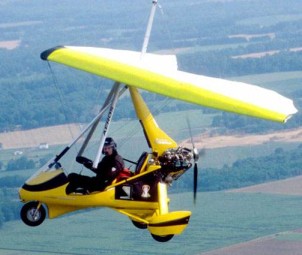
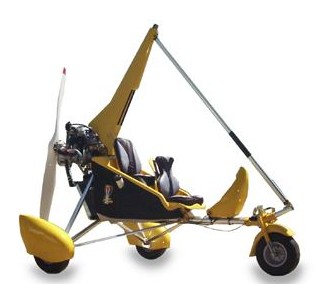
Aerotrike Cobra / Naked Cobra      

The first production Cobra, C-001, flew 46,000 km around the world in the Millennium Microlight Adventure, which proved as an extensive test flight and debugging exercise. Several advances and developments were made to the Cobra following information provided about the performance, comfort and other factors of the Cobra during its rough operations and incredibly long flights of this expedition.
The Cobra was offered with fairing of without (the ‘Naked Cobra’).
Aircraft-grade 4130 chromoly steel and aluminium construction for operation on rough terrain and large diameter aluminium are used. Steel and ali are treated for corrosion protection. All junction points on the Cobra are rubber-bushed to increase the lifespan and ruggedness of the trike.
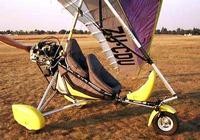
The Cobra is equipped with a folding ‘click-up’ pylon for easy rigging and de-rigging allowing one person to lift the wing and click the pylon into place and bolt. No removing of the fuel tank and seats is involved. Independant seats have full composite backreasts and padding.
A 3/4 nose and pylon fairings encloses all peripherals such as the ballistic parachute. The 55 litre (14 US gal) fuel tank has side access for refuelling with the optional 76 litre (20 US gal) fuel tank (not fitted on the standard 503 model) endurance can be 7 hours and 700 kms depending on engine and other factors.
The Rotax 912 or 912S 4-stroke motors can be fitted to the Cobra with a radiator scoop with adjustable flap (includes full rear underbelly fairing) allowing the radiator to be out of sight. The adjustable intake flap allows the pilot to manually control the airflow onto the radiator to maintain engine temperatures as well as preventing stone and sand damage to the radiator while maneouvring on the ground. (This feature is an option and is only available when the 582, 912 or 912S engine options are selected).
An integral landing light option for after dark taxiing is available.
Equipped with front wheel telescopic suspension through non-degrading poly-urethane with large diameter mecahnical drum brake, mudflap, parking brake, and the front fork pivots on two heavy-duty ball bearings that make steering easier.
Rear wheel suspension is through telescopic poly-urethane shocks though rear nosewheel steering not available on the Cobra.
Standard configuration includes a Rainbow Aircraft Spirit 15 New Generation Dual Surface Wing, Rotax 503 DCDI Engine with Dual Ignition and Twin Carbs (52 HP), and “B” Series Gearbox (reduction 2,58:1). The Aerotrike Cobra is certified by the South African Civil Aviation Authority (CAA) to be fit and safe for general ultralight use.

Naked Cobra

For $1,250 (2009) less than the price of the standard Cobra, the ‘Naked’ Cobra offers open flying. Still retaining the pylon fairing, large wheel spats and composite seating arrangement, the Naked Cobra removes the front fairing and replaces it with a banana pod. This trike can still be fitted with the Rotax 912 engine (and 912S), or the 2-stroke Rotax 503 or 582 engines.

Cobra
Engine: Rotax 582, ‘C’ Gearbox
MTOW: 450 kg / 990 lb
Design Loads: +6g -3g
Typical Useful Load: 247 kg / 543 lb
Empty Weight (trike and engine): 153 kg / 337 lb

Cobra
Engine: Rotax 912
MTOW: 450 kg / 990 lb
Design Loads: +6g -3g
Typical Useful Load: 214 kg / 470 lb
Empty Weight (trike and engine): 186 kg / 409 lb

Aerotrike Scout

Replacing the Safari, the Aerotrike Scout is certified by the South African Civil Aviation Authority (CAA).
Primarily of steel construction the Aerotrike Scout is available as a kit, including the ‘kinked’ pylon, and new rear suspension. The Scout features front wheel ‘trailing link’ suspension and rear wheel suspension through non-degrading polyurethane. The folding pylon allows rigging and de-rigging without removing the fuel tank and seats – just one safety clip and bolt.
The engine mounting has vibration absorbing mounting rubbers and large side luggage bags cover a 55 litre (13 US gal) fuel tank. Individual bucket seats with back rests and lap restrainers are standard.
Standard configuration includes a Rotax 503 DCDI Engine with Dual Ignition and Twin Carbs (52 HP), “B” Series Gearbox (reduction 2,58:1), 2-bladed propeller, 55-litre (14 US gal) fuel tank, side luggage bags, rear wheel pants, and small instrument panel (no instruments).

Empty Weight (trike and engine only – no wing): 107 kg / 235 lbs
Typical Useful Load (Pilot, Passenger, Fuel & Gear): 290 kg / 640 lbs
MTOW: 450 kg / 990 lbs
Design Loads: +6g -3g

Aeros Cross-Country Trike

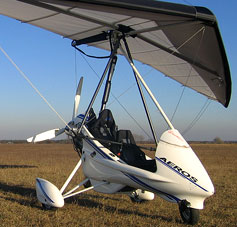
Designed and produced by Aeros of Kiev as a more basic model than the Aeros-2 for off-airport use, the Ukrainian ultralight trike Cross Country features a cable-braced hang glider-style high-wing, weight-shift controls, a two-seats-in-tandem open cockpit, tricycle landing gear and a single engine in pusher configuration.

The aircraft is made from tubing, with its wing covered in Dacron sailcloth. Its 10.3 m (33.8 ft) span wing is supported by a single tube-type kingpost and uses an “A” frame control bar. Unlike the Aeros-2 the Cross Country does not have a cockpit fairing and sports heavy duty main wheel suspension for rough fields.

Engines available include the twin cylinder, two-stroke, air-cooled 50 hp (37 kW) Rotax 503, the liquid-cooled 64 hp (48 kW) Rotax 582, the four cylinder four-stroke 80 hp (60 kW) Rotax 912UL and 100 hp (75 kW) 912ULS or the certified 912A or S. The BMW K-1100 ULS powerplant is also optional. Available wings to be mated to the carriage are the Aeros Profi, Aeros Stranger, Aeros Stream and Aeros Still.

The Aeros Cross Country, sometimes called the Aeros Cross-Country, was supplied as a complete ready-to-fly aircraft or as kit for amateur construction.

An aerial application kit to allow crop spraying was available as an option.

Engine: Rotax 582, 64 hp
Max weight: 472.5 kg
Empty weight: 201 kg
Payload (fuel inc): 313 kg
Std fuel tank: 53 lt
Wing area: 14.5 sq.m
Take off roll dist: 80 m
Landing roll dist: 80 m
Gliding ratio (90 km/h): 5
Cruise speed: 90 km/h
Vne: 130 km/h
Stall speed: 52 km/h
Rate of climb (450 kg): 4 m/sec
Fuel consumption 80%: 14 lt
Service ceiling: 3500 m
Load factors: 4g/-2g

Engine: Rotax 912, 80 hp
Max weight: 472.5 kg
Empty weight: 222 kg
Payload (fuel inc): 250.5 kg
Std fuel tank: 53 lt
Wing area: 14.5 sq.m
Take off roll dist: 70 m
Landing roll dist: 70 m
Gliding ratio (90 km/h): 5
Cruise speed: 90 km/h
Vne: 130 km/h
Stall speed: 52 km/h
Rate of climb (450 kg): 5 m/sec
Fuel consumption 80%: 12 lt
Service ceiling: 3500 m
Load factors: 4g/-2g

Engine: Rotax 912S, 100 hp
Max weight: 472.5 kg
Empty weight: 227 kg
Payload (fuel inc): 294 kg
Std fuel tank: 53 lt
Wing area: 14.5 sq.m
Take off roll dist: 60 m
Landing roll dist: 70 m
Gliding ratio (90 km/h): 5
Cruise speed: 90 km/h
Vne: 130 km/h
Stall speed: 52 km/h
Rate of climb (450 kg): 6 m/sec
Fuel consumption 80%: 12 lt
Service ceiling: 3500 m
Load factors: 4g/-2g

Aeros Aeros-1 / Aeros-2 Trike / Venture

Aeros-2

Aeros produced the Aeros as a wing for other manufacturers and also as a complete trike for the German market, where it was marketed by Ful.

Aeros

When the Aeros-1 couldn’t satisfy the requirements of overseas markets, a decision was made to refine the existing trike, changing its exterior design and using all the achievements and benefits of the load-carrying structure.
The Aero-2 export version of the trike and enter the world UL market and manufacture started in 1999. Attention was given to ergonomics issues, trying to provide comfort in flight both for the pilot as well the passenger. This has been achieved by the widened seats frame, as well as room inside the fairing for the passenger’s feet. A small windshield partially protects the pilot from wind without affecting forward line-of-sight. The instrument panel of the “Aeros 2” is recessed into the fairing and painted with special antiglare paint.
A special beam running longitudinally along the interior of the entire fairing not only makes room for the passenger’s feet, but also increases the rigidity of the fairing, which is important for this type of fairing since the surface area is so large. All fiberglass edges facing the pilot and the passenger are not just covered with rubber, but are shaped, rolled and folded inside. This profile increases rigidity of the design, as well as providing additional safety for the operators.
The folding pylon makes it possible for one person to hang the wing on the trike, and with the idea to increase reliability and safety of the design, there is a safety cable inside the pylon.
The main landing gear of pyramidal shape combined with automobile shock absorbers.
The load-carrying frame of the trike is made of rectangular tubes of aircraft alloy D16T 60 x 40 x 2 reinforced by a rectangular tube 54 x 34 x 2; the seat frame is made of the tube D16T 32 x 2. All load-carrying fittings are made according to aircraft technologies of tubes and plates of 30 HGSA steel. This work is done in close cooperation with the Antonov factory and Aviant Kiev plant.
Engine mounts are available for various engines, including the Rotax 503, Rotax 582, Rotax 912, BMW, and Subaru. The “Aeros 2” trike is available as a kit or the ready-to-fly trike.
The “Aeros 2” can be equipped with various engines, wings and instruments, floats or skis, rescue system, etc. The “Aeros 2” trike with Rotax 503 and Rotax 582 is known at the US market as the Venture 500 and the Venture 600.

Gallery

Aeros
Empty weight: 160 kg
Wing span: 10.2 m
Wing area: 14.8 sq.m
Engine: Rotax 582, 64 hp
MAUW: 400 kg
Seats: 2
Max speed: 120 kph
Cruise speed: 85 kph
Minimum speed: 50 kph
Climb rate: 5 m/s
Fuel consumption: 7.5 lt/hr

AEROS-2
Engine: Rotax 582, 64 hp
Max weight: 472.5 kg
Empty weight: 210.5 kg
Payload (fuel inc): 262 kg
Standart fuel tank: 53 lt
Wing area: 14.5 sq.m
Take off roll dist: 80 m
Landing roll dist: 80 m
Glide ratio (90 km/h): 6
Cruise speed: 90 km/h
Vne: 130 km/h
Stall speed: 52 km/h
Rate of climb (450 kg): 4 m/sec
Fuel consumption 80%: 14 lt
Service ceiling: 3500 m
Load factors: 4g/-2g

Engine: Rotax 912, 80 hp
Max weight: 472.5 kg
Empty weight: 229.5 kg
Payload (fuel inc): 243 kg
Standart fuel tank: 53 lt
Wing area: 14.5 sq.m
Take off roll dist: 70 m
Landing roll dist: 70 m
Glide ratio (90 km/h): 6
Cruise speed: 90 km/h
Vne: 130 km/h
Stall speed: 52 km/h
Rate of climb (450 kg): 5 4 m/sec
Fuel consumption 80%: 12 lt
Service ceiling: 3500 m
Load factors: 4g/-2g

Engine: Rotax 912S, 100 hp
Max weight: 472.5 kg
Empty weight: 234.5 kg
Payload (fuel inc): 238 kg
Standart fuel tank: 53 lt
Wing area: 14.5 sq.m
Take off roll dist: 60 m
Landing roll dist: 70 m
Glide ratio (90 km/h): 6
Cruise speed: 90 km/h
Vne: 130 km/h
Stall speed: 52 km/h
Rate of climb (450 kg): 64 m/sec
Fuel consumption 80%: 12 lt
Service ceiling: 3500 m
Load factors: 4g/-2g

Aeros Graffiti

Graffiti trike

In 1995 the Graffiti trike with the Stranger wing was certified. The wing has successfully undergone strength and aerodynamic testing in the course of the certification at DULV and within a year 80 Stranger wings had been sold.

Certificate DULV (with Stranger wing): D131-1.1

Aeros del Sur Manta         

Aeros del Sur is the importer of Aeros products for Argentina. The Manta was designed by mating the Aeros Profi trike wing with a new, locally designed carriage. The Manta was designed to comply with the Fédération Aéronautique Internationale microlight category, including the category’s maximum gross weight of 472.5 kg (1,042 lb), with a ballistic parachute.

The aircraft is made from a mix of bolted-together aluminum and steel tubing, with its double surface wing covered in Dacron sailcloth. Its 10 m (32.8 ft) span wing is supported by a single tube-type kingpost and uses an “A” frame weight-shift control bar.

It features a cable-braced hang glider-style high-wing, weight-shift controls, a two-seats-in-tandem, open cockpit, tricycle landing gear with wheel pants and a single engine in pusher configuration.

The standard powerplant is a twin cylinder, liquid-cooled, two-stroke, dual-ignition 64 hp (48 kW) Rotax 582 engine, but the HKS 700E four-stroke, dual-ignition 60 hp (45 kW) engine is optional, as are Hirth and Simonini powerplants.

In production in 2013, the aircraft was supplied as a complete ready-to-fly-aircraft.

Engine: 1 × Rotax 582, 48 kW (64 hp)
Propeller: 3-bladed composite
Wingspan: 10 m (32 ft 10 in)
Wing area: 15.4 m2 (166 sq ft)
Gross weight: 472.5 kg (1,042 lb)
Fuel capacity: 50 litres (11 imp gal; 13 US gal)
Wing loading: 30.68 kg/m2 (6.28 lb/sq ft)
Crew: one
Capacity: one passenger