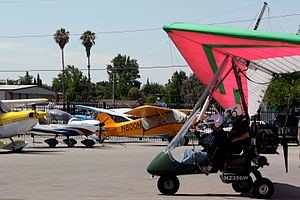
The T-2M was developed by the Antonov Design Bureau at the end of the Cold War when it became necessary to explore civil markets for aircraft, including microlights for club flying. Aside from production for recreational purposes, the T-2M was also designed for use by the Russian Special Forces for use on infiltration missions, and as such incorporated a sophisticated wing folding mechanism at their request.
The T-2M features a cable-braced hang glider-style high-wing, weight-shift controls, a two-seats-in-side-by-side configuration open cockpit, tricycle landing gear and a single engine in pusher configuration. The aircraft is made from tubing, with its wing covered in Dacron sailcloth. Its 163 sq ft (15.1 m2) area wing is supported by a single tube-type kingpost and uses an “A” frame control bar. The standard engine supplied was the 64 hp (48 kW) Rotax 582 twin-cylinder, two-stroke, liquid-cooled powerplant. The smaller 50 hp (37 kW) Rotax 503 and the four-stroke 80 hp (60 kW) Rotax 912 were also supplied.
The T-2M introduced two features not found on western trikes. It has side-by-side seating, which offers advantages in flight training and also has a large single piece leaf spring main landing gear, which is simple, light, low drag and eliminates many of the large number of parts that other designs use. The aircraft can be operated on wheels, skis and floats. An agricultural aircraft aerial application package is also available.
The T-2M was sold in North America and a dealer, UK-Air, was based in Mississauga, Ontario, Canada. It sold for US$18,500 in 2000.
T-2M Engine: 1 × Rotax 582, 48 kW (64 hp) Wing area: 15.1 m2 (163 sq ft) Empty weight: 170 kg (374 lb) Gross weight: 352 kg (775 lb) Fuel capacity: 26 litres (5.7 imp gal; 6.9 US gal) Cruise speed: 89 km/h (55 mph, 48 kn) Stall speed: 45 km/h (28 mph, 24 kn) Rate of climb: 5.1 m/s (1,000 ft/min) Crew: one Capacity: one passenger
The MA-32 is a two-seat design that was originally developed for European microlight competition flying. The aircraft has a standard empty weight of 321 lb (146 kg). It features a cable-braced hang glider-style high-wing, weight-shift controls, an open cockpit, tricycle landing gear and a single engine in pusher configuration.
The aircraft is made from bolted-together aluminum tubing, with titanium used on the carriage structure and wing attachment. The wing is covered in Dacron sailcloth. Its 33.8 ft (10.3 m) span wing is supported by a single tube-type kingpost and uses an “A” frame control bar. A number of single or double surface purpose-designed trike wings are optional, including the Aeros Still-17, Aeros Stream-16, Aeros Stranger 2, Aeros Profi, Aerossa Sprinter-15, Aerossa Stratos and the Aerossa Stratos-13. The landing gear uses a unique curved, slab-sided, main gear leg design made from fiberglass that reduces aerodynamic drag. All wheels have suspension and the steerable nose wheel also features a drum brake. A fiberglass cockpit fairing is optional. Series engines include the Rotax 447 two-stroke powerplant of 40 hp (30 kW), Rotax 503 of 50 hp (37 kW), the liquid-cooled Rotax 582 of 64 hp (48 kW), the Rotax 912 and 912S four-stroke powerplants of 80 hp (60 kW) and 100 hp (75 kW) and the HKS 700E of 60 hp (45 kW).
The aircraft can all be quickly folded for storage or ground transportation.
Designed and produced by Antares Aircraft the MA-32 was at one time marketed by Leading Edge Air Foils as the LEAF Antares. The aircraft are supplied as kits for amateur construction.
As of 2005, 200 had been built, and still in production in 2011, the unit cost was US$37,000 for the Antares MA-33MR912 model.
Antares MA 34R 912 Ranger
Variants:
MA-32 Base two-seat model Engine: Rotax 447, 40 hp (30 kW) Propeller: 6-bladed composite Wingspan: 10.3 m (33.8 ft) Wing area: 15.5 m2 (167 sq ft) Empty weight: 146 kg (321 lb) Gross weight: 250 kg (551 lb) Fuel capacity: 19 litres (4.2 imp gal; 5.0 US gal) Maximum speed: 124 km/h (77 mph, 67 kn) Cruise speed: 64 km/h (40 mph, 35 kn) Stall speed: 45 km/h (28 mph, 24 kn) Range: 320 km (200 mi, 170 nmi) Service ceiling: 6,000 m (19,700 ft) Crew: one Capacity: one passenger
MA-32 R503 Two-seat model Engine: Rotax 503, 50 hp (37 kW)
MA-32 R582 G Two-seat model Engine: Rotax 582, 64 hp (48 kW) optional twin floats
MA-33 / MA-33M R582 Two-seat model Engine: Rotax 582, 64 hp (48 kW)
MA-33M R912 Two-seat model Engine: Rotax 912 80 hp (60 kW) or HKS 700E of 60 hp (45 kW)
MA-34 R912 Ranger Two-seat model Engine: Rotax 912, 80 hp (60 kW) Fuel tank: 15 U.S. gallons (57 L; 12 imp gal)
MA-34R912S Beaver Two-seat model Engine: Rotax 912ULS, 100 hp (75 kW)
MA-34 Open Country Two-seat model Engine: Rotax 912ULS, 100 hp (75 kW) tundra tires Aeros Stratos 15.5 wing
MA-34 R582XB Crop Duster Two-seat model Engine: Rotax 582, 64 hp (48 kW) spray equipment for aerial application
LEAF Antares 503 Base model marketed by Leading Edge Air Foils circa 2000 Engine: Rotax 503, 50 hp (37 kW) Aeros Stream-16 wing Two-seat model
LEAF Antares 582 Model marketed by Leading Edge Air Foils circa 2000 Engine: Rotax 582, 64 hp (48 kW) Aeros Stranger-15 wing Two-seat model
The Antares A-10 Solo Ukrainian ultralight trike is a single-seat derivative of the two-seat Antares MA-32. It was designed to comply with the Fédération Aéronautique Internationale microlight category, including the category’s maximum gross weight of 450 kg (992 lb). The aircraft has a maximum gross weight of 450 kg (992 lb). The aircraft was supplied as a kit for amateur construction or complete and ready-to-fly. The A-10 was distributed as a kit in the United States where it is approved for the Experimental – Amateur-built category.
The aircraft design features a cable-braced hang glider-style high-wing, weight-shift controls, a single-seat open cockpit with a cockpit fairing, tricycle landing gear with wheel pants and a single engine in pusher configuration.
The aircraft is made from bolted-together aluminum tubing, with a single-piece composite mainwheel spring system and a titanium front wheel fork for off-airport landings. The double surface wing covered in Dacron sailcloth. Its 10 m (32.8 ft) span wing is supported by a single tube-type kingpost and uses an “A” frame weight-shift control bar. Optionally a “topless” wing, lacking the kingpost, can be fitted. The powerplant is a twin cylinder, air-cooled, two-stroke, dual-ignition 50 hp (37 kW) Rotax 503 engine or optionally a 40 hp (30 kW) Rotax 447 engine.
A number of different wings can be fitted to the basic carriage, including the standard Aeros Stranger 2, or Aeros Still 17. Optional wings include the Aeros Stranger 2M, Aeros Stream 16 or Aeros Profi
In production in 2018, the unit cost was US$25,000.
Antares A-10R503 SOLO Engine: 1 × Rotax 503, 37 kW (50 hp) Prop “E” gearbox reduction ratio: 2.62:1 Propeller: 3-bladed ground adjustable Length: 2.51 m (8 ft 3 in) Wingspan: 10 m (32 ft 10 in) Wing area: 14 m2 (150 sq ft) Empty weight: 170 kg (375 lb) Gross weight: 450 kg (992 lb) Fuel capacity: 19 litres (4.2 imp gal; 5.0 US gal) Maximum speed: 140 km/h (87 mph; 76 kn) Cruise speed: 83 km/h (52 mph; 45 kn) Stall speed: 43 km/h (27 mph; 23 kn) Service ceiling: 6,200 m (20,300 ft) g limits: +6/-2 Rate of climb: 5 m/s (980 ft/min) Seats: one
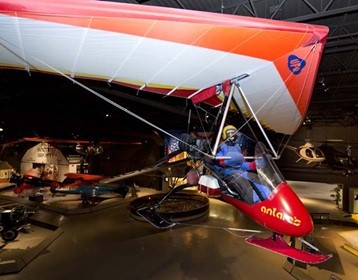
The Antares MA-30 was designed by Russian engineer Sergey Zozulya and manufactured in 1991. Sergey designed the aircraft with triangular engineering, distinctive fairing, and landing gear for the ultralight to be capable of flying on wheels, tundra tires, floats, or skis.
The MA-30 was built for strength and was constructed largely of titanium parts. The design features a Rogallo wing and a standard trike configuration, with a fiberglass cowling installed to protect the pilot from the weather. The MA-30 uses a weight-shift control system and is powered by a 50-hp Rotax 503 engine.
In 1992, Mike Jacober decided to fly his MA-30 to the summit of Mount McKinley, now known as Denali, the highest peak in North America. Mike enlisted the help of fellow MA-30 pilot Joel Wallace, his stepson Matthew Howard, and his friend David Swendiman. Beginning in late December of 1992, the four began meeting weekly to discuss plans for the adventure, figuring what they’d need for equipment, fuel, etc., and making contingency plans for different situations.
On May 1, 1993, the Mount McKinley flying group launched their expedition from Talkeetna, at an altitude of 346 feet, with Matthew and David flying into Kahiltna Base Camp in a Cessna 185 with all the supplies, while Mike and Joel flew their MA-30s across the 60-plus mile glacier. The group spent a total of eight days at Kahiltna, five of which were spent gearing up for the flight to the summit.
On May 6, Mike and Joel pulled on their flying garb, put on their oxygen masks and cylinders and fired up their MA-30s. A string of small problems prevented Joel from reaching the summit, but that didn’t hinder Mike. After about 20 minutes, Mike was high enough to cross the Kahiltna peaks and the valley to the south buttress of Mount McKinley. The MA-30 picked up some ridge lift for about two miles and enabled Mike to reach the south peak. At the peak, the ridge lift went away and Mike had to make a dozen or so 360-degree turns in front of the face to work his way up, eventually making it over the summit by about 150 feet, reaching an altitude of 20,470 feet. After circling the summit, Mike snapped a few pictures, turned off the engine, and glided back down to Kahiltna.
Mike Jacober an aviation pioneer, a dedicated instructor, passed away. In 2002 he was inducted into the EAA Sport Aviation Halls of Fame as one of the nation’s most respected ultralight pilots and promoters. Ginny Jacober, Mike’s widow, donated his MA-30 to the EAA Aviation Museum in 2004.
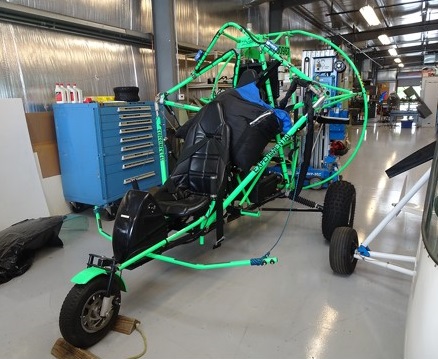
The Alliant Destiny Fusion is a two-seat powered parachute, designed and produced by Alliant Aviation based at Richland, Michigan. USA. The aircraft was designed to comply with the FAI Microlight rules. It features a parachute-style high-wing and two-seats in tandem in a semi-stressed fibreglass cockpit, tricycle landing gear and a single 52 hp (39 kW) Rotax 503 engine in pusher configuration. Versions were also available with a Rotax 582 or Hirth 3701 engine. The Rotax 503 version cost US$18,750 in 2004.
The Alliant Destiny XLT two-seat powered parachute was designed to comply with the FAI Microlight rules. It features a parachute-style high-wing and two-seats in tandem in an open frame, tricycle landing gear and a single 64 hp (48 kW) Rotax 582 engine in pusher configuration. Versions were also available with a Rotax 503 or Hirth 3701 engine. The Destiny XLT cost US$16,050 in 2004 with a Rotax 582 engine.
2005 Alliant Aviation Destiny XLT 2000
Destiny Fusion Powerplant: 1 × Rotax 503, 52 hp (39 kW) Propeller: 3-bladed Wing area: 540 sq ft (50 sq.m) Empty weight: 340 lb (154 kg) Gross weight: 849 lb (385 kg) Cruise speed: 29 mph; 25 kn (47 km/h) Rate of climb: 1,080 ft/min (5.5 m/s) Crew: two
ST Single-seat variant
LT Two-seat lightweight variant
XLT Heavier two-seat variant Powerplant: 1 × Rotax 582, 64 hp (48 kW) Propeller: 3-bladed Empty weight: 386 lb (175 kg) Gross weight: 992 lb (450 kg) Maximum speed: 34 mph; 30 kn (55 km/h) Cruise speed: 32 mph; 28 kn (52 km/h) Crew: two
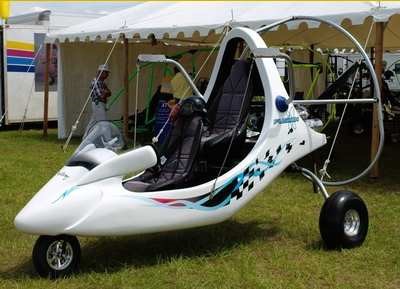
The Airtrike Eagle 5 is a German ultralight trike, designed and produced by Airtrike of Berlin. The aircraft is supplied as a complete ready-to-fly-aircraft.


 All Aero