ASAP Thunderbolt E

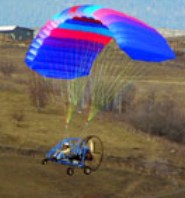
The Thunderbolt “E Series” canopy is an elliptical canopy and is specially designed for use in single, and two place powered parachutes.
The Thunderbolt “E Series” canopy has an extended glide rate and sink rate when compared to the standard S-series. The Thunderbolt “E Series” canopy is better suited for the more experienced PPC pilot, who wants a higher performance canopy and fully understands the flight characteristics of such a canopy.
The Thunderbolt “E Series” is available in the E310, E280 and E340 sizes.

ASAP Mustang S

The ASAP Mustang “S Series” canopy is the standard square type canopy. The characteristics of the Mustang “S Series” canopy are very forgiving, with easy inflation, better handling and stability.
The Mustang “S Series” is available in four sizes: the S380 for single seat applications, the S420 for single and two seat applications and the S500 and S550 which is pretty well the standard size in the two seat powered parachute applications.

ASAP

Brent Holomis owned a Birdman Chinook WT2S two-seat ultralight and when Birdman Enterprises went out of business in late 1987 it left Chinook owners without a source of parts. ASAP was founded by Holomis in 1988, initially the company was to provide Chinook parts, but Holomis proceeded to redesign the Chinook with assistance from Dr David Marsden at the University of Alberta, who had been involved in the first Chinook design. In 1989 ASAP unveiled the improved ASAP Chinook Plus 2. With the acquisition of Canadian Ultralight Manufacturing in St Paul, Alberta who had manufactured the earlier Chinook WT11 and WT2S, the Chinook Plus 2 was placed into production.
In 1992 Spectrum Aircraft of Surrey, British Columbia, the manufacturer of the Spectrum Beaver aircraft line, went out of business and the following year ASAP began making parts for the existing RX-28, RX-35 and RX-550 Beaver fleet. In 1996, after a similar development program to the Chinook Plus 2, ASAP introduced an improved two-seat Beaver, designated the RX-550 Plus. In 2000 ASAP introduced the Beaver SS (single seat) to replace the RX-28 and RX-35 single seat Beavers that had gone out of production with Spectrum’s 1992 demise.
ASAP at one time owned GSC Propellers who made a line of wooden blade, aluminum hub, ground adjustable propellers for the ultralight aircraft market. Founded in 1984 GSC Propellers initially operated from the ASAP Vernon facility. The company was sold in 2000 and, while still located in Vernon, changed its name to GSC Systems in 2004.
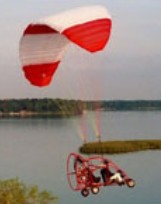
In the late 1990s ASAP decided to develop a line of aluminum-framed powered parachutes. These were developed and are manufactured in-house at ASAP, but marketed by a separate division, Summit Powered Parachutes International. The models presently consist of the two place Summit 2 and the single-seat Summit SS.
ASAP also designed two welded steel tube-frame powered parachute models especially for the US market. These are manufactured by ASAP and marketed by another corporate division, Steel Breeze Powered Parachutes. This division offered two models, the Steel Breeze Two Place and the United States ultralight category FAR 103 Ultralight Vehicles compliant 103 Mini Steel Breeze.
The corporate division, http://www.ppccanopies.com sells powered parachute and powered paraglider canopies, while http://www.ulparts.com provides engines and ultralight parts. ASAP itself provides parts for the legacy Birdman Chinook and Spectrum Beaver aircraft fleets.
1995-8: Box 995, Vernon, BC, V1T 6N2 Canada.

Aquilair Kid

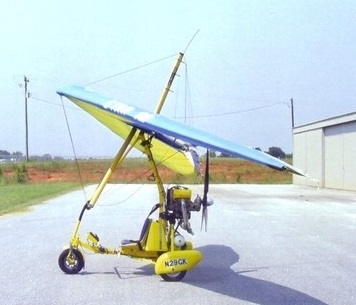
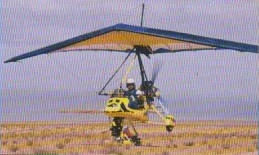
The Aquilair Kid ultralight trike was designed and produced by Aquilair to comply with the Fédération Aéronautique Internationale microlight category, including the category’s maximum gross weight of 450 kg (992 lb). The aircraft has a maximum gross weight of 300 kg (661 lb).

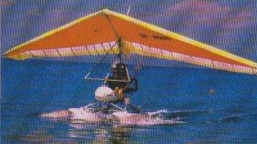
It features a cable-braced hang glider-style high-wing, weight-shift controls, a single-seat open cockpit, tricycle landing gear and a single engine in pusher configuration.

The aircraft is made from metal tubing, with its wing covered in Dacron sailcloth. Its 9.9 m (32.5 ft) span Star 12 wing is supported by a single tube-type kingpost and uses an “A” frame weight-shift control bar. The standard powerplant is a twin cylinder, air-cooled, two-stroke, dual-ignition 50 hp (37 kW) Rotax 503 engine, with the 40 hp (30 kW) Rotax 447 and the 64 hp (48 kW) liquid-cooled Rotax 582 optional.

With the Star 12 wing the aircraft has an empty weight of 132 kg (291 lb) and a gross weight of 300 kg (661 lb), giving a useful load of 168 kg (370 lb). With full fuel of 30 litres (6.6 imp gal; 7.9 US gal) the payload is 146 kg (322 lb).

The aircraft was supplied in modular form, with the chassis, engine, reduction drive and propeller all available separately, Priced at€7912 in 2011. A number of different wings can be fitted to the basic carriage, but the Star 12 was formerly the standard wing offered. The chassis incorporates an under-seat pivot system that allows the wing to be mounted and then raised into position.

Supplied as a kit for amateur construction or as a complete ready-to-fly-aircraft, production was completed in 2014.

Variants:

Kid 447
Aircraft with the twin cylinder, air-cooled, two-stroke, single-ignition 40 hp (30 kW) Rotax 447 and the 64 hp (48 kW)

Kid 503
Aircraft with the twin cylinder, air-cooled, two-stroke, dual-ignition 50 hp (37 kW) Rotax 503 engine

Kid 503 / Star 12 wing
Engine: 1 × Rotax 503, 37 kW (50 hp)
Propeller: 2-bladed wooden
Wingspan: 9.9 m (32 ft 6 in)
Wing area: 12.9 m2 (139 sq ft)
Empty weight: 132 kg (291 lb)
Gross weight: 300 kg (661 lb)
Fuel capacity: 30 litres (6.6 imp gal; 7.9 US gal)
Maximum speed: 145 km/h (90 mph; 78 kn)
Cruise speed: 90 km/h (56 mph; 49 kn)
Stall speed: 52 km/h (32 mph; 28 kn)
Rate of climb: 5 m/s (980 ft/min)
Wing loading: 23.2 kg/m2 (4.8 lb/sq ft)
Crew: one

Kid 582
Aircraft with the twin cylinder, liquid-cooled, two-stroke, dual-ignition 64 hp (48 kW) Rotax 582 engine
Aquilair Swing

Swing 582 S 14

The Swing trike is built in welded dural tube and uses a monopole which pivots behind the rear seat, to lift the wing. The Swing can use a Top 14.9 wing specially built for Aquilair by La Mouette.

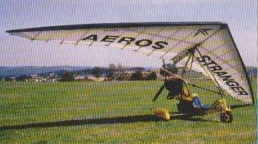
Aquilair does not make its own wings, but the budget Swing 502 Aeros uses Ukranian Aeros wings.

Swing 503 Aeros

The Swing Citroën uses a modified Citroën Visa engine of 56 hp.

Swing Citroën

Swing 582 S 14
Wing span: 9.90 m
Wing area: 14.9 sq.m
Fuel capacity: 50 lt
Certification: Vz
Engine: Rotax 582, 64 hp
MAUW: 405 kg
Seats: 2
Max speed: 148 kph
Cruise speed: 105 kph
Minimum speed: 56 kph
Climb rate: 5.5 m/s
Fuel consumption: 11 lt/hr
Price (1998): 115 000 Fttc

Swing 503 Aeros
Wing area: 14.8 sq.m
Fuel capacity: 30 lt
Engine: Rotax 503, 52 hp
MAUW: 405 kg
Seats: 2
Max speed: 125 kph
Cruise speed: 90 kph
Minimum speed: 52 kph
Climb rate: 5 m/s
Fuel consumption: 11 lt/hr
Price (1998): 80 500 Ftc

Swing Citroën
Empty weight: 151 kg
Wing span: 10.50 m
Wing area: 16 sq.m
Fuel capacity: 50 lt
Engine: Citroën Visa, 56 hp
MAUW: 405 kg
Seats: 2
Max speed: 145 kph
Cruise speed: 95 kph
Minimum speed: 58 kph
Climb rate: 4.8 m/s
Fuel consumption: 8 lt/hr
Price (1998): 135 000 Fttc

Aquilair ULM

Aquilair SA (English: Eagle Air) is a French aircraft manufacturer based in Theizé. The company specializes in the design and manufacture of ultralight trikes.

The privately held company originally produced named trike models with specific wing and engine combinations, such as their Aquilair Swing two-seater and Aquilair Kid single-seater. By 2014 they had moved to a modular system offering any combination of their single seat carriage (Chariot Monoplace) or two seat carriage (Chariot Biplace), five models of Ipsos wings made by La Mouette, various propellers, the 48 kW (64 hp) Rotax 582 twin cylinder, inline, liquid-cooled two-stroke or the 63 kW (84 hp) Verner VM133MK two cylinder, horizontally-opposed, four-stroke engines, instruments, radios and intercoms.

1998:
Pont de Lignon
F-43120 Monistrol
Loire
France

Aircraft built by Aquilair included
Aquilair Swing: Two seat ultralight trike
Aquilair Kid: Single seat ultralight trike
Aquilair Chariot Biplace: Two seat ultralight trike
Aquilair Chariot Monoplace: Single seat ultralight trike