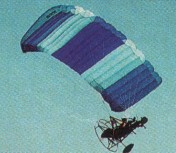
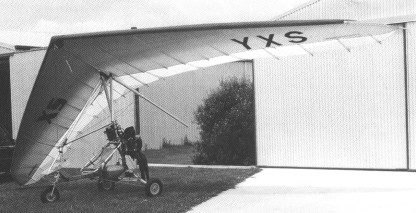
Manufactured in the US, the Dream Machine first flew in 1991. Options included the Rotax 503, instruments and instrument pod. The parachute is 1.1 oz ripstop nylon. The 1998 kit included the engine and propeller for US$8741.50.
Eagle 447 Engine: Rotax 447, 40 hp. Speed max: 26 mph. Cruise: 26 mph. Range: 50 sm. ROC: 500 fpm. Take-off dist: 150 ft. Landing dist: 100 ft. Service ceiling: 9500 ft. Fuel cap: 5 USG. Weight empty: 220 lbs. Gross: 500 lbs. Height: 6 ft. Length: 8.75 ft. Wing span: 35.5 ft. Wing area: 450 sq.ft. Seats: 1. Landing gear: nose wheel.
Eagle 503 Speed max: 26 mph. Cruise: 26 mph. Range: 50 sm. ROC: 650 fpm. Take-off dist: 150 ft. Landing dist: 100 ft. Service ceiling: 10,500 ft. Engine: Rotax 503, 46 hp. Fuel cap: 5 USG. Weight empty: 230 lbs. Gross: 540 lbs. Height: 6 ft. Length: 8.35 ft. Wing span: 35.5 ft. Wing area: 450 sq.ft. Seats: 1. Landing gear: nose wheel.
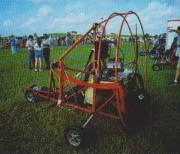
Manufactured in the US, the Dream Machine first flew in 1991. Options included the Rotax 503, instruments and instrument pod. The parachute is 1.1 oz ripstop nylon. Designed by Jack McCormack, the Buckeye is built from dural tubes bolted together.
It was offered as a single or two seater with various Rotax engines.
Dream Machine 503
The 1998 kit included the engine and propeller for US$13,429.08.
Dream Machine 582
Dream Machine 582 Engine: Rotax 582, 66 hp. Speed max: 30 mph. Cruise: 30 mph. Range: 60 sm. ROC: 700 fpm. Take-off dist: 150 ft. Landing dist: 100 ft. Service ceiling: 10,500 ft. Fuel cap: 6 USG. Weight empty: 300 lbs. Gross: 700 lbs. Height: 8 ft. Length: 9.43 ft. Wing span: 36.5 ft. Wing area: 500 sq.ft. Seats: 2. Landing gear: nose wheel.
Dream Machine 503 Empty weight: 123 kg Wingspan: 11.60 m Wing area: 46.5 sq.m Fuel capacity: 35 lt Engine: Rotax 503 DCDI, 52 hp Seats: 2 Max speed: 52 kph Cruise speed: 44 kph Min speed: 23 kph ROC: 2.5 m/sec Fuel burn: 16 lt/hr Kit price (1998): US$10,881
1995: 16111 Linden Rd, Argos, IN 46501, USA. Markets kits for single- and two-seat aircraft comprising ram-air parachute and powered trike, in Eagle and Dream Machine series.
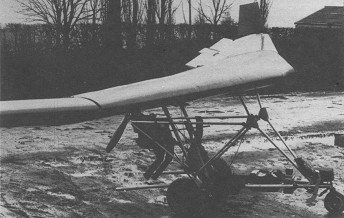
Single seat single engined high wing mono¬plane with conventional three axis control. Wing has swept back leading edge, unswept trailing edge and tapering chord; no tail. Pitch/roll control by stabilator; yaw control by tip rudders; control inputs through stick for pitch/roll and pedals for yaw. No external wing bracing; wing profile 100% double¬surface. Undercarriage has three wheels in tricycle formation; no suspension on any wheels. Flush right go right nosewheel steer¬ing connected to yaw control. No brakes. Aluminium tube framework, without pod. Engine mounted below wing driving pusher propeller. All tubing and bolts are to aircraft specification. Dave Bremner’s home¬built special uses a standard Mitchell B10 wing, the rest of the aircraft being to his own design. Certainly the most unusual aspect of the aircraft is its engine, a Suzuki twin from the GT185 motorcycle. Originally the aircraft was fitted with a 210 cc Villiers kart engine, but this suffered from two disadvantages: first it was difficult to arrange a suitable engine mounting system, and second it could only be started by swinging the prop. Dave’s search for a replacement led him to the GT185, which he chose because it has integral electric start and a horizontally split crankcase, allowing the gearbox to be re moved without expensive machining. In most respects he has built a fairly conventional machine, the cage being based on photographs and sketches of Mitchell’s own. There is no braking or suspension and the pedals are arranged so that both tip rudders can be deployed simultaneously to provide air braking. There were no plans to market the aircraft.
Engine: Suzuki GT 185, 20 hp at 6800 rpm. Propeller diameter and pitch 50 x 27 inch, 1. 28 x 0. 70 m. V belt reduction, ratio 3.0/1. Max static thrust 90 1b, 41 kg. Power per unit area 0.15 hp/sq.ft, 1.6 hp/sq.m. Fuel capacity 2.4 US gal, 2.0 Imp gal, 9.1 litre. Length overall 8.0ft, 2.44m. Height overall 4.8ft, 1.46m. Wing span 34.0ft, 10.36m. Chord at root 5.0ft, 1.52m. Chord at tip 1.3ft, 0.40m. Dihedral 6 deg. Sweepback 6 deg Rudder height 1.0 ft, 0.30 m Total wing area 136 sq.ft, 12.6 sq.m. Total stabilator area 12.0 sq.ft, 1.11 sq.m Rudder area 4.0 sq.ft, 0.37 sq.ft Wing aspect ratio 8.4/1. Wheel track 5.0 ft, 1.52 m Wheelbase 3.5 ft, 1.07 m Nosewheel diameter overall 10 inch, 254 mm Main wheels dia¬meter overall 16 inch, 406 mm Empty weight 242 lb, 110kg Max take off weight 492 lb, 223kg Payload 250 lb, 113 kg Max wing loading 3.67 lb/sq.ft, 17.9kg/sq.m Max power loading 24.61b/hp, 11.0kg/hp
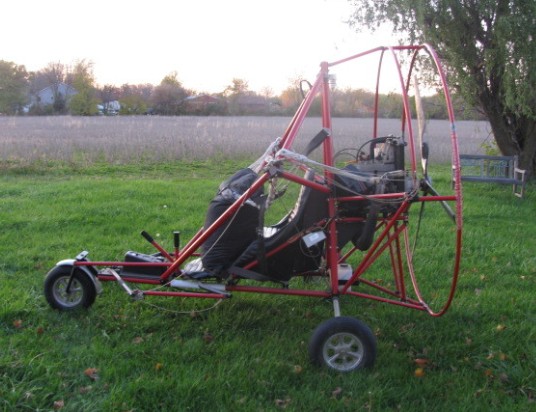
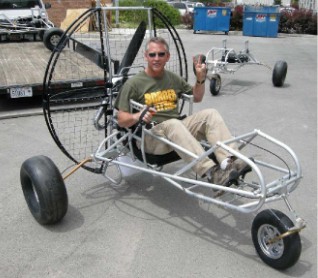
The S-Trike can be used with pretty much any paraglider and some skydiving & base jumping canopies for a variety of applications from transporting heavy gear to acrobatics. With the standard Flat Top 200 attached to the back it is capable of carrying up to 350 lbs. That means a 180 lb pilot can stow up to 170 lbs of gear in the detachable luggage pouch below the unit. Perfect for ferrying gear into remote areas. It can fly as high as 18,000 ft and has a fuel range of 280 miles. With up to an 11:1 glide ratio and speeds up to 50mph it is versatile. With a weight of only 144 lbs total after the addition of a Flat Top 200 it is easily within the ultralight classification so there is no license required for the pilot. It is portable when used with the travel rack designed for it which fits any standard receiver hitch and allows both the Flat Top and S-Trike to be carried behind a vehicle without need for a trailer. Perfectly balanced and fitted with a castered front landing gear the pilot can focus on flying the canopy during launch & landing as the S-Trike will happily follow along to the inputs from recommended gliders. Once under way and your canopy is flying over head the input from the canopy will allow you to steer back and forth and even drive around in circles without having to press the steering peddles or brakes on the S-Trike for direction while on the ground. This lightens the load on the pilot allowing them to focus more freely on throttle and toggle input. The glider hooks in much lower than on other designs making the unit far more stable and less prone to tipping but even with low hang points and a very low center of gravity life saving crumple zone was not forgotten. With over 21 inches of travel and spring steel axles the S-Trike will absorb an enormous amount of impact to help keep the pilot safe. Topped off with a quick release seat belt, an all aluminum 6061 T6 chassis and fitted with a High Energy reserve parachute you can see why pilots feel so secure flying it. The Flat Top 200 power plant is also its own backpack aircraft. If you have a tight or rough launch area you can always unhook the Flat Top and just foot launch it without the S-Trike. High speed stable to over 50mph you can launch much faster gliders for acro or xc flying. Toe steering, heel brakes. Left for left, right for right. Just like an airplane. Hold one brake to make tight turns or reverse launch in wind Every S-Trike joint is machined and fit perfectly. Spare parts are a breeze to install and it is more cost affective than welding. Cross drilled disk brakes allow you to drive it around like an ATV. The Alaskan bush tires and spring axels deliver a smooth ride even on rough ground. The S-Trike luggage bag can fit 7 gallon and 5 gallon gas cans comfortably together, and doubles as a mud flap and prop shield. In about 60 seconds the S-Trike can be broken down and clamped to its travel rack. By having 2 lighter pieces to deal with it is easy for a person to manage setup by themself. The S-Trike has adjustable lumbar support, well laid out controls for comfort and 21 inches of spring steel suspension to absorb impact, the S-Trike sets a new standard for safety. Equipped with a parking brake it gives you the ability to setup to launch on a hill, lock the wheels for transport or make the S-Trike paramotor stay put while warming up the engine. Price 2009: US$4,000.00

 All Aero