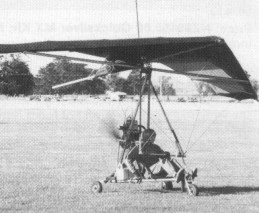
Development Technology Aero / DTA Feeling

Dynamic 15-430
Engine: Rotax 582
Max take-off weight (lbs): 946
Empty weight (lbs): 398
Useful Load (lbs): 548
Wing surface : 13.6 sq.m
Max speed (mph): 85
Min speed (mph): 34
Max rate of climb at 45 mph (ft/min): 866

Dynamic 16
Engine: Rotax 582
Max take-off weight (lbs): 880
Empty weight (lbs): 400
Useful Load (lbs): 480
Wing surface : 14.5 sq.m
Max speed (mph): 75
Min speed (mph): 32
Max rate of climb at 45 mph (ft/min): 905

Dynamic 450
Engine: Rotax 582
Max take-off weight (lbs): 990
Empty weight (lbs): 416
Useful Load (lbs): 574
Wing surface : 15.5 sq.m
Max speed (mph): 84
Min speed (mph): 31
Max rate of climb at 45 mph (ft/min): 945

Dynamic 450
Engine: Rotax 912
Max take-off weight (lbs): 990
Empty weight (lbs): 469
Useful Load (lbs): 521
Wing surface : 15.5 sq.m
Max speed (mph): 85
Min speed (mph): 39
Max rate of climb at 45 mph (ft/min): 984

Dynamic 450
Engine: Rotax 912S
Max take-off weight (lbs): 990
Empty weight (lbs): 469
Useful Load (lbs): 521
Wing surface : 15.5 sq.m
Max speed (mph): 87
Min speed (mph): 39
Max rate of climb at 45 mph (ft/min): 1181

Development Technology Aero / DTA Evolution

Evolution Trike / Dynamic 15/430
Engine: Rotax 503
Max take-off weight (lbs): 946
Empty weight (lbs): 363
Useful Load (lbs): 583
Wing surface : 13.6 sq.m
Max speed (mph): 76
Min speed (mph): 32
Max rate of climb at 45 mph (ft/min): 669

Evolution Trike / Dynamic 15/430
Engine: Rotax 582
Max take-off weight (lbs): 946
Empty weight (lbs): 381
Useful Load (lbs): 565
Wing surface : 13.6 sq.m
Max speed (mph): 83
Min speed (mph): 34
Max rate of climb at 45 mph (ft/min): 866

Evolution Trike / Dynamic 15/430
Engine: Rotax 912
Max take-off weight (lbs): 946
Empty weight (lbs): 444
Useful Load (lbs): 502
Wing surface : 13.6 sq.m
Max speed (mph): 86
Min speed (mph): 31
Max rate of climb at 45 mph (ft/min): 905

Evolution Trike / Dynamic 16
Engine: Rotax 503
Max take-off weight (lbs): 880
Empty weight (lbs): 365
Useful Load (lbs): 515
Wing surface : 14.5 sq.m
Max speed (mph): 71
Min speed (mph): 31
Max rate of climb at 45 mph (ft/min): 708

Evolution Trike / Dynamic 16
Engine: Rotax 582
Max take-off weight (lbs): 880
Empty weight (lbs): 383
Useful Load (lbs): 497
Wing surface : 14.5 sq.m
Max speed (mph): 73
Min speed (mph): 32
Max rate of climb at 45 mph (ft/min): 905

Evolution Trike / Dynamic 450
Engine: Rotax 503
Max take-off weight (lbs): 990
Empty weight (lbs): 381
Useful Load (lbs): 609
Wing surface : 15.5 sq.m
Max speed (mph): 75
Min speed (mph): 30
Max rate of climb at 45 mph (ft/min): 748

Evolution Trike / Dynamic 450
Engine: Rotax 582
Max take-off weight (lbs): 990
Empty weight (lbs): 398
Useful Load (lbs): 592
Wing surface : 15.5 sq.m
Max speed (mph): 82
Min speed (mph): 31
Max rate of climb at 45 mph (ft/min): 945

Evolution Trike / Dynamic 450
Engine: Rotax 912
Max take-off weight (lbs): 990
Empty weight (lbs): 451
Useful Load (lbs): 539
Wing surface : 15.5 sq.m
Max speed (mph): 83
Min speed (mph): 39
Max rate of climb at 45 mph (ft/min): 984

Evolution Trike / Dynamic 450
Engine: Rotax 912S
Max take-off weight (lbs): 990
Empty weight (lbs): 451
Useful Load (lbs): 539
Wing surface : 15.5 sq.m
Max speed (mph): 85
Min speed (mph): 39
Max rate of climb at 45 mph (ft/min): 1181

Development Technology Aero / DTA

DTA (Development Technology Aero) was founded in 1990 by Jean-Michel Dizier. DTA is a trike manufacturer in France, but specialised in the touring trike segment of the market. The DTA line of trikes was initially built around the need for capable aircraft to handle aerial work required in agriculture, territorial tracking and pipeline monitoring.

1998:
Zone d’activité de Nataloup
F-58230 Montsauche
France

Destiny 2000

The Destiny 2000 features bucket seats equipped with a standard 5 point harnes. Landings are controlled both by power and flare. The chassis absorbing landings. Gear legs have built in suspension with fibreglass rods and 22-in tundra tires. With a frame built around such large tires, gives a 4-inch-higher clearance.

Destiny Powered Parachutes’ Destiny 2000 first flew in November 1999.

The Destiny 2000 has no cargo area, but comes with saddle bags. The Destiny 2000 has individual bucket seats in tandem and a 5-point restraint harnesses.

Destiny offered three different canopies. They have 500- and 550-square-foot square canopy models supplied both by Apco and Elan as well as a newer Chiron elliptical canopy. The Chiron (pronounced sha-RONE) canopy is made in Israel by Sycon Aircraft. After being sewn and tested in Israel, the canopies are again tested in Austria, which Brown feels provides extra assurance to buyers. Aluminum airframe, 4130 chromoly steel. Nylon canopy with Dacron suspension lines. The carriage made in the USA.

The instructor works the throttle from the rear, all the student does initially is steer the nosewheel with the hand control on the left. Since it operates fore and aft to steer left and right, it may take some time to acquire comfort with this system.

In light or no winds, the controlling foot bar will be held to a minimum but the instructor can always aid control by hand pulling the canopy’s lines at either side. Pulling in toward you by hand is similar to pushing with your legs in physical exertion and an experienced instructor can stay on top of the controls in this manner.

Despite a 20% increase in glide angle and some boost in handling qualities, most buyers don’t request the Chiron canopy. The added $900 expense no doubt accounts for some of this hesitancy, and the Chiron is somewhat more temperamental in the launch phase. If the lines are sufficiently entangled the canopy won’t inflate. The reliable square canopy rarely has this problem.

The Chiron canopy on the Destiny proved diving turns to 45 mph are possible with the Chiron’s wider speed range. The throttle at each seat is close and convenient; throttle also moves conventionally (i.e., lever forward is more power).

There is no rear steering system; at least other than an instructor tugging on lines by hand. Controls seem counterintuitive for 3-axis pilots: no flying is done by hand (though general aviation pilots all use rudders, which aren’t so different from powered parachute steering bars); and nosewheel steering is non-intuitive until you acquire some experience with it. The higher aspect ratio Chiron canopy brings glide improvement – around 5:1 versus about 4:1. The Chiron is also capable of faster gliding turns. The speed barely passes 40 mph even in a descending diving turn.

The Rotax 503 was standard at $13,800. Standard Features were Digital Engine Information System (EIS), spun aluminum wheels, strobe, adjustable front seat, 5-point seat belts, and side stash pouches. Options were a 66-hp Rotax 582, electric start, and brake. Destiny later added a small roll bar to better protect occupants, especially the rear person.

Destiny Powered Parachutes specialised in delivering a fully ready-to-fly powered parachute with many features built into the base price.

Destiny 2000
Span: 38 ft
Length: 10 ft
Width: 6.7 ft
Wing area: 500 or 550 sq.ft
Empty weight: 370 lb
Gross weight: 850 lb
Top speed: 30 mph
Cruise: 26 mph
Fuel capacity: 10 USG
Rate of Climb: 700 fpm
Take off roll: 150 ft
Landing roll: 150 ft

Destiny 2000 Chiron canopy
Engine: Rotax 503, 50 hp at 6,250 rpm
Canopy Area: 340 square feet
Empty weight: 365 pounds
Gross weight: 850 pounds
Fuel capacity: 10 US gallon
Cruise speed: 29 mph
Rate of climb at gross: 700 fpm
Takeoff distance at gross: 100-150 feet
Landing distance at gross: 100-150 feet
Canopy Loading: 2.5 pounds/square foot
Power loading: 17.0 pounds per hp
Seating: 2-seat, tandem
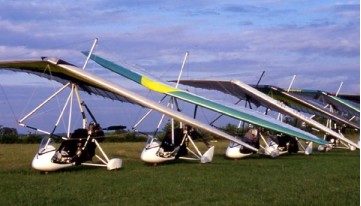
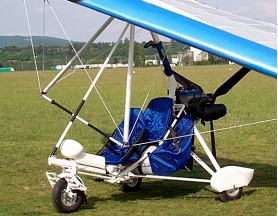
Destiny Powered Parachutes

Destiny Powered Parachutes was founded by sole company owner John Rivers. Using connections from his background in NASCAR Winston Cup auto racing, Rivers designed a sturdy carriage using crashworthy concepts from the racing world. His goal was to provide a higher level of comfort and safety in the carriage than he saw in other brands. A company of 15 employees expected to grow to 20 during 2001, Destiny taps its Michigan-based community for many retired auto workers who are rich in knowledge about machining and parts fabrication. Hiring has been furious with the company growing from 2 employees to 15 in just 2 years.

Began operating circa 2000, in Three Rivers, Michigan.

Delta Wing Trike

Delta Wing Kites turned to the produc¬tion of trikes intended for mounting under a standard hang glider wing without any mod¬ification to the latter in 1979. The first trikes sold by DWK were similar in every way to European models, using at first the Soarmaster trike unit with the single Chrysler 820 engine developing 10hp at 8000 rpm. In 1980 they offered an option of twin Chryslers or the German Solo 335 engine of 210 cc, which develops 20 hp at 7000 rpm. To accompany the trike unit, DWK offered initially its Phoenix D wing in various sizes, but this was replaced by the Phoenix X series; the trike unit can be used equally well under any other manufacturer’s Rogallo.
Because of the American legislation, the company only builds single seaters.
The company has also built trikes with Yahama KT 100S and Lloyd engines, but standardised on Robin power. Principal trike units offered in 1982 were with Robin EC25PS (22 hp, recoil start, $2250), EC34PM (32 hp, recoil start for $2395 or electric start for $2570), EC34PL (55.5 hp, recoil start $2795), and EC44PM (50hp, electric start, $2670).
Single seat single engined flex wing aircraft with weight shift control. Cage containing landing gear/engine unit is suspended from CG position by strong universal-type joint for easy conversion from hang glider to powered glider. Rogallo wing with keel pocket. Pilot suspended below wing in trike unit, using bar to control pitch and yaw/roll by altering relative positions of trike unit and wing. Wing braced from above by kingpost and cables, from below by cables; cross tube construction with double ¬surface enclosing cross tube. Undercarriage has three wheels in tricycle formation. Bungee-cord suspension and push right go left nosewheel steering independent from yaw control. Aluminium tube trike unit, without pod. Engine mounted below wing driving pusher propeller. 6061T6 alumi¬nium tubing, anodized. Stainless steel vinyl¬-coated rigging.

Trike / Phoenix X
Engine: Robin EC25PS, 22 hp.
Reduc¬tion ratio 2.5/1.
Power per unit area 0.13hp/sq.ft, 1.4hp/sq.m.
Fuel capacity 1.2 US gal, 1.0 Imp gal, 4.5 litre.
Wing span 32.5 ft, 9.91 m.
Total wing area 173 sq.ft,16.1sq.m.
Wing aspect ratio 6.0/1.
Main wheels diameter overall 16 inch, 40 cm.
Empty weight 182 lb, 83 kg.
Max take off weight 432 lb, 196kg.
Payload 250 lb, 113kg.
Max wing loading 2.50 lb/sq.ft, 12.2 kg/sq.m.
Max power loading 19.6 lb/hp, 8.9 kg/hp.

Trike / Dream
Wingspan 31 ‘4”.
Wing area 170 sq.ft.
Empty weight 182 lbs.
Wing loading 1.43 lbs./sq.ft.
Fuel capacity 1.2 USG.

Delta Wing Kites and Gliders / Air Sports International

Delta Wing Kites is a specialist in the sale of hang gliders, but then turned to the production of trikes intended for mounting under a standard hang glider wing without any modification to the latter in 1979.
1983: P.O. Box 483, Van Nuys, CA 91408, USA.

Delta king kites and Gliders was bought by Teddy Mack in 1991 and renamed Air Sports International.

The company manufactured The Dream line of gliders as hang gliders and trike wings in San Diego California from 1991 to 1997