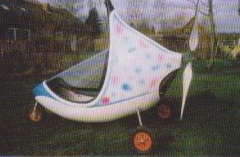
The Silent Racer was originally marketed as a single seater with retractable undercarriage and folding prop. The later Silent Racer Chronos 12 two seater had a fixed undercarriage and prop, but retained the integral fairing.
Silent Racer Chronos 12 Empty weight: 185 kg Wing span: 9.87 m Wing area: 12.9 sq.m Fuel capacity: 65 lt Certification: Vz Engine: Hirth 2704, 50 hp MAUW: 450 kg Seats: 2 Max speed: 140 kph Cruise speed: 100 kph Minimum speed: 65 kph Climb rate: 2.5 m/s Fuel consumption: 10 lt/hr Price (1998): 19 900 DM
The Heldeberg Marathon, also called the Blue Heron Marathon, was an American powered parachute, that was designed and produced by Heldeberg Designs of Altamont, New York.
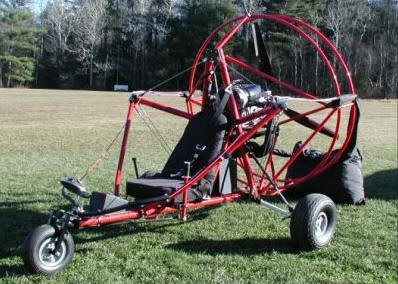
The Marathon was designed to comply with the US FAR 103 Ultralight Vehicles two-seat trainer rules and was marketed as a light-sport aircraft. The aircraft takes its name from its design goal of an aircraft with long range and endurance and features a range of 115 mi (185 km). It features a parachute-style high-wing, two-seats-in-tandem accommodation, tricycle landing gear and originally a single 50 hp (37 kW) Rotax 503 engine in pusher configuration. The 64 hp (48 kW) Rotax 582 was the standard engine used on later models.
The aircraft is built from a combination of bolted dural aluminium and stainless steel tubing. It features a double ring propeller guard that has been roll-over tested. The 10 U.S. gallons (38 L; 8.3 imp gal) fuel tank is made from aluminium. In flight steering is accomplished via foot pedals, or optionally a control stick, that actuate the canopy brakes, creating roll and yaw. On the ground the aircraft has lever-controlled nosewheel steering. The main landing gear incorporates gas strut suspension. The aircraft is factory supplied in the form of an assembly kit that requires 30–50 hours to complete.
Originally marketed by the factory under their own name, the aircraft was later marketed under the brand name Blue Heron, although the manufacturer remained the same. The selling price was US$21,995 in 2012, though production is now completed.
Blue Heron Marathon Powerplant: 1 × Rotax 582, 64 hp (48 kW) Length: 9 ft 8 in (2.95 m) Wingspan: 39 ft 6 in (12.04 m) Height: 6 ft 6 in (1.98 m) Wing area: 500 sq ft (46 m2) Empty weight: 308 lb (140 kg) Gross weight: 850 lb (386 kg) Fuel capacity: 10 U.S. gallons (38 L; 8.3 imp gal) Cruise speed: 32 mph (51 km/h; 28 kn) Range: 115 mi (100 nmi; 185 km) Rate of climb: 900 ft/min (4.6 m/s) Wing loading: 1.7 lb/sq ft (8.3 kg/sq.m) Crew: one Capacity: one passenger
The Heldeberg Spirit 103, also called the Blue Heron Spirit 103, is an American powered parachute, designed and produced by Heldeberg Designs of Altamont, New York.
The Spirit 103 was designed to comply with the US FAR 103 Ultralight Vehicles rules, including the category’s maximum empty weight of 254 lb (115 kg). The aircraft has a standard empty weight of 205 lb (93 kg). It features a parachute-style high-wing, single-place accommodation, tricycle landing gear and originally a single 45 hp (34 kW) 2si 460 engine in pusher configuration. The 40 hp (30 kW) Rotax 447 and 50 hp (37 kW) Rotax 503 engines are used on current models.
Early models used a large sized 500 sq ft (46 m2) parachute, whereas current models use a smaller and faster 400 sq ft (37 sq.m) wing.
The aircraft is built from a combination of bolted 6061 T-6 aluminium and stainless steel tubing. It features a double ring propeller guard that has been roll-over tested. The 5 U.S. gallons (19 L; 4.2 imp gal) fuel tank is made from aluminium. In flight steering is accomplished via foot pedals, or optionally a control stick, that actuate the canopy brakes, creating roll and yaw. On the ground the aircraft has lever-controlled nosewheel steering. The main landing gear incorporates gas strut suspension. The aircraft was factory supplied in the form of an assembly kit that requires 30–50 hours to complete for US$12795 in 2012.
Originally marketed by the factory under their own name, the aircraft was later marketed under the brand name Blue Heron, although the manufacturer remained the same.
Blue Heron Spirit 103 Engine: 1 × Rotax 503, 50 hp (37 kW) Wingspan: 39 ft 6 in (12.04 m) Wing area: 400 sq ft (37 sq.m) Length: 8 ft 6 in (2.59 m) Height: 6 ft 0 in (1.83 m) Empty weight: 235 lb (107 kg) Gross weight: 580 lb (263 kg) Fuel capacity: 5 U.S. gallons (19 L; 4.2 imp gal) Wing loading: 1.45 lb/sq ft (7.1 kg/sq.m) Power Loading: 11.3 lbs. per hp Cruise speed: 32 mph (51 km/h; 28 kn) Rate of climb: 450 ft/min Take Off Distance: 150 ft Landing Distance: 150 ft Seats: one
Founded in 1996, Heldeberg Designs was an American aircraft manufacturer, headquartered in Altamont, New York. The company specialized in powered parachutes.
Heldenberg Designs, 260 Benninger Rd. Delanson NY 12053
Originally marketing under its own name, the company marketed its aircraft under the brand name Blue Heron Powered Parachutes.
The company ceased manufacturing the Blue Heron line of powered parachutes in 2010. By early 2013 the company website stated: “After over 17 years of serving the aviation community, Heldeberg Designs LLC is wrapping up it’s operations and will no longer be manufacturing Blue Heron Powered Parachutes nor parts.”
Introduced in 1988, the Harmening High Flyer powered parachute was designed to comply with the US FAR 103 Ultralight Vehicles rules, including the category’s maximum empty weight of 254 lb (115 kg). The aircraft has a standard empty weight of 247 lb (112 kg). The aircraft was designed to be a single-place or optionally two-seater. The base model High Flyer features an MK Superfit rip-stop nylon parachute-style high-wing, tricycle landing gear and a single 45 hp (34 kW) 2si 460-F engine in pusher configuration. Variants use other engines.
High Flyer Executive
The aircraft is built from a combination of bolted 6061-T6 aluminium, welded 4130 steel tubing and mild steel. In flight steering is accomplished via foot pedals that actuate the canopy brakes, creating roll and yaw. On the ground the aircraft has lever-controlled nosewheel steering. The main landing gear incorporates sprung steel suspension. The aircraft was factory supplied in the form of an assembly kit that required 30–40 hours to complete.
All kits were manufactured in the USA, and includes the engine and 3 blade propeller. FAR 103 legal, the High Flyer Standard converts from single to two place in 10 minutes.
By 1998 the company reported that 75 kits had been sold and 75 aircraft were completed and flying, the cost in 2001 was US$9,500.
High Flyer 503
The production by Harmening’s High Flyers of Genoa, Illinois, USA, ended when the company went out of business in circa 2008.
High Flyer Deluxe
High Flyer Premiere
Variants:
High Flyer Base model Engine: 2si 460-F, 45 hp (34 kW) Cost 2001: US$9,500
High Flyer Standard Engine: Rotax 503, 50 hp (37 kW) Height: 6.7 ft Length: 10 ft Empty weight: 247 lb Gross weight: 687 lb Fuel capacity: 5 USG Cruise: 26 mph Range: 20 sm Rate of climb: 450 fpm Takeoff dist: 50-150 ft Landing dist: 20-50 ft Service ceiling: 10,000 ft Cost 2000: US$9,395 Completed and flown: 25 by early 2000
High Flyer Deluxe Larger fuel tank Engine: Rotax 503 50 hp (37 kW) engine Cost 2000: US$9,895 Completed and flown: 25 by early 2000
High Flyer Premiere Engine: HKS 700E, 60 hp (45 kW) Cost 2000: US$14,980 Completed and flown: 30 by early 2000
High Flyer Executive Engine: Hirth 2706, 65 hp (48 kW) Wingspan: 39 ft (12 m) Wing area: 550 sq ft (51 m2) Length: 10 ft 0 in (3.05 m) Carriage Height: 7 ft 0 in (2.13 m) Empty weight: 280 lb (127 kg) Gross weight: 830 lb (376 kg) Fuel capacity: 9 U.S. gallons (34 L; 7.5 imp gal) Cruise speed: 26 mph (42 km/h; 23 kn) Rate of climb: 1,000 ft/min (5.1 m/s) Crew: one Capacity: optionally one passenger, if second seat fitted Cost 2000: US$11,999 Completed and flown: 30 by early 2000
High Five Engine: Rotax 582, 64 hp (48 kW) Cost 2005: US$12,250 Completed and flown: 10 by early 2005
In 1998 Grif were making two microlight wings; the Spyder and the Trainer. The Spyder trike was made under subcontract and marketed under the Grif name.
Spyder trike Empty weight: 172 kg Wing span: 10.35 m Wing area: 14 sq.m Fuel capacity: 40 lt Engine: Rotax 503, 48 hp MAUW: 400 kg Seats: 2 Max speed: 120 kph Cruise speed: 90 kph Minimum speed: 42 kph Fuel consumption: 12 lt/hr Price (1998): 6 800 000 L
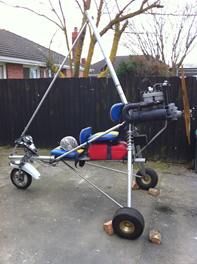
A two seat, custom built powered trike with undercarriage suspension certified with an Airborne Wizard wing. It was registered to Mr P T Goleman, PO Box 41046, Christchurch 8247, New Zealand, as ZK-JQH on 27 April 2005, and the serial noted as PG1. Powered by a Bombardier Rotax 532, single ignition engine and hand made wood, 2 blade prop made by Brent Thompson in NZ. The aircraft was flown out of Rangiora airfield. It was stored in 2006 and the wing sold. The registration was cancelled on 9 November 2007.
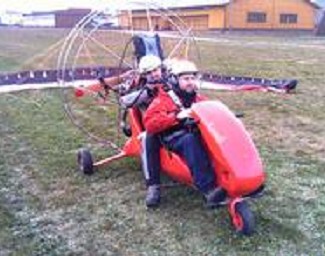
Our paratrikes are completely shell composite (fibre glass) construction which gives them very light weight. Fuel tank (standard): 10 l. (placed inside trike under engine). Very strong construction, durable for hard landings, stainless steel basket, disasembleable, protecting propeller from damage. Composite landing gear, wheels 300 mm with bearing, automatic wing positioning system (simple construction). Two seat trike: weight: 27 kg (without engine) length: 245 cm width: 165 cm. The Kermitt 2 bis fuel tank (standard): 35 l. (placed inside trike under engine). Composite landing gear, wheels 300 mm with bearing, automatic wing positioning system (simple construction). Two seat trike: weight: 32 kg (without engine) length: 245 cm width: 165 cm. Ideal for training.
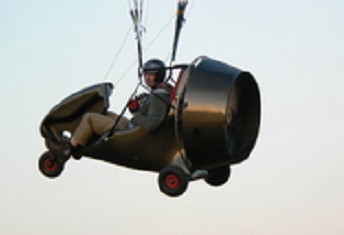
Kermitt Turbo
Worlds first full composite trike for PPG and paraplane, manufactured by polish producer GIMI. Powered by Hirth F33 engine with innovative tunnel drive.
Kermitt 2 Empty Weight: 56 kg / 123 lbs MTOW Weight: 270 kg / 595 lbs
Kermitt 2 bis Stall: 19 kt / 22 mph / 35 kmh Cruise: 38 kt / 43 mph / 70 kmh Empty Weight: 85 kg / 187 lbs MTOW Weight: 300 kg / 661 lbs Climb Ratio: 600 ft/min / 3,5 m/s Take-off distance (50ft obstacle): 100 ft / 30 m Landing distance (50ft obstacle): 70 ft / 20 m

 All Aero