1998:
Old Railway Inn
Clydach
NP7 0RD Abergavenny
United Kingdom
Trike builder
1998:
Old Railway Inn
Clydach
NP7 0RD Abergavenny
United Kingdom
Trike builder
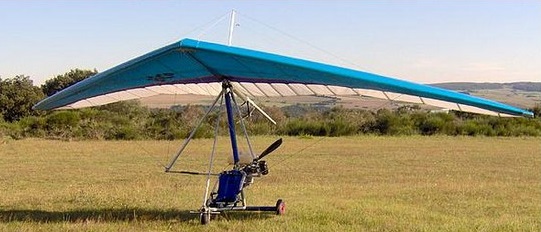
The Hubertec Thermik (English: Thermal) is a German ultralight trike, designed and produced by Hubertec of Aach, Rhineland-Palatinate. The aircraft was supplied as a complete ready-to-fly-aircraft.
The company is an industrial prototyping and exercise machine specialist that decided to produce an ultralight trike design as a sideline project.
The Invader 330 is a one plus one derivative of the Invader 440 (side by side one/two seat), using the smaller Robin EC34PM engine and a Flexiform Sky Sails Striker wing.
Engine: Robin EC34PM.
Toothed belt reduction.
Length overall 11.0ft, 3.35 m.
Wing span 34.5 ft, 10.52 m.
Sweep back 15 degs.
Total wing area 200 sq.ft, 18.6 sq.m.
Wing aspect ratio 7.5/1.
Wheel track 4.3 ft, 1.31 m.
Nosewheel diameter overall 16 inch, 41 cm.
Main wheels diameter overall 16 inch, 41 cm.
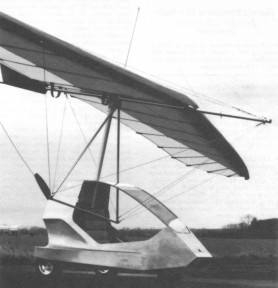
Hornet/Flexiform Sky Sails Invader 440/Dual Striker – A side by side two seat single engined flex wing aircraft with weight shift control. Rogallo wing with keel pocket. Pilot suspended below wing in trike unit, using bar to control pitch and yaw/rod by altering relative positions of trike unit and wing. Wing braced from above by kingpost and cables, from below by cables; bowsprit construction with 65% double surface; pre formed ribs. Undercarriage has three wheels in tricycle formation; steel spring suspension on nosewheel and rubber suspension on main wheels. Push right go left nose¬wheel steering independent from yaw control. Brakes on main wheels. Aluminium tube/ glass fibre trike unit, partially enplosed. Engine mounted below wing driving pusher propeller. All major components made from aircraft quality materials.
The Invader gives weather protection, quick rigging and ease of ground handling a high priority. The wind tunnel developed trike unit is almost fully enclosed, only the sides being open, and is of mono pole construction. The mono pole is an aerofoil rather than the usual round section and is mated to a one piece rear axle instead of the two piece plus tie wire arrangement commonly used with mono poles.
To cope with rough field operation, all three wheels have suspension and in addition the nose wheel geometry is arranged to give a self stabilising effect, so that the aircraft runs true even if the pilot makes a less than perfect touchdown. A hand operated brake is fitted to the main wheels, arranged so that it can be used as a parking brake. The fuel tank is made from aluminium alloy with internal baffles.
Rigging is confined to the wing and is hence claimed to take a maximum of 15 minutes. The trike unit has road tyres on the rear, running on stainless steel axles and taper=roller bearings, so that it can be towed complete on its own wheels. Wing fitment is the Flexiform Skysails Dual Striker, a fast wing which Hornet designer Richard Wolfenden says is well matched to the new trike unit.
Length overall 14.0 ft, 4.27 m.
Height overall 12.5 ft, 3.80m.
Wing span 38.0 ft, 11.58m.
Chord at root 9.0 ft, 2.74m.
Chord at tip 3.5ft, 1.07m.
Dihedral 2 degs.
Sweepback 15 degs.
Keel pocket depth 1.2ft, 0.37m.
Total wing area 250 sq.ft
23.2 sq.m.
Keel pocket area 3.5 sq.ft, 0.33 sq.m.
Wing aspect ratio 6.0/1.
Wheel track 4.3 ft, 1.31 m.
Nosewheel diameter overall 16 inch, 41 cm.
Main wheels diameter overall 16 inch, 41 cm.
Engine: Robin EC44, 50 hp.
Propeller diameter and pitch 60×34 inch, 1.52×0.86m.
Toothed belt reduction, ratio 2.8/1.
Max static thrust 280 lb, 127kg.
Power per unit area 0.20hp/sq.m, 2.2 hp/sq.m.
Fuel capacity 5.0 US gal, 4.2 Imp gal, 19.1 litre.
Empty weight 290 lb, 132kg.
Max take off weight 682 lb, 309kg.
Payload 392 lb, 1.78kg.
Max wing loading 2.73 lb/sq.m, 13.3 kg/sq.m.
Max power loading 13.6 lb/hp, 6.2 kg/hp.
Load factors +4.5, 2.0 design.
The Supreme 440 is identical to the 440 Dual except that the chrome plated joint pieces and electric start are fitted as standard.
While some manufacturers of big engined two seat trikes recommend that ballast should be carried when flying solo, Hornet prefer instead to reduce the throttle opening, saying that, thanks to the lift characteristics of the Cutlass CD wing, the solo pilot can take off quite quickly even on part throttle.
440 Dual
Engine: Robin EC44, 45 hp at 6500 rpm.
Propeller diameter and pitch 54 x 36 inch, 1.37 x 0.91 m.
Toothed belt reduction, ratio 2.5/1.
Max static thrust 270 lb, 122 kg.
Power per unit area 0.23 hp/sq.ft, 2.4hp/sq.m.
Fuel capacity 4.8 US gal, 4.0 Imp gal, 18.2 litre in each tank; two tanks.
Empty weight 293 (313) lb, 133 (142) kg.
Max take off weight 685 lb, 311 kg.
Payload 392 lb, 178 kg.
Max wing loading 3.46 lb/sq.ft, 16.9 kg/sq.m.
Max pow¬er loading 15.2 lb/hp, 6.9 kg/hp.
Load factors; >+3.75 ultimate.
Max level speed 60 mph, 97 kph.
Never exceed speed 68 mph, 109 kph.
Max cruising speed 45 mph, 72 kph.
Economic cruising speed 40 mph, 64 kph.
Stalling speed 26 mph, 42 kph.
Max climb rate at sea level 850 ft/min, 4.3 m/s.
Take off distance 45ft, 14m.
Landing dis¬tance 110ft, 35m (without brakes).
Total range at average cruising speed 190 mile, 306 km.
Supreme 440
Engine: Robin EC44, 45 hp at 6500 rpm.
Propeller diameter and pitch 54 x 36 inch, 1.37 x 0.91 m.
Toothed belt reduction, ratio 2.5/1.
Max static thrust 270 lb, 122 kg.
Power per unit area 0.23 hp/sq.ft, 2.4hp/sq.m.
Fuel capacity 4.8 US gal, 4.0 Imp gal, 18.2 litre in each tank; two tanks.
Empty weight 313 lb, 142 kg.
Max take off weight 705 lb, 320 kg.
Payload 392 lb, 178 kg.
Max wing loading 3.56 lb/sq.ft, 17.4 kg/sq.m.
Max pow¬er loading 15.7 lb/hp, 7.1 kg/hp.
Load factors; >+3.75 ultimate.
Max level speed 60 mph, 97 kph.
Never exceed speed 68 mph, 109 kph.
Max cruising speed 45 mph, 72 kph.
Economic cruising speed 40 mph, 64 kph.
Stalling speed 26 mph, 42 kph.
Max climb rate at sea level 850 ft/min, 4.3 m/s.
Take off distance 45ft, 14m.
Landing dis¬tance 110ft, 35m (without brakes).
Total range at average cruising speed 190 mile, 306 km.
Single seat single engined flex wing aircraft with weight shift control. Rogallo wing with keel pocket. Pilot suspended below wing in trike unit, using bar to control pitch and yaw/roll by altering relative positions of trike unit and wing. Wing braced from above by kingpost and cables, from below by cables; floating cross tube construction with 55% double surface enclosing cross tube; pre-formed ribs. Undercarriage has three wheels in tricycle formation; no suspension on any wheels. Push right go left nosewheel steering independent from yaw control. Optional brake on nosewheel. Aluminium tube trike unit without pod (250), with pod and side fairings (250 Executive). Engine mounted below wing driving pusher propeller. All major components made from aircraft quality materials. Front fork assembly made from aluminium alloy.
The 250 is a basic single seat trike unit generally sold with a Skyhook Sailwings Sabre C wing. Other wings offered are Skyhook Sailwings Cutlass C, Airwave Nimrod, Gold Marque Sports Gyr and Flexiform Skysails Striker.
Instead of the usual bolt and saddle washers method, Hornets use tube joint pieces made from external sleeving, welded together in the appropriate shape (T, L or whatever). The tubes are slid inside the joint pieces and retained by aircraft quality bolts or, for less critical applications, stainless steel rivets. Made from steel, the joint pieces have passivated zinc plating for corrosion protection; chromium plating is an option.
A recognition point is the U shaped nose tube, designed to facilitate the fitting of Hornet’s own glass fibre pod. When fitted with this pod plus glass fibre side fairings, the trike unit is known as the 250 Executive. Other options include a nosewheel brake, alloy skis, alloy wheels, an extra fuel tank holding 3.6 US gal (3.0 Imp Gal).
1983: Templeward Ltd t/a Hornet Microlights, Bankfoot Mills, Wibsey Bank, Bankfoot, Bradford, West Yorkshire BD63JU, Great Britain.
LSA and Trike builder
Wing has floating cross tube construc¬tion with 75 % double surface enclosing cross¬tube; preformed ribs, and optional nosewheel brake.
Length overall 11.0ft, 3.35m.
Wing span 32.0ft, 9.75m.
Chord at root 8.2ft, 2.50m.
Chord at tip 3.5 ft, 1.07 m.
Dihedral 0 degs.
Nose angle 120 degs.
Total wing area 175 sq.ft, 16.3 sq.m.
Wing aspect ratio 5.9/1.
Empty weight 195 lb, 88kg.
Max take off weight 470 lb, 213 kg.
Payload 275 lb, 125 kg.
Max wing loading 2.69 lb/sq.ft, 13.1 kg/sq.m.
Max power loading 14.7 lb/hp, 6.7kg/hp.
Max level speed 40 mph, 64 kph.
Never exceed speed 45 mph, 72 kph.
Max cruising speed 35 mph, 56 kph.
Economic cruising speed 30mph, 48kph.
Stalling speed 22 mph, 35 kph.
Max climb rate at sea level 600 ft/min, 3.0 m/s.
Min sink rate 300 ft/min at 28 mph, 1.5 m/s at 45 kph.
Best glide ratio with power off 7/1 at 28 mph, 45 kph.
Take off distance 80 ft, 25 m.
Landing distance 100 ft, 30 m.
Range at average cruising speed 65 mile, 105 km.
Engine: Hiro Delta Mk.I, 22 hp at 8000 rpm.
Propeller diameter and pitch 52 x 30in, 1.32 x 0.76m.
Gear reduction with oil bath, ratio 3.64.
Max static thrust 150 lb, 68 kg.
Power per unit area 0.13hp/sq.ft, 1.3hp/sq.m.
Fuel capacity 2.4 US gal, 2.0 Imp gal, 9.1 litre.
Empty weight 175 lb, 79kg.
Max take off weight 429 lb, 195kg.
Payload 254 lb, 115 kg.
Max wing loading 2.45 lb/sq.ft, 12.0 kg/sq.m.
Max power loading 19.5 lb/hp, 8.9kg/hp.
Max level speed 40 mph, 64 kph.
Never exceed speed 45 mph, 72kph.
Max cruising speed 35mph, 56kph.
Economic cruising speed 30 mph, 48 kph.
Stalling speed 22 mph, 35 kph.
Max climb rate at sea level 450 ft/min, 2.3 m/s.
Min sink rate 350 ft/min at 28 mph, 1.8 m/s at 45 kph.
Best glide ratio with power off 8/1 at 28 mph, 45 kph.
Take off distance 80 ft, 25 m.
Landing distance 80 ft, 25 m.
Range at average cruising speed 65 mile, 105 km.
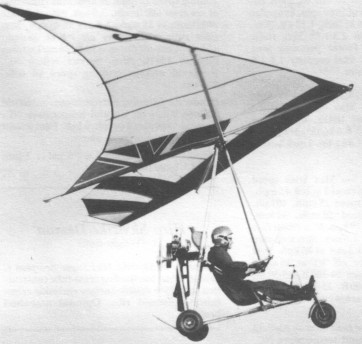
The Skytrike was the first British produced trike unit; allied to Hiway’s simple but effective Super Scorpion wing, (usually in the larger ‘C’ size). Designed by Frank Tarjanyi, the Skytrike/Super Scorpion C was introduced in 1979, the combination of a single surface wing and 10 hp did not exactly make for high performance and its pilot weight range was distinctly limited, but the basic formula was obviously right.
The power shortage was solved by the introduction of Robin engines, in which form the trike unit was dubbed Skytrike Mk II, with the Valmet engined version being known retrospectively as the Mk I. Two versions of the Mk II were offered, a single cylinder 250 cc version which usually retained the Super Scorpion wing, and a twin cylinder 330 cc version which typically is flown with the Hiway Demon wing.
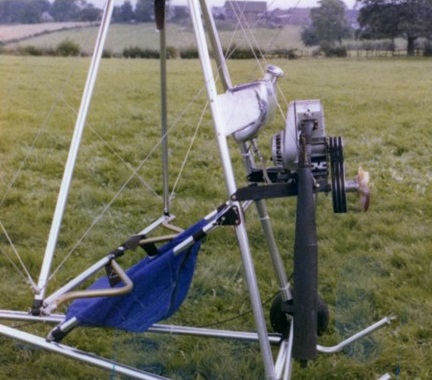
Hiway’s next move was an attempt to retain the performance of the 330 cc version but save some weight, by using the small but powerful liquid cooled Hiro Delta MkI engine to produce the Hiro Skytrike trike unit. The result was an aircraft with an impressive performance for its engine size, due partly to the elimination of drive belts in favour of integral reduction gearing. Moreover, the liquid cooling allowed the inclusion of an effective carburettor anti icing system. Other than the engine, the only significant change to the trike unit was the replacement of the front wire by a strut.
Despite these qualities, the Hiro Skytrike found few buyers in a market which was becoming enamoured with the smoothness and reliability of the 330 cc Robin. It was not helped by the Skytrike’s growing reputation for poor detail engineering. Having made the initial great leap to power, it seemed that the company’s heart had returned to soaring; the marketing and detail development of the Skytrike were neglected and the company’s resources concentrated instead on a radical new hang glider called the Explorer. When this was received less than rapturously by the hang gliding world, it spelt the end of the company. In 1983 Hiway Hang Gliders Ltd was in liquidation.
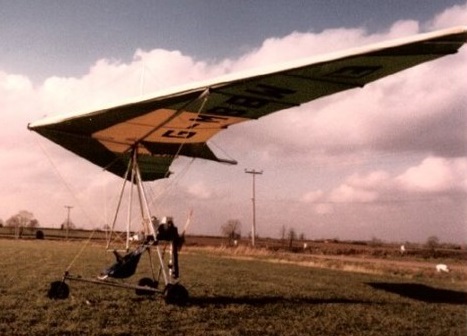
The Mk.II 330/Demon wing has floating cross tube construc¬tion with 75% double surface enclosing cross¬tube; pre formed ribs, and optional nosewheel brake.
Mk.I
Engine: Valmet, 10 hp at 5000 rpm.
Propeller diameter and pitch 54 x 30 ft, 1.37 x 0.76 m.
V belt re¬duction, ratio 2.8/1.
Max static thrust 75 lb, 34 kg.
Power per unit area 0.05 hp/sq.ft, 0.5 hp/sq.m.
Fuel capacity 2.1 US gal, 1.8 Imp gal, 7.9 litre.
Wing span 33.5 ft, 10.21 m.
Mean chord at 5.9 ft, 1.80 m.
Total wing area 198 sq.ft, 18.4 sq.m.
Wing aspect ratio 5.7/1.
Empty weight 1251b, 57kg.
Max take off weight 286 lb, 130kg.
Payload 161 lb, 73kg.
Max wing loading 1.44 lb/sq.ft, 7.1 kg/sq.m
Max power loading 28.6 lb/hp, 13.0 kg/hp.
Max level speed 26 mph, 42 kph.
Never exceed speed 40 mph, 64kph.
Max cruising speed 22mph, 35kph.
Economic cruising speed 22mph, 35kph.
Stalling speed 17 mph, 27 kph.
Max climb rate at sea level 100 ft/min, 0.5 m/s.
Min sink rate 190 ft/min at 21 mph, 1.0 m/s at 34 kph.
Best glide ratio with power off 8/1 at 22 mph, 35 kph.
Take off distance 150 ft, 45 m
Land¬ing distance 70 ft, 20 m
Range at average cruising speed 51 mile, 83 km.
Mk.II 250/Super Scorpion C
Engine: Robin EC25PS, 18 hp at 7000 rpm.
Propeller diameter and pitch 52 x 31 inch, 1.32 x 0.79 m.
V belt reduction, ratio 2.3/1. (Early aircraft used a 54×24 inch propeller with reduction ratio 2/1.)
Max static thrust 1301b, 59kg.
Power per unit area 0.09hp/sq.ft, 1.0hp/sq.m.
Fuel capacity 2.4 US gal, 2.0 Imp gal, 9.1 litre. (Early aircraft used a 1.6 US gal (1.3 Imp gal, 6.1 litre) fuel tank.)
Wing span 33.5 ft, 10.21 m.
Mean chord at 5.9 ft, 1.80 m.
Total wing area 198 sq.ft, 18.4 sq.m.
Wing aspect ratio 5.7/1.
Empty weight 1651b, 75kg.
Max take off weight 3491b, 158kg.
Payload 1841b, 83kg.
Max wing loading 1.76 lb/sq.ft, 8.6kg/sq.m.
Max pow¬er loading 19.41b/hp, 8.8kg/hp.
Max level speed 30 mph, 48 kph.
Never exceed speed 45 mph, 72kph.
Max cruising speed 25mph, 40kph.
Economic cruising speed 25 mph, 40 kph.
Stalling speed 18 mph, 29 kph.
Max climb rate at sea level 300 ft/min, 1.5 m/s.
Min sink rate 250 ft/min at 25 mph, 1.3 m/s at 40 kph.
Best glide ratio with power off 9/1 at 25 mph, 40kph.
Take off distance 90 100ft, 25 30 m.
Landing distance 90 100ft, 25 30m.
Range at average cruising speed 50 mile, 80 km.
Mk.II 330/Demon
Engine: Robin EC34PM, 32 hp at 6500 rpm.
Propeller diameter and pitch 52 x 30 inch, 1.32 x 0.76 m.
V belt reduction, ratio 2/1.
Max static thrust 180 lb, 82 kg.
Power per unit area 0.18 hp/sq.ft, 2.0 hp/sq.m.
Fuel capacity 2.4 US gal, 2.0 Imp gal, 9.1 litre. (Early aircraft used a 1.6 US gal (1.3 Imp gal, 6.1 litre) fuel tank.).
Length overall 11.0ft, 3.35m.
Wing span 32.0ft, 9.75m.
Chord at root 8.2ft, 2.50m.
Chord at tip 3.5 ft, 1.07 m.
Dihedral 0 degs
Nose angle 120 degs.
Total wing area 175 sq.ft, 16.3 sq.m.
Wing aspect ratio 5.9/1.
Empty weight 195 lb, 88kg.
Max take off weight 470 lb, 213 kg.
Payload 275 lb, 125 kg.
Max wing loading 2.69 lb/sq.ft, 13.1 kg/sq.m.
Max power loading 14.7 lb/hp, 6.7kg/hp.
Max level speed 40 mph, 64 kph.
Never exceed speed 45 mph, 72 kph.
Max cruising speed 35 mph, 56 kph.
Economic cruising speed 30mph, 48kph.
Stalling speed 22 mph, 35 kph.
Max climb rate at sea level 600 ft/min, 3.0 m/s.
Min sink rate 300 ft/min at 28 mph, 1.5 m/s at 45 kph.
Best glide ratio with power off 7/1 at 28 mph, 45 kph.
Take off distance 80 ft, 25 m.
Landing distance 100 ft, 30 m.
Range at average cruising speed 65 mile, 105 km.
Hiway, founded by John Ievers and Steve Hunt, first produced a standard Rogallo, in 1973.
Hiway Hang Gliders Ltd
Sirhowy Hill
Tredegar
Gwent NP2 4XP
UK
27/35 Bernard Rd
Brighton
UK
Hiway decided to return to simplicity for a new range of gliders, with no wing wires. Hiway designed the airframe to fles in a particular way under flight loads, and then sew the sail to fit the shape exactly.
The first of the range were 1) Super Scorpion, a cross-country hang glider. 2) Spectrum, intermediate glider. 3) Gemini, purpose designed two-place glider. 4) Harrier, primary and training glider.
Hiway hang gliders was re-floated as Hiway (83) Ltd. under the directorship of Jim Bowyer, Rod Macdonald and John Ievers (one of the original founders). Glider designs which have been carried over to the new company were as follows: Excalibur, a high performance CFX with flexible tips. Price £1141.95. Vision. double surface intermediate. £897.00. Explorer .Advanced rigid wing with aerodynamic controls. These were made to fulfill a German contract.Price £1581.25. Superscorpion 2. Post P1 .Price £747.50.(Manufactured 83 to 85).Stubby. Training glider.
 All Aero