Klub Siniaya Ptica SPM

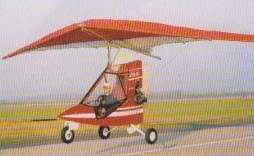
Single seat single engined flex wing aircraft with hybrid control. Rogallo wing; tail carries rudder and horizontal stabiliser. Pilot suspended below wing in trike unit, using bar to control pitch and roll by altering relative positions of trike unit and wing. Control input through pedals for yaw. Wing braced from above by kingpost and cables, from below by cables. Undercarriage has three wheels in tricycle formation. Engine mounted below wing driving pusher propeller.
Two Rogallo winged microlights are known to have been produced under the umbrella of this organisation, both of them attributed to Yevgueni Chevcheriko. As such they are hybrid control aircraft and are best described as ‘trike plus rudder on trike unit’. The trike unit is hung from the Rogallo in the normal way and the relative positions of the two can be altered to give pitch and roll control, just as in any other trike, but instead of relying on roll to initiate yaw, a separate rudder is attached to the rear of the trike unit, controlled by rudder pedals.
The Russian aircraft have a horizontal stabiliser behind the pilot. The Ptica 2, the earlier of the two Russian designs, has a large windscreen. The Ptica 2 has a 42 hp engine, 4 hp less than the SPM.
The initials SPM stand for Siniaya Ptica Modernisovanna, and it is basically an updated version of the Ptica 2.

Engine: 46 hp.
Total wing area 221 sq.ft, 20.5 sq.m.
Power per unit area 0.21 hp/sq.ft, 2.2 hp/sq.m.
Max take off weight: 401 lb, 182 kg.
Max wing loading: 1.81 1b/sq.ft, 8.9 kg/sq.m.
Max power loading 8.7 lb/hp, 4.0 kg/hp.
Take off speed 25mph, 40 kph.
Take off distance 100 130ft, 30 40m.
Landing dis¬tance 80 100 ft, 25 30 m.
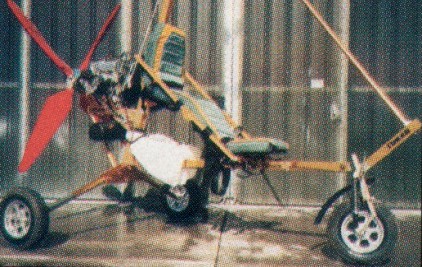
Klub Siniaya Ptica Ptica-2

Single seat single engined flex wing aircraft with hybrid control. Rogallo wing; tail carries rudder and horizontal stabiliser. Pilot suspended below wing in trike unit, using bar to control pitch and roll by altering relative positions of trike unit and wing. Control input through pedals for yaw. Wing braced from above by kingpost and cables, from below by cables. Undercarriage has three wheels in tricycle formation. Engine mounted below wing driving pusher propeller.
Two Rogallo winged microlights are known to have been produced under the umbrella of this organisation, both of them attributed to Yevgueni Chevcheriko. As such they are hybrid control aircraft and are best described as ‘trike plus rudder on trike unit’. The trike unit is hung from the Rogallo in the normal way and the relative positions of the two can be altered to give pitch and roll control, just as in any other trike, but instead of relying on roll to initiate yaw, a separate rudder is attached to the rear of the trike unit, controlled by rudder pedals.
The Russian aircraft have a horizontal stabiliser behind the pilot. The Ptica 2, the earlier of the two Russian designs, has a large windscreen. The Ptica 2 has a 42 hp engine, 4 hp less than the SPM.

Engine: 42hp.
Propeller diameter: 15in, 0.38m.
Total wing area 242 sq.ft, 22.5sq.m.
Power per unit area 0. 17 hp/sq.ft, 1.9hp/sq.m.
Take off speed 40mph, 65kph.
Cruising speed 62 mph, 100 kph.

Kemmeries Tukan

Engine: Rotax 447, 40 hp.
HP range: 40-70.
Height: 13 ft.
Length: 8 ft.
Wing span: 35 ft.
Wing area: 220 sq.ft.
Weight empty: 250 lbs.
Gross: 750 lbs.
Fuel cap: 5 USG.
Speed max: 55 mph.
Cruise: 38 mph.
Range: 70 sm.
Stall: 24 mph.
ROC: 750 fpm.
Take-off dist: 50 ft.
Landing dist: 50 ft.
Service ceiling: 15,000 ft.
Seats: 2.
Landing gear: nose wheel.

I-TEC Maverick

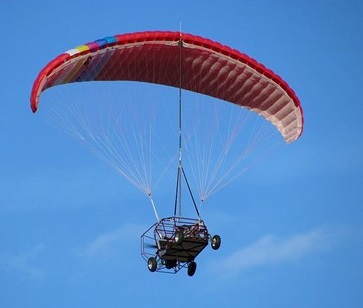
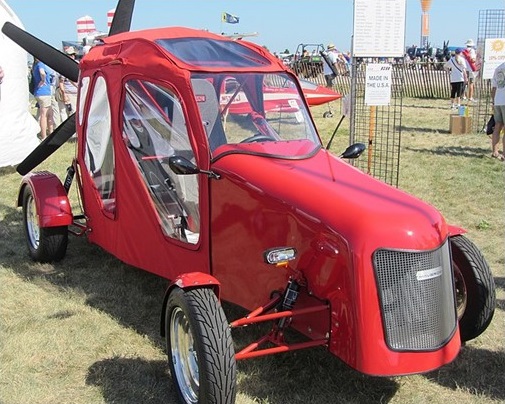
The I-TEC Maverick is a powered parachute aircraft with a roadable fuselage. Equipped with the largest powered parachute certified by the FAA, the Maverick received experimental aircraft airworthiness certification on April 14, 2008, with N-Number 356MV.

prototype flight

Capable of interstate speeds on pavement, the Maverick’s dune buggy-like frame of chromoly tubing gives it the ability to be used off-road. Additionally, the vehicle can deploy a parafoil and fly as a powered parachute, it weighs about 1100 pounds and has a useful carrying capacity equivalent to a Cessna 172 (fuel and 550 pounds cargo). With a 22-foot mast, the Maverick can take off and land in weather conditions that other powered parachutes would not be able to safely operate in. Steve Saint has said he envisions the Maverick being useful to the Huaorani and other Indian groups, farmers and ranchers, pipeline inspection crews and anyone else with a requirement to traverse rough, roadless ground. Popular Mechanics gave it their Breakthrough Award in 2009. In 2012, the Maverick was accepted by the United States FAA to operate as an Experimental homebuilt, S-LSA, or E-LSA.

Variants:

Maverick URVATV (Ultimate Roadable, All-Terrain, Aerial Vehicle)
Initial model

Maverick HPAV (High Performance Aerial Vehicle)
Transaxle removed, fan drive only

Maverick HPRATV (High-Performance, Roadable, All-Terrain Vehicle)
Wheel drive only, convertible to flight.

Maverick XTRV (Xtreme Roadable Vehicle)
300 hp (224 kW) wheel drive only.

Specifications:
Engine: 1 × 2.5l Subaru Four cylinder, 190 hp (140 kW)
Propeller: 5-bladed Warp Drive
Cruise speed: 35 kn; 64 km/h (40 mph)
Endurance: 3 hours
Service ceiling: 10,000 ft (3,000 m)
Rate of climb Crew: 1
Capacity: 1
ROC: 600 ft/min (3.0 m/s)

Institute of Aviation ZEM-94 Mozeta

This stick-controlled all-enclosed topless winged prototype was designed to evaluate wing performance by measuring deflection of the trike unit in relation to its drag.

Empty weight: 170 kg
Wing span: 10.2 m
Wing area: 15 sq.m
Fuel capacity: 20-60 lt
Engine: Rotax 503, 52 hp
MAUW: 360 kg
Seats: 2
Max speed: 150 kph
Cruise speed: 120 kph
Minimum speed: 60 kph
Climb rate: 6 m/s
Fuel consumption: 10 lt/hr
Price (1998): 45 000 PLZ

Huntwing Avon / Experience

Initially a homebuilt designed and constructed by John Hunt purely for himself, the Avon trike unit and Experience wing were later marketed as an inexpensive flexwing. The wing was bought complete and the rest built from plans.

Empty weight: 160 kg
Wing span: 10.6 m
Wing area: 15.24 sq.m
Fuel capacity: 50 lt
Certification: BMAA
Engine: Rotax 582, 65 hp
MAUW: 372 kg
Seats: 2
Max speed: 121 kph
Cruise speed: 88 kph
Minimum speed: 48 kph
Climb rate: 3.3 m/s
Fuel consumption: 12 lt/hr
Plan price (1998): £115