Parachute, Trigear trike unit
Trike unit
Paraborne Buckshot / Goodwin Buckshot
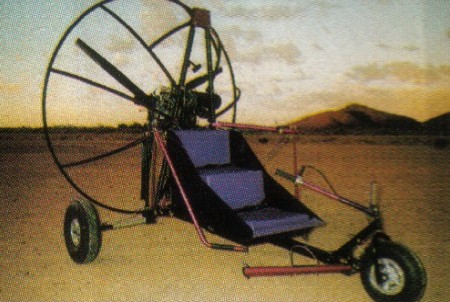
The Goodwin Buckshot is an American powered parachute that was designed and produced by FL Goodwin of Phoenix, Arizona and introduced in 1998.
Designed as a US FAR 103 Ultralight Vehicles two seat trainer, it features a parachute-style high-wing, two seats in side-by-side configuration, tricycle landing gear and a single engine in pusher configuration. The standard engines supplied were the 45 hp (34 kW) 2si 460F-45 and the 45 hp (34 kW) Zenoah G-50 engine, although any light, two-cylinder, two-stroke engine can be used.
The aircraft is built from bolted anodized aluminium tubing to save weight. In flight steering is accomplished via foot pedals that actuate the canopy brakes, creating roll and yaw. On the ground the aircraft has tiller-controlled nosewheel steering. The main landing gear does not incorporate suspension and the aircraft relies on large tundra tires to provide this.
The aircraft was distributed by Paraborne Aviation of Kissimmee, Florida. The Buckshot is out of production.
The rectangular canopy is made from double ripstop, mylar and kevlar. The trike design utilises shroud lines and risers.
Engine: Rotax 503, 46 hp
hp range: 40-65
Height: 7 ft
Length: 9 ft
Wing span: 50 ft
Wing area: 502 sq.ft
Empty weight: 230 lb
Gross weight: 730 lb
Fuel capacity: 13.5 USG
Cruise: 26 mph
Rate of climb: 700 fpm
Takeoff dist: 50 ft
Landing dist: 30 ft
Service ceiling: 10,000 ft
Seats: 2
Buckshot
Engine: 1 × 2si 460F-45, 45 hp (34 kW)
Empty weight: 230 lb / 104 kg
Fuel capacity: 13.5 U.S. gallons / 51 lt / 11.2 imp gal
Cruise speed: 25 mph / 22 kph / 40 km/h
Crew: one
Capacity: one passenger
Unit cost: US$9000 (2001)
Paraborne Aviation
1998: PO Box 423217, Kissimmee, FL l 34742, USA.
Trike and paraglider builder
Palmer Skyhook
The second Palmer trike, the Skyhook (FAA registered N4411) in spite of its early date of origin, had most of the attributes of a modern ultralight trike, except it used a single cylinder snowmobile engine, as the two-stroke twin cylinders were not available yet. It was powered by a 17 hp (13 kW) at 5000 rpm single cylinder JLO L297 two stroke engine, driving a composite propeller designed and built by Palmer himself and driven by a 2.1/1 reduction gearbox. The engine had electric start and the craft had fiberglass composite spring landing gear.
The airframe consisted of bolted 6061-T6 aluminum tube, with 6061 T-6 extruded angle. The craft took off, flew, and landed at about 30 mph (48 km/h). Palmer’s trikes were not developed further and remained in obscurity. Palmer moved on to design a successful line of personal hovercraft.
Palmer Paraplane D-6
In March 1967 Palmer built and flew the first true weight-shift powered ultralight trike aircraft: the Paraplane (FAA Registered N7144) and it was controlled by a single vertical control bar. The Paraplane used two West Bend-Chrysler 820 engines (8 hp at 6000 rpm, reduced to 4700 rpm for about 6.5 hp (4.8 kW) each, for a total of 13 hp). Each engine had a direct drive to a 27in diameter two-blade propeller made of polyester & fiberglass. On March 24, 1967 Palmer registered the trike at the American FAA as the Palmer Parawing D-6, serial 1A, N7144; No restrictions were noted.
Palmer, Barry Hill
Barry Hill Palmer (born November 10, 1937) is an American aeronautical engineer (UC Berkeley, 1961), inventor, builder and pilot of the first hang glider based on the Rogallo wing or flexible wing. Palmer also designed, built and flew the first weight-shift ultralight trike aircraft.
Pagotto Brako
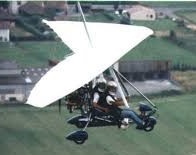
The Pagotto Brako is an Italian ultralight trike, designed by Enio Pagotto and produced by Carpenterie Pagotto of Pianzano.
The aircraft was designed to comply with the Fédération Aéronautique Internationale microlight category, including the category’s maximum gross weight of 450 kg (992 lb). The aircraft has a maximum gross weight of 450 kg (992 lb). It features a cable-braced hang glider-style high wing, weight-shift controls, a two-seats-in-tandem open cockpit without a cockpit fairing, tricycle landing gear with wheel pants and a single engine in pusher configuration.
The aircraft is made from welded stainless steel tubing, with its single or double surface wing covered in Dacron sailcloth. The Brako is factory supplied only with Grif wings. With the Trainer wing it has a wingspan of 10.35 m (34.0 ft). The wing is supported by a single tube-type kingpost and uses an “A” frame weight-shift control bar. The powerplant is a twin-cylinder, air-cooled, two-stroke, dual-ignition 50 hp (37 kW) Rotax 503 engine, with a reconditioned four-cylinder, air- and liquid-cooled, four-stroke, dual-ignition 80 hp (60 kW) Rotax 912UL engine optional.
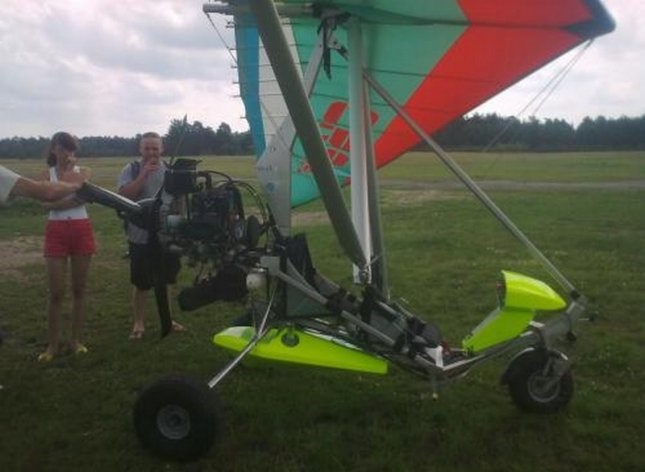
With the Rotax 503 engine and Grif Trainer wing the aircraft has an empty weight of 158 kg (348 lb) and a gross weight of 450 kg (992 lb), giving a useful load of 292 kg (644 lb). With full fuel of 42 litres (9.2 imp gal; 11 US gal) the payload is 261 kg (575 lb).
A number of different wings can be fitted to the basic carriage, including the beginner Grif Trainer, intermediate Grif Spyder and the higher performance Grif Corsair with wing areas of 12.8 sq.m (138 sq ft) and 13.7 sq.m (147 sq ft).
The aircraft was in production in 2013 and was supplied as a complete ready-to-fly-aircraft.
Brako / Grif Trainer wing
Engine: 1 × Rotax 503, 37 kW (50 hp)
Propeller: three-bladed composite
Wingspan: 10.35 m (33 ft 11 in)
Wing area: 16.0 m2 (172 sq ft)
Empty weight: 158 kg (348 lb)
Gross weight: 450 kg (992 lb)
Fuel capacity: 42 litres (9.2 imp gal; 11 US gal)
Maximum speed: 100 km/h (62 mph, 54 kn)
Cruise speed: 75 km/h (47 mph, 40 kn)
Stall speed: 45 km/h (28 mph, 24 kn)
Rate of climb: 2.8 m/s (550 ft/min)
Wing loading: 28.1 kg/m2 (5.8 lb/sq ft)
Crew: one
Capacity: one passenger
Pacific Sails Santana Trike
Built circa 1983 in Palmerston North, New Zealand.
Engine: 215 cc, (1987 onwards) Cuyuna 430 cc.
Pacific Sails
Bob Shute Sales took over Pacific Sails
Trike and Hang glider builder
NST Schwarze Aerostar Chronos 12
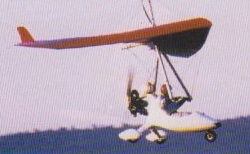
From the Czech Republic and designed by Norbert Schwarze, the engine is an American four stroke twin. A variety of wings can be fitted.
Aerostar Chronos 12
Empty weight: 90 kg
Wing span: 9.8 m
Wing area: 13.4 sq.m
Fuel capacity: 20 lt
Certification: Vz
Engine: NS 600, 30 hp
MAUW: 200 kg
Seats: 1
Max speed: 130 kph
Cruise speed: 90 kph
Minimum speed: 35 kph
Climb rate: 2.5 m/s
Fuel consumption: 4 lt/hr
Price (1998): 19 500 DM
 All Aero