Pegasus Aviation

UK
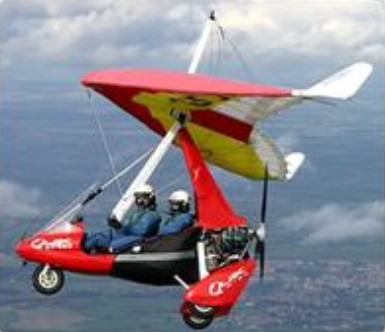
Markets the AX2000 two-seat very light monoplane and several flex-wing microlights as the single-seat Chaser- S, two-seat Quantum Sport and Supersport, two-seat Quantum LITE Basic 503TC and two-seat Quasar.
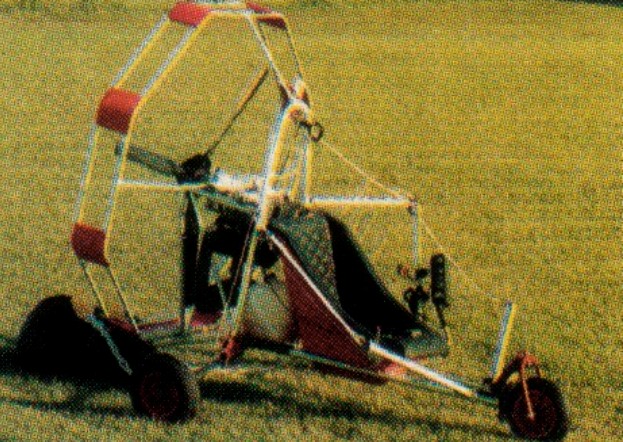
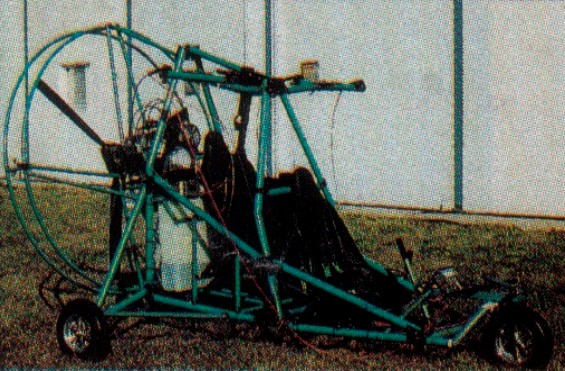
Publicly owned Pegasus Aviation bought the rights to the French edition of a highly modified Weedhopper.

1998:
Elm Tree Park
Manton
SN8 1PS Marlborough
United Kingdom

Patricroft Rogallo

Geoff Ball and Hughie McGovern

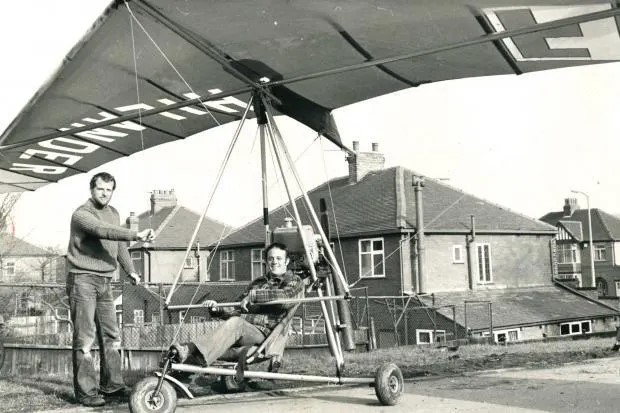
Geoff Ball and Hughie McGovern had a novel way of beating the traffic to work in the morning in 1981 – they flew in by hang-glider.
The engineers worked at Patricroft which made powered hang-gliders and they commuted to the factor from a field near Geoff’s Meadowside Avenue home in Tong Fold.

The journey took them less than 10 minutes and they never had to face any hold-ups

Para-Ski Top Gun

The Para-Ski Top Gun is a powered parachute that was designed and produced by Para-Ski of Mascouche, Quebec, Canada.

The Top Gun was designed to comply with the Canadian Basic Ultralight Aeroplane category, as well as the Fédération Aéronautique Internationale microlight category. In kit form the aircraft was designed to comply with the Canadian Amateur-built Aircraft rules as well as the US Experimental – Amateur-built aircraft rules. It features a 521 sq ft (48.4 sq.m) parachute-style wing, two-seats-in-tandem accommodation, four-wheeled landing gear and a single 64 hp (48 kW) Rotax 582 engine in pusher configuration. The 65 hp (48 kW) Hirth 3203, the 80 hp (60 kW) Hirth F-30 or 110 hp (82 kW) Hirth F-30ES engines were factory options. Parachute options included square or elliptical canopies of 400 to 600 sq ft (37 to 56 sq.m). Landing gear options include skis and floats.

The aircraft carriage is built from welded aluminium tubing and has a “sledge-like” cockpit fairing incorporating dual square headlights. In flight steering is accomplished via handle bars that actuate the canopy brakes, creating roll and yaw. On the ground the aircraft has front wheel steering. The aircraft uses a large rudder to offset the engine torque effects. The landing gear incorporates independent shock and spring suspension.

The aircraft has an empty weight of 400 lb (181 kg) and a gross weight of 900 lb (408 kg), giving a useful load of 500 lb (227 kg). With full fuel of 38 litres (8.4 imp gal; 10 US gal) the payload for crew and baggage is 440 lb (200 kg).

The Top Gun was introduced in 2003 and was available as a complete ready-to-fly-aircraft and also as a kit for amateur construction at US$17,050 in 2004. Production ended when the company went out of business in about 2011.

Two variants were produce; the Top Gun base model, and the Top Gun Discovery model including some options as standard.

In July 2015 three examples were registered with the Transport Canada.

Top Gun Discovery
Engine: 1 × Rotax 582, 64 hp (48 kW)
Propellers: 3-bladed Ivo-Prop, 5 ft 8 in (1.73 m) diameter
Wingspan: 30 ft 0 in (9.14 m)
Wing area: 521.0 sq ft (48.40 sq.m)
Aspect ratio: 1.72:1
Empty weight: 400 lb (181 kg)
Gross weight: 900 lb (408 kg)
Fuel capacity: 30 litres (6.6 imp gal; 7.9 US gal)
Maximum speed: 35 mph; 30 kn (56 km/h)
Cruise speed: 30 mph; 26 kn (48 km/h)
Stall speed: 25 mph; 22 kn (40 km/h)
Rate of climb: 790 ft/min (4 m/s)
Wing loading: 1.7 lb/sq ft (8.4 kg/sq.m)
Crew: one
Capacity: one passenger

Para-Ski VX

The Para-Ski VX is a powered parachute that was designed and produced by Para-Ski of Mascouche, Quebec, Canada.

The aircraft was developed from the two-seat XS and, like that model, was designed to be an all-terrain vehicle, capable of operating cross-country on wheels, skis, floats and flying under a canopy. As such it incorporates some design features that are unusual on powered parachutes. It features a custom made Para-Ski parachute-style high-wing, single-seat accommodation, quadracycle landing gear and a single 64 hp (48 kW) Rotax 582 engine in pusher configuration. To allow land and water operations the propeller has a rudder behind it, in the manner of an airboat, for steering via a set of handlebars. For surface operations the parachute is stowed in a specially designed compartment under the rear seat and the handlebars steer the wheels or the float-fitted water rudders. In flight the VX is steered either by the rudders, by foot pedals that actuate the canopy brakes, creating roll and yaw, or by a combination of both.

The aircraft is made from welded aluminum with the axles made from steel. It includes a fairing to provide occupant protection and a shield to keep water and stones out of the propeller during surface operations. The aircraft is capable of taking off from water, provided the wing can be laid out on the shoreline without getting wet. The wing is a high-performance design that allows a fast cruising speed for a powered parachute of 40 mph (64 km/h).

In 1998 the VX design was altered to allow it to also optionally mount a hang glider-style wing, transforming it into an ultralight trike and allowing faster cruising speeds than the parachute wing permits.

The aircraft was supplied as a completed aircraft or as component kits for amateur construction, priced at US$12,700 in 2001. Production is now completed.

VX
Engine: 1 × Rotax 582, 64 hp (48 kW)
Wing area: 555 sq ft (51.6 sq.m)
Empty weight: 340 lb (154 kg)
Gross weight: 690 lb (313 kg)
Fuel capacity: 9 U.S. gallons (34 L; 7.5 imp gal)
Cruise speed: 40 mph (64 km/h; 35 kn)
Rate of climb: 950 ft/min (4.8 m/s)
Wing loading: 1.24 lb/sq ft (6.1 kg/sq.m)
Crew: one
Parascender Para-AG

An adaptation of the Parascender I 503 for application of herbicides and pesticides.

Engine: Rotax 503DC, 52 hp
Height: 6.2 ft
Length: 9 ft
Wing span: 38.5 ft
Wing area: 520 sq.ft
Empty weight: 200 lb
Gross weight: 700 lb
Fuel capacity: 5 USG
Speed max: 26 mph
Cruise: 26 mph
Rate of climb: 450 fpm
Takeoff dist: 150 ft
Landing dist: 25-50 ft
Service ceiling: 7500 ft
Landing gear: nose wheel
Seats: 1

Parascender II

Manufactured in the US, the design meets the FAA 51% rules.

Parascender II XHP
Engine: Rotax 503DC, 52 hp
Height: 6.2 ft
Length: 9 ft
Wing span: 38.5 ft
Wing area: 520 sq.ft
Empty weight: 250 lb
Gross weight: 720 lb
Fuel capacity: 5 USG
Cruise: 26 mph
Rate of climb: 450 fpm
Takeoff dist: 150 ft
Landing dist: 25-50 ft
Service ceiling: 7500 ft
Landing gear: nose wheel
Seats: 2

Parascender I

Manufctured in the US, ground steering is with the left hand, and the right hand has the throttle for altitude control. Feet control turns.

The Parascender I has a rectangular parachute with 1.1 oz zero porosity rip-stop nylon.

Parascender
Engine: Rotax 447, 40 hp
Height: 6.2 ft
Length: 8.8 ft
Wing span: 36.5 ft
Wing area: 440 sq.ft
Empty weight: 205 lb
Gross weight: 455 lb
Fuel capacity: 5 USG
Cruise: 26 mph
Rate of climb: 450 fpm
Takeoff dist: 50-125 ft
Landing dist: 25-50 ft
Service ceiling: 7500 ft
Landing gear: nose wheel
Seats: 1

Parascender I
Engine: Rotax 503, 46 hp
Height: 6.2 ft
Length: 6.2 ft
Wing span: 8.9 ft
Wing area: 440 sq.ft
Empty weight: 230 lb
Gross weight: 650 lb
Fuel capacity: 5 USG
Cruise: 26 mph
Rate of climb: 650 fpm
Takeoff dist: 75-150 ft
Landing dist: 25-50 ft
Service ceiling: 7500 ft
Landing gear: nose wheel
Seats: 1

ParaPlane Corp Golden Eagle II

Manufactured in the USA and supplied as a completely assembled trike style powered parachute. The rectangular ram air parachute has a zero porosity silicon coating. Electric start was included, and powder coating optional. The Golden Eagle 2 has a patentd steering system.

Engine: Hirth 2706
Height: 6.7 ft
Length: 10.4 ft
Wing span: 39.5 ft
Wing area: 560- sq.ft
Empty weight: 340 lb
Gross weight: 850 lb
Fuel capacity: 10 USG
Cruise: 28 mph
Range: 52 sm
Rate of climb: 500 fpm
Takeoff dist: 150-200 ft
Landing dist: 0 ft
Service ceiling: 10,000 ft
Seats: 2