
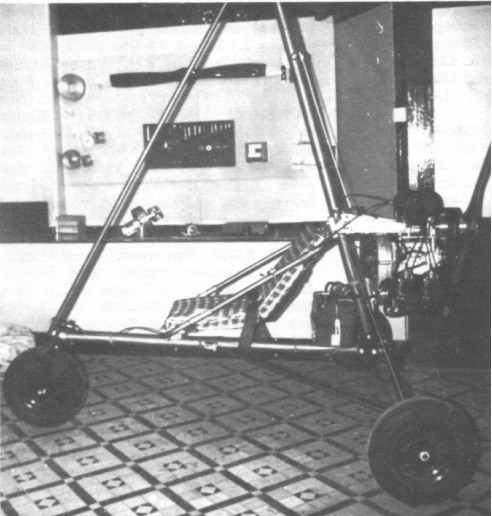
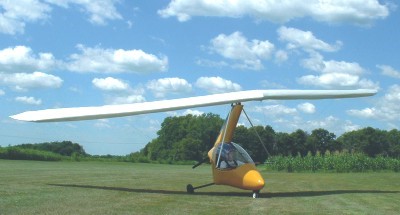
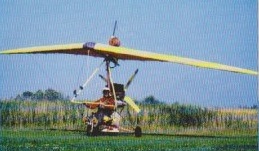
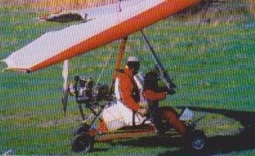
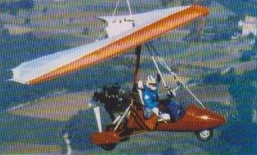
The Sheffield Micro Light/ Skyhook Sailwings Trident (Solo Engine)/ Sabre C is a single seat single engined flex wing aircraft with weight shift control. Rogallo wing with keel pocket. Pilot suspended below wing in trike unit, using bar to control pitch and yaw/roll by altering relative positions of trike unit and wing. Wing braced from above by kingpost and cables, from below by cables; floating cross tube construction with 55% double surface enclosing cross tube preformed ribs. Undercarriage has three wheels in tricycle formation; no suspension any wheels. Push right go left nosewheel steering independent from yaw control. No brakes. Aluminium tube trike unit, with optional pod. Engine mounted below wing driving pusher propeller.
The company’s single seat trike units are all identical except for the power pack, three choices being offered: Solo, Robin EC25PS or Hunting GS260A. All three are single-cylinder engines, the Hunting having an electric start.
In design the Trident is a conventional mono pole machine, and is typically flown with the Skyhook Sailwings Sabre C wing. Its reduction drive is a Sheffield Micro Lights own design, using a ‘dead’ shaft and hub assembly rather than the normal plummer blocks.
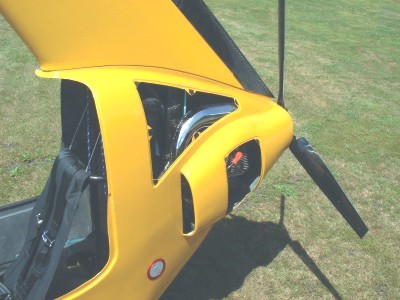
All three versions were in production in 1982; by when Peter Jackson has built six with the Solo, ten with the Robin and five with the Hunting. The aircraft are available only in ready to fly form. Regardless of engine fitted, all Sheffield Micro Lights single seat trikes can be fitted with the following optional extras: glass fibre pod, wheel fairings and an alloy folding propeller.
The Sheffield Micro Light/ Skyhook Sailwings Trident Dual/Dual Striker is a side by side two seat single engined flex wing aircraft with weight shift control. Rogallo wing with keel pocket. Pilot suspended below wing in trike unit, using bar to control pitch and yaw/roll by altering relative positions of trike unit and wing. Wing braced from above by kingpost and cables, from below by cables; bowsprit construction with 65% double surface; pre formed ribs. Undercarriage has three wheels in tricycle formation; no suspension any wheels. Push right go left nosewheel steering independent from yaw control. Brake on nosewheel. Aluminium tube trike unit, without pod. Engine mounted below wing driving pusher propeller.
The Trident Dual/Dual Striker is Sheffield Microlights’ training air¬craft and is of generally similar arrangement to the single seaters, the most notable difference being the inclusion of a nosewheel brake.
By 1982 only one Trident Dual/Dual Striker had been produced, and that used the Hunting HS525A engine. Wheel fairings are an optional extra.
Trident / Sabre C
Engine: Solo, 20hp at 6900rpm
Propeller diameter and pitch 50x33inch, 1.27×0.84m
V belt reduction, ratio 2.3/1
Max static thrust 125 lb, 57kg
Power per unit area 0.10hp/sq.ft, 1.1 hp/sq.m
Fuel capacity 2.4 USG, 2.0 Imp gal, 9. 1 lt main tank; (inc. 0.15 USG, 0. 13 Imp gal, 0. 57 lt integral res)
Length overall 12.7 ft, 3.87 m
Height overall 11.0ft, 3.35m
Wing span 34.0ft, 10.36m
Total wing area 195 sq.ft, 18.1 sq.m
Wheel track 5.0 ft, 1.52 m
Wheelbase 5.0 ft, 1.52 m
Nose¬wheel diameter overall 12 inch, 30 cm
Main wheels diameter overall 12 inch, 30 cm
Empty weight 139 lb, 63kg
Max take off weight 375 lb, 170 kg
Payload 236 lb, 107 kg
Max wing loading 1.92 lb/sq.ft, 9.4 kg/sq.m
Max pow¬er loading 18.8 lb/hp, 8.5 kg/hp
Load factors, 3.0 design; >+4.0, ultimate
Max level speed 55 mph, 88 kph
Max cruising speed 43 mph, 69kph
Economic cruising speed 27mph, 43kph
Stalling speed 22mph, 35kph
Max climb rate at sea level 450ft/min, 2.29m/s
Min sink rate 200 ft/min at 25 mph, 1.0 m/s at 40 kph
Best glide ratio with power off 8/1 at 27 mph, 43 kph
Take off distance 85 ft, 26 m
Landing distance 110ft, 35m
Range at average cruising speed 115 mile, 185 km
Engine: Robin EC25PS, 18 hp at 6000rpm
Propeller diameter and pitch 54x30inch, 1.37×0.76m
V belt reduction, ratio 2.3/1
Max static thrust 133 lb, 60 kg
Power per unit area 0.09 hp/sq.ft, 1.0 hp/sq.m
Fuel cap: 2.4 USG, 2.0 Imp gal, 9. 1 lt main tank; (incl 0.15 USG, 0. 13 Imp gal, 0. 57 lt integral res).
Length overall 12.7 ft, 3.87 m
Height overall 11.0ft, 3.35m
Wing span 34.0ft, 10.36m
Total wing area 195 sq.ft, 18.1 sq.m
Wheel track 5.0 ft, 1.52 m
Wheelbase 5.0 ft, 1.52 m
Nose¬wheel diameter overall 12 inch, 30 cm
Main wheels diameter overall 12 inch, 30 cm
Empty weight 179 lb, 81 kg
Max take off weight 455 lb, 206 kg
Payload 276 lb, 125 kg
Max wing loading 2.33 lb/sq.ft, 11.4 kg/sq.m
Max pow¬er loading 25.3 lb/hp, 11.4 kg/hp
Load factors, 3.0 design; >+4.0, ultimate
Max level speed 55 mph, 88 kph
Max cruising speed 44 mph, 71kph
Economic cruising speed 28mph, 45kph
Stalling speed 24mph, 39kph
Max climb rate at sea level 460ft/min, 2.34m/s
Min sink rate 225 ft/min at 26 mph, 1.1 m/s at 42 kph
Best glide ratio with power off 7/1 at 28 mph, 45 kph
Take off distance 80 ft, 24 m
Landing distance 125 ft, 40 m
Range at average cruising speed 101 mile, 163km
Engine: Hunting HS260A, 25hp at 6900rpm
Propeller diameter and pitch 54x32inch, 1.37×0.81m
V belt reduction, ratio 2.3/1
Max static thrust 139 lb, 63 kg
Power per unit area 0.13hp/sq.ft, 1.4 hp/sq.m
Fuel capacity 2.4 USG, 2.0 Imp gal, 9. 1 lt main tank; (incl 0.15 USG, 0. 13 Imp gal, 0. 57 lt integral res)
Length overall 12.7 ft, 3.87 m
Height overall 11.0ft, 3.35m
Wing span 34.0ft, 10.36m
Total wing area 195 sq.ft, 18.1 sq.m
Wheel track 5.0 ft, 1.52 m
Wheelbase 5.0 ft, 1.52 m
Nose¬wheel diameter overall 12 inch, 30 cm
Main wheels diameter overall 12 inch, 30 cm
Empty weight 183 lb, 83kg
Max take off weight 459 lb, 208kg
Payload 276 lb, 125 kg
Max wing loading 2.35 lb/sq.ft, 11.5 kg/sq.m
Max power loading 18.3 lb/hp, 8.3kg/hp
Load factors, 3.0 design; +4.0, ultimate
Max level speed 55 mph, 88 kph
Max cruising speed 43 mph, 69kph
Economic cruising speed 27mph, 43kph
Stalling speed 22mph, 35kph
Max climb rate at sea level 490ft/min, 2.5 m/s
Min sink rate 200 ft/min at 25 mph, 1.0 m/s at 40 kph
Best glide ratio with power off 8/1 at 27 mph, 43 kph
Take off distance 85 ft, 26 m
Landing distance 110ft, 35m
Range at average cruising speed 104 mile, 167 km
Trident Dual / Dual Striker
Engine; Hunting HS525A, 45 hp at 6000 rpm
Prop¬eller diameter and pitch 56x36inch, 1.42×0.91m
Toothed belt reduction, ratio 2.3/1
Max static thrust 285 lb, 129 kg
Power per unit area 0.18hp/sq.ft, 1.9 hp/sq.m
Fuel capacity 2.4 USG, 2.0 Imp gal, 9.1 lt main tank; (incl 0.15 USG, 0.13 Imp gal, 0.57 lt integral res)
Length overall 14.0 ft, 4.27 m
Height overall 10.5ft, 3.20m
Wing span 38.0ft, 11.58m
Chord at root 9.0ft, 2.74 m
Chord at tip 3.5ft, 1.07m
Dihedral 2 deg
Sweepback 15 deg
Keel pocket depth 1.2ft, 0.37m
Total wing area 250 sq.ft, 23.2 sq.m
Keel pocket area 3.5 sq.ft, 0.33 sq.m
Wing aspect ratio 6.0/1
Wheel track 5.0 ft, 1.52 m
Wheelbase 5.5 ft, 1.68 m
Nose¬wheel diameter overall 17 inch, 43cm
Main wheels diameter overall 16 inch, 41 cm
Empty weight 252 lb, 114kg
Max take off weight 688 lb, 312kg
Payload 436 lb, 198kg
Max wing loading 2.75 lb/sq.ft, 13.4 kg/sq.m
Max power loading 15.3 lb/hp, 6.9kg/hp
Load factors +4.5, 2.0 design
Max level speed 58 mph, 93 kph
Max cruising speed 44 mph, 71 kph
Economic cruising speed 30 mph, 48kph
Stalling speed 27mph, 43kph
Max climb rate at sea level 780 ft/min, 4.0 m/s
Min sink rate 320ft/min at 29mph, 1.6m/s at 47 kph
Best glide ratio with power off 5/1 at 33mph, 53kph
Take off distance 100ft, 30m
Landing distance 80ft, 25m (using brake)



 All Aero