Reich Marshal Herman Goring and General Adolf Galland
Hermann Goering was born in Rosenheim, Barvia in 1893, the fourth child of Dr. Heinrich Goering and Fanny Tiefenbrunn. Heinrich was a career diplomat in south-west Africa but returned to Germany for his birth. His parents returned to Africa leaving the new infant son with family for the next three years. The possessor of a raw native cunning rather than any great intellect, Goering was popular in moneyed social circles. Naturally egotistical and almost comically vain, the fame he attracted with his fighter pilot exploits during the First World War only served to convince Goering further of his own greatness. A talented pilot, he flew several missions with Manfred von Richthofen and later earned the Pour le Merite, Germany’s highest military decoration. By the war’s end, Goering was one of the most famous soldiers in Germany. His picture appeared in countless newspapers, he was profiled in several national magazines and a series of commerative postcards. By 1919, the flying aces were no longer in demand, Gangs of Bolsheviks roamed the city streets often heckling and sometimes attacking returned soldiers in uniform. Goering almost lost one of his prized medals in a Munich street scuffle. Disillusioned with Germany, the 26 year old Goering managed to secure a number of lucrative positions, working as a stunt pilot in Stockholm and an aircraft advisor to the Danish government. During this time he met and married Carin von Kantzow, from Sweden. During 1922 he met Adolf Hitler and saw the new National Socialist German Workers Party as a means to achieving personal power.
Adolf Hitler and Herman Goering
Goering quickly played a pivotal role in raising the Nazi profile and in the early years the Nazi party needed Hermann Goering far more than he needed it. As Minister for Economic Affairs, he gifted himself with the state-owned Hermann Goering Works – a stolen industrial complex employing some 700,000 workers (mostly from concentration camps) and with a capital base of more than 400 million Marks. His lavish lifestyle was largely funded by money he extracted illegally from German-owned industries under his control. Goering also directed the forced labour programs in the occupied territories under which hundreds of thousands of people were brutalised, starved and eventually killed. Georing survived a serious morphine addiction (which had arisen from treatment for an injury received during the Beer Hall Putsch) and the death of his wife from tuberculosis in 1931. His second wife was actress Emmy Sonnemann. The pressure of running the Luftwaffe took further toll on Goering.
At Nuremberg, Hermann Goering was found guilty of war crimes and crimes against humanity and was sentenced to be executed by hanging on 15 December 1946. Two hours before the scheduled execution he was found dead of cyanide poisoning. Goering’s body was cremated in Munich and his ashes, together with those of nine other high-ranking Nazi also executed on the same day were transported to a remote country road outside the city. There, in driving rain, the combined ashes were unceremoniously dumped in the road.
Frank Whittle was born on 1 June 1907 in Coventry, the son of a mechanic. His first attempts to join the RAF failed as a result of his lack of height, but on his third attempt he was accepted as an apprentice in 1923. He qualified as a pilot officer in 1928.
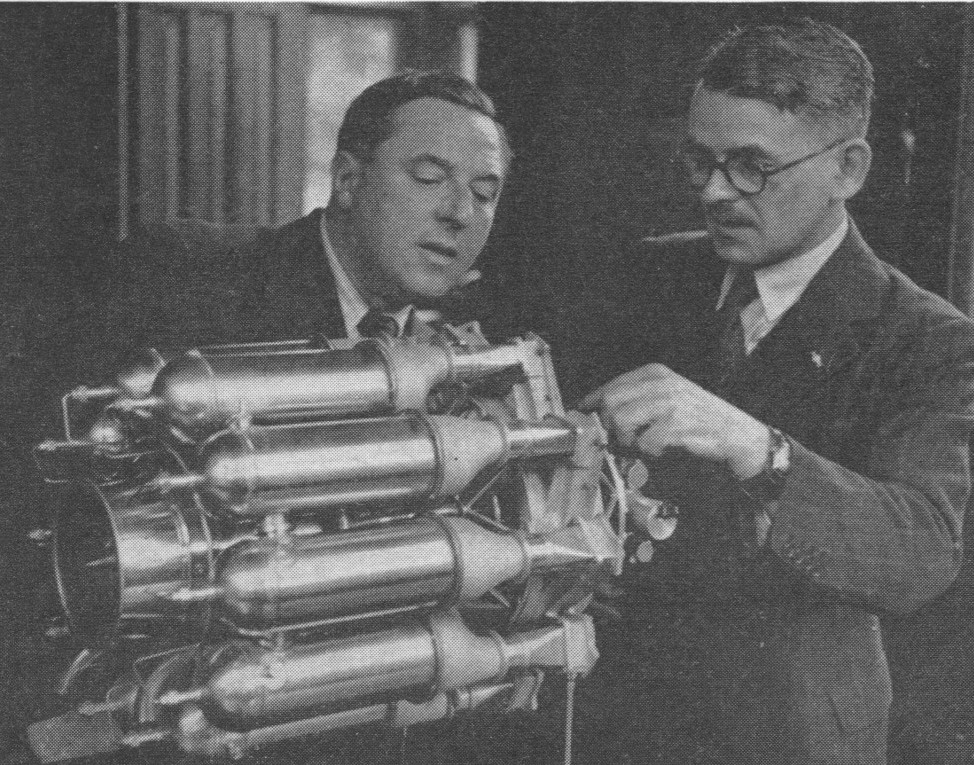
As a cadet Whittle had written a thesis arguing that planes would need to fly at high altitudes, where air resistance is much lower, in order to achieve long ranges and high speeds. Piston engines and propellers were unsuitable for this purpose, so he concluded that rocket propulsion or gas turbines driving propellers would be required. Jet propulsion was not in his thinking at this stage. By October 1929, Whittle had considered using a fan enclosed in the fuselage to generate a fast flow of air to propel a plane at high altitude. A piston engine would use too much fuel, so he thought of using a gas turbine. After the Air Ministry turned him down, he patented the idea himself.
In 1935, Whittle secured financial backing and, with Royal Air Force approval, Power Jets Ltd was formed. They began constructing a test engine in July 1936, but it proved inconclusive. Whittle concluded that a complete rebuild was required, but lacked the necessary finances. Protracted negotiations with the Air Ministry followed and the project was secured in 1940. By April 1941, the engine was ready for tests. The first flight was made on 15 May 1941. By October the United States had heard of the project and asked for the details and an engine. A Power Jets team and the engine were flown to Washington to enable General Electric to examine it and begin construction. The Americans worked quickly and their XP-59A Airacomet was airborne in October 1942, some time before the British Meteor, which became operational in 1944.
For his work, Frank Whittle received a knighthood and a tax-free award of £100,000 post-war.
The jet engine proved to be a winner, particularly in America where the technology was enthusiastically embraced. Whittle retired from the RAF in 1948 with the rank of air commodore. He was knighted in the same year and went to work in the US shortly afterwards, becoming a research professor at the US Naval Academy at Annapolis. Whittle died on 9 August 1996.
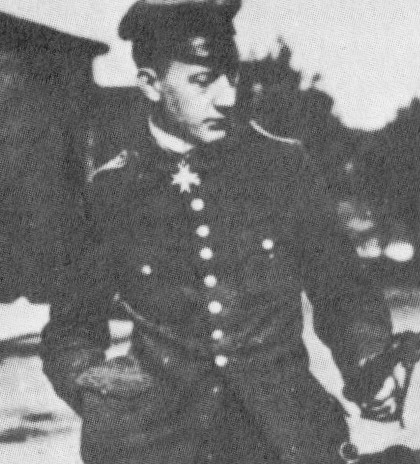
Born in Krefeld in 1897, Voss was the youngest of three sons and two daughters of an industrial dyer. Voss enlisted in 1914 at the age of 17 in the 2nd Westphalian Hussar Regiment Nr. 11, serving on the Eastern Front. When his regiment was disbanded he transferred to the Luftstreitkräfte (German Air Service) in August 1915, joining FEA7 in Cologne. In September, he was sent to Egelsberg to learn to fly. A gifted pilot, he was immediately enrolled as an instructor at FEA 7 upon graduating in February 1916, before finally departing to the front on 10 March.
Vizefeldwebel Voss was posted to Kampfstaffel 20 of Kampfgeschwader IV, and served as an observer before he was allowed to fly as a pilot, receiving his pilot’s badge in May 1916. Commissioned in September, he then transferred to scout aircraft and was posted to Oswald Boelcke’s Jasta (Jagdstaffel) 2 in November 1916.
Voss scored his first two victories at the age of 18 on 27 November 1916. Scoring rapidly during February – March 1917, he was awarded the Pour le Merite on 8 April 1917, with his score already 24.
After 28 claims, Voss was sent to command Jasta 5 on 20 May, then briefly posted to Jasta 29 as temporary commander, before a similar posting to Jasta 14 on 3 July. On 30 July, Voss moved to permanent command of Jasta 10 in Richthofen’s Jagdgeschwader I (JG I) (or the “Flying Circus” as it became called by the Allies).
Voss had a gift for mechanical engineering, and was an avid rider of motorcycles. Voss also mechanically “tweaked” his aircraft, often being found in the hangar working on his motorcycle or his machine and its guns. Voss was known as a loner and an inspirational, rather than effective, unit leader. Modern writers often describe him as “mercurial”. He was a casual dresser, but when flying would wear full uniform, in case of a forced landing.
Voss was wounded on 6 June 1917 during a dogfight with 6 Naval Squadron Royal Naval Air Service, (possibly by Flt Sub-Lt Christopher Draper) but soon returned to duty. He was by now credited with 38 confirmed victories in his Albatros D.III, at the time decorated with a swastika and heart motif (for good luck).
In August, having tested a F.I prototype (103/17, Wk. Nr.1730) of the Fokker Dr.I triplane Voss adopted the rotary engine triplane as his personal aircraft. Voss had flown kites with his cousins in Krefeld and the kites gave him the inspiration to paint the nose of his Fokker Dr.I with two eyes, eyebrows and a moustache.
Voss rapidly claimed 10 more victories between 3 and 23 September to raise his total to 48, second only to the Red Baron.
After shooting down a No. 57 Squadron DH 4 bomber on 23 September, Voss went out on a further patrol and was engaged by six Royal Aircraft Factory S.E.5s of the elite 56 Squadron. In one of the most remarkable encounters in aerial history, Voss fought a single-handed dogfight against several aces: Capt. James McCudden, Lt. Richard Maybery Lt. Geoffrey Hilton Bowman, Capt. Reginald Hoidge, Lt. Arthur Rhys Davids. Keith Muspratt and Lt V.P. Cronyn, with Lt. Harold A. Hamersley and Lt. Robert L. Chidlaw-Roberts of 60 Squadron. The dogfight developed over Poelkapelle. Another German ace, Carl Menckhoff, attempted to assist Voss but was downed by Rhys-Davids, (though surviving). Voss fought the RFC aces for just 10 minutes, eluding them and achieving hits on nearly every S.E.5.
Using the triplane’s superior rate of climb and its ability to slip turn (using the rudder to turn quickly), Voss managed to evade his opponents. He was able to turn at high speeds and attack those behind him. After flying past McCudden in a head-on confrontation, however, Voss’s Fokker was hit with bullets on the starboard side by Hoidge. One round pierced his right side and passed through his lungs. Nearing death, Voss did not see Rhys-Davids approach from the 6 o’clock position, directly behind his tail.
Rhys-Davids got below him and poured two drums of Lewis fire into the underside of the triplane, then attacked again with both guns. The Fokker fell away, stalled and crashed into the British line. McCudden recalled: “I saw him go into a fairly steep dive and so I continued to watch, and then saw the triplane hit the ground and disappear into a thousand fragments, for it seemed to me that it literally went into powder.”
Voss crashed near Plum Farm north of Frezenberg in Belgium. Only the rudder, cowling, and parts of the undercarriage were salvaged; the new type of aircraft was the subject of an intelligence report by 2nd Lieutenant G. Barfoot-Saunt.
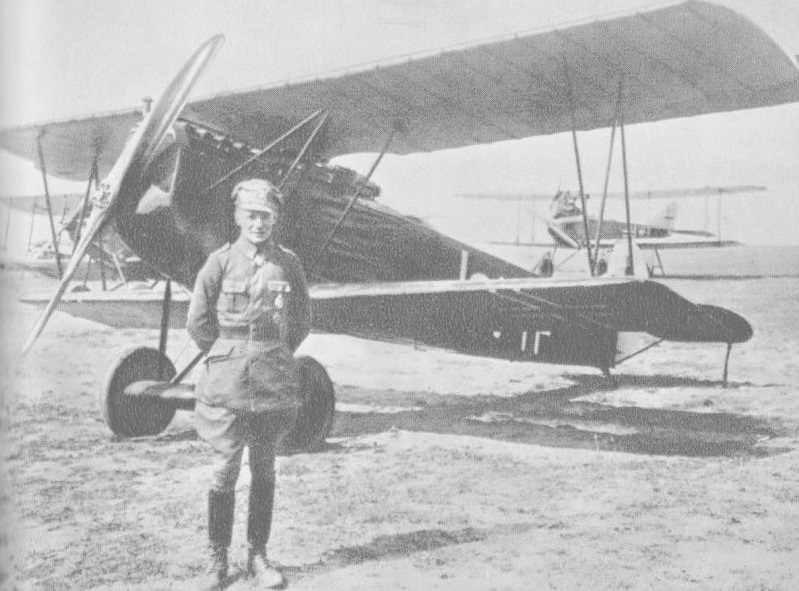
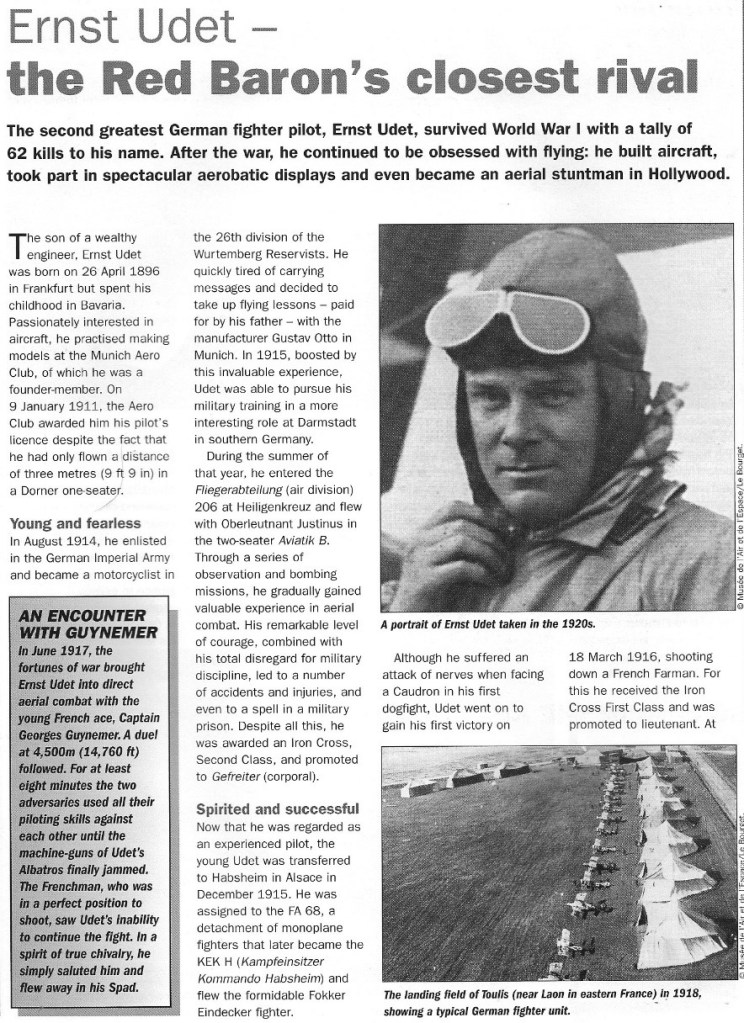
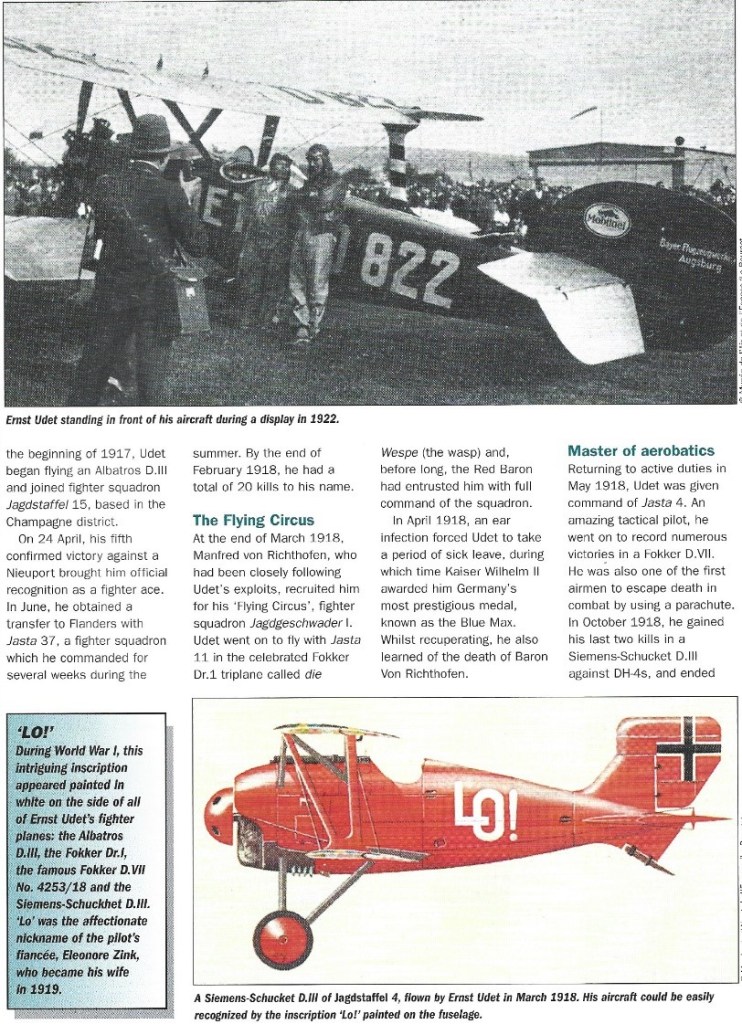
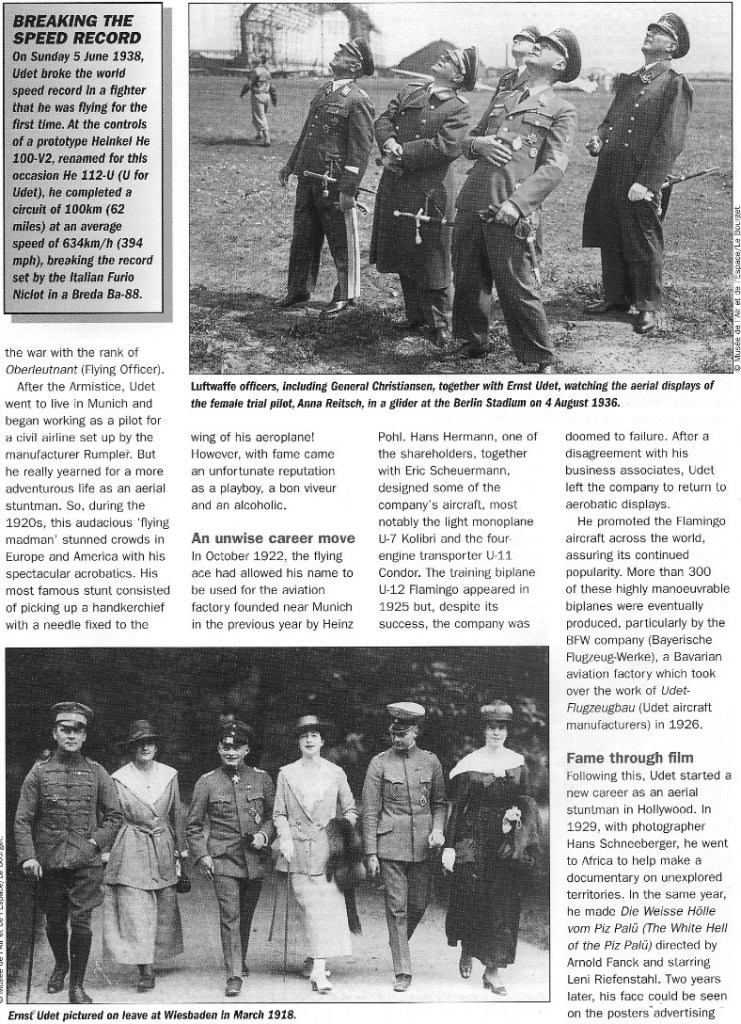
Ernst Udet was born in Frankfurt, Germany, on 26th April 1896. He joined the German Army Air Service in 1915. Flying a Fokker D-III, he scored his first victory on 18th March 1916 in a lone attack on 22 French aircraft. By the end of the First World War Udet had 62 victories. This made him the second highest German war ace of the war.
Ernst Udet and his Fokker D.7, 1918
After the war Udet appeared with Leni Riefenstahl in the film SOS Eisberg. He was also active in the Richthofen Veterans’ Association and caused great controversy when he campaigned to have Hermann Goering rejected for for making false claims of air victories during the First World War.
Udet joined the Luftwaffe in June 1935 as a colonel and a year later was appointed head of the Technical Office of the Air Ministry. In this post Udet was responsible for the introduction of the Junkers Stuka and the Messerschmitt Bf109.
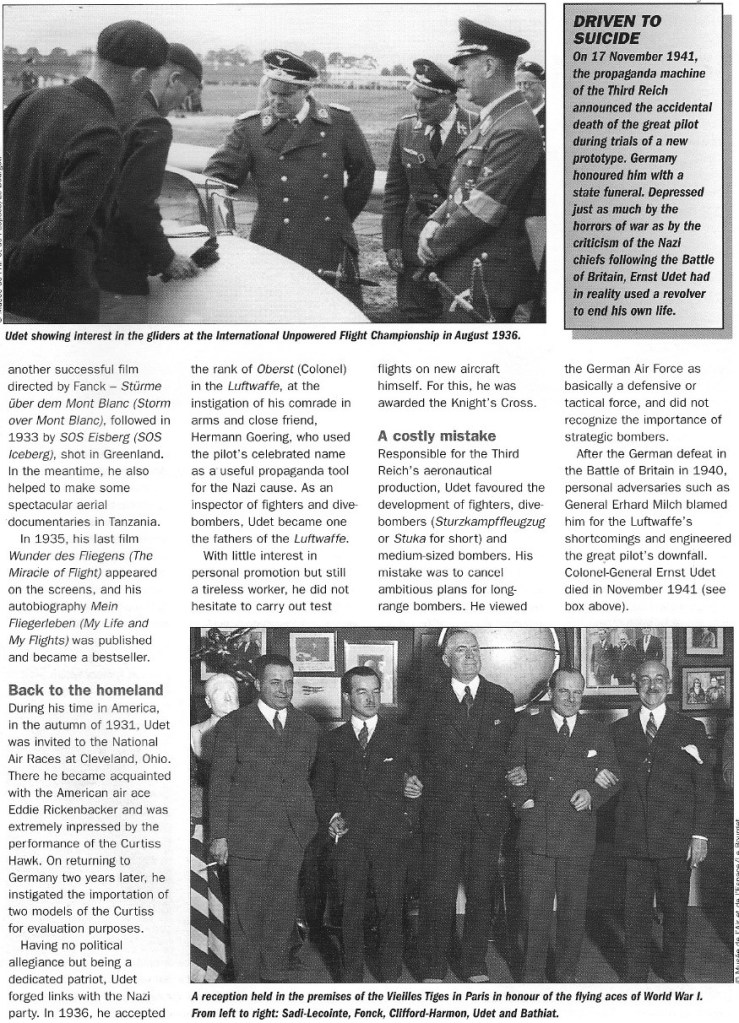
During the Second World War he rose to the rank of colonel general and Director of Air Armaments. In 1940 pilots began to complain that the Spitfire was superior to German aircraft. Later Adolf Hitler and Hermann Goering both accused him of being responsible for the defeat of the Luftwaffe during the Battle of Britain. He was also criticized for neglecting the development of new heavy bombers.
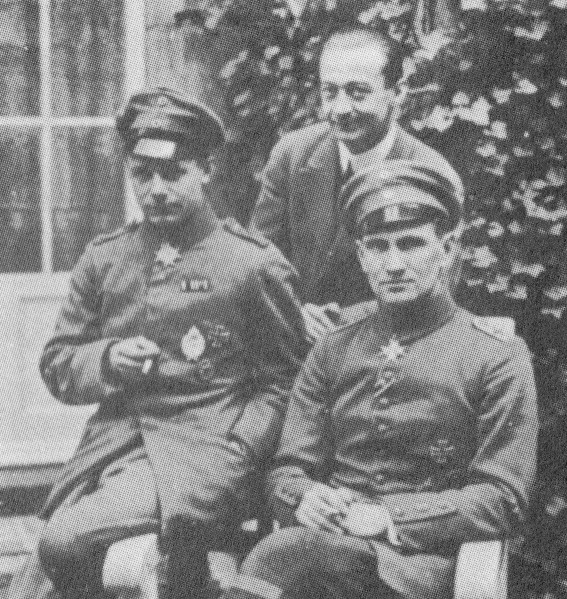
Ernst Udet – left, Bruno Loerzer – right, Siegmund Abel – rear
Udet became depressed by the performance of the Luftwaffe during Operation Barbarossa and the decision by Erhard Miltch to overrule his plans to develop the Focke Wulf FW 190. On 17th November, 1941, Udet shot himself in the head while on the phone to his mistress.
Adolf Hitler was embarrassed by Udet’s death and the Nazi Government issued a statement that Udet had been accidentally killed while testing out a new weapon.
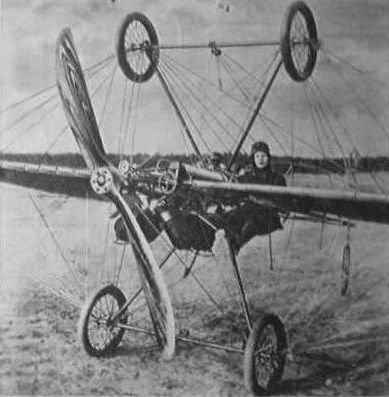
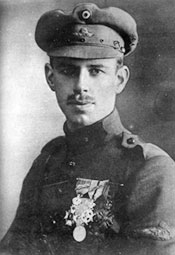
Gustav Tweer learned to fly with the French Adolphe Pegoud, who was the first acrobat pilot. He died in a fatal accident on November 1, 1916 on a new type of plane.
Edmond Thieffry was born in Etterbeek, a municipality of Brussels, and went on to study law in Leuven (hence his nickname “The Flying Judge”). After qualifying he was conscripted into the Belgian Army, joining the 10th Regiment in 1913. At the start of the First World War he saw service as a staff attaché to General Leman, but was captured by the Germans. He escaped on a stolen motorcycle to the neutral territory of the Netherlands, where he was arrested by Dutch military police. Using his legal knowledge and Dutch language skills he managed to talk his way out of internment, and travelled to Antwerp to rejoin the Belgian army.
In 1915, Thieffry joined the Compagnie des Ouvries et Aérostiers—the Belgian Army Air Corps—and with some difficulty qualified as a pilot at Étampes. On 1 February 1916 he joined the 3rd Squadron as an observer for artillery, where he was appreciated for his exactitude and courage. He crash-landed so many aircraft that he was promptly assigned to a single-seat fighter squadron, as no one would fly with him! He was rapidly transferred to 5th Squadron (The Comets) under Captain Jules Dony based at De Panne in December 1916.
His first confirmed victory was on 15 March 1917, flying a Nieuport 11. His second followed eight days later above Gistel, and his third on 12 May above Houthulst. His fourth was on 14 June—an Albatros D.III above Westende. The 5th Squadron then relocated to Les Moëres, and was equipped with Nieuport 17s. Thieffry gained official status as an “ace” when he shot down two German fighters over Diksmuide on 3 July. In August he received the first SPAD VII fighter in the Belgian Air Force, bought by the Belgian prince. He gained three more victories with it.
On 31 August his aircraft was badly damaged by two German Albatros D.V fighters, but he managed to land behind the Belgian lines. He continued to fight and he claimed his 10th and last confirmed kill on 10 October 1917. He also had five ‘probable’ kills. This placed him third on the list of Belgian aces, behind Willy Coppens and André de Meulemeester. Shortly afterwards he was shot down and wounded by return fire from a German two-seater aircraft of FAA 227 over Kortrijk on 23 February 1918. He spent the rest of the war as a prisoner of war in Germany. He tried to escape on 13 April 1918 but was caught ten days later.
At the end of the war Thieffry returned to Brussels by way of Switzerland, arriving home on 6 December 1918. He returned to his practice as a lawyer, but remained active in aviation, being one of the founders of Sabena in 1923. He then devised a plan to inaugurate an air link between Belgium and the Belgian Congo. At the start of 1925 he obtained permission from the government for this hazardous flight. Sabena supplied a Handley Page W8f, which Thieffry named “Princesse Marie-José”, after getting the support of his friend King Albert.
He left from Brussels (presumably from Haren airfield, the present national airport would only be created in 1940 at Melsbroek, its Zaventem terminal dates from 1956) on 12 February 1925, with mechanic Joseph “Jef” de Bruycker and co-pilot Léopold Roger, heading for N’Dolo airfield at Leopoldville (now Kinshasa). Thieffry himself acted as navigator. The flight plan called for stops at Marseille, Oran, Colomb-Bechar, Gao, Fort-Lamy, Bangui and Coquilhatville, and should have taken seven days. However strong adverse winds and a broken propeller meant that it took 51 days. Finally on 3 April, after 8,200 kilometres, they arrived at Leopoldville. The first air connection was made, and Thieffry returned to a hero’s welcome in Belgium.
He made two further attempts to reach Congo. The first on 9 March 1928 in an ACAZ C.2 with Joseph Lang and Philippe Quersin, did not get any further than Philippeville. The second on 26 June in a Stampe et Vertongen RSV.22-180, again with Philippe Quersin, also failed, this time ending in a marsh at Clapier, near Vauvert. Thieffry then developed a plan to set up an internal air service in Congo. During his second test flight in Congo on 11 April 1929, flying Avimeta C.92, Thieffry, with fellow flyer Gaston Julien, was killed in a crash close to Lake Tanganyika (only a mechanic survived). He was 36 years old. It would be another 10 years before a regular air service was established between Brussels and Kinshasa.
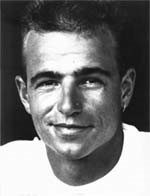
Ernst Strobl, born 1965 in Munich, is among the pathfinders of paragliding in Germany. As European- and Vice World Champion, Ernst “the sailplane” is one of the most successful pilots in Germany’s history.
From 1989 to 1995 he served as professional pilot and Head of Development of UP Europe. From 92/93 he worked as DHV-testpilot, being in charge of conducting the so-called “Gütesiegelprüfungen” (Certifications). 1989 – 1995 Strobl was member of Team Germany and from 1996 to 2002 professional pilot and Head of Development of AiREA.
Strobl ranks beyond controversy among the best paraglider developers in the world. As a self-educated person, he works with more enthusiasm than anybody else. People say about Strobl, he is able to see air-current.
Intuition and utilisation of the latest design-software lead Strobl often to innovations such as the AFS-system. The abbrevation stands for “Automatic Flight Stabilisation”, which means a great leap forward in safety and convenience.
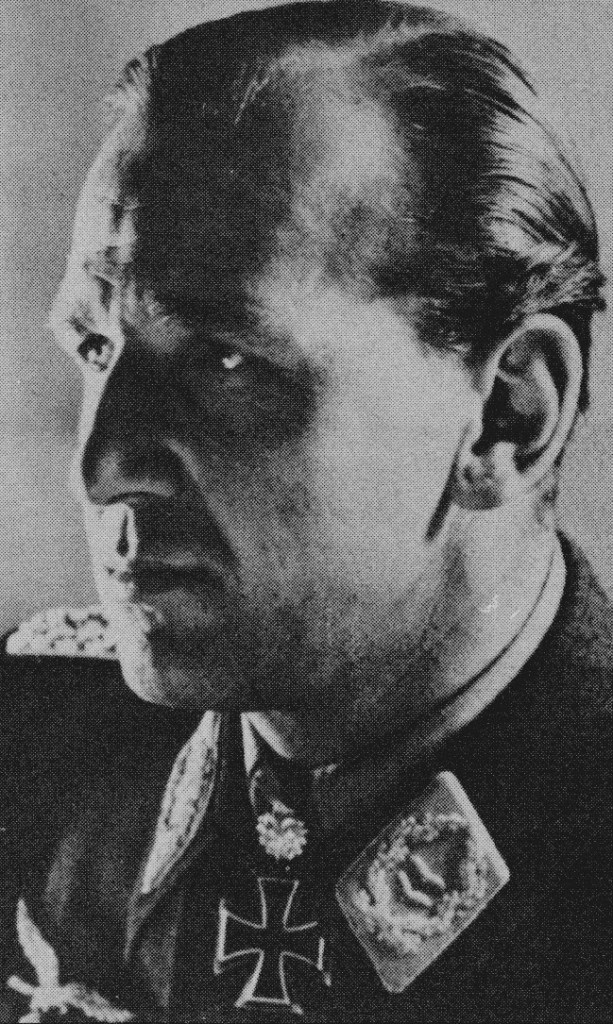
Werner Streib was born on 13 June 1911 in Pforzheim/Baden. Upon graduation from high school he attended a business school then served a three year apprenticeship in the banking business. When he was 23 Werner joined the new German Army and was assigned to Infantry Regiment No.14 based at Konstanz. He entered officer training. Two years later, in 1936, as a Lieutenant Streib transferred to the Luftwaffe as an observer in a reconnaissance group. He soon applied for pilot training, went through the instrument flying schools at Wesendorf and Brandis during 1937. The following year the new pilot was in No.2 Staffel of the Richthofen Jadegeschwader flying Heinkel 51 biplanes at Juterborg-Damm.
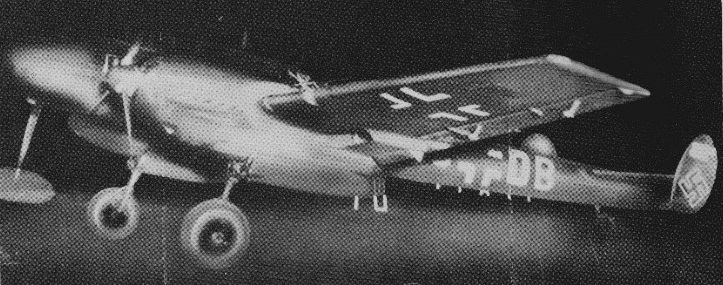
At the beginning of the war Oberleutnant Streib was Chief of Air Base Operations with Zerstorergeschwader (Destroyer Wing) No.1. He also flew a Messerschmitt 110 twin engine heavy fighter and was soon promoted to Staffel Fuhrer or Squadron Leader. On 10 May 1940 Streib scored his first victory, which remained his only day victory, when he shot down a British Bristol Blenheim bomber. Shortly after that the night fighting experiments began and he was transferred to the newly formed Nachtjageschwader (Night Fighter Wing) No.1 as the Stafffel Fuhrer of No.3 Staffel.
It was only after the RAF bombers began accelerating their nocturnal activities to forestall the German invasion of Denmark and Norway during early 1940, that the Luftwaffe admitted the need for a night fighter organisation. Despite this realisation little was done. It remained for the pilots in combat to forge ahead and experiment with equipment at hand.
The first German unit to take the initiative was a Zerstorergeschwader based in Aalborg, near the Kategat, in the newly occupied Denmark. This destroyer unit had been moderately successful in air battles with the British bombers by day but when the night bombing increased in intensity the Geschwader Kommodore, Oberst Wolfgang Falck, decided to act on his own. He selected a few of his best pilots and exposed them to a short period of vigorous night flight training as well as a special diet to improve their eyesight in the darkness.
When they were considered ready Falck selected his two most promising trainees, Oberleutnants Streib and Moelders, to attempt an interception
It was a bright night in the late sprig of 1940 when the two pilots took off in Messerschmitt 110 fighters to intercept British bombers over the North Sea. With no radar or radio contact to assist the Streib and Moelders had to rely on visual contact in the dark sky. Neither was able to score. They did discover that by flying above 10,000 ft visibility increased considerably. The entire wing then began intensive training but no bombers fell until the night of 20 July 1940 when a British bomber squadron flew over the Ruhr. Streib sighted a twin-engine Armstrong-Whitworth Whitley bomber at 2.15am. The initial attack was wide and the bomber undamaged. After a second attack with 20mm cannon the bombers fuel tank burst into flames. The intruder exploded and became the first German night victory in the second world war.
Streib’s Messerschmitt 110
Streib repeated this 48 hrs later when he shot down another Whitley bomber. On 30 August he destroyed a Vickers Wellington, and another during the following night. In the early morning of 30 September he shot down three twin-engine Wellingtons within 40 minutes.
Streib was awarded the Knights Cross of the Iron Cross on 16 October for his performance as a night fighter pilot. By September 30 the Luftwaffe decided to develop a potent night fighter force. Pilots, including Streib, began to meet with considerable success.
Geschwader Kommodore Streib and his aides
By October 1940 Streib held the Rank of Hauptmann and was the leader of Number One Gruppe in the Luftwaffe’s first night fighter wing. His unit was based in Schleswig near the Danish-German border. The Gruppe Kommabder’s victories continued to mount during the night of 14 October he shot down his tenth bomber. Streib’s score reached fifteen by 4 July 1941. In November Number One Gruppe was shifted to Venlo, Holland, directly in the path of British bombers on their way to the Ruhr. Streib became the Geschwader’s leading ace.
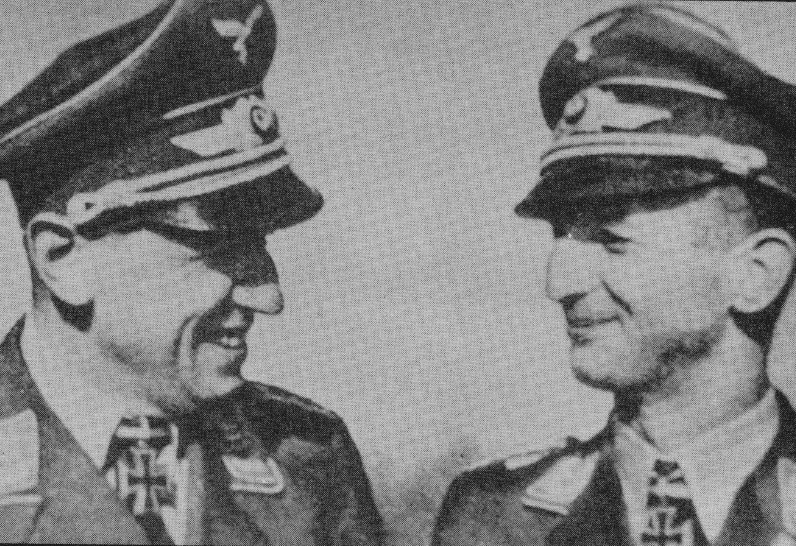
Major Streib and Oberst Wolfgang Flack
On the night of 26 March 1942, Streib attacked British bombers from 17,000 ft and within eight minutes two bombers fell. With his Messerschmitt 110 on the night of 30 May Streib scored his twenty-fifth and twenty-sixth victories.
By the middle of 1941 Telefunken had developed an airborne radar set for night fighter use. The Lichtenstien B.C. 409 Megacycle radar was given top industrial priority to ensure quick production.
In early spring of 1942, two Junkers 88 night fighters equipped with the Lichtenstien B.C. 409 Megacycle radar entered operational service with Nachtjagdgeschwader No.1 in Holland. The antennae mounted in the nose of the aircraft reduced the plane’s speed by as much as 25 mph, the first radar-directed victory being attained by Hauptmann Becker in the summer of 1942. Many night fighters being manned by a crew of three; pilot, radar operator, and radio operator – tail gunner.
The effectiveness of the Telefunkenwas evident by the mounting losses among the RAF night bomber squadrons. The British tried several jamming techniques but finally employed radar equipped Bristol Beaufighters and de Havilland Mosquitos beginning in June 1943.
During the following three months they accounted for forty-three German interceptors yet Streib attained his fiftieth victory in the early summer of 1943. He had been awarded the Oak Leaves and Swords to his Knight’s Cross of the Iron Cross on 26 February 1943. He was now a Major. Streib’s Gruppe No.2 had shot down its 250th bomber on 4 April 1943.
The techniques of night interception were improved and although the modified Messerschmitt 110 and Junkers 88 continued to be moderately effective, the RAF escorts made life difficult. In January 1942 the Heinkel 219 was revived for adaptation as a night fighter.
Major Streib was in close touch with Heinkel during the 219 development and formulating the final design. During the first week of June 1943, the first 219 was delivered to Number One Gruppe of Nachtjageschwader No.1 in Venlo. It was accompanied by a team of Heinkel engineers.
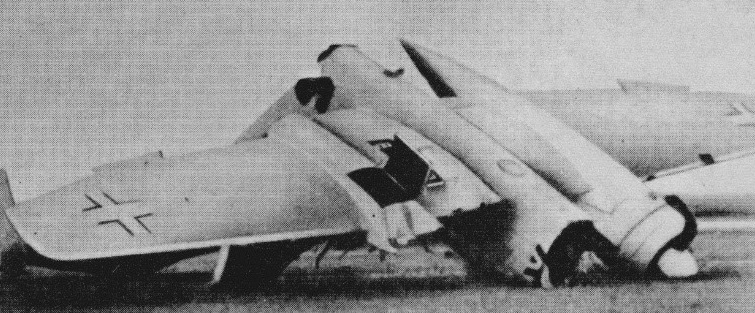
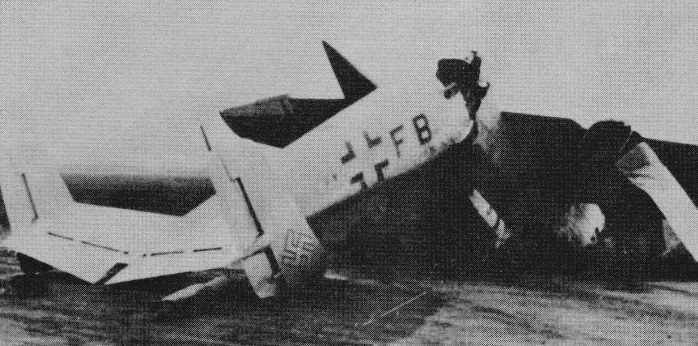
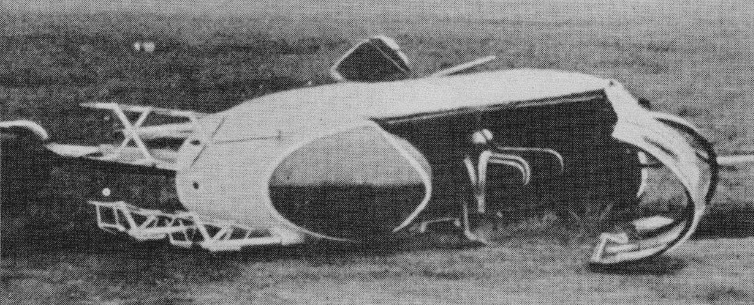
On the night of June 11-12 Major Streib took off in his new He 219 with Unteroffisier Fischer operating the newest Telefunken Lichenstein SN-2 radar, and over half an hour, scored five Lancaster bombers. The operational debut of the Heinkel 219 was a success. But as Streib prepared to land on the dark Venlo airfield he discovered that several vital instruments were not functioning properly. Although the Heinkel had not been hit, electrical trouble caused the landing flaps to malfunction. Each time that the pilot depressed the flaps they automatically returned to their closed position resulting in an approach speed of nearly two hundred miles an hour. Visibility was reduced due to condensed water and oil mixture from bomber slipstreams. The craft touched down heavily on its starboard side causing the right engine to tear away.
As Streib’s plane slid along the concrete its cockpit section broke free, shot through the air for 50 yards with the rest of the plane coming to a halt with its fuselage snapped in two at the wing trailing edge.
Pilot and radar operator emerged unscathed.
The He 219 had proved itself in combat and was quickly placed on operational status. During the following ten-day period the Heinkel sog NJG-1 destroyed twenty more bombers as well as six de Havilland Mosquitos.
On 1 July 1943 Werner Streib was made Kommodore of Nachtjagdgeschwader No.1 and promoted to the rank of Oberst. His victories were then approaching 60. On 11 March 1944 Streib was named Inspector of Night Fighters. Under his leadership the twin engine night fighter force increased to about 650 aircraft.
At the war’s end Werner Streib was credited with 65 official night victories and one day victory. Upon returning to civilian life the ace entered the packaged food business and was manager and co-owner of a successful firm. He was married in Munich in November 1947. During March 1956, he again entered military service as Commander of the Flight Training School at Landsberg in order to help his country fulfil its military commitments to NATO. In 1958 Werner Streib was Commander “Fliegerfuhrer Sud”; by 1961 he was Commander Air Division South. In 1965 he was Deputy
Brigadegeneral Streib’s military career ended with his retirement on 31 March 1966. His last position was Inspizient Fliegende Verbände (Inspector of Flying Forces).
He died on 15 June 1986 and is buried in Munich, Germany.


 All Aero