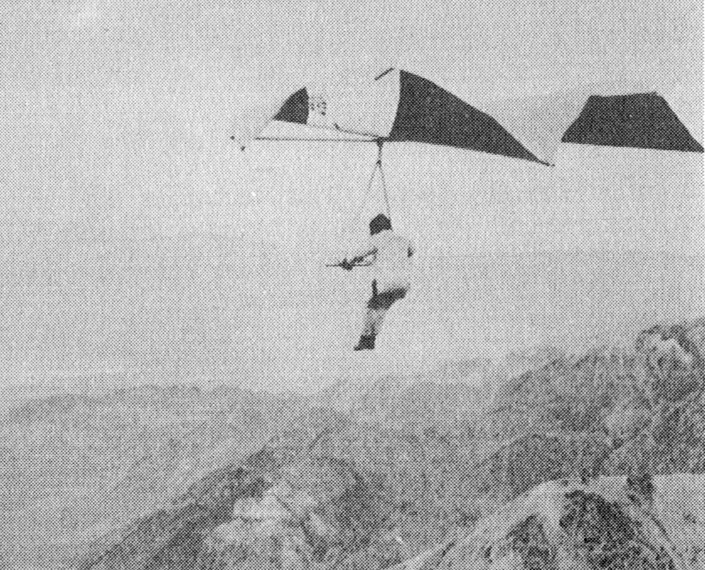
Bill Bennet leaves Dante’s View for Death Valley’s floor a mile below
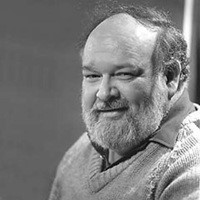
William Edward Norman Bennett was born in Korumburra, Australia, on Sept. 26, 1931. He served in the Australian Royal Navy as a machinist, and afterward continued to pursue activities related to water, in particular water-skiing. He was ranked eighth in the world in barefoot water-skiing in the 1960’s.
Bill Bennett, a pioneer aviator and entrepreneur who helped introduce the fledgling sport of hang gliding to America in the 1960’s and 70’s
Mr. Bennett, who moved to the United States from Australia in 1969, was known for his bold barnstorming flights in hang gliders in the late 1960’s and early 1970’s. He circumnavigated the Statue of Liberty in 1969 and landed at its base.
John Dickenson, an Australian electronics technician, saw a picture of the Rogallo invention in a magazine, and used it as the basis for making the first human-carrying gliders in 1963, according to the Smithsonian. Mr. Bennett and his friend Bill Moyes, friends of Mr. Dickenson through water-skiing, took up the sport; Mr. Moyes began making and selling hang gliders in Australia, Mr. Bennett in California.
Mr. Bennett’s company, Delta Wing Kites and Gliders in Los Angeles, was among the first to make and sell hang gliders in the United States.
Hang gliders were originally pulled by boats, then by planes. Mr. Bennett, probably in 1969 or 1970, according to a 1990 article in The Los Angeles Times, was demonstrating a hang glider towed by a car at the Ontario Motor Speedway in California when the rope broke. “Bennett was forced to maneuver and land the glider for the first time without being attached,” The Times reported. “The crowd, assuming it was part of the act, gave rousing applause.”
Mr. Bennett and Mr. Moyes both added design improvements. Mr. Harris said Mr. Bennett’s most important contribution was a better system for bracing the wings.
In 1972, he was hired as the stunt pilot double for the actor Roger Moore, playing James Bond for a hanggliding scene in the film “Live and Let Die.”
But by the mid-1980’s, Mr. Bennett’s aircraft could not keep pace with more innovative designs by competitors, and Delta Wing Kites and Gliders folded in 1989.
In the 1997 book “Sky Adventures,” the editors Jim Palmieri and Maggie Palmieri said Mr. Bennett’s other stunts after moving to the United States included flying higher than a mile and being the first to launch a hang glider from a hot-air balloon, thereby setting a world altitude record of 10,000 feet for hang gliders.
On 7 October 2004, Mr. Bennett was piloting a powered hang glider at the airport in Lake Havasu City, Ariz., where he lived, with an instructor in order to be recertified to fly. In the accident the instructor, Drew Reeves, received multiple injuries during takeoff and Bennett died in the crash. He was 73.
In addition to his fiancée, Mr. Bennett was survived by his sons, Gary and Glenn, of Australia; his daughters, Michelle Martin and Nicole McKinney, both of Lake Havasu City; his stepson, Dennis Firestone of Loma Linda, Calif.; his brother, Raymond, of Australia; his sister, Cheryle Winkler of Australia; seven grandchildren; and one great-granddaughter.
James R. Bede, who designed 18 aircraft in his 50-plus-year career in aviation, passed away at the age of 82 on July 9, 2015. Bede died as the result of an unrecoverable aneurysm suffered at the Cleveland Clinic in Ohio. Bede, EAA Lifetime 3758, had a number of well-known designs including the BD-4 high wing, BD-5 piston pusher, and BD-5J microjet. The latter gained considerable attention after being featured in the 1983 James Bond movie Octopussy. It was also popular at air shows flown by the Coors Light Silver Bullet Jet Team. In 1971, Bede was honored with the Dr. August Raspet Memorial Award for having made outstanding contributions to the advancement of light aircraft design.
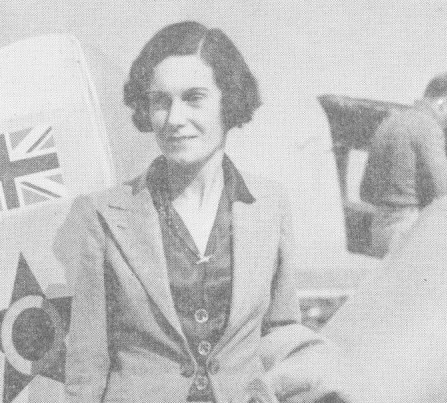
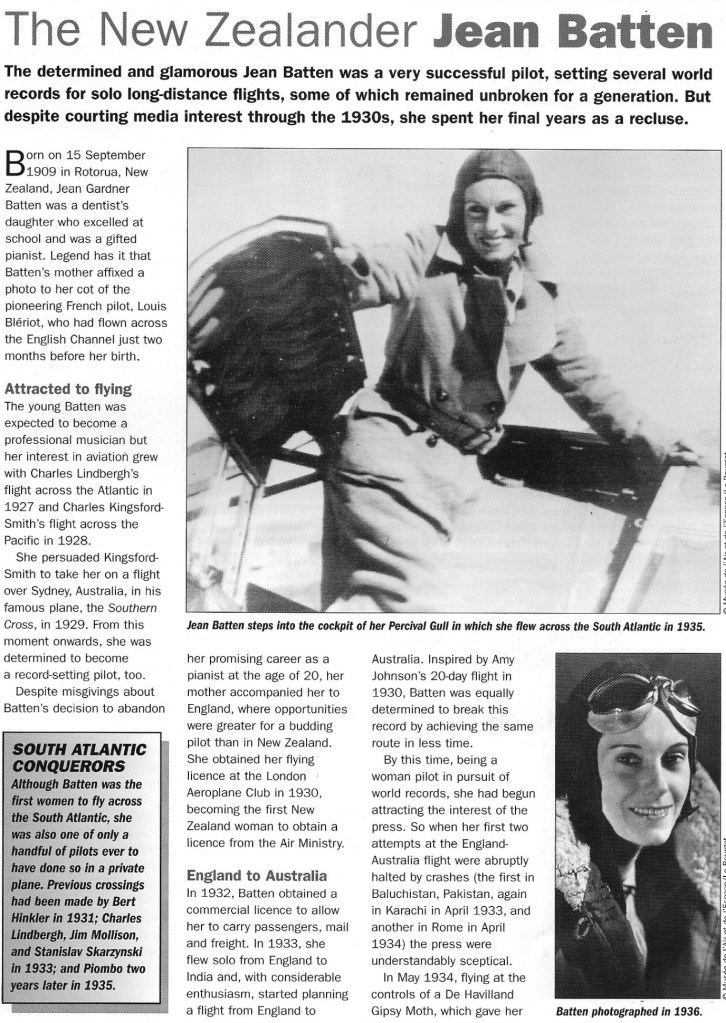
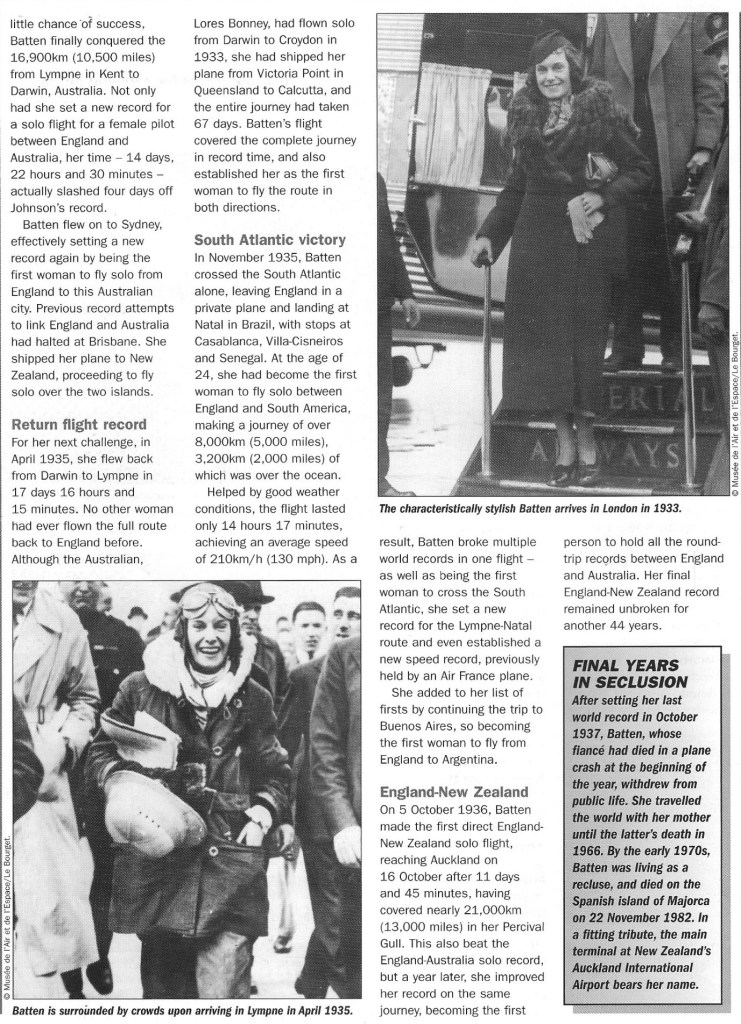
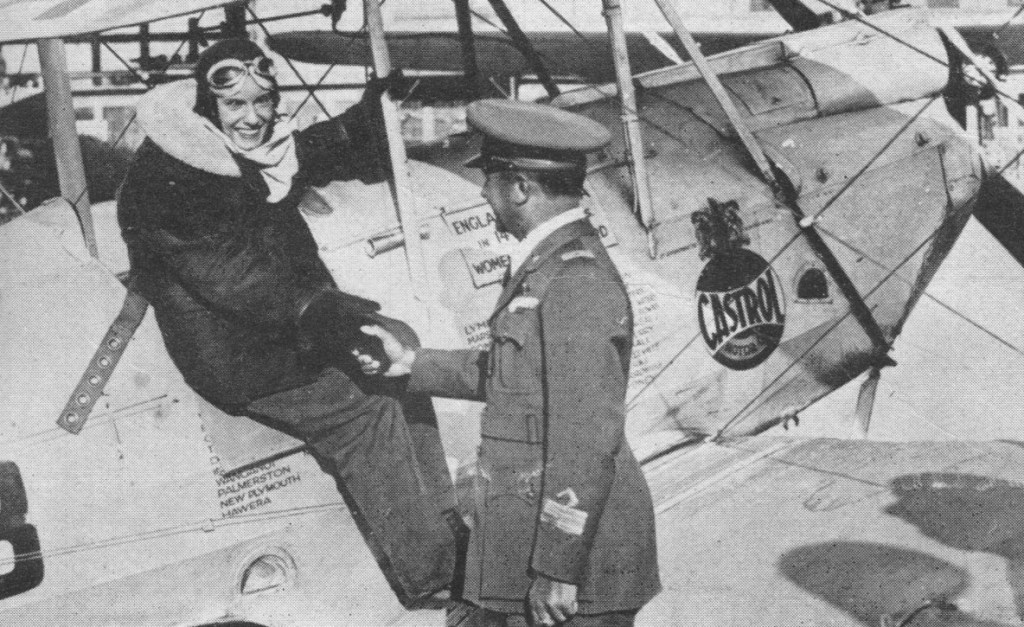
Born 1900 in Rotorua, New Zealand woman pilot Jean Batten made a series of record breaking flights in the 1930s. She flew solo from Britain to Australia in 1934 and, in 1935, became the first woman to make the solo return flight to Britain. Also in 1935, she flew from Britan to Brazil, becoming the first woman to fly solo across the South Atlantic. In 1936, she made the first direct flight from Britain to New Zealand. On this flight, she established a new world record time from Britain to Australia – 5 days 21 hrs. in 1937, on her return flight from Australia to Britain, she set a world record of 5 days 18 hrs 15 min.
She was the first woman to receive the Gold Medal of the Federation Aeronautique International.
Born at San Marino CA July 14, 1901. Died March 30, 1975.
Florence Lowe “Pancho” Barnes, grand-daughter of Thaddeus Lowe, who pioneered American aviation with the establishment of the Union Army Balloon Corps during the Civil War, was brought up in high society but acquired her famous tom-boy streak while learning hunting, fishing, and camping skills from her father, Thaddeus Lowe II. A marriage to clergyman C Rankin Barnes in 1919 survived in name only as she continued her flambuoyant adventures and, on inheriting the family fortune in the mid-’20s, she ran off to Mexico, where she acquired her nickname—an equestrian friend likened her, riding alongside on a burro, to Don Quixote’s sidekick, Sancho Panza—and the name got twisted around to “Pancho,” which stuck with her forever after.
Contrary to popular belief, and folklore, Barnes was not a working motion picture stunt pilot, nor was she ever filmed flying through a hangar. Her sole contribution to movies was flying, with a few other pilots, past studio sound trucks at Muroc Dry Lakes, to record their motors to dub into “Hell’s Angels” after Howard Hughes decided to revise his silent epic as a sound film.
A social member of the film pilots, she encouraged them to form a union, opened her home for their meetings, and provided administrative and secretarial services in helping them charter their new organization. In appreciation for her help she was made an honorary member of the Associated Motion Picture Pilots.
A heavily-laundered, “Hollywoodized” version of her life story was filmed for television in 1988.
He is one of the old stagers of the combat Luftwaffe, with experience extending from the Battle of Britain to the very eve of Germany’s collapse. He is one of his country’s most decorated soldiers.
The final World War II rank- Maj. Erich Hartmann (352) Maj. Gerhard Barkhom (301) Maj. Guenther Rall (275) Maj. Wilhelm Batz (237)
Barkhorn’s military flying career started in the spring of 1938, and a year later, he was introduced to fighters. He’s flown nothing else since. By1969 he had logged some 2,000 hours in the Messerschmitt 109, five hours in a Focke-Wulf Weihe instrument trainer, five hours in the Me 262 Schwalbe, the world’s first combat jet, and some 1,400 jet hours in the new Luftwaffe, which he rejoined in 1956.
He started with JG 2 “Richthofen” in the Battle of Britain, but experience came hard. “I was a very slow learner,” he says today. “I shot at two, but nothing.” Instead, he was himself twice shot down.
The first time he was over England when a Spitfire riddled his oil cooler. Nursing the crippled 109E back across the Channel, he cleared the cliffs between Dover and Folkestone and was just off the water when he was attacked again. Engine dead, Barkhorn bailed out, though he was still on the English side.
Another pilot from his squadron saw him bobbing in the water and notified a German E-boat nearby. The fast German speedboat and a British rescue crew raced each other to the downed flyer. The German crew won, but the narrow escape convinced Barkhorn there was little future in bailing out. He never did again, preferring eight times to ride his crippled 109 down instead.
He had not long to wait for the first one. His Staffel was converting from the E model to the new F, and Barkhom was flying to a field near Hamburg to turn in the older model when he found a scrap enroute. He crash-landed the shot-up fighter on the delivery field, saving him the paperwork of transferring it.
Assigned to II/JG 52 in August, 1940, Barkhorn took part in the invasion of Russia, but even then success eluded him. His first kill took nearly a month, when he scored in July, 1941.
His personal drought continued for nearly a year, but in May and June, 1942, he bagged more than 20 Soviet aircraft, mostly fighters. “Then I really started. Then I could do it very, very easily. In winter of ’42, I had already 100. In December of ’43, 1 had 250′.
Despite the cold and the demands of operational flying, Barkhorn flew one F for more than 300 hours in 1941-42, with only routine maintenance required on the DB 601E. The plane finally was destroyed in a bombing raid.
Barkhorn flew 14 planes on operations during the entire war, not a bad record for a man grounded two days in 1940 for damaging a 109E-7 during takeoff. The Messerschmitt’s swinging tendencies and weak gear caught up with him again in 1944, during the evacuation of Sevastopol, when he bellied in a 109G he was landing. But most were lost by enemy action.
Once Barkhorn almost was lost as well. He was dueling a Yak 9 low over the Black Sea, when the Yak riddled his coolant radiators before it was downed. “I thought, 1 never will make it. 1 was sweating.”
Climbing to clear the hills of the Caucasus, he would shut down the dangerously overheating engine and glide nearly to treetop level then restart it and climb back to altitude.
He rates the Yak 9 as his most dangerous opponent, but says the 109’s speed edge over the Russian increased with altitude. “We always went up to get away from the Russians, in a shallow climb. Then we’d come back.”
Today, Barkhorn says the hardest Russian plane to fight was the 1-16, the Rata, world’s first low-wing retractable gear pursuit. A stubby unstable airplane, it was blooded in the Spanish Civil War and the SinoJapanese conflict of 1937-38 and was considered obsolete when the Germans invaded. Despite its slow speed, Barkhorn notes “It could turn like-” his English failed him and he, shrugged, spread his hands and finished, “oooh!’”
One widely used American plane in Russia was the Douglas A-20, which Barkhorn considered a satisfying target. The twin-engine attack bomber was caught “easily” by a 109, and he says, “It burned quite well.” He shot one down in the Black Sea near Sevastopol, he recalls. “It burned on the water. It was quite amazing”.
Luftwaffe veterans generally ‘rank RAF pilots as the most troublesome, Yanks next and Russians last. But occasionally, there were Red pilots high in the list. They were mostly Red Guards Regiment flyers, and Barkhorn met one once over Kharkov late in 1943, flying a LaGG-3 painted red from spinner to wing root. “This guy I did fight for half an hour and I couldn’t get him and he couldn’t get me. We both did everything we knew and some we just made up. 1 was wet like I had been in a bath. Never did I work so hard. Finally, we had to give up because of fuel starvation, so we both flew off.
The German fighters’ short range was one reason Luftwaffe pilots made so many sorties. Four a day were routine, and Barkhorn’s personal record is eight in one day. His total for the war is 1,104, more than 10 times the normal mission total of a USAAF pilot. Barkhorn’s averaged a 70 minute sortie time throughout the war. The Messerschmitt could be equipped with an 80-gallon centerline drop tank to augment internal fuel, but those flying on the Eastern -front didn’t like it. And as Barkhorn says, “In comparison with the Mustang, for example, forget it.”
The usual foe was a Pe-2, a Douglas A-20, one of several Russian-built or U. S. Lend-Lease fighters, or one of the endless stream of Il-2 Stormoviks operating on the 1,800-mile front. These were well armored and always caused trouble for German fighters. “Sometimes we shot away all our ammunition on one of them without any reaction, but they burned well if they were hit in the oil cooler,” Barkhom remembers. “Sometimes, too, you had to saw off a wing.” Since the plane was mostly wood, this could be done by a skilful and determined pilot.
For months, Barkhorn was the Luftwaffe’s leading ace. But one afternoon in May, 1944, his II/JG 52 was operating near Yashi, Rumania, in the slow, bitter retreat westward. Barkhom was homeward bound after escorting Stuka ace Hans-Ulrich Ruedel on a ground-support mission, and he was feeling frustrated because there had been no contact with the Reds on this sortie. The Gruppe Kommandeur’s score stood at 273 and he badly wanted to add a couple that day to round out the number.
The returning planes passed Eric Hartmann and his Staffel, heading out on a fighter sweep. Hartmann then was trailing Barkhorn’s lead closely and pressing hard to outscore him.
Suddenly Barkhorn heard Hartmann announce contact with a large fleet of Russian bombers. Barkhorn had been up since before dawn and was finishing his sixth mission of the day, “But when 1 heard that,” he says, “I turned around and started back there. It wasn’t far, and 1 had enough fuel. 1 headed straight for them, and suddenly 1 was headed for the ground.”
His fatigue had made him careless. He’d neglected to check his rear, “and this bloody Airacobra sneaked up behind me”.
He was wounded in the right leg and arm. The knee required corrective surgery, and Barkhorn spent four months hospitalised in Tegernsee. While he was laid up Hartmann took the scoring lead, never to be challenged.
Barkhorn rejoined JG 52 that fall in Hungary, but soon afterward he was tapped as wing commander of JG 6 Horst Wessel, in Sorau, Silesia. He took command of his new unit which was equipped with the 1ong nose” FW 190D-9 in January, 1945, and on January 5, he tallied his 300th kill. There was to be only one more, also in Silesia.
By then, the Luftwaffe was nearly grounded for lack of fuel. JG 6’s airstrip adjoined a Focke-Wulf assembly plant, so aircraft were no problem. “I had 160 brand-new birds and we were allowed to fly only four airplanes once a day due to lack of fuel.”
He tells of dispatching a lieutenant in a Fieseler Storch to find a train, reported stalled in Hungary and laden with aviation gasoline. The lieutenant found the train, sans locomotive. Ransacking Hungary, the lieutenant eventually found a locomotive and a crew to run it, connected it to the train and personally delivered the badly needed fuel to Sorau.
In 1945 Lt. Gen. Adolf Galland was fired as General of the Fighters and allowed to form JV 44, the “Squadron of Experts.” One of his first staff members was Lieutenant Colonel Steinhoff, who was put in charge of pilot recruiting. And one of Steinhoff’s first choices was a onetime member of his Battle of Britain staffel, Maj. Gerd Barkhorn,
Barkhorn’s association with JV 44 was very brief. After converting to the Me 262, he was attacking a USAAF bomber formation on 16 April 1945, on his second combat sortie when his right engine failed.
A flight of P-51s promptly jumped the crippled Swallow. With an engine. out, the jet was slightly slower than the American fighters. Lacking maneuverability to evade the P-51s, Barkhorn was forced to crash-land.
He dived for a clearing in the woods below, opened the canopy and prepared for his eighth crash landing. Like the 109, the jet’s canopy hinged to the side. As it bounced across the ground on its belly, Barkhorn was pitched out of his seat and the canopy slammed down across his neck. As usual, the 262 then caught fire and the semiconscious Barkhorn was slightly burned before he could get clear. Back he went to the hospital.
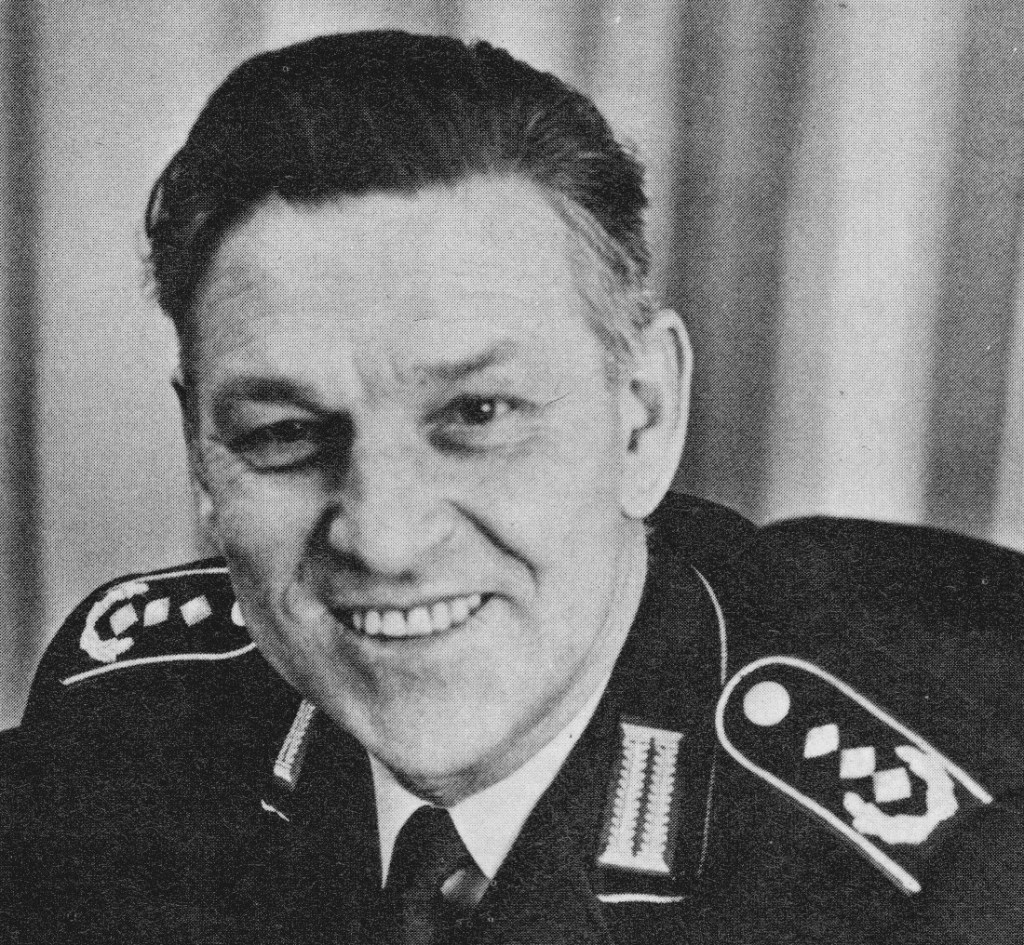
Oberst Gerhard Barkhorn
In 1969 Barkhorn, at 50, was still a fully qualified fighter pilot, this time on the Luftwaffe’s F104G. But he says, “I am a desk pilot since April last year,” and is limited to 15 hours’ fighter time a year for budgetary reasons. The man who survived five years’ combat over England, Russia, and the Reich.
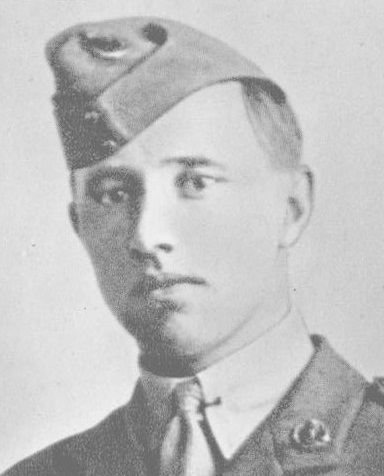
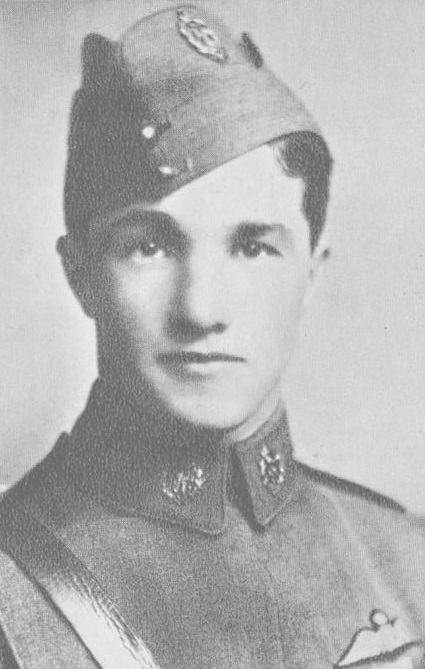
The first British pilot to be nationally acclaimed on account of his mounting score of air victories. Albert Ball had joined the Sherwood Foresters at the age of 18 in 1914. Transferred to No. 13 Squadron RFC in 1916, Ball flew BE.2c on artillery spotting before changing to Nieuports with No. 11 Squadron, and by the end of the year had shot down 10 enemy aircraft.
He then changed to the S.E.5 and before his death on 7 May 1917 had down a total of 44 German aircraft.
A loner, and an intensely religious young man, he was deadly stalker in the air, against the enemy. His death inaction remains a mystery to this day.
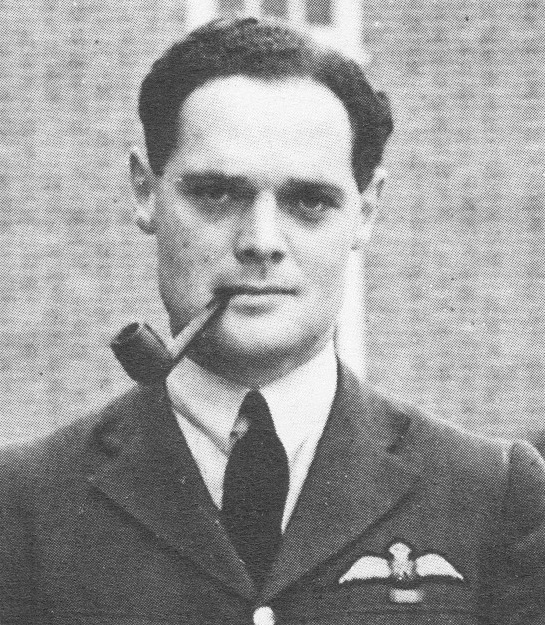
Douglas Robert Stewart Bader was born in London on 21 February 1910, the second son of Fredrick Bader. Fredrick died as a result of wounds during the First World War and eight-year-old Douglas was sent to live with his aunt and her husband who was the Adjutant at the Cranwell military flying school.
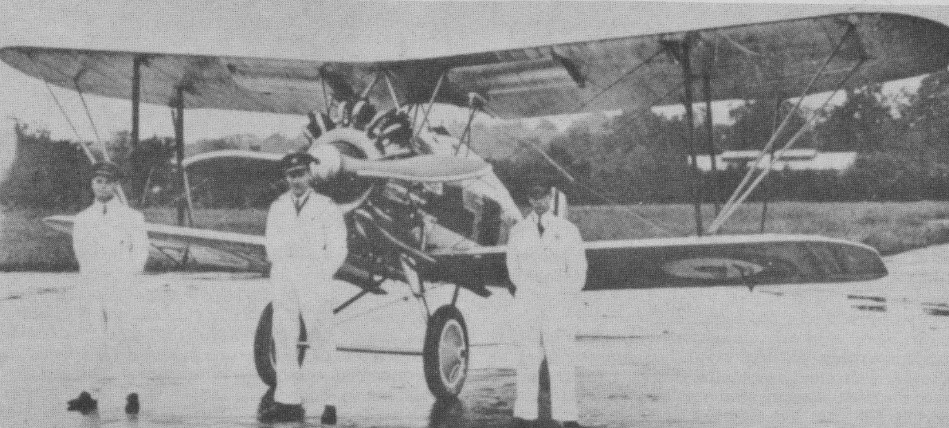
Douglas won a scholarship in 1923 and went to St Edward’s School, Oxford, and on graduation, went to the RAF College, Cranwell in 1928. Showing exceptional flying aptitude, he soloed after six-and-one half hours of instruction. He graduated in 1930 and was posted to 23 Sqn Fighter Squadron based at Kenley. The unit was equipped with Gloster Gamecock biplanes and Bader was selected for the three-man exhibition team in an annual air display at Hendon Aerodrome,
No.23 Sqn Gloster Gamecock stunt team – Bader at left
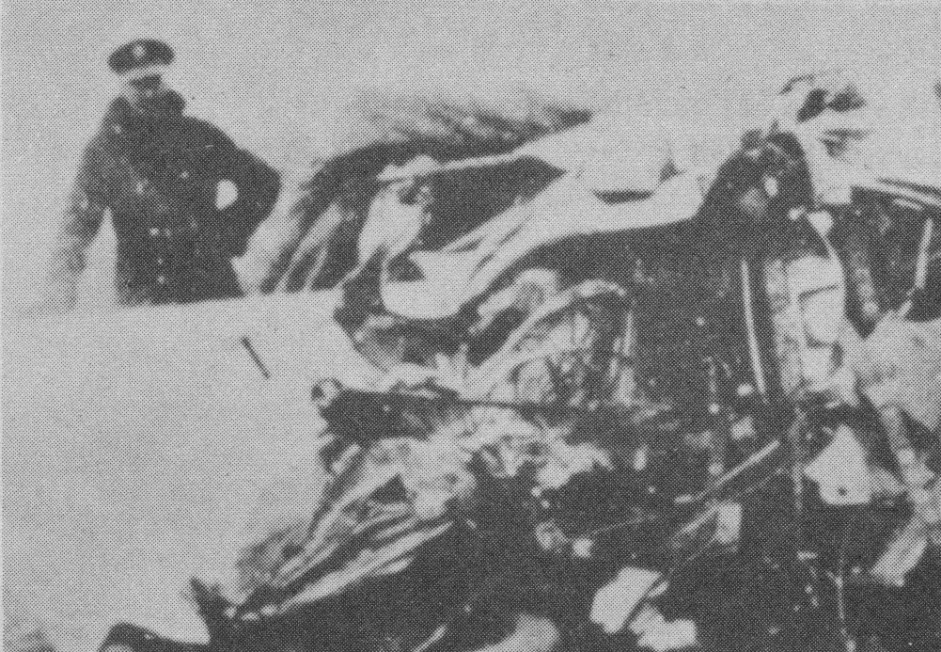
In 1931 No.23 Squadron re-equipped with more powerful, but less manoeuvrable Bristol Bulldog. On Monday, 14 December 1931, Bader flew to Woodley Aerodrome and while there went to perform a low, slow, roll. The second half of the roll was precariously close to the ground. As the wings neared the perpendicular, their downwards tips struck the ground. The aircraft cartwheeled and lost the engine. Bader remained semi-conscious in his seat.
In hospital Bader had both legs amputated. By November 1932, with artificial legs, he piloted an Avro 504 from No.601 Auxiliary Squadron. The RAF grounded him and he was invalided out of the service in 1933.
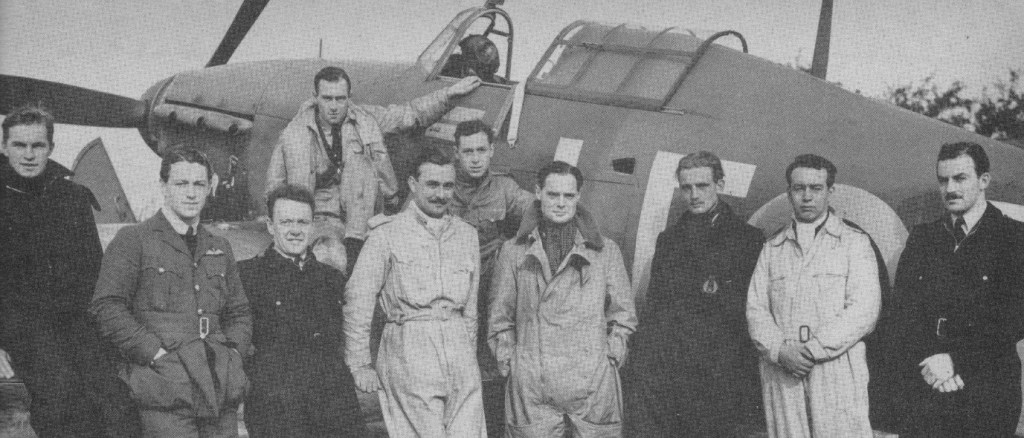
Bader at centre – Commanding Officer of 242 Squadron RAF
He was re-admitted for flying duties in 1939 and in December 1939 first flew a Hawker Hurricane, then on 7 February 1940 joined 19 Sqn at Duxford, which was equipped with Spitfires. He was soon promoted to flight lieutenant and transferred to 222 Sqn as a flight commander.
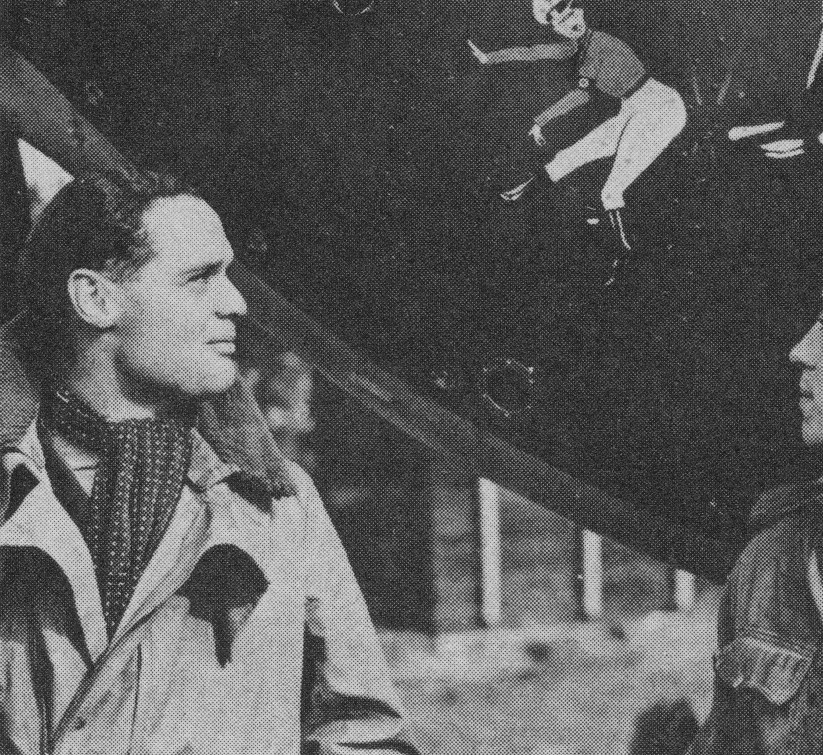
On 1 June 1940 he shot down a Bf 109. He was promoted again in July and given 242 Sqn to command. On 11 July he destroyed a Do 17 and another on 21 August. He sent down two Bf 110s nine days later, a 110 and a Bf 109 on 7 September and a Do 17 on the 9th. On 13 December his DSO was gazetted. On 15 September he got a Do 17, a Ju 88 and a Do 17 on the 18th. On 27 September he was credited with one confirmed and one probable Bf 109.
Early in 1941 he was awarded a DFC, promoted to wing commander and made leader of the Tangmere Wing of three Spitfire squadrons. In the course of several sweeps over France he shot down three 109s and shared another in June, and six more with a half share in a seventh during July. On 9 August, after bringing down two 109s, he collided with a third, baled out and was taken prisoner. His total score was 23.
 All Aero