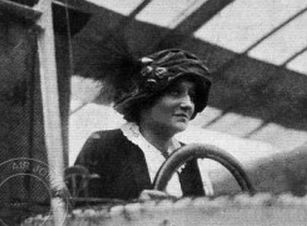
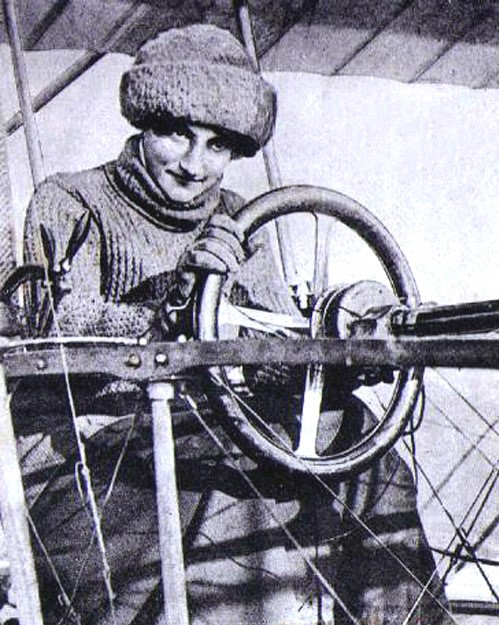
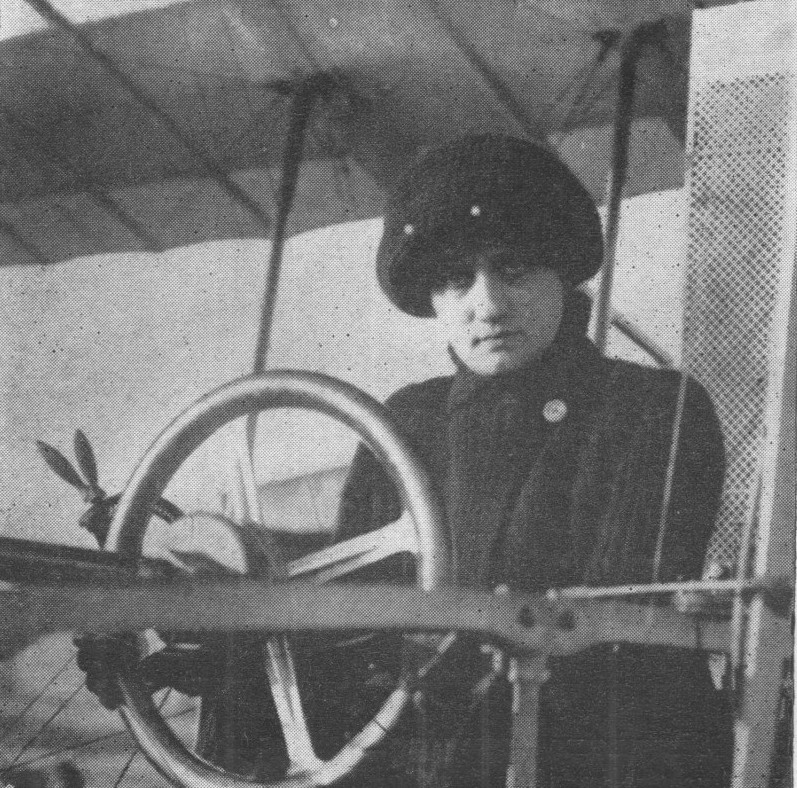
Raymonde de Laroche (22 August 1882 – 18 July 1919), born Elise Raymonde Deroche, was a French pilot and the first woman in the world to receive an aeroplane pilot’s licence.
French actress Elise Deroche, better known as Baroness Raymonde de Laroche, took flying lessons at the Châlons-en-Champagne aviation camp on a Voisin biplane, with Charles Voisin having encouraged her to do so.
She passed the pilot’s license on March 8, 1910 in Mourmelon, making her the first woman in the world to achieve this.
On October 22, 1909 she made a historic first solo flight from the aerodrome of Bouy with a single-seater aircraft, then browsing a distance of 300 meters at 5 meters altitude. Charles Voisin as well as an English journalist being the witnesses of this flight during which Elise Deroche seemed a perfect mistress of his airplane.
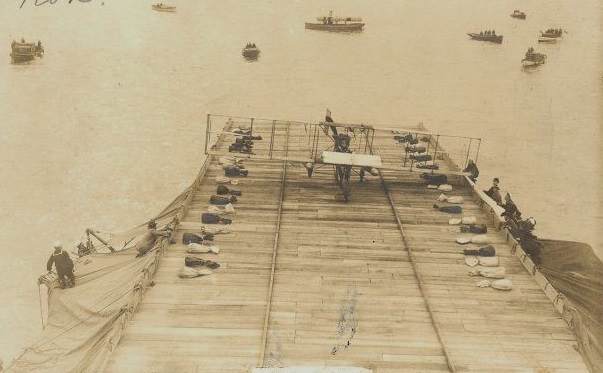
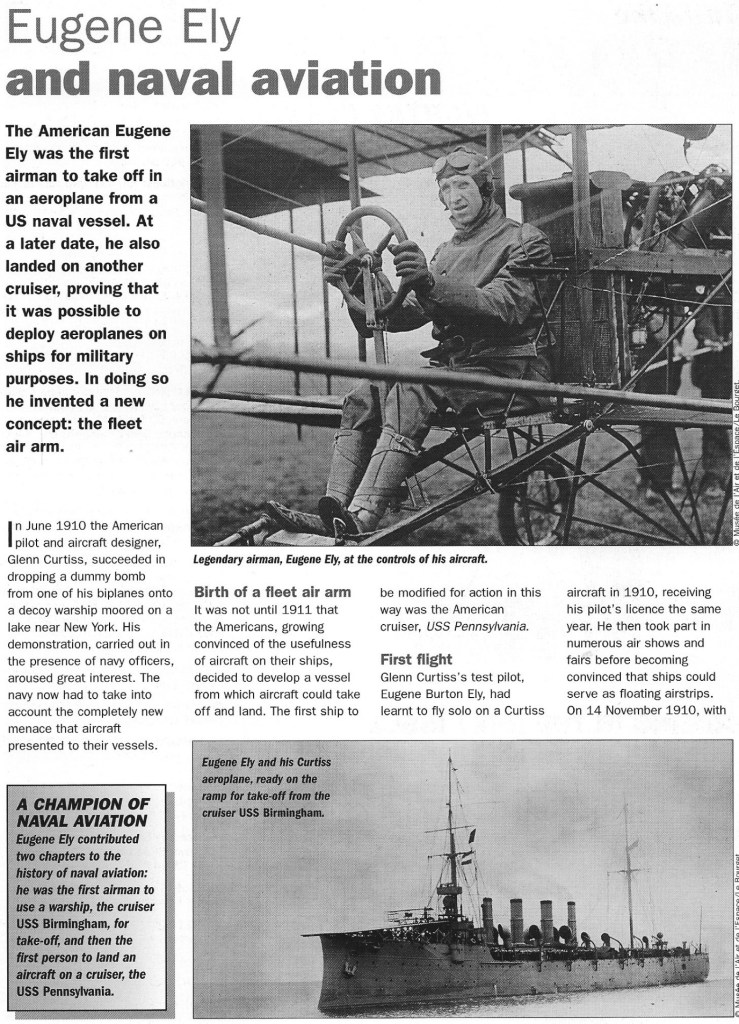
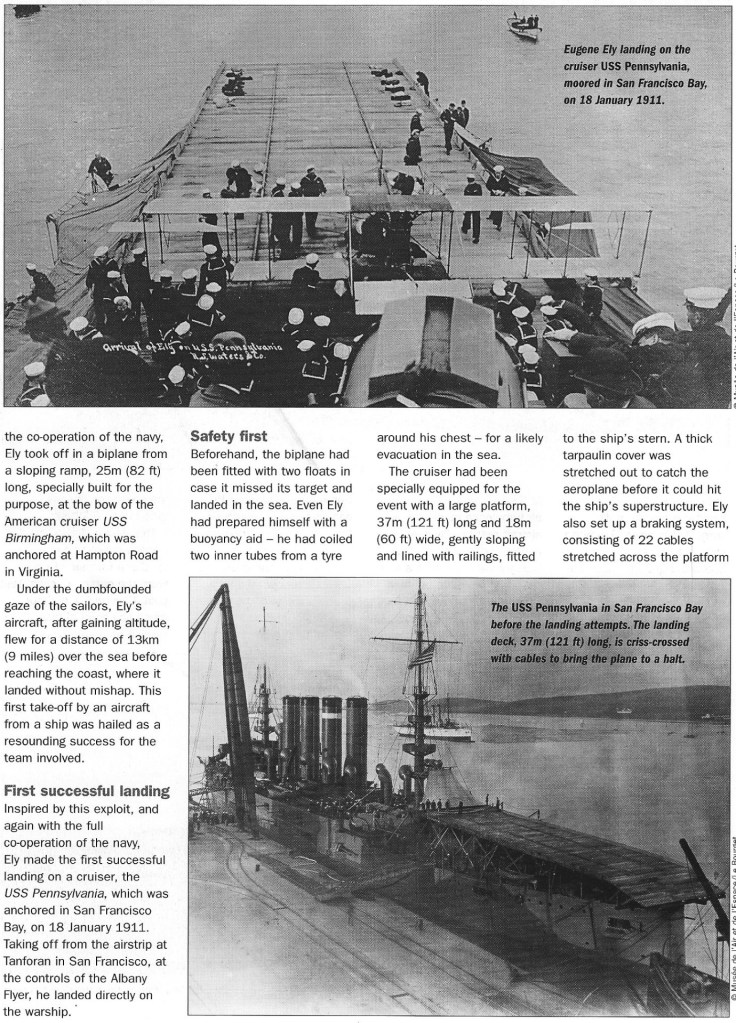
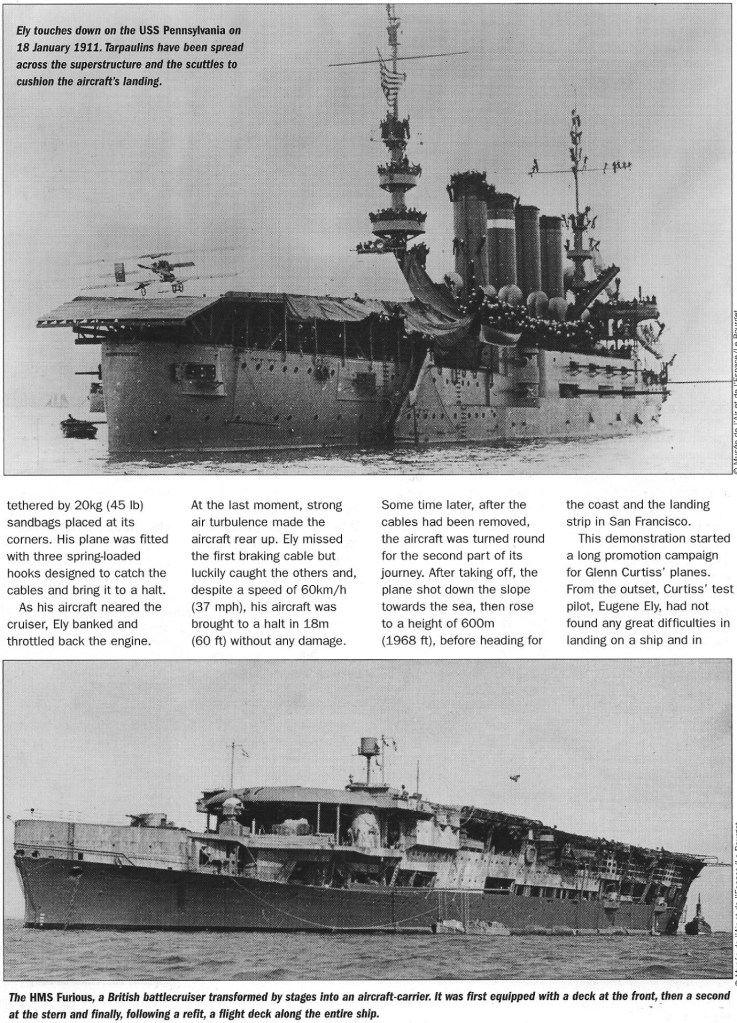
After receiving an engineering degree in 1904 from Iowa State University, Eugene Ely began a career in the fledging automobile industry as a salesman, mechanic, and racing driver. He taught himself to fly in 1910 and never looked back. He had natural skills as an aviator and quickly became a well-known pilot with the Curtiss Exhibition Team that toured all around the county. In the fall of 1910, the Navy identified Captain Washington I. Chambers “to observe everything that will be of use in the study of aviation and its influence upon the problems of naval warfare.” Chambers quickly realized the most important first step to prove that the airplane could operate at sea was to show that landings and take-offs from ships were possible. Chambers attended one of the first major flying meetings, being held at Belmont Park, NY, in October 1910. He met Glenn Curtiss and Eugene Ely at the competition and made a proposition. If he would supply the ship, would they make the attempt to land on board? Ely was excited at the prospect and agreed.
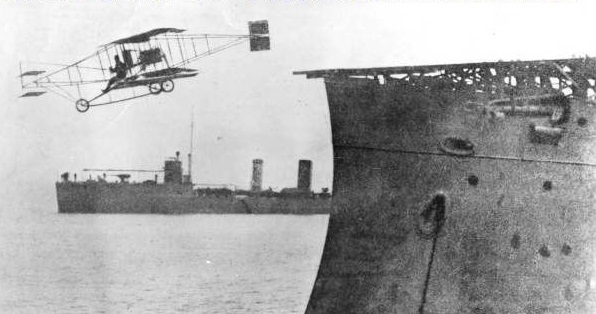
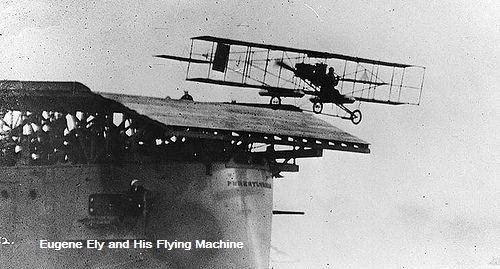
On November 14, 1910, the light cruiser USS Birmingham was readied at Norfolk, Va., with a wooden platform erected on the bow, approximately 80 feet long. Ely’s Curtiss Pusher aircraft, equipped with floats under the wings, was hoisted aboard and the ship moved off shore. Ely succeeded in making the first take-off from a ship, barely. The Curtiss rolled off the edge of the platform, settled, and briefly skipped off the water, damaging the propeller. Ely managed to stay airborne and landed 2 ½ miles away on the nearest land, called Willoughby Spit.
Born in British Columbia in 1893, Collishaw transferred to the Royal Naval Air Service from the merchant service in 1916, first flying Sopwith 1 1/2-Strutters; by the end of that year he had destroyed three enemy aircraft. After a short spell flying Pups with No. 3 (Naval) Squadron, was appointed ‘B’ Flight commander on No.10 (Naval) Squadron, flying Sopwith Triplanes.
Under his leadership ‘Black Flight’ of ‘Naval Ten’ became one of the most successful of all Allied units in France, all its pilots being Canadians. Although his own score reached 40 by the end of 1917, it was for his leadership that he was most respected. He subsequently took his victory tally to 60 while commanding Nos 3 and 13 (Naval) Squadrons in 1918.
Collishaw was awarded the CB, DSO and Bar, OBE, DSC, and DFC.
After the war he rose to become an Air Marshal in the RAF and pursued a distinguished career during World War II.
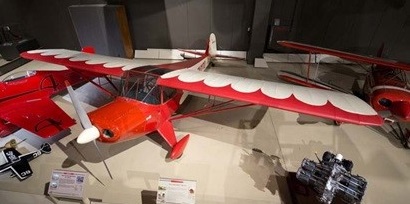
Duane Cole (1915-2004) was a flight instructor, author, aerobatic instructor, and air show performer. His trademark Taylorcraft, with Cole’s name written upside-down on its fuselage, was a common sight at air shows around the U.S. Duane Cole took his first flying lesson in 1937, on Christmas Day. He earned his Private Pilot license in 1938, his commercial license in 1939, and his instructor’s license in 1940. He also flew his first air show in 1940, launching an aerobatic career that spanned more than 50 years. From 1940 to 1955, Cole taught aerobatics to students in the Civilian Pilot Training Program (a wartime program to increase the number of qualified pilots), and to cadets in the U.S. Army Air Force and the British Royal Air Force. After WWII, Duane and his brothers Marion, Arnold, and Lester formed the “Cole Brothers Air Circus.” The name was quickly changed to “The Cole Brothers Air Show” to avoid a legal conflict with the popular Cole Brothers Circus. In 1951, Cole was one of 12 men who gathered in Milwaukee to form a new airplane builders club that, two years later, became the Experimental Aircraft Association. Cole’s Taylorcraft, a BF-50, was built in 1938, the same year Cole earned his Private Pilot license. In 1950, it was acquired by John Vasey, a well-known aerobatic pilot and air show performer. Vasey shortened (“clipped”) the wingspan from 36 feet to 28 feet, 10 inches, and strengthened the wings. That gave the airplane more speed and a faster roll rate. Vasey also moved the pilot’s seat and control seat to the center of the cabin, making the two-seat BF-50 into a single-seat airplane, and shifting the airplane’s center of gravity. Finally, he replaced the original Franklin 50-horsepower engine with an 85 hp fuel-injected engine. His modifications turned the docile BF-50 into a powerful and agile aerobatic performer.
1938 Taylorcraft/Cole BF-50 Clipped-Wing – N21292
Duane Cole bought N21292 from Vasey in 1952. Thus began one of the longest running aerobatic “partnerships” in history. Duane Cole and his signature red and cream Taylorcraft entertained millions of air show spectators in 47 states and five foreign countries. Cole installed a new 150-horsepower engine on the plane, but otherwise left the basic structure and Vasey’s modifications unchanged. He had little use for radios or instrument flying, and flew all over the US using pilotage and dead reckoning skills. In 1962 and 1964, Cole flew the Taylorcraft to win the US National Aerobatic Championship and was named in 1962 to the US aerobatic team to compete for the international title in Budapest, Hungary. Cole’s other accomplishments include: Owned and operated an aerobatics school from 1967 to 1987 and authored nine books, produced several videos, and wrote a monthly column for FLYING magazine. Won many writing awards, including the Aviation/Space Writers Association Writer’s Award for Non-Fiction in 1972 and 1974. Introduced the “pace plane start” at the 1963 Phoenix 100 Air Race and the 1964 Pendleton 100 Air Race, similar to pace car starts at the Indianapolis 500 automobile race. Organized and ran the first Reno Air Races in 1964 and served as Reno’s race director through 1967. Inducted into the Illinois Aviation Hall of Fame (1983), the International Aerobatic Hall of Fame (1987), and the International Council of Air Shows Hall of Fame (1996). Cole died of natural causes at the age of 89, with more than 30,000 hours of flight time.
A native of Texas, USA, Samual Franklin Cody had been a buffalo hunter and cowboy in America. Because of this, he was often mistaken for “Buffalo Bill” Cody, who was Colonel W.F.Cody of the US Cavalry.
S.F.Cody adopted the title of Colonel when King George V, falling into the mistake, called him Colonel in a telegram of congratulation. The airman said, “As His Majestry has referred to me as ‘Colonel’ Cody, so in future ‘Colonel’ Cody it has to be.”
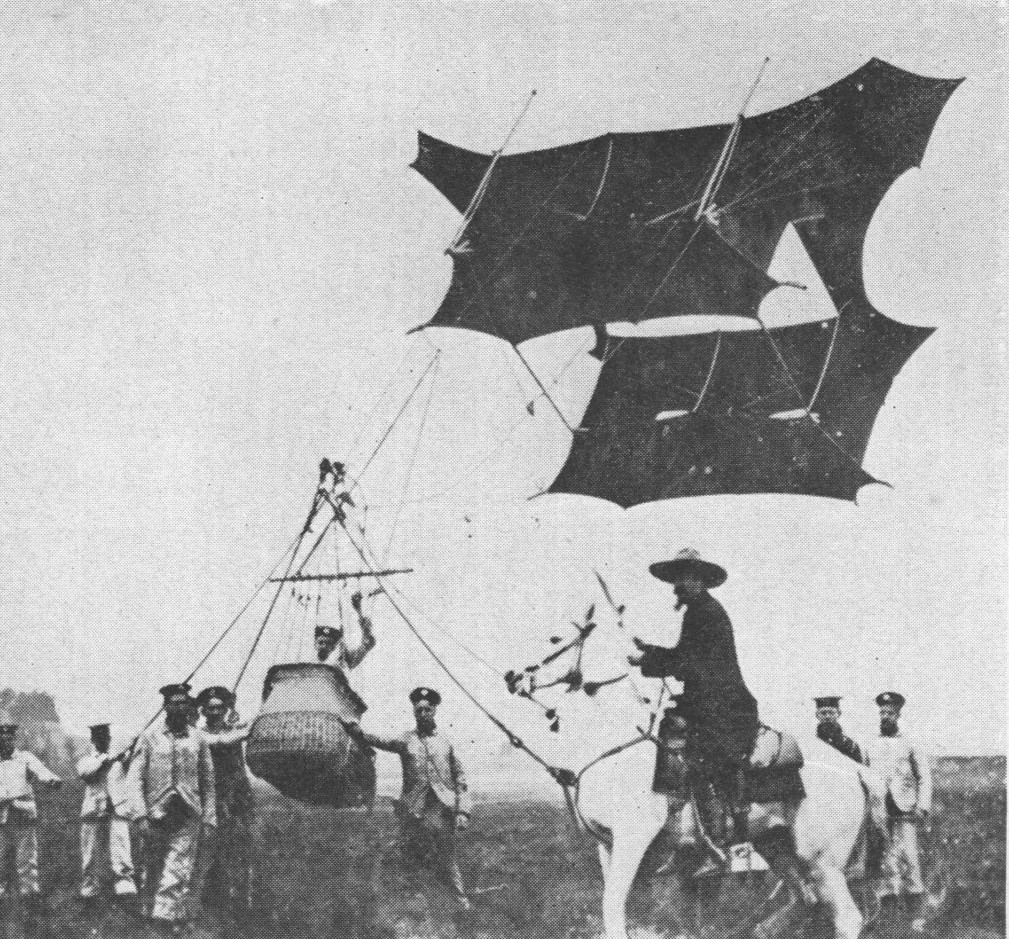
It was about 1900 when Cody began to improve on earlier man-lifting kites, and even before the Wright brothers had made their flights, he had flown his kites for the Royal Navy. In 1904, he was engaged by the War Office to make kites for the Army. It was hoped that kites could be used in war for watching the movements of the enemy.
By 1906 Cody’s kites were regularly used to carry men of the Royal Engineers up to 2,000 ft. One kite remained at a height of 2,600 ft for more than an hour, and another reached 3,000 ft, which was a world record.
In 1907 Cody rebuilt one of his kites and fitted it with a petrol engine to drive a propeller. This machine, with no one on board, was set off on Farnborough Common in Hampshire and remained off the ground for four and a half minutes.
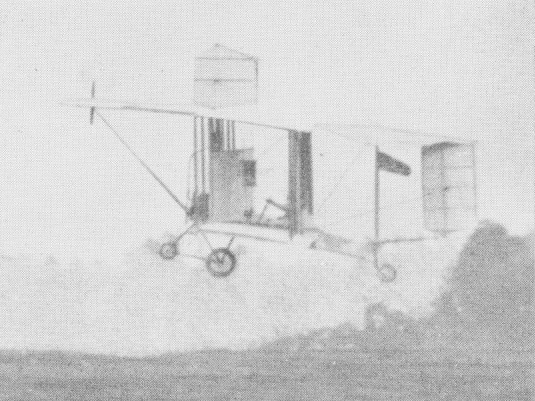
In the spring of 1908, Cody finished building British Army Aeroplane No.1. He fastened this aircraft to a tree with a spring balance, so that he could measure the power of the engine. The tree can still be seen today on Farnborough Common. It is known as :Cody’s Tree.” A tablet below it says, “nearby he made…..his flight of 1,390 feet on 16th October, 1908…..the first powered and sustained flight in Great Britain.”
Cody flying at Farnborough, October 1908
This flight ended in a crash, but next year, Cody made successful flights in a new biplane. By the end of 1908, he could only stay in the air for twenty-even seconds, whereas the Wright brothers had by then achieved two hours, twenty minutes.
At Doncaster in 1909, Cody completed his naturalisation as a British subject and announced his intention of trying for the Daily Mail £1000 prize offered for the first British pilot to fly a mile in an all-British aircraft.
At Doncaster in 1909, Cody completed his naturalisation as a British subject
The cross English Channel prize was given by the Daily Mail. It had been offered in October 1906, together with a prize of £10,000 for the first flight from London to Manchester, a distance of 183 miles.
Cody set out in an attempt to win the London-Manchester prize on 8 October 1909. After four miles he had engine trouble which caused him to give up the attempt.
When the channel had been crossed attention turned to the London-Manchester prize. Interested was Colonel Cody.
In September 1909, Cody became the first man in England to make a flight lasting more than an hour. He was in the air for 66 minutes, flying over Aldershot, Farnborough, Fleet and the surrounding countryside at a height of about 700 feet.
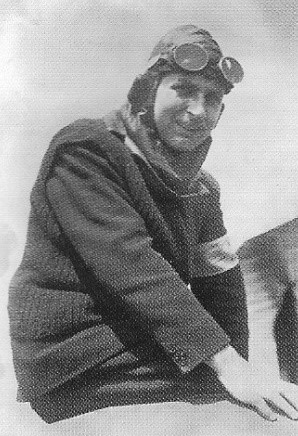
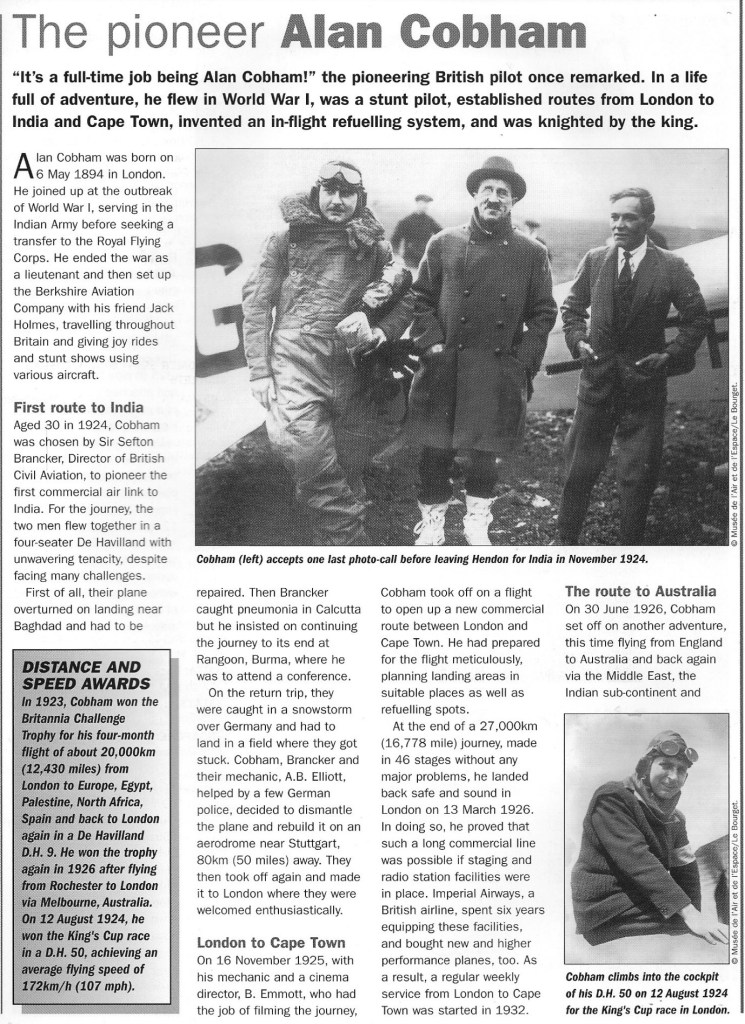
On November 20, 1924, Alan Cobham set out from Croydon in a DH.50 to survey a route for regular air services to India and Burma.
The journey to Rangoon was made without serious trouble. On the return flight he was forced down by a snowstorm in the Back Forest, Germany. Impossible to takeoff from where he landed, Cobham had the DH.50 taken to pieces and moved to a field nearby. Then it had been put back together, he flew it home to London.
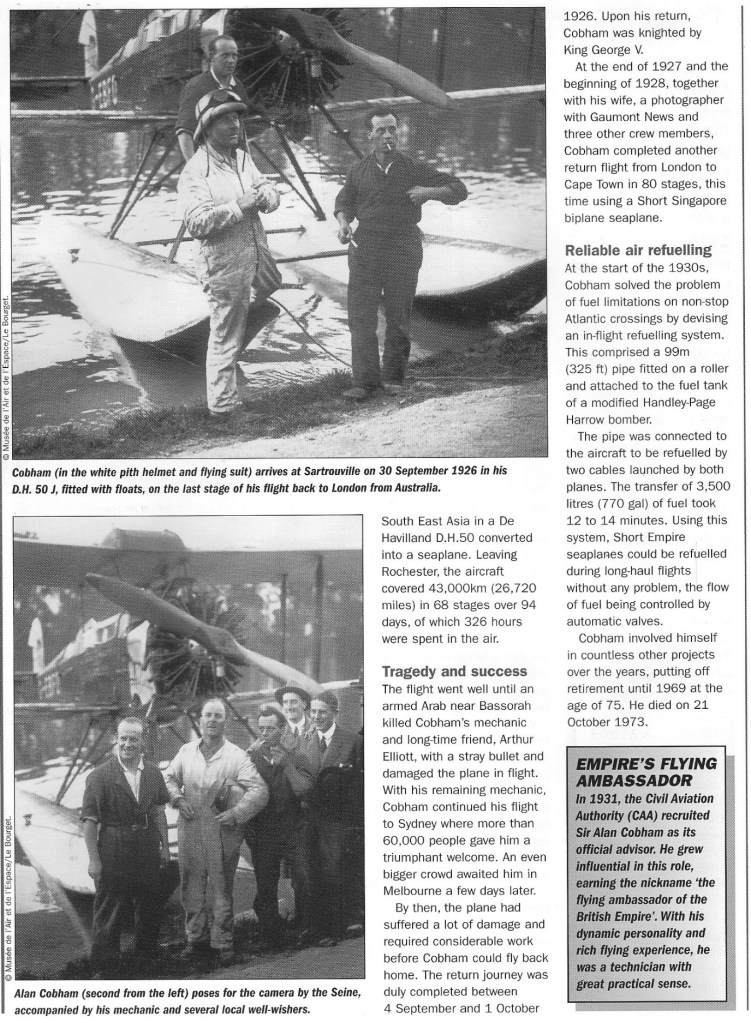
In 1925 Cobham tookoff from London for South Africa to survey a route for Imperial Airways. With him were his mechanic, Arthur Elliott, and a cameraman, Emmott. The flight was without mishap.
Cobham flew back from Capetown in fifteen days. This was the first flight from South Africa to England and a vast crowd greeted him when he landed at Croydon.
Wilfred Greville Clouston was a New Zealander who joined the RAF in 1936 and by 1940 was a flight lieutenant on 19 Sqn. In the last days of May 1940 h shot down an He 111, a Bf 109, a Do 17 and two Ju 87. /in June he added another 109 and got a DFC. Flying a Spitfire experimentally fitted with two 20mm cannon, he destroyed a 109, a 110, a Do 17 and a Ju 88 during August and September. In 1942, when a wing commander, he was captured by the Japanese. His total score was 12.

 All Aero