
Norwegian explorer Roald Amundsen, leader of the first expedition to successfully reach the South Pole, died on 22 June 1928 when his French Latham 47 Flying Boat crashed into the Barents Sea, in the Arctic circle. He was on route to Spitsberhen as part of an international team to rescue the crew of the crashed airship ‘Nobile’. Although rescuers saved nine of the sixteen members of Noblie’s crew, no one ever fund the body of Amundsen or the five others aboard the flying boat.
Born in Missouri, 1854.
Baldwin’s was orphaned at an early age, he became an acrobat at 14 with a traveling circus and then progressed, step-by-step, to prominence in aviation. He made his first balloon ascent in 1875 and soon became a star attraction at county fairs, but after 10 years and thousands of shows the novelty began to fade. Searching for a daring new exhibition specialty, he rediscovered the rigid parachute invented a century before, redesigning it and making it flexible so it could be packed. With this he offered to parachute from his balloon, at the rate of a dollar a foot, and his services were eagerly bought, a thousand feet worth, at San Francisco’s Golden Gate Park. On Jan 30, 1885, it one of the first times in history that a man descended from a balloon in a parachute.
Again the luster faded and he set out in 1900 to devise an act of even greater daring, with a motor-driven balloon. On finding a lightweight engine to power his elongated airship, it was Glenn Curtiss’ motorcycle engine that powered his new dirigible, California Arrow, on Aug 3, 1904, in the first circuitous flight in America. The Army was impressed and offered to pay $10,000 for a practical means of aerial navigation. His creation was 90′ long, powered by a novel Curtiss engine, and was accepted and designated SC-I, the Signal Corps’ first such craft, which set the design for all the dirigibles of the time.
By then another craft had staked the promise for the future, and interest faded in all but the Wright brothers’ flying machine. In 1911 Baldwin built the first plane with a steel framework and christened it Red Devil. Showman that he was, he knew that people around the world wanted to see an airplane fly, and formed a troupe of performers in 1913 to tour the Philippines and the Orient, where in most cases an airplane had never flown.
Just before WW1 his interest turned to dirigibles again and he designed the Navy’s first successful dirigible,the DN-I. Training fliers was also the need, so he managed the Curtiss Flying School at Newport News, where one of his students would later become the unsung champion of the air service, General William E “Billy” Mitchell. When the US went to war, although 62 years old, Baldwin volunteered his services to become Chief of Army Balloon Inspection and Production, personally inspecting every balloon and airship used by the Army in the war. His final employment was with the Goodyear Tire & Rubber Co, continuing the design and manufacture of airships.
Enshrined in National Aviation Hall of Fame 1964.


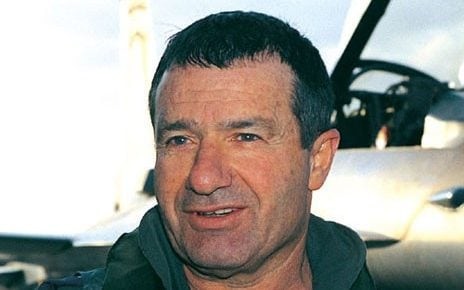
Giora Epstein, who has died aged 87, was an Israeli Air Force pilot who could claim to be the top fighter ace of the supersonic age.
He shot down a total of 17 enemy aircraft – 16 Egyptian jets and one Egyptian Mi-8 helicopter. His 16 victories over Egyptian jets place him third on the all-time list for jet-to-jet combat, behind two Soviet pilots in the Korean war; Epstein holds the top international rank for victories against supersonic fighters.
On June 5 1967, Israel launched what would later be called the Six-Day War, beginning with Operation Moked (“Operation Focus”), a pre-emptive air strike against Egypt in which Epstein, flying the French-built Dassault Mirage III, took part. The Israelis destroyed most of the Egyptian air force, mainly on the ground, within three hours. Some Egyptian aircraft survived, and on the second day of the war, Epstein claimed his first kill by shooting down an Egyptian Sukhoi-7 in the Sinai.
Soon after the Six-Day War, Gamal Abdel Nasser, Egypt’s president, began a war of attrition in which the Israeli Air Force (IAF) played a leading role in bombing targets deep inside Egypt. In this conflict, Epstein shot down four additional aircraft: a MIG-17, a Sukhoi-7 and two MiG-21s.
Two of his kills occurred when Epstein lured a squadron of four Egyptian MiGs into a carefully prepared ambush. These victories increased Epstein’s total tally to five, earning him the title of “flying ace”, a designation given to pilots with five or more confirmed kills.
It was during the October 1973 Yom Kippur War that Epstein cemented his reputation as a cool and brilliant pilot: in one dogfight, facing 20 Egyptian fighter jets, he shot down four aircraft in a single sortie before returning to base to refuel. In this war, Epstein downed 12 Egyptian aircraft overall.
In eight of his 17 aerial victories, Epstein flew a Mirage III. In his other nine, he flew an Israel Aircraft Industries Nesher (“Eagle”), an Israeli-built version of the Mirage 5. Five of his kills were achieved using air-to-air missiles, the rest with cannons.

He was born Giora Epstein, a name he later changed to Giora Even (“stone” in Hebrew), on May 20 1938. His parents, Hillel and Chaya, emigrated from Poland in the early 1930s and settled in Kibbutz Negba, in British Mandatory Palestine.
Young Giora became passionate about aviation after watching RAF manoeuvres over his kibbutz in southern Palestine. He eagerly read books about air battles and the biographies of pilots. While in school, he joined Gadna (“Youth Battalions”), an organisation that prepared young Israelis for military service.
In 1956, Epstein joined the Israeli Defence Forces (IDF), but was disappointed when he was rejected from the (IAF’s pilot- training course due to his enlarged heart and low pulse. Instead, he became a paratrooper.
In 1959, Epstein was discharged and returned to agricultural work on the kibbutz, but re-enlisted three years later as a parachuting instructor. He reapplied to the IAF’s flight school and was accepted after gaining medical clearance.
In 1963, Epstein graduated and was assigned to fly helicopters in the IAF’s 124 Squadron. But he refused to fly, and instead walked into the office of the Air Force Commander, General Ezer Weizman, declaring: “I’m going to sit here at your reception until you transfer me to a fighting unit.” Weizman replied: “OK, you bastard.”
Epstein was nicknamed “Hawkeye” because he could spot enemy aircraft from a distance of 24 miles, nearly three times further than a typical pilot. His shorter stature also helped him withstand G-forces during flight.
After the Yom Kippur War, Epstein was awarded the Medal of Distinguished Service. In 1974 he was appointed commander of the IAF’s 117 Squadron, and three years later, he retired from active service, having flown 9,000 sorties and amassed 5,000 flight hours.
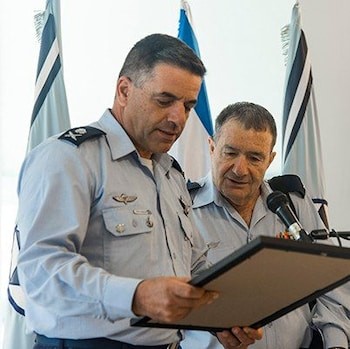
He continued to serve as a combat pilot in the reserves, and in 1988 he obtained special permission to transfer to the F-16. But to an old hand like Epstein, the computer-controlled aircraft lacked the pleasure of piloting a Mirage. “You are not flying the F-16,” he explained. “The F-16 flies itself… you, as a pilot, are just another input… As a pilot, I like to feel the aircraft. In a Mirage, every flight is a joy.”
After retiring, Epstein worked as a commercial pilot for El Al, Israel’s national airline, until 2003.
In 2018, he was promoted to brigadier-general in recognition of his contribution to Israel’s security. Epstein was the primary focus of the “Desert Aces” episode of the History Channel series Dogfighters (2007). In 2020 he published a memoir, Hawkeye.
He was married to Sarah, who served as an operations officer in his squadron. They had three children.
Giora Epstein-Even, born May 20 1938, died July 19 2025

William Lendrum Mitchell (December 29, 1879 – February 19, 1936) was a United States Army officer who had a major role in the creation of the United States Air Force.
In 1908, as a young Signal Corps officer, Mitchell observed Orville Wright’s flying demonstration at Fort Myer, Virginia. Mitchell took flight lessons at the Curtiss Flying School at Newport News, Virginia.
In June, he took private flying lessons at the Curtiss Flying School because he was proscribed by law from aviator training by age and rank, at an expense to himself of $1,470 (approximately $33,000 in 2015).[12] In July 1916, he was promoted to major and appointed Chief of the Air Service of the First Army.
Mitchell served in France during World War I and, by the conflict’s end, commanded all American air combat units in that country. After the war, he was appointed deputy director of the Air Service and began advocating for increased investment in air power, believing that this would prove vital in future wars. He argued particularly for the ability of bombers to sink battleships and organized a series of bombing runs against stationary ships designed to test the idea.
Recognized as one of the top American combat airmen of the war alongside aces such as his good friend, Eddie Rickenbacker, he was probably the best-known American in Europe. He was awarded the Distinguished Service Cross, the Distinguished Service Medal, the World War I Victory Medal with eight campaign clasps, and several foreign decorations. Despite his superb leadership and his fine combat record, he alienated many of his superiors during and after his 18 months of service in France.

He antagonized many administrative leaders of the Army with his arguments and criticism and in 1925, his temporary appointment as a brigadier general was not renewed, and he reverted to his permanent rank of colonel, due to his insubordination. Later that year, he was court-martialed for insubordination after accusing Army and Navy leaders of an “almost treasonable administration of the national defense” for investing in battleships. He resigned from the service shortly afterwards.
On February 19, 1936, Mitchell died in New York City at Doctors Hospital of a coronary occlusion. He had been admitted to the hospital on January 28. He was 56 years old.
Mitchell was buried at Forest Home Cemetery in Milwaukee, Wisconsin. None of Mitchell’s children from his first marriage attended the funeral. His widow, Elizabeth, later married Thomas Bolling Byrd, the brother of Virginia governor Harry F. Byrd Sr. and explorer Richard E. Byrd.
Mitchell received many honors following his death, including a Congressional Gold Medal. He is also the first person for whom an American military aircraft design, the North American B-25 Mitchell, is named. Milwaukee Mitchell International Airport in Milwaukee, Wisconsin, is also named after Mitchell.
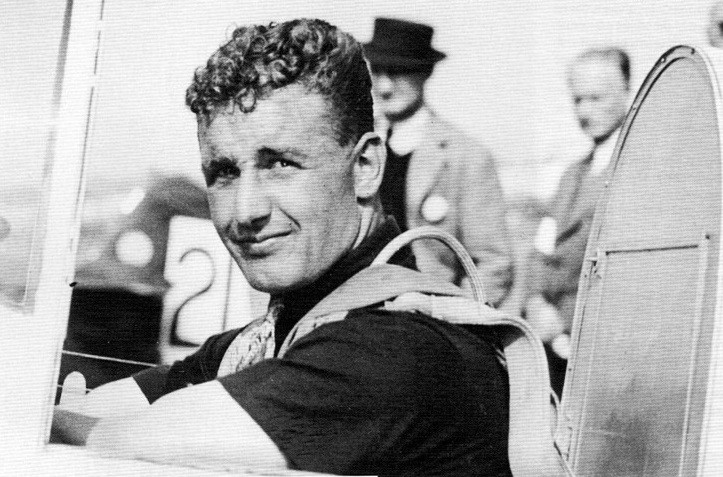
Alexander Adolphus Dumphries Henshaw, MBE (7 November 1912 – 24 February 2007) was a British air racer in the 1930s and a test pilot for Vickers-Armstrongs during the Second World War.
Henshaw was born in Peterborough, the eldest son of a wealthy Lincolnshire family. He was educated at King Edward VI Grammar School, Stratford-on-Avon (“Shakespeare’s School” where he sat at the Bard’s desk), and Lincoln School (formerly Lincoln Grammar School). He was awarded the Royal Humane Society Medal for saving the life of a boy from the River Witham.
Henshaw’s early ambition was to race motorcycles, and he harboured dreams of competing in the Isle of Man TT Races.
However after watching a biplane swooping low over the sea, he decided that he wished to learn to fly and undertook lessons at the Skegness and East Lincolnshire Aero Club in 1932, funded by his father, who bought him a de Havilland Gipsy Moth. Henshaw received his private pilot’s licence (no. 4572) on 6 June 1932. He made a name for himself in the 1930s in air racing. Aged only 20, he competed in King’s Cup Air Race in 1933 flying a Comper Swift, winning the Siddeley Trophy. He also flew a Leopard Moth and an Arrow Active which caught fire while he was performing aerobatics: Henshaw bailed out safely.
On 6 September 1935 Henshaw’s aircraft came down in the Irish Sea while he was competing in the King’s Cup; he was rescued by the Isle of Man Steam Packet Company steamer, Ramsey Town. Following the rescue Henshaw presented Ramsey Town’s commanding officer, Captain Archibald Holkham, with a barometer bearing an inscription which acknowledged that his skill and seamanship had probably saved his life.
He later acquired Percival Mew Gull G-AEXF, with which he won the inaugural London-to-Isle of Man air race in 1937. Following extensive modifications by Essex Aero, he flew it to victory in the 1938 King’s Cup, flying at a record average speed of 236.25 mph.
Henshaw then turned his attention to long-distance flying. After reconnaissance of the eastern and western routes in 1938, he set off from Gravesend at 0335 GMT on Sunday 5 February 1939 to fly his Mew Gull to Cape Town and back. He refuelled on the way out in Oran in Algeria, crossed the Sahara to land in the Belgian Congo and then Angola, landing at Wingfield Aerodrome Cape Town after flying 6,377 miles in 40 hours. He spent 28 hours in Cape Town, and retraced his route back to the UK, landing on 9 February after a flight of 39 hours, 36 minutes. He experienced hazardous landings at remote bush airstrips, battling through a tropical storm, and overcoming extreme exhaustion on the return leg. He completed the whole 12,754-mile round trip in 4 days, 10 hours and 16 minutes, breaking the record for each leg and setting a solo record for the round trip. By the end, he was so tired that he had to be lifted out of the cockpit.
His account of his air racing career is given in his book Flight of the Mew Gull (1980).
The Cape record stood for more than 70 years. On 11 May 2009, Charles Stobart, flying a homebuilt Osprey GP-4, set a new record ratified by the FAI for the reverse route, Cape Town – London – Cape Town. Subsequently, on 3 September 2010, Steve Noujaim, flying a homebuilt Vans RV-7 supported by Prepare2go, landed at Southend Airport in the UK after completing a round-trip to Cape Town in 3 days, 11 hours and 16 minutes. The new record bettered Henshaw’s time by just over four hours.
G-AEXF was restored to its Cape flight configuration in the 1980s. It remained in flying condition at Breighton in Yorkshire until Feb 2013 when it was purchased by The Shuttleworth Collection. The Royal Aero Club awarded Henshaw the Britannia Trophy for his record flight.
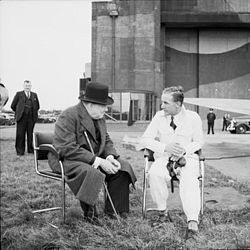
Henshaw considered enlisting in the Royal Air Force at the start of the Second World War, but he instead became a test pilot for Vickers-Armstrongs. He subsequently took the rank of sergeant pilot to fly a fully armed Spitfire to defend the factory, if needed, although he was never called upon to fly in combat. Henshaw started with Vickers Wellingtons at Weybridge. He did not enjoy the work, and was on the point of leaving when Jeffrey Quill invited him to test Spitfires in Southampton.
In June 1940 Henshaw moved to the Castle Bromwich factory in Birmingham, which had been taken over by Vickers after poor production results by the Nuffield group. He was soon appointed to the post of Chief Test Pilot, leading a team of 25 others. The factory built over half of the total output of Spitfires ever made, and 350 Lancaster heavy bombers; Henshaw tested both types of aircraft. Production/acceptance test flying was essential, ensuring that faults were detected before aircraft were delivered to the front line, but it was potentially dangerous: two of his team were killed testing new aircraft. Henshaw survived many forced landings and a catastrophic crash in Wednesfield near Wolverhampton on 18 July 1942 which destroyed his aircraft.
It is estimated that Henshaw flew 10% of all Spitfires and Seafires, testing up to 20 aircraft a day in often foggy conditions. He would also demonstrate the Spitfire to visiting dignitaries, such as Winston Churchill, and once flew the length of Broad Street in Birmingham at low level. He is the only pilot known to have performed a barrel roll in a Lancaster bomber, a feat that was considered by some to be reckless or impossible due to the aircraft’s size and relatively modest performance. He flew this manoeuvre on several occasions with other members of his flight test team on board, including Peter Ayerst and Czech pilot Vaclav ‘Venda’ Jicha. (Venda was a pre-war aerobatic pilot, fighter ace, Battle of Britain pilot and previous member of No. 124 (“Baroda”) Squadron RAF.)
Henshaw was appointed a Member of the Order of the British Empire in recognition of his wartime service.
After the war Henshaw became a director of Miles Aircraft in South Africa, a job which entailed visiting potential customers in the region and making demonstration flights. But the company folded and he returned to England in 1948. Although still only in his mid-30s, he never again flew as pilot in command of an aircraft. Instead he took charge of his family’s farming and holiday business interests in Lincolnshire. He was awarded the Queen’s Commendation for Brave Conduct for his rescue work in the 1953 floods.
Following his retirement, Henshaw wrote a book recounting his wartime experiences at the Castle Bromwich Aeroplane Factory (CBAF), Sigh for a Merlin (1979), the title referring to the Rolls-Royce Merlin engine of the same name which powered most Spitfires and Lancasters. This book was followed in 1980 by Flight of the Mew Gull, an account of the author’s pre-war air racing and record-setting adventures.
The Air League awarded Henshaw the Jeffrey Quill Medal in 1997. In 2003, he became a Companion of the Air League in 2002 and was elected an Honorary Fellow of the Royal Aeronautical Society. In 2005, Henshaw donated his papers and mementoes to the RAF Museum, funding a curator to catalogue his collection. In his later years he was invited to make several flights in a two-seater Spitfire, occasionally handling the controls. The last of these came on 5 March 2006 when, at the age of 93, he took part in a flypast at Southampton Airport to mark the 70th anniversary of the first flight of the prototype.
Henshaw wrote a third book, Wings across the Great Divide which was published in 2004. This final part of his trilogy details his experiences flying in Africa in the immediate aftermath of the Second World War.
In 1940, Henshaw married Barbara, the widow of French race and test pilot Guy de Chateaubrun. Barbara Henshaw died in 1996. Alex Henshaw died at home in Newmarket on 24 February 2007. He was survived by their only child, Alexander Henshaw Jr.


 All Aero