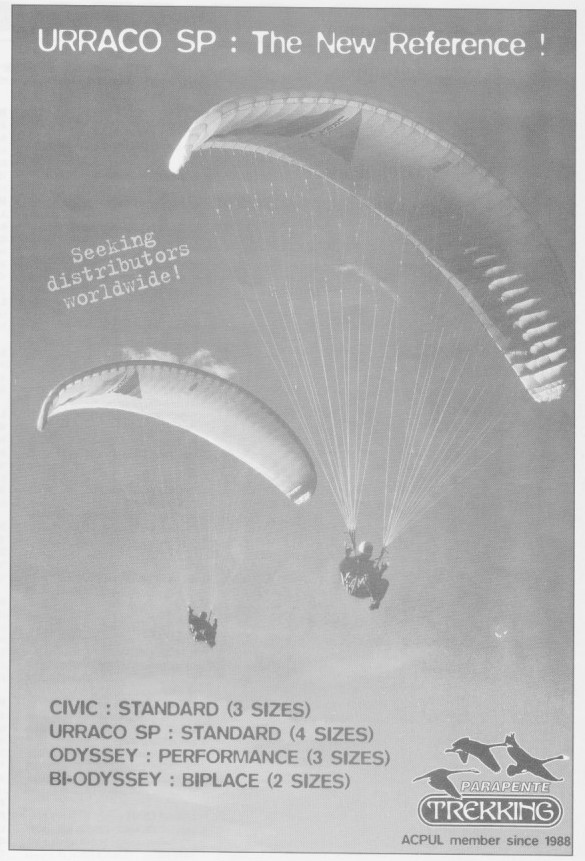
Civic L Paraglider circa 1998. Wing area: 30 sq.m Certification: Afnor Pilot weight: 80-100 kg No. of cells: 27 Wing span: 11.20 m Aspect ratio: 4.3 Max speed: 43 kph Price (1998) £ 1699
Civic M Paraglider circa 1998. Wing area: 27 sq.m Certification: Afnor Pilot weight: 70-90 kg No. of cells: 25 Wing span: 10.37 m Aspect ratio: 4.2 Max speed: 43 kph Price (1998) £ 1699
Civic S Paraglider circa 1998. Wing area: 24 sq.m Certification: Afnor Pilot weight: 55-75 kg No. of cells: 23 Wing span: 9.54 m Aspect ratio: 3.9 Max speed: 43 kph Price (1998) £ 1699
Designed as a successor to the Minoa, the Nimbus paraglider appeals to experienced pilots as well as competitors.
A new profile and the protected diagonal strap design minimize the resistors on the Nimbus. The speed system expanded the speed range of the beyond of the Minoa, without the use of a beam.
The Nimbus uses the proven at the Minoa Vectranleinen (top line) also on the Nimbus to lower the line resistance, but also to reduce (rather than its splice!) sewing jobs. Porcher marine ribbed material and Carrington N1080 for top and bottom sail are used.
Nimbus S Type: Acpul comp Acpul comp Acpul comp Pilot weight without equipment: 50-65 kg Pilot weight incl. equipment: 65-85 kg Number of cells: 60 Number of additional ribs/diagonal straps: 54/110 Area: 25.8 sq.m Area projected: 23.7 sq.m Span: 12.3 m Span projected: 10.1 m Stretching: 5.9 Aspect ratio projected: 5.3 Glider’s weight: 6 kg Min sink: 1.0 m/s Vmin: 23 km/h Vmax: 56 km/h Trim speed: 37 km/h List price 2012: DM 6190
Nimbus M Type: Acpul comp Pilot weight without equipment: 62-80 kg Pilot weight incl. equipment: 77-100 kg Number of cells: 64 Number of additional ribs/diagonal straps: 58/110 Area: 28.5 sq.m Area projected: 26.7 sq.m Span: 13.4 m Span projected: 10.6 m Stretching: 6.3 Aspect ratio projected: 5.7 Glider’s weight: 6.3 kg Min sink: 1.0 m/s Vmin: 22 km/h Vmax: 56 km/h Trim speed: 37 km/h List price 2012: DM 6390
Nimbus L Type: Acpul comp Pilot weight without equipment: 75-97 kg Pilot weight incl. equipment: 90-117 kg Number of cells: 64 Number of additional ribs/diagonal straps: 58/110 Area: 32 sq.m Area projected: 30.1 sq.m Span: 14.3 m Span projected: 11.2 m Stretching: 6.3 Aspect ratio projected: 5.7 Glider’s weight: 6.7 kg Min sink: 1.0 m/s Vmin: 22 km/h Vmax: 56 km/h Trim speed: 37 km/h List price 2012: DM 6590
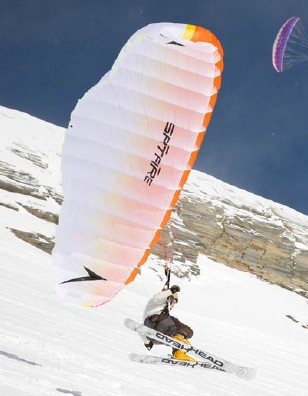
In late 2007, Swing created the Savage and the harness Brave, into speed riding, after which the core speed riding development team led by Manuel Croci and Daniel Kalberer introduced the Spitfire. The primary objective in this development was to achieve the maximum increase in the glide-dive range. The result is a wing which combines the good glide features and the low launch speed of a speed flyer with the speed riding characteristics and dive possibilities offered by a true speed rider.
Available from December 2009 in 4 sizes, 15 – 13 – 11 – 9, the Spitfire features 3 risers with very long trim, efficient back-riser control travel, an easily identifiable stall limit, and wide speed range with high V.max.
Spitfire II Speedwing
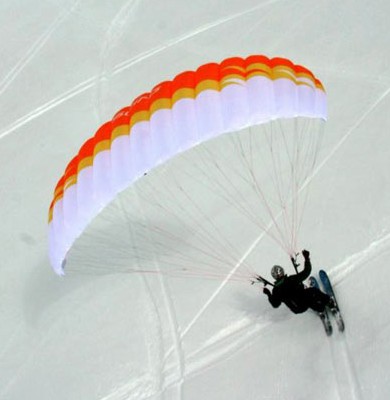
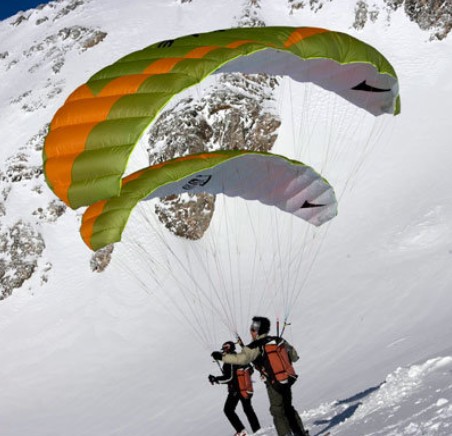
The Swing Spitfire is not suitable for foot-launch. It is recommended that it be used only in combination with skis.
Spitfire 8 No. of cells: 17 Area flat: 8,0 sq.m Area projected: 7,23 sq.m Span flat: 5,03 m Span projected: 4,28 m Aspect ratio: 3,16 Aspect ratio projected: 2,53 Glider weight: 1,6 kg
Spitfire 9 No. of cells: 17 Area flat: 9,0 sq.m Area projected: 8,08 sq.m Span flat: 5,33 m Span projected: 4,52 m Aspect ratio: 3,16 Aspect ratio projected: 2,53 Glider weight: 1,9 kg
Spitfire 11 No. of cells: 17 Area flat: 11,0 sq.m Area projected: 9,86 sq.m Span flat: 5,89 m Span projected: 4,99 m Aspect ratio: 3,16 Aspect ratio projected: 2,53 Glider weight: 2,2 kg
Spitfire 13 No. of cells: 17 Area flat: 13,0 sq.m Area projected: 11,64 sq.m Span flat: 6,42 m Span projected: 5,43 m Aspect ratio: 3,16 Aspect ratio projected: 2,53 Glider weight: 2,5 kg
Spitfire 15 No. of cells: 17 Area flat: 15,0 sq.m Area projected: 13,43 sq.m Span flat: 6,89 m Span projected: 5,83 m Aspect ratio: 3,16 Aspect ratio projected: 2,53 Glider weight: 2,8 kg
Swing has developed the Savage speed glider introduced in late 2007. The Savage has very good launch behaviour for all types of launch. There is no tendency for it to twist or hang back as it launches. The large range of glide ratio achievable and the increase in ‘dive’ and ‘speed’ (which can be altered using the trimmers and brakes to suit the pilot’s level of ability) guarantee fun with this glider.
The extremely stable and well-behaved canopy does not create any concertina movement due to internal pressure shifts even at high speed or when turning. It holds its path and there is no difficulty with the canopy rolling. Swing has used only high-quality materials for this unique concept. Sorting the lines is also very easy thanks to the excellent choice of materials. Accurate steering using the brakes even allows you to ‘dive’ using this glider. A true contour flight using the brakes is no problem.
Energy from speed is converted perfectly into lift, allowing pilots to climb almost vertically if confronted with obstacles or if dangerous situations arise. The Savage is unbelievably easy to flare and exhibits the best possible landing characteristics.
The Savage was available in three sizes: 13 = beginner, 12 = advanced, 10 = expert.
Swing Savage 10 Classification: expert Color: grey No. of cells: 17 Area flat: 10 sq.m Area projected: 8,80 sq.m Span flat: 5,62 m Span projected: 4,65 m Aspect ratio: 3,16 Aspect ratio projected: 2,45
Swing Savage 12 Classification: advanced Color: blue No. of cells: 17 Area flat: 11,5 sq.m Area projected: 10,11 sq.m Span flat: 6,02 m Span projected: 4,95 m Aspect ratio: 3,16 Aspect ratio projected: 2,45
Swing Savage 13 Classification: beginner Color: green No. of cells: 17 Area flat: 13 sq.m Area projected: 11,42 sq.m Span flat: 6,42 m Span projected: 5,28 m Aspect ratio: 3,16 Aspect ratio projected: 2,45
With the 3D Free-Style, Swing introduced a fun glider at only 22sq.m. The small surface area not only ensures relaxed flying in areas with strong wind thanks to its large speed range (up to 65km/h), but still also allows good and dynamic thermalling. All of the usual acro manoeuvres can be flown smoothly and energetically.
The glider passed the load test with 147kg at 8g. Further authorisations with the DHV or CEN were not called for. The 3D displayed very straightforward and standard behaviour during our tests.
Manoeuvres include:
Full stall
SAT
asymetric SAT
rhythmic SAT
Spiral
asymm. Spiral
Looping
Wingover
Mac Twist
Helicopter
Infinity tumbling not possible (due to glider size)
Swing 3D Freestyle 3D.22 No. of cells: 50 Area flat: 22 sq.m Area projected: 19 sq.m Span flat: 11,2 m Span projected: 9,1 m Aspect ratio: 5,78 Aspect ratio projected: 4,35 Trim speed approx: 41 km/h Max. speed approx: >50 km/h
The Stratus 2 gives the highest possible performance for competition pilots. The Stratus 2 is a totally new glider with diagonal profiles with trim speed up more than 60 km/h.
Swing officially withdrew from the competition scene, but the development of high-performance wings continued. With the 4th generation Stratus, Swing decided not to withhold this glider from competition and cross-country pilots and was making the Stratus available to this group following requests from interested pilots. Michael Hartmann has put his competition experience into this product and flew at the Stubai Cup 2002.
Attention has be given to distortions in the canopy right from the paraglider’s development phase. This noticeably reduces the undesirable micro-folds in the fabric, which has a direct effect on glide performance and speed. A 44 g/m silicone fabric from Perseverance is used for the top surface and the proven WT 7 from Toray is used for the bottom surface. This combination of materials allows moisture to escape from the inside of the paraglider by diffusion, despite a good porosity reading for the top surface.
Comparisons with the world’s current best competition gliders at Stubai Cup 2002 show that the Stratus is one of the strongest performing wings in the high-performance area.
The Stratus 5 has much higher canopy stability compared to its predecessors in both unaccelerated and accelerated flight. This improvement was achieved by profile changes and additional design elements in the wing design. The resulting possibilities for trim adjustment were optimised and the result of this is a higher Vmax and noticeably better glide in unstable air. The handling was reworked and it guarantees effective centring even in rough thermals. The high-end glider was available in five sizes with Breitenerprobung (second stage of the DHV prototype license).
For the top surface of the canopy a 44 g/m², siliconised nylon fabric is used which has high UV resistance. A particularly stiff and tear-resistant PU coated nylon fabric is used for the bottom surface and ribs. The unsheathed Edelrid Aramid lines, HMA 8000, demonstrate very high strength for the same or less diameter than the HMA 7000. The new line material with the special braiding technique contributed in the load test to the high score of 1200 kg, which allows a theoretical start weight of 150 kg with a safety factor of 8.
In 2004 and 2005 Stratus 5-pilots such as Alfredo Studer and André Bussmann dominated the leading positions in the international OLC.
The 2006 Stratus 6 has much better canopy stability when fully accelerated than other competition gliders. Tests and alterations to profile and wing construction allowed improvment in performance yet again. Designer Michael Hartmann produced the Stratus 6 concept in 8 different sizes. The weight range for each of the 8 sizes is just 6 to 10 kg, which optimizes performance for pilots of all weights from 85 to 145 kg.
The Swiss pilots Alfredo Studer and André Bussmann chose the Stratus 6 when they went to the South African desert for their ambitious goal of making an attempt on the world paragliding distance record. Alfredo says “The Stratus 6 is exactly the right glider for a plan such as this. I wouldn’t want to compromise on a high level of safety in such a remote area, even with a competition glider”.
A survey of competition and cross-country pilots showed that, for many pilots, the glide performance and glider handling up to a speed range of about 55 km/h are the most important criteria for a competition wing. The development team headed by Michael Hartmann (Swing’s chief designer and test pilot) incorporated these findings when developing the Stratus 7, and focused on climb performance, lower control pressures and lighter handling.
Two models have practically identical construction when it comes to size, plan form, line geometry and profile. The only differences in the GS version with certification under the LTF* (Lufttüchtigkeitsforderungen / airworthiness requirements) are that it has:
1) lower wing-load (and thus lower weight ranges too) 2) shorter speed system travel 3) lower maximum speed (GS: 54 km/h open class 60km/h) 4) LTF 2-3 certification (making it suitable for “serial class”)
All other features are more or less identical between the two models.
The Stratus 7 could even still come within the general rating (certification process, DHV 3).
Stratus 8 – Up into the Stratussphere
The Stratus 8 high-performance has:
* an aspect ratio of 7.4  with EN-D certification
* outstanding glide
* unbeatable ascent behaviour
* a classy high-performer look
* easy launch behaviour despite the high aspect ratio
* good bite into thermals
* smooth handling
* equilibrium and directional stability
* smaller pack size and canopy weight
The Stratus 8 – shifting your limits!
Status – 3-4 weeks delivery time update on 22. Nov 2010
With the Stratus Core, the R&D team created a competition glider which was developed out of their best concepts. Designed competition flying, the Stratus Core has swept back wing tips, an aspect ratio of 7.7 and the new basic form and curvature line, which is distinctive to all current Swing models.
The newly developed profile of the Stratus Core produces a forward thrust. In combination with a complex rigid structure (which Swing has applied to patent as a new design) the surface area produces a high shear stiffness, which achieves a clear increase in performance, particularly in turbulent conditions and glide sections into the wind. “Mini ribs” are used for the first time, which further optimise the contour accuracy of the trailing edge. In addition to the rigid elements and mini-ribs, V-ribs are used to shape the inner structure, which brace the wing across three cells. The transmission of force occurs through specially designed mylar rigid elements, where the thin 0.45 – 0.75mm unsheathed aramid lines are attached. The loops of the “hand-shake” connections (special loop technology) are further strengthened by splicing in an additional line, to be able to withstand maximum stress. There are other details, such as the speed system’s new ball-bearing mounted pulley, a new shackle shape for the 12mm wide kevlar risers and individual adjustment options, so that the Stratus Core can be altered to suit a pilot’s personal preferences for speed.
The Stratus Core is noticeably more demanding to fly when it comes to extreme manoeuvres than its predecessor, the Stratus WRC. Swing does not recommend the Stratus Core as an introduction into the open class or for pilots who have not mastered extreme manoeuvres. Swing therefore reserves the right to refuse to sell the glider to pilots who do not have adequate qualifications.
Stratus 2 2.25 Pilot weight without eq: 65 – 85 kg All up starting weight: 80 – 110 kg Number of cells: 87 Surface area flat: 27 sq.m Surface area projected: 24 sq.m Wingspan flat: 13.1 m Wingspan projected: 10.9 m Aspect ratio flat: 6.39 Aspect ratio projected: 5 Weight of glider: 7.8 kg Minimum sink: 1.0 m/s VMin / Vmax: 24 – 63 km/h Trim Speed: 39 km/h
Stratus 2 2.27 Pilot weight without eq: 80 – 105 kg All up starting weight: 95 – 125 kg Number of cells: 87 Surface area flat: 29 sq.m Surface area projected: 26 sq.m Wingspan flat: 13.6 m Wingspan projected: 11.4 m Aspect ratio flat: 6.39 Aspect ratio projected: 5 Weight of glider: 8.5 kg Minimum sink: 1.0 m/s VMin / Vmax: 24 – 63 km/h Trim Speed: 39 km/h
Stratus 4 4.22 Take-off weight incl. Equipment: 75-100 kg No. of cells: 72 Area flat: 25,0 sq.m Area projected: 21,8 sq.m Span flat: 12,75 m Span projected: 9,7 m Aspect ratio: 6,0 Glider weight: 6,6 kg Trim speed approx: 39-40 km/h Max. speed approx: 60 km/h
Stratus 4 4.24 Take-off weight incl. Equipment: 85-110 kg No. of cells: 75 Area flat: 27,0 sq.m Area projected: 23,6 sq.m Span flat: 13,14 m Span projected: 10,23 m Aspect ratio: 6,2 Glider weight: 7,0 kg Trim speed approx: 39-40 km/h Max. speed approx: 60 km/h
Stratus 4 4.26 Take-off weight incl. Equipment: 95-120 kg No. of cells: 75 Area flat: 28,5 sq.m Area projected: 25,7 sq.m Span flat: 13,5 m Span projected: 10,78 m Aspect ratio: 6,2 Glider weight: 7,3 kg Trim speed approx: 39-40 km/h Max. speed approx: 60 km/h
Stratus 5 5.21 Take-off weight incl. Equipment: 75-85 kg No. of cells: 75 Area flat: 24,7 sq.m Area projected: 21,4 sq.m Span flat: 12,6 m Span projected: 10 m Aspect ratio: 6,4 Aspect ratio projected: 4,7 Glider weight: 7,2 kg Min. sink rate approx: 1 m/s Trim speed approx: 41 km/h Max. speed approx: 68 km/h LTF-certification competition (Breitenerprobung)
Stratus 5 5.22 Take-off weight incl. Equipment: 85-95 kg No. of cells: 75 Area flat: 25,5 sq.m Area projected: 22,2 sq.m Span flat: 12,7 m Span projected: 10,1 m Aspect ratio: 6,4 Aspect ratio projected: 4,7 Glider weight: 7,3 kg Min. sink rate approx: 1 m/s Trim speed approx: 41 km/h Max. speed approx: 68 km/h LTF-certification competition (Breitenerprobung)
Stratus 5 5.23 Take-off weight incl. Equipment: 95-105 kg No. of cells: 75 Area flat: 26,3 sq.m Area projected: 22,8 sq.m Span flat: 12,9 m Span projected: 10,3 m Aspect ratio: 6,4 Aspect ratio projected: 4,7 Glider weight: 7,4 kg Min. sink rate approx: 1 m/s Trim speed approx: 41 km/h Max. speed approx: 68 km/h LTF-certification competition (Breitenerprobung)
Stratus 5 5.24 Take-off weight incl. Equipment: 105-115 kg No. of cells: 75 Area flat: 27 sq.m Area projected: 23,4 sq.m Span flat: 13,1 m Span projected: 10,5 m Aspect ratio: 6,4 Aspect ratio projected: 4,7 Glider weight: 7,5 kg Min. sink rate approx: 1 m/s Trim speed approx: 41 km/h Max. speed approx: 68 km/h LTF-certification competition (Breitenerprobung)
Stratus 5 5.25 Take-off weight incl. Equipment: 115-125 kg No. of cells: 75 Area flat: 28 sq.m Area projected: 24,3 sq.m Span flat: 13,4 m Span projected: 10,7 m Aspect ratio: 6,4 Aspect ratio projected: 4,7 Glider weight: 7,6 kg Min. sink rate approx: 1 m/s Trim speed approx: 41 km/h Max. speed approx: 68 km/h LTF-certification competition (Breitenerprobung)
Stratus 5 5.26 Take-off weight incl. Equipment: 125-135 kg No. of cells: 75 Area flat: 29 sq.m Area projected: 25,1 sq.m Span flat: 13,60 m Span projected: 10,9 m Aspect ratio: 6,4 Aspect ratio projected: 4,7 Glider weight: 7,7 kg Min. sink rate approx: 1 m/s Trim speed approx: 41 km/h Max. speed approx: 68 km/h LTF-certification competition (Breitenerprobung)
Stratus 6 6.20 Take-off weight incl. Equipment: 85-92 kg No. of cells: 75 Area flat: 24 sq.m Area projected: 20,8 sq.m Span flat: 12,4 m Span projected: 9,9 m Aspect ratio: 6,4 Aspect ratio projected: 4,7 Glider weight: 7,1 kg Min. sink rate approx: 1 m/s Trim speed approx: 41 km/h Max. speed approx: 68 km/h LTF-certification competition (Breitenerprobung)
Stratus 6 6.21 Take-off weight incl. Equipment: 92-98 kg No. of cells: 75 Area flat: 24,7 sq.m Area projected: 21,4 sq.m Span flat: 12,6 m Span projected: 10 m Aspect ratio: 6,4 Aspect ratio projected: 4,7 Glider weight: 7,2 kg Min. sink rate approx: 1 m/s Trim speed approx: 41 km/h Max. speed approx: 68 km/h LTF-certification competition (Breitenerprobung)
Stratus 6 6.22 Take-off weight incl. Equipment: 98-105 kg No. of cells: 75 Area flat: 25,5 sq.m Area projected: 22,2 sq.m Span flat: 12,7 m Span projected: 10,1 m Aspect ratio: 6,4 Aspect ratio projected: 4,7 Glider weight: 7,3 kg Min. sink rate approx: 1 m/s Trim speed approx: 41 km/h Max. speed approx: 68 km/h LTF-certification competition (Breitenerprobung)
Stratus 6 6.23 Take-off weight incl. Equipment: 105-111 kg No. of cells: 75 Area flat: 26,3 sq.m Area projected: 22,8 sq.m Span flat: 12,9 m Span projected: 10,3 m Aspect ratio: 6,4 Aspect ratio projected: 4,7 Glider weight: 7,4 kg Min. sink rate approx: 1 m/s Trim speed approx: 41 km/h Max. speed approx: 68 km/h LTF-certification competition (Breitenerprobung)
Stratus 6 6.24 Take-off weight incl. Equipment: 111-118 kg No. of cells: 75 Area flat: 27 sq.m Area projected: 23,4 sq.m Span flat: 13,1 m Span projected: 10,5 m Aspect ratio: 6,4 Aspect ratio projected: 4,7 Glider weight: 7,5 kg Min. sink rate approx: 1 m/s Trim speed approx: 41 km/h Max. speed approx: 68 km/h LTF-certification competition (Breitenerprobung)
Stratus 6 6.25 Take-off weight incl. Equipment: 118-125 kg No. of cells: 75 Area flat: 28 sq.m Area projected: 24,3 sq.m Span flat: 13,4 m Span projected: 10,7 m Aspect ratio: 6,4 Aspect ratio projected: 4,7 Glider weight: 7,6 kg Min. sink rate approx: 1 m/s Trim speed approx: 41 km/h Max. speed approx: 68 km/h LTF-certification competition (Breitenerprobung)
Stratus 6 6.26 Take-off weight incl. Equipment: 125-135 kg No. of cells: 75 Area flat: 29 sq.m Area projected: 25,1 sq.m Span flat: 13,60 m Span projected: 10,9 m Aspect ratio: 6,4 Aspect ratio projected: 4,7 Glider weight: 7,7 kg Min. sink rate approx: 1 m/s Trim speed approx: 41 km/h Max. speed approx: 68 km/h LTF-certification competition (Breitenerprobung)
Stratus 6 6.27 Take-off weight incl. Equipment: 135-145 kg No. of cells: 75 Area flat: 30,4 sq.m Area projected: 26,4 sq.m Span flat: 13,90 m Span projected: 11,2 m Aspect ratio: 6,4 Aspect ratio projected: 4,7 Glider weight: 7,8 kg Min. sink rate approx: 1 m/s Trim speed approx: 41 km/h Max. speed approx: 68 km/h LTF-certification competition (Breitenerprobung)
Stratus WRC 7.20 Take-off weight incl. Equipment: 82-90 kg No. of cells: 75 Area flat: 22,5 sq.m Area projected: 19,1 sq.m Span flat: 12,9 m Span projected: 10,2 m Aspect ratio: 7,4 Aspect ratio projected: 5,41 Min. sink rate approx: 1 m/s Trim speed approx: 42 km/h Max. speed approx: 68 km/h
Stratus WRC 7.21 Take-off weight incl. Equipment: 91-97 kg No. of cells: 75 Area flat: 24,5 sq.m Area projected: 20,8 sq.m Span flat: 13,5 m Span projected: 10,6 m Aspect ratio: 7,4 Aspect ratio projected: 5,41 Min. sink rate approx: 1 m/s Trim speed approx: 42 km/h Max. speed approx: 68 km/h
Stratus WRC 7.22 Take-off weight incl. Equipment: 98-104 kg No. of cells: 75 Area flat: 25,4 sq.m Area projected: 21,7 sq.m Span flat: 13,7 m Span projected: 10,8 m Aspect ratio: 7,4 Aspect ratio projected: 5,41 Min. sink rate approx: 1 m/s Trim speed approx: 42 km/h Max. speed approx: 68 km/h
Stratus WRC 7.23 Take-off weight incl. Equipment: 105-111 kg No. of cells: 75 Area flat: 26,3 sq.m Area projected: 22,5 sq.m Span flat: 14 m Span projected: 11 m Aspect ratio: 7,4 Aspect ratio projected: 5,41 Min. sink rate approx: 1 m/s Trim speed approx: 42 km/h Max. speed approx: 68 km/h
Stratus WRC 7.24 Take-off weight incl. Equipment: 112-119 kg No. of cells: 75 Area flat: 28 sq.m Area projected: 23,8 sq.m Span flat: 14,4 m Span projected: 11,3 m Aspect ratio: 7,4 Aspect ratio projected: 5,41 Min. sink rate approx: 1 m/s Trim speed approx: 42 km/h Max. speed approx: 68 km/h
Stratus WRC 7.25 Take-off weight incl. Equipment: 120-127 kg No. of cells: 75 Area flat: 29,2 sq.m Area projected: 24,9 sq.m Span flat: 14,8 m Span projected: 11,6 m Aspect ratio: 7,4 Aspect ratio projected: 5,41 Min. sink rate approx: 1 m/s Trim speed approx: 42 km/h Max. speed approx: 68 km/h
Stratus WRC 7.26 Take-off weight incl. Equipment: 128-135 kg No. of cells: 75 Area flat: 30,5 sq.m Area projected: 25,9 sq.m Span flat: 15 m Span projected: 11,8 m Aspect ratio: 7,4 Aspect ratio projected: 5,41 Min. sink rate approx: 1 m/s Trim speed approx: 42 km/h Max. speed approx: 68 km/h
Stratus 7 7.20 Take-off weight incl. Equipment: 75-85 kg No. of cells: 75 Area flat: 23 sq.m Area projected: 19,8 sq.m Span flat: 12,1 m Span projected: 9,59 m Aspect ratio: 6,4 Aspect ratio projected: 4,65 Glider weight: 7,1 kg Min. sink rate approx: 1 m/s Trim speed approx: 39 km/h Max. speed approx: 60 km/h
Stratus 7 7.21 Take-off weight incl. Equipment: 85-95 kg No. of cells: 75 Area flat: 24,5 sq.m Area projected: 21,1 sq.m Span flat: 12,6 m Span projected: 10 m Aspect ratio: 6,4 Aspect ratio projected: 4,65 Glider weight: 7,2 kg Min. sink rate approx: 1 m/s Trim speed approx: 39 km/h Max. speed approx: 60 km/h
Stratus 7 7.22 Take-off weight incl. Equipment: 95-105 kg No. of cells: 75 Area flat: 25,5 sq.m Area projected: 21,9 sq.m m Span flat: 12,7 m Span projected: 10,1 m Aspect ratio: 6,4 Aspect ratio projected: 4,65 Glider weight: 7,3 kg Min. sink rate approx: 1 m/s Trim speed approx: 39 km/h Max. speed approx: 60 km/h
Stratus 7 7.23 Take-off weight incl. Equipment: 100-110 kg No. of cells: 75 Area flat: 26,3 sq.m Area projected: 22,6 sq.m Span flat: 12,9 m Span projected: 10,3 m Aspect ratio: 6,4 Aspect ratio projected: 4,65 Glider weight: 7,4 kg Min. sink rate approx: 1 m/s Trim speed approx: 39 km/h Max. speed approx: 60 km/h
Stratus 7 7.24 Take-off weight incl. Equipment: 105-115 kg No. of cells: 75 Area flat: 27 sq.m Area projected: 23,3 sq.m Span flat: 13,1 m Span projected: 10,4 m Aspect ratio: 6,4 Aspect ratio projected: 4,65 Glider weight: 7,5 kg Min. sink rate approx: 1 m/s Trim speed approx: 39 km/h Max. speed approx: 60 km/h
Stratus 7 7.25 Take-off weight incl. Equipment: 115-125 kg No. of cells: 75 Area flat: 28 sq.m Area projected: 24,1 sq.m Span flat: 13,4 m Span projected: 10,5 m Aspect ratio: 6,4 Aspect ratio projected: 4,65 Glider weight: 7,6 kg Min. sink rate approx: 1 m/s Trim speed approx: 39 km/h Max. speed approx: 60 km/h
Stratus 7 7.26 Take-off weight incl. Equipment: 125-135 kg No. of cells: 75 Area flat: 29 sq.m Area projected: 25,1 sq.m Span flat: 13,60 m Span projected: 10,9 m Aspect ratio: 6,4 Aspect ratio projected: 4,65 Glider weight: 7,7 kg Min. sink rate approx: 1 m/s Trim speed approx: 39 km/h Max. speed approx: 60 km/h
Stratus 7 7.27 Take-off weight incl. Equipment: 135-145 kg No. of cells: 75 Area flat: 30,4 sq.m Area projected: 26,4 sq.m Span flat: 13,90 m Span projected: 11,2 m Aspect ratio: 6,4 Aspect ratio projected: 4,65 Glider weight: 7,8 kg Min. sink rate approx: 1 m/s Trim speed approx: 39 km/h Max. speed approx: 60 km/h
Stratus 7 GS 7.22 LTF-certification: 2-3 LTF Take-off weight incl. Equipment: 75-95 kg Max. speed approx: 54 km/h No. of cells: 75 Area flat: 25,5 sq.m Area projected: 21,9 sq.m m Span flat: 12,7 m Span projected: 10,1 m Aspect ratio: 6,4 Aspect ratio projected: 4,65 Glider weight: 7,3 kg Min. sink rate approx: 1 m/s Trim speed approx: 39 km/h
Stratus 7 GS 7.23 LTF-certification: 2-3 LTF Take-off weight incl. Equipment: 85-105 kg Max. speed approx: 54 km/h No. of cells: 75 Area flat: 26,3 sq.m Area projected: 22,6 sq.m Span flat: 12,9 m Span projected: 10,3 m Aspect ratio: 6,4 Aspect ratio projected: 4,65 Glider weight: 7,4 kg Min. sink rate approx: 1 m/s Trim speed approx: 39 km/h
Stratus 7 GS 7.24 LTF-certification: 2-3 LTF Take-off weight incl. Equipment: 90-110 kg Max. speed approx: 54 km/h No. of cells: 75 Area flat: 27 sq.m Area projected: 23,3 sq.m Span flat: 13,1 m Span projected: 10,4 m Aspect ratio: 6,4 Aspect ratio projected: 4,65 Glider weight: 7,5 kg Min. sink rate approx: 1 m/s Trim speed approx: 39 km/h
Stratus 8 8.22 No. of cells: 75 Area flat: 26,0 sq.m Area projected: 21,77 sq.m Span flat: 13,87 m Span projected: 10,78 m Aspect ratio: 7,4 Aspect ratio projected: 5,32 Min. sink rate approx: 1 m/s Trim speed approx: 39 km/h Max. speed approx: 55 km/h
Stratus 8 8.23 No. of cells: 75 Area flat: 27,0 sq.m Area projected: 22,61 sq.m Span flat: 14,13 m Span projected: 10,97 m Aspect ratio: 7,4 Aspect ratio projected: 5,32 Min. sink rate approx: 1 m/s Trim speed approx: 39 km/h Max. speed approx: 55 km/h
Stratus 8 8.24 No. of cells: 75 Area flat: 27,8 sq.m Area projected: 23,23 sq.m Span flat: 14,33 m Span projected: 11,12 m Aspect ratio: 7,4 Aspect ratio projected: 5,32 Min. sink rate approx: 1 m/s Trim speed approx: 39 km/h Max. speed approx: 55 km/h
Stratus 8 8.25 No. of cells: 75 Area flat: 28,5 sq.m Area projected: 23,86 sq.m Span flat: 14,52 m Span projected: 11,27 m Aspect ratio: 7,4 Aspect ratio projected: 5,32 Min. sink rate approx: 1 m/s Trim speed approx: 39 km/h Max. speed approx: 55 km/h
Stratus 8 8.26 No. of cells: 75 Area flat: 29,5 sq.m Area projected: 24,70 sq.m Span flat: 14,77 m Span projected: 11,47 m Aspect ratio: 7,4 Aspect ratio projected: 5,32 Min. sink rate approx: 1 m/s Trim speed approx: 39 km/h Max. speed approx: 55 km/h
Stratus Core 21 Take-off weight incl. Equipment: 84-92 kg No. of cells: 77 Area flat: 23,94 sq.m Area projected: 20,56 sq.m Span flat: 13,57 m Span projected: 10,91 m Aspect ratio: 7,70 Aspect ratio projected: 5,79 Min. sink rate approx: 0,95 m/s Trim speed approx: 40 +/- 2 km/h Max. speed approx: 65+ km/h
Stratus Core 22 Take-off weight incl. Equipment: 92-100 kg No. of cells: 77 Area flat: 25,51 sq.m Area projected: 21,90 sq.m Span flat: 14,01 m Span projected: 11,26 m Aspect ratio: 7,70 Aspect ratio projected: 5,79 Min. sink rate approx: 0,95 m/s Trim speed approx: 40 +/- 2 km/h Max. speed approx: 65+ km/h
Stratus Core 23 Take-off weight incl. Equipment: 99-107 kg No. of cells: 77 Area flat: 26,55 sq.m Area projected: 22,80 sq.m Span flat: 14,30 m Span projected: 11,49 m Aspect ratio: 7,70 Aspect ratio projected: 5,79 Min. sink rate approx: 0,95 m/s Trim speed approx: 40 +/- 2 km/h Max. speed approx: 65+ km/h
Stratus Core 24 Take-off weight incl. Equipment: 106-114 kg No. of cells: 77 Area flat: 27,62 sq.m Area projected: 23,71 sq.m Span flat: 14,58 m Span projected: 11,72 m Aspect ratio: 7,70 Aspect ratio projected: 5,79 Min. sink rate approx: 0,95 m/s Trim speed approx: 40 +/- 2 km/h Max. speed approx: 65+ km/h
Stratus Core 25 Take-off weight incl. Equipment: 115-125 kg No. of cells: 77 Area flat: 28,85 sq.m Area projected: 24,77 sq.m Span flat: 14,90 m Span projected: 11,98 m Aspect ratio: 7,70 Aspect ratio projected: 5,79 Min. sink rate approx: 0,95 m/s Trim speed approx: 40 +/- 2 km/h Max. speed approx: 65+ km/h
The Swing development team spent a year fine-tuning and testing a new tandem glider before they were satisfied with the result. All of the standard requirements for a tandem glider have been satisfied. The Twin 4 received LTF/ EN-A classification from the DHV for a weight range of 140kg to 220kg without using the 8cm long trimmers. The Twin 4 is reportedly a pleasure to fly at the upper end of the weight range and also at the lower end because of its (nearly) “solo handling”. It was even flown with a load of only 110kg to make sure that the entire weight range permissible can be used effectively. Only “big ears” with open trimmers received LTF/EN-B classification.
The high arc technology was also used successfully for the Twin 4, making the canopy weight is only 8.6kg. A lightning flash design adorns the top surface of the Twin 4, while the bottom surface has been kept completely white so it can be used for sponsorship. In Germany, Austria and Switzerland, Swing also offer the Twin 4 to commercial tandem operators.
The first feedback: “Every time we made a test flight, it was a really effortless pleasure to launch on the TWIN 4! Whatever the launch area, whether tight, flat or tricky, we never had any problems! The very clearly arranged line design meant that we didn’t lose any time having to sort out lines. Brilliant design Michael!” (Peter Neuenschwander – CH – Swing Race team pilot)
Status – 3-4 weeks delivery time update on 22. Nov 2010
Twin 4 S Take-off weight incl. Equipment: 110-190 kg No. of cells: 49 Area flat: 42 sq.m Area projected: 35,8 sq.m Span flat: 15,1 m Span projected: 11,9 m Aspect ratio: 5,4 Aspect ratio projected: 3,96 Glider weight: 8,3 kg Min. sink rate approx: 1,05-1,15 m/s Max. speed approx: 45-47 km/h Trim speed approx: 38-40 km/h
Twin 4 Take-off weight incl. Equipment: 140-220 kg No. of cells: 49 Area flat: 43,9 sq.m Area projected: 37,5 sq.m Span flat: 15,4 m Span projected: 12,19 m Aspect ratio: 5,4 Aspect ratio projected: 3,96 Glider weight: 8,6 kg Min. sink rate approx: 1,05-1,15 m/s Max. speed approx: 45-47 km/h Trim speed approx: 38-40 km/h CEN Certification: EN B LTF-certification: LTF B
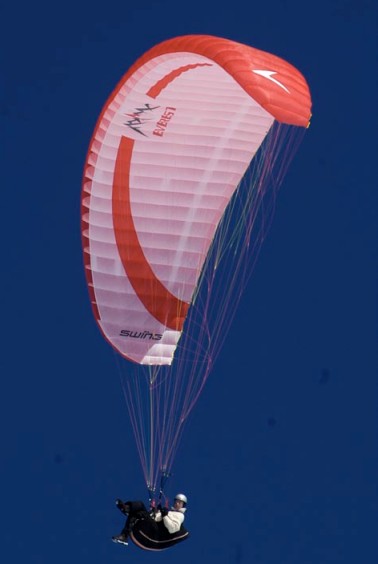
The Swing development team worked on a lightweight paraglider, which is suitable both for use as a mountain glider and also for everyday flying thanks. It was important to have a low weight and volume, and uncomplicated launch and flight characteristics. A 35gm/m² siliconised fabric was developed specifically for the Everest according to Swing specifications. Work on all aspects of the glider resulted in a weight reduction of 30% compared to gliders with similar construction.
The backpack supplied with the glider has also been reduced in weight and it has been adapted to suit the needs of a mountaineer-pilot. The cells of the Everest are individually suspended. A weight-optimised, Kevlar-strengthened 12mm wide webbing with high load capacity is incorporated for the risers. A 4-point riser system is used so that changes in the angle of attack on acceleration are even. This complex distribution means that the pilot is not under any disadvantage when using descent methods such as “big ears” or B-stall. The main lines of the Everest are made from sheathed Tecnora to protect them from chafing and damage on uneven surfaces. Unsheathed Dyneema lines are used for the top lines to keep the glider’s weight down.
The silicon fabric used for the Everest has high UV-resistance and abrasion resistance. Nylon bands are sewn into the top surface to stop the fabric slipping in the snow. It has sealable DIRT.EX openings on the stabilo lines so that dirt and debris can be removed from inside the paraglider.
The Everest has the same good-natured profile as the Axis 3. It is notable for its very low tendency to shoot forward and its easy launch procedure. The long control travel and the progressively increasing control pressure give the Everest forgiving behaviour in connection with the brakes, without creating a sluggish feeling. The paraglider has a particularly high degree of safety and is excellent for use on rough launch sites and in challenging flying areas.
Everest 22 Take-off weight incl. Equipment: 55-80 kg No. of cells: 37 Area flat: 25,4 sq.m Area projected: 22,9 sq.m Span flat: 11,45 m Span projected: 9,20 m Aspect ratio: 5,15 Aspect ratio projected: 3,65 Glider weight: 4,0 kg Min. sink rate approx: 1,1 m/s Max. speed approx: 45 km/h Trim speed approx: 36 km/h LTF-certification: DHV 1
Everest 24 Take-off weight incl. Equipment: 65-90 kg No. of cells: 37 Area flat: 27,3 sq.m Area projected: 24,7 sq.m Span flat: 11,85 m Span projected: 9,50 m Aspect ratio: 5,15 Aspect ratio projected: 3,65 Glider weight: 4,3 kg Min. sink rate approx: 1,1 m/s Max. speed approx: 45 km/h Trim speed approx: 36 km/h LTF-certification: DHV 1
Everest 26 Take-off weight incl. Equipment: 80-110 kg No. of cells: 37 Area flat: 29,2 sq.m Area projected: 26,5 sq.m Span flat: 12,25 m Span projected: 9,83 m Aspect ratio: 5,15 Aspect ratio projected: 3,65 Glider weight: 4,6 kg Min. sink rate approx: 1,1 m/s Max. speed approx: 45 km/h Trim speed approx: 36 km/h LTF-certification: DHV 1
Everest 28 Take-off weight incl. Equipment: 95-125 kg No. of cells: 37 Area flat: 31,1 sq.m Area projected: 28,2 sq.m Span flat: 12,65 m Span projected: 10,15 m Aspect ratio: 5,15 Aspect ratio projected: 3,65 Glider weight: 4,9 kg Min. sink rate approx: 1,1 m/s Max. speed approx: 45 km/h Trim speed approx: 36 km/h LTF-certification: DHV 1
Everest 30 Take-off weight incl. Equipment: 105-140 kg (mono) / 105-165 kg (tandem) No. of cells: 37 Area flat: 33,0 sq.m Area projected: 29,9 sq.m Span flat: 13,05 m Span projected: 10,47 m Aspect ratio: 5,15 Aspect ratio projected: 3,65 Glider weight: 5,2 kg Min. sink rate approx: 1,1 m/s Max. speed approx: 45 km/h Trim speed approx: 36 km/h LTF-certification: DHV 1
The goal of Swing’s development team was to design an uncompomising and manoeuvrable freestyle glider for loops, tumbles and other manoeuvres.
The Salto is is notable for its above average rotation speed due to its pronounced curvature and low roll damping in manoeuvres such as the helicopter. The design of the Salto is based on the Astral 4 and it is suitable for acro-beginners too.
The Salto is sold only to people who demonstrate mastery of their glider and hold the Breitenerprobung ( second stage of the DHV prototype license).
The Salto passed the shock load test using 100kg being subjected to 10 g. The glider does not have DHV certification.
Salto 19 Take-off weight incl. Equipment: <105 kg No. of cells: 57 Area flat: 22,35 sq.m Area projected: 19,2 sq.m Span flat: 11,14 m Span projected: 8,74 m Aspect ratio: 5,55 Aspect ratio projected: 3,98 Min. sink rate approx: 1,2 m/s Trim speed approx: 38 km/h Max. speed approx: >50 km/h LTF-certification: acro
Salto 21 Take-off weight incl. Equipment: >100 kg No. of cells: 57 Area flat: 23,5 sq.m Area projected: 20,2 sq.m Span flat: 11,4 m Span projected: 8,96 m Aspect ratio: 5,55 Aspect ratio projected: 3,98 Min. sink rate approx: 1,2 m/s Trim speed approx: 38 km/h Max. speed approx: >50 km/h LTF-certification: acro
 All Aero