U-Turn Butane

The Butane paraglider from U-Turns sits in between the Nitro all out race kite and the Oxigen intermediate. Many people will remember that U-Turn’s head designer, Ernst Stroble, was responsible for the much-loved Airea Raptor (I & II) well, the Butane is the Raptor III by any other name.

The kite is supplied in a simple stuff sack as per U-Turn’s other kites but it’s a posher one with a mesh insert to let the sand out and promote drying.

The U-Turn Claw design is on both sides of the kite.

Construction is up to the usual standard, with multiple internal bracing on its 28 cells. The leading edge vents are reinforced with mylar and extend to the majority of the cells.

It doesn’t have power rings or turn-assist brake eyelets like the Oxigen but this doesn’t make any difference to the Butane. This kite turns fast.

Upwind performance is usually one of the key performance criteria in a race kite and the Butane doesn’t disappoint.

U-Turn Free Force

U-Turn Freeforce 22

A freestyle and acro wing. Good as a ground handler trainer and then a glider you can immediately begin to fly in suitable, stronger, coastal conditions.

U-Turn Free Force II

FreeForce 22
Pilot weight: 55-95 kg
Glide ratio: 8:1
DHV 2
Span projected: 22 m
Span flat: 24 m

U-Turn Fides

Fides 2 Evo

Fides 2 Evo is the successor of Fides 2. Fides 2 Evo and was redesigned incorporating new, state of art materials and the whole glider was certified according to EN 926 certification procedures.

Even though Fides 2 Evo introduces a whole series of improvements (new wingtip, new material, new certification, new risers) it is called an evolution (therefore evo) and not a new generation of glider (which would make it FIDES 3). During the development the team, led by Alexandre Paux of Switzerland, managed to reach performance attributes that is confirmed by the new EN certification methods. It’s certified EN B.

The glider is well suited for use by professional schools (thanks to the new generation of SKYTEX used on the leading edge) and occasional pilots who enjoy maximum passive safety when coring thermals.

The main distinctive performance features are:

  • High speed range (22–45 km/h)
  • High stability with minimal front and side collapses
  • If collapsed, the reopening is very smooth
  • Easy take-off with no overshooting tendency
  • Minimum pitching tendency even when regenerating from massive collapses
  • Very stable in rough air
  • Nice entering into the thermals with no losses due to the roll instability
  • Optimized for ground handling
  • High efficiency when thermalling
  • Very low weight – only 4,8 kg (for the M size)
  • New materials used

U-Turn Infinity

Paraglider designer Ernst Strobl created the Infinity to combine security, performance, fun and aesthetics in a sole glider, and sizes S and M have been certified in DHV 1-2 (DHV 1, not accelerated). According to the company, the glider has a very wide speed range, from 20k/h up to 52k/h with full speed bar pushed.

The company claims the high stability of the glider in yaw and pitching, even in turbulent conditions, make it very difficult to collapse.

Aspect ratio 5.21

U-Turn Emotion

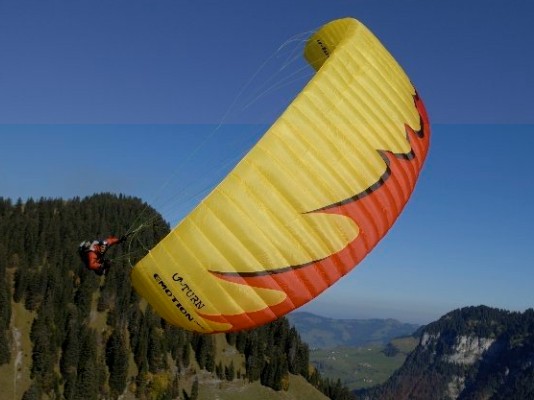
This DHV-1 canopy not only provides lots of fun in the air, but also much, much passive safety due to the AFS-system.

The aspect ratio of the Emotion has been slightly reduced in comparison to the Bodyguard, the reference model among the safest category 1 paragliders. Nevertheless constructor Ernst Strobl has decreased the curvature at the wing ends. The Emotion gains agility and improved handling reaction because of this. The AFS system provides the safety and security: The Automatic Flight Stabilization influences all cells and prevents in the majority of all cases unpleasant asymmetric deflations already during their initial phase.

The Emotion is delivered from the factory with a conventional harness. The Emotion can be made available optionally with the divided riser system. With this the Emotion can perform the B-stall safely, that is sinking at a rate of around 5m/s while still being fully manoeuverable with a glide ratio of 1:3,5. This for example makes it easier for inexperienced pilots to land on small landing areas which is more difficult to manage when the maximum gliding ratio has to be used without the B-stall technique. In any case the Emotion is very suitable for instruction purposes with both harness systems.

Another feature available for the Emotion is the MYLAR-FIX-system, the unique folding system to protect the sensitive leading edges and air intakes.

The Emotion was available in four colors and in the sizes XS (55 80kg), S (70 – 90kg), M (85 – 110kg) and L (100 -130kg).

Price 2009: US$3,500.00

U-Turn Obsession

The Obsession paraglider is from designer Ernst Strobl, with an aspect ratio of 5.55. The DHV 1-2 Obsession has the automatic flight stabilization system (AFS). The dynamic basic design of the glider canopy allows room for an increase in the AFS effectivity without the danger of losing enjoyment or performance potential. The wing area upon which the AFS system is effective has been increased by 20% in comparison to the Infinity II. This increase in the effectivity and further enhanced stability in turbulent conditions is successfully realized without degrading the fine tuned reactivity of the system.
Price 2009: US$3,700.00

The Obsession is situated between DHV 1-2 and DHV 2. It defines the cross-over point between maximum performance and the security level of DHV 1-2. The fantastic glide ratio, available even at full speed, is one of the significant properties of the glider. The obsession possesses the typical U-Turn long accelerator travel for exact control and high final speed. In addition the agility and manoeverability are second to none. All of the know-how from the development of the Acro-reference G-Force 360 has been applied to the very dynamic and direct handling of the Obsession. Very flat yet confined thermalling is the gliders trademark and the Obsession’s turning sink rate is extremely low.

The Obsession has a large number of upper cascade lines. The upper cascades are 40cm long, extremely thin 0.6mm Liros lines. This causes a better distribution of the forces across the paraglider canopy and a reduction of the single force per line and connection point. Ernst Stroble explains, “This higher count of topmost lines costs some slight performance reduction because of their air resistance, nevertheless by their employment I was able to construct the wing to have significantly higher performance with the same good resistance to collapse, so that these losses are more than overcompensated. Because of this design feature the OBSESSION is particularly resistant to collapses. Should a dangerous situation arise and the large secure performance region be exceeded then the canopy will give a corresponding feedback beforehand.

Strobl decided to use the glider fabric for the series production which had been tested so convincingly during the Trans Speed Europe by Mad Mike Küng at highest stress rates. It was clear after exhausting tests with several prototypes of different sizes: “An even lighter material did not show improvements neither during start, flying or landing” Strobl says. The selected material from Porcher Marine offers superior UV-resistance and overall mechanical stress resistance. In order to ensure the longevity of the paraglider and its second-hand value, not to mention the easy start behaviour, the Obsession also has the Mylar Fix System, which is implemented in the Infnity II and which has been universally applauded. Any unwanted creasing of the leading edges is prevented with a fixing loop system the paraglider stays in form and keeps within the original performance criteria.

The Obsession is not intended for beginners and it is not suitable for learning/beginners training purposes.

The Obsession was available in the sizes S (65-90 kg to be confirmed during the DHV-tests that are scheduled in the next weeks), M (80-110 kg) and L (100-130 kg). The characteristic U-Turn motif has been restyled and this gives the paraglider a very sporty, dynamic appearance.