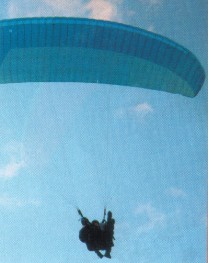
Paraglider circa 1998.
Wing area: 42.6 sq.m
Pilot weight: 130-200 kg
No. of cells: 48
Wing span: 15 m
Aspect ratio: 5.29
Min sink: 1.2 m/s
Max speed: 48 kph
Price (1998) 5050 DM
Paraglider circa 1998.
Wing area: 42.6 sq.m
Pilot weight: 130-200 kg
No. of cells: 48
Wing span: 15 m
Aspect ratio: 5.29
Min sink: 1.2 m/s
Max speed: 48 kph
Price (1998) 5050 DM
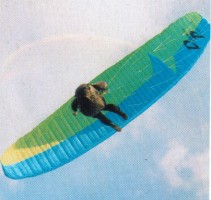
Paraglider circa 1998.
Enigma 26
Wing area: 26.5 sq.m
Pilot weight: 50-70 kg
No. of cells: 54
Wing span: 12 m
Aspect ratio: 5.4
Min sink: 1 m/s
Max speed: 49 kph
Price (1998) 3800 DM
Enigma 28
Wing area: 28 sq.m
Pilot weight: 68-86 kg
No. of cells: 56
Wing span: 12.4 m
Aspect ratio: 5.5
Min sink: 1 m/s
Max speed: 49 kph
Price (1998) 3850 DM
Enigma 30
Wing area: 30.5 sq.m
Pilot weight: 80-110 kg
No. of cells: 58
Wing span: 12.8 m
Aspect ratio: 5.5
Min sink: 0.9 m/s
Max speed: 49 kph
Price (1998) 3900 DM
Founded in 1995 by the Polish Aero Club and Wojciech Pierzynsl to develop the paraglider.
1998: P-UL Zascianek 1, PL-25-037 Kielce, Poland
Paraglider and powerpack builder.
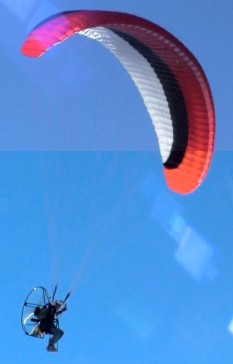
The Escape glider was made especially for paramotor flying by Eric Dufour. Made by Swing in Germany, the four certified sizes cover a take-off weight range from 80-250 kg, which means that even tandem trike flying is possible with the Escape.
The Escape is a glider for beginners as well as for experienced pilots, DVH 1-2 and DULV 1, considering the corresponding weight range.
The Escape glider is very easy to inflate and is also an excellent choice to fly PPG on trike. It has risers a for paramotor. It has performance with high passive safety and pleasant handling for situations ranging from training to cross-country or distance flying.
The Escape is certified for motorized flying as well as for free flying. The trimmers allow cruise speed to be increased to approx. 45 km/h and the counter-torque to be compensated without troublesome counter-braking.
Made from a high-quality and durable fabrics: Perseverance PN6 and Toray WT7, the Escape comes complete with back-pack bag or stuff sack, wind sock, and 3 year warranty.
An Escape was 1st place at the 2006 PPG National American competitions.
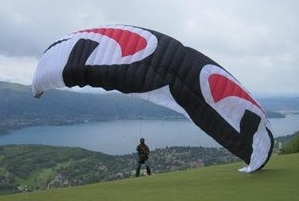
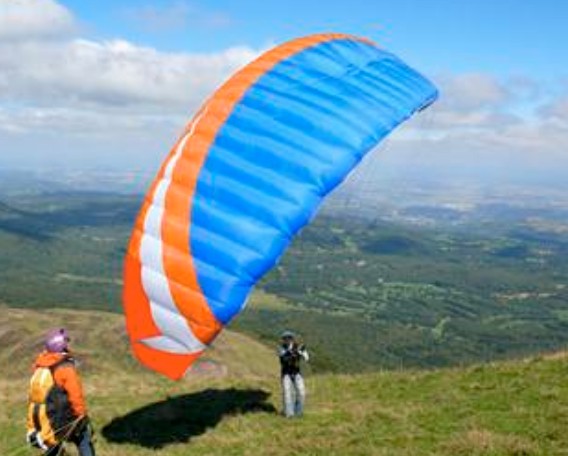
This is a versatile wing in smooth winds of 25-45km/hr. Trimmed slow its a high wind soaring & strong day thermalling wing. Trimmers off it’s a fast speedflyer.
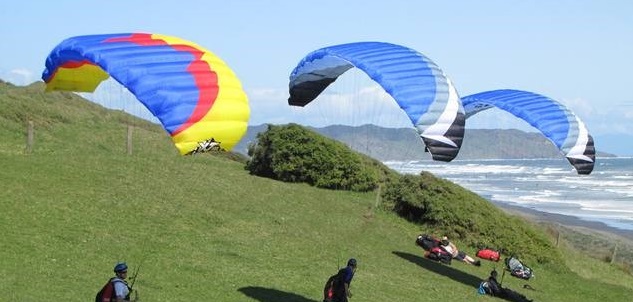
This wing and its performance, safety & quality is completely proven. Full strength materials – 6g tested to 110kgs.
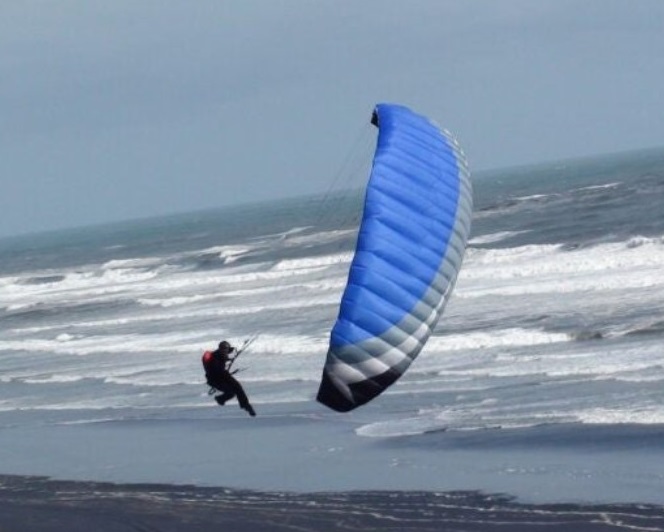
Three sizes were available, brand new in 2012 $2490
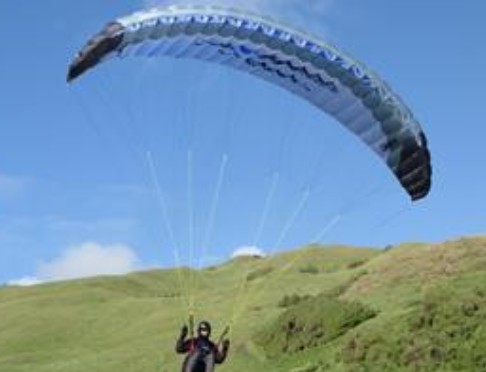
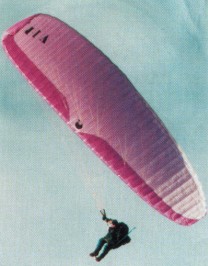
Paraglider circa 1998.
Vip 22
Pilot weight: 45 kg
Vip 24
Wing area: 24.3 sq.m
Pilot weight: 50/80 kg
No. of cells: 48
Wing span: 10.7 m
Aspect ratio: 4.7
Min sink: 1 m/s
Max speed: 46 kph
Price (1998) 1,275 Pounds
Vip 27
Wing area: 27.4 sq.m
Pilot weight: 70/100 kg
No. of cells: 50
Wing span: 11.4 m
Aspect ratio: 4.7
Min sink: 1 m/s
Max speed: 46 kph
Price (1998) 1,375 Pounds
Vip 30
Wing area: 30.4 sq.m
Pilot weight: 90/125 kg
No. of cells: 54
Wing span: 12 m
Aspect ratio: 4.7
Min sink: 1 m/s
Max speed: 46 kph
Price (1998) 1,475 Pounds
Paraglider circa 1998.
Top 24
Wing area: 23.9 sq.m
Pilot weight: 50/80 kg
No. of cells: 90
Wing span: 11.7 m
Aspect ratio: 5.7
Min sink: 1 m/s
Max speed: 50 kph
Price (1998) 1,375 Pounds
Top 30
Wing area: 30 sq.m
Pilot weight: 90/125 kg
No. of cells: 104
Wing span: 13 m
Aspect ratio: 5.7
Min sink: 1 m/s
Max speed: 50 kph
Price (1998) 1,575 Pounds
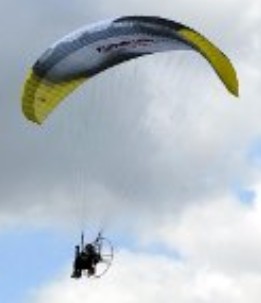
After successful experiments with Action and Reaction models, Piotr Dudek committed to a model that would allow pilots of any level security and efficiency with a simple classic.
The reflex profile has max speed of 61 km/h and trim speeds of 37-49 kph.
It is also suitable for training.
25
Certificate CEN: C
Number of cells: 50
Area: 25 sq.m
Area projected: 21,46 sq.m
Wingspan: 11,29 m
Wingspan projected: 9,01 m
Aspect ratio (flat/projected): 5,10/3,78
Sink rate: trim=1,2-2,2 m/s
Speed: 23 -61 km/h
Chord: 274 cm
Line and riser length: 724 cm
Weight: 5,7 kg
Weight range: 70-90 kg
27
Certificate CEN: C
Number of cells: 50
Area: 27 sq.m
Area projected: 23,17 sq.m
Wingspan: 11,73 m
Wingspan projected: 9,36 m
Aspect ratio (flat/projected): 5,10/3,78
Sink rate: trim=1,2-2,2 m/s
Speed: 23 -61 km/h
Chord: 285 cm
Line and riser length: 753 cm
Weight: 6,7 kg
Weight range: 80-105 kg
29
Certificate CEN: C
Number of cells: 50
Area: 29 sq.m
Area projected: 24,89 sq.m
Wingspan: 12,16 m
Wingspan projected: 9,70 m
Aspect ratio (flat/projected): 5,10/3,78
Sink rate: trim=1,2-2,2 m/s
Speed: 23 -61 km/h
Chord: 295 cm
Line and riser length: 780 cm
Weight: 7,2 kg
Weight range: 95-120 kg
31
Certificate CEN: C
Number of cells: 50
Area: 31 sq.m
Area projected: 26,61 sq.m
Wingspan: 12,57 m
Wingspan projected: 10,03 m
Aspect ratio (flat/projected): 5,10/3,78
Sink rate: trim=1,2-2,2 m/s
Speed: 23 -61 km/h
Chord: 305 cm
Line and riser length: 806 cm
Weight: 7,6 kg
Weight range: 110-135 kg
34
Certificate CEN: C
Number of cells: 50
Area: 34 sq.m
Area projected: 29,18 sq.m
Wingspan: 13,17 m
Wingspan projected: 10,50 m
Aspect ratio (flat/projected): 5,10/3,78
Sink rate: trim=1,2-2,2 m/s
Speed: 23 -61 km/h
Chord: 320 cm
Line and riser length: 845 cm
Weight: 8,2 kg
Weight range: 135-165 kg
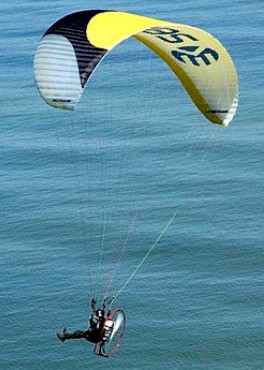
Based on the same proven reflex-wing concept of the popular PPG wing Action (from Dudek and Paramania), the ReAction is a technically improved and graphically renewed version aimed at advanced pilots. In comparison to its predecessor, the ReAction is a bit faster, inflates easier and has improved wing durability and ease of use. Like its ancestor, the Reaction features a self-stabilizing wing section that, in the case of a decrease in its angle of attack, automatically responds to compensate. “In other words it always stays neutral with regard to its load, so it’s tuck-resistant. The risers now have two suspension points (low and high) to adjust to the pilot’s harness/engine setup, and come with new trimmer buckles and exchangeable trimmer tapes. It has partially closed leading edge with 65 cells, an aspect ratio of 5,43, and top speed is 60 k/h, with 42-46 k/h trim speed, according to Dudek. It is also available in an ‘S’ version, equipped with non-sheathed lines in the upper rigging, and a trike version called “Reaction Cabrio” for a weight range of 150 to 300 kg. For foot-launch flight there are 4 sizes to choose from.
Afnor/CEN Performance
 All Aero