1998: Bullachbergweg 34 a, D-87645 Schwangau, Germany
From 1996, Stephan Müller supervised design and build while Stephen Hüglin handled production and testing.
Paraglider builder
1998: Bullachbergweg 34 a, D-87645 Schwangau, Germany
From 1996, Stephan Müller supervised design and build while Stephen Hüglin handled production and testing.
Paraglider builder
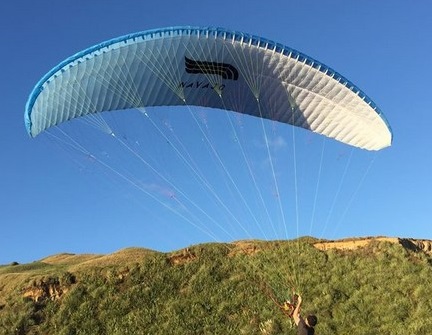
The FireBird Navajo performance paraglider has high trimming speed and quite nervous behavior in turbulence with high maneuverability.
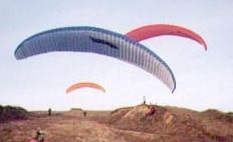
Certified DHV 3 and Afnor Competition
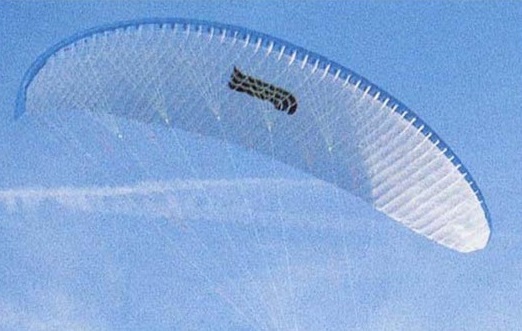
Navajo 25
1993: € 3400
Area: 25.10 m²
Span: 11.80 m
Ratio: 5.30
Surfaces: Skytex 44 g/m
No. of chambers: 50
Wing-Weight: 5.9 kg
Box-Cell-Closed: 50/52/10
Risers: 3(5A/5B/5C)
Lines: 1.5/1.0 mm Kevlar
Lines total: 7.35 m
Pilot weight: 60/78 kg
Best sink rate: 1.2 m/s
Maximum speed: 38 kph
Maximum speed (with speed system) 48 kph
Minimum speed: 20 kph
Glide ratio: 8.5
Best glide ratio: 1.4 m/s › 33 km
Certification: ACPUL/SHV 10A
Navajo 28
1993: € 3500
Area: 27.70 m²
Span: 12.40 m
Ratio: 5.50
Surfaces: Skytex 44 g/m
Wing-Weight: 6.2 kg
Box-Cell-Closed: 52/54/10
Risers: 3(5A/5B/5C)
Lines: 1.5/1.0 mm Kevlar
Lines total: 7.40 m
Pilot weight: 75/95 kg
Best sink rate: 1.2 m/s
Best glide ratio: 1.4 m/s › 33 km
Certification: ACPUL/SHV 10A
Navajo 30
1993: € 3500
Area: 31.20 m²
Span: 12.60 m
Ratio: 5.10
Surfaces: Skytex 44 g/m
Wing-Weight: 6.5 kg
Box-Cell-Closed: 52/54/10
Risers: 3(5A/5B/5C)
Lines: 1.5/1.0 mm Kevlar
Lines total: 7.50 m
Pilot weight: 90/117 kg
Best sink rate: 1.2 m/s
Best glide ratio: 1.4 m/s › 33 km
Certification: ACPUL/SHV 10A
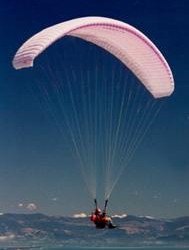
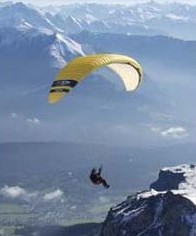
Firebird’s 2003 (successor for the Matrix) DHV 1-2 Grid has passed certification. The most interesting design feature of the glider is the circular shape of the air intakes on the wingtips, which has a “significant impact” on handling, glide, speed, performance and safety, according to the design team. This design feature came out after research and tests done with the aid of aircraft development industries. Finally, they concluded that “the most efficient for rammed air and an increase of pressure was with pure round intakes.
The Grid is intended for recreational pilots and those who want “fun without worries”. According to its creators, it has a light, precise handling and reacts to every input given. “It will do the turn the way you want, steep, flat, precise”, they say. It has a maximum speed of about 48k/h according to DHV test reports.
Paraglider
33sqm
Paraglider
Paraglider circa 1998.
Arcus Spirit 230
Wing area: 25.3 sq.m
Certification: Afnor
Pilot weight: 57-74 kg
No. of cells: 31
Wing span: 10.94 m
Aspect ratio: 4.9
Min sink: 1.2 m/s
Max speed: 46 kph
Price (1998) 15,500 Fr
Arcus Spirit 255
Wing area: 29.9 sq.m
Certification: Afnor
Pilot weight: 70-91 kg
No. of cells: 31
Wing span: 11.89 m
Aspect ratio: 4.9
Min sink: 1.2 m/s
Max speed: 46 kph
Price (1998) 16,000 Fr
Arcus Spirit 285
Wing area: 32.9 sq.m
Certification: Afnor
Pilot weight: 86-111 kg
No. of cells: 31
Wing span: 12.49 m
Aspect ratio: 4.9
Min sink: 1.2 m/s
Max speed: 46 kph
Price (1998) 16,500 Fr
Paraglider circa 1998.
Wing area: 45.8 sq.m
Certification: Afnor
Pilot weight: 120-220 kg
No. of cells: 27
Wing span: 15.66 m
Aspect ratio: 5.4
Price (1998) 22,900 Fr
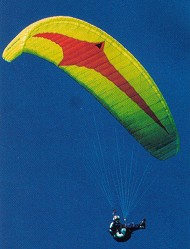
Paraglider circa 1998.
Aspire 225
Wing area: 26.2 sq.m
Certification: Afnor
Pilot weight: 70-91 kg
Wing span: 12.4 m
Aspect ratio: 5.9
Min sink: 1.1 m/s
Max speed: 50 kph
Price (1998) 20,800 Fr
Aspire 265
Paraglider circa 1998.
Wing area: 31.9 sq.m
Certification: Afnor
Pilot weight: 85-110 kg
Wing span: 13.76 m
Aspect ratio: 5.9
Min sink: 1.1 m/s
Max speed: 50 kph
Price (1998) 21,200 Fr
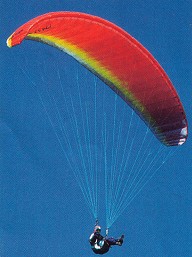
The Awak, new in 1998, was put together jointly with Swiss importer Asagiri, aided by Laforge, Viret and Stocker.
Awak 215
Wing area: 24.3 sq.m
Certification: Afnor
Pilot weight: 60-78 kg
No. of cells: 66
Wing span: 11.61 m
Aspect ratio: 5.6
Min sink: 1.1 m/s
Max speed: 50 kph
Price (1998) 18,000 Fr
Awak 245
Wing area: 27.6 sq.m
Certification: Afnor
Pilot weight: 75-98 kg
No. of cells: 66
Wing span: 12.38 m
Aspect ratio: 5.6
Min sink: 1.1 m/s
Max speed: 50 kph
Price (1998) 18,500 Fr
Awak 275
Wing area: 31.1sq.m
Certification: Afnor
Pilot weight: 90-117 kg
No. of cells: 66
Wing span: 13.14 m
Aspect ratio: 5.6
Min sink: 1.1 m/s
Max speed: 50 kph
Price (1998) 19,000 Fr
 All Aero