Icaro 2000 Incanto

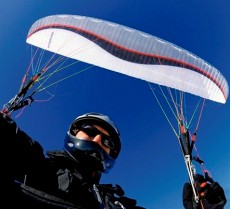
The Incanto (DHV 1-2) was designed in 2006 by designer Michael Nesler and Icaro. The glide ratio (5.65) equals that of some DHV 2 gliders but due to a number of performance intake valves, it has the rating and security of a 1-2.
Great communication from this wing, easy to launch and a joy to fly, the Incanto needs an active pilot in turbulence but is not demanding.
DULV and EN-B (size M) rated.
Price 2009: US$3,600.00

Icaro 2000 Instinct

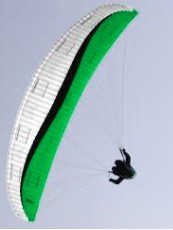
The 2007 design Instinct from designer Michael Nesler and Icaro is certified DHV 1-2. With an aspect ratio equal to higher end 1-2’s but with the security of a 1 due to cell design and performance intake air valves. Accelerated speed is over 50 km/h.
Suitable for all types of flying with the performance of an intermediate and stability of a DHV 1. Freestyle, acro, or long distance.
Price 2009: US$3,500.00

Icaro 2000 Maverick

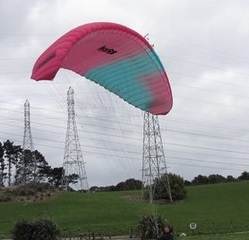
The DHV 2 Maverick is a simple to fly XC class 2 wing with convincing performance data. Professional race risers, four different sail cloths which are selectively used in the canopy according to tension and weight, a mix of five different line diameters in Dynema and Kevalar give the Maverick an edge on comparable class 2-3 wings.
Price 2009: US$3,800.00

Icaro 2000 Nikita

Released in 2006, the Nikita (Acro) was developed for extreme dynamic performance by qualified acro pilots. The wing curvature and special trimming reduce forces on the pilot from SAT and other maneuvers, risers tensioned to prevent twist and diagonal tape and line loops arranged for safe landings in case of line breakage. Factory approval is required before purchasing!
For each paraglider model is offered special ICARO motor risers which have been developed for motored flight. ICARO motor risers have many functional details and are an optimal partner for free flight, backpack motor, trike or flyke. Weather installed at ICARO or bought as an optional accessory, ICARO motor risers are for paramotoring and at the same time can also be used for free-flight.
The trimmer can be operated easily and provides optimal adaption to the airspeed. A small asymmetrical adjustment to both trimmers balances the torque of the engine. One-sided balancing of the brake is gone.
Two attachment loops for main suspension as well as variable fastening points for the brake pulley provide maximum flexibility in all variants of motorised flight.
Two pulleys attached at different heights allow the brake line to be adjusted to a suitable position.
Price 2009: US$3,300.00

Icaro 2000 Twice

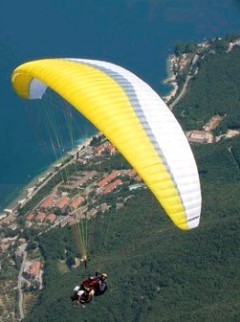
The tandem design for 2007, the Twice was certified DHV 1-2.
Suitable for the professional tandem instructor or hobby pilots, the shorter line length and canopy curvature make the Twice light and efficient. For each paraglider model is offered special ICARO motor risers which have been developed for motored flight. ICARO motor risers have many functional details and are an optimal partner for free flight, backpack motor, trike or flyke. Wheather installed at ICARO or bought as an optional accssory, ICARO motor risers are for paramotoring and at the same time can also be used for free-flight.
The Twice was designed so that the flight characteristics would remain the same no matter how heavy the load. Fitted with trimmers as a standard feature and comes the providing optimal adaption to the airspeed. A small asymmetrical adjustment to both trimmers balances the torqe of the engine. One-sided balancing of the brake is gone.
Two attahment loops for the main suspension as well as variable fastening points for the brake pulley provide maximum flexibilty in all variats of mororized flight.
Two pullys attached at diffeent heights allow the brake line to be adjusted to a sutable position.
Price 2009: US$3,900.00

Icaro 2000

ICARO 2000, the first hang-glider factory in Europe, was founded in 1973 by Alfio Caronti & Peter Skaarup.

Alfio received his first glider from Bill Moyes, during a water-ski competition in 1969. He was the first Hang glider pilot in Europe, who took off from a mountain on the 4th November 1971. The glider used by Alfio Caronti was a kingpostless glider with square tubes.

Peter Skaarup was the technician of the factory and together they manufactured hang-gliders under the license of the Australian firm Moyes.

In 1981 Franco Garzia & Gianni Hotz, became the new owners of ICARO 2000 and continued to make Moyes hang-gliders. Their first glider was the Meteor 170.

Since 1983 ICARO has been using only tubes in Perunal (aluminium alloy 7075 for aeronautics) from the Swiss manufacturer Alumenziken.

Until 1991 ICARO sold, in Europe, more then 3,000 gliders (Moyes models like Mega II, Missile, Mars, GT, GTR and XS).

In 1992 Manfred Ruhmer becomes part of the staff and ICARO started to develop original designs with its own sailmakers and workshop with 20 employees and a 1,200+ sq m building. The development of new models was carried out by Manfred Ruhmer, one of the world’s best pilots and Franco Garzia, a former Italian champion. Since this time all ICARO hang glider models are certified by the DHV (Germany).

In 1992 the first ICARO’s original design appeared: the Brazil, followed in 1994 by the Laminar. With this wing ICARO started to reach competition results 1994 European Championship in Laragne (France): Manfred Ruhmer is 2nd 1995 World Championship in Ager (Spain): Manfred Ruhmer is 2nd. In 1995 the first prototype of kingpostless gliders appears.

In 1996 ICARO presented its first prototype of topless glider and with this wing, Manfred reached 2nd place in the European Championship in Hungary.

Since 1998 ICARO has its own landing area (more then 50.000sq m) with Club House, Camping facilities and Store of accessories for Sport Aviation: these facilities are located at Lago Maggiore (northern Italy), facing a mountain ideal for flying.

1998: Via Verdi, I-21038 Sangiano (VA), Italy.

In 1998 ICARO forms an agreement with Felix -A.I.R., by which ICARO will make keels and sails for the Atos (ICARO has made 550 so far) and obtains the option to sell the Atos in certain markets.

ICARO introduces on the paragliders’ scenery the Cyber, a new basic-intermediate wing, with the latest technology and construction methods and highest safety DHV 1. Also in 2000, on October 25th, ICARO reviewed its agreement with Felix; ICARO takes over the worldwide production and distribution of the Atos from the home base in Sangiano. Felix works exclusively on the development of the design.

After having sold more than 400 Atos in two years, a period in which ICARO took an active part in the manufacturing of sails, A-frames and keels, it was decided that henceforth A.I.R. would devote 100% to the development and technical support, whereas ICARO would become in charge of the production and distribution of the Atos.

In September 2001 Christian Ciech starts working for Icaro 2000 in the development team, and after six months comes into the scenery the new Icaro 2000’s rigid wing: the Stratos.
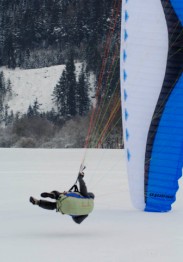
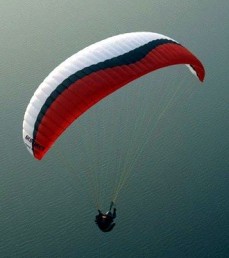
Gypa-Aile Estive

Paraglider circa 1998.

Estive 22
Wing area: 22.7 sq.m
Certification: Afnor
Pilot weight: 55-70 kg
No. of cells: 34
Wing span: 9.4 m
Aspect ratio: 4
Min sink: 1.3 m/s
Max speed: 43 kph
Price (1998) 12,700 Fr

Estive 26
Wing area: 26.5 sq.m
Certification: Afnor
Pilot weight: 70-100 kg
No. of cells: 38
Wing span: 10.6 m
Aspect ratio: 4.4
Min sink: 1.2 m/s
Max speed: 43 kph
Price (1998) 13,300 Fr

Estive 30
Wing area: 30 sq.m
Certification: Afnor
Pilot weight: 90-11- kg
No. of cells: 38
Wing span: 11.4 m
Aspect ratio: 4.4
Min sink: 1.2 m/s
Max speed: 43 kph
Price (1998) 13,900 Fr

Estive 34
Wing area: 34 sq.m
Certification: Afnor
Pilot weight: 105-150 kg
No. of cells: 42
Wing span: 12.6 m
Aspect ratio: 4.7
Min sink: 1.2 m/s
Max speed: 44 kph
Price (1998) 14,500 Fr

Gypa-Aile Carlit

Paraglider circa 1998.

Carlit 21
Wing area: 21 sq.m
Pilot weight: 55-70 kg
No. of cells: 25
Wing span: 8.4 m
Aspect ratio: 3.3
Min sink: 1.5 m/s
Max speed: 36 kph

Carlit 24
Wing area: 24 sq.m
Pilot weight: 70-90 kg
No. of cells: 27
Wing span: 9.1 m
Aspect ratio: 3.5
Min sink: 1.5 m/s
Max speed: 36 kph

Carlit 27
Wing area: 27 sq.m
Pilot weight: 85-100 kg
No. of cells: 29
Wing span: 10 m
Aspect ratio: 3.7
Min sink: 1.5 m/s
Max speed: 36 kph

Carlit 32
Wing area: 32 sq.m
Pilot weight: 100-140 kg
No. of cells: 33
Wing span: 10.8 m
Aspect ratio: 3.6
Min sink: 1.5 m/s
Max speed: 40 kph