ITV Jade

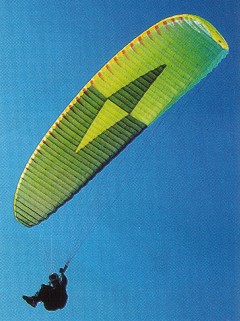
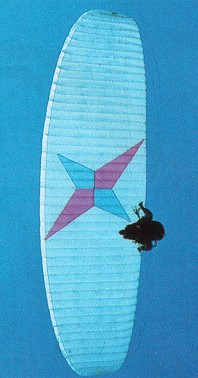
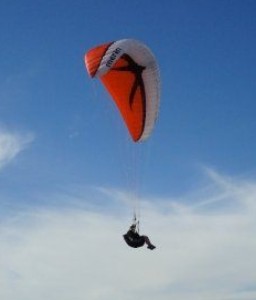
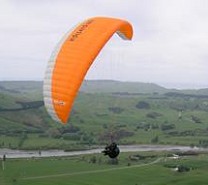
Paraglider circa 1998.

Jade 22
Wing area: 23.8 sq.m
Certification: Afnor
Pilot weight: 58-70 kg
No. of cells: 28
Wing span: 10.1 m
Aspect ratio: 4.92
Max speed: 39 kph
Price (1998) £1799

Jade 25
Wing area: 26.5 sq.m
Certification: Afnor
Pilot weight: 65-80 kg
No. of cells: 28
Wing span: 10.70 m
Aspect ratio: 4.29
Max speed: 39 kph
Price (1998) £1799

Jade 28
Wing area: 29 sq.m
Certification: Afnor
Pilot weight: 65-78 kg
No. of cells: 30
Wing span: 11.45 m
Aspect ratio: 4.5
Max speed: 35 kph
Price (1998) £1849

Jade 30
Wing area: 30.9 sq.m
Certification: Afnor
Pilot weight: 95-115 kg
No. of cells: 30
Wing span: 11.8 m
Aspect ratio: 4.5
Max speed: 39 kph
Price (1998) £1949

ITV Equinox

Paraglider new in 1998.

Equinox 24
Wing area: 24 sq.m
Certification: Afnor
Pilot weight: 60-75 kg
No. of cells: 57
Wing span: 11.46 m
Aspect ratio: 5.45
Max speed: 47 kph
Price (1998) £2099

Equinox 26
Wing area: 26 sq.m
Certification: Afnor
Pilot weight: 73-91 kg
No. of cells: 57
Wing span: 11.98 m
Aspect ratio: 5.45
Max speed: 48 kph
Price (1998) £2199

Equinox 28
Wing area: 28 sq.m
Certification: Afnor
Pilot weight: 90-110 kg
No. of cells: 57
Wing span: 12.5 m
Aspect ratio: 5.45
Max speed: 50 kph
Price (1998) £2299

ITV Azimut

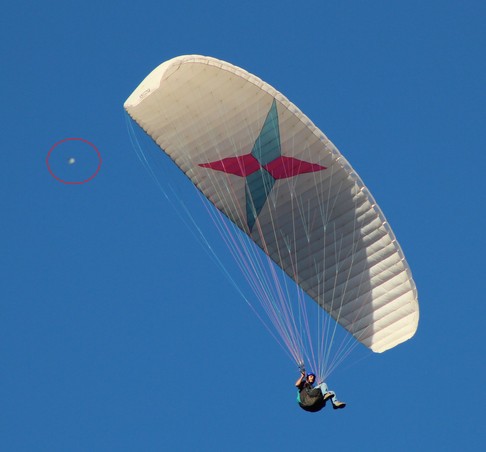
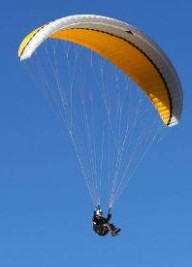
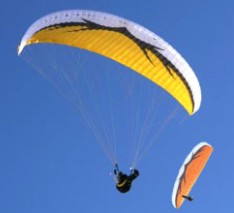
Paraglider circa 1998.

Santiago, Chile (Rafael Soto)

Azimut 24
Wing area: 24 sq.m
Certification: Afnor
Pilot weight: 55-70 kg
No. of cells: 46
Wing span: 10.51 m
Aspect ratio: 4.66
Max speed: 42 kph
Price (1998) £1799

Azimut 26
Wing area: 26,4 sq.m
Certification: Afnor
Pilot weight: 55-70 kg
No. of cells: 48
Wing span: 10.98 m
Aspect ratio: 4.6
Max speed: 42 kph
Price (1998) £1899

Azimut 28
Wing area: 28.1 sq.m
Certification: Afnor
Pilot weight: 83-100 kg
No. of cells: 48
Wing span: 11.44 m
Aspect ratio: 4.66
Max speed: 44 kph
Price (1998) £1999

Azimut 30
Wing area: 30.4 sq.m
Certification: Afnor
Pilot weight: 95-115 kg
No. of cells: 48
Wing span: 12.02 m
Aspect ratio: 4.66
Max speed: 43 kph
Price (1998) £2099

Independence Dragon

Dragon I

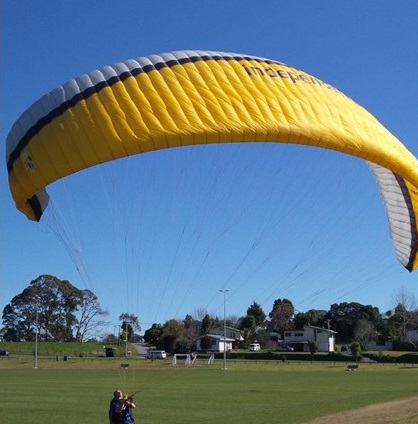
After 2 years, Independence (the brand created by designer Michael Nesler) created a replacement for its intermediate model Dragon. The Dragon 2 comes with a higher aspect ratio and increased number of cells (46). The glider features a black stripe that goes from tip to tip, on the centre of the canopy and used in all the 2003 models of this brand. In the development of Dragon 2, Independence worked with the new design software FD, with which they obtained “a really clean upper and lower surface”, according to the brand. Special attention was paid to the tension between the leading and the trailing edge, which adds up for better performance at the same security level DHV 1-2, say the designers. Dragon 2 was to be available in 4 sizes including S, L and XL.

Dragon 1 Medium
Clip in weight: 85 – 105kg.
DHV 1-2

Dragon 2

The Dragon 3 is a completely new glider, introducing a new material for the profile that helps reduce the diagonal extension and get a smoother, cleaner canopy, according to the manufacturer. The handling has also been improved to obtain a “very good dynamic for a DHV1-2 glider”, together with safe and good-natured extreme-flight behaviour that make the Dragon 3 a good choice for “freestyle” pilots. Another design feature is the brake system with variable rear-edge-tension to slightly contract the rear edge during braking for more efficient turning and improved performance, as fewer lines are used and so there’s less drag. The Dragon 3 was available in 3 sizes.

Dragon 3

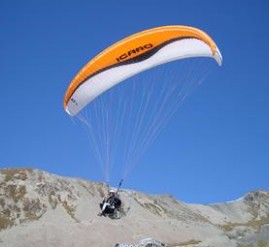
Icaro 2000 Cyber 2

Cyber 2

The Cyber 2 (DHV 1) is the second generation of Icaro’s school and beginner wing. Takes you through your beginning years with ease.
Very easy to launch, and with good handling, it’s the perfect wing for those wanting a stable and relaxed trip to cloudbase.
DULV rated for paramotors.
Price 2009: US$3,000.00