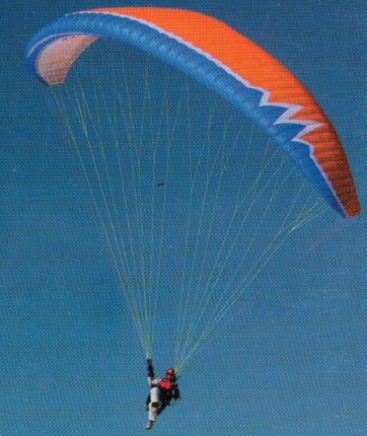
Paraglider circa 2005.
The Artex was replaced by the Mamboo.
Seats: 1
DHV: 1-2
Paraglider circa 2005.
The Artex was replaced by the Mamboo.
Seats: 1
DHV: 1-2
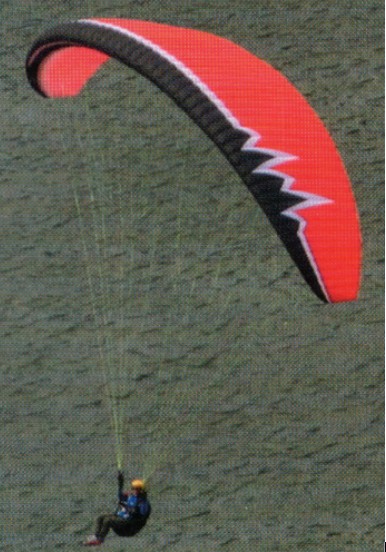
Circa 2005, the Tattoo is Nova’s replacement for the Aeron in the DHV2 class. Nova talks of easier handling, better climb in weak lift, slightly improved performance and all in a package aimed in the middle of DHV2. No special techniques needed with inflation and launch; just a gentle pull on the “A’s” and, despite rising pretty quickly, it comes to a rapid halt overhead. If inflated slightly out of wind it settles overhead easily. Collapsing was better done on “D” risers than brakes, but presents no problems. The small Tattoo is rated for the 80-100kg weight range The brake input needed is on the short side of average. Pushing the bar through the sink is light pressure and short travel, (27cm for full acceleration). The glider isn’t particularly floaty and prefers to carve turns in well defined lift. The glider felt solid with good pitch stability. The liveliness in roll is generally a positive thing. The Tatoo uses a lighter grade Gelvenor cloth and the skinny risers. All the stitching is fine but the sail isn’t quite as wrinkle-free as the cleanest cut gliders. Nova has produced an absolute beauty in the Tattoo. It has excellent glide at trim and on the bar. The sink rate is good and the thermalling ability is excellent. The inflation and launch are sweet, but best of all is the handling.
Seats: 1
DHV: 2
Glide: 9-1
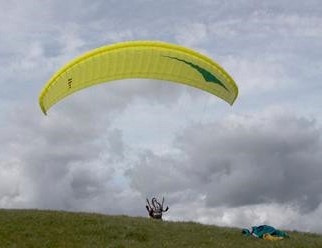
Nova make two DHV1 gliders, one for use within the school [Phorus] and a top end 1 for new club pilots called the Pheron.
Nova use Gelvenor OLKS siliconised PU coated nylon for the top surface, some parts of the bottom surface and Porcher Skytex 9052 for the rest of the undersurface. Suspended and diagonal ribs are Skytex 9092 with the hard, low stretch finish, and unsuspended ribs are 9052. Riser material is black 25mm webbing, except for the 15mm baby A riser, woven by Güth and Wolf. Lines are Liros. The glider has a three riser system with split As, for those who prefer a standard [non-split] A riser this is available to special order or as a retrofit. The glider has a system of diagonal ribs, & compression straps across A, B & C line attachment points. There is full span compression strap across what would be the D line attachment points; there is no D riser and the lines attached here branch backward from the upper end of the middle cascade of the C lines. In the centre of the canopy there is a further cascade rearwards to what would be an “E” attachment point.
The Nova Artax is a member of the Radon family, which is made up of the Artax [1-2], Aeron [2] and Radon [some sizes 2 but others could be 2-3]. All the gliders have a similar diagonal rib and line layout, but with number of cells and aspect ratio increasing as you go up the range. Work on these started round about the end of 2001 but was slightly held up by a change of material choice for the construction of the glider.
Nova also make a two DHV1 gliders, one for use within the school [Phorus] and a top end 1 for new club pilots called the Pheron.
Nova use Gelvenor OLKS siliconised PU coated nylon for the top surface, some parts of the bottom surface and Porcher Skytex 9052 for the rest of the undersurface. Suspended and diagonal ribs are Skytex 9092 with the hard, low stretch finish, and unsuspended ribs are 9052. Riser material is black 25mm webbing, except for the 15mm baby A riser, woven by Güth and Wolf. Lines are Liros. The glider has a three riser system with split As, for those who prefer a standard [non-split] A riser this is available to special order or as a retrofit. The glider has a system of diagonal ribs, & compression straps across A, B & C line attachment points. There is full span compression strap across what would be the D line attachment points; there is no D riser and the lines attached here branch backward from the upper end of the middle cascade of the C lines. In the centre of the canopy there is a further cascade rearwards to what would be an “E” attachment point.
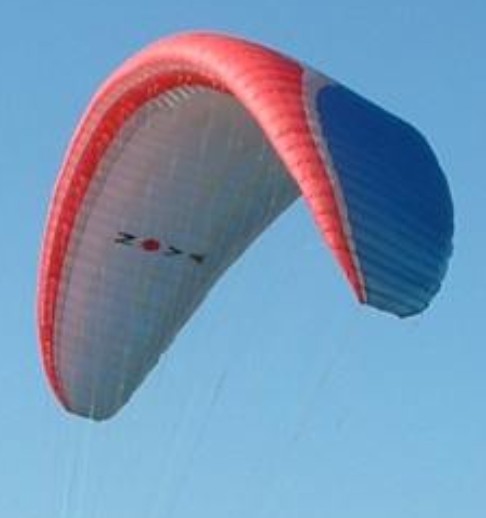
Nova make a two gliders, one for use within the school [Phorus] and a top end 1 for new club pilots called the Pheron. The DHV 2 Nova Artax is a member of Hannes Papesh’s Radon family, which is made up of the Artax [1-2], Aeron [2] and Radon [some sizes 2 but others could be 2-3]. All the gliders have a similar diagonal rib and line layout, but with number of cells and aspect ratio increasing as you go up the range.
Work on these started round about the end of 2001 but was slightly held up by a change of material choice for the construction of the glider. Early computer simulations indicated excellent performance figures for the Aeron despite a big reduction in the aspect ratio of the Radon prototype. The Radon profile is retained.
The differences from most previous Nova wings include thin risers with control-loop pulleys on the B-risers, all-internal stitching and Gelvenor top-surface material.
In flight the Aeron is trimmed quite fast at hands-off, although half-brake equals about average trim for this type of glider. The control feel is very linear and provides excellent feedback, whether flat turning in weak early-spring thermals or doing big wingovers.
Nova use Gelvenor OLKS siliconised PU coated nylon for the top surface, some parts of the bottom surface and Porcher Skytex 9052 for the rest of the undersurface. Suspended and diagonal ribs are Skytex 9092 with the hard, low stretch finish, and unsuspended ribs are 9052. Riser material is black 25mm webbing, except for the 15mm baby A riser, woven by Güth and Wolf. Lines are Liros. The glider has a three riser system with split As, for those who prefer a standard [non-split] A riser this is available to special order or as a retrofit. The glider has a system of diagonal ribs, & compression straps across A, B & C line attachment points. There is full span compression strap across what would be the D line attachment points; there is no D riser and the lines attached here branch backward from the upper end of the middle cascade of the C lines. In the centre of the canopy there is a further cascade rearwards to what would be an “E” attachment point.
The wing displays the characteristics of a good DHV1-2 wing. The leading edge would start to deform and turn under, but as soon as corrective control input was applied it would immediately regain its normal profile.
The slow-flight characteristics were excellent. Begin to stall, and then immediately letting up, produces a surprisingly benign response. Like a lot of current performance wings, the Aeron has a very taut, solid feel. Apart from the slightly unusual technique required to get the Aeron to bite into strong lift, the glider is a joy to thermal, with excellent feedback through the canopy and controls. Because of this, altering the bank angle and turn rate whilst thermalling become very intuitive.
The Aeron has a claimed glide of over 9:1 and in glide at least, was seen by many as class leading.
Aeron XS(20)
No of cells: 57
Span: 9.46 m
Area: 22.75 sq.m
Aspect ratio: 5.66:1
Line diameter: 0.6 / 1.2 / 1.45 mm
DHV weight range: 60 – 85 kg
Top speed: 53 kph
DHV certification: 2
Guarantee: 3 years/300 hours materials & workmanship + Nova Protect
Aeron S(22)
No of cells: 57
Span: 9.92 m
Area: 25 sq.m
Aspect ratio: 5.66:1
Line diameter: 0.6 / 1.2 / 1.45 mm
DHV weight range: 75 – 95 kg
Top speed: 53 kph
DHV certification: 2
AFNOR certification: Performance
Guarantee: 3 years/300 hours materials & workmanship + Nova Protect
Aeron M(24)
No of cells: 57
Span: 10.35 m
Area: 27.25 sq.m
Aspect ratio: 5.66:1
Line diameter: 0.6 / 1.2 / 1.45 mm
DHV weight range: 90 – 110 kg
Top speed: 53 kph
DHV certification: 2
AFNOR certification: Performance
Guarantee: 3 years/300 hours materials & workmanship + Nova Protect
Aeron L(26)
No of cells: 57
Span: 10.76 m
Area: 29.47 sq.m
Aspect ratio: 5.66:1
Line diameter: 0.6 / 1.2 / 1.45 mm
DHV weight range: 95 – 130 kg
Top speed: 53 kph
DHV certification: 2
AFNOR certification: Performance
Guarantee: 3 years/300 hours materials & workmanship + Nova Protect
The Nova Artax is a member of the Radon family, which is made up of the Artax [1-2], Aeron [2] and Radon [some sizes 2 but others could be 2-3]. All the gliders have a similar diagonal rib and line layout, but with number of cells and aspect ratio increasing as you go up the range. Work on these started round about the end of 2001 but was slightly held up by a change of material choice for the construction of the glider. The Artax was first seen in production form at St Hilaire in Sept 2002
Nova use Gelvenor OLKS siliconised PU coated nylon for the top surface, some parts of the bottom surface and Porcher Skytex 9052 for the rest of the undersurface. Suspended and diagonal ribs are Skytex 9092 with the hard, low stretch finish, and unsuspended ribs are 9052. Riser material is black 25mm webbing, except for the 15mm baby A riser, woven by Güth and Wolf. Lines are Liros. The glider has a three riser system with split As, for those who prefer a standard [non-split] A riser this is available to special order or as a retrofit. The glider has a system of diagonal ribs, & compression straps across A, B & C line attachment points. There is full span compression strap across what would be the D line attachment points; there is no D riser and the lines attached here branch backward from the upper end of the middle cascade of the C lines. In the centre of the canopy there is a further cascade rearwards to what would be an “E” attachment point.
The large size [27], is DHV certified for 100 -130 kg. This has a flat surface area of over 31sq.m. The glider is supplied with a two stage speed bar.
In the air the glider turns flat and easily on the brakes, some weight shift helps but isn’t essential. Brake pressure is firm but still comfortable over a long period of time. Even on the bottom end of the weight range, the glider is very solid and whilst it may occasionally rustle or even unload, the collapses don’t materialise. This glider is rock steady and simply shrugs off turbulence. Pitch control isn’t much of an issue, even when the glider drops slightly behind on entry to strong lift or accelerates forward as it falls out of a piece of very small lift. The glider never seems to stray far from being overhead and simply returns there if not actively placed.
Other manoeuvres confirm this gentle giant behaviour. B line stall is classic and easy, the glider simply falls back slightly and then comes back overhead as the descent rate rises. A good descent rate is easy to get and the glider snaps sharply back into normal flight as the stall is released. Brakes were ready to damp the dive but were not needed. Asymmetric collapses start a turn but the inflation pressure whips the riser out of your hand as the glider insists on re-inflating. Big ears require a firm pull, it gets much easier once they are in and they can easily be adjusted via the baby A riser. Ears come out by themselves when released, although they take longer on the lighter end of the weight range. Spiral dives are easily controlled once you are familiar with the glider’s handling and if not maintained exit without drama.
Trim speed at 110 kg was 37 km/h, rising to 38km/h with an all up weight of 117 kg. The full speed bar travel gave 51-52km/h, again at 117 kg. The speed system is light and easy to use and the glider feels very solid with it in use.
The Nova Artax is a great glider for simply cruising around the sky with no stress. It can ride out the rough well and will build the confidence of the pilot upgrading to it. Nova have produced a very tolerant, solid, benign glider with top end performance for its class.
Nova’s Artax was replaced by the Mamboo
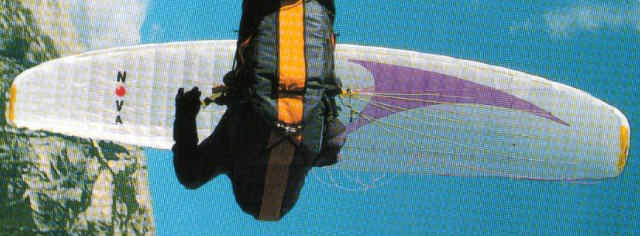
Paraglider. Available in six sizes.
Cert: DHV2
Glide: 8+.
Top speed: 48-49 kph.
A 2004 design. A perfect first glider for a small pilot.
Extra Small
DHV 1
Pilot weight: 65-85kg.
Taxy Bi
Paraglider circa 1998.
Wing area: 43.6 sq.m
Certification: DHV 2/Afnor
Pilot weight: 140-220 kg
No. of cells: 54
Wing span: 15 m
Aspect ratio: 5.2
Price (1998) 2699 £
Philou 23
Paraglider circa 1998.
Wing area: 27.4 sq.m
Certification: DHV 1/Afnor
Pilot weight: 65-85 kg
No. of cells: 27
Wing span: 11.03 m
Aspect ratio: 4.44
Min sink: 0 m/s
Max speed: 0 kph
Price (1998) 1899 £
Philou 26
Paraglider circa 1998.
Wing area: 30.28 sq.m
Certification: DHV IGH/Afnor
Pilot weight: 75-100 kg
No. of cells: 29
Wing span: 11.93 m
Aspect ratio: 4.7
Min sink: 0 m/s
Max speed: 0 kph
Price (1998) 1949 £
Philou 29
Paraglider circa 1998.
Wing area: 33.82 sq.m
Certification: DHV 1-2/Afnor
Pilot weight: 90-120 kg
No. of cells: 29
Wing span: 12.61 m
Aspect ratio: 4.7
Min sink: 0 m/s
Max speed: 0 kph
Price (1998) 1999 £
 All Aero