Ozone Viper

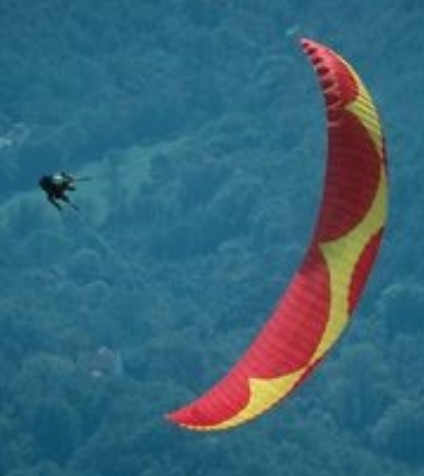
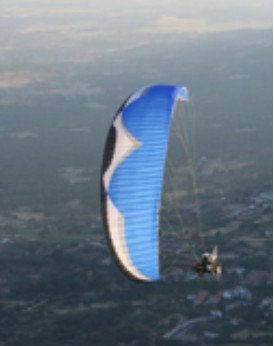
The Viper is a paramotor wing for expert pilots who fly in high level competitions and make advanced XC flights. This wing is an advanced competition glider designed for highly experienced pilots only. The Viper is a paramotor specific wing that has stability at high speed and the high maneuverability and handling of a normal paraglider.
Developed in cooperation with Mathieu Rouanet, World Champion 2005, the high top speed, low sink rate and high efficiency of the Viper gives lower fuel consumption and longer, faster flights. The handling is direct and precise, with clear feedback. Launching is simple due to the benign inflation characteristics.

This Viper is an Open Class wing, and load tested to 1607kg on average, which means 11.5G for the 27 and 14G for the 24.

The Ozone Roadster and Viper both feature a customized Ozone Reflex Profile (OZRP) that has been tuned specifically for powered flight. The OZRP is what gives the Roadster and Viper their stability at high speed and collapse resistance in turbulent air.

This special airfoil design provides constant lift in a wider range of angles of attack. When you apply speed-bar or fly with the glider accelerated at a lower angle of attack, the RP takes effect and provides continuous lift and heightened stability.

Through carefully moderating the shape and amount of curve in the OZRP, a balance that provides increased lift at extreme angles of attack, while still retaining excellent launch characteristics and stall resistance has been achieved.

The Viper is constructed with Porcher Marine Skytex Evolution 45, and comes standard with the Ozone Paramotor Risers which feature double hang points and a reinforced trimming system.

Viper 24
Cells: 59
Flat Area: 24.5 sq.m
Projected Area: 21.0 sq.m
Flat Span: 12.24 m
Projected Span: 9.78 m
Flat Aspect Ratio: 6.11
Projected Aspect Ratio: 4.54
Root chord: 2.50 m
Glider weight: 11.9lb
In flight weight range: 80-115 kg
Recommended weight: 95-105 kg
Load test: Yes

Viper 27
Cells: 59
Flat Area: 27.5 sq.m
Projected Area: 23.6 sq.m
Flat Span: 12.97 m
Projected Span: 10.36 m
Flat Aspect Ratio: 6.11
Projected Aspect Ratio: 4.54
Root chord: 2.65 m
Glider weight: 13lb
In flight weight range: 100-140 kg
Recommended weight: 115-125 kg
Load test: Yes
Ozone Roadster

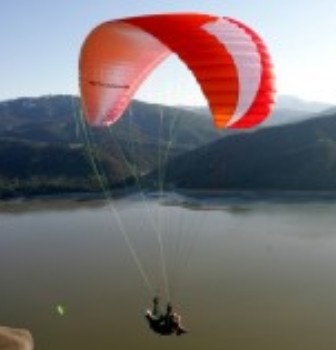
The Roadster was created for a wide range of intermediate paramotor pilots, ranging from XC distance fliers to ground skimmers and adventure pilots. It is a paramotor specific glider, with characteristics similar to the Viper but with an overall much higher ease of use.

The Roadster’s OZRP Technology (Ozone Reflex Profile) means that it is more stable in accelerated flight than a normal free-flight wing.

Special attention was put into the launching characteristics of the Roadster. The inflation is smooth and constant in any wind speed, and the wing comes up directly overhead without shooting in high winds or lagging behind in no wind.

The Roadster can also be flown without a motor. Its sink rate is low enough to soar in light lift, thermal in all conditions, and fly cross country. Although it is designed for pilots who fly a majority (if not exclusively) under power, the Roadster performs excellently unpowered as well.

The Ozone Roadster and Viper both feature a customized Ozone Reflex Profile (OZRP) that has been tuned specifically for powered flight. The OZRP is what gives the Roadster and Viper their stability at high speed and collapse resistance in turbulent air.

This airfoil design provides constant lift in a wider range of angles of attack. When you apply speed-bar or fly with the glider accelerated at a lower angle of attack, the RP takes effect and provides continuous lift and heightened stability.
Through carefully moderating the shape and amount of curve in the OZRP, increased lift at extreme angles of attack, and still retains excellent launch characteristics and stall resistance.
The Roadster is constructed with Porcher Marine Skytex Evolution 45, and comes standard with Ozone Paramotor Risers, which feature double hang points and a reinforced trimming system.

Small
Cells: 45
Projected Aspect Ratio: 3.74
Flat Aspect Ratio: 5.1
Weight Range: 65-105 kg

Medium
Cells: 45
Projected Area: 22.45 sq. m
Flat Area: 26 sq.m
Projected Span: 9.16 sq.m
Flat Span: 11.52 m
Projected Aspect Ratio: 3.74
Flat Aspect Ratio: 5.1
Root Chord: 2.86 m
Glider Weight: 12.5 lb
Weight Range: 80-120 kg

Large
Cells: 45
Projected Aspect Ratio: 3.74
Flat Aspect Ratio: 5.1
Weight Range: 95-140 kg

Ozone Mojo / Mojo Power

The Mojo has been in the DHV 1 category since its inception, as a solid, stable, and easy glider for beginning paramotor pilots. The Mojo Power, with DULV certification, is for the first phase of paramotoring.

The Mojo Power has long brake travel, but the handling is direct enough for more experienced pilots to appreciate, while still remaining forgiving enough for new beginners. The progressive nature of the Mojo Power’s handling makes for great turning behavior with or without weight-shift. High stability in pitch and roll creates an overall feeling of comfort and safety in flight, however the glider does provide the pilot with feedback, in amounts comfortable and subtle enough for new pilots. The sink rate and handling of the Mojo Power mean that beginning pilots will not outgrow this wing too soon.

The Mojo Power is constructed with Gelvenor cloth on its top surface, and Porcher Sport bottom surface and internal ribs. It comes standard with Ozone Paramotor Risers which feature double hang points, reinforced trimming system, and trimmer lock-off for free flight.

Ozone Mojo 2 Small

Medium
Cells: 39
Projected Area: 23.63 sq.m
Flat Area: 27.40 sq.m
Projected Span: 9.33 sq.m
Flat Span: 11.73 m
Projected Aspect Ratio: 3.68
Flat Aspect Ratio: 5.02
Root Chord: 2.95 m
Glider Weight: 12 lb
Weight Range: 176-264 lb
DHV: 1

Large
Cells: 39
Projected Area: 25.55 sq.m
Flat Area: 29.70 sq.m
Projected Span: 9.69 sq.m
Flat Span: 12.18 m
Projected Aspect Ratio: 3.68
Flat Aspect Ratio: 5.02
Root Chord: 3.07 m
Glider Weight: 13 lb
Weight Range: 209-297 lb
DHV: 1

Mojo 2 Small
Pilot weight: 65-85kg

Ozone Vib

Ozone Vib M.L
D.H.V. 1-2 Suitable for Beginner to Intermediate.
Pilot weight range 65-85 kgs plus Ozone recommended allowance of 20kgs for gear, achieves the certified weight range of 85-105 kgs for the glider
44 Cells. Area 23.61 square metres
Speed Bar

Ozone Rush

The Rush Power was created circa 2005 for the performance pilot who needs DHV 1-2 security in their DULV certified wing. With a higher aspect ratio and more cells than the Mojo Power, the Rush Power is closer to a DHV2 in performance while remaining well within the boundaries of the DHV 1-2 class. It features sportier, more dynamic handling, along with a higher speed range.

The Rush Power’s launch characteristics are benign for a wing with such performance and dynamic character, and pilots will find that the inflation is simple to control in all conditions. In light wind or no wind, the Rush Power comes up easily overhead, with no tendencies to hang back or slip to one side.

In flight, the handling is direct and well coordinated, and ideal for maneuvering close to the ground or for thermalling with the engine off. Feedback is transmitted to the pilot and it is feedback that the pilot can understand and use, not just turbulence or noise.

The Rush Power is a well proven and ideal intermediate paramotor wing that also flies just as well unpowered. We think that pilots searching for an intermediate wing that is equally capable of powered and unpowered flight need look no further.

The Rush Power is constructed with Porcher Marine Skytex Evolution cloth, and comes standard with Ozone Paramotor Risers which feature double hang points, reinforced trimming system, and trimmer lock-off for free flight.

Small
Cells: 46
Projected Area: 21.18 sq.m
Flat Area: 24.57 sq.m
Projected Span: 8.89 m
Flat Span: 11.27 m
Projected Aspect Ratio: 3.73
Flat Aspect Ratio: 5.17
Root Chord: 2.77
Glider Weight: 12.3 lb
Weight Range: 154-242 lb
DHV: 1-2

Medium
Cells: 46
Projected Area: 23 sq.m
Flat Area: 26.66 sq.m
Projected Span: 9.26 m
Flat Span: 11.74 m
Projected Aspect Ratio: 3.73
Flat Aspect Ratio: 5.17
Root Chord: 2.89
Glider Weight: 13 lb
Weight Range: 187-275 lb
DHV: 1-2

Large
Cells: 46
Projected Area: 25.14 sq.m
Flat Area: 29.16 sq.m
Projected Span: 9.68 m
Flat Span: 12.28 m
Projected Aspect Ratio: 3.73
Flat Aspect Ratio: 5.17
Root Chord: 3.02
Glider Weight: 14 lb
Weight Range: 220-308 lb
DHV: 1-2

Ozone Vulcan

The replacement for the Octane, the Vulcan was announced as a wing for the true sport pilot, which outperforms its predecesor whilst keeping “the feeling”. The glider has a higher aspect ratio of 5,4, a smaller tip area, and also more cells (56) to improve the performance. It was to be available in 3 colors schemes (quite original).

Ozone claims that the Vulcan offers more performance throughout the speed range, “but interestingly it also offers more pitch stability than before”. It also features the brand’s B2 tabs (introduced with the Vibe) which are supossed to offer more stability in flight “and reduce the pitching effect even further making the wing very comfortable to fly even when it’s rough and turbulent”, according to the designers. The Vulcan made an interesting debut in the acro scene at the last Bregenzerwald Cup (Austria) in the hands of Mike Kung.

The Vulcan passed DHV2 certification in sizes S, M, L & XL. The XS size was yet to be certified.

Ozone Mantra

Mantra 2

An evolution of the Mantra, Ozone says the DHV2-3 Mantra 2 is similar in that it has the same excellent handling and user-friendly feel. The big difference is that the Mantra2 is being developed with true 3-Line technology, which Ozone has been experimenting with since the X-Alps of 2003. Combined with an all new internal structure, the Mantra2 has 90 meters less lines than the Mantra! The M size prototype currently has just 290 meters of total line, which Ozone says is a drastic reduction in drag. Other changes include an aspect ratio of 6.22, a new planform to increase stability and performance at speed, and special span-wise reinforcement to moderate sail tension.