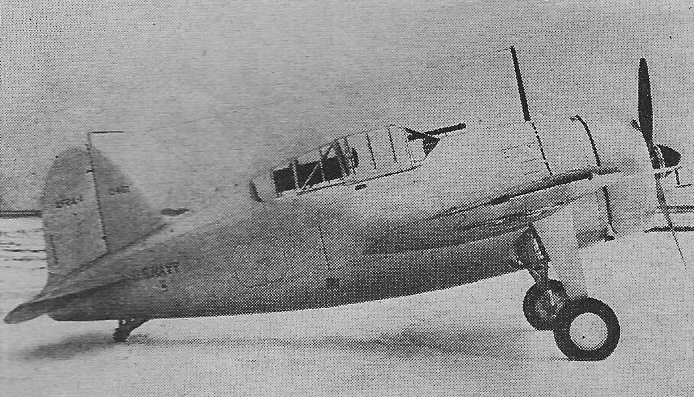
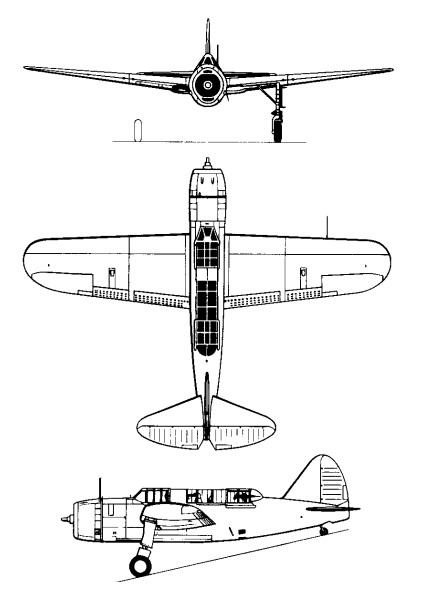
The prototype of this single-seat all-metal fighter flew for the first time in December 1937.
1938 XF2A-1
The first production version was the F2A-1 powered by a 700.4kW Wright R-1820-34 radial engine which went into service with the US Navy in 1939. From the initial order of 54, only 11 were actually accepted into service with US forces. The eleven were operated by the US Navy on board USS Saratoga and 44 were exported to Finland. The F2A-1 was the US Navy’s first monoplane fighter.
These were followed by 43 894kW R-1820-40-engined F2A-2 and 108 F2A-3 for the US Navy. Addition of armour plate on the F2A-2 version reduced any performance advantage the basic Buffalo may have had over Japanese fighters.
A contract was placed by the RAF in 1939 for 170 Brewster Model 339’s (called Buffalos) to be operated as a land fighter. Meanwhile a few fighters had reached Belgium and others were in service in the Netherlands East Indies and with the RAF.
Finland bought 44 Brewster 239 from USA 1939-1940. Basically 43 Brewsters were on sale (US Navy order was 54 and only 11 was delivered). But Finland bought 44 and 38 came from US Navy order and six from Belgium order. Since Belgium has ordered Brewster 339, the factory had to make rather big modification to front fuselage.
After the Russian invasion of Finland in 1940, slowly reinforcements began to arrive for the Finnish air force. The first to come were 5 Gloster Gladiators, 12 Hurricanes, 17 Lysanders and 24 Blenheims, all from Britain. After that, 76 Morane-Saulnier and Koolhoven F.K. fighters arrived from France. Italy sent 17 Fiat fighters, Sweden 12 Gloster Gladiators, and the USA 44 Brewster Buffalo, of which however only 5 reached Finland in time. Even the Union of South Africa sent 25 Gloster Gladiators. Pilots and ground personnel from a number of countries also volunteered to assist them.
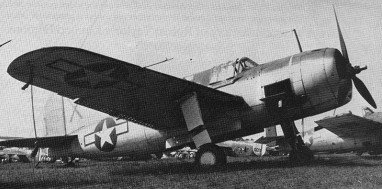
Apart from the Finnish fighters which fought well against the Russians, F2A were used almost exclusively against the Japanese and in all cases met superior aircraft. Heavy British losses in the Far East led to their withdrawal and US Navy action during the Battle of Midway was equally unsuccessful as 13 out of the 19 available Buffalos were lost to enemy fire.
In an attempt to improve performance against the Japanese Zero, the .50 in mgs were replaced by .303s and the number of rounds reduced to 350. The fuel was restricted to 80 gallons.
A total of more than 500 F2A were built.
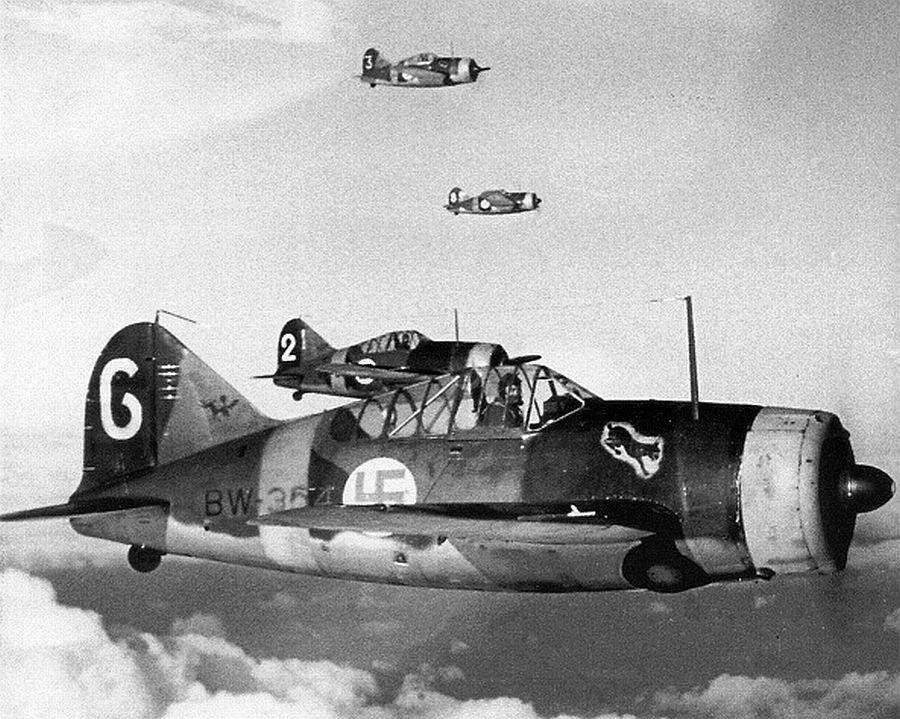
In 1939, following requests by the Finnish Embassy in Washington, D.C., a total of forty-four U.S. Brewster F2A-1 “Buffalo” aircraft that were originally intended for the U.S. Navy were diverted at the behest of the U.S. State Department to Finland for use by the Finnish Air Force (FAF) and designated by Brewster as the Model B-239E. They were flown at first during the Winter War of 1939-40 between the Soviet Union and Finland. There they were never referred to as the “Buffalo” by the FAF, but merely “Brewster” or by nicknames such as “Sky Pearl” and “Pearl of the Northern Skies” and “Butt-Walter” (or “Pylly-Walter”) and “American Hardware” (American metal) and “Flying Beer Bottle,” and they received FAF serial numbers BW-351 though BW-394 (“BW” aircraft).
Brewster B-239s over Lake Tikshozero, 1942.
The Finns liked the Buffalo enough to design a version called the Humu (‘Reckless’) with a wooden wing and a Russian engine. It proved unsatisfactory in trials and only a single example was built.
The one Brewster 239 (F2A-1) is in The Aviation Museum of Central Finland in Tikkakoski, Finland. There is also the prototype of VL Humu which is the clone of F2A-1 or 239.
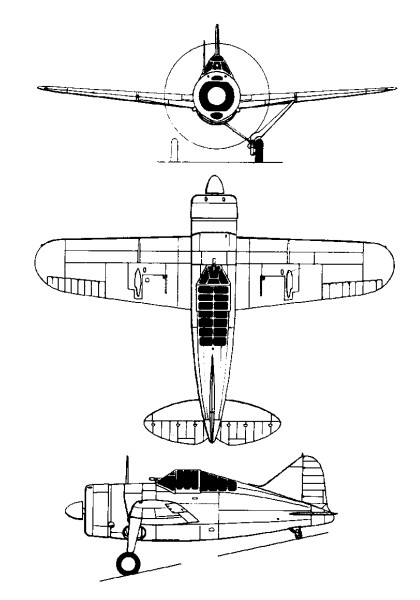
Brewster F 2 A Buffalo Carrier based fighter aircraft 1938 Length: 26.345 ft / 8.03 m Height: 12.073 ft / 3.68 m Wingspan: 35.007 ft / 10.67 m Wing area: 208.929 sqft / 19.41 sq.m Max take off weight: 7159.6 lb / 3247.0 kg Weight empty: 4731.9 lb / 2146.0 kg Max. speed: 279 kts / 517 km/h Cruising speed: 224 kts / 415 km/h Service ceiling: 33202 ft / 10120 m Wing load: 34.24 lbs/sq.ft / 167.00 kg/sq.m Range: 839 nm / 1553 km Engine: Wright R 1820-40 Cyclone, 1184 hp Crew: 1 Armament: 4x cal.50 MG (12,7mm), 2x 45kg Bomb.
F2A-2 Engine: 1100 hp Wright R-1820-40 (G-205A) Cyclone Wingspan: 35 ft / 10.67 m Length: 26 ft 4 in / 8 m Height: 12 ft 1 in / 3.7 m Empty weight: 4630 lb / 2100 kg Loaded weight: 7055 lb / 3200 kg Max speed: 300 mph / 483 km ROC: 3070 fpm / 935 m/min Service ceiling: 30,500 ft 9300 m Range: 650-950 mi / 1045-1530 km Armament: 4 x mg, 0.30 in, 0.303 in, or 0.50 in
Brewster F2A-3 Buffalo Length: 26 ft 4 in (8.03m) Wingspan: 35 ft 0 in (10.67m) Height: 12 ft 1 in (3.68m) Wing area: 19.41 sq.m / 208.93 sq ft Maximum Speed: 321mph (517kmh; 279kts) Cruise speed: 415 km/h / 258 mph Maximum Range: 965miles (1,553km) Rate-of-Climb: 3,070ft/min (936m/min) Service Ceiling: 33,202ft (10,120m) Armament:4 x 12.7mm machine guns, 2 x 45-kg bombs Accommodation: 1 Empty Weight: 4,731lbs (2,146kg) Maximum Take-Off Weight: 7,158lbs (3,247kg) Engine: 1 x Wright R-1820-40 cyclone radial piston , 895kW
The US Navy issued a requirement for a new scout/dive bomber aircraft early in 1938. From half a dozen designs submitted, those of Brewster and Curtiss were considered most suitable, both incorporating the new 1700 hp Wright R 2600 Cyclone 14 cylinder two row radial, conforming adequately with the Navy Bureau of Aeronautics specifica¬tion. In January 1939, prototypes of the XSB2A1 (Brewster) and XSWC 1 (Curtiss) were ordered.
First flown on 17 June 1941, this was a mid-wing all-metal monoplane fitted with a 1,267kW Wright Double-Row Cyclone R-2600-8 engine. The prototype was tested with a mock-up powered dorsal turret, but this caused such buffeting that it was abandoned and traditional hand-aimed guns were used instead.
Production deliveries were made to the RAF in 1942 as SB2A-1 (known as Bermuda and quickly relegated to training and target-towing duties), and to the US Navy from 1943 as SB2A-2, -3 and -4; the latter were produced for the Netherlands East Indies but were not delivered and were used instead as trainers. The RAF’s Bermudas lacked the arrester hook and folding wings of the US Navy’s SB2As.
The Bermuda has split flaps which act as dive brakes, reducing the operational diving speed to a maximum of 240 mph.
Founded in the mid-1930s, the first product of this company was a two-seat scout/bomber for the U.S. Navy designated SBA. When this aircraft entered production in 1937-1938 the company had inadequate productive capacity and 30 were built by the Naval Aircraft Factory as SBNs.
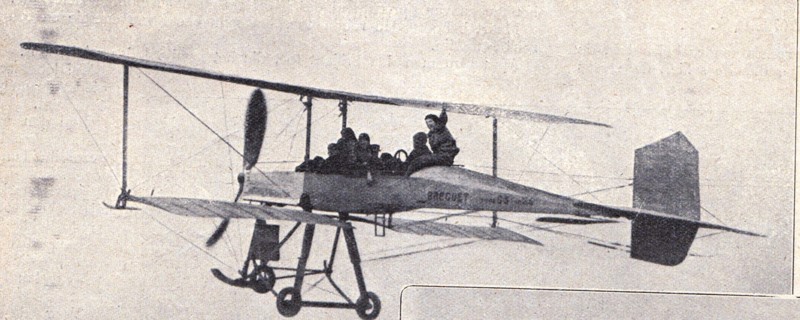
Bréguet and around 10 passengers above the airport of Douai in March 1911
The Bréguet Type IV was developed from the Bréguet Type III which had appeared during 1910. It was a tractor biplane with a tricycle undercarriage.
The Bréguet Type IV was an aircraft built by Bréguet Aviation. It was first flown in 1911, and was the first Bréguet aircraft to be produced in quantity. It was used by the French Army and the British Royal Flying Corps. It is notable for the extensive use of metal in its construction, unusual in an aircraft of its time.
The Bréguet Type IV was produced in a number of variants, differing in their seating arrangement and in the engine fitted.
G, later G.1 powered by a 50 hp (37 kW) Gnome Omega G.2 powered by a 70 hp (52 kW) Gnome G.3 powered by a 100 hp (75 kW) Gnome Gnome Double Omega G.4 powered by a 160 hp (120 kW) Gnome Gnome Double Lambda R.1 powered by a 50 hp (37 kW) REP R.2 powered by a 70 hp (52 kW) REP L.1 powered by a 50 hp (37 kW) Renault 50/60 hp (the ‘L’ for Louis Renault) L.2 powered by a 70 hp (52 kW) Renault C.1 powered by a 40 hp (30 kW) Chenu C.2 powered by an 80 hp (60 kW) Chenu U.1 powered by an 80 hp (60 kW) Canton-Unné U.2 powered by an 80 hp (60 kW) Canton-Unné D.1 powered by a 100 hp (75 kW) Dansette O.1 powered by an 80 hp (60 kW) Le Rhône
R.U.1
Although Bréguet’s earlier aircraft were referred to using a type number, the aircraft produced after the Type III were generally referred to using an airframe number and a letter/number combination denoting the type of engine fitted.
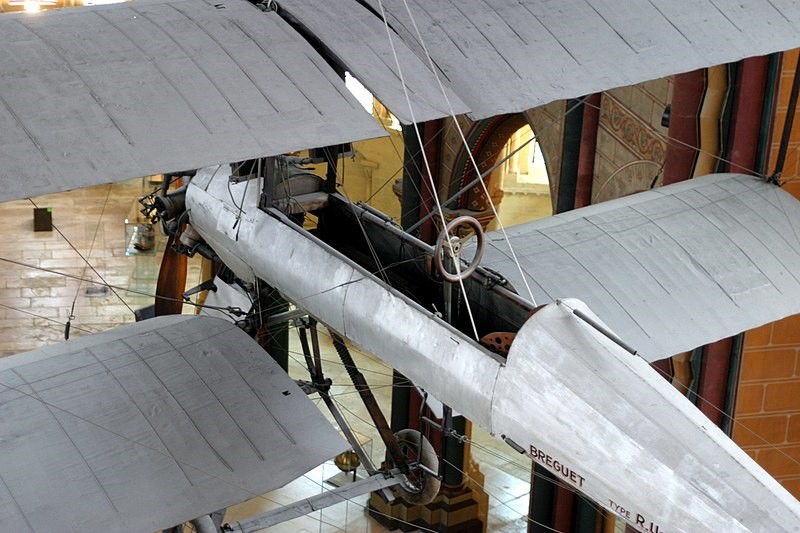
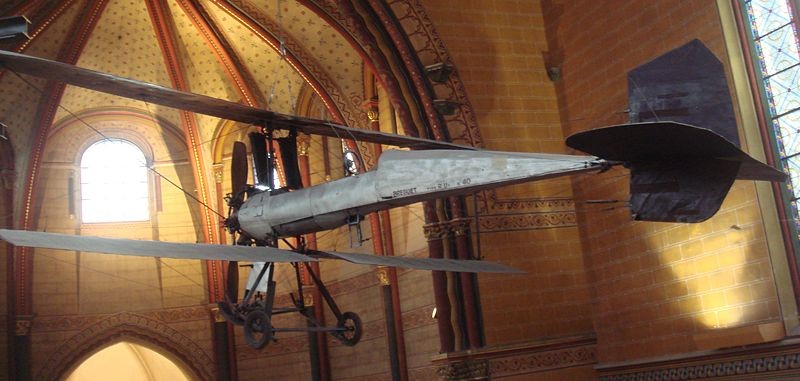
An example, an R.U.1, is on display at the Musée des Arts et Métiers in Paris.
R.U.1 at the Musée des Arts et Métiers
Breguet 1-bis of 1909 at aérodrome de la Brayelle
A large Breguet RU1 biplane.
U.I
The original 1909 Breguet U.I designed and built by Louis Breguet was later improved into the U.I-bis. Originally the Breguet biplane 1, but after a crash, it was re-designed and rebuilt. Sometimes referred to as the Breguet 2.
Number 40, of 1911 had a radial engine, two-blade wood propeller.
U.2
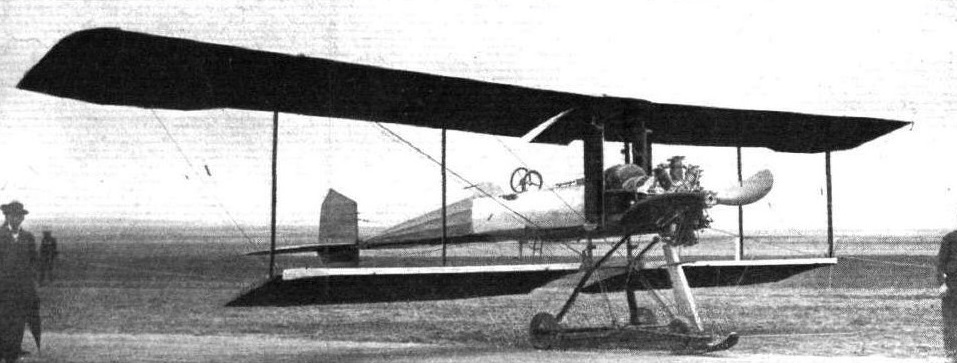
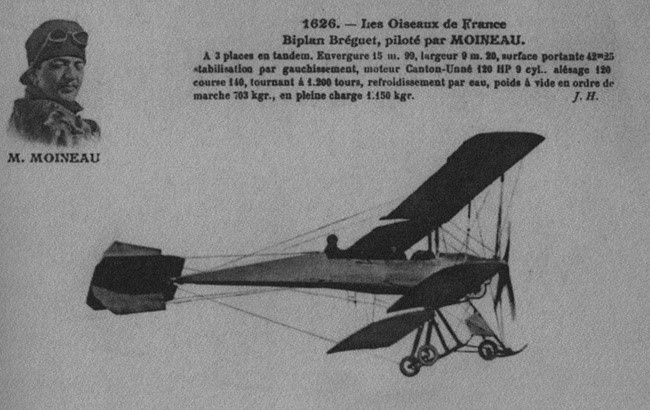
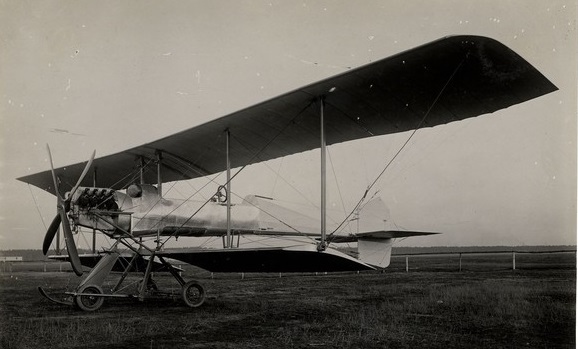
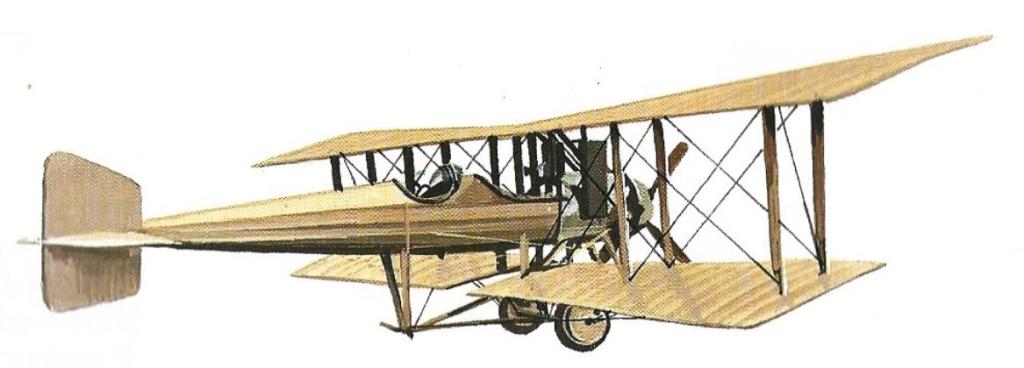
Proposed by the manufacturer to meet a military requirement, the Breguet U2 biplane was presented in various versions from 1911. The 1911 U2 version with a Salmson Canton-9 liquid cooled engine cylinder, two-bladed propeller, had the fuel tank between the two radiators placed vertically. The pilot, in back position, faced a rear-facing passenger, the other passenger, in the front, looked forward.
This machine has a steel structure fuselage, with a main landing gear with four wheels comprising two rear wheels mounted on the same axis and two front wheels detached. On early versions, lateral control was obtained by warping the wings, and later aileron control.
Initially the aircraft was equipped with a 130 hp Gnome rotary engine and was able to carry three people. Many engines were mounted on these machines, including Anzani, Renault 55 or 60 CV, and Canton-Unné of 120 hp. The propellers can be bladed or four-bladed.
U.2
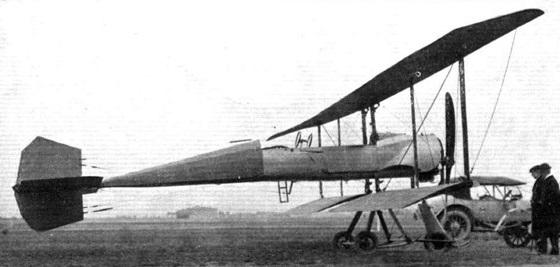
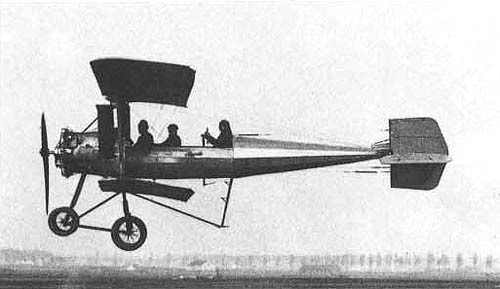
Type U.2 No 45; Another military machine showing in the same Concours. A heavier aircraft than L.1 No 3, with an interwing strut between the earlier 2, retaining the original wiring. 2 tall radiators stood up under the center-section; the nosewheel was now doubled.
Type U.2 No 102: This 3-seater 2-bay single-spar biplane appeared in 1913. The 4-wheel landing gear was supported under the rear cockpit by a tall skid, keeping the cruciform tail off the ground. The fuselage was no longer a single boom aft, but consisted of 4 steel tube longerons supporting a structure faired out with stringers.
Type U.2 No 138: Similar to No 102, this new 1914 machine was a 2-bay 2-spar biplane, with 2 separate cut-out cockpits. The wing cell design was named “semi-rigide,” and the wings still warped.
The Breguet H-U2 and U3 H seaplanes were derived from U-2 biplane. These became famous in April 1913, in Monaco, then in August of the same year in Deauville, in the hands of Henri Brégi and René sparrow.
Breguet biplane U2, three-seater tandem, piloted by René Moineau
At the beginning of the First World War, the first bombing took place early in August 1914 with an attack of Frascati airship hangar near Metz by the airman Corporal Finck. Projectiles were almost exclusively former 90 or 120 caliber artillery shells. These weapons were crammed into cabins and launched by hand by the observer. Some firebombs were tried, but proved difficult to use and dangerous for the aircraft that carried them. The first months of war dart boxes (cylindrical steel rods of 12 cm long and 8 mm in diameter, tapered tip and Phillips tail to rotate to stabilize during the fall) were used. This process of low efficiency (lack of accuracy and dispersion) was abandoned in early 1915.
Used for reconnaissance missions at the beginning of the First World War these machines had rigid wings equipped with ailerons and a Salmson Canton-Unné liquid cooled 110 hp or rotary Gnome engine of 100 HP that allowed them to reach 110 km / h.
French forces employed about 30 machines.
U.2
A small batch of the popular Breguet L.2 biplane, powered by an air-cooled Renault V-8, was assembled or built by Albatroswerke, Johannisthal in Germany under license and test flown by Bréguet factory pilot Debussy in March 1912.
Breguet L.2, license-built by Albatroswerke
A myriad of versions of the Breguet biplane, were produced between 1910 and 1914. Breguet used a complex letter-number designation for the engine used in the machine. The L.2 uses a 70 hp Renault engine driving a four bladed propeller. In the Breguet system it was then coded as L (= Renault) 2 (70 hp). It might seem strange to code the Renault engine with the letter L, but the letter R was already taken by the R.E.P. engine. Code 2 stood here for 70 hp, where code 1 denoted 50 hp.
The machine had a tricycle undercarriage with a nosewheel. There were undercarriage skids to prevent the machine from nosing over. The big bulb in the front of the fuselage is the petrol tank. After the tank is a compartment holding two persons and the pilot at the back. The whole fuselage was a metal construction and in this version the big wings are two-bay.
The Breguet Biplane managed to set a world record with seven passengers.
The Royal Flying Corps (RFC) around August 1912 bought two machines of this exact type (L.2). They lasted till December 1913 but did very little flying, at most a few hours.
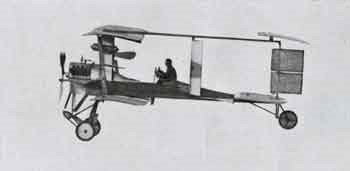
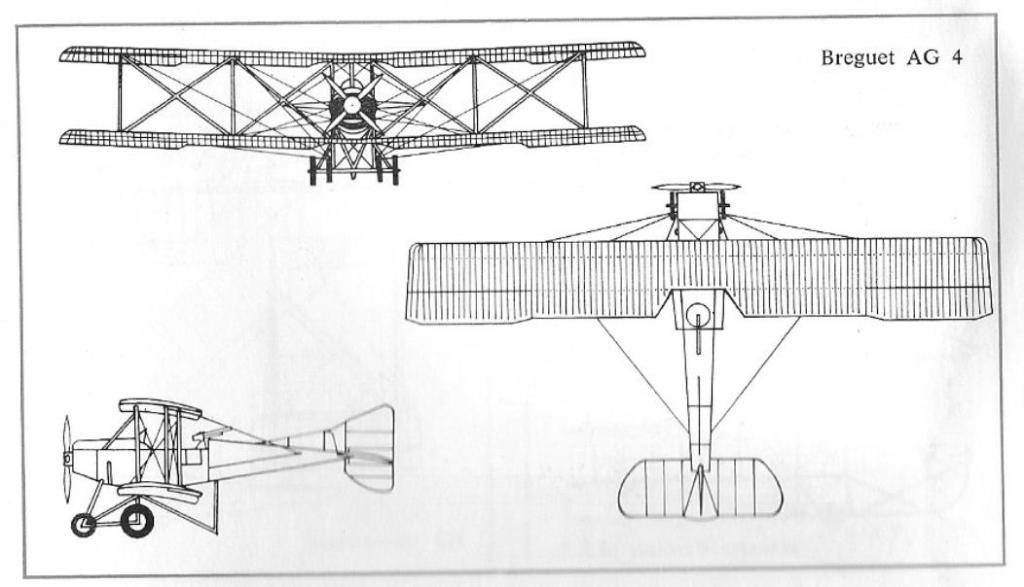
Just before the outbreak of the War, Breguet had started 2 new aircraft and projected a third. The A-G.4 was a 160 Gnome tractor; the A-U.3 was a 200 hp Canton-Unne tractor, and B-U.3 was a 200 hp Canton-Unne pusher (the A and B now used to distinguish similarly-powered machines only.)
A-G.4
The relative success of the use of cannon in the Breguet BU.3 led the Breguet company to install it in their latest aircraft, the Breguet 5.
The French forces employed some type A-G4, the British employed some A-G4 for the Royal Flying Corps and 15 A-G4 for the Royal Royal Naval Air Service, the Italians some A-G4.
The A-G4 was the definitive 1913 military version with a rotary engine.
L-1 Cruiser Propeller: 2.4 m (8 ft) diameter Upper wingspan: 13.94 m (45 ft 9 in) Lower wingspan: 8.74 m (28 ft 8 in) Wing area: 30.43 m2 (327.5 sq ft) Length: 8.5 m (28 ft) Crew: 1 Capacity: 1
U.I Engine: Salmson Canton-Unné, 85 hp Span upper: 45′ / 13,70 m Span lower: 39’4″ Length: 30′ / 9.15m Empty weight: 1275 lb Total weight: 1150 kg Speed: 80 kph
U.I-bis Span: 41′ Length: 27’11” Weight: 1100 lb
U.2 Engine: Canton-Unné, 110 hp Wingspan: 44 ft 4 in / 13.5 m Length: 27 ft 10 in / 8.5 m Height: 8 ft 4 in / 2.5 m Empty weight: 1234 lb / 560 kg Loaded weight; 2116 lb / 960 kg Max speed: 68 mph / 110 kph Armament: none
U.2 Engine: Salmson Canton-Unné, 85 hp Wingspan: 13,70 m Length: 9.15m Total weight: 1150 kg Speed: 80 kph
A-G.4 Engine: Gnome, 160 hp Wingspan: 50 ft 4 in / 15.35 m Length: 27 ft 1 in / 8.25 m Height: 10 ft 10 in / 3.30 m Weight: 2970 lb / 1350 kg Max speed: 62 mph / 100 kph Ceiling: 42900 ft / 1500 m Armament: 1 x mg Crew: 2
When the specification was outlined in January 1958, designs were submitted to NATO and by the end of 1958, the Breguet Br 1150 had been selected as the best of the projects. The choice was endorsed by all 15 nations in NATO, including the USA, Canada and the UK. A joint develop¬ment contract was drawn up in February 1959, which provided for work on the Br 1150 to be financed by Belgium, France, Germany, the Netherlands and the USA, although only France and Germany were at that time indicating an interest in acquiring the new MR type in operational quantities. Belgian and Dutch interest was maintained as a means of obtaining a share in the production programme for indigenous companies, while US financing was part of that nation’s general support for NATO. To handle the joint design and production of the Br 1150, for which the name Atlantic had been adopted, Societe d’Etude et de Construction de Breguet Atlantic was set up as the industrial executive agency, the original constituent companies of which were Breguet, Sud Aviation, ABAP (the Belgian grouping of SABCA and the then Fairey company), Fokker and Seeflug (the German grouping of Dornier and Siebel). Engines, propellers and the radar ECM system were to be government funded equipment (GFE) but were also made the subject, so far as possible, of European joint production programmes. The Rolls Royce Tyne RTy 20 Mk 21 was selected to power the Atlantic, production being under licence in France by SNECMA (with a 44 per cent share) and contributions by MTU in Germany (28 per cent), Rolls Royce (20 per cent) and FN in Belgium (8 per cent). The Hawker Siddeley Dynamics (de Havilland) propeller was put into production by Ratier. CSF was chosen to produce the radar in France and other major suppliers were Hispano Suiza for the undercarriage, Crouzet for navigation equipment and Bendix, Sperry and Canadian Marconi for avionics items.
To launch the programme two prototypes were ordered in July 1959, and the basic industrial programme for the prototype and production stages was agreed in December. The first prototype, powered by RTy 20 engines supplied completely by Rolls Royce, flew at Toulouse on 21 October 1961. It was followed by the second (Atlantic 02), which flew on 25 February 1962, but was lost in an accident two months later, on 19 April. Meanwhile, two pre-¬production examples had been ordered in February 1961; the first of these (Atlantic 03) flew on 25 February 1963 and featured the lengthened fuselage that had been adopted for the production model, 3 ft 3 in (1 m) longer than the prototypes. Other features of the production standard Atlantic, for which orders were placed in June 1963, were incorporated in the second pre production Atlantic, 04, which flew on 10 September 1964 and subsequently being referred to as the first production model. This same aircraft was eventually to be used, in 1979, as an aerodynamic test vehicle for the Atlantic NG (in which guise it was known as the ANG 001). The initial phase of flight test and development was completed on 31 October 1965, with some 2,000 hrs of flying, and on 10 December that year the first production Atlantic for the French Aeronavale and the Federal German Marineflieger were handed over in a formal ceremony at Nimes Garons. By the end of the year, five aircraft were off the line and production was at a rate of two a month. Production was shared between France (60.5 per cent by value of the airframe), Germany (17 per cent), the Netherlands (15 per cent) and Belgium (7.5 per cent). In practice, the work was divided between Sud Aviation (outer wings), Breguet (front and centre fuselage plus final assembly at Toulouse (Colomiers), Dornier (rear fuselage and lower lobe of centre fuselage), SIAT (tail unit), SABCA (power plant cowlings), Fairey (centre section flaps) and Fokker (centre section structure and nacelles).
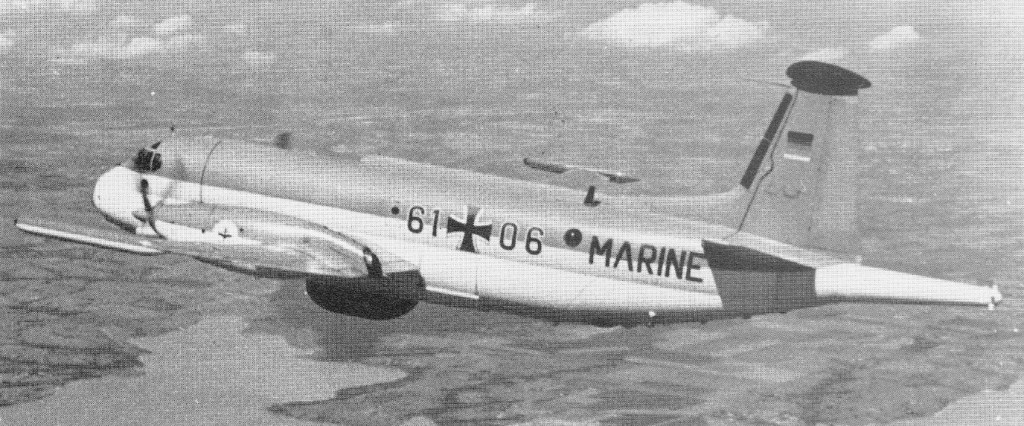
Between 1965 and 1968, Aeronavale received 40 Atlantic Is and Marineflieger, 20. In France, these aircraft were issued progressively to four Flottilles, Nos 21F and 22F based at Nimes Garons and operating in the Mediterranean area, and Nos 23F and 24F based at Lann Bihoue and operating over the Atlantic. The front line strength of each of these Flottilles is seven aircraft. Late in 1975, the Aeronavale released three of its Atlantics for sale to Pakistan and these are now based at Karachi for operation by the naval aviation element of the Pakistan armed forces.
In the Marineflieger, the Atlantic replaced the Fairey Gannets operated in the ASW role by Marineflieger-geschwader (MFG) 3 “Graf Zeppelin” at Nordholz. Of the 20 aircraft acquired, five were converted by LTV for special electronic intelligence (ELINT) duties over the Baltic (one of these having subsequently been lost). Early replacement of the 15 Atlantic Is in the ASW role having been ruled out on financial grounds, the Marineflieger embarked in 1978 on a programme to update the avionics and sonar equipment in the existing fleet, all of which will have been cycled through the so¬called KWS modernisation programme by Dornier GmbH at Friedrichshafen by 1983. Dutch interest in the Atlantic crystallised towards the end of 1960, just as production of the initial run of 60 was completed; purchase of nine was linked to the formation of a new squadron to help replace the aircraft carrier Karel Doorman, and as the need was urgent Avonavale released four of its Atlantic Is for early use by the MLD pending deliveries from the re opened production line. With the Dutch designation SP 13A (the MLD, unlike its land based counterpart the KLu, assigns its own designations to its current aircraft), the Atlantics were issued to VSQ 321 (No 321 Squadron) based at Valkenburg, and were supplemented by the five new production aircraft by January 1972. Meanwhile, Italy’s Marinavia (or A viazione per la Marina Militare) had also decided to adopt the Atlantic 1 and had ordered 18. This brought Aeritalia into the SECBAT partnership, with responsibility for producing (on the finat batch of aircraft) the moving control surfaces, rear fuselage lower lobe, parts of the front fuselage and the engine nacelles. The final batch of aircraft included not only the 18 for Italy but the four replacement Mk Is for Aeronavale to make good those transferred to MLD. Delivered between June 1972 and July 1974, the Italian aircraft entered service with two Stormi Anti¬Somergibile, the 30o Stormo (86o Gruppo) at Cagliari Elmas and the 41o Stormo (88 o Gruppo) at Catania Fortanarossa, each with nine aircraft. Marinavia provides half the crews for these two squadrons, but since 1978, control of land based ASW aircraft has been assigned to the AMI (Italian Air Force) rather than the Navy. On July 19 1974 the Toulouse-Colomiers plant of Dassault/Breguet Aviation delivered the 18th Breguet 1150 Atlantic maritime patrol aircraft to the Italian Government. This delivery ended the first production phase involving 87 Atlantics. The 87 Atlantics delivered are absolutely identical. Delivery schedule was as follows: 40 for the French Navy, 20 for the German Navy, nine for the Dutch Navy and 18 for the Italian armed forces. Improved versions of the basic Atlantic 1 were under study as early as 1972, with the primary objective of expanding the aggressive roles of the aircraft to include anti shipping strike as well as the primary anti submarine mission, and of improving its performance. The French government decided, on 23 February 1978, that the programme should go ahead, and two prototypes of the ANG were duly ordered from Dassault Breguet on 21 December 1978 (these to be conversions of Atlantic I airframes). Destined to become the first prototype (ANG 01), the Atlantic 1 No 42 arrived at Toulouse on 17 July 1979, and made its maiden flight after conversion on 8 May 1981; the second prototype (ANG 02) was a conversion of Atlantic 1 No 69. Breguet, in the original Br 1150 design, a mid wing layout that provided good flotation characteristics in case of ditching, with a two lobe or “double bubble” fuselage permitting pressurisation of most of the upper lobe and an unobstructed cabin of constant width over a length of nearly 50 ft (15 m), with a weapons bay in the unpressurised lower lobe some 27 ft in length. The mid wing position also allowed the weapons bay doors to open by sliding up the sides of the fuselage, thus avoiding obstruction of the panoramic search field of the radar, with its antenna in a retractable radome ahead of the bay, and keeping drag to a minimum with the doors open; loading of weapons also was facilitated by this weapon door arrangement. The Atlantic’s wing was designed with a relatively high aspect ratio of about 11:1, producing a good economy in cruising flight and excellent manoeuvrability at low altitude. The wing was a three spar structure with powered ailerons, slotted flaps, air brakes above and below each half wing and three spoiler segments ahead of the flaps each side. The tail unit included conventional powered control surfaces and a fixed tailplane, with ECM sensors in a fairing atop the fin. The undercarriage had twin wheels on each leg, with the nosewheel retracting to the rear and the main wheels retracting forwards. An APU was located in the forward starboard side of the lower fuselage to provide compressed air for engine starting and ground air conditioning, plus emergency electrical services. Breguet chose turboprop power, electing to use a pair of Rolls Royce Tyne RTy 20s. Structurally, extensive use was made of bonded light alloy/ honeycomb sandwich material for the wing and fuselage panels. In particular, such sandwich construction, in moulded form, was adopted for the wing torsion boxes (containing the integral fuel tanks), the pressurised upper fuselage lobe, tail unit torsion boxes and doors to the weapons bay and landing gear.
Five West German Atlantic converted by ‘Peace Peak’ E-Systems for electronic reconnaissance
Systems in the Atlantic 1 have been almost totally replaced in the ANG included sonobuoy systems and a CSF magnetometer for submarine detection and tracking. Typically, the two forward racks carried four L4 or eight Mk 44 torpedoes, the centre rack could receive a nuclear depth charge and 10 active sonar buoys would be mounted in the third rack. Four wing strong points usually carried four AS 12 missiles and internal storage was provided for flares, marker buoys, smoke bombs, submarine detection charges and 72 active sonar buoys. A retro launcher in the rear fuselage allowed sonobuoys to be dropped at nil forward speed. In developing the ANG, the objective has been to produce an airframe with a 12,000 hr life with increased operational serviceability. In pursuit of these targets, the structural design of the ANG has been improved in several respects for easier and more economical maintenance and longer fatigue life. The improve¬ments include a refined bonding technique, extended anti-corrosion protection, better jointing between skins and the use of lighter structural materials in some areas, such as the landing gear, without loss of strength. No changes have been made in the power plant, fuel systems, basic flying controls or hydraulic and electric systems. The ANG has Tyne 21 engines that are functionally interchangeable with the Atlantic Mk 1 powerplants, three integral fuel tanks in each wing with two engine driven pumps and two separate fuel systems with crossfeed options. The weapon bay in the ANG is physically the same size as that in the Atlantic 1, and the same range of stores can be mounted on the three transverse carriers: each carrier or bridge can accommodate four Mk 46 torpedoes, four ASW depth charges or bombs of up to 275 lb (125 kg) weight, three 550 1b (250 kg) mines or four ASR packs not all these items can be carried on all three bridges at the same time, but with the rear bridge empty any combination is possible on the forward and centre bridges, ie, up to eight torpedoes, depth charges or bombs. The new feature for the ANG is the provision to carry Aerospatiale AM 39 Exocet ASMs either two on special bridges, or one AM 39 in combination with three torpedoes, this latter representing a likely standard load. Supplementing the internal stores are four wing hardpoints, now of increased capacity 1,650 lb (750 kg) outboard and 2,205 lb (1000 kg) inboard each able to carry an air to-surface missile such as the AS 12 carried by the Atlantic 1. Initial deliveries began in October 1988 to meet a requirement for 42 aircraft to equip four Aeronavale squadrons.
Breguet Br 1150 Atlantique Engine: 2 x Rolls-Royce Tyne R.Ty 20 Mk 21, 6022 shp Wingspan: 119 ft 1 in / 36.3 m Wing area: 1292 sq.ft Length: 104.167 ft / 31.75 m Height: 37.172 ft / 11.33 m Max take off weight: 95917.5 lb / 43500.0 kg Max. speed: 355 kts / 658 km/h Service ceiling: 32808 ft / 10000 m Range: 4860 nm / 9000 km Max endurance: 18 hr at 195 mph / 1000 ft Crew: 12
Dassault Breguet Atlantic NG Power Plant: Two Rolls Royce/SNECMA Tyne 21 turboprops each rated at 5,665 shp at 15,250 rpm for take off (5 min limit) and 5,190 shp at 14,500 rpm for unrestricted continuous operation. Propellers: Ratier built BAe Dynamics four blade variable pitch of 16 ft (4,88 m) diameter. Fuel capacity, 5,086 Imp gal (23120 1t). Max permissible speed, 355 kts (658 km/h) or Mach = 0.70 Max speed, 320 kts (593 km/h) at sea level Cruising speed, 300 kts (556 km/h) or Mach = 0.50 at 25,000 ft (7 620 m) Typical patrol speed 170 kts (315 km/h) Take off run, 5,420 ft (1650 m) ISA at sea level max weight Initial rate of climb, 2,000 ft/min (10,1 m/sec) Ceiling 30,000 ft (9 100 m) Max endurance, 18 hrs. Empty equipped weight, 55,115 lb (25 000 kg) Max fuel load, 40,785 lb (18 500 kg) Military load (ASW), 6,615 lb (3 000 kg) Normal take off weight, 97,885 lb (44 400 kg) Max overload weight, 101,850 lb (46200 kg) Max zero fuel weight, 71,650 lb (32 500 kg). Wing span, 122 ft 7 in (37,36 m) Length, 107 ft 0.25 in (32,62 m) Height, 37 ft 11 in (11,31 m) Undercarriage track, 29 ft 6 in 4 (9,00 m) Wing area, 1,295.3 sq ft (120,34 sq.m) Aspect ratio, 10.94:1. Internal weapons bay, length 29 ft 6 in (9,99 m), width, 6 ft 1012 in (2,1 m), height, 3 ft 314 in (1,0 m), Armament: up to eight Mk 46 homing torpedoes, two AM 39 Exocet ASMs, 12 depth charges, nine 550 1b (250 kg) mines, etc; four wing strong points have combined capacity of 7,715 lb (3 500 kg); rear fuselage bay contains up to 78 sonobuoys. Normal flight crew: 12, two pilots, flight engineer, forward observer, radio navigator, ESM/ ECM/MAD operator, radar operator, tactical co ordinator, two acoustic operators and two aft observers.
ATL.2 Atlantique Engine: 2 x R-R Tyne RT.20 Mk.21 turboprop, 6,100 shp (4549 kW). Installed thrust: 8450 kW. Prop: 16 ft 0 in (4.88 m) dia 4 blade. Wing span: 119 ft 1 in (36.30 m). Length: 104 ft 2 in (31.75 m). Wing area: 1,295 sq ft (120.34 sq.m). Empty wt: 27,500 kg. MTOW: 95,900 lb (43,500 kg). Warload: 3000 kg. Max speed: 645 kph. Initial ROC: 885 m/min. Ceiling: 9100+ m. T/O run (to 15m): 1840 m. Ldg run (from 15m): 1500 m. Fuel internal: 23,120 lt. Range: 1850 km. Endurance: 5 hr on station. Air refuel: No. Cruising speed: 345 mph (556 km/h). Max range: 5,590 miles (9,000 km). Crew: 12.
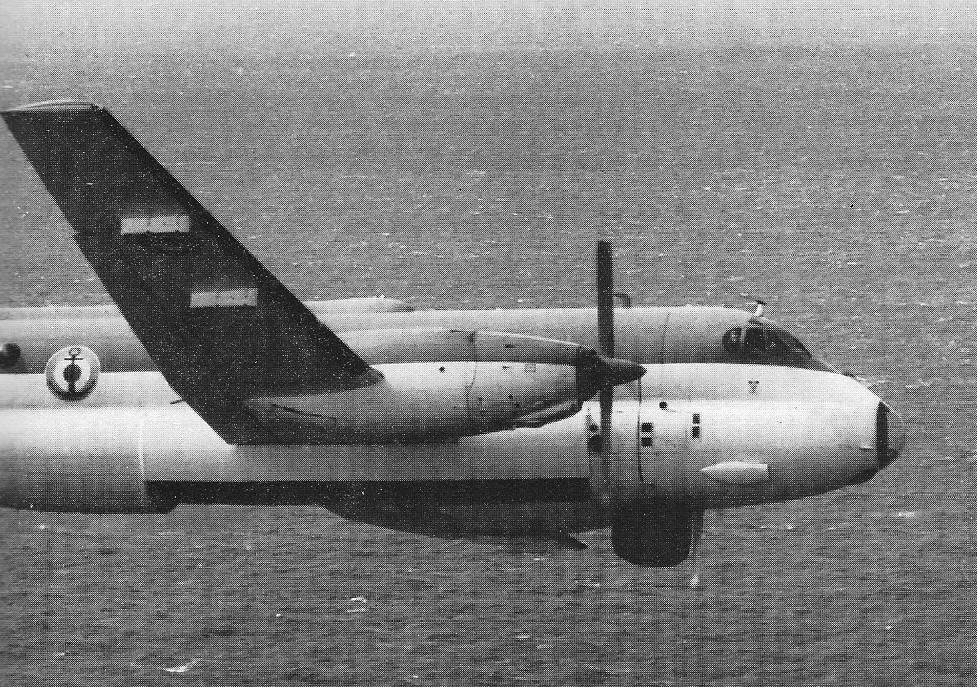
Initially a Breguet design known as the Br.960 “Vultur” and designed as a conventional strike aircraft, the Br.960 grew into the Br.965 as French Navy requirements changed. The resulting Br.965 later became the definitive anti-submarine warfare system designated as the Br.1050 Alize (Tradewind).
Breguet received a development contract in 1954 for a three seat ASW version. Power was provided by a 2,100 eshp Rolls Royce Dart turboprop, and the first Dart powered prototype flew on 6 October 1956 followed by five pre-production aircraft.
The Br.1050 is a most distinct-looking aircraft, particularly in the design of the nose assembly. A crew of three monitors the various systems aboard the craft and the wings are designed to be carrier-friendly and fold for storage.
Fuel is in four tanks in the inner wings and one fuselage tank, with a total capacity of 462 Imp.Gal. There was provision for a 105 Imp.Gal auxiliary tank.
The Alize carried three depth charges or a torpedo in the internal weapon bay, sonobuoys in the wheel housings, and more depth charges, rockets, or two AS.12 air to-surface missiles on under-fuselage/wing stations. The racks under the inner wings hold two depth charges of up to 385 lb each.
Orders for 75 production Alizes were placed by the French Navy and the first was officially delivered on 20 May 1959. Sixty-five were in service by May 1961. Two French Navy squadrons operated Alizes on board the carriers Foch and Clemenceau.
A further contract for Alizes was received subsequently from the Indian Navy and 12 were delivered, plus two ex-French aircraft.
Breguet Br 1050 Alizé Engine: Rolls Royce Dart R Da 21, 2100 shp, 1450kW Length: 45.505 ft / 13.87 m Height: 14.993 ft / 4.57 m Wingspan: 51 ft 2 in / 15.6 m Wing area: 36.0 sq.m / 387.50 sq ft Max take off weight: 18081.0 lb / 8200.0 kg Empty weight: 5700 kg / 12566 lb Max. speed: 243 kts / 450 km/h Cruise speed: 370 km/h / 230 mph Service ceiling: 20505 ft / 6250 m Range: 1550 nm / 2870 km Maximum Range: 1,785miles (2,872km) Crew: 3 Armament: 1 x Tordedo or 3 x Depth Charges (held in an internal bay) 2 x Depth Charges (externally held) 6 x RP or 2 x air-to-surface missiles (underwing) Hardpoints: 8
Br 1050-ASM Engine: Rolls-Royce Dart R.Da.7 Wingspan: 51 ft 2 in Wing area: 387.5 sq.ft Length: 40 ft 4.25 in Loaded weight: 18.078 lb Max speed: 276 mph Endurance: 4 hr
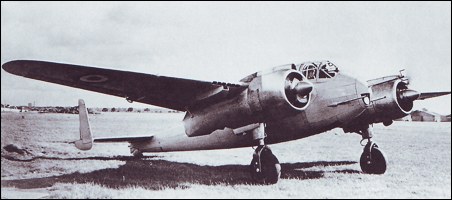
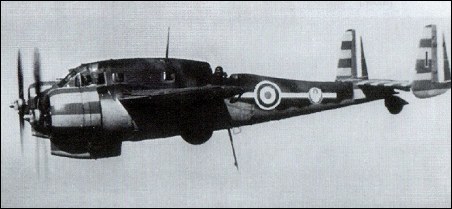
In 1934 the French Air Force issued a requirement for a twin-engined three-seat heavy fighter. Several manufacturers submitted proposals, and the contest was won by the Potez 630. The Breguet proposal had been heavier and more powerful than the other submissions, its designers believing it to be a more versatile, multi-role aeroplane. Design of the Breguet 690 was started in 1935 and a prototype was completed in 1937, first flying on 23 March 1938 with two 507-kW (680-hp) Hispano-Suiza 14AB-02/03 engines. The aircraft was found to have a performance superior to that of the Potez 630, and Breguet received a contract to supply 100 aircraft, configured as two-seat light attack bombers as the Bre.691, first flying in March 1939 with 522-kW (700-hp) 14AB-10/11s.
The Breguet 691 was a cantilever mid-wing monoplane of all-metal construction, with two wing-mounted engines and a short fuselage nose. Aft of the wing the fuselage tapered to a tailplane with twin endplate fins and rudders. Conversion from Bre.690 to Bre.691 was deletion of the navigator’s position to provide a small bomb bay. Experience with the Bre.691 proved the Hispano-Suiza powerplants to be unreliable, and the Bre.693.01 was introduced with two Gnome-Rhone 14M-6/7 engines after only 78 Bre.691s had been built. Two hundred and thirty four examples of the Bre.693 were built, later examples having two extra 7.5mm machine-guns, one installed in the tail of each engine nacelle, to improve self-defence. The Breguet 693 proved extremely vulnerable and almost half were lost to enemy action. Foreign interest in the Bre.690 series was cut short by the German invasion of France and the single Bre.694.01 built, intended as a three-seat reconnaissance aircraft, was delivered directly to the Aeronavale. The Bre.694 was generally similar to the original Bre.690 with no bomb bay and a navigator’s compartment, but with Gnome-Rhone 14M-4/5 engines. The Bre.695 was virtually identical to the Bre.693 but with Pratt & Whitney SB4G Twin Wasp Junior engines. Fifty Bre.695s were built, being delivered to Groupe 18 in June 1940.
Breguet 695
The Bre.696 and 697 were built only as prototypes and were respectively a two-seat light bomber and a two-seat heavy destroyer.
Bre.690 two 507-kW (680-hp) Hispano-Suiza 14AB-02/03 engines
Bre.691 Hispano-Suiza 14AB-10/11, 522-kW (700-hp)
Bre.693.01 two Gnome-Rhone 14M-6/7 engines
Bre.693 Engines: 2 x Gnome-Rhone 14M-6/7, 522kW (700 hp). Span: 15.37m (50ft 5in). Length: 9.67m (31ft 8.75in). Max T/O weight: 4900 kg (10,803 lb). Max speed: 304 mph at 16,405 ft. Operational range: 839 miles. Armament: 1 x 20-mm Hispano¬Suiza cannon and 4 or 6 7.5-mm (0.295-in) Darne mg, up to 400kg (882 lb) of bombs
Bre.693 AB2 Engines: 2 x Gnome-Rhone 14M-6/7, 522kW (700 hp). Take-off weight: 4892 kg / 10785 lb Empty weight: 3006 kg / 6627 lb Wingspan: 15.4 m / 50 ft 6 in Length: 9.7 m / 31 ft 10 in Height: 3.2 m / 10 ft 6 in Wing area: 29.2 sq.m / 314.31 sq ft Max. Speed: 490 km/h / 304 mph Ceiling: 9500 m / 31150 ft Range: 1350 km / 839 miles Crew: 2 Armament: 1 x 20mm cannon, 3 x 7.5mm machine guns, 400kg bombs
Bre.694.01
Bre.694 Gnome-Rhone 14M-4/5 engines.
Bre.695 Pratt & Whitney SB4G Twin Wasp Junior engines.
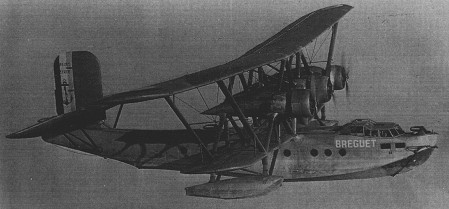
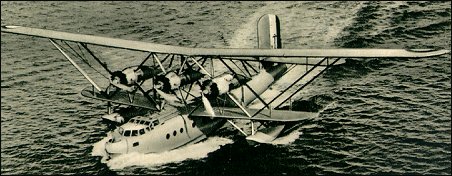
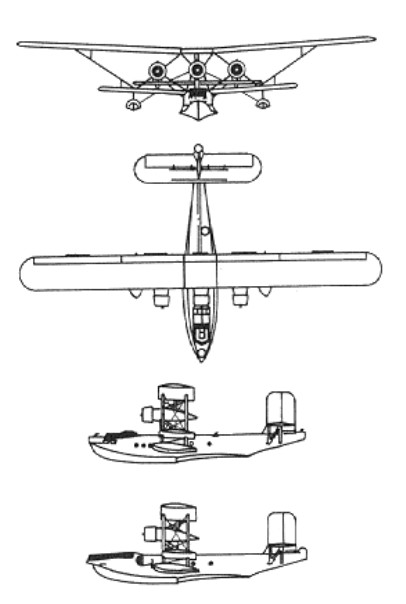
In 1931 Breguet secured a licence to build the Short Calcutta, and this was used as the basis for the company’s Bre.521 submission to meet a 1932 French Navy requirement for a long-range reconnaissance flying-boat. The Bre.521 was of all-metal construction with stabilising floats strut-mounted under the lower wings, a strut-braced empennage and three tractor engines located between the biplane wings. The Bre.521.01 prototype flew on 11 September 1933 with 630-kW (845-hp) Gnome-Rhóne l4Kdrs radials, and was followed by three pre¬production boats. The second of these introduced refinements intended for the production variant, includng an improved cockpit enclosure and more potent defensive armament. Armament comprised five 7.5mm Darne machine-guns: one in the cupolas each side at the rear of the cabin, one under each of two sliding hatches (with retractable windscreens) staggered to port and starboard amidships, and one in the extreme tail cockpit aft of the tail unit. Thirty were built up to 1940, powered by three 671kW Gnome-Rhone 14 Kirs radial engines. These served with “Exploration” escadrilles of the French Aeronavale from 1935 until the end of World War II, latterly being used as maritime reconnaissance and anti-submarine aircraft. Of these, nine were captured by the Germans and were used during 1943-45 for air-sea rescue.
One ‘boat became the sole Bre.522 when re-engined with 746-kW (1,000-hp Hispano-Suiza l4Aa radial engines.
In 1935 a civilian version – the Breguet Br.530 Saigon – was produced.
Bre.521 Bizerte Engines: 3 x Gnome-Rhône l4Kirs or 14N-11, 671 kW (900 hp). Wingspan: 35.1-18.9 m / 115 ft 2 in-62 ft 0 in Wing area: 169.8 sq.m / 1827.71 sq ft Length: 20.5m (67 ft 3in). Height: 7.5 m / 24 ft 7 in Max T/O weight: 16600 kg (36,597 lb). Empty weight: 8855 kg / 19522 lb Max speed: 243 km/h / 152 mph at 3,280ft. Cruise speed: 200 km/h / 124 mph Ceiling: 6600 m / 21650 ft Range w/max.fuel: 3000 km / 1864 miles Range w/max.payload: 2000 km / 1243 miles Seats: 8 Crew: 5 Armament: 5 x 7.5-mm (0.295-in) Darne mg plus up to 300 kg (661 lb) of bombs.
Bre.522 Engines: 3 x Hispano-Suiza 14Aa, 1000 hp, (746 kW). Span: 35.15m / 115ft 4in. Length: 20.5m / 67 ft 3in. Armament: 5 x 7.5-mm (0.295-in) Darne mg.
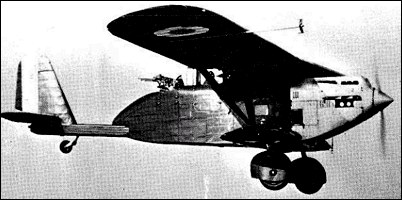
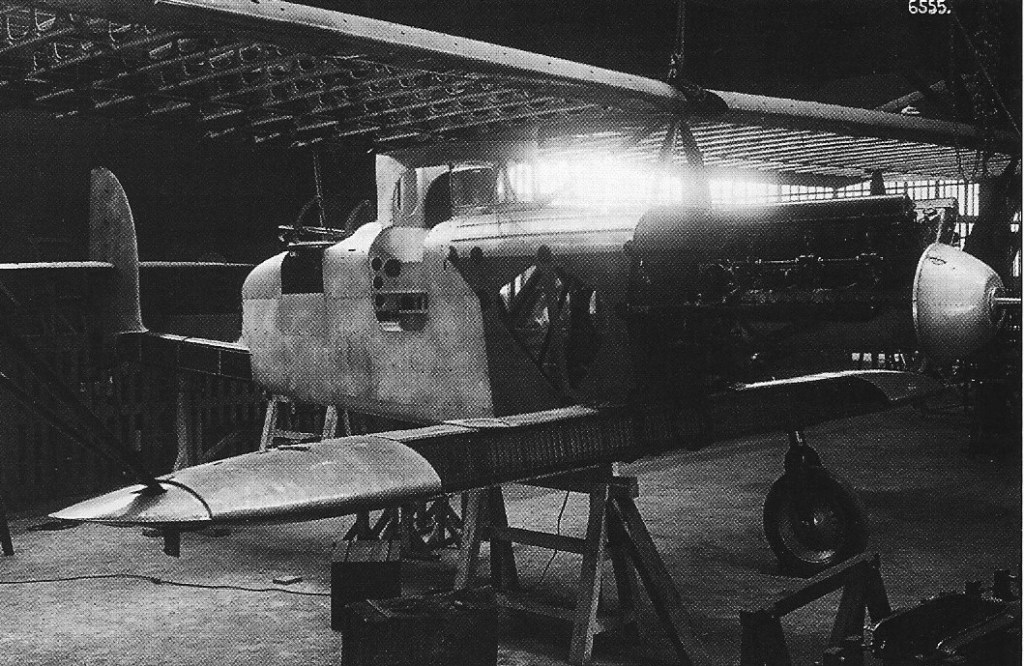
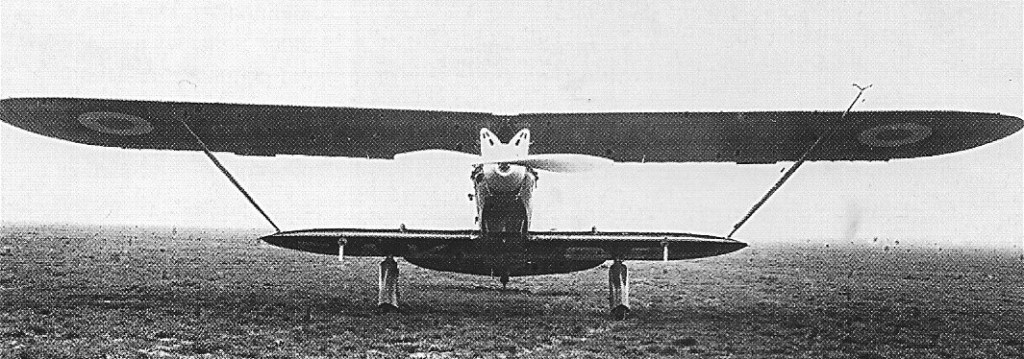
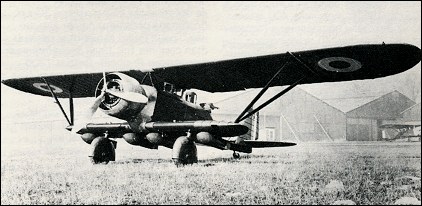
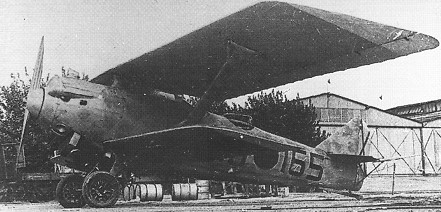
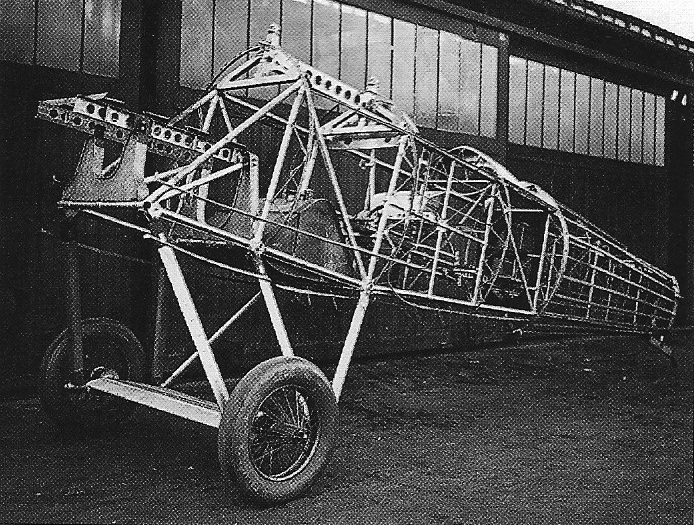
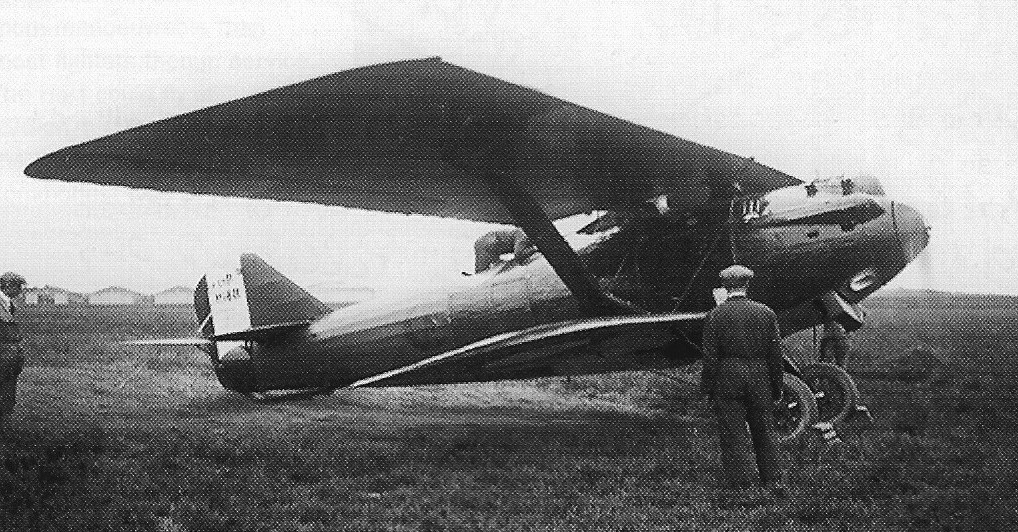
Built to an official requirement of 1928 for a two-seat observation aircraft, the Breguet 270 was designed by a distinguished team led by Marcel Vuillerme and including Rene Dorand, Rene Leduc and Paul Deville. The prototype Bre.270.01 made its maiden flight on 23 February 1929 with Bucquet, chief Breguet test pilot, at the controls. A two-seat all-metal sesquiplane, it introduced a number of interesting design features. High-tensile steel replaced aluminium alloys, and the short fuselage, engine, lower wing and tail boom were all attached to a steel chassis, resulting in a very tough aircraft. Following early tests, the prototype was returned to the company’s Velizy-Villacoublay workshops where the tail unit was redesigned with a more angular fin/rudder assembly and lower-set horizontal tail-plane. Nine further prototypes under the Bre.270/271 designations were completed, two of them being displayed at the 1930 Paris Salon de I’Aeronautique. Despite a rather poor overall performance, orders for a total of 85 Breguet 270s were received during 1930, all for the French Armee de I’Air. In 1932, an order was placed for 45 examples of the Breguet 271, powered by an engine delivering 112kW more than the original Hispano-Suiza 12Hb, and capable of lifting an increased useful load. Several Bre.270s were subsequently modified for VIP liaison duties, with a ‘glasshouse’ covering both cockpits. In 1932 the original prototype registered F-AJRC and fitted with a supplementary ventral fuel tank, made a longdistance flight across Africa to Madagascar. Besides small batches of Bre.270s bought by Brazil and Venezuela, 15 examples of the Breguet 273 reconnaissance-bomber development were exported to Venezuela and six to China. The Bre.273 prototype had flown in April 1934. Powered by a 641kW Hispano-Suiza 12Ybrs engine with a frontal radiator (all previous versions had ‘chin’ radiators), the Bre.273 had improved performance and bombload increased to 400kg.
Experimental versions of the basic design included the Bre.272 TOE fitted with a radial engine, initially a Gnome-Rhone 9K and finally a Renault 9Fas, and the Bre.274 with a 567kW Gnome-Rhone 14K. The latter, intended as a bomber, was subsequently operated by sporting Frenchwoman Maryse Hilsz, who flew it to victory in the 1936 Coupe Helene Boucher contest, averaging 277km/h. A series of experimental Breguet 41 twin-engined biplanes, which shared the same ‘chassis’ and tailboom construction as the Breguet 270, met with initial success and secured an order for the Armee de I’Air, which intended them for the ‘multiplace de combat’ role, capable of fighting, bombing or reconnaissance. With the appearance of more promising rival designs, the order was cancelled before deliveries had commenced.
Bre.272 TOE
On 1 January 1936 Bre.270s and Bre.271s were still in service in the French observation escadrilles. At the outbreak of World War II a number of Groupes Aeriens d’Observation (manned largely by reserve pilots) had Bre.27s on charge. These included GAOs 509, 543 and 547. A number of Bre.27s were shot down while on reconnaissance patrols across the Rhine before being withdrawn from service at the end of 1939.
Breguet 270 Engine: 1 x Hispano-Suiza 12Hb inline piston engine, 373kW Take-Off Weight: 2393 kg / 5276 lb Loaded Weight: 1756 kg / 3871 lb Wingspan: 17.01 m / 55 ft 10 in Length: 9.76 m / 32 ft 0 in Height: 3.55 m / 11 ft 8 in Wing Area: 49.67 sq.m / 534.64 sq ft Max. Speed: 236 km/h / 147 mph Ceiling: 7900 m / 25900 ft Range: 1000 km / 621 miles Armament: 3 x 7.7mm machine-guns, 120kg of bombs
The first prototype Bre 19.01 was displayed at the Salon Aeronautique in 1921 while fitted with a 335.3kW Breguet-Bugatti engine. However, for the first flight in March 1922 (piloted by Marcel Vuillermet), a similarly rated Renault 12Kb was installed.
The Bre 19 was mostly of metal construction, with fabric covering only the unequal-span wings, aft fuselage and tailplane. Large-scale production of A2 (observation) and B2 (day bomber) versions, powered by Renault 12K or Lorraine 12 engines, was undertaken; ‘Amenagement 1926’ machines having increased fuel capacity.
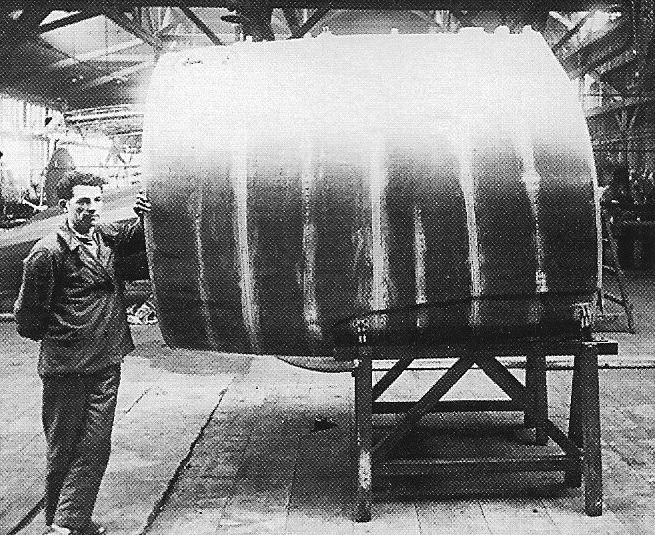
Breguet XIX main fuel tank
The aircraft featured a biplane design with I-type struts, the upper wing substantially wider than the lower section and the aircraft was armed with 3 (or 4) .303 machine guns. The landing gears were covered. It being a day-time bomber, it could carry a payload of over 1,500lbs of ordnance.
In 1923 the prototype won a Spanish international military aircraft contest and the 11 pre-production machines under construction in France were inspected by a Yugoslav delegation. Sales to both countries followed. More than 1,000 were built for French service, the type equipping many Groupes of the French Aeronautique Militaire from 1925; the last escadrilles did not relinquish their aircraft until 1935. Included in the total were a number of night fighter (Cn2) variants.
Spain imported 19 aircraft, and CASA then produced 26 aircraft from French components before building another 177 with Lorraine (127 with licence-built and the other 50 with imported engines). The type was widely used in action within Spain’s North African territories, and 135 were still on strength in 1936, the majority of them in Spain where each side had about 60 aircraft. The Nationalists bolstered their numbers with 20 ex-Polish machines to create five units (1-G-10 to 5-G-10), but after considerable ground-attack and coastal patrol service in 1937 the survivors were retired on both sides to training.
1923 Bre.19 for Poland
Foreign deliveries went to Poland (250), Yugoslavia (160, plus 190 built under licence at Kraljevo), Romania (108), China (74), Greece (30), Argentina (25), Turkey (20), Spain (19, plus 177 built under licence by CASA), Venezuela (12), Bolivia (15), Belgium (6, plus 146 built under licence by SABCA) and Brazil (5). One hundred and three Yugoslav Bre 19 were still in service in 1939, many powered by 313kW Gnome Rhone Jupiter radial engines.
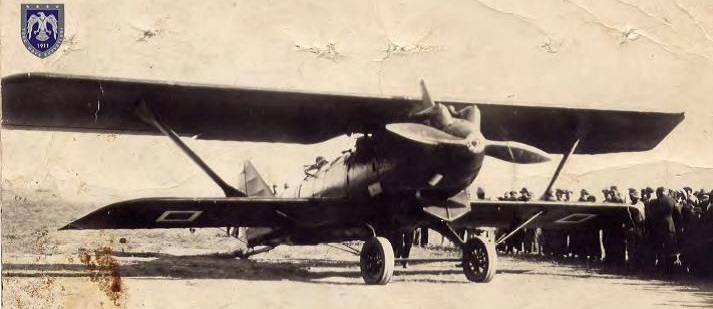
From 1926 twenty Bréguet XIX B-2 were licence built by Türk Hava Kurumu / THK, assembled in the halls of the Türk Tayyare Cemiyeti / TTaC.
THK- Bréguet XIX B2
Many record flights were made by Breguet 19 including one made by the ‘Grand Raid’ version named Nungesser-Coli, which was flown from Paris to San Francisco and Tokyo to Paris by Diudonne Costes and Joseph Le Brix, covering 57,000km in 350 hours flying time, powered by a 600 hp Hispano-Suiza.
Pilot Lt Pelletier d’Olsy during the Paris-Peking rally of 1926
Piloted by Lucien Girier and Dordilly the first non-stop air crossing of the South Atlantic, from St.Louis, Mauritania to Natal, Brazil, on 14 October 1927 (2356 miles in 27 hours).
Also, in September 1929 a Breguet 19 ‘Super Bidon’ named Point d’Interrogation was flown by Costes and Bellonte from Le Bourget to Manchuria to set up a new world distance record of 7,905km. A year later it was the first aircraft to fly non-stop from Paris to New York. It also flew Paris-Jask, Iran (3472 miles in 32 hours) piloted by Coatws and Jean Rignot.
After a total of 74,400 miles in 650 flight hours it was donated to a museum by the Breguet company.
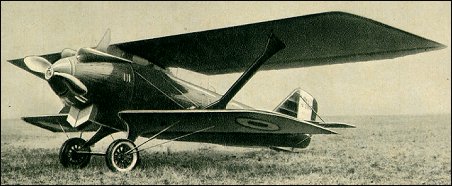
In 1928 the Breguet 19ter was developed into the improved Breguet 19.7, with a 484.3kW Hispano-Suiza 12Nb engine, new wings with semi-elliptical tips, redesigned vertical tail-plane and increased fuel tankage. Yugoslavia built 75 and a small batch built by Breguet went to Romania. Fifty similar aircraft were exported to Turkey in 1932 and were the last of the breed to be built by Breguet. Forty-eight Yugoslav-built Breguet 19.8 had Wright Cyclone 580kW radials with long chord cowlings, the last being completed in 1937. Yugoslav Breguets were used later by Croat forces, and two recaptured by Tito’s troops were flown during 1945.
2700 units of the Bréguet XIX were produced worldwide.
Engine: 1 x HS 12Nb, 480kW Take-off weight: 6700 kg / 14771 lb Empty weight: 2190 kg / 4828 lb Wingspan: 18.3-11.5 m / 60 ft 0 in-37 ft 9 in Length: 10.7 m / 35 ft 1 in Height: 4.1 m / 13 ft 5 in Wing area: 60.0 sq.m / 645.83 sq ft Max. speed: 245 km/h / 152 mph Ceiling: 6500 m / 21350 ft Range: 950 km / 590 miles Armament: 1 x 12.7mm machine-guns Crew: 2
Breguet Bre.19 Engine: 1 x Renault 12Kc water-cooled inline, 550hp. Length: 29.17ft (8.89m) Width: 48.56ft (14.80m) Empty Weight: 3,272lbs (1,484kg) Maximum Take-Off Weight: 5,093lbs (2,310kg) Maximum Speed: 149mph (239kmh; 129kts) Maximum Range: 497miles (800km) Service Ceiling: 25,591ft (7,800m; 4.8miles) Armament: 3 or 4 x .303in machine guns 1,543 lbs (700 kg) of external ordnance Accommodation: 2 Hardpoints: 2
Bre.19A2 Engine: l x Lorraine l2Ed, 336kW (450 hp). Wing span: 14.83m (48ft 7.75in). Length: 9.61m (31 ft 6.25in). Max T/O weight: 2500 kg (5,511 lb). Max speed: 133 mph at sea level. Operational range: 497 miles. Armament: 3 x 7.7-mm (0.303-in) mg plus light bombs.
Bréguet XIX B2 Engine: Lorraine 12Ed, 336kW (450 hp) Wingspan 14.83 m Wing area: 50 sq.m Length: 9,61 m Height: 3.69 m Empty weight: 1387 kg MTOW: 2500 kg Maximum speed: 214 km / h Range: 800 km Service ceiling: 7200 m





 All Aero