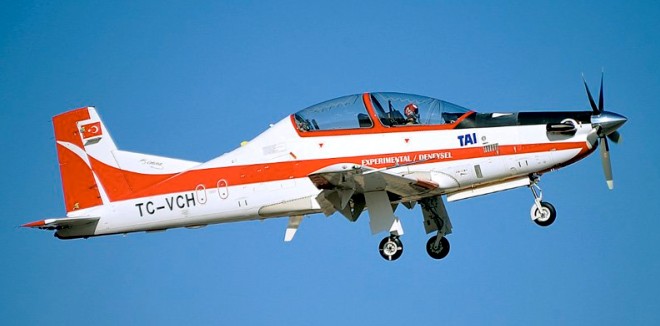
The TAI Hürkuş (Free Bird) is a tandem two-seat, low wing, single engine, turboprop aircraft developed by Turkish Aerospace Industries (TAI) as a new basic trainer and ground attack aircraft for the Turkish Armed Forces.
The aircraft is named after Vecihi Hürkuş, a Turkish aviation pioneer and the first Turkish airplane manufacturer.
The TAI Hürkuş Development Program started with an agreement signed between Turkish Undersecretariat for Defense Industries (Savunma Sanayii Müsteşarlığı (SSM)) and TAI in March 2006. Under the agreement the company was to design, manufacture and complete the civil certification the aircraft to European Aviation Safety Agency CS 23 standards.
HÜRKUŞ Within the framework of the program; two aircraft configurations were to be developed.
HÜRKUŞ-A: Basic version which is to be certified with EASA according to CS-23 requirements. HÜRKUŞ-B: Advanced version with integrated avionics (including HUD, MFDs, and Mission Computer).
By June 2012 the Hürkuş program had consumed one million man-hours with the work of 140 engineers. About a quarter of the Turkish engineers who have worked on Hürkuş are female, as well as two of the three project heads.
The Hürkuş was to be equipped for inverted, day and night flying as well as basic pilot training, instrument flying, navigation training, weapons and formation training. The aircraft has good visibility from both cockpits with a 50 degree down-view angle from the rear cockpit, cabin pressurization (nominal 4.16 psid), Martin-Baker Mk T-16 N 0/0 ejection seats, an on-board oxygen generation system (OBOGS), an Environmental Control System (Vapor Cycle Cooling), an anti-G system, high shock absorbing landing gear for training missions, and Hands On Throttle and Stick (HOTAS). Microtecnica of Turin, Italy was been selected to provide the aircraft’s environmental control system. The Hürkuş has been designed for a 35-year service life with a TAI designed wing airfoil.
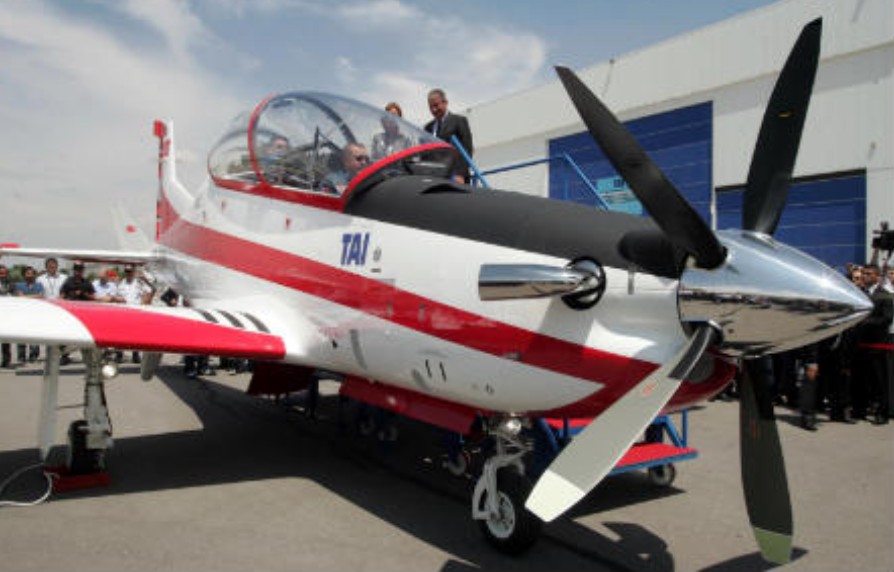
The Hürkuş development program has been subject to delays. In 2007 it was forecast that the first prototype would fly in late-2009 with first delivery, upon completion of the certification process, forecast for 2011. On 27 June 2012, the Hürkuş was officially rolled out at a ceremony held at TAI’s Kazan premises. The forecast date for the first flight was then delayed until later in 2012 and actually occurred on 29 August 2013 when the aircraft flew from the Ankara Akıncı Air Base on a 33-minute flight. The first flight was performed with landing gear down and to a height of 9500 ft.
Stability and control checks in different flight configurations have been conducted in the following flight tests. Landing gear up-down tests, cockpit pressurized tests and system functions pre-checks have been performed. The aircraft has reached 12.500 ft height and 158 knots speed currently.
At an SSIK’s meeting, held on Sept. 26, 2013, in order to meet the 15 new-generation trainer aircraft requirement of TurAF, contract negotiations regarding the serial production of HÜRKUŞ was started with TAI. The negotiations regarding HÜRKUŞ-B contract was on the signing.
Two prototypes were built. Entering service in 2015, 15 were built.
Hürkuş Engine: 1 × Pratt & Whitney Canada PT6A-68T turboprop, 1,200 kW (1,600 shp) Propellers: 5-bladed Hartzell Propeller HC-B5MA-3 Wingspan: 9.96 m (32 ft 8 in) Length: 11.17 m (36 ft 8 in) Height: 3.70 m (12 ft 2 in) Maximum speed: 574 km/h (357 mph; 310 kn) Cruising speed: 463 km/h (288 mph; 250 kn) Stall speed: 143 km/h (89 mph; 77 kn) Range: 1,478 km (918 mi; 798 nmi) at 15000 ft (4572 m) Endurance: 4.25 hours at 15000 ft (4572 m) Service ceiling: 10,577 m (34,701 ft) Rate of climb: 22 m/s (4,300 ft/min) Total Take-Off Distance (@ sea level): 1605 ft (489 m) Total Landing Distance (@ sea level): 1945 ft (593 m) g limits: +7/-3.5 Hardpoints: 4 Seats: 2
On 28 November 1967 the Soviet government specified the requirements for a competition for a new strategic bomber. Technical parameters were high. The aircraft was to reach 11000 to 13000 km (5,970 to 7,020 nm) and have a cruising speed of 3200 to 3500 km/h. The maximum range at subsonic speed was to be 16000 to 18000 km (8,640 to 9,720 nm) at high altitude. Basic armament was to be nuclear missiles, including heavy Kh-45 and small Kh-2000s.
Tupolev, which was formally called Moscow Engineering Plant ‘Opyt’ (meaning Test), joined Sukhoi and Myasishchev in the quest for a supersonic strategic bomber. Unlike the others, Tupolev started designing by not aiming at the specifications given by the government. Tupolev thought a Mach 3.0 to 3.2 bomber, compared with a Mach 2.3, did not off-set the cost of construction and technology. In the early 1970s Tupolev prepared a series of flying-wing designs designated 160M, which were based on the contemporary delta-winged Tu-144 supersonic airliner.
In 1972 the air forces selected Sukhoi as the winner, however it was realised a design with these specifications was not possible. So it was decided to start a second stage of the competition. The maximum speed was lowered to Mach 2.3 enabling Tupolev’s 160M flying-wing design to enter the competition. Myasishchev came with the M-18, based on the M-20 design which had a variable-geometry wing. Sukhoi gave up the competition and decided to concentrate on fighter aircraft.
The air force selected the M-18, because of its variable-geometry wing design and the design was supported by TsAGI (large and powerful Soviet technical research institute) and the Technological-Scientific Council of the Ministry of Air Industry. Tupolev’s flying-wing design was a single-mode aircraft and the air force required bomber following a compound flight profile and be able to also land at ‘smaller’ airfield.
Myasishchev’s winning design was developed by the Tupolev bureau, because the former’s team was too small. In 1973 the first design for the Tu-160 was prepared by Tupolev based on the M-18 variable-geometry design. The design was gradually improved and Tupolev began selecting the aircraft systems, together with the scientific and government research institutes. The NK-25 engine of the Tu-22M3 were selected at first, but the high fuel consume rate required a new development. In 1980 the first Nk-32 was test flown on a Tu-142 and production began in 1983.
Aleksei Tupolev (son of Andrei Tupolev, founder of the design bureau) lead the Tu-160 design program during the initial period, in 1975 Valentin Bliznyuk was appointed as chief designer and remained in charge of the program. In 1977 the preliminary design and a full scale mock up were submitted for state committee acceptance. At this stage the aircraft would carry two Kh-45 missiles. During the Strategic Arms Limitation Treaty II (SALT II) talks in the late 1970s, the plans for a new strategic bomber and the name Tu-160 were first revealed to the west.
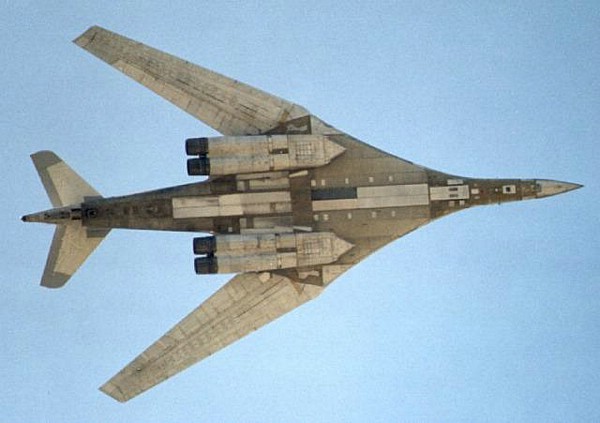
The aircraft has a slender long blended wing-body design with a variable-geometry wing. The four NK-32 afterburning turbofans are arranged in pairs under the mid-wing each with variable-area intakes. The undercarriage consists of one front double-wheel leg and two six-wheel bogies (three tandem pairs), which are located between the engine pairs. Along the aircraft’s centreline between the two gear units there are two weapon bays, which are divided by the wing carry-through structure.
The nose of the aircraft contains the Obzor-K (Survey) radar, which is used for both ground and air observation. It also contains another radar, the Sopka (Hill), which is used for terrain following when flying at low altitude. The upper center part in front of the windscreen contains the retractable inflight refuelling probe. Under the front fuselage there is a forward looking OPB-15T optical bombing sight and video. Behind the sight, there is the nose gear. The four man crew enters the cabin through the front gear bay. The pressurized cabin has four fighterjet-like K-36LM ejection seats. There are two control sticks for commander pilot (front left) and co-pilot (front right). The Tu-160 has a conventional flight deck, which is divided by a central console with the thrust and flap selection levers for the co-pilot. Behind the pilots there is the navigator/offensive weapons operator (left) and the navigator/electronic warfare and communications operator (right). Behind the crew there is corridor leading to a galley and a toilet.
The weapons carried in the weapon bays comprises of six (or a maximum of 12) Raduga Kh-55SM (NATO AS-15B ‘Kent’) cruise missiles, which are launched from two six-round MKU6-5U revolving launchers located in the forward area of each bay. The nuclear warhead loaded Kh-55SM is a development of the subsonic Kh-55 cruise missile. For guidance of the Kh-55SM the Tu-160 is equipped with the Sprut-SM (Octopus) navigation/attack system, which automatically aligns the coordination axes of both aircraft and weapons. It also generates a digital map of the terrain which is transferred from the aircraft to the missile before launch. Alternatively the Tu-160 can be equipped with up to 24 Raduga Kh-15 (NATO AS-16 ‘Kickback’) short-range attack missiles (SRAM) or Kh-15P anti radiation missiles, which are both launched from up to four MKU6-1U revolving drums. However reportedly the Kh-15 capability has not been implemented on any production aircraft.
The variable-geometry wing has three positions. 20 degree sweep for landing, 35 degree for cruise and 65 degree sweep for high speed flight. The inner portion of the wing forms a vertical plane for directional stability when the wings are fully swept backwards. When the wing is swept forwards this portion lies flat to fill the gap between wing and fuselage and forms the most inner part of the flap.
The Tu-160 houses a Baykal self-defence systems of which most systems are located in the ‘carrot’ tail cone. These systems include a Mak (Poppy) infra-red missile launch sensor, radar warning receiver, electronic jammer and a battery of APP-50 chaff/flare dispensers. The underside of the tailcone houses the brake chutes. Directional control is provided by an all moving fin.
When the Soviets learned about the American AGM-86 ALCM-B cruise missile, the requirement of the Kh-45 as main armament for the Tu-160 was dropped and a strategic (nuclear) version of the Kh-55 cruise missile was developed. The Tu-160 armament would now consist of 12 Kh-55SM missiles, with 12 to 24 Kh-15 being the alternative. Although there was enough time to design the weapon bays after the plans for Kh-45 were dropped, the Tu-160 design held its long weapon bays. The Kh-55SM and Kh-15 are much shorter, and can be launched with only the forward longer doors openened (each weapon bay has four doors). Initially a traditional self-defence system was proposed for the Tu-160, including a tail turret with a 30mm GSg-6-30 cannon. However the designer replaced the plans later during developed with the Baykal system. Also the plans for R-77 medium-range air-to-air missiles were abondoned.
The program was accepted in 1977 and Tupolev began production of three prototypes. Although the aircraft were assembled at Tupolev’s workshop at Moscow, the sub-assemblies were built at other production plants.
The first prototype 70-01 intended for flight testing the basic flight characteristics had incomplete equipment. Prototype 70-02 was built for static tests. Prototype 70-03 was practically an equivalent of series production aircraft. 70-01 was completed at Zhukovskity in January 1981. On 14 November, the aircraft taxied the airstrip for the first time, after months of testing. On 25 November 1981 a picture was taken of the aircraft near two Tu-144 by a US reconnaissance satellite, this was the first picture of the Tu-160 revealed to the world, at that time designated ‘RamP’.
On Friday 18 December 1981 Tu-160 70-01 made its maiden flight. Three months later the first supersonic flight was achieved. And during one of the test flight the top speed of 2200 km/h was reached. The 70-01 can be distinguished from the other Tu-160 by having a long probe at the nose tip. Internally there are greater differences in equipment and structural elements. Work on new materials and engineering methods, lead to postponement of the 70-03 prototype, which did not take off until 6 October 1984.
Although there are some differences between the first prototype, the development and the production aircraft, only one variant of the Tu-160 entered production. NATO codename for this variant is ‘Blackjack-A’.
Series production was started at Ulyanovsk production plant, but was soon replaced to KAPO (Kazan Aviation Production Association) in favor of the An-124 production. The first series Tu-160 took off from Kazan on 10 October 1984. The first aircraft to enter service took off from Kazan on 15 August 1986.
On 23 April 1987 this aircraft as well as a second example were delivered to the 184th Heavy Bomber Regiment of Guards, based at Pryluky airfield in the Ukaine. The squadron had previously been operating the Tu-16 Badger, so it obtained a small number of Tu-22M3 ‘Backfire-C’ to train the crew on high supersonic bombers, with a variable-geometry wing. Later the Tu-134UBL dedicated trainer for the Tu-160 replaced the Tu-22Ms. At the end of 1991, the 184th regiment had two squadron and a total of 19 Tu-160 were delivered.
The first time the Tu-160 was shown to the public was on 20 August 1989 flying over Tushino airfield in Moscow. The first ground presentation was in August 1992 at MosAeroshow held at Zhukovskiy. It made its international debut at the Paris Airshow in June 1995, were it was presented as space carrier for the Burlak space vehicle with a mock up of the Burlak under its belly.
After the break up of the Soviet Union the Ukrainian parliament took all military units based in its country under control. At first this had no effect on the 184th bomber regiments. But in 1992 25% of the pilots and personnel swore oath to the Ukraine. At Engels airbase in Russia, the first Russian Tu-160 regiment was formed. Russia had just three Tu-160 remaining at the Kazan factory. On 16 February the first arrived at Engels AB, but because of lack of pilots it was not until 29 July 1992 when the first Tu-160 took off from Engels. The production at Kazan continued for a short while until the air force ran out of money and in June 1994 the sixth and last Tu-160 left the factory for Engels. Four unfinished airframes remained at Kazan.
The Ukrainian 19 Tu-160 from the 184th regiment were flown only a small number of sorties, before they were grounded because of lack of technical support from Tupolev and manufacturer, lack of spares and lack of fuel. Also the Ukraine did not have areas suitable for training with strategic missiles. The Ukraine could not sustain the aircraft and had no need for them, so they started negotiations with Russia in 1991. When in 1998 no agreement was reached, Ukraine decided to scrap the aircraft. The first Tu-160 was cut up in November 1998.
In April 1999, Russia proposed buying back eight Tu-160 and three Tu-95MS ‘Bears’ which were in the best technical condition, as well as 575 Kh-55 and Kh-55SM missiles, documentation and ground equipment. On 6 October 1999 an agreement was signed and a total of US$285 million was deducted from the Ukraine’s outstanding payments to Russia for the supply of natural gas. On 5 November the first two bombers, a Tu-160 and a Tu-95MS, landed at Engels AB. The last two Tu-160 ‘Blackjacks’ arrived at Engels on 21 February 2000. All the aircraft were overhauled at the Kazan factory during 2001. On 5 May 2000, another aircraft that was nearly finished aircraft was commissioned into service at Engels as ’07’.
The 182nd Heavy Bomber Regiment of Guards operated 15 Tu-160 ‘Blackjacks’ after all eight Ukrainian Tu-160 were returned into service. In September 2003 one Tu-160 bomber was lost in a fatal crash. Reportedly production restarted work on another one of the unfinished Tu-160 airframes at Kazan to replace the lost bomber. This is the second Tu-160 bomber to be lost in a crash, in 1987 the first Tu-160 (a series production test aircraft) crashed due to an engine problem.
The total number of Tu-160 Blackjacks built was 35 at the end of 2000, comprising of 3 prototypes built in Moscow and 32 series aircraft built in Kazan. Three unfinished aircraft remain at the Kazan factory today. Of the 11 Tu-160 airframes that remained in the Ukraine 1 serves as a gate monument, while the remaining 10 were cut up. The last Ukrainian Tu-160 was cut up in 2001.
The Russian Air Force was planning a limited upgrade for their Tu-160 fleet. First stage of the upgrade was to equip the aircraft with the conventional armed Kh-101 and Kh-555 cruise missiles and a new fire control system for these missiles, called Sigma. The Kh-101 uses a electro-optical terminal homing system and the Tu-160 will be able to carry up to 12 of these missiles. The Kh-555 is a reworked Kh-55SM with uses the Kh-101 homing system and replaces the nuclear warhead with a conventional one. Second stage of the upgrade was to include upgraded mission equipment and a new search-attack radar. Besides the Kh-101, this will enable the Tu-160 to be equipped with the Kh-102 strategic missile, medium range subsonic Kh-SD and a medium range supersonic weapon, presumable designated the Kh-41. Other upgraded system include navigation, communication and self-defence systems. The upgrade was to be carried out by KAPO at Kazan and would extend the service life of the Tu-160 until at least 2020-2025.
In the mid-1960s, the Soviet Navy developed a requirement for a long-range anti-submarine and maritime patrol aircraft to supplement the IL-38 medium-range aircraft. With the Tu-95 and Tu-114 in operation, Tupolev was asked to prepare proposals.
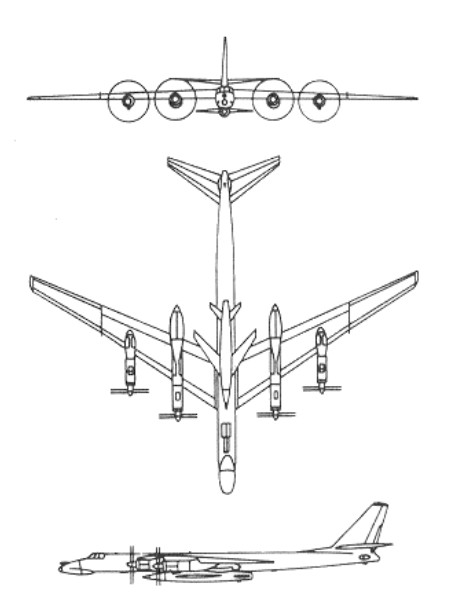
Nikolai Bazenkov was appointed chief designer for the project, which was given the number 142. He took the basic Tu-95 design but omitted all the strategic equipment. The wing was redesigned with increased span, up from 50.05m to 51.10m, which allowed more fuel to be carried, and with increased camber. Much of the defensive weaponry was also removed. Then he added the electronic equipment needed for its new role.
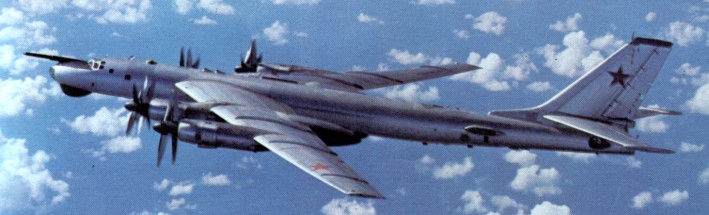
Featuring lengthened forward fuselage and Mod II (Tu-142M) and successive Bear-F variants having redesigned nose with revised cockpit. Bear-J is SovNavAir VLF communications version. SovAir strike version (with fuselage lengthening omitted) is Bear-H. All are powered by four NK-12MV turboprops, 14,795 ehp.
The crew in all versions is accommo¬dated in nose and rear fuselage press¬urized cabins, as well as the pressu-rized but isolated rear turret, fitted to most versions. Most operational variants have an inflight refuelling probe on the nose, but even on internal fuel it is possible to fly missions lasting 26 hours.
The prototype Tu-142 made its first flight from Zhukovski in July 1968. After flight tests by the designers and the NIl VVS, the aircraft was put into production at Kuibyshev and later at Taganrog. It entered service with Naval Long Distance Aviation in 1972; it was then the world’s largest anti-submarine aircraft. It served as Bear-F alongside the smaller IL-38 but its long-range capability made it able to launch an attack on a submarine 5,000km from the aircraft’s base. With improvements in electronics, work began in 1973 on an improved version, the Tu-142M, and its first flight was made on 4 November 1975.
The -142M was fitted with electronic equipment capable of early detection of low-noise submarines, a new and more accurate INS navigation system and automated radio communications. Its surveillance system worked on a 360 degree arc, and was more capable than that of the IL-38 at detecting magnetic abnormalities. Data was transferred immediately by satellite link back to base. With a capability to patrol for seventeen hours, the aircraft was provided with bunks for crew rest. Its internal fuel load was seventy tonnes, and it was equipped for in-flight refuelling which could extend the patrol duration beyond the seventeen hours when needed.
The VMS based its Tu-142s, which were given the NATO codename ‘Bear F’, in the Northern and Pacific regions; some were also based in Cuba and Vietnam until 1990, when political developments prompted their return to Russia.
Production was running at ten a year until 1983, when output was split between Bear F and Bear H, with five of each being produced. Bear F was identified in 1973, and later aircraft have a MAD sensor at the top of the fin.
A new version of the long-range four-turboprop Bear, carrying the subsonic 3,000km range AS-is Kent cruise missile, entered service late in 1984, according to the Pentagon. The new Bear H carries at least four AS-b5s, two under each inboard wing section, and may carry more internally. According to US estimates, some 40 Bear Hs were in service by 1986.
Production continued at Taganrog until 1988 suspended by President Yeltsin as a unilateral arms limitation measure, with one aircraft per month being completed. Total production run at both factories was 225 aircraft, including eight delivered to the Indian Navy starting in the mid- 1980s and continuing until 1988.
The standard armament of the Tu-142 was two GSh-23 cannons mounted in the tail for defensive use. It could carry up to eight Kh-35 anti-shipping cruise missiles (NATO code AS-17) mounted on pylons under the wing, and internally, 450mm calibre anti-submarine torpedoes and/or 533mm calibre anti-shipping torpedoes. Depth charges could also be dropped. With a combat load of 11,340kg, its maximum range was 12,550km. Normal take-off weight was 170 tonnes, but 188 was possible with little difficulty.
Tu-142M3 Engines: 4 x NK-12MP, 15000hp Max take-off weight: 188000 kg / 414471 lb Empty weight: 80000 kg / 176371 lb Fuel capacity: 73,000 lt Wingspan: 51.10 m / 168 ft 8 in Length: 49.50 m / 162 ft 5 in Height: 12.12 m / 40 ft 9 in Wing area: 295 sq.m / 3175.35 sq ft Max. speed: 925 km/h / 575 mph Ceiling: 13500 m / 44300 ft Range: 12550 km / 7798 miles Endurance: 25 hr Crew: 10
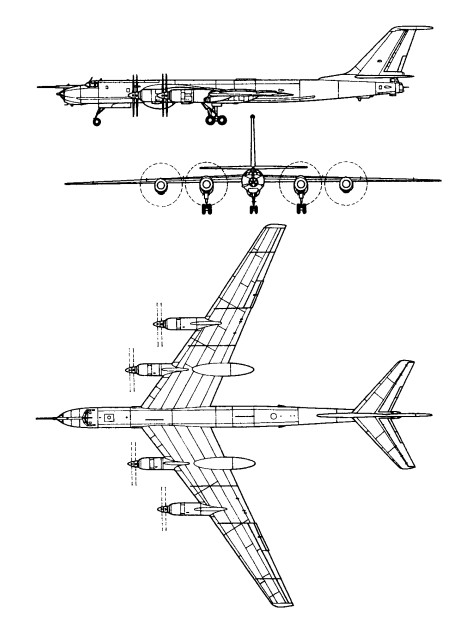
NATO code name ‘Moss’, about 10 surviving Tu-114s were retired and converted to Tu-126 ‘Moss’ configuration as airborne early warning platforms with a rotating radome pylon-mounted over the rear fuselage for the Soviet air force. The aircraft also has an inflight-refuelling probe and a number of blisters and fairings covering operational equipment. The former passenger cabin provides ample space for extensive communications, radar and signal processing equipment, and consoles for specialist operators.
First deployed in the mid-1960s, the Tu-126 carries a crew of 12. It is powered by four NK-I2MV turboprop engines and has a range of 7,700 miles at a cruise speed of 380-485 mph. The endurance at cruising speed for a 1,250-mile radius is six hours, which with flight refuelling can be extended to 17 hours.
Engines: 4 x NK-12MV, 15000hp Max take-off weight: 170000 kg / 374788 lb Wingspan: 51.20 m / 168 ft 0 in Length: 55.20 m / 181 ft 1 in Height: 16.05 m / 53 ft 8 in Wing area: 311.10 sq.m / 3348.65 sq ft Max. speed: 850 km/h / 528 mph Cruise speed: 650 km/h / 404 mph Ceiling: 13000 m / 42650 ft Range: 12550 km / 7798 miles Crew: 5 + 12 systems operators.
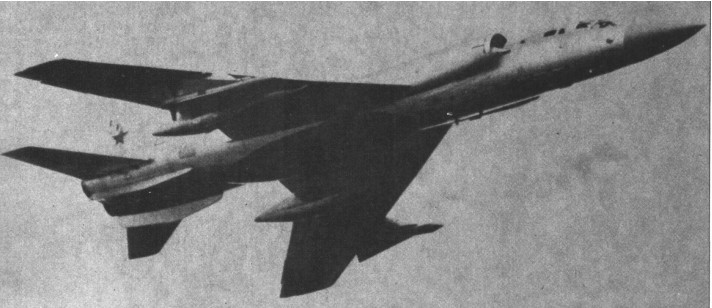
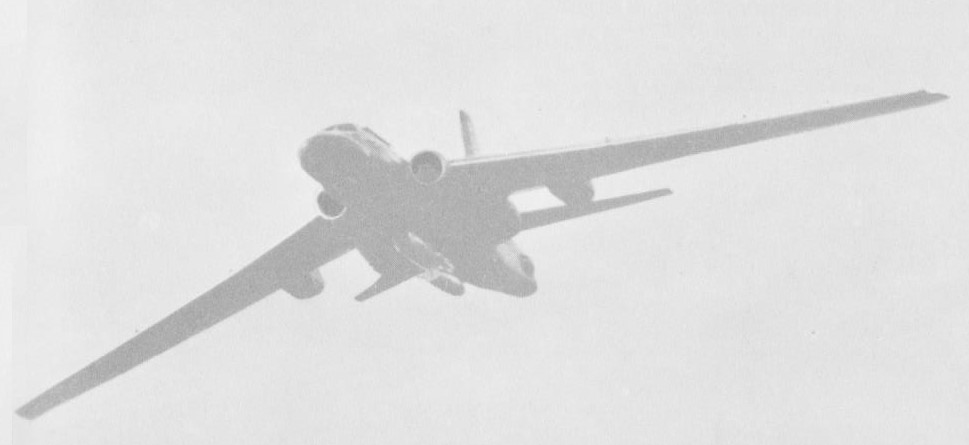
The Tu 28, which carries the design bureau designation Tu 102, was originally thought to be intended for strike and reconnaissance, and was described by the commentator at the 1967 Soviet Aviation Day as being a descendant of the Shturmovik, capable of engaging targets in the air or mobile targets on the battlefield. When revealed to Western eyes in 1961, the Tu 28 Fiddler A was fitted with a large ventral blister which was thought to contain, variously, a reconnaissance pack, an early warning radar, avionics, fuel or weapons. By the time of the 1967 display, however, this bulge had disappeared and the Tu 28P Fiddler B was revealed as carrying twice the armament, in the form of four AA 5 Ash air to air missiles.
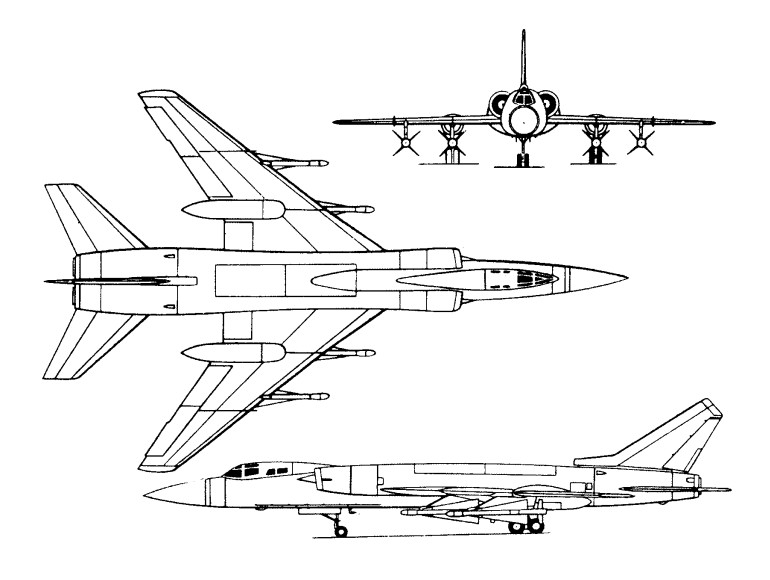
The Tu 28 was developed in competition with the Lavochkin La 250 Anaconda and made its maiden flight in 1957, a year after its rival. The La 250 was abandoned in 1958 after a series of accidents, and Fiddler entered service in 1962 63. The Tu 28’s lay¬out is similar to that of the Tu 98, although the bogie main gears retract into underwing fairings thus freeing space in the fuselage and a fire control radar replaces the glazed nose. The wing, mounted part way up the area ruled fuselage, is slightly tapered and has 56 degrees of leading edge sweepback at the wing centre section, reducing to 50 degrees on the outer panels. The all moving tailplane is mounted low on the fuselage, and the original Tu 28 was fitted with two ventral fins; these have been discarded on the Tu 28P.
Air is fed from two shoulder mounted intakes to a pair of afterburning turbojets side by side in the rear fuselage. The original powerplant was the Lyulka AL 7F, develop¬ing 6440 kg (14,198 lb) of dry thrust and 10 000 kg (22,046 lb) with afterburning.
The Tu-28P has a distinctive wing with sharply kinked trailing edge, the outer 45 degrees panels being outboard of large fairings extending behind the trailing edge accommodating the four-wheel bogie landing gears. The Tu 28P is understood to have been employed primarily on standing patrols around the periphery of the Soviet Union, beyond the belts of surface to air missiles (SAM) and in areas unprotected by SAM. Maximum frontline strength is thought not to have exceeded 150 Fiddlers, most of which were based in the Moscow military district. Others are reported to have been deployed in the Arctic alongside Tu 126 Moss early-¬warning and control aircraft. Normal endur¬ance of the Tu 28P is thought to be 3.5 hours, but this could be increased to 5.5 hours with the addition of auxiliary fuel tanks. The standard armament is four AA 5s, two with infrared seekers and the other pair with semi¬active radar guidance. Normal Soviet prac¬tice is to ripple fire the weapons, the radar ¬guided missile following its IR counterpart Two crew sit in tandem under upward-hinged canopies, and all armament is carried on wing pylons.
The largest and heaviest interceptor fighter ever to have achieved service status, the Tu-128 was developed by a team led by I. Nezval’. A dedicated interceptor fighter intended for the high-altitude patrol of sections of the Soviet periphery unprotected by surface-to-air missile screens, the Tu-128 was flown as a prototype (Tu-28-80) on 18 March 1961 powered by two TRD-31 (Lyulka AL-7) turbojets. Production deliveries to the Voyska PVO began in late 1966, the Tu-128 having a crew of two and paired AL-7F-2 turbojets each rated at 7425kg unaugmented and 10,000kg with afterburning. Equipped with a large I-band radar, the Tu-128 had a primary armament of two radar-homing and two infra-red homing Bisnovat R-4 missiles. Progressively withdrawn from the Voyska PVO home defence fighter force through the ‘eighties, the Tu-128 was finally succeeded by the MiG-31 in late 1990.
Tu-28 Type: long range all-weather interceptor Estimated span: 65 ft (20 m) Estimated length: 85ft (26m) Estimated Height: 23ft(7m) Estimated empty weight: 55,000 lb (25.000 kg) Estimated maximum loaded: 100.000 lb (45,000 kg) Estimated maximum speed (with missiles, at height): 1150 mph (M 1.75) Estimated initial climb 25,000 ftpm Estimated service ceiling: 60,000 ft (18.000 m) Range: about 1.800 miles Seats: 2.
Fiddler A Armament: 2 x AA-5 AAM Combat radius: 4989 km (3100 km)
Tu-28P Engine: 2 x Lyulka AL-21F turbojets, 11200kg Max take-off weight: 40000 kg / 88185 lb Loaded weight: 25960 kg / 57232 lb Wingspan: 18.1 m / 59 ft 5 in Length: 27.2 m / 89 ft 3 in Max. speed: 1850 km/h / 1150 mph Ceiling: 20000 m / 65600 ft Range: 5000 km / 3107 miles
The Tu-22 ‘Blinder’ was the first Soviet supersonic bomber design intended to replace the Tu-16. The Tu-22 original design was aimed at creating a bomber that could avoid contemporary fighter interceptors utilizing its high speed and altitude. The medium range Tu-22 would strike Anglo-American bomber bases and other NATO key targets including US Navy Carriers in Europe and Asia.
The Tupolev OKB-156 design bureau was already working on supersonic aircraft in 1950-1953. So on August 10 1954 official authorisation for a supersonic bomber was given by the government to Tupolev. By the end of 1955 a design was finished called Samolet 105 and selecting of the aircraft components began. In December 1957 the prototype of the Samolet 105 was completed and flight trials began with the first flight on 21 June 1958. A redesigned Samolet 105A prototype was built and would be powered by the new Kuznetsov NK-6 engines. However it was not ready in time, and the VD-7M engines were used instead.
The Tu-22 design feautres area ruling with a long, slender, tube-like fuselage with a sharp pointing nose and 52 degree swept-back wings with small LERXes. The aircraft was nicknamed ‘Shilo’ by its aircrew for its metallic, pointed shape. The two Dobrinin VD-7M engines are located in pods above the main body, one at either side of the tailplane. From 1965 onwards these were replaced by the improved Kolesov RD-7M2 engine. The layout improved the airflow into the engines, while minimizing the chance of debris sucked up from the ground. Downside of the design was the troublesome maintenance of the engines at this position, the required reinforcement of the tail section and the forward section had to be longered because the center of gravity was at the rear of the aircraft. The main landing gear is retracted into seperate trailing-edge nacelles extended beyond the wing.
In order to decrease the frontal cross section of the design, the Tu-22 only had one pilot. The navigator sits in front and below the pilot and can only see below the aircraft. The communications/navigation/weapons officer occupies the rear seat which is behind the pilot and only can see thru the side windows. The crew would enter and exit the cabins by being raised and lowered in their K-22 ejection seats. The seats would fire downwards, making ejection during take off and landing impossible.
The first flight of the 105A took place on 7 September 1959 and was subsequently lost on 21 December 1959 during the seventh test flight.
Before the loss the government authorised production at State Aviation Plant No.22 in Kazan and replaced the Tu-16 production line. The first three series produced Tu-22 bombers were finished in July-August 1960 and used for more flight trials at Zhukhovskii. The first flight of a production Tu-22 was on 22 September 1960. Onwards until 1965 multiple upgrades were carried out to fix problems with flight control systems. Tu-22s were built with a 23mm cannon in the tail, aimed by a gunner in the forward fuselage using a TV camera. Later this was replaced by an electronic countermeasures system.
Tu-22M-3
First production variant developed was the Tu-22A ‘Blinder-A’ which carried free-fall bombs. Because of the bomber role, the variant has often been referred to as Tu-22B. The payload depended on the mission, but could consist of 24 FAB-500 500kg (1,102 lb) bombs. The radar equipped was the surface-search Rubin-1A radar. However because of the trouble prone design and the increasing threat of Surface-to-Air Missiles only 15 Tu-22A were built. Most of which served only as test aircraft and trainer.
The aircraft was first revealed to the public on Aviation Day 1961 over Moscow. NATO originally codenamed it ‘Bullshot’, then ‘Beauty’ and finally ‘Blinder’. The air force ordered concurrent production of the Tu-22B bomber variant and a reconnaissance aircraft designated Tu-22R. Initial production batch was planned to be 12 and 30 respectively, but this was trimmed back to seven and five. The Tu-22 carried up to 450 litres of pure grain alcohol to service its hydraulic and de-icing systems. The ground crews, who predictably drank a lot of it, nicknamed the Tu-22 the ‘booze carrier’.
The Tu-22B bombers produced proved to be very trouble prone and were used primarily for training. Cockpir ergonomics were poor and the aircraft was very tiring to fly, even with autopilot. Even though the pilot’s seat was offset, the central windscreen frame blocked the view during crosswind landing. They were accepted into service in September 1962 with the 43rd Combat Training Center (43 TSBP i PLS). After one year they were transferred to the 203rd Heavy Bomber Aviation Regiment of the 46th Air Army.
The Tu-22R ‘Blinder-C’ was the second variant, which was developed as a reconnaissance platform. Film camera was equipped in the nose and in the weapons bay. It retained the free-fall bombs capability, including the bomb sight and weapons control system and search radar and was also equipped with the Romb electronic intelligence system. A total of 127 Blinder-C were built. The Tu-22R was operated by both the air force and the navy reconnaissance regiments. The suffix -D was added to all the aircraft that were equipped with the inflight refuelling probe on the nose of the aircraft. D standing for dalniy which means long range. A small number of Tu-22R were converted to Tu-22RK or Tu-22RDK featuring the Kub electronic intelligence system to detect air defence radars. Later a small number was converted to Tu-22RDM having advanced reconnaissance package, including the M-202 Shompol side-looking radar.
Tu-22 Blinder-C
The Tu-22R was also accepted into service in 1962 with the 260th Seperate Guards Long Range Reconnaissance Regiment (OGDRAP) of the 46th Air Army and the navu’s 15th Long Range Reconnaissance Regiment (DRAP) as part of the Baltic Fleet. In 1965 two additional regiments were raised, the 199th OGDRAP with the 46th Air Army and another navy DRAP attached to the Black Sea Fleet. The Tu-22R replaced the navy’s Ilyushin Il-28R aircraft. The navy’s Tu-22R fleet was in peak strength during 1969-1970 when it deployed 62 aircraft.
Following the Tu-22R was the Tu-22U ‘Blinder-D’ trainer. A trainer version was found neccessary because of the highly different handling characteristics compared to the earlier Tu-16. Simulators were very crude and gave only a rough indication of the handling. On the station that was formerly occupied by the weapons officer a raised cabin was constructed for the instructor. The trainer version lacked the tail gun and fuel capacity was decreased. A total of 46 Tu-22U ‘Blinder-D’ trainers were built.
The Tu-22K ‘Blinder-B’ was a missile carrier version of the Tu-22 and was the first real combat capable Blinder to be operational. Because of the introduction of ballistic missiles, the aim for the Blinder-B was maritime strike. It was armed with the K-22 weapon system and the associated Kh-22 supersonic stand-off anti-ship missile (NATO AS-4 ‘Kitchen’). The Tu-22K was fitted with a modified version of the Rubin-1A radar, the Leninets PN radar (NATO ‘Down Beat’).
The K-22 (Kompleks-22) weapon systems was fitted to the Tu-22K missiles carrier and the Kh-22 (AS-4 ‘Kitchen’) could be carried semi submerged in the bomb bay. Problems with the aircraft/missile combination, such as flight control, fuselage stress and fuel leaks occured because the aircraft was not designed to carry such a large missile. The Kh-22 missile was accepted into service in 1964 before Tu-22K trails were completed.
A total number of 76 Tu-22K versions were built, which was insufficient to replace all the Tu-16 which were in service as missile carriers with both the air force and the navy. The Tu-22KP designation was used for Tu-22K aircraft that were fitted with Kurs-N and later Kurs-NM electronic intelligence system, which scanned for NATO air defence radar emissions. It was equipped with an anti-radar version of the Kh-22 the Kh-22P.
Although viewed as a failure, Tupolev used its political pressure to avoid the program from being cancelled. During 1965 Tu-22K bombers were issued to bomber regiments, but it was not until 1967 when the testing was completed and the type was accepted into service officially. Three regiments of Tu-22K became operational in 1965, the 121st DBAP (Long Range Aviation Regiment), the 203rd DBAP and the 341st DRAP, all attached to the 15th Heavy Bomber Division of the 46th Air Army. Although it was reported that another regiment was serving with the Tu-22K in the Pacific Area with the 30th Air Army.
The Tu-22K was pushed into service prematurely resulting in a high accident rate. The downward firing K-22 ejection seats could not be used during take off and landing, which were the most difficult and dangerous moments of flight. The high landing speed compared with the Tu-16 made transition onto the aircraft more difficult. The aircraft suffered from a tendency to pitch up. When landed flaws in the shock absorber caused the gear to collapse, when the Kh-22 missile was carried this could lead to fatal explosions. The pilot had difficulty seeing the runway when flying with cross winds. Crew attached strings and hooks to cockpit levers which were out of reach. Visibility from all stations were poor. Ground crews used specially built scaffolds to service the aircraft engines, but these were not always available. The ground crew had to wear specials clothing to protect them from toxic fumes of the Kh-22 missile fuel.
By the 1970s all flaws were worked out and experience with the type lowered the accidents. Nevertheless the Tu-22 was never popular and had the highest accident rates in the Soviet Air Force. 311 Tu-22 variants were produced, of which 70 were lost through 1975. Combat readiness was low resulting in a high loss-per-sortie number.
In the 1970s several air forces in the Middle East were interested in obtaining a more modern bomber than their Tu-16. The latest Tu-22M ‘Backfire’ design was not avialable for sale, so the countries wanted the Tu-22 ‘Blinder’. The first country to request the Tu-22 was Egypt, but the request was turned down. Export orders for Libya and Iraq were approved. Tu-22 production line at Kazan already ceased operation, so Tu-22R were converted to Tu-22B standard.
Iraq ordered 12 Tu-22 in 1973, one report says 10 of these would have been Tu-22B ‘Blinder-A’ aircraft. But in 1981 Iraq took delivery of 4 Tu-22KD/KDP and more than 200 Kh-22 and Kh-22M/MA missiles. The pilots were trained in the Soviet Union during 73-74 and the Tu-22K crews are reported to have been Soviet. The Iraqi Tu-22s were based at Al-Walid and saw action during the 1980-1988 war with Iran. The inventory after the war is reported to have been 5 to 8 aircraft, at least 3 Tu-22Ks have been lost. In January 1991, it was reported that 5 aircraft were still operational. In 2003 is was reported that these have all been destroyed by F-117s during Desert Storm, including one Tu-22U trainer.
Libyan Tu-22 Blinders were delivered from 1977 to 1983. The exact number remains a mystery, some say 12 to 18 while other reports only indicate 7 or 8 aircraft. The Libyan Tu-22s were based at Obka Ben Nafi Air Base near Tripoli. At least four were lost during combat in Chad and elsewhere in the 1980s. One of the Tu-22s was downed by a French NIM-23 Hawk battery, the cockpit section was found with inside all three dead East German crew members. It is thought that 6 to 8 Tu-22s remain in the inventory. These are probably not operational, given the low level of pilot training, shortage of spares and the Tu-22 maintenance problems.
Libyan Tu-22 Blinder
The Tu-22 was used in a limited support role during the Soviet operations in Afghanistan. In October 1988 four Tu-22PDs were deployed to provide electronic warfare support for Tu-22M3 ‘Backfire-C’ bombers operating near the border with Pakistan. The need for EW support arrose because of concerns that Pakistani F-16 or SAM would be deployed. The Tu-22PD were replaced by other four Tu-22PD in January 1989. These saw little action and were withdrawn in February.
The Tu-22 never entirely replaced the Tu-16 as its intended. The Tu-16 had better range and could carry two Kh-22 missiles. Main role of the Tu-22 was that of long range reconnaissance platform, which it performed well after all the flaws had been ironed out in the 1970s. During 1991 the number of Tu-22s on strength were half the number produced. Reduced by attrition, exports and replacement. The Soviet Navy began retiring the Tu-22R fleet of the Baltic Fleet during the mid 1980s and disbanded the regiment in 1989. In 1994 also the other navy’s reconnaissance regiment had been disbanded. Only six aircraft remained in service in 1991 as part of the Black Sea Regiment.
The Tu-22P ‘Blinder-E’ was an electronics intelligence variant of the Tu-22 and features the REB-K Elint system mounted in the bomb bay and had its tail gun replaced with a SPS-100A Rezeda-A jammer station. Although some Tu-22P retained the original self defence machine guns. The Tu-22P task was to locate US Navy carrier battle grounps or would accompany Tu-22K aircraft providing jamming support.
There has been one Tu-22R converted to server as a high-speed equipment testbed. The aircraft was designated Tu-22LL, LL standing for letayuschchaya laboratoriya or flying laboratory. The aircraft features a modified nose cone and resides at the Russian flight test institute at Zhukhovskii.
In 1991 the Soviet Air Force still operated 100 Tu-22K and Tu-22P and 55 Tu-22R outside Russia. When the Soviet Union collapsed the bombers mostly remained at their airbases in the Ukraine and Belarus. The Russian Tu-22s have all been scrapped in favor of the Tu-22M ‘Backfire’ replacement for the bomber and the Su-24MR recon aircraft which entered service in the 1980s. The number of Ukrainian Tu-22 continued to drop during the 1990s. It is reported that they remained in service until lack of spare parts.
Tu-22M
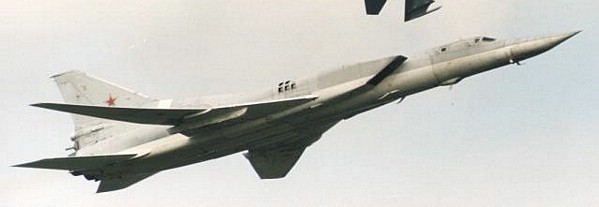
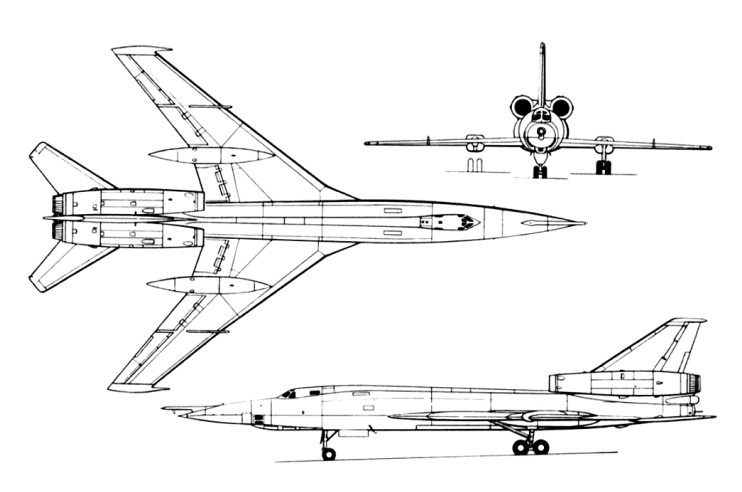
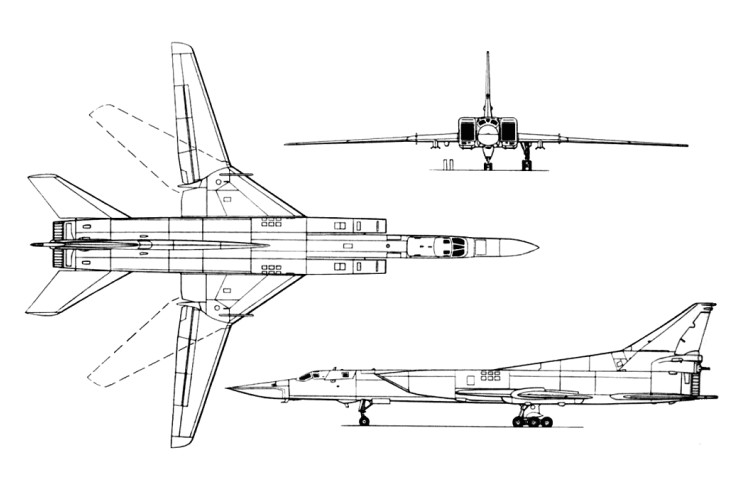
NATO revealed existence of a Soviet variable geometry bomber programme in 1969, development having begun in 1962 and the Tupolev Tu-22M (NATO ‘Backfire’) is a supersonic medium bomber which was designed to replace the subsonic Tu-16 and the troublesome Tu-22 missile carriers. Although its designation may suggest that the ‘Tu-22M’ Backfire is basically a modified Tu-22 ‘Blinder’ it is a completely different and new design with only a few small Tu-22 features maintained. The Tu-22M design features a variable geometry wing which is also found on contemporary tactical fighters and the American B-1B bomber. The two turbofan afterburning engines are unlike almost every other bomber located in its fuselage body, with large shoulder mounted intakes.
The first of between five and nine Tu-22MO prototypes were observed in July 1970 on the ground near the Kazan plant, and confirmed subsequently as a twin-engined design by Tupolev OKB. The first flight was on 30 August 1969. Nine Tu-22M-1 preproduction models for development testing, weapons trials and evaluation were built and the Tu-22M-1 first flew in July 1971, and first displayed in the West at the 1992 Farnborough Air Show.
The aircraft can be equipped with up to three Kh-22 air-to-surface missiles, with one under each wing and a third under its belly, semi-recessed into the bomb bay. The second ASM option is the Kh-15 (NATO AS-16 ‘Kickback’) on a six-round launcher carried in the bomb bay. Up to four external bomb racks can be equipped, each rack capable of carrying nine conventional 250kg general purpose bombs. Also the 500, 1500 and 3000 kg conventional bombs can be equipped. The Tu-22M is equipped with a Leninets PN-A attack radar in the nose and a OPB-15T television sight for optical bomb aiming located below the fuselage just in front of the nose gear.
The Tu-22M has a crew of four: commander (left front), co-pilot (right front), communications officer (left rear) and navigator (right rear). All crew is sitting on KT-1 ejection seats which fire up, a much improvement after the downward firing seats in the Tu-22 Blinder. The rear crew have no forward visibility, but have a large side window each.
The first production variant was the Tu-22M2. The variant was capable of being refuelled in flight. However after the SALT treaty the probe was removed, remaining the probe housing. Later the probe housing was also removed, but the aircraft keeps the bulge-like shape of the nose.
The latest version, the Tu-22M3 or ‘Backfire-C’, has two NK-25 engines replacing the original NK-22s. The new engines coupled with redesigned engine intakes boosted performance. Also the maximum wing sweep was increased back to 65 degrees. The Tu-22M3 is capable of Mach 1 at low level and has a max speed of Mach 2.05. The Tu-22M3 was also armed with a new weapon, the Raduga Kh-15 which was better suited against enemy air defenses than the obsolete Kh-22. Probably because of the large available inventory of Kh-22 missile, the Kh-22 was improved (Kh-22M and Kh-22MA) and remained in service on the Tu-22M.
Although satellites took over the role of the Tu-22R for the larger part, a small number of Tu-22M3s were modified for the recconnaissance role. The designation for this variant is Tu-22M3(R) or Tu-22MR. The variant has a large sensor package (equivalent to that of the Tu-22RDM) built into the bomb bay.
The ECM package of the Tu-22M2 and despite improvements the Tu-22M3 was not considered adequate and an escort jamming aircraft was needed. The old Tu-16P was too slow for the job and two alternatives were considered. One being the Tu-22MP, a Tu-22M3 fitted with the Miass electronic warfare system. Three prototypes were built by 1992 but the type did not enter service. The other option was the Il-76PP, a converted Il-76 transport. It was equipped with the Dandish system which could not be equipped to the Tu-22M3 because it required too much power. One prototype was tested, but none were produced.
No Tu-22M Backfires were exported, altough China and Iran showed serious interest in the 1990s. Lately there have been reports that the Tu-22M3 was offered to India for the maritime attack role. Russia remains the biggest operator of the type. In 1997 a study for the upgrade of the Tu-22M3 was started under the name of project 245 or Tu-245.
Ukraine was the only other operator, it inherited a large number of Tu-22M3 from the Soviet Union.
Production at Kazan ended 1992, probably totalling nine Tu-22MO prototypes, nine Tu-22M-1s, 211 Tu-22M-2s and 268 Tu-22M-3s, or 497 in all.
Confirmed Iraqi Tu-22s air-to-air losses by Iranian fighters:
Date: 25 March 1984 Type: Tu-22B Shot down by: F-14A 73TFS/TFB.1 Shot down by: AIM-154A
Date: 06 April 1984 Type: Tu-22B Shot down by: F-14A 82TFS/TFB.6 Shot down by: AIM-154A
Date: 06 April 1984 Type: Tu-22B Shot down by: F-14A 82TFS/TFB.6 Shot down by: AIM-154A
Date: 16 February 1986 Type: Tu-22B Shot down by: ? unconfirmed Shot down by: ? unconfirmed
Date: 19 March 1988 Type: Tu-22B Shot down by: F-14A 82TFS/TFB.6 Shot down by: AIM-154A
Date: 19 March 1988 Type: Tu-22B Shot down by: F-4E TFB.6 Shot down by: AIM-7E2
Tupolev Tu-22M
Specifications:
Tu-22 Engines: 2 x 26,000 lb (11,790 kg) after-burning turbojet Wing span 90 ft 10½ in (27.7 m) Length (most versions): 132 ft 11½ in (40.53 m) Height: 17 ft (5.18 m) Weight empty: about 85,000 lb (38,600 kg) Maximum loaded weight: 184,970 lb (83,900 kg) Max speed (clean, 40,000 ft/12200 m): 920 mph (1480 km/h, Mach 1 4) Initial ROC: about 11,500 ft (3500 m)/min Service ceiling: 59,000 ft (18,000 m) Range (high, internal fuel only): 1400 miles (2250 km) Armament: one 23 mm NS-23 Internal bombload: 20 000 lb (9070 kg)
Blinder-A Engines: 2 x Koliesov VD-7 turbojet, 30,900 lb (14,015 kgp) thrust Payload: 4410 lb (2000 kg) of free fall weapons
Blinder-B Engines: 2 x Koliesov VD-7 turbojet, 30,900 lb (14,015 kgp) thrust Payload: 1 x AS-4 Kitchen
Tu-22KD ‘Blinder-C’ Powerplant: two 156.9 kN (35,275 lb st) VD-7M afterburning turbojets; later two 161.9 kN (36,376 lb st) RD-7M2 afterburning turbojets Length 42.60m (139 ft 9 in) Height 10.00m (32 ft 9¼ in) Wing span 23.50m (77 ft 1¼ in) Empty weight: 40000 kg (88,183 lb) Max Take-Off Weight 84000 kg (185,185 lb) or 94000 kg (202,820 lb) with four take off rockets Max level speed at 12200 m (40,000 feet) Mach 1.5 or 1510 km/h (938 mph) Max level speed at sea level 890 km/h (553 mph) Ceiling 18300m (60,040 ft) Armament: two R-23 23mm cannons Bombload internal: 24000 kg (847,547 lb)
Tu-22M Engines: 2 x VD-7M, 156.9 kN Max take-off weight: 84000-92000 kg / 185189 – 202826 lb Wingspan: 23.8 m / 78 ft 1 in Length: 40.5 m / 133 ft 10 in Height: 10.7 m / 35 ft 1 in Wing area: 162.0 sq.m / 1743.75 sq ft Max. speed: 1610 km/h / 1000 mph Ceiling: 14700 m / 48250 ft Range w/max.fuel: 5650 km / 3511 miles Range w/max.payload: 4900 km / 3045 miles Crew: 3 Armament: 1 x 23mm remote-controlled cannon Bombload: 12000kg
Tu-22M Engines: 2 x afterburning turbo-jet NK-25, 245.1kN Max take-off weight: 124000 kg / 273375 lb Wingspan: 23.3-34.3 m / 76 ft 5 in-113 ft 6 in Length: 42.5 m / 139 ft 5 in Height: 11.1 m / 36 ft 5 in Wing area: 165.0 sq.m / 1776.04 sq ft Max. speed: 2300 km/h / 1429 mph Ceiling: 14000 m / 45950 ft Range: 5100 km / 3169 miles Armament: 1-2 x 23mm cannons Bombload: 24000kg Crew: 4
Tu-22M3 ‘Backfire-C’ Powerplant: two 245.2 kN (55,115 lb st) Kuznetsov/KKBM NK-25 afterburning turbofans Length 42.46m (139 ft 3¼ in) Height 11.05m (36 ft 3 in) Wing span maximum sweep 23.30m (76 ft 5½ in) Wing span minimum sweep 34.28m (112 ft 5¾ in) Empty weight: 54000 kg (119,048 lb) Max Take-Off Weight 126400 kg (278,660 lb) with RATO Max level speed at high altitude Mach 2.0 or 2000 km/h (1242 mph) Max level speed at sea level 1050 km/h (652 mph) Ceiling 13300m (43,635 ft) Armament: one GSh-23 23mm twin-barrel gun Bombload: 24000 kg (52,910 lb) Crew: 4
Tu-26 Backfire B Engine: 2 x Kuznetsov NK-144. Installed thrust reheat: 400 kN Span: 34.5 m / 26.2 m Length: 40.2 m Wing area: 165 sq.m MTOW: 130,000 kg Warload: 12,000+ kg Max speed: 2 Mach Ceiling: 16,000+ m Max range: 12,000 km Air refuel: Yes Combat radius: 8900 km
The Tu-95 was developed for use by the Soviet Union’s DA (Long-Range Aviation) as an intercontinental strategic bomber. Design of the Tu-95 version began before 1952, powered by four Kuznetsov NK-12 turboprop engines, the bench-testing of which started in 1953.
Making use of identical systems, techniques and even similar airframe structures as the Tu-16, the Tu-95 (service designation Tu-20) is much larger and has roughly double the range of its turbojet predecessor. The 35 degree swept wing, formed integral tanks, with turboprop engines and their eight blade 18 ft 4½ in (5.6 m) contraprops. Sweptback tail surfaces have an adjustable-incidence tailplane. Conventional control surfaces are supplemented by spoilers in the upper surface of the wings forward of the ailerons. Fowler-type trailing edge flaps are fitted. The tricycle undercarriage, with twin nose wheels and a four-wheel bogie on each main unit all retract rearward, plus a small two-wheel retractable tail-bumper,
The basic bomber called “Bear A” by NATO had a glazed nose, chin radar and gun-sight blisters on the rear fuselage. First seen in 1961, “Bear B” fea¬tured a solid nose with enormous radome, refuelling probe and centreline attachment for a large cruise missile (‘Kangaroo”). C appeared in 1964 with a large new blister on each side of the fuselage (on one side only on B). while D was obviously a major ECM/FSM reconnaissance type with chin radar, very large belly radar, and from 12 to 21 avionic features visible from stem to stern. F is a multi-sensor reconnaissance conversion of A. while F is a recent further conversion with an array of ventral radars and stores bays in place of the ventral guns. Older Tu-95 Bear A and B variants are being converted to carry the supersonic AS-4 Kitchen air-to-surface missile in place of the AS-3 Kangaroo. Modified aircraft are codenamed Bear G by Nato.
First flown in prototype form on 12 November 1952, the aircraft was allocated the service designation Tu-20, and began to enter service with the DA bomber force in 1955. Its turboprop powerplant gives remarkably high speed and, at the same time, long range and endurance. Additionally, the large size of the Tu-95 has permitted the carriage of extensive radar equipment and the largest Soviet air-to-surface missiles and bombs.
Built up to 1992, the total production run was fewer than 300.
In 1984 DA (Long Range Aviation) had an ultra long range backbone comprising 113 bombers called ‘Bear A’ and ‘Bear B’ by NATO.
The AV MF had 75 of various types used for ocean patrol, anti ship attack, and ECM/EW.
The crew in all versions is accommodated in nose and rear fuselage pressurized cabins, as well as the pressu-rized but isolated rear turret, fitted to most versions. Most operational variants have an inflight refuelling probe on the nose, but even on internal fuel it is possible to fly missions lasting 26 hours. Some models, such as the ‘Bear D’ maritime surveillance aircraft, are packed from nose to tail with radars, navaids, special com-munications, missile guidance links and other advanced electronics.
Engines: 4 x turbo-prop NK-12M, 11030kW Max take-off weight: 185000 kg / 407857 lb Empty weight: 94400 kg / 208117 lb Wingspan: 51.0 m / 167 ft 4 in Length: 49.0 m / 161 ft 9 in Height: 13.0 m / 43 ft 8 in Wing area: 310.0 sq.m / 3336.81 sq ft Max. speed: 860 km/h / 534 mph Cruise speed: 710 km/h / 441 mph Ceiling: 11000 m / 36100 ft Range w/max.fuel: 15000 km / 9321 miles Crew: 10 Armament: 2-6 x 23mm cannons Bombload: 20000kg
Engine: 4 x NK-12MV turboprops, 14,794 ehp Wing span: 159 ft (48.5 m) Length 155 ft 10 in (4750 in). (certain versions differ by up to 6 ft.) Height 38 ft 8 in (11.78 m) Maximum speed (typical Bear clean) 540 mph (870 km/h) Service ceiling, about 44.000 ft (13,400 m) Range with 25,000 lb (11.340 kg) bomb load. 7,800 miles (12,550 km) Armament: normally six 23 mm NS-23 in radar-directed manned tail turret and remote-aimed dorsal and ventral barbettes (defensive guns often absent from late conversions and from Moss); internal weapon bay for load of about 25,000 lb (11,340 kg).
Tu 20/Tu 95 ‘Bear A’ Type: strategic bomber Crew: 8 Powerplant: four 14,795 ehp (11033kW) Kuznetsov NK 12M turboprops Max speed: 950 km/h (590 mph) at high alt Service ceiling: 14000 m (45,930 ft) Range with bombload: 17500 km (10,875 miles) Wing span: 51.10 m (167 ft 7.75 in) Length: 49.50 m (162 ft 4.75 in) Height: 12.12 m (39 ft 9 in) Wing area: 310.50 sq.m (3,342.3 sq ft) Fuel capacity: 73,000 lt Armament: two internal bays for a total bombload of 20000 kg (44,092 lb), plus a defensive armament of four (or, with rear dorsal, five) powered turrets each with two 23 mm NR 23 cannon.
The prototype flown under OKB designation Tu-88 on 27 April 1952 was overweight and Andrei Tupolev delayed production until a second prototype flew in 1953 with uprated AM-3A turbojets and 5,500kg weight reduction. The maximum speed increased to 992km/h at a cost. The maximum IAS of only 700km/h at low altitude was achieved instead of the originally required M0.9
Deliveries began in 1954 and nine Tu-16 took part in the May Day 1954 flypast over Moscow, and 54 in the Aviation Day flypast 1955.
The Tu-88 entered service service in 1954/55 as the Tu-16 series in for a number of missile-carrier and reconnaissance roles. NATO code name ‘Badger’, the Tu 16 was notable in having only two engines, mounted on the sides of the fuselage inside the roots of the swept wing. The mid-set wings, sweptback at 40 deg 30 sec on the inner sections and at 37 deg 30 sec on the outer panels, and with slight anhedral. Bogie main landing gears fold backwards into compartments in streamlined fairings on the trailing edge.
By the 1960s at least 2,000 aircraft in this family had been delivered and 11 main versions have been identified for use as bombers, missile carriers, anti ship attack aircraft, reconnaissance aircraft and EW/ECM platforms. The Long Range Aviation force had almost 600 still in service in 1984, while the AV MF (Naval Aviation) still used some 300. There have been many updates of systems and equipment, and the EW/ECM versions are all rebuilds of free fall bombers.
The first (“Badger A”) version had blind-bombing radar and glazed nose, and a few were supplied to Egypt and Iraq. The ‘Badger A’ pioneered inflight refuelling using a looped hose between wingtips. The B carried two “Kennel” cruise missiles on underwing pylons and served the AV-MF (Navy) and Indonesian AF. C carried the large Kipper” stand-off missile on the centreline, with panoramic’ nose radar for ship search and missile guidance. D is a maritime reconnaissance type, with comprehensive radars and ECM. E is a photo and multi-sensor reconnaissance type, F is an E with major new ECM and ESM installations, and G is an updated B which launched many missiles against Israel in 1973.
Total production exceeded 2,000, and production (without Soviet aid) continued in China in the 1980s as the Xian H-6.
H-6
Armament: in most variants, six 23 mm NFI-23 cannon in radar-directed manned tail turret and remote-aimed upper dorsal and rear ventral barbettes; versions without nose radar usually have seventh NR-23 fixed firing ahead on right side of nose. Internal weapon bay for load of 19,800 lb (9000 kg), with certain versions equipped to launch missiles. Payload: 8377 lb (3800 kg) bombs or 2 stand-off missiles.
Operated with SovAir in strategic bombing role (Badger-A and -B), and with SovNavAir in ELINT, ECM, photographic and electronic recce, and anti-shipping roles (Badger-C to -H, Badger-J- to -K).
Engines: 2 x AM-3M, 19,290 lb (8750 kgp) thrust Wingspan: 111 ft 6 in Length: 118 ft Height: 35 ft 6 in Wing area: 1820 sq.ft MTOW: 175,000 lb approx. Fuel capacity: 10,000 gal approx Max speed, clean at 35,000 ft: 587 mph (945 km/h) Initial climb, clean, about 4,100 ft (1250 m)/min Service ceiling 42,650 ft (13,000 m) Range with maximum weapon load, no missiles: 3,000 miles (4,800 km) Extreme reconnaissance range, about 4,500 miles (7250 km) Armament: 4 x 23mm guns Bombload: 10,000 lb approx.
Type: multi role bomber/ reconnaissance/ECM aircraft Crew: 6 Engine: two 9500 kg (20,943 lb) thrust Mikulin RD 3M turbojets Max speed: 1000 km/h (621 mph) at 6000 m (19,685 ft) Service ceiling: about 14000 m (45,930 ft) Range with 3790 kg (8,355 lb) bombload: 4800 km (2985 miles) Empty wt: 37200 kg (82,010 lb) MTOW: 72000 kg (158,730 lb) Wing span: 32.93 m (108 ft 0.5 in) Length: 34.80 m (114 ft 2 in) Height: 10.80 m (35 ft 6 in) Wing area: 164.65 sq.m (1,772.3 sq ft) Armament: three power turrets each armed with two 23 mm cannon, and usually one 23 mm cannon fixed firing ahead Internal bombload: 9000 kg (19,841 lb)
Engines: 2 x AM-3M, 93.1kN Max take-off weight: 72000-79000 kg / 158734 – 174166 lb Empty weight: 37200 kg / 82012 lb Wingspan: 32.9 m / 108 ft 11 in Length: 34.8 m / 114 ft 2 in Height: 10.9 m / 36 ft 9 in Wing area: 164.7 sq.m / 1772.81 sq ft Max. speed: 1050 km/h / 652 mph Cruise speed: 850 km/h / 528 mph Ceiling: 13000 m / 42650 ft Range: 5800 km / 3604 miles Range w/max.fuel: 7200 km / 4474 miles Crew: 6 Armament: 7 x 23mm cannons Bombload: 3000-9000kg
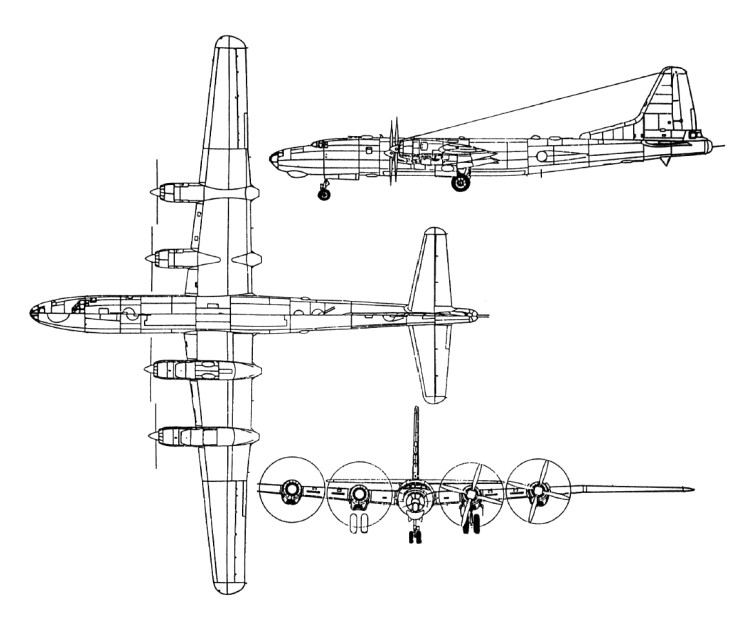
At the end of 1948, just as production Tu-4s were beginning to be delivered to the VVS, Tupolev and Markov began work on a replacement. In a sense, it was an improved B-29 design, with a major programme to trim weight and thus to improve performance.
A new wing with better aerodynamic qualities and with a lighter but stronger spar was developed with integral wing tankage. The fuselage was lightened and the round Tu-4 nose of the same chord as the fuselage was replaced with one in which the cockpit was raised above the nose for improved visibility. A new, more angular tail was also built, with a distinctive dorsal fin. Its engines were four of Shvetsov’s ASh-73TKFNs, a Soviet-built turbocharged version of the original B-29 engines.
All these changes resulted in the Tu-80 being substantially lighter than the Tu-4, and this allowed it to carry more fuel. Its first flight was made on 1 December 1949 from Zhukovski. In state tests, its maximum speed was established as 640km/h. But the Tu-80 was just another step on the way to the Soviet Union achieving a long-range strategic bomber. With the coming of age of turbines, it was not developed beyond its test programme.
Engines: 4 x ASh-73FN, 1770hp Max take-off weight: 67200 kg / 148151 lb Empty weight: 41030 kg / 90456 lb Wingspan: 44.3 m / 145 ft 4 in Length: 36.6 m / 120 ft 1 in Height: 8.91 m / 29 ft 3 in Wing area: 173.1 sq.m / 1863.23 sq ft Max. speed: 650 km/h / 404 mph Ceiling: 11180 m / 36700 ft Range: 7000-8000 km / 4350 – 4971 miles Crew: 11
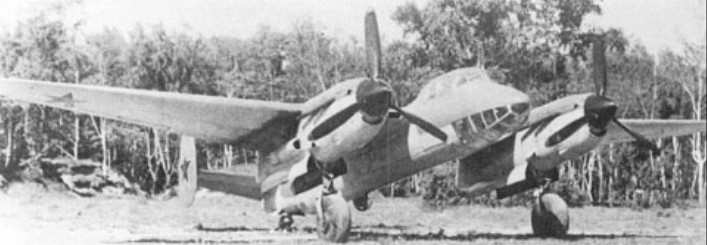
Another Tu-2 variant was the Tu-10. This was a four-crew aircraft fitted with inline Mikulin AM-39FNVs of 1850hp. Its first flight took place on 19 May 1945, and it proved to have perhaps the best performance of any Tu-2. At 8600m it attained a speed of 641km/h. Ceiling was 10,450m but range fell to 1,740km. A small batch was produced in Omsk between 1945 and 1947.















 All Aero