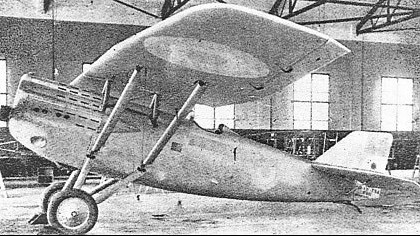
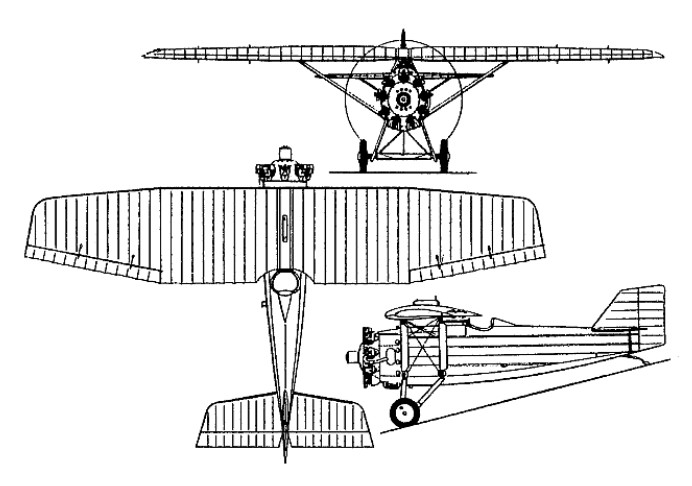
The D 27 was evolved to meet the requirements of the STAe 1926 C1 leger programme for lightweight fighters. Incorporating a split-axle (with independently articulated wheels) rather than cross-axle undercarriage, the D 27 was powered by the SLM Saurer built 500hp Hispano-Suiza 12Mb (HS 57) 12-cylinder Vee engine and had an armament of two synchronised 7.7mm guns. The fuel was carried in a tank which formed the underside of the centre fuselage. In emergency this tank could be jettisoned.
The liquidation of the Construction Aeronautique E Dewoitine in January 1927 resulted in the transfer of development of the D 27 to the EKW in Switzerland, where a prototype flew on 3 June 1928.
By the end of 1929, three had been ordered by Romania, one by Argentina and three by Yugoslavia (of which two were to be assembled by Zmaj at Zemun), and the prototype was undergoing evaluation by the Swiss Fliegertruppe in competition with Alfred Comte’s AC-1.
The five prototypes and two of a strengthened model, the D 53, were flown experimentally for a time on board the aircraft carrier Bearn. In the autumn of 1928, the EKW initiated a pre-series of 12 D 27 fighters, these adopting a redesigned tail and a revised wing of 0.45sq.m less area, modifications first tested in the Laboratoire Eiffel wind tunnel. Meanwhile, in March 1928, Emile Dewoitine had reestablished himself in France, forming the Societe Aeronautique Francaise-Avions Dewoitine.
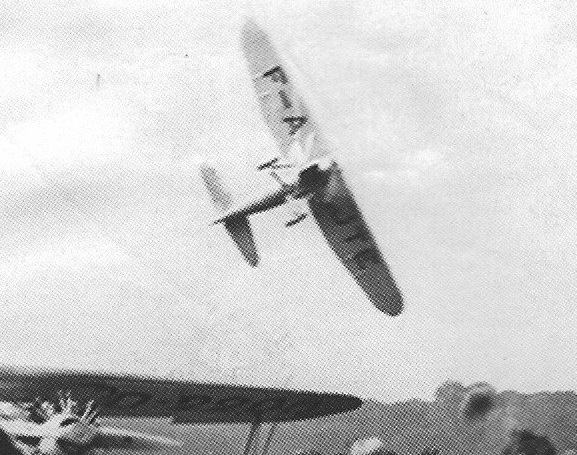
The second and third pre-series D 27s were delivered to France in April 1929, the former being re-engined with the 400hp HS 12Jb as the D 272 F-AJTE for Marcel Dorset for aerobatic demonstrations. After 267 flight hours it was accidently destroyed in 1936.
The latter undergoing STAe evaluation at Villacoublay from 28 May equipped with two 7.7mm Darne guns. On 29 November 1929, a contract was issued by France’s DGT (Direction Generale Technique) of the Ministere de l’Air for the second and third pre-series aircraft plus three (later increased to four) additional fighters to be assembled by Liore-et-Olivier.
The D 27 was offered to the Forces Aeriennes Terrestres as the D 271 with the 500hp HS 12Hb engine and as the D 273 with a Gnome-Rhone Jupiter VII with a compressor enabling 425hp to be delivered at 4000m, but neither model was adopted.
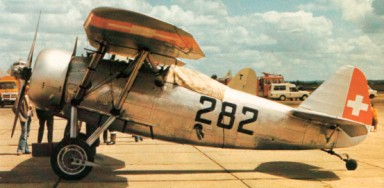
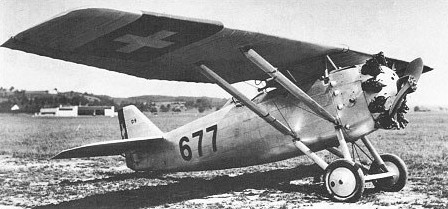
At the end of 1929, however, the decision was taken in principle to re-equip the fighter element of the Swiss Fliegertruppe with the D 27, a pre-series of five being ordered from the EKW as D 27 IIIs, with deliveries commencing in 1931. A pre-production batch of 15 followed, additional contracts being placed for 45 D 27 IIIs to bring deliveries to the Fliegertruppe to 66 (including the prototype). Sixty six were delivered from 1930 to the Swiss Fliegertruppe, which also received 11 examples of the D 26, a version fitted with a 250 hp Wright Cyclone radial engine. Fifty six of the Swiss D 27s were still in first line fighter squadron service when war broke out in 1939. During the following year, they were withdrawn to training units, from which they did not disappear completely for another decade.
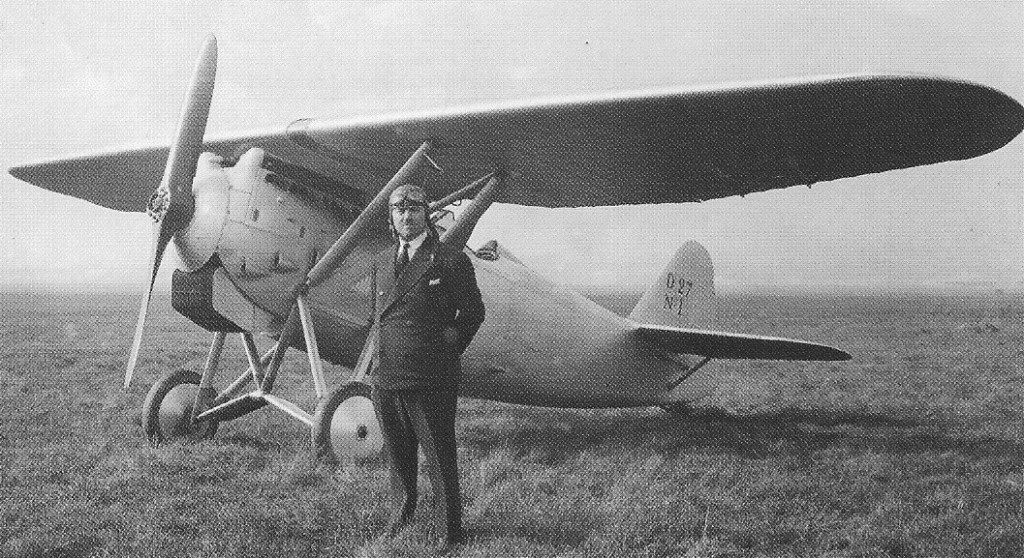
On November 30, 1930, Dewoitine chief test pilot Doret broke the world 1000 km (621 mile) closed circuit speed record flying a Dewoitine D 27 at an average of 286.227 km/h (177.854 mph).
Marcel Doret and his D.27
Swiss D 27 III Take-off weight: 1415 kg / 3120 lb Empty weight: 1038 kg / 2288 lb Wingspan: 10.30 m / 33 ft 10 in Length: 6.56 m / 21 ft 6 in Height: 2.78 m / 9 ft 1 in Wing area: 17.55 sq.m / 188.91 sq ft Max. speed: 298 km/h / 185 mph Range: 425 km / 264 miles Armament: 2 x 7.5 mm (0.295 in) machine guns Service ceiling: 8300 m / 27231 ft Climb to service ceiling: 11 minutes
The Dewoitine D 27 was designed in Switzerland and built there by the EKW state aircraft factory at Thun. It first flew in 1929, with an SLM Saurer built Hispano Suiza 12 Mc engine of 600 hp, and a total of 85 were built at Thun between 1929 33. Sixty six of these were delivered from 1930 to the Swiss Fliegertruppe, which also received 11 examples of the D 26, a version fitted with a 250 hp Wright Cyclone radial engine.
The D 25 tandem two-seat day and night fighter was developed in response to the 1925 C2 (two-seat fighter) programme. Based on the single-seat D 21, but with local reinforcement of the aft fuselage to permit installation of an open turret for a gunner. The D 25 was powered by a 450hp Lorraine-Dietrich 12Eb water-cooled W-type engine, the D 25 entered flight test in 1926, but the C2 programme for which it was intended was abandoned and the type was offered for export. Four were ordered by Argentina in 1928, and these, fitted with an armament of two 7.9mm synchronised Madsen guns and two similar weapons on a ring mount in the rear cockpit, were built under subcontract by the Hanriot company (which also built the last 10 D 21 single-seaters for Turkey).
Engine: 450hp Lorraine-Dietrich 12Eb Take-off weight: 1750 kg / 3858 lb Empty weight: 1182 kg / 2606 lb Wingspan: 12.80 m / 41 ft 12 in Length: 7.64 m / 25 ft 1 in Height: 3.00 m / 9 ft 10 in Wing area: 24.80 sq.m / 266.94 sq ft Max. speed: 222 km/h / 138 mph
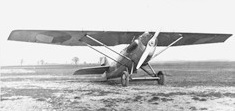
At the end of 1925, the second prototype D 12 single-seat fighter was re-engined with a 500hp Hispano- Suiza 12Gb (HS 50) 12-cylinder W-type water-cooled engine and redesignated D 21. The D 21 had the four 7.5 mm (0.295 in) Darne machine¬guns. Intended for export, the D 21 was first demonstrated in January 1926 at Bruxelles-Evere, the first export order from Turkey, for two D 21s for evaluation. Czechoslovakia ordered three and Argentina 18, plus the prototype. Of these, the three Czech aircraft and seven of the Argentine aircraft were assembled by the EKW in Switzerland.
A manufacturing licence was obtained by Czechoslovakia, Skoda building 26 D 21s during 1928-29 (as Skoda D 1s) with Skoda L engines (derived from the HS 12G) of 562hp. Out dated by the late 20s, they were discharged by the Czechoslovak Army and used by the Police Air Patrol.
Skoda D-1
Argentina also procured a manufacturing licence and the Fabrica Militar de Aviones (FMA) built 58 examples during 1930-31, but with Madsen machine guns and the licence-built Lorraine-Dietrich 12Eb W-type engine. They became effectively D 12s, although the designation D 21 was retained.
One French built D 21 was sold to Switzerland, where in late 1926 Emile Dewoitine had taken up residence, his French company having been bankrupted by the lack of domestic orders for any type since the D 1, and where, in 1928, there appeared the final development of the D 1 formula, the D 27.
In the autumn of 1927, Turkey placed a follow-on order for 10 D 21s, these being delivered during 1928-29.
Max take-off weight: 1580 kg / 3483 lb Empty weight: 1090 kg / 2403 lb Wingspan: 12.80 m / 42 ft 0 in Length: 7.93 m / 26 ft 0 in Height: 3.00 m / 9 ft 10 in Wing area: 24.80 sq.m / 266.94 sq ft Max. speed: 267 km/h / 166 mph
Skoda D-1 Engine: Skoda L, 500 hp Span 12.24 m Length 7.64 m Top speed 270 kph Rate of climb: 10m/s Service ceiling: 9000 m Endurance: 1hr 30min Armament: two synchronized machine guns
First flown in 1924, the Dewoitine D 9 was essentially a scaled¬ down development of the earlier D 1 single ¬seat parasol monoplane fighter, from which it differed mainly in being powered by a 420 hp Gnome Rhone 9 Ac radial engine, a licence-¬built version of the 9 cylinder Bristol Jupiter. Developed for participation in the 1923 C1 programme, two prototypes were completed. The Aviation Militaire purchased one for evaluation, but despite the extra available power the performance was not significantly improved, the D 9 took only 9 seconds less than the D 1 to reach 5000 m (16404 ft), and no French production contracts resulted. Early in the flight test programme, the standard D 1 wing was replaced with a new wing of 2.5 sq.m greater area. A six-month delay in the commencement of evaluation of the contenders in the C1 programme provided Dewoitine with the opportunity to increase wing area by yet a further 2.5sq.m. Armament consisted of two fuselage-mounted 7.7mm Vickers guns and two Darne model 19 guns of 7.5mm calibre mounted on the wing centre section outside the area of the propeller disc. The D 9, placed sixth among the contenders, was destroyed on 15 October 1925. Apart from the prototypes, only 13 were manufactured by Dewoitine, two for Belgium in 1925, Switzerland acquired the sec¬ond prototype and assembled three others in 1928 from French built components, and Yugoslavia (eight). The components of three were delivered in 1927 to the EKW (Eidg. Konstruktions-Werkstatte) in Switzerland for assembly, with delivery to the Fliegertruppe in 1928. The largest production was undertaken by Ansaldo in Italy, which built 147 for the Regia Aeronautica with the designation AC 3.
Max take-off weight: 1333 kg / 2939 lb Empty weight: 945 kg / 2083 lb Wingspan: 12.80 m / 41 ft 12 in Length: 7.30 m / 23 ft 11 in Height: 2.93 m / 9 ft 7 in Wing area: 25.00 sq.m / 269.10 sq ft Max. speed: 244 km/h / 152 mph Range: 400 km / 249 miles
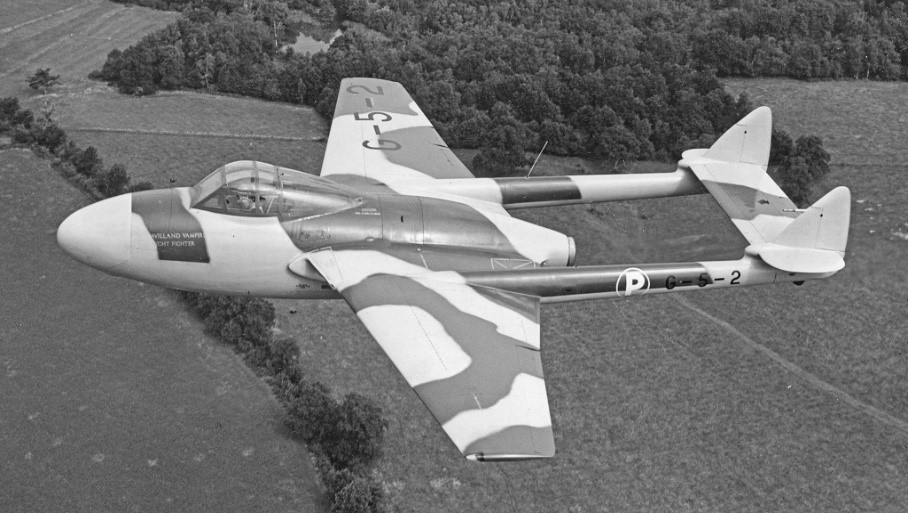
DH 113 Vampire NF10 prototype G-5-2 showing the extended tailplane adopted for production aircraft.
Although developed earlier than the Venom, the DH113 Vampire Night-Fighter (NF) had a later type number in the company sequence by the time it was produced. It was developed from the single-seat Vampire FB.5 as a private venture low-cost Night-Fighter for the export market. It featured lengthened and wider two-seat, side-by-side arrangement and a wooden fuselage nacelle with AI Mk.10 radar within a nose radome. A more powerful 3,350 lb Goblin 3 engine was fitted and first flight was from Hatfield on 28th August 1949 by Geoffrey Pike.
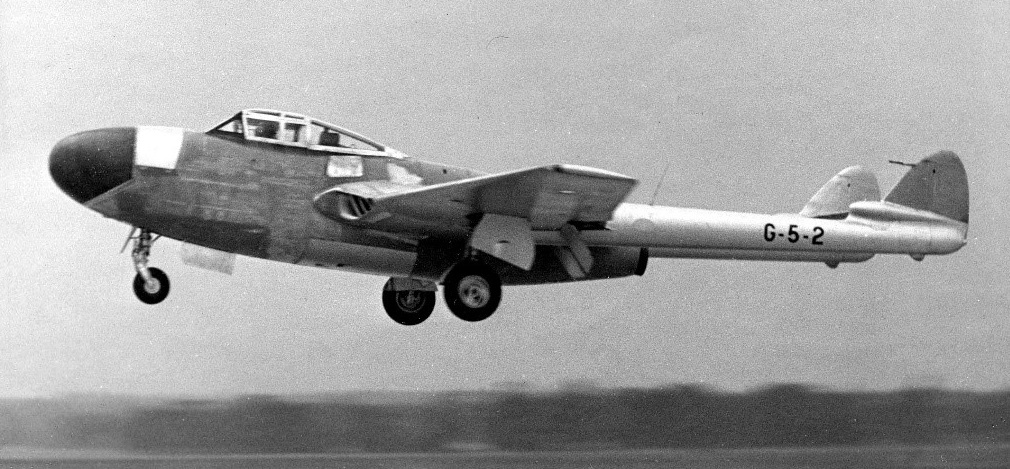
The first prototype DH Vampire NF10 (G-5-2) was flown for the first time at Hatfield on 28th August 1949 with test pilot Geoffrey Pike at the controls. Nine days later it made its public debut at the SBAC Show at Farnborough and just a month later Egypt became its first customer when it ordered 12 aircraft. This order was never fulfilled due to a UK Government enforce embargo due to the increasing hostilities between Egypt and Israel.
The prototype DH 113 Vampire NF10 G-5-2 takes off for the first time on 28 August 1949.
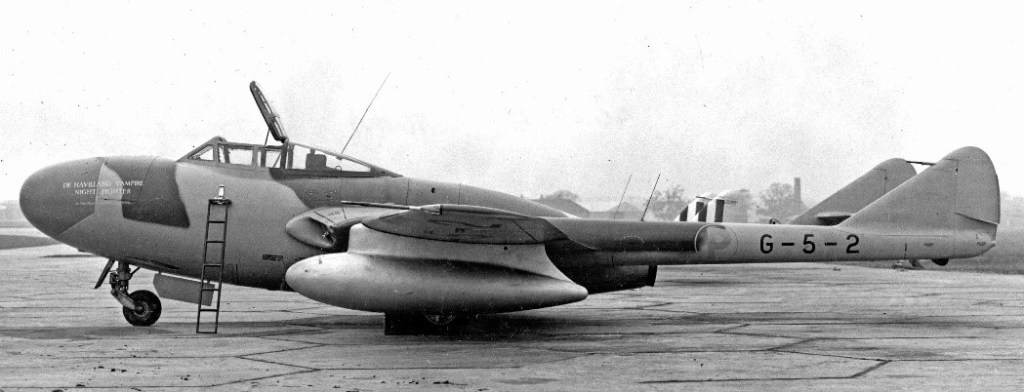
The enlarged nose section resulted in concerns over both directional and longitudinal stability as well as overall control and because of this the prototype was test flown with enlarged triangular tail fins.
DH 113 Vampire NF10 prototype G-5-2 being tested with modified fins in November 1949.
These were later found not to be necessary and were not fitted to production aircraft. An increase in tailplane span was required however and this is a characteristic feature of production two-seat Vampires. The extended tailplane was also used by the DH112 Venom and Sea Venom.
The RAF took over the Egyptian Air Force order and put them into service as an interim measure between the retirement of the de Havilland Mosquito night fighter and the full introduction of the Meteor night fighter.
Three prototypes were built, the third of which was completed as the prototype night fighter, the DH112 Venom. The DH113 was originally designed utilising the wings and tail of the single-seat vampire day-fighter which could accommodate a side-by-side configuration, albeit slight offset behind the pilot.
Those DH113 Vampire NF10 aircraft that were originally ordered by Egypt were taken into RAF service in the UK as the NF.Mk.10 and this then led to the further procurement of additional RAF aircraft. Initial service deliveries of the NF.10 were in the spring of 1951. Crews were never happy about the lack of ejection seats. Only 78 NF.10s were built, and they only remained in front-line service to 1954.
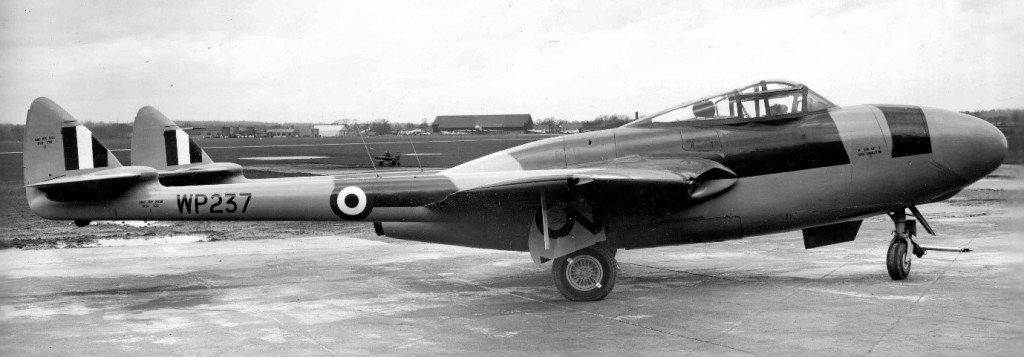
DH 113 Vampire NF10 WP237 in RAF service in April 1951.
The aircraft became the first RAF jet Night-Fighter when the initial Vampires replaced Mosquitos of 25 Squadron at West Malling in July 1951, two other home-defence units (RAF Coltishall and RAF Leuchars) were also equipped with this aircraft. By November 1953 the short operational life began coming to an end with the arrival of the Venom NF.2s for 23 Squadron.
Equipped with an AI Mk X radar, the type was also operated by the Indian and Italian Air Forces.
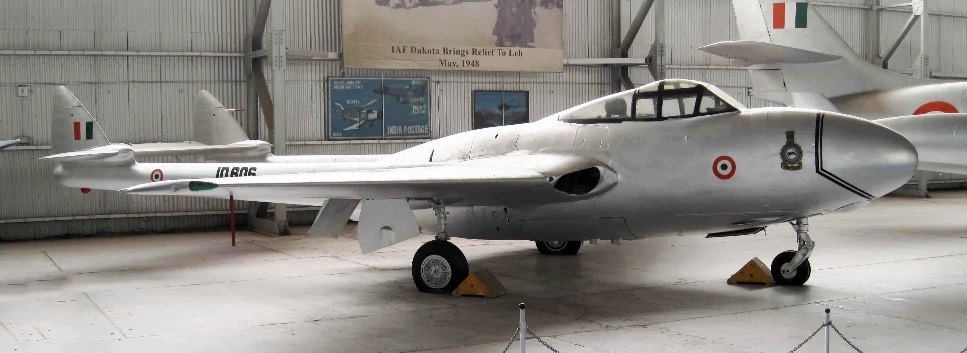
DH113 Vampire NF54 ID606 of the Indian AF on display at Palam, New Delhi.
Export sales were to Switzerland, who had one example for evaluation, and Italy, followed by India who acquired surplus RAF aircraft. Thirty-six NF.10s were converted to a navigation trainer and redesignated “Vampire NF(T).10”. The AI.X radar was replaced by ballast in the form of concrete blocks, and the navigation kit was upgraded. They were modified for navigation training with a clear-view canopy, but still without ejector seats. These aircraft were used by 1 ANS at Topcliffe, 2 ANS at Thorney Island and the Central Navigation & Control School (CNCS) at Shawbury, the last retiring in September 1959.
Total production was of 93 aircraft, comprising three prototypes, 76 aircraft for the RAF and 14 Vampire NF54 aircraft for the Italian Air Force. De Havilland built an export variant of the NF.10 designated the “Vampire NF.54”. A total of 14 was built for Italy and delivered in 1952:1953; 30 retired NF.10s were also refurbished to the NF.54 configuration for India, with deliveries from 1954 to 1958.
Removal of the radar from the night fighter and fitting of dual controls resulted in a jet trainer model of the aircraft, the DH.115 Vampire which entered British service as the Vampire T.11.
Surviving DH 113 are Vampire NF10 ID606 at the Indian Air Force Museum, Palam, New Delhi, India, and Vampire NF54 MM6152 at the Italian Air Force Museum, Vigna di Valle, Italy.
Engine: De Havilland Goblin 35 B, 14911 N / 3,350 lbst Length: 34.613 ft / 10.55 m Height: 6.562 ft / 2.0 m Wingspan: 38.025 ft / 11.59 m Wing area: 262.642 sq.ft / 24.4 sq.m Max take off weight: 13119.8 lb / 5950.0 kg Weight empty: 7673.4 lb / 3480.0 kg Max. weight carried: 5446.4 lb / 2470.0 kg Max. speed: 454 kts / 840 km/h / 538 mph at sea level Initial climb rate: 3346.46 ft/min / 17.0 m/s Service ceiling: 32808 ft / 10000 m Wing load: 50.02 lb/sq.ft / 244.0 kg/sq.m Range: 324 nm / 600 km Range with drop tanks: 1,220 miles Endurance: 1 h Crew: 2 Armament: four 20mm Hispano cannon
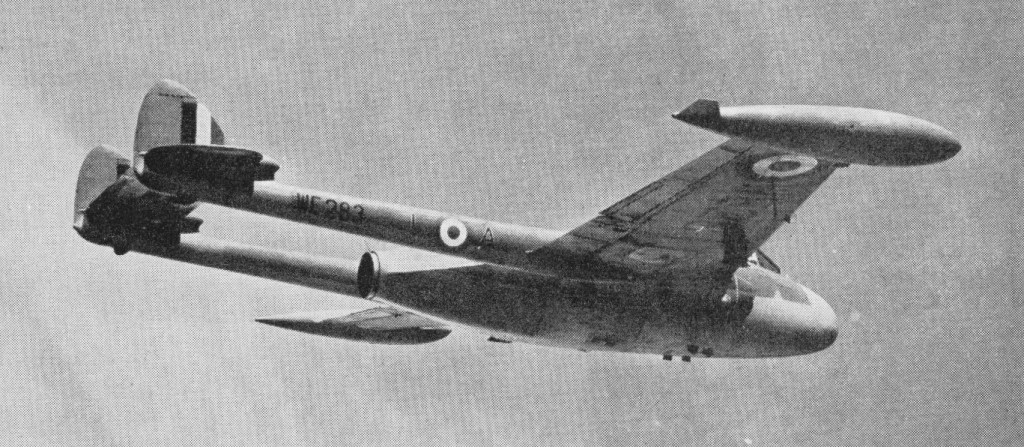
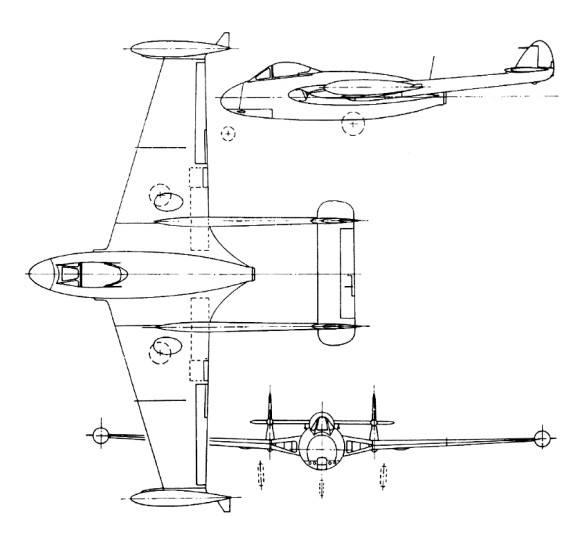
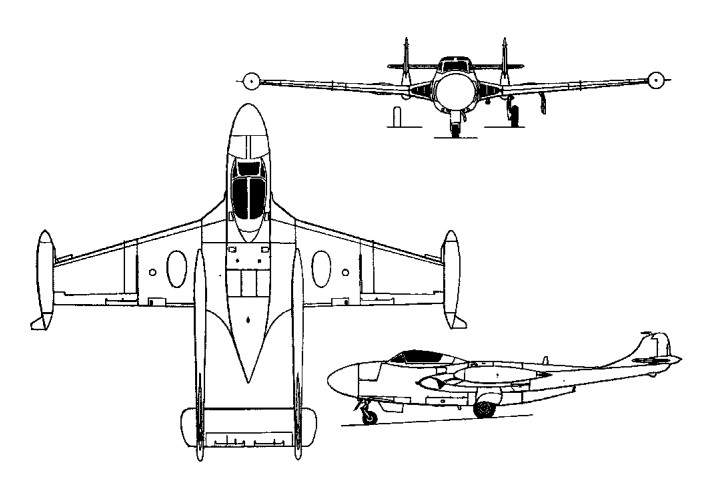
The Venom was a development of the Vampire, designed to accommodate the de Havilland Ghost engine and with aerodynamic refinements enabling it to take full advantage of the increased power. The nacelle and tail assembly were substantially similar to those of the Vampire, but the wings were entirely new, with square tips, very thin section and jettisonable long-range wingtip tanks. Fences were incorporated into the top surface of the wings to direct airflow, and wingtip fuel tanks were fitted as standard.
Originally designated the Vampire FB Mk.8, the Venom FB.1 was the first version for the RAF: a day fighter and fighter-bomber with provision for bombs and rockets in addition to the standard four 20 mm Hispano Mk 5 cannon in the nose. The prototype of this version flew for the first time on 2 September 1949 and entered squadron service in September 1952. A total of 373 FB.1 were built, powered by one de Havilland Ghost 103 turbojet of 4850 lbs thrust.
DH Venom FB.1
Built by the Swiss under licence in the early 1950s, the FB.Mk.1 designated by the Swiss Flugwaffe as the FB.Mk.50.
Fences were incorporated into the top surface of the wings to direct airflow, and wingtip fuel tanks were fitted as standard. The Venom FB 1 had four Hispano 20mm cannon in the nose and hard points under the wings for up to 2,000lb of bombs or rockets.
Introduced in 1955 was the single seat Venom, the FB. 4 (D.H. Ghost 103), with powered ailerons, an ejection seat and under wing fuel tanks in addition to the tip tanks. These new external tanks have a very high fineness ratio and a minute tailplane for stability. The FB.4 also had completely revised fin outlines, with both the front bullet fairing of the earlier Venoms and the rear bullet fairing of the Sea Venoms.
de Havilland DH112 Venom FB 4
A two-seat night fighting version of the single-seat Venom fighter was evolved in the same way that the Vampire night fighter was derived from the original Vampire, and a company-funded prototype was first flown on 23 August 1950. The front fuselage was lengthened and widened to accom¬modate Al Mk 10 radar and crew of two side-by-side, the remainder of the airframe being basically as Venom 1 and the engine being the 4,850 lb st (2200 kgp) Ghost 104. Ninety similar Venom NF Mk 2s (first flight 4 March 1952) were delivered to the RAF from 1953 onwards, many later being modified to NF Mk 2A standard with revised tail units, including dorsal fins and acorn fairings, and clear-view canopies. Further tail unit changes distinguished the Venom NF Mk 3, first flown on 22 February 1953; 129 were built for the RAF with Al Mk 21 radar, powered ailerons, 5,150 lb st (2338 kgp) Ghost 105 engine and other changes. Sweden’s Flygvapnet bought 62 Venom NF Mk 51s, similar to the NF Mk 2s and powered by Swedish-built Ghost RM 2A engines; they served from 1953 to 1960.
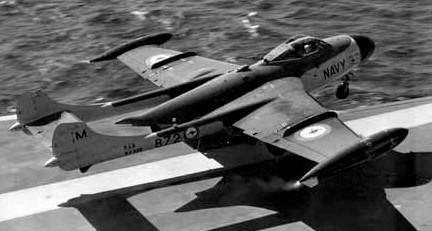
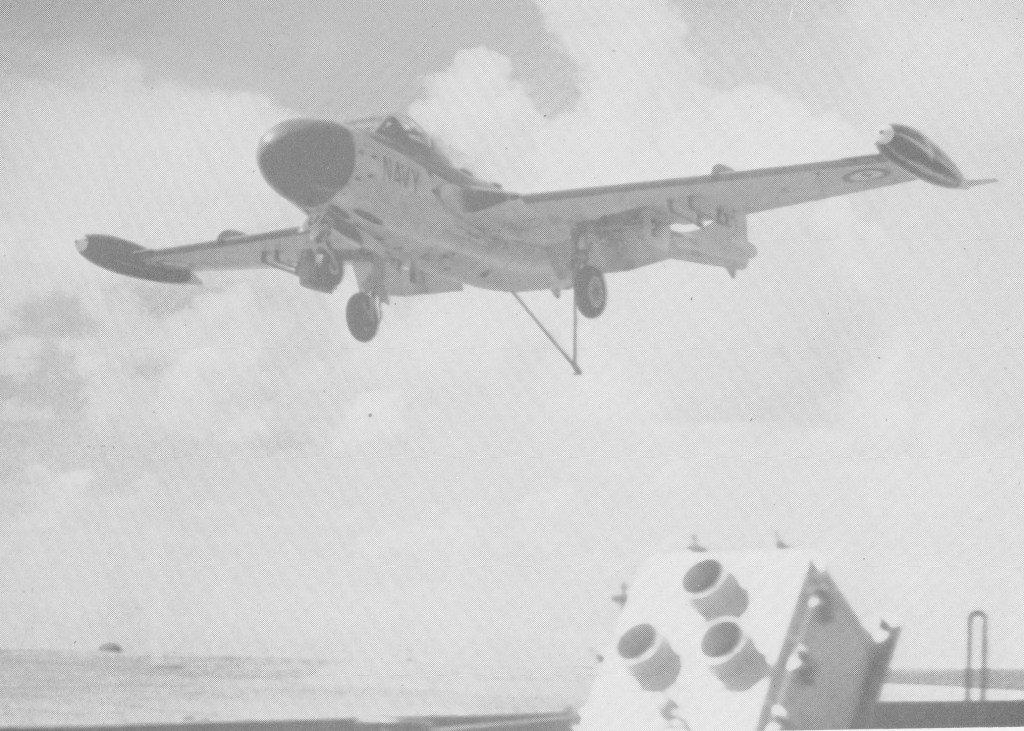
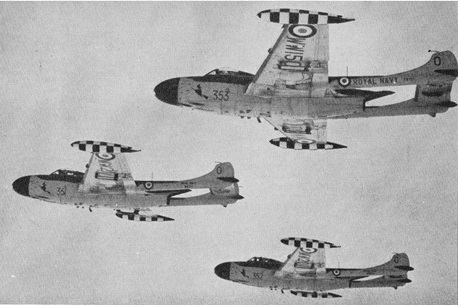
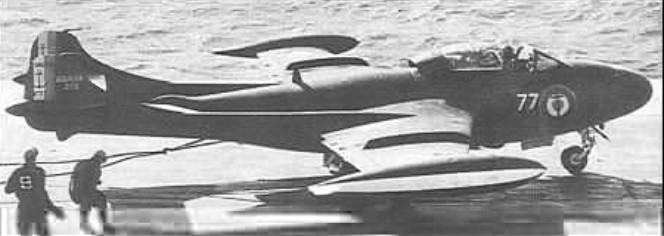
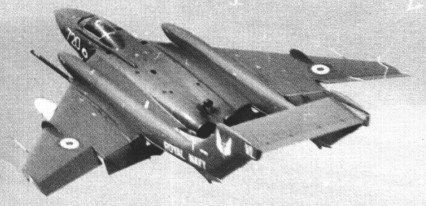
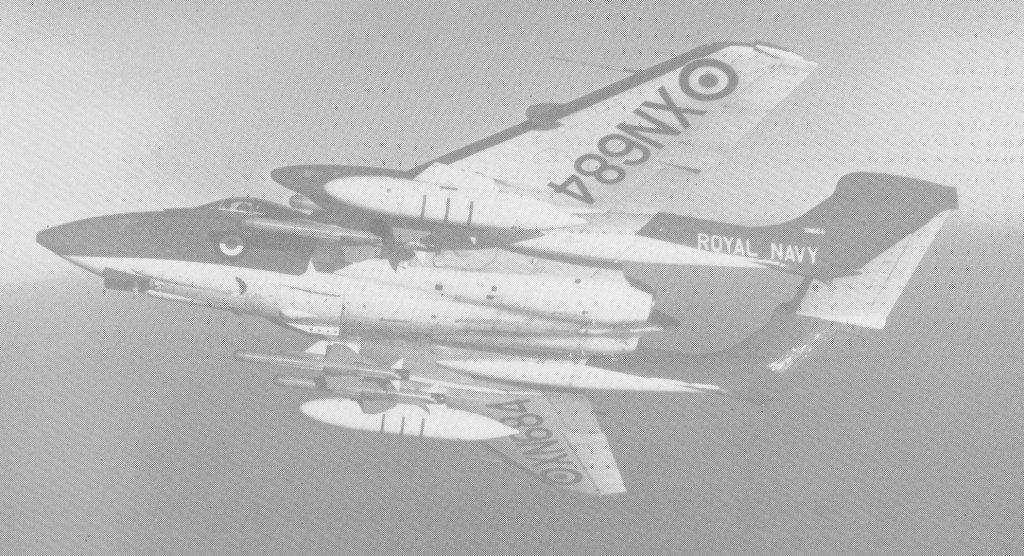
Following the evaluation of a standard RAF Venom NF.Mk 2 night-fighter during the course of 1950, the Royal Navy ordered three fully navalized prototype aircraft to Specification N.107, as the de Havilland Sea Venom NF. (later FAW, for Fighter, all-weather) Mk 20, the first of which made its maiden flight on 19 April 1951. Principal Naval features were a V-type arrester hook, strengthened longer-stroke undercarriage, catapult pick-up points and (from the third prototype onwards) folding wings with tip tanks of revised design.
Subsequent carrier compatibility trials conducted aboard HMS illustrious showed that the type possessed considerable promise, and an initial batch of 50 production Sea Venom NF.Mk 20s was contracted, deliveries getting under way during the mid-1950s. Attaining operational status with No. 890 Squadron aboard HMS Albion in July 1955
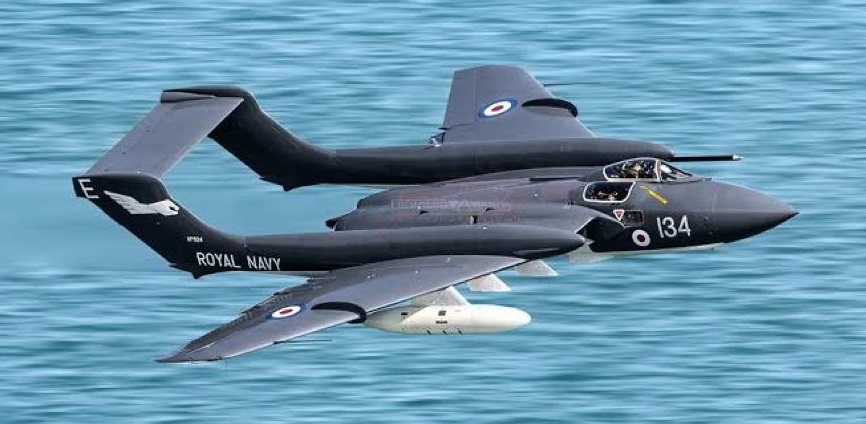
Following the NF.Mk 20 was the Sea Venom FAW.Mk 21, which used the more powerful Ghost 104 turbojet engine, Martin-Baker ejection seats and which was also fitted with American APS-57 airborne interception radar. Deliveries of the Sea Venom FAW.Mk 21 began before the Sea Venom NF. Mk 20 became operational, the delivery beginning in May 1955 of what eventually became the most widely used version, a total of 167 being built for service with the Fleet Air Arm.
Sea Venom F.(A.W.)21s – 1956 890 Sqn aerobatic team. Sqn CO Lt.Cmdr P.G.Young, Lt. Anderdon & Commsd. Plt Hilditch.
Production of the Sea Venom was completed with 39 examples of the Sea Venom FAW.Mk 23, which dif-fered mainly by virtue of being pow¬ered by the Ghost 105 turbojet.
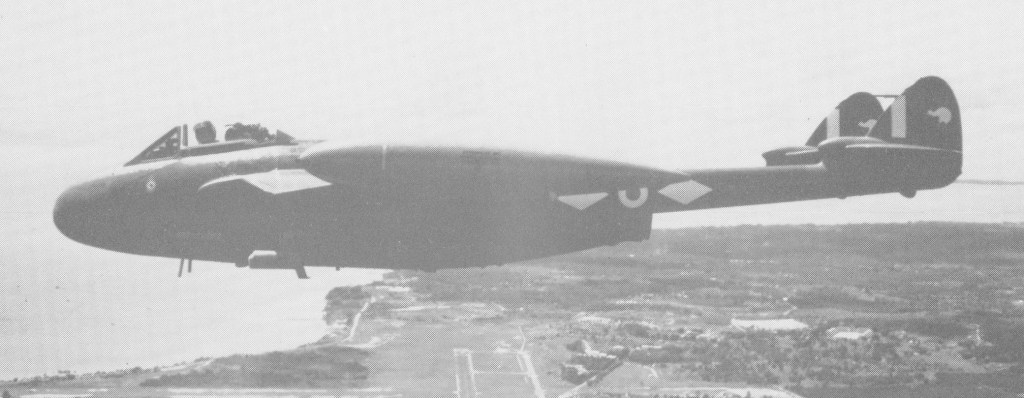
Sea Venoms were also operated by the Royal Australian Navy which received 39 NF.53 (similar to F(AW).21) from 27 February 1955. British-operated Venoms and Sea Venoms were withdrawn from operational service in 1962 and 1960 respectively.
Failure of the shipboard fighter requirement issued by the Service Technique Aeronautique in June 1946 (and which had resulted in Aerocentre NC 1080, Arsenal VG 90 and Nord 2200 prototypes being built) led to consideration being given to adoption by the Aeronavale of the Grumman F9F-5 Panther. In January 1951, however, the Ministere de la Marine announced the decision to adopt the de Havilland Sea Venom Mk 20, which was being developed for the Royal Navy as a side-by-side two-seat shipboard all-weather fighter and had yet to enter flight test. Four aircraft were supplied to the SNCASE in knocked down form for assembly as a “pre-series”, the first of these flying on 31 October 1952, and the name Aquilon (North Wind) being adopted. A fifth “pre-series” aircraft and 25 production aircraft employing sub-assemblies provided by Airspeed, the first known as Aquilon 20s and subsequentl aircraft as Aquilon 201s, the first of these flying on 24 March 1954 (The designation Sea Venom NF Mk 52 referred to a version licensed for production by SNCASE). These were powered by the 4,850 lb st / 2200kg Fiat-built de Havilland Ghost 48 Mk 1, armament comprising four 20mm cannon. Non-availability of the intended Thomson AI radar restricted the Aquilon 201s to diurnal operation, the same restriction being imposed on the next 25 aircraft which, delivered as Aquilon 202s, were entirely manufactured in France and differed in having ejection seats, an aft-sliding rather than aft-hinged cockpit canopy and a strengthened undercarriage. A decision was taken to adopt the Westinghouse APQ 65 AI radar, but, without major redesign of the airframe, it was found impossible to fit this equipment in the ejection seat-equipped two-seater. Production therefore continued with the Aquilon 203 single-seater, the last 25 of the 40 production examples of this version being equipped with APQ 65 radar as were the six two-seat Aquilon 204 radar trainers (not fitted with ejection seats) that brought production to an end, the last of these being flown at the beginning of 1958. The Aquilon was flown operationally by Flottilles 11F and 16F, eventually serving in the fighter training role and being phased out during 1964-65.
Sud-Est Aquilon
During 1955-58 sixteen served with the Royal New Zealand Air Force.
de Havilland DH112 Engine: de Havilland Ghost 103 turbojet, 4850 lbf thrust Length: 31 ft 10 in (9.7 m) Wingspan: 41 ft 8 in (12.7 m) Maximum speed: 640 mph (1030 kph) Range: 1080 miles (1730 km) Service Ceiling: 39,400 ft (12,000 m)
Venom FB.1 / FB.50 Engine: De Havilland Ghost 48 Mk I, 21778 N Length: 32.087 ft / 9.78 m Height: 6.168 ft / 1.88 m Wingspan: 41.732 ft / 12.72 m Wing area: 279.003 sq.ft / 25.92 sq.m Max take off weight: 15655.5 lb / 7100.0 kg Weight empty: 8820.0 lb / 4000.0 kg Max. weight carried: 6835.5 lb / 3100.0 kg Max speed: 640 mph below 20,000 ft. Initial ROC: 7230 fpm. Service ceiling: 39370 ft / 12000 m Wing load : 56.17 lb/sq.ft / 274.0 kg/sq.m Range : 378 nm / 700 km Endurance : 1 h Armament: 4 x 20mm mg, 2000 lbs of bombs or 8 x 60 lb rockets. Range (max): 1075 mile. Crew: 1
Venom FB.4 Engine: one 2336-kg (5,150-tb) thrust de Havilland Ghost 105 turbojet. Maximum speed 961 km/h (597 mph) at sea level Initial climb rate 2204 m (7,230 ft) per minute Service ceiling 14630 m (48,000 ft) Range 1730 kin (1,075 miles). Empty weight 3674 kg (8,100 lb) MTOW: 7180 kg (15,830 lb) Wingspan 12.70 m (41 ft 8 in) Length 10.06 m (33 ft 0 in) Height 2.03 m (6 ft 8 in) Wing area 25.99 sq.m (279.75 sq ft) Armament: four 20-mm Hispano cannon, 907 kg (2,000 lb) of external stores
Venom NF Mk 3 Engine: DH Ghost 104. Max speeds, 576 mph (927 km/h) at sea level, 555 mph (893 km/h) at 30,000 ft (9145 m) 529 mph above 40,000 ft (12 200 m). Initial climb rate, 6,280 ft/min (31,9 m/sec). Patrol duration, 1.85 hrs. Loaded weight, 14,400 lb (6538 kg). Span, 42 ft 10 in (13,06 m). Length, 36 ft 8 in (11,17 m). Height, 6 ft 6 in (1,98 m). Wing area, 279.75 sq ft (25,99sq.m).
Sea Venom FAW Mk 20 Engine: Ghost 103.
Sea Venom FAW.Mk 21 Engine: one 2245-kg (4,950-lb) thrust de Havilland Ghost 104 turbojet. Maximum speed 1014 km/h (630 mph) at sea level Service ceiling 14995 m (49,200 ft) Range 1609 km (1,000 miles) Maximum take-off 7212 kg (15,900 lb) Wingspan 13.08 m (42 ft 11 in) Length 11.15 m (36 ft 7 in) Height 2.59 m (8 ft 6 in) Wing area 25.99 sq.m (279.75 sq ft). Armament: four 20-mm cannon, 907 kg (2,000 lb) of external ordnance
Sea Venom FAW Mk 22 Engine: de Havilland Ghost 104, 4850 lb Span: 42 ft 10 in (13,06 m). Length: 36 ft 8 in (11,17 m). Height: 8 ft 6¼ in (2,62 m). Wing area: 279.75 sq ft (25.99 sq.m). MTOW: 15,400 lb (6980 kg). Max speeds: 576 mph (926 km/h) at sea level 555 mph (893 km/h) at 30,000 ft (9150 in). Initial climb rate: 5,750 ft/min (29,2 m/sec). Service ceiling: 37,000 ft Patrol duration: 1.73 hrs. Armament: 4 x 20mm cannon
Sea Venom F.A.W. Mk 53 Engine One 5,300lb thrust De Havilland Ghost 105 Wing Span: 42 ft 10 in Length: 36 ft 8 in Height: 8 ft 6.25 in Weight 15,000 (loaded) Initial Rate of Climb: 5,900 ft per minute Ceiling: 40,000 ft Speed: 575 mph Range: 705 miles Armament Guns: 4 x 20 mm (150 rounds per gun) Bombs: 8 x 60lb rockets Crew 2
Aquilon 203 Loaded weight: 5500 kg / 12125 lb Wingspan: 13.07 m / 43 ft 11 in Length: 11.17 m / 37 ft 8 in Height: 2.60 m / 9 ft 6 in Wing area: 26.00 sq.m / 279.86 sq ft Max. speed: 935 km/h / 581 mph Range w/max.fuel: 1557 km / 968 miles
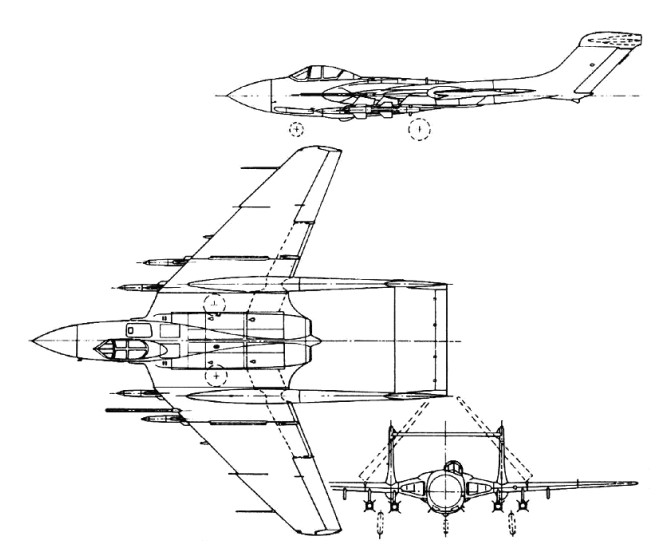
The D.H.110 was designed during 1946 to meet the requirements of the Royal Navy for an advanced carrier-based all-weather fighter (Specification N.40/46) and of the RAF for a night fighter (F.44/46). In 1949, orders were placed for seven night fighters and two long range fighter prototypes for the RAF and two night fighter and two strike fighter prototypes for the RN, but the Naval version was later cancelled and the RAF order reduced to two (to Specification F.4/48) on economy grounds.
The mid-set wings have 40 degrees sweepback and conventional ailerons, rudders and Fowler flaps are fitted. The rear portion of the all-moving tailplane is deflected upward separately to avoid trim changes when the flaps are lowered. ‘Dog-tooth’ wing leading edges, air intakes in the wing roots and a large air-brake under the centre-fuselage are fitted.
The tricycle undercarriage has a single wheel on each unit. The main wheels retract inward into the wings, and the nose wheel retracts rearward.
The prototypes first flew on 26 September 1951 and 25 July 1952, powered by 7,500 lb st (3405 kgp) Avon RA7s. The pilot occupied a single cockpit offset to port, with the observer alongside in the fuselage nacelle; provision was made for radar in the nose and four 30 mm Aden cannon in the fuselage. After the loss of the first prototype and selection of the Gloster Javelin to meet the F.4/48 requirement, the second D.H.110 was modified to have an all-flying “slab” tailplane, variable gearing in the aileron and tailplane primary control circuits, reduced ventral fin area and cambered leading edge extensions outboard of the wing fences.
Royal Navy interest in the D.H.110 revived in 1952 and while the second prototype was used for preliminary deck landing trials, a new semi-navalised prototype was built as the Mk 20X, making its first flight on 20 June 1955. The first production Sea Vixen flying on 20 March 1957. It was followed by the fully-navalised Sea Vixen FAW Mk 1 which had folding wings, revised tail unit, longer stroke undercarriage, new GEC radar, nosewheel steering, ejection seats, 11,230 lb st (5 100 kgp) Avon 208s, and armament of 28 x 2-in (5,08-cm) rockets in retractable packs in the nose plus four Firestreak JR AAMs or rocket pods or two 1,000-lb (454-kg) bombs under wings. An intensive period of flying trials was undertaken in the first half of 1959 by the Sea Vixen FAW.1 in the hands of No.700 “Y” Flight at RNAS Yeovilton.
114 Sea Vixen FAW Mk 1s were built and the first Royal Navy squadron (No 892) was formed on 2 July 1959. This version subsequently equipped five other squadrons, including No 766 all-weather training and No 899 HQ Squadrons
The Sea Vixen FAW Mk 2 differed in having extra fuel in forward extensions of the tail booms and provision to carry Red Top AAMs in place of Firestreaks. Prototypes flew on 1 June and 17 August 1962, and were followed in 1963-66 by 29 new production Mk 2s and 67 converted Mk 1s. Service use continued until 1972, after which about two dozen Sea Vixens were converted to pilotless drones for use as targets at the Aberforth range.
Prototype Engines: 2 x 7,500 lb st (3405 kgp) Avon RA7
FAW Mk 1 Engine: 2 x Rolls-Royce Avon RA 208, 11,230 lb st (5100 kgp) Wingspan: 15.2 m / 49 ft 10 in Length: 16.3 m / 53 ft 6 in Height: 3.4 m / 11 ft 2 in Wing area: 60.2 sq.m / 647.99 sq ft Max. speed: 1158 km/h / 720 mph Ceiling: 14630 m / 48000 ft Armament: 28 x 2-in (5,08-cm) rockets, four Firestreak JR AAMs or rocket pods or two 1,000-lb (454-kg) bombs Crew: 2
Sea Vixen FAW Mk 2 Engine: 2 x RR Avon 208, 11250 lb. Span, 51 ft 0 in (15,54 m) Length, 55 ft 7 in (16,94 m). Height, 10 ft 9 in (3,28 m) Wing area, 648 sq ft (60,19 m). Loaded weight 41,575 lb (18875 kg). Max speed, 690 mph (1110 km/h) at sea level. Initial climb 1½ min to 10,000 ft (3050 m), 5 min to 42,500 ft. Service ceiling, 48,000 ft (21792 m).
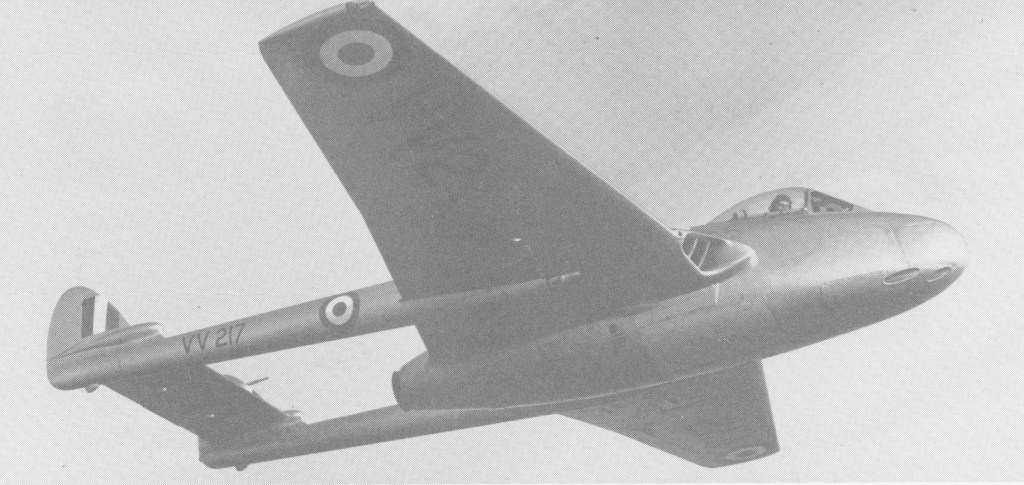
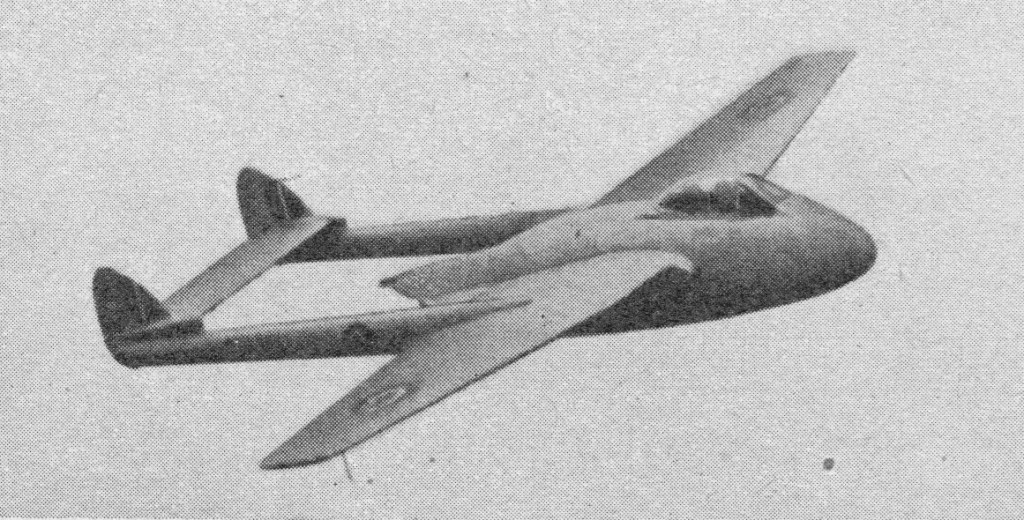
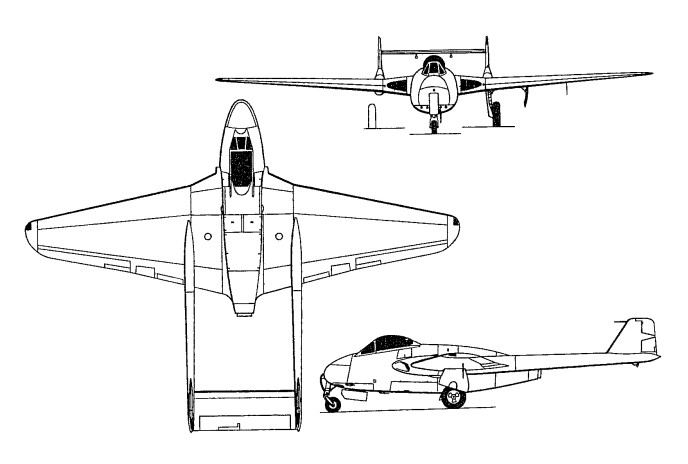
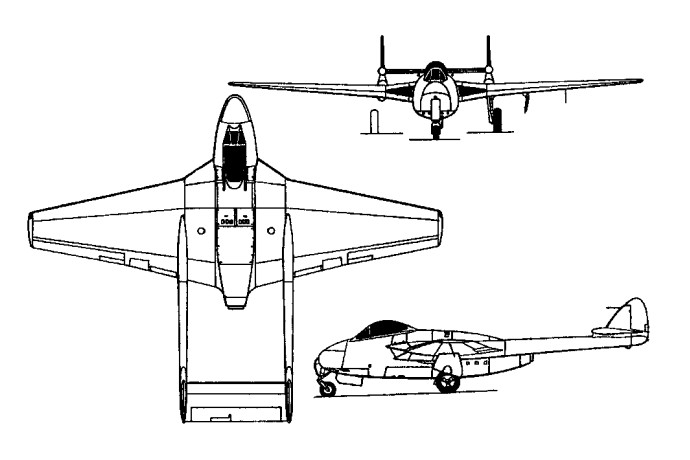
The design began in 1941, to satisfy Air Ministry Specification E.6/41 for an interceptor fighter to be powered by the then-developing Halford-designed de Havilland H-1 Goblin turbojet of 2,700 lb St (1 226 kgp), the twin-boom configuration of this aircraft was virtually dictated by the chosen power plant. This was because a single turbojet was to provide the total thrust; as this was very limited in early engines, it was necessary to ensure that power loss from the jet tailpipe was restricted to an absolute minimum by keeping the tailpipe as short as possible.
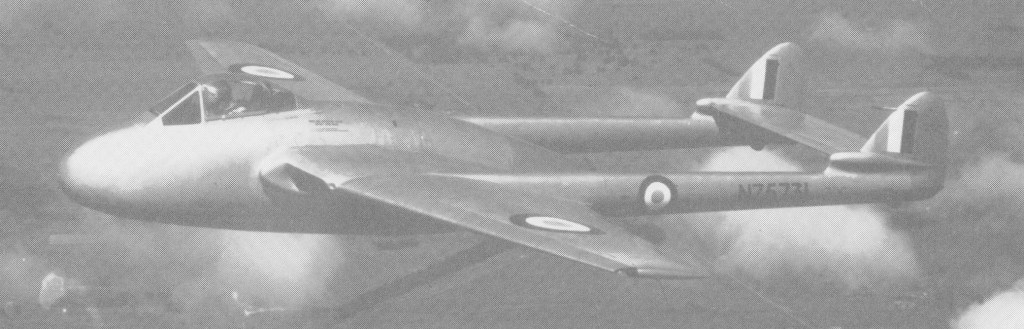
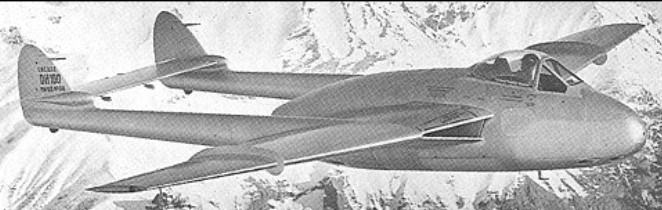
The first flight of the prototype, made by Geoffrey de Havilland jr, took place at Hatfield in Hertfordshire on 20 September 1943 powered by a 12kN de Havilland Goblin turbojet, just 16 months after the start of design the aircraft (LZ548/G) featuring pointed fins. Two further prototypes (LZ551/G and MP838/G) quickly joined the flight programme, the latter car¬rying the planned armament of four 20 mm Hispano cannon under the nose which, like the Mosquito, was of plywood and balsa construction, the remainder of the aircraft being metal. Like the Mosquito’s fuselage, this was built in two half-shells which were joined top and bottom. The monoplane wing was an all-metal structure, incorporating the engine air intakes in the wing roots, split trailing-edge flaps, air brakes and ailerons. The pilot, was seated well forward in the central nacelle beneath a three-piece canopy (replaced later by a bubble canopy).
The name was changed from Spider Crab to Vam¬pire when on 13 May 1944 a contract for 120 production examples of the Vam¬pire F.Mk 1 (later increased to 300) was placed for manufacture by the English Electric Company, Preston. The first production aircraft (TG274/G), with square cut fins and Goblin turbojet (as the Halford engine was named) was flown at Samlesbury on 20 April 1945, becoming the first British fighter with a speed of over 805 km/h (500 mph). Pre service and handling trials occu¬pied the remainder of 1945, however, and the Vampire saw no operational service during the war.
The first production F.1 Vampire was powered by the same engine as the prototype, as were the next 39 aircraft. Subsequent F.1 had 3,100 lb / 13.8kN Goblin Gn.2 engines and a pressurised cockpit, the first 50 production Vampires lacking this feature. Entering service too late to make a contribution to World War II, the first squadron to operate the Vampire was 247 Squadron at Chilbolton in Hampshire, taking delivery of their first aircraft in March 1946 and becoming operational in April.
Production of the Vampire F Mk I, with 3,100 lb St (1407 kgp) Goblin II, was undertaken by English Electric, which built a total of 174 for the RAF and 70 for Sweden’s Flygvapen, delivered from 1946; Switzerland’s Flugwaffe acquired four Vampire Is for evaluation in 1946 and El Cuerpo de Aviaçion Militar of Dominica acquired 25 from Flygvapnet in 1952. One supplied to RCAF.
In 1948 John Cunningham established an altitude record in the Ghost-Vampire at 59,492 feet.
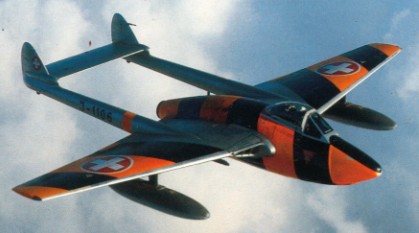
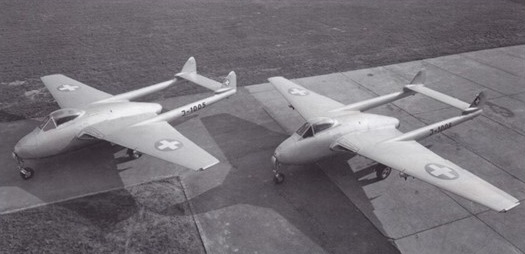
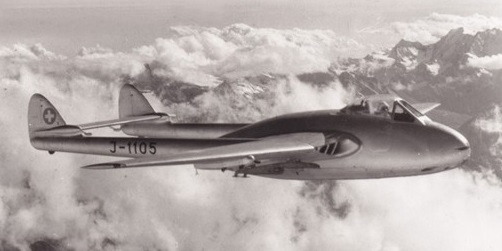
The Vampire 6 was specially evolved to meet Swiss requirements. This variant had clipped wings and powered by a Goblin 3 of 3300 lb thrust. It was designed for combined fighter and ground attack roles.
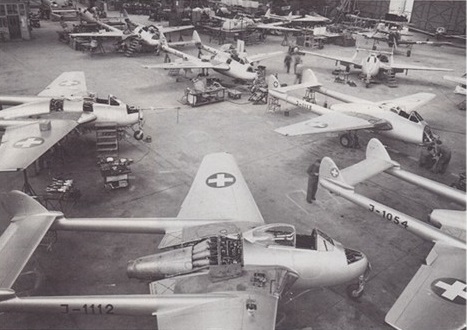
Based on the positive test results achieved with the DH-100 Mk 1, the decision for a new combat aircraft foe the Swiss Air Force was at the end of 1948 and a series of 75 DH-100 MK6s were ordered. In May 1949, the first aircraft were taken over and replaced obsolete Me109 E-1/3 and Morane D-3800/01. All airplanes were flown to Switzerland from Hatfield, England to Emmen without any incidents. The 75 aircraft (J-1005 to J-1079) were delivered in the years 1949 and 1950.
A year later licence production of a second series of 100 aircraft by FFA began. The 100 licence built DH-100 Mk 6 Vampire (J-1101 to J-1200) were in service from 1951 onwards. Until 1960, all vampires were still in operation without Martin Baker’s seats. Against the heat in the summer, due to the insufficient air conditioning, a light flightsuit and white helmets were introduced. At the beginning of the 1960s, the vampires were equipped with a Martin Baker sling seat, an emergency package, a new joystick and a new cabin roof with single glazing.
The DH-100 Mk 6 Vampire were operational from 1949 to 1973, but most aircraft were retired during 1968/1969. In Switzerland, they were in use from 1949 to 1990. On 12th June 1990, the last Vampire at the Emmen airfield were taken out of the pilot school. A respectable number was written off in 1974, but liquidations were still carried out until 1988. From 1953, two-seater (DH-115) were also used.
The Vampire F Mk 3 was similar to the Mk I but carried 100-imp gal (454-l) drop tanks and had a revised tail unit with lower tailplane, rounded rudders and a tailplane/fin acorn fairing. Production by EEC totalled 117 for the RAF and 85 for the RCAF. The RNoAF evaluated four Mk 3s and the Fuerza Aérea Mexicana acquired 15 from the RCAF in 1961. To adapt the Vampire for ground attack duties, de Havilland introduced a strengthened and clipped wing (first flown on a Mk I airframe on 29 June 1948) to produce the FB Mk 5. With the basic airframe of the F Mk 3 and a 3,100 lb st (1 407 kgp) Goblin 2 or 4,400 lb st (1 998 kgp) Goblin 2/2 turbojet, the Vampire FB Mk 5 had a longer-stroke undercarriage and in addition to the four 20-mm British Hispano cannon could carry, on wing strong points inboard and outboard of the booms, eight 60-lb (27-kg) RPs and two 500-lb (227-kg) or two 1,000-lb (454-kg) bombs, or two 200 Imp gal (9091) drop tanks. The first of 888 FB Mk 5s for the RAF flew on 23 June 1948; some of these were diverted either new or secondhand to the RNZAF, SAAF, Armée de lAir, Aeronautica Militare Italiana and the Lebanon Air Force. Specific export versions similar to the FB Mk Shad the 3,350 lb st (1 521 kgp) Goblin 3 and improved performance; these included the FB Mk 50 for Sweden’s Flygvapnet and the FB Mk 52 built for Egypt, Finland, Iraq, India, New Zealand, Norway and Venezuela.
In New Zealand it became the RNZAF’s first jet fighter, with 58 examples serving between 1951 and 1972 before their replacement by the Strikemasters and Skyhawks.
In the early 1950s, De Havilland produced a two-seat night-fighter version, the NF10, and these aircraft formed the backbone of the RAF’s night-fighter force until the arrival of the Meteor NF11. A total of 95 two-seat NF.10 Vampire night-fighters also served in an interim capacity with the RAF from 1951, pending the introduction of Meteor and Venom night fighters.
The T11 trainer version was a development of the NF10 and the type continued in service until well into the 1980s.
The last major variant was the Vampire T.11 two- seat trainer, over 800 of which were built.
The Royal Navy had a small number of F.20 Sea Vampires, generally similar to the RAF’s FB.5, and 74 T.22 two-seat trainers derived from the T.11.
Sea Vampire F.20 1948
Earlier Sea Vampire were hooked Mk.1, and although the F.20 is virtually a hooked Mk.3, the wings have been clipped, and the aircraft modified to full Naval standard.
Foreign licence production comprised 100 FB Mk 6 by FFA in Switzerland; 80 FB Mk 52A by Macchi and Fiat in Italy; 183 by SNCASE in France in addition to 67 assembled from British components and 281 by HAL in India including 34 from imported components.
Production of single-seat Vampires for the RAF ended with 381 FB Mk 9s, essentially a FB.Mk.5 with cockpit air conditioning for Far East service and 3350 lb thrust. Seventeen ex-Swedish FB Mk 50s were transferred to Dominica in 1956, and ex-RAF Mk 9s went to Rhodesia (5), Jordan and Ceylon.
Three Vampire Is were fitted with 4,500 lb St (2043 kgp) Rolls-Royce Nene 1 engines to Specification F. 11/4S for evaluation but no production of the proposed F Mk II to this standard was undertaken in the UK. After further modification by Boulton Paul to enlarge the wing-root air intakes, one of the three Nene-engined aircraft was shipped to Australia to become the pattern aircraft for 57 Vampire F Mk 30s built by de Havilland for the RAAF. With a 5,000 lb st (2270 kgp) Nene 2-VH assembled in Australia by CAC, the first Vampire 30 flew on 29 June 1948, this and subsequent aircraft having the same tail unit as the British Mk 3 and “elephant ear” intakes above the rear fuselage. Twenty-three FB Mk 31s had a similar airframe to that of the RAF’s FB Mk 5, and 28 Mk 30s were converted to the same standard. Two examples in 1951 became F Mk 32s with cockpit air conditioning, as in the British Mk 9, and ejection seats. The Mk T.35 Vampire was licence built at Bankstown during the 1950s for the Royal Australian Air Force and is outwardly identical to the de Havilland T.11 Vampire. One major difference is that the T.35 has hydraulic “maxaret” anti skid brakes compared to the T.11 s pneumatic system, and the engine is slightly different, being a Mk.5 Goblin compared to the Mk.11 engine. The Mk.T.35 was equipped with Martin Baker Mk.IB ejection seats.
On 14 July 1948 six Vampire 3s of No.54 Squadron became the first ever jet aircraft to fly across the Atlantic under their own power.
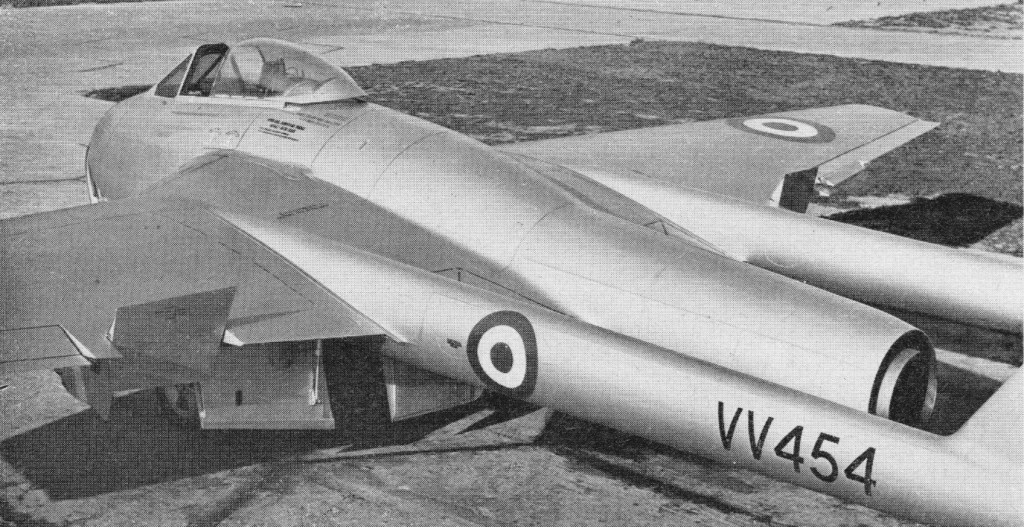
Vampire FB.5 VV454 was fitted with an extended jet pipe to test a reheat (afterburner) system for the Goblin 2, with extended tail bumpers to stop the jet pipe touching the ground.
FB.5 VV454 testing reheat
Only the F. 1, and the Nene powered F.2 (not adopted by the RAF, but later Nene powered aircraft were built under licence in Australia and France, the latter being named Mistral) had the original, squared off style tail. The F.3 had a smaller, more rounded type of a shape that was almost a De Havilland trademark. As for the two seaters: these initially had a tail similar to the F.3, etc, but with taller rudders, latter the acorn fairing was deleted and the fin area increased so it extended forward in a gentle curve. Up to the F.3 the wingtips were rounded, but on the FB.5 fighter-bomber the rounded portion was deleted, the result being a “clipped” wing of slightly reduced span.
After assembling 67 Vampire FB Mk 5 single-seat fighters from British-supplied components and licence-building a further 120 aircraft in their entirety, the Societe Nationale de Constructions Aeronautiques de Sud-Est (SNCASE) began production of a more powerful version of the basic aircraft. Assigned the designation Vampire Mk 53 by the parent company and given the appellation of SE 530 by Sud-Est, this was developed for the Armee de l’Air. It utilised the basic Mk 5 airframe mated with the 2270kg Hispano-built Nene 102, the wing root intakes being enlarged and the split-trunk intake of the Hawker P.1040 being adapted to provide the extra air demanded for the rear face of the Nene’s double-sided impeller. Fuel tankage was increased, cabin pressurisation introduced and the pilot was provided with an SNCASO ejection seat. A pre-series of four aircraft was built, the first of these flying on 1 April 1951. Baptised Mistral, the type entered series production in SE 532 form, the first flying in December 1951 and 97 being built. These were followed by 150 examples of the SE 535, the last of which was delivered on 25 March 1954. The SE 535 was powered by the Nene 104 with similar rating to the Nene 102B of the SE 532, and, in addition to its four 20mm HS 404 cannon, could carry eight T-10 or HVAR rockets, or two 450kg bombs. The Mistral internal fuel tanks in the fuselage and wings can be supplemented by two large underwing tanks. The Mistral entered Armee dl’Air service in 1952 and was finally withdrawn in 1961.
Deck-landing trials with one of the prototype D.H. 100 Vampire fighters began aboard HMS Ocean as early as 3 December 1945, these being the first-ever carrier operations by a pure jet aircraft. Successful trials with two fully-navalised Vampire I conversions led to an order for 30 Sea Vampire F Mk 20s, the first of which flew in October 1948. Armed with four 20-mm cannon and with the basic airframe of the Vampire FB Mk 5, they served primarily in a training role to give Fleet Air Arm pilots jet experience. Six RAE Vampire F Mk 3s were converted to Sea Vampire 21s, with reinforced undersides and armament removed, for use in flexible deck landing trials at RAE Farnborough and on HMS Warrior in 1947-55. The total built include 804 in UK, fifty in India and 109 in Australia. The Sea Vampire T.22 land-based pilot trainer was ordered in 1952 by the RAAF. Thirteen were delivered, the first in June 1954 and the last in August 1959. A total of 85 Vampires were delivered to the RCAF between 1948 and 1950. They were built for the RCAF in a contract dated June 13, 1946, the first aircraft flying on June 3, 1947. Construction of the entire batch was carried out by English Electric at their Preston, Lancashire, plant with test flying undertaken at Samlesbury. They received RCAF numbers 17001 to 17042 and 17044 to 17086. After their retirement, 27 were sold to Fliteways Inc at West Bend, Wisconsin, possibly in early 1958. The President of Fliteways Ine, Merle C Zuelilke, wanted to introduce these former military jets onto the private market as fast hacks or executive aircraft some had already been sold to private owners. However, the American Federal Aviation Administration (FAA) was not keen on the idea of Cessna/Piper Cub pilots zipping about in jets, and so introduced a number of restrictions. New Vampire F.3 owners suddenly found that they could only register them in the experimental/exhibition category as was the case with N6877D (formerly 17069, constructor’s number EEP 42387) which meant that every flight had to be authorised ahead of time, be made under Visual Flight Rules conditions, and be registered on a flight plan. Intended destinations, be they airports or runways, also had to be approved by an FAA safety agent before a flight could take place. Not surprisingly the FAA killed the market stone dead in the US, leaving Fliteways with a number of Vampires it could not sell. At about the same time (1960) the Mexican Air Force was looking for a fighter aircraft. The aircraft were flown to Mexico in groups initially by Minnesota Air National Guard pilots, but this idea was abandoned after the local ANG Commanding Officer suffered an engine blow out in FAM 4 (N6875D, formerly RCAF 17019). This was later repaired at a cost of $9,000 for a new wing, nose landing gear, new engine, electrical system and hydraulic system. It is reported that Mr Leo Geib of West Bend ferried most of the aircraft in Mexico and helped to check out the Mexican pilots. One group of FAM Vampires (FAM 13, FAM 6 and FAM 1) were photographed during their stopover at Love Field, Dallas, Texas in February 1961, as they made their way to Mexico. It was reported in the Mexican Air Force magazine Anuahuac, that by February 14, 1961, 12 of the 15 Vampires had been delivered to BAM 1 (Base Aerea Militar Military Air Base No 1) at Santa Lucia, outside Mexico City. Eventually all 15 were delivered, but it appears that one was damaged en route at Acapulco, Gueffero repairs to FAM 6 cost $2,000 and required, among other things, new landing gear. Only 14 Vampires were flown operationally, the 15th aircraft was possibly used as a spares source. The number FAM-15 was later allocated to one of the two Mk 11 trainers. The Escuadron Aireo 200 was chosen to receive the Vampires. One thing that the Escuadron Aireo Jet de Pelea 200 lacked was a suitable training aircraft to convert pilots to the Vampires. By 1962 the Mexican Air Force had acquired two de Havilland Vampire T.11 two seat trainers, one being WZ414 which was the first production Mk 11 to enter service in the RAF in 1952. It had been built by de Havilland at Christchurch and spent some time at the Aeroplane & Armament Experimental Establishment at Boscombe Down and with the Empire Test Pilot School. It was declared a non effective airframe on January 29, 1960 and sold to Shackleton Aviation on January 5, 1962. The other was XD439 (built by de Havilland at Chester) which was delivered to the RAF in 1954, and had once served at the Central Navigation and Control School at Shawbury. It was retired to 19 Maintenance Unit at St Athan on May 11, 1959 and was sold to Shackletons on the same date as WZ414. Their date of arrival in Mexico is not known. In 1970 fears over safety, grounded the Vampires even the Mk 11 trainers were considered to be unsafe as there were no more stocks of cartridges for their ejection seats. This occurred during the tenure of Gral Brig P A Jose Vergara Ahumada, as chief of the air force. For many years the surviving F.3s and the two T.11 s were stored in one of the hangars at BAM 1. It was later reported that some of the F.3s were sent as training aids to the Aviation Mechanic School at BAM 5 at Zapopan, Jalisco. Others provided background scenery for the 1969 Mexican movie Aguilas de Acero (Iron Eagles) filmed at BAM 1. Years later some of the aircraft were scrapped one of the Mk.IIs met a similar demise, but the cockpit section went to a private collector in Mexico City. The other Mk 11 is preserved at the main army base inside Mexico City where, for many years, there was also Mk 3 No 5 acting as gate guard, wearing an incorrect camouflage scheme. It was removed in 1992, restored and, then put on display in the grounds of the new Mexican Air Force HQ building in Mexico City. No 13 is on display at the Military Aviation School (Colegio del Aire) at BAM-5 at Zapopan, as a tribute to the first jet fighters of the Fuerza Airea Mexicana.
3268 DH-100 Vampires were built, a quarter of them under licence.
Vampire Engine: one 1225 kg (2,700 lb) thrust de Havilland Goblin 1 centrifugal-flow turbojet. Max speed 824 km/h (512 mph) at 10365 m (34,000 ft) Initial climb 1235 m (4,050 ft) per minute Service ceiling 12620 m (41,400 ft) Range 1190 km (740 miles) Empty weight 2803 kg (6,180 lb) Maximum take off 4627 kg (10,200 lb) Wing span 12.19 m (40 ft 0 in) Length 9.37 m (30 ft 9 in) Height 2.69 m (8 ft 10 in) Wing area 24.71 sq.m (266.0 sq.ft) Armament: four 20 mm Hispano cannon
Vampire 1 Engine: 1 x de Havilland Goblin 2 engine, 3,100 lbst (1,407kgst). Max take-off weight: 3890 kg / 8576 lb Empty weight: 2890 kg / 6371 lb Wingspan: 12.2 m / 40 ft 0 in Length: 9.4 m / 30 ft 10 in Height: 2.7 m / 8 ft 10 in Wing area: 24.7 sq.m / 265.87 sq ft Max. speed: 869 km/h / 540 mph Range w/max.payload: 1175 km / 730 miles Crew: 1 Armament: 4 x 20mm cannons
Vampire 1 Engine: 1 x de Havilland Goblin, 2700 lbst Wingspan: 11.58 m / 38 ft 0 in Length: 10.49 m / 34 ft 6 in Max. speed: 885 km/h / 531 mph Crew: 1
F Mk 3 Engine: One 3,100 lb thrust de Havilland Goblin D.Gn.2 turbojet Span, 40 ft 0 in (12,20 m). Length, 30 ft 9 in (9,37 m). Height, 6 ft 3 in (1,9 1 m). Wing area, 266 sq ft (24,71 sq.m). Empty weight, 7,134 lb (3239 kg). Normal loaded weight, 12,170 lb (5 525 kg). Maximum weight: 11,970 lb (5429 kg) Max speed, 531 mph (854 km/h) at sea level and 505 mph (813 km/h) at 30,000 ft (9 145 m). Range, 1,145 mls (1 842 km) at 30,000 ft (9 145 m) at 350 mph (563 km/h). Initial climb, 4,375ft/min (22,2 m/sec).
FB Mk 5 Engine: de Havilland Goblin turbojet, 3100 lb thrust. Max speed, 530 mph (846 km/h) at sea level, 540 mph at 20,000 ft, 482 mph (772 km/h) at 40,000 ft (12200 m). Range, 1,145 mls (1 842 km) at 30,000 ft (15 150 m) at 350 mph (563 km/h). Empty weight, 7,253 lb (3 310 kg). Max loaded weight, 12,360 lb (5632 kg). Span, 38 ft 0 in (11,50 m). Length. 30 ft 9 in (9,37 m). Height, 6 ft 3 in (1,91 m). Wing area, 261 sq ft (24,25 sq.m). Armament: 4 x 30mm mg + 2000 lb disposable stores.
Vampire T.11 Engine: 1 x 3,500 lbs.t. (1588 kgp) de Havilland Goblin 35. Max speed, 549 mph (883 kph) at 20,000ft (6 096 m) Cruise, 403 mph (649 kph) Initial climb, 4,500 fpm. (22.86 m/sec) Range, 853 mls (1373 km). Empty weights: 7,380 lb (3 347 kg) Loaded weight: 12,920 lb (5 860 kg). Wingspan 38 ft (11.58 m) Length, 34 ft 5 in (10.49 m) Wing area, 262 sq.ft (24.33 sq.m). Armament: Two 20 mm cannon.
Sea Vampire F.Mk.20 Span, 38 ft 0 in (11,50 m). Length. 30 ft 9 in (9,37 m). Height, 6 ft 3 in (1,91 m). Wing area, 261 sq ft (24,25 sq.m). Max speed, 526 mph (846 km/h). Time to 25,000 ft (7620 m), 10 min. Range, 1,145 mls (1 842 km) at 30,000 ft (9 144 m) at 350 mph (563 km/h). Loaded weight, 12,660 lb (5 748 kg).
Sea Vampire T.22 Engine One 3,500lb thrust De Havilland Goblin 35 centrifugal turbojet Empty weight 7,380 lb Loaded weight 12,920 lb Wing Span: 38 ft 10 in Length: 34 ft 5 in Height: 6 ft 2 in Crew 2 Initial Rate of Climb: 4,500 ft per minute Ceiling: 43,000 ft Speed: 538 mph Range: 623 miles Armament 2 x 20 mm cannon , 8 x 60lb rockets
SNCASE SE 535 Mistral Engine: Hispano-built RR Nene 104, 5000 lbst Span: 38 ft 0 in (11,50 m). Length: 30 ft 9 in (9,37 m) Height: 6 ft 2 in Wing area: 262 sq ft (24,25 sq.m). Empty weight: 7,665 lb (3840kg). Loaded weight (with drop tanks): 12,643 lb (5740 kg). Max take-off weight: 13,448 lb / 6100 lb Max speed: 575 mph (925 km/h) at sea level and 557 mph (896 kmh) at 19,685 ft (6000 m). Initial climb: 7,086 ft/min (36 m/sec). Service ceiling: 49,200 ft Range w/max.fuel: 1118 miles / 1800 km Armament: 4 x 20 mm cannon Hardpoints: 2 x 1000 lb
By 1937 Geoffrey de Havilland had become convinced that war with Hitler was inevitable. His idea had been a bomber fast enough to out fly enemy fighters, a two man crew, no rear armament, pure speed for defense. Two Rolls Royce Merlins for power, and the sleekest possible shape, entirely fashioned from wood, since in war there was likely to be a surplus of wood and woodworkers, DH thought, and a shortage of aluminum alloy.
When he showed up at the Air Ministry with his drawings of a 400 mph gunless carpentry bomber faster than a Spitfire, they told him: “Forget it. You haven’t built a war machine in years. Start on something simple, nothing this ambitious.” As they drove home, DH and a colleague discussed the Mosquito and what a good idea it had been. As they turned in the factory gate at Hatfield, DH said: “We’ll do it anyway.”
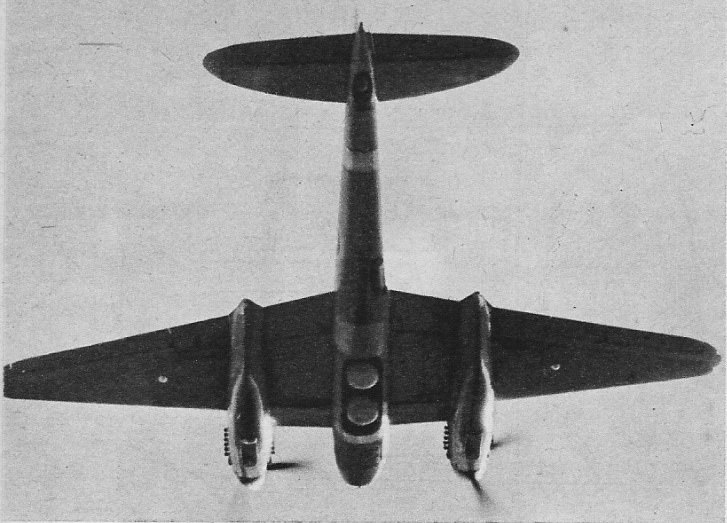
DH set up to de¬sign and build his prototype plywood bomber in an old moated mansion, Salisbury Hall, five miles away. In December 1939, a team under Geoffrey de Havilland, with R E Bishop and C C Walker, started detailed design. The radiators for the Merlins were in a two foot forward extension of the wing root between the engines and the fuselage, with intakes in the leading edge and cooling air exits beneath the wings that actually gave cooling thrust, not drag. From these inboard radiators, and with a minimum of plumbing, they were also able to contrive a cabin heat system that kept Mosquito crews warm at altitude. The fuselage was in cross section of tapered ovals. It was a balsa filling sandwiched be¬tween ply sheets, built in two vertical halves and glued together. The one piece wing and fixed tail surfaces were wooden, but the control surfaces were ply covered wooden flaps, metal covered al¬loy ailerons and elevators, fabric covered rudder. When all the wooden bits had been sanded smooth, screwed, glued and pinned, they were covered with fabric, the fabric stretched with dope and then painted.
The Rolls Royce Merlin engines were descendants of the R type racing engines developed for the Schneider Trophy floatplanes in the early 1930s. They were V 12s, cooled by a mixture of water and glycol, and (in later versions) aspirated by a two stage, two speed supercharger but the engines held power to rare altitudes. Takeoff power was 1,200 to 1,700 horsepower each, depending on the mark of Merlin. The wing, while more straightforward than the fuselage, requires a great deal of jigging and tooling. Made in one piece 51 feet long, it contains two spars built up of booms of laminated spruce with webs of birch ply. The rear spar is swept forward to give that distinctive wing shape. The spars are separated by 32 ribs, and then covered by an inner top skin of ply with an outer ply skin separated by spanwise douglas fir stringers. The bottom is single skin with stressed panels covering the fuel tank openings. All the skins are glued and screwed, with over 4000 screws in the top in alone.
The de Havilland team designed, drew up some 10,000 drawings, built a mockup, designed and built all the jigs and tooling, and rolled the aircraft out in 11 months.
On 1 March 1940 a contract was signed for 50 aircraft and the first flew on 25 November 1940, 11 months after design work began.
The prototype was taken to Hatfield Aerodrome and assembled in November 1940. The prototype’s first flight test pilot was DH’s eldest son, also named Geoffrey de Havilland.
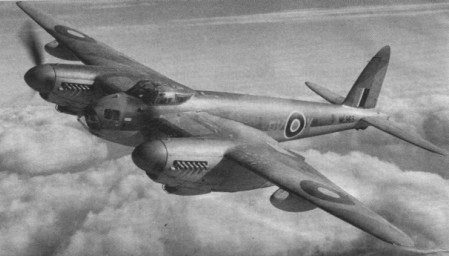
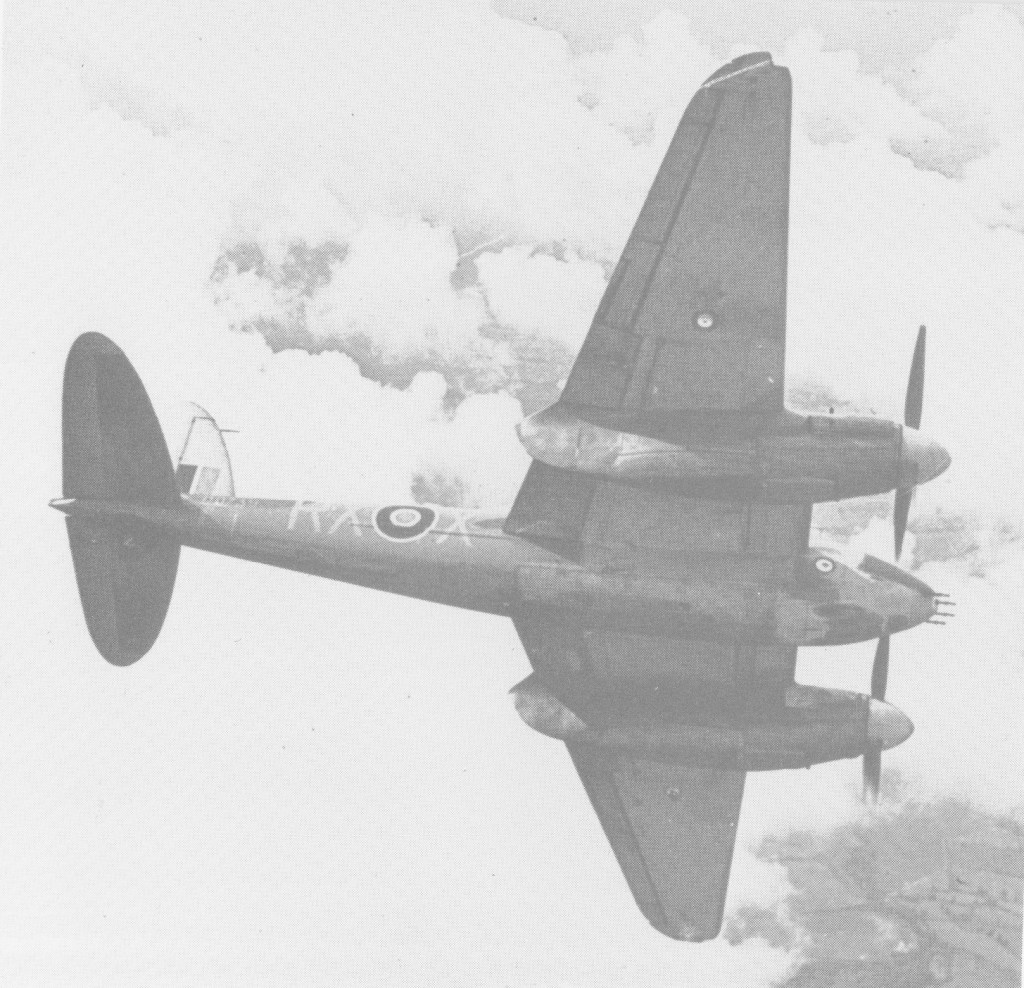
Conceived as an unarmed fast light bomber, the Mosquito was also planned as a photo-reconnaissance aircraft and a night fighter. The second aircraft, flown on 15 May 1941, was the night fighter prototype. Also constructed at Salisbury Hall, and young Geoffrey decided he’d fly it out of the pasture beyond the manor’s cabbage patch, to save the time and labour of dismantling, trucking and reassembly at the airfield. Test flying of the Mosquito revealed airspeed readings so high that DH wasn’t sure he believed his pilots. So he one day “borrowed” (DH’s word) a Spitfire as a pace aircraft. Both pilots agreed the Mosquito was almost 20 knots faster, doing eventually 370 knots at 30,000 feet. DH arranged demonstrations for the Air Ministry at which young Geoffrey would fly such unbomber-like manoeuvres as vertical rolls with one engine feathered. In Boscombe Down trials the Mosquito proved some 20 mph faster than the then fastest mark of the Spitfire and was almost as manoeuvrable. It reached a maximum speed of 437 mph and a maximum altitude of 44,600 feet in the early 1940s. The third prototype was a fighter variant. Production wasn’t helped by the ex¬traordinary number of different models ordered 43 in all and by the Air Ministry oft changing its mind as to which variants were needed most urgently. Since they were possibly the fastest airplanes in the world for two and a half years, Mosquitos flew as fighters, both day and night, heavily armed with cannon and machine guns, as intruders fighter-bombers, pure bombers, marker bombers with the pathfinder squadrons of Bomber Command, photoreconnaissance aircraft, dual control trainers, airliners, and as antisubmarine aircraft, carrying a six pounder antitank gun or, later, rockets. The first Mossies into service, in the autumn of 1941, were photorecon variants. The first PR aircraft made their initial daylight sorties over Paris on 20 September 1941. PR Mosquitoes also had the distinction of being the last in RAF front-line service, being withdrawn in December 1955. In time, these PRU aircraft roamed all over Germany and Europe. They flew between 22,000 and 30,000 feet, just below contrail height, so that any German fighters above them might be revealed by their own trails. But they’d photograph from as little as 400 feet if that was the cloud base. The Mosquitos’ speed did give them substantial immunity from fighters though not from flak with the same FW 190s that the night-fighter Mosquitos were after being their principal adversary. When attacked by German jets, the Mosquitos could avoid their fire by tight turns; one held off two Me 262s for 15 minutes like this, till the Messerschmitts ran low on fuel. The Mosquitos’ cameras were good enough to reveal the markings on German aircraft on the ground from 24,000 feet. By 1943, they were getting good photographs at night, using American photoflashes of 600,000 candlepower.
Entering service at the end of July 1941, the first 50 Mosquitos were deployed as long-range reconnaissance aircraft (Mk.1), as night fighters (Mk.IIs) or as bombers (Mk.IVs).
No.105 Squadron introduced Mosquitos into service in May 1942 as daylight bombers. Mosquitos were also the first Allied aircraft to bomb Berlin in broad daylight. The British learned that on January 30, 1943, both Goering and Goebbels were to address a rally in the city, and the RAF timed nuisance raids by two trios of Mosquitos to coincide with the start of their speeches. Back in Britain, those in the know tuned their wireless sets to Berlin radio, and to their great joy heard muffled noises and shouts, then an hour of martial music when there should have been live broadcasts of grandiose Nazi pomposity. No great damage was done, and one Mossie was lost; but Nazi pride had been ruffled, and Goering’s boast that no Allied aircraft would ever bomb Berlin had been most obviously disproved. Unarmed Mosquitos flew in BOAC colours between Scotland and Stockholm. The British needed Swedish ball bearings, and they also transported POW mail and a few VIP passengers in a makeshift bunk inside the bomb bay. Passengers were loaned a flying suit, warm boots, Mae West and parachute for the trip; they had oxygen masks, heat and an intercom to the pilot but no means at all of seeing out. The Mosquito was an economical weapon. Four or five could be built for the man hours necessary for one heavy bomber; wood and women were resources not in short supply and women did much of the work in building Mosquitos. There were only two crewmen to train, against 10 for a heavy; two engines against four, and half the fuel consumption. By the war’s end, Mosquitos were carrying 4,000 pound bombs to Berlin: about the same load as a B 17, but the Mossies only took half the time and had a third of the loss rate. A total of 466 Mosquito Night Fighter Mk IIs were produced.
On the night of 18-19 August 1942, the British tried out their new pathfinder tactics for the first time in a riad on the ship docks in Flensburg (western Germany). British Mosquitos equipped with Gee navigational and blind-bombing equipment were supposed to mark the area bombing target with flares, but despite precise theoretical planning, the raids went awry: the Gee devices became non-operational several miles before reaching the city due to German jamming, and the marker flares were dropped in the wrong place.
On Sunday 20 December 1942, six British Mosquitos of 109 Squadron guided by the ‘Oboe’ radar-controlled blind-bombing and navigational aid that was here used for the first time, raided a power plant in Lutterade (eastern Holland). This target-finding radar used two ground transmitters – the ‘cat’ and ‘mouse’ stations – to lead an aircraft to its target by the shortest possible route.
The T.Mk.IIIs were a direct development of the F.Mk II fighter, possessing dual controls and no armament. The origin of the armed Mosquito T.Mk.IIIs was wartime Australia. The need for training in the ground attack role had led to some British built T.Mk.III trainers being armed with the machine gun packs removed from FB.Mk.40s previously converted to the photo reconnaissance role.
Mosquito B.IV
The prototype of the most widely used of the Mosquito fighters (HJ 662) made its first flight in February 1943, and more than 2,500 of this Mk VI version were built eventually. With two 1,710 hp Rolls Royce Merlin XXX engines, it had a maximum level speed of 407 mph (655 km/h) at 28,000 ft (8,535 m).
The B.IV Srs 2 bomber version first operation was on 20 November 1942.
Little has been said of No.618 Sqn of Coastal Command, formed on 1 April 1943, before the dam buster raids, to operate Mosquito carrying a variant of the Wallis bomb. The primary function was to attack the German fleet in Norway using the weapon code-named Highball.
Smaller than the Lancaster weapons, Highball worked the same. Bouncing across water, rebounding, the spinning under the ship, where a hydrostatic fuse exploded the 600 lb / 272 kg explosive charge. The Mosquito accommodated two of these weapons in tandem in the bomb-bay, with the doors removed.
Highball Mosquito
Work on the Mosquito weapon, including dropping trials, was undertaken by Vickers during April 1943. Most of the test flying was done from Manston by ‘Shorty’ Longbottom, the Vickers test pilot who shared the Lancaster trials with Mutt Summers.
For the first two weeks 619 Sqn used standard Mosquito IVs. The first converted aircraft, DZ531/G, reached their Skitten base, from Vickers, on 18 April 1943. Another five had arrived by the end of the month. The Highball programme eventually had sixty of the 263 B.Mk.IV Series 2 Mosquitos built, but thirty were subsequently re-converted to take a 4000 lb bomb installation.
Highball Mosquito
618 Sqn began dropping trials with Highball on 13 April 1943, three days before the Dam Buster Lancaster. By the end of the month twenty-three drops were completed, using prototype weapons and flying the Mosquitos from Manston. Much of this practice was against the Bonaventura target ship in Loch Cairnbarn.
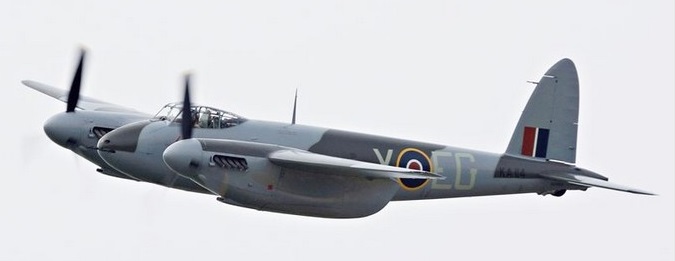
Mosquito FB.26 KA114
On 4 October 1944 the US 8th Air Force Headquarters announced that for several days the German Luftwaffe had been using allied Mosquito and Mustang aircraft furnished with German national emblems. On 3 October 1944 a Mosquito flown by Germans was shot down near Aachen. Aerial combats had taken place over Holland between allied and German Mustang fighters. These machines in German hands were aircraft which had been forced to land behind German lines.
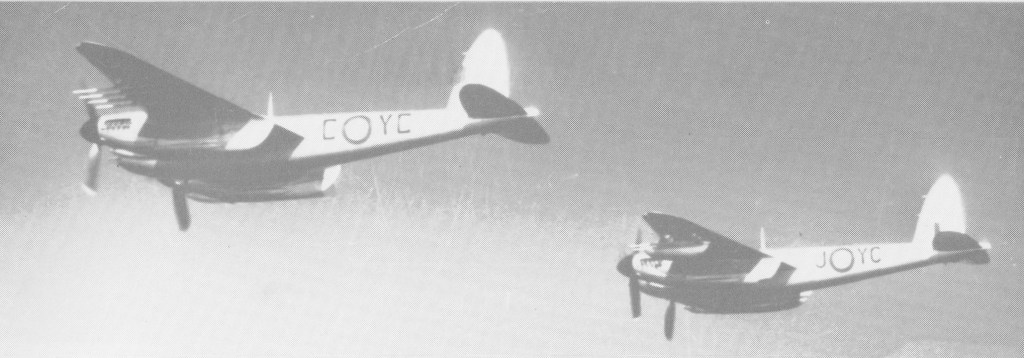
The Royal Navy operated a number of Mosquito FB.Mk VI and T.Mk 3 land-based aircraft in the anti-ship attack and trainer roles, but its most important type was the Sea Mosquito TR.Mk 33 carrierbome torpedo and reconnaissance fighter. This model first flew in November 1945 and entered service in August 1946. The variant was based on the FB.Mk VI with larger propellers, American radar, and naval features such as fold¬ing wings and an arrester hook. With the Second World War over, deliveries of this model totalled just 50, though there were also six examples of the related Sea Mosquito TR.Mk 37.
On New Year’s Eve 1944, the RAF Mosquitos of 627 Squadron carried out another precision raid. This time the target was Gestapo Headquarters in Oslo. Forty-four Mosquitos badly damaged the buildings, destroying many German documents.
On the night of 14-15 June 1944 was the first time a V-1 flying bomb was shot down by an aircraft. An RAF Mosquito of 6-5 (County of Warwick) Squadron, flown by Lt. J.G. Musgrave and Sgt. F.W. Samwell, shot down a ‘doodlebug’ over the Channel.
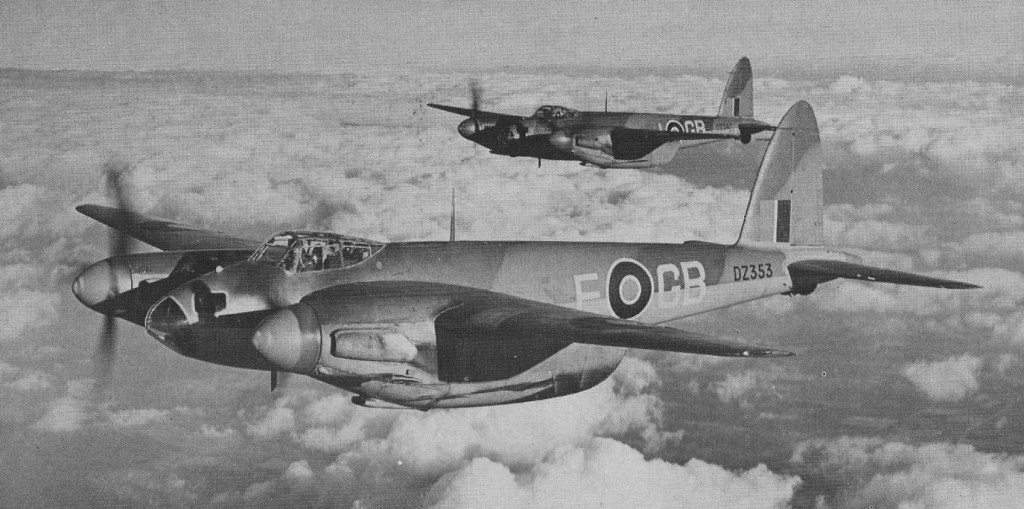
The availability of two-stage two-speed supercharged versions of the Merlin led to the introduction of numerous new Mosquito bomber and PR versions but, apart from their use in the high-altitude NF Mk XVs, these engines were not introduced in a fighter variant until the spring of 1944, when the Mosquito NF Mk 30 appeared. This night fighter had the same “universal” radome as the NF Mk X1X, together with 1,680 hp Merlin 72 engines (in the first 70 production examples) or 1,710 hp Merlin 76s (in the other 460 built). First Mk 30 flew in March 1944 and operational service began in June 1944 with No 219 Squadron for home defence, other squadrons using this type for long-range escort of Bomber Command formations attacking Germany in 1944/45.
Mosquito night fighters
The PR.34 differences from earlier machines appear in an altered canopy, that has an astrodome in addition to the bulged side windows and vee-windscreen found on the bomber version. The engine cowlings feature an enlarged chin intake and the fuselage belly has a distinct bulge. The aircraft also features the paddle-bladed propellers that give the late series of this type such an air of purpose.
On the night of 2-3 May 1945, the RAF flew its last raid on Germany when 125 Mosquitos of 608 Sqn dropped 174 tonne of bombs on the harbour at Kiel. The crews met no opposition and all aircraft came back.
On 12 March 1945 the last bomber variant of the Mosquito, the B35, made its first test flight. The war had ended before it could be used operationally, but it entered service with the post-war Royal Air Force and served as a bomber until the beginning of 1954.
Some Mosquito B35s were converted for other duties including target-towing and in this role they continued in service until 1963.
The Mosquito NF Mk 36 was similar but had 1,690 hp Merlin 113s; the first example flew in May 1945 and 163 were delivered, up to March 1947. The Force Aérienne Beige acquired sufficient to equip two squadrons after RAF service, these remaining in service until the mid ‘fifties. The final fighter version of the Mosquito was the NF Mk 38, differing from the Mk 36 in having British Al Mk X1 radar in place of American Al Mk X and Merlin 113 / 114 engines, Of 101 built, 54 were supplied to the Yugoslav Air Force in 1950 and the others were scrapped.
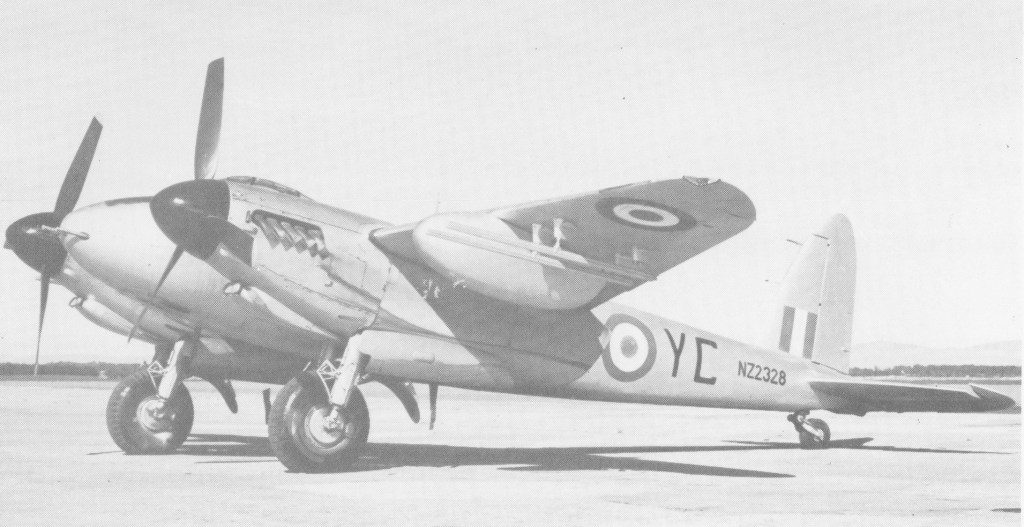
The Mosquito T.43 is an Australian built dual control model similar to the T.3 but with Packard Merlin engines and retaining its armament of four .303 machine guns and four 20mm cannon.
Other versions were Sea Mosquito TR.Mk 33 (initial model with American ASH surface search radar), Sea Mosquito TR.Mk 37 (derived model with British ASV surface search radar), and Mosquito TT.Mk 39 (naval target-tug model based on the B.Mk XVI bomber).
Towards the end of the war Mosquito units were averaging one aircraft loss per 2,000 sorties – by far the lowest figure recorded by Bomber Command. Mosquito bombers, which had entered service carrying a 907kg bomb load, were later to carry a 1800kg block-buster in a bulged bomb bay. Mosquito fighters were to distinguish themselves in fighter-bomber, anti-shipping and night-fighter roles, and were to destroy some 600 V-1 flying-bombs in the defence of Britain. For reconnaissance duties the Mosquito was the RAF’s major long-range aircraft in this category, serving in Europe, Burma and the South Pacific. Including 1,342 Mosquitoes built in Australia and Canada, total construction was 7,785 aircraft when production ended in November 1950. 6,710 were built during WW2.
Eighty-nine were ordered by the RNZAF to re-equip 1946-55 but the bulk were never put into service.
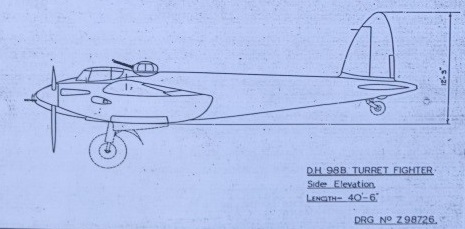
Specification F.18/40 was originally written for a fixed gun two-seat night fighter to replace the BP Defiant, dated 10/11/1940, but on 9 December a correction was made in that armament was changed to incorporate a ‘dorsal power-operated turret’.
de Havilland was asked to examine the spec, even though the firm was not invited to tender to it. The result was the two turret fighter Mosquitoes, the fourth prototype W4053 built at Salisbury Hall and flown from there to Hatfield with the turret fitted on 14 September 1941, and W4073, first flight 5 December from Hatfield.
turret equipped Mosquito
The turret was to be a Bristol B.11 four-gun turret, which was designed for the Bristol Beaumont bomber project, and was very light and compact.
DH also did much research into Mosquitos fitted with turrets as a result, to discover that a considerable amount of performance was lost as a result of the installation. The two turret fighter Mosquitos, after having their turrets removed, went on to become the prototype T.III trainers.
turret equipped Mosquito
W4050 July 1941
The prototype W4050 was fitted with a mock up turret for aerodynamics trials in July 1941. In September 1941 the fourth prototype Mosquito, W4053, which was the first prototype turret fighter (the third prototype, W4052 was the first night fighter NF.II, built to F.21/40), flew for the first time, but with a mock up turret only.
By then the decision had been made not to continue with the turret fighter, although a second prototype turret fighter was finished, W4073, in December 1941. This aircraft and W4053 became the prototypes of the T.III trainer variant once the turret fighter was cancelled.
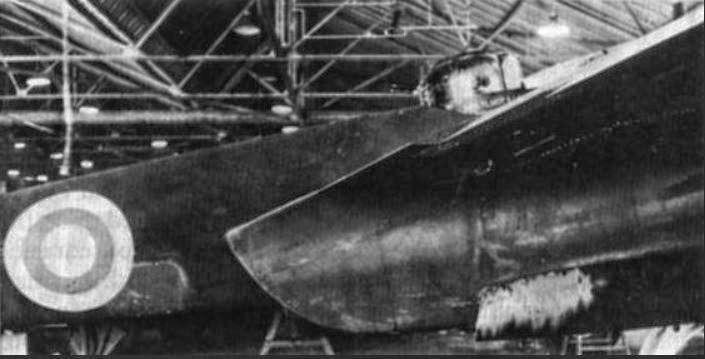
This faint vertical line on the canopy of the prototype shows where the fairing for the turret mock up rubbed against the canopy. Within the structure are four mounting bolts where the turret was fitted.
In 1949 Mosquitos of No.540 PR Squadron carrying a pilot and a navigator normally used the standard F.52 camera with two of these units arranged for split cover and a third rear unit for vertical photography. The F.52 can be fitted with lenses of various focal length, but normally 20in or 36in units; the picture size is 8.5in x 7in. and the magazine holds film for 500 exposures.
For aerial survey work, 6in K.17 cameras were used giving a 9in x 9in picture.
Engines: 2 x 1,680 hp Rolls Royce Merlin 72. Length 41.5 ft. (12.65 m.). Wing span 54.2 ft. (16.5 m.) Weight empty 15,510 lb. (7,035 kg.) Crew: 2. Max. bomb load: 4,000 lb. (1,800 kg.) Max speed 408 mph (656 kph) Ceiling 37,000 ft. (11,000 m) fully loaded Range 1,370 miles (2,200 km.) Stall flaps down and light: 90 knots, 119 knots flaps up and at gross weight Vmc: 185 knots at full power and 175 knots at climb power.
Prototype Wingspan: 52 ft 6 in
PR.I Unarmed reconnaissance Wingspan: 54 ft 2 in
F.II Night fighter Engines: 2 x Rolls-Royce Merlin 21, 1230 hp Seats: 2 side-by-side Armament: 4 x 20mm Hispano cannon 300 rds / 4 x 0.303 Browning 2000 rds each
T.III Dual control trainer First flown January 1942 Last delivery 1949 Engines: 2 x Rolls-Royce Merlin 21, 1230 hp
B.IV Unarmed bomber Engines: 2 x Rolls-Royce Merlin 21, 1230 hp Bombload: 4 x 500 lb / 227 kg Later bulged bomb-bay: 4000 lb / 1814 kg
Mosquito FB Mk VI Engine: 2 x Rolls-Royce Merlin 25, 1208kW / 1,635 hp Props: 12 ft 0 in (3.66 m) dia 3 blade. Max take-off weight: 10115 kg / 22300 lb Empty weight: 6486 kg / 14299 lb Wingspan: 16.51 m / 54 ft 2 in Length: 12.47 m / 40 ft 11 in Height: 4.65 m / 15 ft 3 in Wing area: 42.18 sq.m / 454.02 sq ft Wing loading: 47.15 lb/sq.ft / 230.0 kg/sq.m Max. speed: 583 km/h / 362 mph at 13,000 ft (3,960 m) Cruise speed: 523 km/h / 325 mph Service Ceiling: 10060 m / 33000 ft Initial climb rate: 2500.00 ft/min / 12.70 m/s Range: 2655 km / 1650 miles Endurance: 7 hr Armament: 4 x 20mm Hispano cannon, 4 x 7.7mm Browning machine guns Bomb load: 4 x 250 lb / 113 kg – later 2 x 250 lb / 113 kg & 2 x 500 lb (2,000 lb / 900kg) Crew: 2 No built: 2584
Mk VI Engine: 2 x Rolls Royce Merlin XXX, 1,710 hp. Max level speed of 407 mph (655 km/h) at 28,000 ft (8,535 m). Wing span: 54 ft 2 in (16.51 m). Length: 40 ft 6 in (12.34 m). Height: 15 ft 3 in (3.51 m). Max TO wt: 22,300 lb (10,115 kg)
B.VII Canadian-built – used in North America only
PR.VIII Reconnaissance Engines: 2 x Rolls-Royce Merlin 61
B.IX Bomber Engines: 2 x Rolls-Royce Merlin 72, 1680 hp Bombload: 4000 lb
PR.IX Reconnaissance – First flew July 1943 Engines: 2 x Rolls-Royce Merlin 72, 1680 hp
NF.XII Night fighter F.II with AI Mk.VIII radar Engines: 2 x Rolls-Royce Merlin 21, 1230 hp Seats: 2 side-by-side Armament: 4 x 20mm Hispano cannon 300 rds
NF.XIII As Mk.XII but new build Aug 1943 Mk.VI wing
NF.XV High altitude pressurised fighter Wing span: 59 ft Radar: AI Mk.VIII
Mk.XVI pressurised cockpit Engines: 2 x Rolls-Royce Merlin 72, 1680 hp or Merlin 74 or 77, 1710 hp Armament: 4 x 0.303 Browning mg Bombload: 4000 lb
NF.XVII Radar: AI Mk.X or SCR 720 Armament: 4 x 20mm, 500 rds each
Mk.XVIII Role: Fighter-bomber Wingspan: 54 ft 2 in Length: 40 ft 10.75 in Max speed: 380 mph at 13,000 ft Range: 1270 miles Armament: 1 x 57mm Molins gun, 4 x .303 in Bowning mg Bombload: 2 x 500 lb bomb
FB.XVIII Coastal Command fighter Armament: 1 x 57mm 6-pounder Molins, 24 rds / 4 x .303 Bowning mg Bombload: 8 x 60 lb rockets or bombs
NF.XIX Engines: 2 x Rolls-Royce Merlin 25, 1640 hp Radar: AI Mk.VIII or SCR 720
B.XX Canadian-built B.IV USAAF designation F-8
FB.21 Canadian-built Engines: 2 x Packard V-1640 Merlin
T.29 Canadian-built Engines: 2 x Packard V-1640 Merlin
Mk.XXX Engines: 2 x Rolls-Royce Merlin 76, 1710 hp
NF Mk 30 Based on Mk.XIX Max speed, 338 mph (544 km h) at sea level and 424 mph (682 kmh) at 26,500 ft (8077 m) Initial climb, 2,250 ft/min (11,4 m/sec) Range, 1,180 mls (1 900 km) Empty weight, 15,156 lb (6880 kg) Loaded weight. 21,600 lb (9806kg) Span, 54 ft 2 in (16,51 m) Length, 41 ft 6 in (12,64 m) Height, 15 ft 3 in (4,65 m) Wing area, 450 sq ft (41,81 sq.m).
Mk.32 Engines: 2 x Rolls-Royce Merlin 25, 1640 hp
PR.32 Extended-span reconnaissance Engines: 2 x Rolls-Royce Merlin 113/114, 1690 hp
Sea Mosquito TR.Mk 33 1st RN Sea Mosquito Folding wings Engines: two 1,640-hp (1,223-kW) Rolls-Royce Merlin Prop: 4 blade Maximum speed 385 mph (620 kph) at 13,500 ft (4,115 m) Initial climb rate 3,000 ft (914 m) per minute Service ceiling 30,000 ft (9,145 m) Range 1,260 miles (2,028 km) Empty weight: 17,165 lb (7,786 kg) Normal take¬off 22,500 lb (10,206 kg) Wing span 54 ft 2 in (16.51 m) Length 42 ft 3 in (12.88 m) Height 13 ft 6 in (4.11 m) Wing area 454.0 sq ft (42.18 sq.m) Armament: four 20-mm cannon, 2,000 lb (907 kg) bombs or one 18-in (457-mm) torpedo. Radar: ASH Equipment: arrestor hook, JATO boost
MK.34 Strategic reconnaissance Pressurised cabin Engines: 2 x Rolls-Royce Merlin 113/114, 1690 hp Fuel capacity: 1269 Gal (200 gal drop tanks)
MK. 35 Engines: 2 x Rolls-Royce Merlin 113/114, 1690 hp
Mk.36 Engines: 2 x Rolls-Royce Merlin 113/114, 1690 hp Wingspan: 54 ft 2 in / 16.52 m Length: 44 ft 6 in / 13.57 m Max speed: 404 mph / 646 kph Armament: 4 x .303 Browning MG, 4 x 20 mm Hispano cannon Crew: 2 Radar: AI Mk.X
TF.37 Torpedo fighter Engines: 2 x Rolls-Royce Merlin 113/114, 1690 hp Radar: AI/ASV Mk.XIII







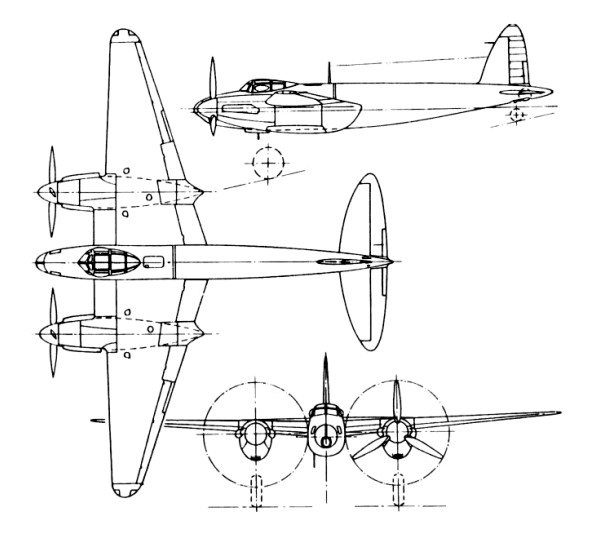
 All Aero