The EC 635 Military version of the EC 155 mockup was a conversion of first preproduction EC 135 (D-HECX). Offered (unsuccessfully) to South Africa and unveiled at Aerospace Africa Air Show on 28 April 1998. First customer was Portuguese Army, which ordered nine EC 635T1s on 22 October 1999 for delivery from June 2001. However, these retrospectively cancelled on 14 August 2002, following delay in post-delivery modifications; all sold to Jordan which, in March 2003, increased its order to 16.
The EC 635 underwent testing with FN Herstal HMP 400 12.7mm machine gun, Giat NC621 20mm gun and 12-round 70mm rocket launcher.
EC-635 D-HECM (c/n 0529), the first of the type for the Swiss Air Force, first flew, from the Donauwörth facility in Germany, on 23 May 2007.
France and Germany agreed in 1984 to develop a common combat helicopter, and Eurocopter Tiger GmbH was formed on 18 September 1985 to manage development and manufacture for French and German armies. It was not a full member of Eurocopter because it was working on a single government contract. Executive authority for programme is DFHB (Deutsch Franzosisches Hubschrauberburo) in Koblenz; procurement agency is German government BWB (Bundesamt fur Wehrtechnik und Beschaffung).
The original 1984 MoU was amended 13 November 1987; FSD approved 8 December 1987; main development contract awarded 30 November 1989, when name Tiger (Germany)/Tigre (France) adopted.
Original partners require three versions in two basic configurations with about 80% commonality: U-Tiger is basis of the UHT and ÍÀÑ, both with mast-mounted sight and Trigat missiles; HCP (Helicoptere de Combat Polyvalent) is basis of the HAP (roof sight and turreted gun). Other variants proposed to meet export requirements.
Tigre HAP: Helicoptere d’Appui et de Protection; name Gerfaut dropped late 1993; escort and fire support version for French Army; armed with 30mm Giat AM-30781 automatic cannon in undernose turret, with 150 to 450 rounds of ammunition; four Mistral air-to-air missiles and two pods each with twenty-two 68mm unguided TDA rockets delivering armour-piercing darts, mounted on stub-wmgs, or 12-round rocket pod instead of each pair of Mistrals, making total of 68 rockets; roof-mounted sight, with TV, FLIR, laser range-finder and direct view optics sensors; image intensifiers integrated, in helmets; and extended self-defence system. ÍAÐ configuration was approved by late 1998, permitting òóðå qualification in December 2002. Deliveries from Marignane in 2003; final aircraft due in 2010.
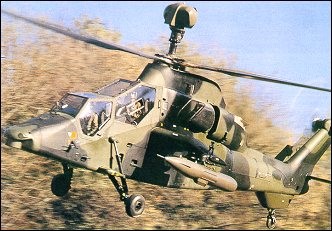
UHT: Unterstutzangshubschrauber Tiger (previously designated UHU); German Army multirole ‘utility’ or muttirole anti-tank and fire-support helicopter for delivery from 2002; replaces dedicated anti-tank PAH-2 Tiger; type qualification due in December 2002; final assembly at Donauwörth. Underwing pylons for HOT 3 or (from 2006) Trigat missiles, Stinger self-defence missiles, unguided rockets, gun pod and extended self-defence system; mast-mounted TV/FLIR/laser ranger sight for gunner; nose-mounted FLIR for piloting. A mid-life upgrade for the UHT may integrate the Mauser 30mm gun in a chin turret which traverses ±140° in azimuth and from +20 to -45° in elevation.
Tigre ÍÀÑ: Helicoptere Anti-Char; anti-tank variant for French Army; final assembly at Donauwörth. Type qualification due in third quarter of 2011; same weapon options (except Mistral AAM in place of Stinger), mast-mounted sight and pilot FLIR system as UHT. A mid-life upgrade to the HCP could see addition of a mast-mounted automatic air surveillance and warning system, in the form of DAV pulse Doppler radar, together with HUMS and an IR jammer.
Five development aircraft built, including three unarmed aerodynamic prototypes, used also for core avionics testing (PT1, 2 and 3), one (PT4) in HAP (initially called Gerfaut) configuration and one (PT5) as UHT prototype; PT1 rolled out 4 February 1991; first flight 27 April 1991; fifth prototype flew on 21 February 1996, at which time the first four aircraft had accumulated 1,090 flying hours; total of 2,869 hours flown by five prototypes up to June 2001. Germany confirmed purchase of full 212 required, 1994, having considered cut to 138, but later reconsidered.
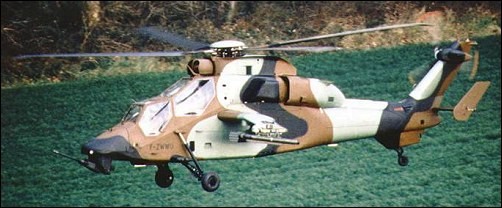
PT1/F-ZWWW: Aerodynamic prototype; basic avionics; first flight 27 April 1991. Successively fitted with aerodynamic mockups of mast-mounted and roof-mounted sights, nose-mounted gun and weapon containers. Relegated to ground fatigue testing and static display in early 1996 on completion of flight programme. Flown 502 hours.
PT2/F-ZWWY: HAP aerodynamic configuration; full core avionics; rolled out 9 November 1992; first flight 22 April 1993. Used for radar cross-section and detectability tests. Retrofit with HAP systems completed in November 1996; redesigned PT2R. Mistral launch trials at Landes ranges 14/15 December 1998; Technical assessment by French Army at Valence between 17 May and 3 June 1999; rocket qualification, June 1999. Used for HAP version qualification (redesignated PT2R2) at Landes test centre between 4 April and 12 May 2000. Redesignated PT2X in 2001 to serve as multimission demonstrator, adding LFK/ SAGEM sighting system for HOT 3 anti-tank missiles in addition to original Mistral missiles and rockets. Deck landing trials, May 2002, aboard FS Siroco, an amphibious landing ship.
PT3/9823: Full core avionics (including navigation and autopilot); first flight (as F-ZWWT) 19 November 1993. Retrofit with UHT systems began in February 1997; redesignated PT3R; Euromep Ñ (see Avionics) from late 1997. ÏÎÒ launches with mast sight at extreme range in night and smoke conditions, June 1999; hot weather trials at Bateen AB in Abu Dhabi September 1999. Moved back to France for ÍÀÑ development,
PT4/F-ZWWU: HAP aerodynamic configuration and avionics (including roof sight, HUD and Topowl helmet sight; first Tiger with live weapons system); first flight 15 December 1994. Sighting system trials early 1995; Giat cannon trials (15 ground-based tests) completed at Toulon, April 1995; full testing began at CEV Cazaux, 21 September 1995 and, by late November, had demonstrated airborne cannon firing and launch of Mistral AAM (without seeker); by 1 January 1997 had fired eight Mistrals, 3,000 cannon rounds and 50 rockets; 1997 trials included two more Mistrals, rockets and tests of gun controls. Painted in three-tone disruptive camouflage. Winter trials in Sweden, early 1997 with skid/skis landing gear. Flown 296 hours to 1 December 1997; crashed during night low-level evaluation by Australian Army 17 February 1998.
PT5/9825: Full UHT avionics; first flight 21 February 1996. Undertook German Army weapon trials (Stinger, HOT 2 and 12.7mm podded gun) in 1997 including the firing of six HOT 2s using Euromep Osiris mast-mounted sight. Retrofitted as PT5R with production-standard weapon system; first flight 8 October 1999.
PT6 and PT7: Static test airframes for fatigue and crash-resistance trials.
PS1/F-ZVLJ: Ðòå-series HAP built at Marignane on production tooling; laid down in third quarter of 1998; first flight 21 December 2000. Tasks include validation of production methods and planned production configuration.
UHT S01/9826: First true production aircraft; planned to fly on 1 March 2002, but not rolled out until 22 March; first flight 2 August 2002; used for six-month techeval/opeval trials, replacing PT5R.
HAP S01: First production French Tiger, first flight (F-ZKDB) 26 March 2003; delivery to French Army in July 2003.
Industrialisation phase brought forward by two years to strengthen export prospects and Franco-German MoU signed 30 June 1995; timetable then was first deliveries in 1999 to France (approximately 10) and for export, but France announced spending moratorium in November 1995, postponing authorisation of further funding commitments until signature of a FFr2.5 billion (DM733.6 million) production investment contract on 20 June 1997. Deliveries then expected in 2001, but further delayed to July 2003 (for HAP; 2011 for ÍÀÑ) by May 1996 defence plan, which envisaged procurement of only 25 Tigres in 2000-2002 budgets.
In October 1996, Germany announced a 12-month delay in launching Tiger production because of funding constraints. However, the government planned to recoup lost time by accelerating production when eventually begun, maintaining in-service date (ISD) of 2001 and having 50 delivered by 2006, after which the manufacturing tempo would be reduced. However, by 1999, first UHT delivery planned in December 2002. France indicated in early 1997 that it would be prepared to see a single Tiger production line located at Donauwörth in Germany which, combined with other economies, would reduce French expenditure by FFr13.5 billion, but a second assembly line at Marignane was subsequently confirmed. Production investment agreed June 1997.
On 20 May 1998, France and Germany signed a commitment to order an initial joint batch of 160 Tigers. However, planned late 1998 placing of contracts was delayed by requirement of new German government to conduct a defence review; options included delaying ISD; or reducing numbers; or even cancelling UHT and procuring French HAP version. Production contract was finally signed on 18 June 1999 for the full 160 aircraft; first deliveries in 2002. HAP deliveries to include two in 2003, eight in 2004 and 10 per year in 2005-10; first production aircraft (9826) flew in Germany, 2 August 2002. Production of the first batch of 320 engines (plus 12 spares) began during 2000, and will continue through 2011. June 1999 contract also formalised German contract change from PAH2 to UHT and French change from HAP to HAP-F (Finalise).
Joint team at Marignane is flight testing basic helicopter, updating avionics during trials, and testing HAP variant; similar team at Ottobrünn is qualifying basic avionics, Euromep mission equipment package, and integrating weapons system. Rotor downwash problems resulted in trial forward positioning of horizontal stabiliser; by mid-1994 definitive solution adopted of reversion to original position, but halving area. By January 1998, the design had been frozen, and the development programme was more than 90% complete.
First export order for Tiger confirmed 14 August 2001, when Australia announced selection to meet AIR 87 requirement. Contract signed 21 December 2001 for 22 helicopters. MoU on co-operation and exchange of information, to lead to production and delivery, signed by Eurocopter and Australian Defence Science and Technology Organisation on 12 July 2002.
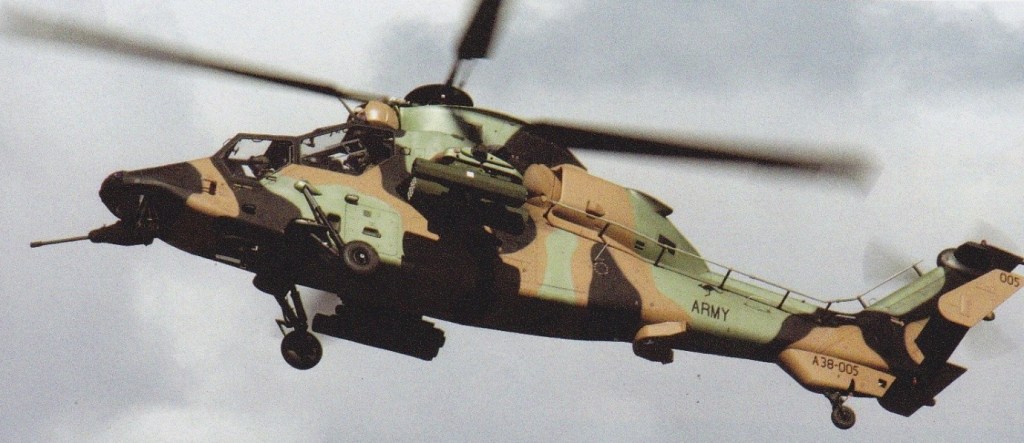
The first locally-assembled Eurocopter Tiger for the Australian Army, A38-005, was handed over at Brisbane on 18 July 2005.
Tiger development cost, shared equally by France and Germany, reported DM2.2 billion. Production tooling cost FFr2.6 billion (US$500 million) (1996). Unit cost (1996) for UH estimated as US$ 11 million, including launchers and all government-furnished equipment. Initial batch of 160 assigned FFr21.5 billion, of which FFr13 billion for 80 German helicopters and FFr8.5 billion for 80 French (1998). Australian programme unit cost US$30.6 million (2001).
Original requirement was for 427 (France 75 HÀÐ and 140 ÍÀÑ, Germany 212 PAH-2); UHU (later UHT) version substituted for PAH-2s in 1993; French order amended by 1994 to 115 HAP and 100 ÍÀÑ but may be reduced to overall total of 180; in mid-2001 French Army expressed preference for multirole Helicoptere d’Appui-Destructiou (HAD) version in place of two subvariants now on order. Germany committed to 212, of which 112 to be funded between 2001 and 2009; initial commitment of 20 May 1998 confirmed 80 each by France (70 HAP, 10 ÍÀÑ) and Germany (80 UHT), as agreed by Franco-German Security Council on 9 December 1996. By 2002, official German sources suggesting full requirement only 110 and Eurocopter resigned to total of 240 between two launch partners. Germany’s Tigers are required to equip four 48-aircraft regiments, each supporting an Army division, first being established in 2009-11. A joint training school at le Luc is being established as the Ecole Franco-Allemand, or EFA with a Thomson Training and Simulation/STN Atlas aircrew training system, including six-axis motion simulators and wide-angle visual systems. Training course lasts 28 weeks for a crew chief, or 19 weeks for a pilot. Fleet of 14 German and 14 French Tigers will be assigned by 2006, with eleven simulators. In October 2000 there were reports that the German MoD was considering reducing its Tiger buy to 100 helicopters.
A tandem-seat design with pylon-mounted armament, FEL (fibre elastomer) main rotor has infinite life except for inspection of elastomeric elements at more than 2,500-hour intervals; hub consists of titanium centrepiece (including duct for mast-mounted sight) with composites starplates bolted above and below; flap and lead/lag motions of blades allowed by elastic bending of neck region and pitch change by elastic part of elastomeric bearings; lead/lag damping by solid-state viscoelastic damper struts faired into trailing-edge of each blade root; equivalent flapping hinge offset of 10.5% gives high control power; SARIB passive vibration damping system between transmission and airframe; three-blade Spheriflex tail rotor has composites blades with fork roots; built-in ram air engine exhaust suppressors.
Flying controls are fully powered hydraulic controls by SAMM/Liebherr; Labinal/Electrometal servo trim; horizontal tail mounted beneath tail rotor; autopilot is part of basic avionics system.
The structure is 80% CFRP, block and sandwich and Kevlar sandwich; 6% titanium and 11% aluminium; airframe structure protected against lightning and EMP by embedded copper/bronze grid and copper bonding foil; stub-wings of aluminium spars with CFRP ribs and skins; titanium engine deck may be replaced by GFRP; airframe tolerates crash impacts at 10.5m/s and meets MIL-STD-1290 crashworthiness standards; titanium main rotor hub centrepiece and tail rotor Spheriflcx integral hub/mast; blade spars filament-wound; GFRP, CFRP skins and subsidiary spars and foam filling. French plants building transmission, tail rotor, centre-fuselage (including engine installation), aerodynamics, fuel and electrical systems, weight control, maintainability, reliability and survivability; Eurocopter Deutschland responsible for main rotor, flight control and hydraulic systems, front and rear fuselage (including cockpits), prototype assembly, flight characteristics and performance, stress and vibration testing and simulation.
Th landing gear is a tail wheel type, non-retractable, with single wheel on each unit. Designed to absorb impacts of up to 6m/s. Main gear by Messier-Bugatti, tail gear by Liebherr Aerotechnik.
Power is from two MTU/Rolls-Royce/Turbomeca MTR 390 modular turboshaft engines mounted side by side above centre-fuselage, divided by armour plate ‘keel’ (engine first flown in Panther testbed 14 February 1991); power ratings are maximum T-O 958kW, super emergency 1,160kW, maximum continuous 873kW. LHTEC has proposed the T800-801 as a potential alternative power plant for export variants of the Tiger. Self-sealing crashworthy fuel tanks, with explosion suppression and with non-return valves, which minimise leakage in a crash; total capacity 1,360 litres. Provision for two external tanks, one on each inboard pylon, each of approximately 350 litres capacity. Gearbox has specified 30 minutes’ dry running capability (demonstrated 65 minutes, November 1994).
The crew of two is in tandem, with pilot in front and weapons system operator at rear; full dual controls; both crew members can perform all tasks and weapon operation except that anti-tank missile firing only available to gunner. Armoured, impact-absorbing seats; stepped cockpits, with flat-plate windscreens and slightly curved non-glint transparencies.
Redundant hydraulic, electrical and fuel systems. Primary power generation by two 20kVA alternators; DC power generation by two 300A 28V transformer/rectifiers and two 23Ah Ni/Cd batteries.
Dual redundant AFCS provides four-axis command and stability augmentation. Basic AFCS modes: attitude hold, heading hold. Higher AFCS modes: Heading/acquire/hold, barometric altitude capture/hold, altitude acquire, airspeed hold, vertical speed acquire/hold, nav coupling, radar height hold. Doppler hover hold, line of sight acquisition/ hold. Other AFCS functions: gun recoil force compensation, axis decoupling and tactical mode (follow-up trim on override of break-out forces).
Basic or core avionics common to all three versions include bus/display system, com radio (French and German systems vary), autonomous nav system and radio/DoppIer navaids, Thales TSC 2000 IFF Mk 12, NH 90-based ECM suite (including laser warning) and AFCS, all connected to and controlled through redundant MIL-STD-1553B data highway. Flight: Navigation system, by Thales, Teldix and EADS, is fully redundant; system contains two Thales PIXYZ three-axis ring laser gyro units, two air data computers, two magnetic sensors, one Teldix/BAE Canada CMA 2012 Doppler radar, a radio altimeter and GPS providing data to Dornier EuroGrid digital map system; these sensors also provide signals for flight control, information display and guidance; integrated duplex AFCS by Thales and Nord Micro; AFCS computers produced by Thales, VDO-Luft and Litef. Instrumentation: Colour liquid crystal flight displays showing symbology and imagery (two per cockpit for flight and weapon/systems information) by Thales and VDO-Luft; each crewman has central control/display unit for inputting all radio, electronic systems and navigation selections; digital map display system by Dormer and VDO-Luft (incorporating NH 90’s Eurogrid map generation system); engine and systems data are fed into the databus for in-flight indication find subsequent maintenance analysis. BAE Systems Knighthelm fully integrated day and night helmet ordered for German Tigers; French Tigres have similar Thales Topowl helmet-mounted sights, with integrated night vision (image intensifiers), FLIR, video and synthetic raster symbology. Mission: Euromep (European mission equipment package) includes SATEL Condor 2 pilot vision subsystem (PVS), air-to-air subsystem (Stinger or Mistral), mast-mounted sight and missile subsystem and Euromep management system all connected to separate MIL-STD-1553B data highway. Euromep Standard  avionics first flew February 1995 (PT5); Standard Ñ testing began in late 1997 (PT3R). PVS has 40×30° instantaneous field of view (with ±110 x 35° total field of view) thermal imaging sensor steered by helmet position detector giving both crewmen day/night/bad weather vision, flight symbology and air-to-air aiming in helmet-mounted display; mast-mounted sight, gunner sight electronics and gunner’s head-in target acquisition display and ATGW 3 subsystem connected by separate data highway; HOT 3 missile system also available. Thales armament control panel and fire-control computer.
HAP combat support mission equipment package includes SFIM STRIX gyrostabilised roof-mounted sight (with IRCCD IR channel) above rear cockpit; includes direct view optics with folding sight tube, television and IR channels and laser ranger/designator. Self-defence: EADS C-model EW suite (as in NH 90) is one element in HAP’s fully integrated avionics suite. This has an EADS laser warning receiver, EADS missile launch warning device (Lenkflugkörpersysteme) and Thales EW processor and radar warning receiver. Also chaff and flare dispensers (with up to 144 cartridges, sequenced by a Saphir M system). UH is similar, but with option of fitting IR jammer.
The Tiger has four outboard weapon stations or auxiliary fuel tank. HCP (HAP) options all include one 30mm Giat AM-30781 automatic cannon with up to 450 rounds (traversing from +33 to -30° in elevation and through ±90° in azimuth).
Interest shown by Spain in 25 Tigers to be delivered from 2010; in early 2002, contract discussions reached impasse over R&D funding for specific Spanish multirole HAD variant.
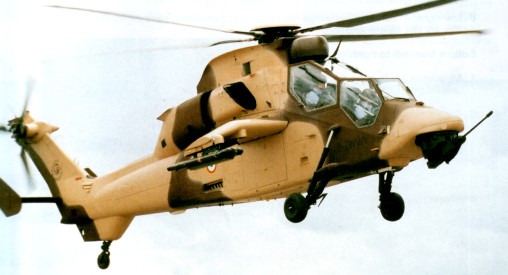
The Tiger was being built in three variants, the PAH-2, HAC and HAP versions to undertake the anti-tank, close support and fighter helicopter roles. The Tiger will form the backbone of the German Heeresflieger anti-tank helicopter fleet (PAH-2) and the French ALAT fleet, undertaking both the antitank (HAC-3) and combat support role (HAP).
The two anti-tank versions (PAH-2/HAC-3) will be almost identical except for some armament, communications and navigation systems. Both versions will be fitted with a mast-mounted sight, nose-mounted thermal imager and helmet-mounted sight/display and can be armed with either 8 x HOT 2/3 or TRIGAT anti-tank missiles, 4 x Stinger or Mistral air-to-air missiles. The HAP escort/attack version is fitted with a roof-mounted STRIX sight and 30mm turret-mounted GIAT AM-30781 cannon, 4 x Mistral air-to-air missiles, 2 x 22 rockets and each stub wing has tip-mounts for additional air-to-air missiles.
Versions built are:
ARH Tiger (HCP): Hybrid Tiger variant to meet Australian Army Air 87 requirement. Based on French HAP, with undernose Giat 30-781 30mm cannon, roof-mounted sight and provision for underwing rocket pods, but with added anti-tank capability, initially with HOT missile then (from 2006) with Trigat AC3G. Australia also requires integration of the AGM-114 Hellfire ATM. Maximum mission weight of 6,100 to 6,300kg. A$1,300 million (US$674 million) contract for 22 signed 21 December 2001. First four from European production; remaining 18 to be assembled in Brisbane, beginning April 2003. First European deliveries (two) due December 2004; Australian-built deliveries between July 2005 and April 2008.
HCP Tiger (HCP): Export version based on French Army HAP with the same undernose gun turret and roof-mounted sight, HOT 3 and Trigat missiles; Hellfire optional. Strix roof sight (direct view optics optional) and additional laser designator plus video signal interfacing for Trigat operation. Either Mistral or Stinger air-to-air missiles. A mid-life upgrade to the HCP could see addition of a DAV mast-mounted air surveillance radar (pulse Doppler type) or a mast-mounted MMW radar for automatic ground and air surveillance. No gun pod option.
Tigre HAD: Helicoptere d’Appui-Destruction. Multirole version; development cost estimated as ˆ152 million (2002). Offered to Spain. Uprated engines, roof sight for Trigat ATMs.
Tiger T800: LHTEC T800 or CTS800 engines proposed as an engine option for the Tiger. Turkey is sales prospect, as Army has reservations about growth potential of MTR390.
The first two Eurocopter Tiger for the Australian Army were handed over on 15 December 2005. The first four were manufactured in France and remaining 18 assembled by Eurocopter’s Australian Aerospace facility at Brisbane airport. The first of these was flown on 21 December 2005.
Tiger Engine: 2 x MTU/R-R Turbomeca MTR 390, 1267 shp. Instant pwr: 958 kW. Rotor dia: 13 m. Length: 15m. Height: 3.83m. Rotor diameter : 42.651 ft / 13.0 m Fuselage width 1.11m MTOW: 12789.0 lb / 5800 kg. Weight empty : 7276.5 lb / 3300.0 kg Payload: 6000 kg. Max speed: 269 kts. Cruise (armed) 150 knots Cruise (econ) 130 knots De¬sign limit speed 175 knots. Max range: 670 km. Endurance 2 h 50 mm (incl reserve) Ferry range 700 nm (1300 km). HOGE: 10,655 ft. Initial climb rate: 1968.5 ft/min / 10.0 m/s Service ceiling: 13,000 ft / 3960 m. Crew: 2. Typical weapons load: 30mm turreted gun (450 rounds); plus up to 8 HOT (anti-armor) and 4 Mis¬tral (air-to-air) missiles; or 44 rock¬ets and 4 Mistral missiles; or 68 rockets; or two ferry tanks.
Eurocopter Tiger UT Engine: 2 x MTU/R-R Turbomeca MTR 390, 1267 shp. Main rotor diameter: 13.0m Tail rotor diameter: 2.70m Length overall, with rotors turning: 15.80m Fuselage length: 14.08m Height to top of rotor head: 3.84m Height to top of tail rotor disc: 4.32m Width over weapon pylons: 4.53m Internal fuel weight: 1080kg External fuel weight (two tanks): 555kg Mission take-off weight: 5300-6100kg Max take-off weight: 6100kg Cruising speed: 230km/h Range on internal fuel: 800km Range with ferry tanks: 1280km Endurance: operational mission: 2h 50min Endurance: max external fuel: 3h 25min
Eurocopter Tiger HCP Engine: 2 x MTU/R-R Turbomeca MTR 390, 1267 shp. Main rotor diameter: 13.0m Tail rotor diameter: 2.70m Length overall, with rotors turning: 15.80m Height to top of rotor head: 3.84m Height to top of tail rotor disc: 4.32m Width over weapon pylons: 4.53m Empty weight: 4200kg Internal fuel weight: 1080kg External fuel weight (two tanks): 555kg Mission take-off weight: 5300-6100kg Max take-off weight: 6100kg Never-exceed speed: 322km/h Max level speed: 278km/h Cruising speed: 230km/h Range on internal fuel: 800km Range with ferry tanks: 1280km Endurance: operational mission: 2h 50min Endurance: max external fuel: 3h 25min
Eurocopter Tiger HAP Engine: 2 x MTU/R-R Turbomeca MTR 390, 1267 shp. Main rotor diameter: 13.0m Tail rotor diameter: 2.70m Length overall, with rotors turning: 15.80m Height to top of rotor head: 3.84m Height to top of tail rotor disc: 4.32m Width over weapon pylons: 4.53m Internal fuel weight: 1080kg External fuel weight (two tanks): 555kg Mission take-off weight: 5300-6100kg Max take-off weight: 6100kg Never-exceed speed: 322km/h Cruising speed: 230km/h Max rate of climb at sea level: 690m/min Vertical rate of climb: 384m/min Hovering ceiling OGE: 3500m Range on internal fuel: 800km Range with ferry tanks: 1280km Endurance: operational mission: 2h 50min Endurance: max external fuel: 3h 25min
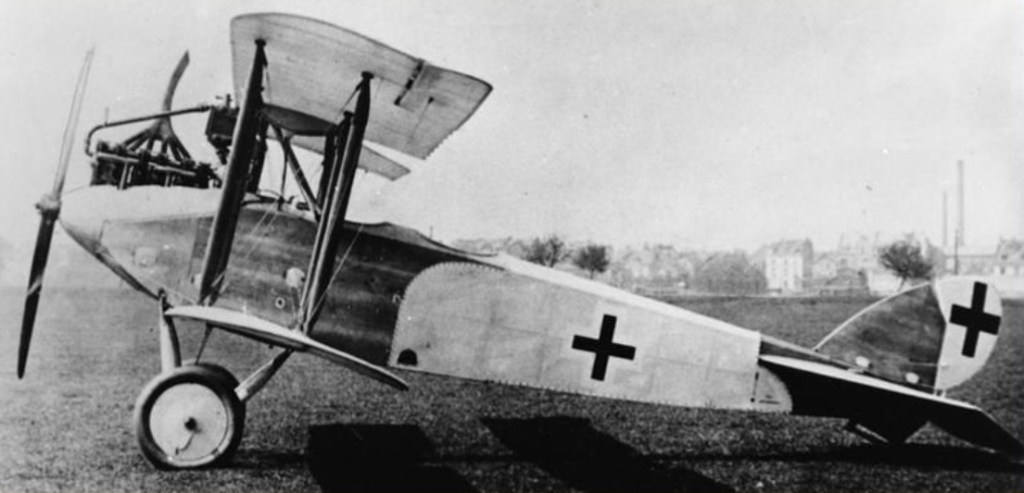
After seeing the success of the French Nieuport 11 at the front, German designer August Euler set about to create a German aircraft based on the Nieuport 17 design. The Euler D.I single-seat fighter first flew in December 1916. It was powered by an 80 hp engine with the Euler patented machine gun on the front.
Two prototypes were recorded as being in service at the front in October 1916, and the German government ordered 50 in the same month. A further 50 were ordered in early 1917, but this order was largely transferred over to the D.I’s successor, the Euler D.II. About 75 were built. The D.I saw very little combat service with the German Empire, being largely used as a fighter trainer for the remainder of the war and retired around 1920.
Euler D.II
The Euler D.II single-seat fighter successor to the Euler D.I was essentially a re-engined Euler D.I, the airframe being virtually unchanged and the power plant being a 100 hp Oberusel U I seven cylinder rotary.
Thirty D.II fighters were ordered by the German air force in March 1917, however due to slow production these were not delivered until December 1917. As a result, the D.II was relegated to the role of a trainer aircraft for the rest of the war and retired in 1918.
Euler D.I Engine: 1 × Oberursel U.O, 60 kW (80 hp) Wingspan: 8.10 m (26 ft 6⅞ in) Length: 5.80 m (19 ft 0¼ in) Height: 2.66 m (8 ft 8¾ in) Wing area: 13.00 m² (139.93 ft²) Empty weight: 380 kg (838 lb) Loaded weight: 600 kg (1,323 lb) Maximum speed: 140 km/h (87 mph) Time to 2,000 m: 12.5 minutes Crew: One Armament: 1 x engine-mounted 7.92-mm machine gun
Euler D I Engine: 80 or 100 h.p. Oberursel U O or U I rotary Span: 8.1 m. (26 ft. 7 in.) Length: 7.12 m. (23 ft. 4 3/8 in.) Height: 2.66 m. (8 ft. 8 3/4 in.) Empty weight: 380 kg. (836 lb.) Loaded weight: 600 kg. (1,320 lb.). Climb to 2,000 m: (6,560 ft.): 12.5 min.
Euler D.II Engine: 1 × Oberursel U.I, 75 kW (100 hp) Wingspan: 7.47 m (24 ft 6 in) Length: 5.94m (19 ft 5⅞ in) Height: 2.75 m (9 ft 0 in) Empty weight: 380 kg (838 lb) Loaded weight: 615 kg (1,356 lb) Maximum speed: 145 km/h (90 mph) Time to 2,000 m: 9.5 minutes Endurance: 1.5 hours Armament: 1 x engine-mounted 7.92mm machine gun Crew: One
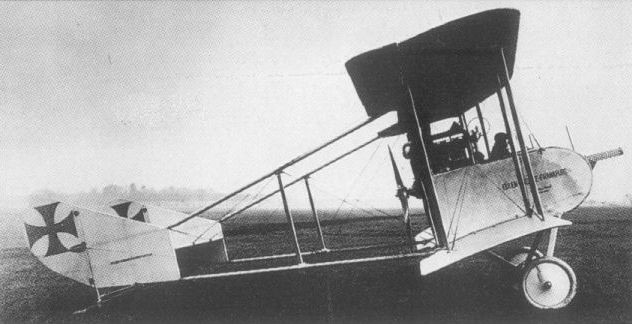
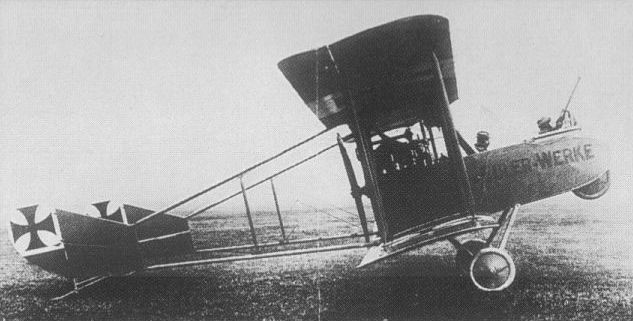
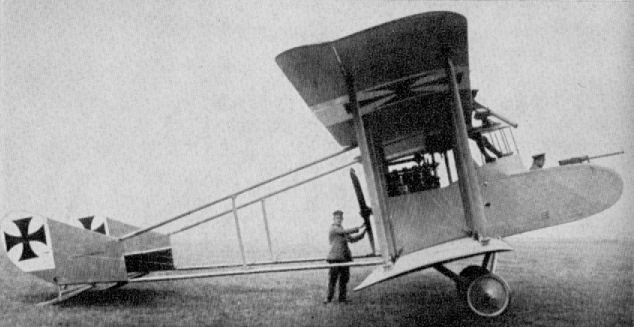
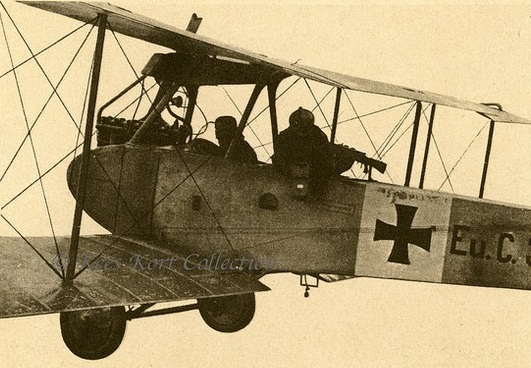
The Euler Type C a reconnaissance aircraft with a pusher engine of 1913-14. The initial form with nose turret of the Euler two-seat fighter of 1915 intended primarily for anti-airship and escort missions.
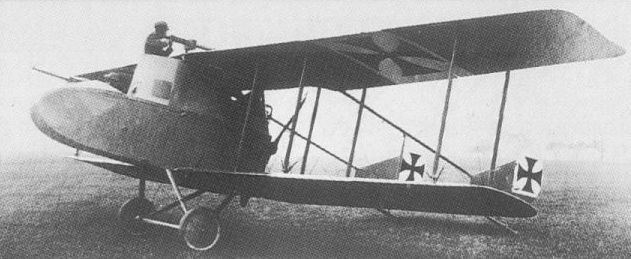
The final form of the Euler two-seat fighter of 1915 with faired, pulpit-like gun position, intended primarily for anti-airship and escort missions.
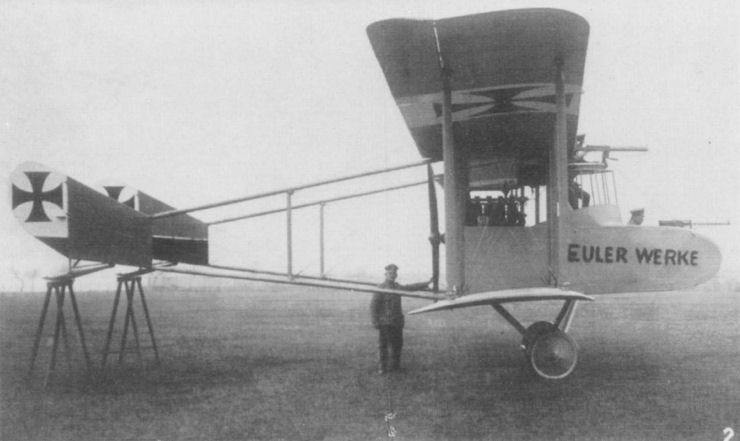
Euler C-type under test in mid-1916: note the armament of two parabellum machine guns. This, along with the Spandau, was a very effective aerial weapon and a success for German machine gun technology. Only one machine was built.
Engine: 160 hp Mercedes D III Span: 14.8 m. (48 ft. 6 3/4 in.) Length: 9.3 m. (30 ft. 6 1/8 in.) Height: 3.2 m. (10 ft. 6 in.) Wing area: 52.6 sq.m. (568 sq.ft.) Empty weight: 492 kg. (1,082 lb.) Climb 3.000 m. (9,840 ft.): 44 min Endurance: 4 hr. Armament: two Parabellum machine-guns
An early wartime reconnaissance type was the BII tractor biplane (built at Frankfurt in late 1914), an early version of which had tricycle landing gear.
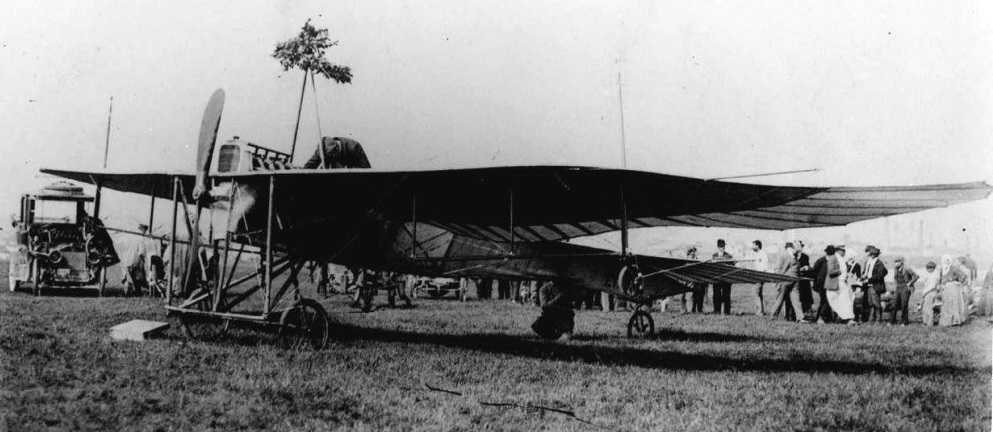
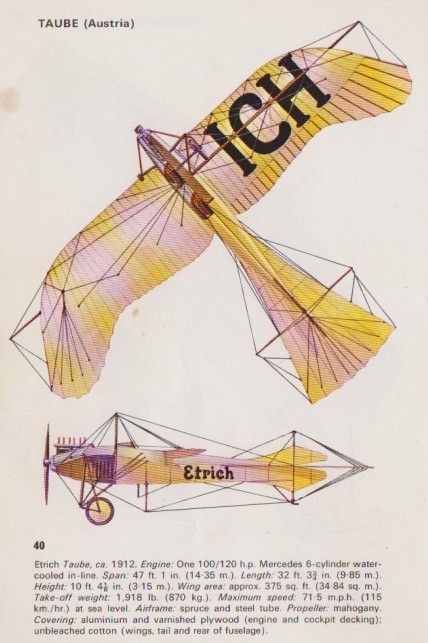
The Etrich Taube was designed by Igo Etrich in 1908 in Austria. After considerable successes, the rights were sold to the German Government, who commissioned Rumpler to produce 20.
These were so successful that the design was standardised for issue to the German Armies.
A training and reconnaissance aircraft, about 500 were ordered from various companies. Those built by Albatros, Gotha and Rumpler had wooden airframes while those produced by DFW and Jeannin had steel structures.
It was built in large scale by Rumpler in Germany and became the first German military aircraft to be used in large scale. A 100hp Mercedes or Argus engine was standard, and no armament was fitted.
The wooden airframe of the Rumpler Taube was fabric covered and wing-warping was used instead of ailerons. The tail surfaces usually comprised a long-chord tailplane ad elevator, fixed fin and a small rudder.
Rumpler 1913 Taube
Taubes were noted for their high flying qualities at the beginning of the War and just before the war began a Rumpler Taube broke the then record by reaching just below 20,000 ft.
Taubes were used operationally in the first nine month of the war, mainly for reconnaissance, and one played a leading role I the Battle of Tannenberg, in East Prussia, by reporting a Russian advance that would have taken the German Army unawares. With clear doping on their fabric covered wings they were relatively invisible at height.
Lt. von Hiddesen dropped five tiny bombs on Paris from a Taube on 30 August 1914, accompanied by a second, piloted by then Lt. Max Immelmann, dropped message inviting the city to surrender.
Rumpler built in 1912-1913 a small number of Taube floatplanes, two with a single float and the others with two floats. It was a pusher, powered by a 100 hp Daimler, and had two floats and a four-blade propeller. The photo was taken at the Johannisthal works in late 1913.
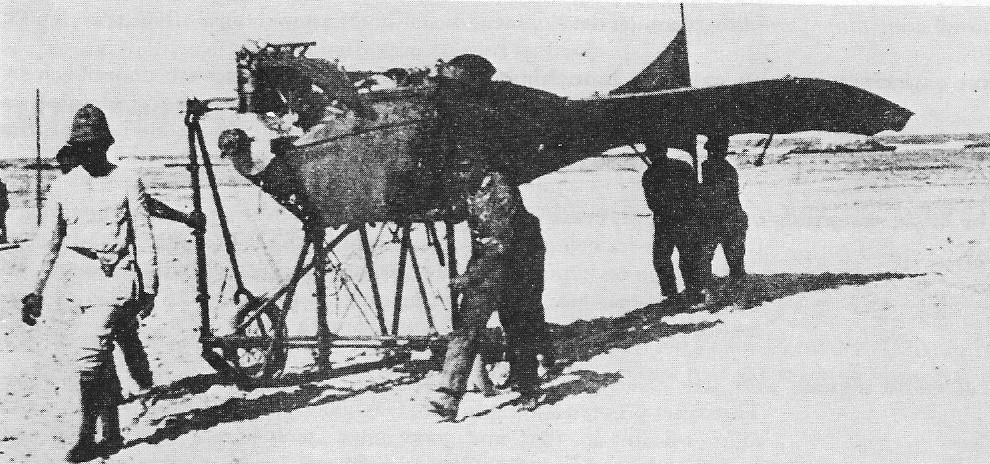
1911 Italian Etrich Taupe in Libya
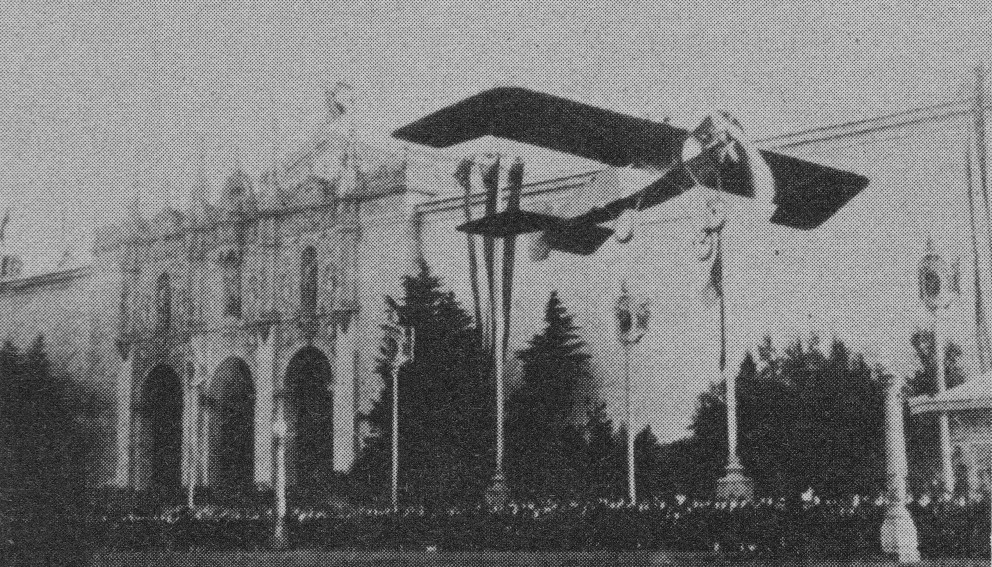
Lincoln Beachy, stunt pilot, took off from the Panama Pacific International Exposition at San Francisco on his fatal flight.
Engine : Argus As I, 99 hp Length: 33.465 ft / 10.2 m Height : 10.499 ft / 3.2 m Wingspan : 45.932 ft / 14.0 m Wing area : 301.392 sq.ft / 28.0 sq.m Max take off weight : 1896.3 lb / 860.0 kg Weight empty : 1323.0 lb / 600.0 kg Max. weight carried : 573.3 lb / 260.0 kg Max. speed : 54 kt / 100 km/h Cruising speed : 49 kt / 90 km/h Wing load : 6.36 lb/sq.ft / 31.0 kg/sq.m Range : 162 nm / 300 km Crew : 2
Rumpler Taube Engine: Mercedes, 100 hp Wingspan: 45 ft 4 in Length: 26 ft 11 in Height: 10 ft 2 in Empty weight: 1323 lb MTOW: 2005 lb Max speed: 74 mph at SL Endurance: 4 hr
Rumpler Taube Engine: Daimler, 100 hp / Austro-Daimler, 120 hp Wing span: 46 ft Wing area: 301 sq.ft Length: 27 ft 3 in Height: 9 ft 9 in Empty weight: 682 lb Loaded weight: 1323 lb Wing loading: 4.3 lb/sq.ft Max speed: 75 mph at SL Crew: 1-2
As chief engineer of English Electric’s Aircraft Division it was W.E.W.(Teddy) Petter’s responsibility to keep looking at new projects. Towards the end of 1946 he spent some time sketching possible configurations for a supersonic aeroplane. It was characterised by sharply swept wings and tailplane and a long slab sided body with two engines one above the other. He had discussions with officials at the Ministry of Supply early in 1947, and was rewarded in May of that year by a study contract for an aircraft to meet a supersonic specification, ER.103 (ER= experimental research). The officials suggested Mach 1.5, equivalent at 36,000ft to about 860 kt. The Air Staff agreed to write a specification for an aeroplane “to investigate the practicality of supersonic speed for military aircraft”, designed to have fighter like handling characteristics, to be built to fighter strength factors (7g) and to carry guns and a sighting system.
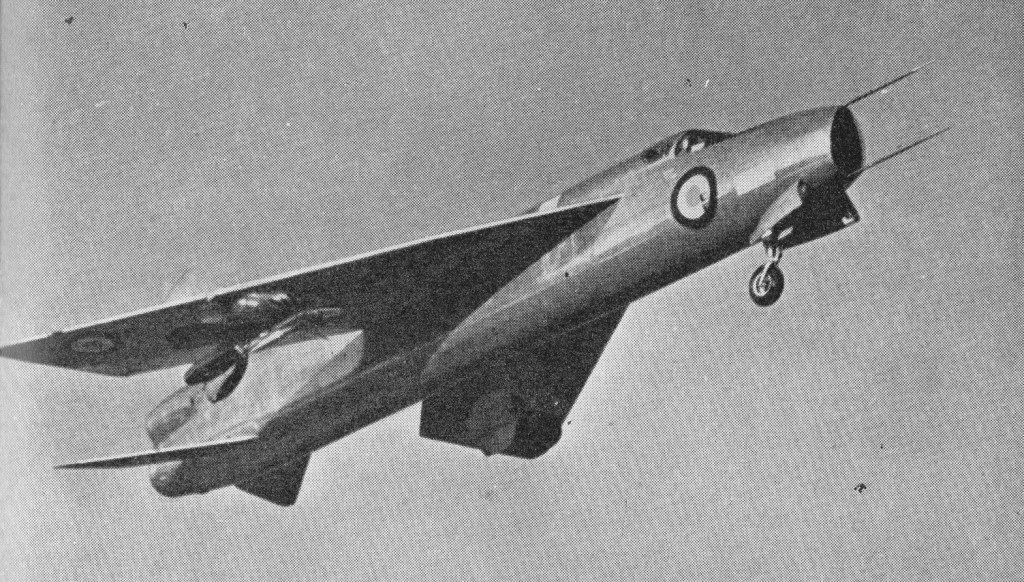
The specification was F.23/49. It was not put out to general tender; instead English Electric were awarded a contract for two flight prototypes and a static test airframe. They called the aircraft the P.1 (project 1). It followed Petter’s long earlier refinement of the classic configuration he had conceived, with the single notable change that he put the tailplane very low on the rear fuselage instead of on top of the fin. He chose to use a pair of simple Armstrong Siddeley Sapphire turbojets, with plain fixed nozzles and no reheat, and fed by a plain inlet in the nose. This was in keeping with his “simple, off the shelf” philosophy. To minimise frontal area he staggered the engines, bringing the lower one well forward with a long jet pipe. After a lot of study he adhered to his original plan to have a mid wing, with the engine air ducts passing above and below it. The form of the wing was crucial, and unique, notable features being the fact that the 60O sweep halved the apparent ratio of thickness to chord and allowed it to have a generous radius on the leading edge, and the ailerons joined the leading and trailing edges in a novel way. Petter left the body free of fuel and marked out part of the main torsion box of the wing to serve as an integral tank. He devoted a large bay to the rear of the torsion box to house the main gears in an unusual installation with doors hinged on the inboard side of the wheel well, even though the legs retracted outwards. The legs had to be long, because it was clear that the P.1 would take off and land at a marked nose up angle. Owing to the thin wing the wheels had to be of large diameter and have tyres inflated to high pressure (no less than 2801b/sq in). To minimise drag the canopy was made flush with the top of the fuselage, though a flat windscreen was provided for the gunsight. The nosewheel folded forwards and turned to lie flat under the inlet duct. All controls were fully powered, the horizontal tail being of the new “slab” type, and there were sharply swept split flaps. Petter was careful not only to stress the P.1 for 7g but also to make weight provision for a military payload. So advanced was the design – and so complex the aerodynamic problems which this design posed – that Britain’s first transonic wind tunnel was built to facilitate testing. Short Brothers at Belfast were instructed by the Ministry of Supply (MoS) to build a research aircraft able to investigate aspects of Petter’s design which the MoS considered more revolutionary than functional. Thus Short’s S.B.5 had a wing which could investigate sweepback at 50 degrees, 60degrees and 69degrees, landing gear which could be adjusted to cater for the CG changes in these different configurations and, at a later stage, a low-set tailplane. When both wind tunnel testing and S.B.5 confirmed that Petter’s design had been right from the outset, the MoS let English Electric get on with construction of two prototypes and a static test airframe.
Pilot – Wg.Cdr. R.P.Beaumont
English Electric P1A, WG760, was the first of two prototypes and had its maiden flight on 4 August 1954, piloted by Roland Beamont. On its third flight the aircraft became the first British aircraft to exceed Mach 1 in level flight. On his third flight the Mach needle refused to move beyond 0.98, but subsequent analysis suggested the P.1 had gone supersonic. Later this machine, WG760, and its partner, WG763 (which had guns, and first flew on July 18, 1955), explored the flight envelope to mach 1.53, demonstrated superb handling qualities and were later given a bigger fin to ensure ample stability margins at high Mach numbers, and a neat faired in belly tank to increase the fuel capacity above the original limit of a mere 5,000lb. The first aircraft flew with Sapphires with crude reheat and fixed area nozzles sized to the reheat condition.
P.1B
The second flew with a revised wing with a kinked leading edge and broad tips with inset ailerons which gave better low speed lift and longer range, as well as opening out the high altitude buffet boundary.
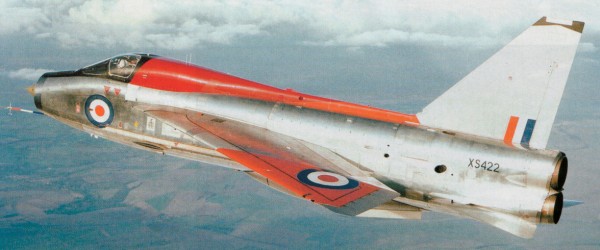
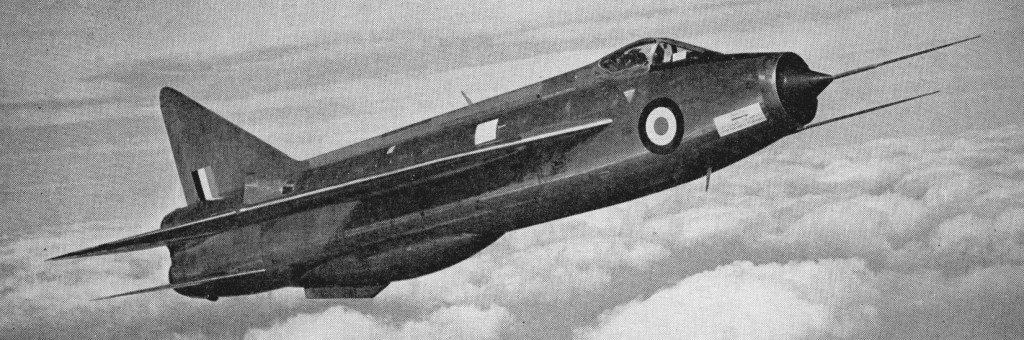
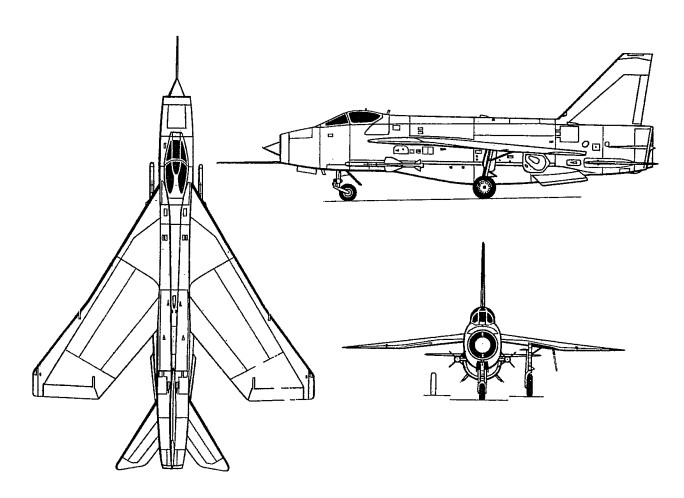
In 1953 a standard of build was agreed for an operational fighter designated P.1B. It was to carry the Ferranti AI 23 radar in the pressurized conical centrebody of a redesigned inclined shock intake with a centrally mounted shock cone, and have a removable armament pack carrying two Blue Jay (Firestreak Mk 1) guided weapons on external pylons, plus their associated electronics and interface systems, or as an optional alternative, two 30mm Aden guns and ammunition. A third alternative was two retractable boxes, each housing 24 FFARs (foldingfin aircraft rockets). After a lot of argument it was also agreed to fit a 30mm Aden gun on each side of the cockpit in a permanent installation. The engines were changed to Rolls-Royce Avon 201s, with four stage reheat, the flaps were made of the plain type (and later used as integral tanks), the fuselage was redesigned with a raised clear vision canopy and many other changes (such as new air¬brakes and dozens of access panels to the profusion of added equipment items), the nose gear was redesigned to fold into the “6 o’clock” inlet strut, and there were countless less obvious changes such as an air bleed turbo¬alternator. The kinked/cambered wing was not incorporated, neither was a refuelling probe. The first of the three hand-built P.1B prototypes first flew on 4 April 1957 with the more powerful engines mounted one above the other in the rear fuselage, with the lower engine well forward of the upper. The production F.1 Lightning began to enter service with the Central Fighter Establishment at RAF Coltishall in December 1959, and after protracted development the Lightning finally entered service in May 1960 with No 74 Squadron. The third aircraft built, a P.1B, became the first British aircraft to exceed SQ.M.0 on 25 November 1958. The jet is capable of cold start to airborne in 1.5 minutes, a climb to 40,000 ft in 2.5 minutes from brakes off and a zoom climb to over 70,000 ft. Twenty development machines had been ordered, the first of these, XG307, flying on April 3, 1958. These led, fairly smoothly into the production fighter, which in October 1958 was named Lightning F.1, and CA Release was obtained late in 1959, No 74 “Tiger” Sqn being equipped at Coltishall the following July and August. The Lightning PE1B XG337 was the last of 20 pre-production Lightnings used for armament, powerplant and radar testing at Farnborough.
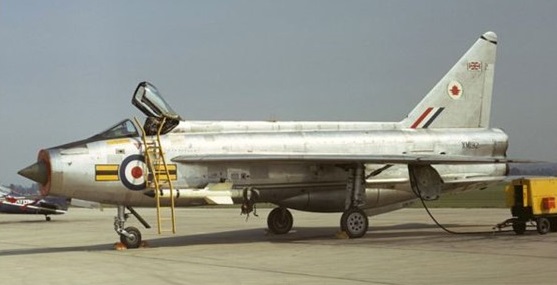
English Electric Lightning F1A, RNAS Yeovilton (8 September 1973)
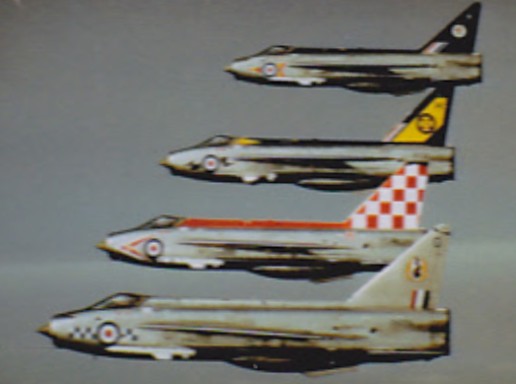
Gradually the Air Staff and ministry officials grudgingly permitted small improvements to be made. The Mk 1A introduced a crude refuelling probe fixed under the left wing (nobody would pay for a neat folding one); the Mk 2 brought in improved Avon 210 engines and numerous systems advances. The F.3 (which entered RAF service in January 1964) was the major production version having an improved radar and collision course Red Top missiles, as well as more powerful Avon 301 engines and other changes including a bigger square topped fin.
Lightning T.4
Thirty RAF Lightning F.2s were to be modified to F.2a from 1967, incorporating the larger ventral fuel tank of the Mk.6 or, alternately, the mixed fuel tank/twin-Aden gunpack ventral bulge.
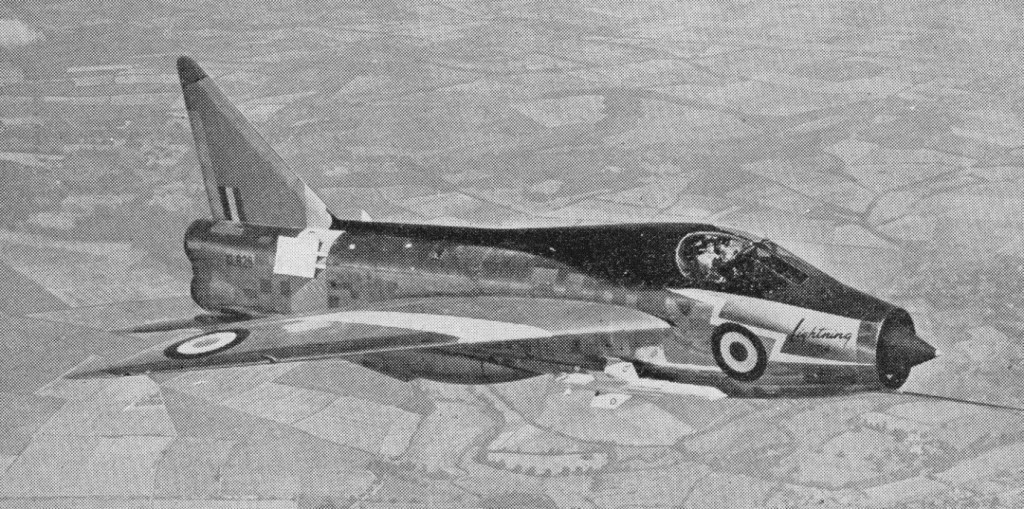
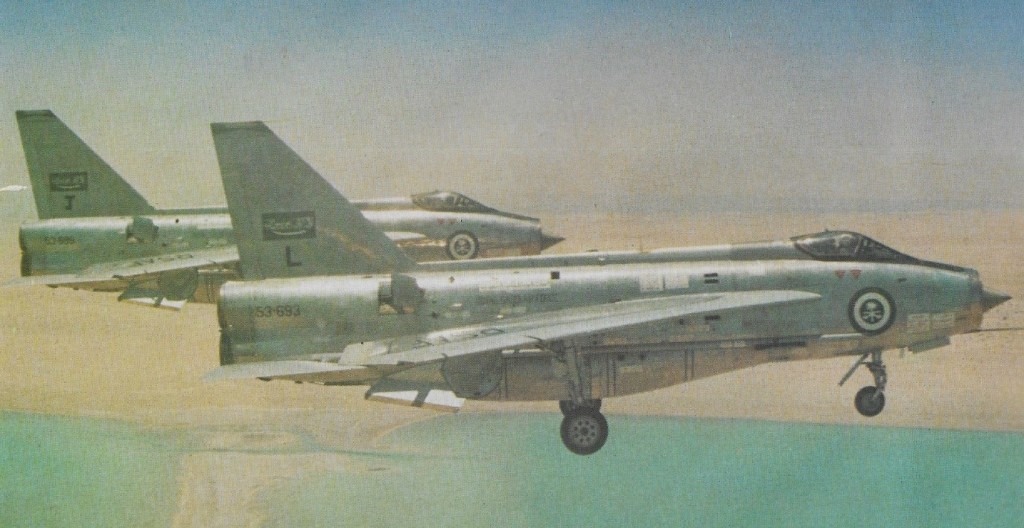
The T.4 was a dual control side by side Mk 1A; the T.5 was a dual control Mk 3; and the Mk 6 was the result of common ¬sense finally creeping into the minds of the Air Staff. With the Mk 6 BAC, as the company had become in 1960, were allowed to fit a proper fuel system, with roughly double the capacity of the early versions. One visible manifestation of this was the area ruled ventral bulge, housing 600gal, which could also carry twin 30mm Aden guns or other stores (the original nose guns had been left off and then later put back again) and overwing pylons for twin 260gal ferry tanks or force ejected retarded bombs. The Mk 6 also, at last, got the improved wing. The F.6 entered service during August 1966 and remained operational until 30 June 1988. While Mk 3s were expensively modified to Mk 6 standard, in 1964 BAC were able to offer an export version (with racks for a 4,0001b load under wing), and sold F.53 and T.55 Lightnings to Saudi Arabia (which led to a further BAC assistance deal in 1972 73). Kuwait bought a smaller number.
285 were built for the RAF or development service.
A total of 338 Lightnings were built by English Electric and the British Aircraft Corporation.
Lightning F.1 Engine: 2 x Rolls Royce Avon 210, 64206 N / 6545 kp / 17,250 lb Length: 55.249 ft / 16.84 m Height: 19.587 ft / 5.97 m Wingspan: 34.81 ft / 10.61 m Max take off weight: 41707.6 lb / 18915.0 kg Max. speed: 1303 kts / 2414 km/h Service ceiling: 62073 ft / 18920 m Range: 778 nm / 1440 km Crew: 1 Armament: 2 MK 2 A/A FK
F.1A Engines: 2 x Rolls/Royce Avon, 14,430 lb. Wing span: 34 ft 10 in (10.61 m). Wing area: 380.1 sq.ft Length: 55 ft 3 in (16.84 m). Height: 19 ft 7 in (5.97 m). Wheel track: 12 ft 9.25 in Armament: 2 x 30mm Aden cannon
F.3 Seats: 1. Wing span: 34 ft 9 in.
F.6 Engines: 2 x 16,360 lb. (7,420 kg.) thrust Rolls Royce Avon 301 turbojet. Length 55.25 ft. (16.84 m.) Wing span 34.8 ft (10.61m). Seats: 1. Armament: 2 x 30 mm. cannon and two Redtop missiles, 4 hardpoints Max speed: Mach 2.0.
T.5 Seats: 2.
Lightning Mk53 Length (including pitot probe): 55ft 3in / 16.84m. Height: 19ft 7in / 5.97m. Wing Span: 34ft 10in / 10.61m. Wing area: 460 sq ft. / 42.7sq.m. Track: 12ft 9.5in / 3.89m. Wheelbase: 18ft 1.5in / 5.52m. Sweepback (leading edge): 60 degs. Empty wt (with gun pack and missiles): 29,600 lb / 13,426kg. Maximum Take off wt (Fully armed Mk53): 41,700 lb / 18,914kg. Gross wt: approx. 45,000 lb / 20,412kg. TO run (at 38,500 lb / 17,464 kg: 3300 ft / 1006m. Time from brakes release to Mach 0.9 at 40,000ft: 150sec. Time to accelerate from Mach 1 to over Mach 2: 210sec. Landing (with parachute) at 29,000 lb (13,154kg): 3,600ft / 1,097m. Landing run (at 38,000 lb / 17,237 kg: 4500 ft / 1371m. Max speed: Over Mach 2 (over 1,500 mph / 2,414km/hr). External fuel cap: 520 Imp.Gal / 2364 lt.
Engines: 2 x RR “Avon 302C”, 58.8kN Max take-off weight: 19000 kg / 41888 lb Wingspan: 10.6 m / 34 ft 9 in Length: 16.8 m / 55 ft 1 in Height: 6.4 m / 20 ft 12 in Wing area: 35.3 sq.m / 379.97 sq ft Max. speed: M.3 Ceiling: 18300 m / 60050 ft Crew: 1 Armament: 2-4 x 30mm machine-guns, 2 guided or 48 unguided missiles
Early developments of the turbojet engine, with then very limited power output, restricted somewhat the size and type of aircraft able to take advantage of this new power plant. Thus, it was not until Air Ministry Specification B.3/45 was issued that the English Electric Company was able to design and build Britain’s first turbojet-powered bomber -the first such aircraft to serve with the RAF. W.E.W. ‘Teddy’ Petter, former chief designer at Westland, was hired by English Electric in 1945 to give this company the ability to design its own aircraft. The resulting English Electric Canberra (the first prototype, VN799) (designed to the high altitude bomber specification B3/45) first flew on 13 May 1949 piloted by Roland Beaumont, and astonished everyone by its amazing agility, though its bombload was 2722 kg (6,000 lb).
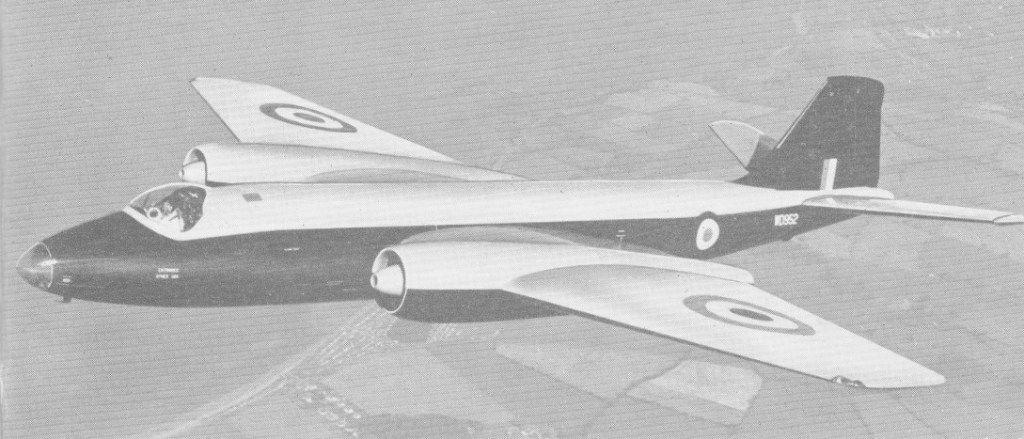
A B.2 was ready for delivery from English Electric in November 1951. It was issued to Bristol Aero Engines at Filton for development work on the Olympus destined to power the Vulcan and much later, Concorde. Delivered to Filton in December 1951, WD952’s engine bays underwent a radical re engineering to accommodate the Olympus the engine would project much further forward than the Avon that the Canberra was designed around.
Fitted with a pair of Olympus B.01.1/2BS of 8,000 lb st (35.5kN), WD952 first flew in this guise on August 5, 1952 just 25 days before the prototype Vulcan undertook its maiden flight. As well as undertaking development flying for the engine, it was soon clear that the Canberra Olympus combination offered significant gains in altitude and Bristol’s chief test pilot, W/C Walter Gibb achieved a Class C world record of 63,668ft (19,406m) on May 4, 1953.
Olympus testbed
As Olympus development continued, WD952 was re engined with the Series 101 of 11,000 lb st (48.9kN) and then in 1955 with the B.01.11 (the Series 102) of 13,000 lb st (57.8kN). With the 102s in place, W/C Webb achieved another world record for altitude on August 29, 1955, this time with 65,876ft (20,079m). The aircraft performed at that year’s SBAC display at Farnborough the nose placarded with details of its record flights. On March 12, 1956, WD952 came to grief in a crash near Filton.
The Canberra has unswept wings and tail surfaces, a variable incidence tailplane, split trailing edge flaps and finger type airbrakes in top and bottom wing surfaces. The tricycle undercarriage has twin nose-wheels and single wheels on each main unit. The nose wheel retracts rearward and main wheels into the centre section.
Four prototypes of the English Electric A1, later designated as B.1s, were all used for development flying. The initial order was for 130, in three variants, and the type was put in production in 1949 by the English Electric Co at Preston, Short Brothers and Harland, Avro, and Handley Page.
The original intention had been to produce a two-crew aircraft which would rely upon radar for the accurate delivery of its bomb load. But although the four prototypes were built to this configuration, the first production Canberra B.2 carried a crew of three and were configured for visual bombing. Of mid-wing monoplane configuration, all-metal, semi-monocoque construction with a cantilevered wing and a wooden vertical stabiliser, these aircraft were powered by two 28.91kN Rolls-Royce Avon 101 engines and could carry internally 2,722kg of conventional or nuclear weapons. Canberras entered RAF service with No 101 Squadron at RAF Binbrook in May 1951. These aircraft were unarmed, relying (as had the war-time de Havilland Mosquito) on speed.
Canberra TT.18
The major production variant was the B.2 bomber the first prototype flying on April 21, 1950. B.2s were built by English Electric, Avro, and Handley Page. Conversions of the B.2 were as follows: T.4, B.8, U.10 (D.10), T.11, U.14 (D.14), T.17, TT.18 plus some to B(TT).2 target tug status and one to B.2E for special fit trials. The type did not officially adopt the name Canberra until January 1951.
The photo reconnaissance version of the B.2, including slightly lengthened fuselage was designated PR.3. Prototype first flown March 19 1951. The B.2 three seat tactical bomber which entered service with the RAF in January 1951 had 6500 lb Avon 101 engines.
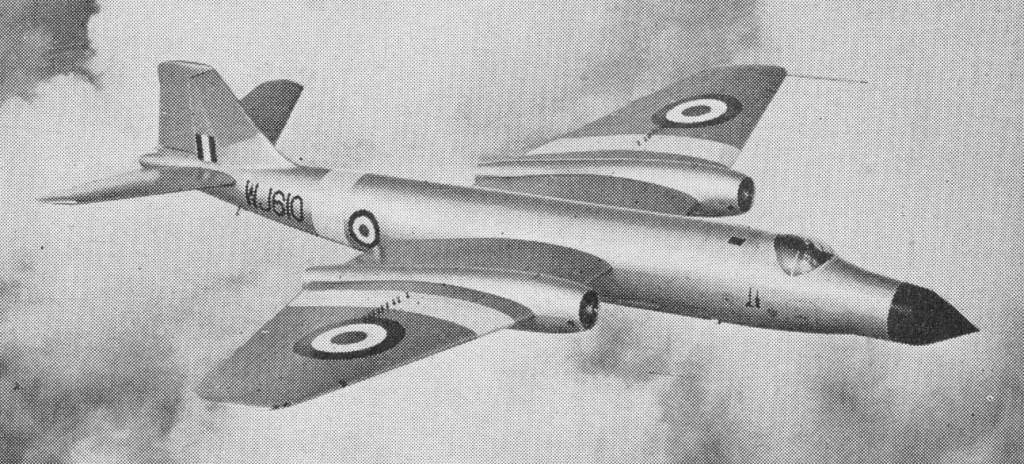
Dual control trainer version of the B.2, readily identifiable by its ‘solid’ nose was the T.4. Prototype first flown on June 6, 1952, entering service in 1954.
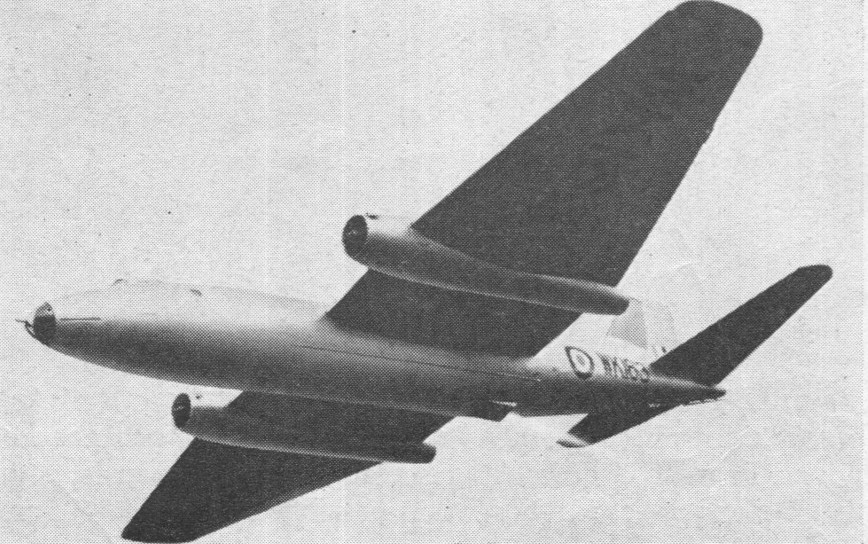
A ‘Pathfinder’ or target marker version of the B.2 was the B.5, the prototype of which was flown for the first time on July 6, 1951. Only one, VX165, was produced this aircraft was converted to B(1).8 status and later used for PR.9 development work.
An improved B.2 with more powerful Avons and increased range was the B.6. The first production B.6 flew on January 26, 1954, introducing more powerful engines and increased fue capacity. B.6s were built by English Electric and Shorts. An interim bomber interdictor variant, with wing pylons for bombs and a ventral gun pack, the B(1).6 was also produced. The first production B(1).6, WT307, was used for a variety of trials, it finally served with RAF Germany before retirement in 1969. Some B.6 airframes were converted to B.15 and B.16 status carrying two 1000 lb bombs or packs of 37 unguided rockets under their wings in addition to a full bombload, and others were converted to take BLUE SHADOW equipment as B.6(BS), and others for radar research. A conversion of the B.6 with additional underwing hardpoints for weapons was designated B.15, and a generally similar B.16 with more radar equipment.
Canberra B.6
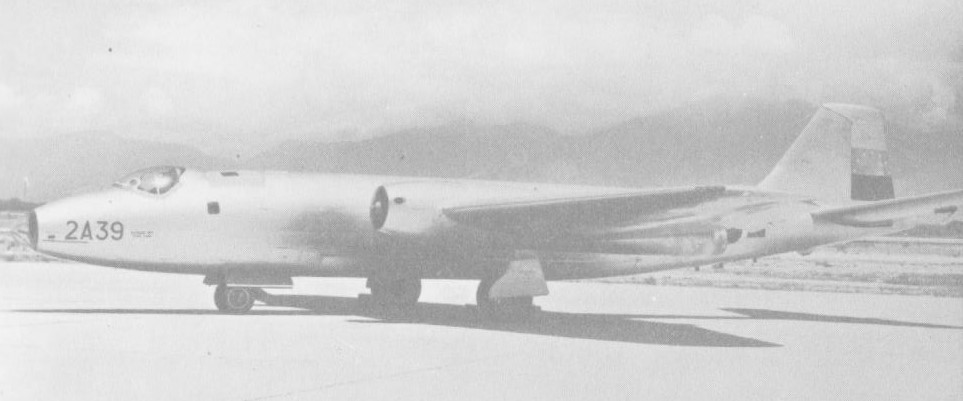
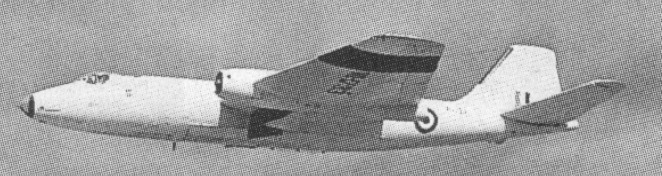
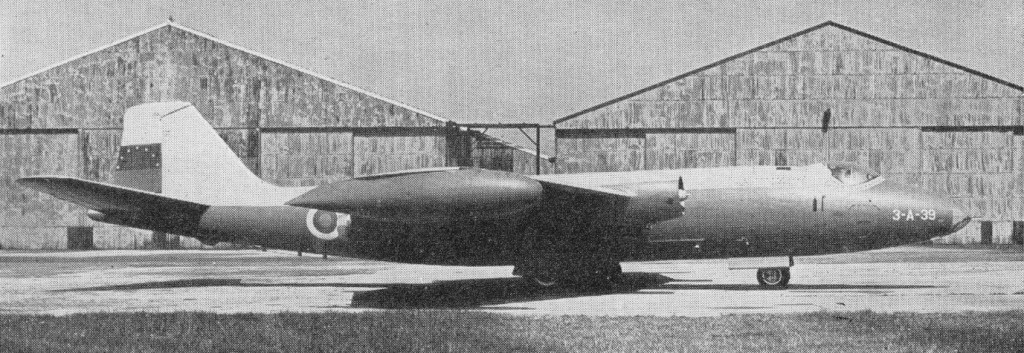
The B.2 and B.6 were in service with the air forces of Rhodesia, Venezuela and Ecuador.
Eighteen B.2s were converted by Shorts (company designation SC.4) to U.10 (later D.10) pilotless drone status for use on the Australian ranges at Woomera. The first aircraft was first flown in this form on June 11, 1957. One U.10 was later upgraded to U.14 status.
The PR.3 carried seven cameras for high altitude reconnaissance.
Shorts SC-4
The PR.7 was a photo reconnaissance version of the B.6; the prototype first flying on August 16, 1953.
Venezuelan Canberra B.2
A Napier Scorpion rocket assisted Canberra set a World Altitude Record of 70,309 ft in 1957.
Napier Scorpion rocket power altitude record setter
Seven PR.7s were converted to TT.22 status and one to interim high-altitude PR.9 guise. Deliveries of T.22 Canberras to the Royal Navy began in November 1973. They were used for radar training and are basically rebuilt PR.7s.
Canberra B(I).8
The Canberra B(l)Mk 8 of 1954 introduced a new nose with the nav/bomb aimer in front and the pilot under a fighter canopy offset to the left; previous marks had mainly been three seaters with two crew in ejection seats behind the pilot. The radar equipped Canberra B.Mk 1 was not put into production, so the first variant was the Canberra B Mk 2 with a visual bomb aiming position in the nose for a third crew member, who had to leave his ejection seat before the high level bombing run. Normal bombload was tandem triplets of 454¬kg (1,000 lb) weapons. The Canberra B.Mk 6 introduced more powerful engines as well as underwing pylons for two further 454 kg (1000 lb) bombs, and like some other versions added fuel in the leading edge of the outer wings. All bomber versions were equipped with a visual aiming station in the nose, though the offset canopy Canberra B(I).Mk 8 and its many derived export versions normally operated at low level and bombs were sometimes released by the pilot in close dive attacks. These tactical models could also be fitted with a removable pack of four 20 mm cannon with well over 2,000 rounds of ammunition. The Canberra 8 is distinguished from previous variants mainly by the revised cockpit, which is moved back and is offset to the port side so that the pilot now sits in a long blister canopy. It appears that the second crew member carried for this role is now housed forward of the pilot instead of behind and has no ejection seat. The Canberra 8 has Rolls Royce Avon RA.7 engines of increased power. The B Mk. 6 and PR.7 have the same span of 63 ft. 11 in. as the B.2 and PR.3, but their length has been increased to 66 ft. 9 in.
With the arrival of the B.(1).8, the RAF at last had a dedicated interdictor, capable of night strikes. The prototype was the reworked B.5 one off, VXL85 which first flew in the new form On July 23, 1954. Production was carried out by both English Electric and Shorts. Most obvious change was the fighter like canopy, offset to port, allowing the navigator/bomb aimer to be positioned in the nose. A ventral gun pack could also be carried.
The B(1).12 was an improved version of the B(1).8 ordered by the Royal New Zealand Air Force (RNZAF) in 1958 and the South African Air Force (SAAF) in the early 1960s. The RNZAF aircraft served until 1970 when the survivors went to the Indian Air Force.
14 Sqn RNZAF Canberra NZ6105 May 1970
The B(I).8 two-seat long-range night interdictor or high-altitude bomber was built also as the B(I).58 for India.
Two B(1).8s were converted to approximately B.6 status with the substitution of new noses.
The PR.3 followed directly from the B2. In fact its first flight on March 19, 1950 preceded that of the B2 which first flew on April 23 1950. Likewise the PR7, which followed the B6, first flew on October 28, 1953 whilst the B6 flew on January 26, 1954. The PR9 first flew on July 8 1955 following its predecessor the B(1)8 which first flew on July 23, 1954.
The Canberra PR.9 photographic reconnaissance aircraft is externally very like the Mk.8, but has a 4 ft greater span, a centre-section of increased chord, and 10,500 lb Avon 206 engines. In the United Kingdom a handful of Canberra PR.Mk 9 aircraft equiped No.1 Photographic Reconnaissance Unit at Wyton but the main force of PR. Mk 9s are being completely rebuilt by Shorts (the original manufacturer) to carry CASTOR (Corps Airborne Stand-Off Radar), a giant SAR (Synthetic Aperture Radar) for surveillance over Germany from heights over 18.3 km (60,000 ft).
Canberra PR.9
Development of the PR9 was made by Short Bros, using the PR7 as a base but by the time they had finished, there was hardly anything of the original PR7 left. The PR9 is markedly different from the rest of the Canberra family in that it has a new wing of greater span and increased centre section chord, and a longer span tailplane. It has a fighter style cockpit similar to that of the B(1)8, but the B(1)8 is a little unfortunate that the canopy could not be opened. The navigator is similarly unfortunate on the B(1)8 in that he does not have the benefit of an ejector seat, having to make his egress in an emergency through the entrance hatch in the side of the nose. Taking into account the more powerful engines also, there is no family tie between these two aircraft other than general appearance and a common ancestry. The prototype first flew on July 8,1955. One PR.9, XH132, was rebuilt by Shorts as the SC.9 test bed for the Red Top air to air missile system. Production PR.9s were all built by Shorts.
The Fleet Air Arm used six U.14 (later D.14) pilotless drone conversions of the B.2 for development work of the Seacat and Seaslug guided missiles, flying the Canberras from Hal Far, Malta. The conversion was similar to the U.10 but featured hydraulic flying controls. The first example undertook its maiden flight in August 1961. Two D.14s, as the type became designated (D for drone in place of U for unmanned which had become U for utility), were reconverted to B.2 Status.
The B-57 served in Vietnam with the USAF in the bomber and reconnaissance roles but was also in use with the USAF and Air National Guard in bomber, trainer, reconnaissance (including a high altitude and long endurance variant), ELINT, weather sampling and research, EW/ECM, and as a night interdictor. The Pakistan Air Force were the only foreign operator of the B-57, in an official capacity, having received twenty-six examples from the USAF under the then Mutual Defence Assistance Programme in the mid-1950s.
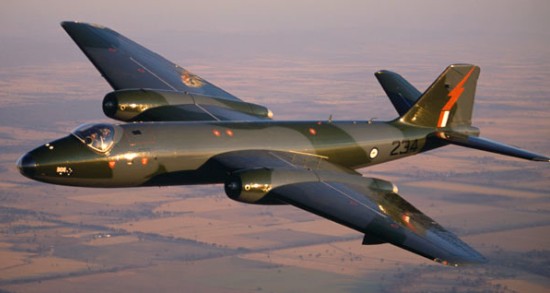
The Canberra was also built under licence in Australia, by the Government Aircraft Factory at Melbourne, for the Royal Australian Air Force (RAAF), where forty-eight examples (s/ns A84-201-248), known as the Mk.20 (48 built), were produced between 1953 and 1958.Five were later modified to Mk.21 dual trainers. The Mk.12 was a modified version of the RAF B(1)8 with an autopilot and extra navigation equipment. Following development work on B.2 WJ734, 1956 1957, eight B.2s were converted to T.11 radar targets for the training of AI radar operators for aircraft such as the Gloster Javelin. The nose section was elongated to take a radar with a distinctive conical radome. All eight T.11s were later converted, by the removal of the radar, for target facilities work as T.19s.
Canberra T.11
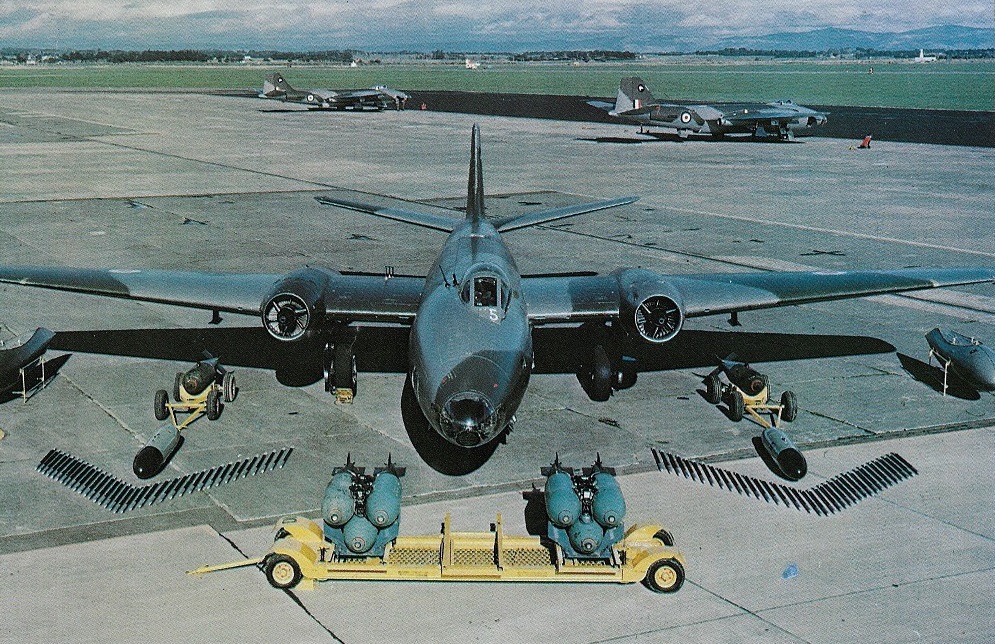
The T13 were type conversion trainers and T.17A EW/ECM variant. Along with the B(1).12s, the RNZAF ordered two T.13s, the equivalent of the RAF T.4. Both were handed on to India in 1970. The B.15 and B.16 were conversions of the B.6 for use by the Near East and Far East Air Forces. The main difference between the two variants was that the B.16 was fitted with the Blue Shadow radar system the two could he told apart by the trunking on the starboard fuselage above the nosewheel bay and the bomb bay. Provision was included for underwing air to ground unguided rockets and later for guided missiles to be carried. The first B.15 conversion flew for the first time on October 4, 1960. Eight B.15s were converted to E.15 target facilities aircraft. The first B.16 undertook its maiden flight during 1960. The T.17 was a dedicated electronic countermeasures (ECM) training aircraft, equipped with a variety of ‘nasties’ to teach defending forces what combat in ECM conditions would be like. The first conversion flew on September 19, 1965. T.17s equipped the unique 360 Squadron, manned by both RAF and Navy personnel. From 1986 six T.17s were upgraded with further ECM equipment to T.17A status; all were retired in 1994. On March 21, 1966, the first conversion of a B.2 to target tug status, TT.18, undertook its maiden flight. This was followed by 22 other examples, serving with the RAF and with the Fleet Air Arm. A Rusliton winch pack and towed target ‘bird’ could he carried under each wing. All eight T.11s were converted for target facilities work as T.19s. This involved simply removing the radar in the nose and replacing it with a concrete weight to keep the centre of gravity. The Canberra Mk.20 was a licence produced version of the B.2 built by Government Aircraft Factories (GAF) at Fisherman’s Bend, Melbourne, NSW for the Royal Australian Air Force (RAAF). The first aircraft, A84 201 flew on May 29,1953. A84 201, piloted by S/L P Raw, took part in the London to New Zealand air race (as No. 5) and came second, in an elapsed time of 24 hours 31 minutes. Five RAAF Mk.20s were later converted to dual-control trainers and redesignated as Mk.21s. Initially Mks.22 to 24 were allocated for further GAF produced Canberras, but this did not come about. The final Canberra variant in the home and Commonwealth system was the T.22 target facilities and radar instruction aircraft for the Royal Navy. These were conversions of PR.7s, the first example flying on June 28, 1973. Unlike other radar conversions, the T.22 boasted a somewhat elegant ‘nose job’.
A total of 1376 were built by the six manufacturers (including Avro, Handley Page and Short Bros) including 403 built under licence by Martin (in six variants) as the B-57. The B-57 saw combat over Vietnam beside other Canberras from Australia. 782 being supplied to the Royal Air Force. 48 were manufactured by the Government Aircraft Factory in Australia.
The Canberra was formally retired from RAF service on 28 July 1993 with the disbanding of No 39 (1 PRU) Sqn at RAF Marham in Norfolk. The squadron’s last three were PR.9. One of the pilots, Sqn Ldr Terry Cairns, at 61 was the oldest serving operational pilot in the RAF, was to retire too.
B(1) Engines: 2 x Rolls Royce Avon 101, 6500 lb thrust. Max speed: 570 mph @ 40,000 ft. Service ceiling: 48,000 ft.
B(I).6 Intruder variant
B(1)8 Two-seat long-range night interdictor or high-altitude bomber Engines: 2 x Rolls-Royce Avon 109, 7400 lb Wingspan: 63 ft 11.5 in Length: 65 ft 6 in Height: 15 ft 7 in Wing area: 960 sq.ft Empty weight: 23,173 lb MTOW: 56,250 lb Fuel capacity fuselage & wings: 2765 gal Wingtip tank fuel capacity: 2 x 244 gal Max speed: 541 mph at 40,000 ft Service ceiling: 48,000 ft Max range: 3630 mi Bomb bay capacity: 6 x 1000 lb or 3 x 1000 lb + 4 x 20mm guns
B(1)12 Engines: 2 x Rolls Royce Avon 109, 32.9kN / 7400 lbs thrust Max speed: 541 mph @ 40,000 ft. Length 65.5 ft. (19.96 m.) Wing span 64 ft. (19.5 m.) Height: 4.8 m / 15 ft 9 in Wing area: 89.2 sq.m / 960.14 sq ft Weight empty 23,170 lb. (10,510 kg.) Max take-off weight: 24925 kg / 54951 lb Max bomb load: 6,000 lb. (2,700 kg.) Max. speed: 827 km/h / 514 mph Ceiling: 48,000 ft. (14,600 m.) fully loaded. Range w/max.fuel: 5800 km / 3604 miles Range w/max.payload: 1300 km / 808 miles Armament: 4 x 20mm machine-guns, bombs, missiles Crew: 2
B(1)58
B.2 Wing span: 66 ft 11.5 in (19.49 m). Length: 65 ft 6 in (19.96 m). Height: 15 ft 7 in (4.75 m). Engines: 2 x RR Avon 101, 6500 lb. Max take off weight : 46712.9 lb / 21185.0 kg Max level speed: 517 mph (827 kph). Service ceiling : 47999 ft / 14630 m Range : 2308 nm / 4274 km. Crew : 3 Armament : 2722 kg Bomb.
B.2(TT)
B.6 Type: three seat light bomber. Engines: 2 x Rolls Royce Avon Mk 109 turbojets, 3402 kg (7,500 lb) thrust. Wing span: (excluding tiptanks): 19.51 m (64 ft 0 in). Length: 19.96 m (65 ft 6 in). Height: 4.75 m (15 ft 7 in). Wing area: 89.19 sq.m (960.0 sq ft). Empty wt: 10099 kg (22,265 lb). MTOW: 24041 kg (53,000 lb). Max speed sea level to 4570 m (15,000 ft): 973 km/h (605 mph) Max speed: 541 mph at 40,000 ft Service ceiling: 14630 m (48,000 ft). Combat radius (high, with full bombload): 1779 km (1,105 miles). Max range: 3790 mi Armament: internal bombload of 2722 kg (6,000 lb) and two underwing pylons for two 454 kg (1,000 lb) stores.
B.8 Engines: 2 x RR Avon Wingspan: 64 ft Length: 65 ft 6 in
Mk.20
Mk.21
B.Mk.82
PR.9 Type: two-seat tactical photographic reconnaissance aircraft Engines: two Rolls-Royce Avon 206 turbojets, 4559-kg (10,050-1b) thrust Maximum speed: 998 km/h (620 mph) / Mach 0. 94 Maximum Speed at 40,000 ft: 541 mph Service ceiling: 18290 m (60, 000 ft) Maximum range: 7240 km (4, 500 miles) Max Takeoff 54,950 lb Normal take-off weight: 22680 kg (50,000 lb) Wingspan 20.68 m (67 ft 10 in) Length 20,32 m (66 ft 8 in) Height 4.75 (15 ft 7 in). Armament: None
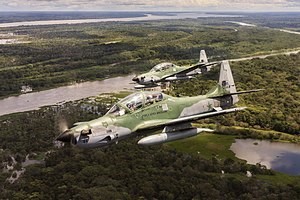
During the mid-1980s, Embraer was working on the Short Tucano alongside a new version designed EMB-312G1, carrying the same Garrett engine. The EMB-312G1 prototype flew for the first time in July 1986. However, the project was dropped because the Brazilian Air Force was not interested in it. Nonetheless, the lessons from recent combat use of the aircraft in Peru and Venezuela led Embraer to keep up the studies. Besides a trainer, it researched a helicopter attack version designated “helicopter killer” or EMB-312H. The study was stimulated by the unsuccessful bid for the US military Joint Primary Aircraft Training System program. A proof-of-concept prototype flew for the first time in September 1991. The aircraft features a 1.37-m (4.49-ft) fuselage extension with the addition of sections before and after of the cockpit to restore its center of gravity and stability, a strengthened airframe, cockpit pressurization, and stretched nose to house the more powerful PT6A-67R (1,424 shp) engine. Two new prototypes with the PT6A-68A (1,250 shp) engine were built in 1993. The second prototype flew for the first time in May 1993 and the third prototype flew in October 1993. The request for a light attack aircraft was part of the Brazilian government’s Amazon Surveillance System project. This aircraft would fly with the R-99A and R-99B aircraft then in service and be used to intercept illegal aircraft flights and patrol Brazil’s borders. The ALX project was then created by the Brazilian Air Force, which was also in need of a military trainer to replace the Embraer EMB 326GB Xavante. The new aircraft was to be suited to the Amazon region (high temperature, moisture, and precipitation; low threat). The ALX was then specified as a turboprop engine aircraft with a long range and autonomy, able to operate night and day, in any meteorological conditions, and able to land on short airfields lacking infrastructure.
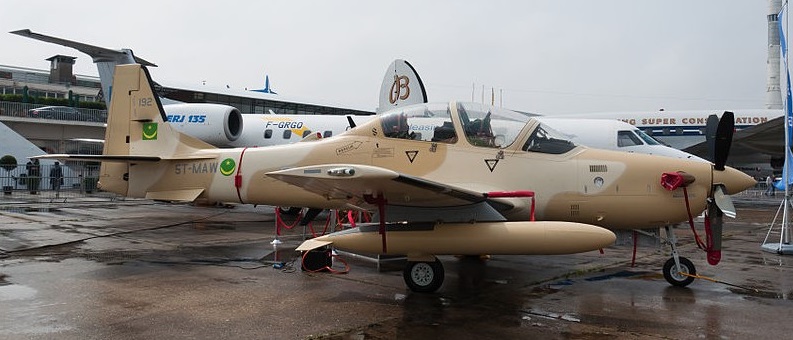
The Embraer EMB 314 Super Tucano, also named ALX or A-29, turboprop light attack aircraft is designed to operate in high temperature and humidity conditions in extremely rugged terrain, the Super Tucano is highly maneuverable, has a low heat signature, and incorporates fourth-generation avionics and weapons systems to deliver precision-guided munitions.
Mauritania AF A-29B 5T-MAW
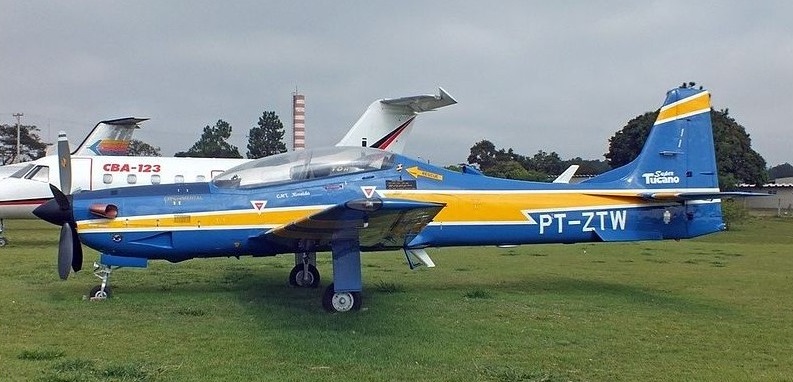
In August 1995, the Brazilian Ministry of Aeronautics awarded Embraer a $50 million contract for ALX development. Two EMB-312Hs were updated to serve as ALX prototypes. These made their initial flights in their new configuration in 1996 and 1997, respectively. The initial flight of a production-configured ALX, further modified from one of the prototypes, occurred on 2 June 1999 (PT-ZTW).
The second prototype was brought up to two-seater configuration and performed its first flight on 22 October 1999. The changes had been so considerable that the type was given a new designation, the EMB-314 Super Tucano. The total cost of the aircraft development was quoted to be between US$200 million and US$300 million.
EMB-312H Prototype PT-ZTW first flew on 9 September 1991, and currently is on display at the Memorial Aeroespacial Brasileiro in São José dos Campos.
EMB-312H Prototype PT-ZTW first flew on 9 September 1991, and currently is on display at the Memorial Aeroespacial Brasileiro in São José dos Campos.
Variants:
A-29A
A-29A
Single-seater for attack and armed reconnaissance (on interdiction tasks), attack and cover (on close air support tasks), able to intercept and destroy low-performance aircraft, incorporates an additional fuel tank (+ 400 liters)
A-29B Twin-seater for the same tasks as the single-seat version, also used in training and advanced aerial control (on monitoring tasks)
Operators:
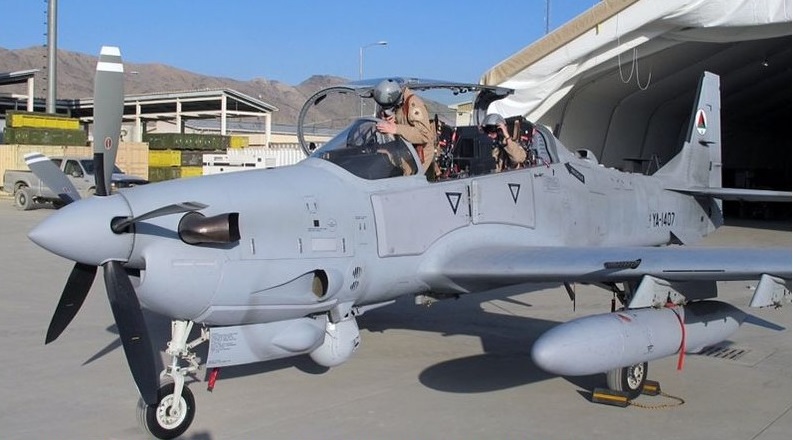
Afghan Air Force Embraer A-29 Super Tucano
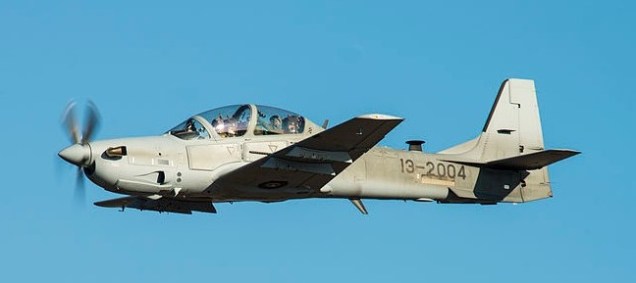
Afghan Air Force – 20 aircraft ordered. The first aircraft were delivered in 2016 and the last were to be in service by late 2018. The first A-29 Super Tucano of the Pentagon’s Light Air Support (LAS) program, destined for the Afghan Air Force, delivered to the US Air Force in Jacksonville, Florida, by the Sierra Nevada Corporation and Embraer in September 2014. The first eight Afghan airmen are trained in the US to form a new Afghan fighter squadron. The first four aircraft arrived in-country at Hamid Karzai International Airport in Kabul on the 15 January 2016. Four more were delivered in July 2016, and an additional four arrived in March 2017, bringing the total of delivered Super Tucanos to 12.
National Air Force of Angola – six aircraft ordered. Deliveries were scheduled to begin in early 2012; but the first three delivered on 31 January 2013.
Brazilian Air Force – 99 aircraft (33 A-29A & 66 A-29B). At least 4 aircraft lost.
Air Force of Burkina Faso – 3 aircraft delivered in September 2011 of version A-29B.
Chilean Air Force – 12 aircraft.
Colombian Air Force – 25 aircraft, introduced between 2006 and 2008. At least one aircraft crashed, claimed shot down by FARC.
Dominican Air Force – 8 aircraft
Ecuadorian Air Force – 18 aircraft, all delivered by 2011.
Ghana Air Force – 5 aircraft ordered in 2015.
Honduran Air Force – 2 aircraft ordered in 2014.
Indonesian Air Force – 16 aircraft ordered & delivered, one lost in a crash February 2016. The first four aircraft of the first batch of eight were delivered as of August 2012, the delivery of the second batch of four aircraft was delayed till September 2014. A total of 16 were ordered in 2011 with deliveries taking place in 2012, 2014, 2015 and 2016.
Lebanese Air Force – 2 A-29s delivered in October 2017, 4 more to be delivered in 2018.
Mali Air Force – 6 A-29 on order.
Mauritanian Air Force – 4 aircraft ordered, received two aircraft as of December 2012, two more aircraft on order.
Nigerian Air Force – 12 aircraft on order
Senegalese Air Force – 3 aircraft on order.
EP Aviation – part of Academi (formerly Blackwater) – at least one twin-seater variant for pilot training (delivered in February 2008).
United States Navy leased an aircraft for testing, as part of the Imminent Fury program.
The first A-29 Super Tucano of the Pentagon’s Light Air Support (LAS) program, destined for the Afghan Air Force, has been delivered to the US Air Force in Jacksonville, Florida by the Sierra Nevada Corporation and Embraer in September 2014. The LAS contract was developed by the Pentagon to supply Afghanistan’s military with 20 planes, which should ensure air superiority in the country after the majority of US forces leave. Because the contract is a foreign military sale, Nevada-based SNC and Brazil-based Embraer deliver the planes to the Air Force, which then passes them on to the Afghan military. The first of 20 A-29 Super Tucano aircraft arrived at Moody Air Force Base on September 26, 2014 in preparation for the Afghanistan pilot and maintenance training mission.
EMB 314 Super Tucano Engine: 1 × Pratt & Whitney Canada PT6A-68C turboprop, 1,196 kW (1,600 shp) Propeller: Hartzell 5-blade constant speed, fully feathering, reversible-pitch propeller Wingspan: 11.14 m (36 ft 6.5 in) Wing area: 19.4 sq.m (208.8 sq ft) Length: 11.38 m (37 ft 4 in) Height: 3.97 m (13 ft 0.25 in) Empty weight: 3,200 kg (7,055 lb) Max. takeoff weight: 5,400 kg (11,905 lb) Payload: 1,500 kg (3,307 lb) Maximum speed: 590 km/h (319 knots, 367 mph) Cruise speed: 520 km/h (281 knots, 323 mph) Stall speed: 148 km/h (80 knots, 92 mph) Service ceiling: 10,668 m (35,000 ft) Rate of climb: 16.4 m/s (3,242 ft/min) Range: 720 nmi (827 mi, 1,330 km) Combat radius: 550 km (300 nmi, 342 mi) (hi-lo-hi profile, 1,500 kg (3,300 lb) of external stores) Ferry range: 1,541 nmi (1,774 mi, 2,855 km) Endurance: 8hrs 24mins g-limit: +7/-3.5 g) Crew: Pilot plus one navigator/student Armament: 2× 12.7 mm (0.50 in) 1,100 rounds per minute FN Herstal M3P machine guns, one in each wing. Hardpoints: 5 (two under each wing and one under fuselage centreline) with a capacity of 1,550 kg (3,300 lb)







 All Aero