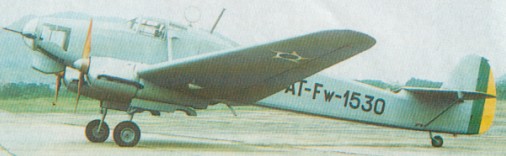
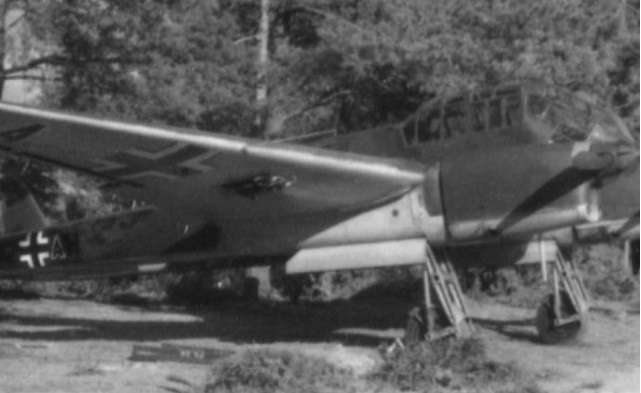
The Weihe was first flown in prototype form in 1935 as an advanced training, light 6 passenger transport and communications aircraft for the Luftwaffe, powered by two 179kW Argus As.10G engines. The main undercarriage retactable, and tail wheel fixed.
Before the outbreak of World War II Deutsche Luft-Hansa received eight as six-passenger commercial transports. Armament in the military training version comprised a gunner’s turret in the nose (which could be replaced by a metal cone for blind-flying instruction) and an aft gun position. The turret had space for an instructor and pupil for machine-gun and bomb-aiming training. Two seats side-by-side were provided in the cockpit for flying training, while a bomb trap with sights in a further compartment was provided for bombing instruction.
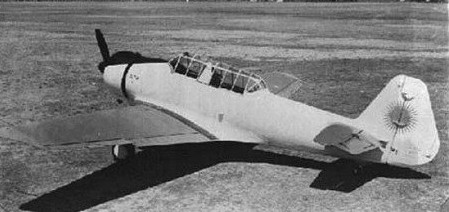
Fifteen were licence built by Brazil’s Oficinas Gerais da Aviation Naval during 1939-40. These were based on the Fw 58B-2 which was used as a gunnery trainer by the Luftwaffe.
Total production: 1350
V-1 Engines: 2 x Argus Ace 10c, 240 hp Props: two-blade metal fixed pitch Wingspan: 21,00 m Length: 14,00 m Height: 3,90 m 1 prototype
V-2: Armament: 1 MT MG 15 7,92 mm, 1 MT MG 15, 7,92 m 1 prototype.
V-4: Armament: 1 MT MG 15 7,92mm 1 prototype
Fw 58B-1 Engines: 2 x Argus Aces 10c, 240 hp Props: two-blade wood variable pitch Wingspan: 21,00 m Length: 14,00 m Height: 3,90 m Wingarea: 47,00 sq.m Empty weight: 2400 kg MTOW: 3600 kg Wing loading: 76,595 kg/sq.m Power loading: 7,5 kg/hp Vmax: 270 kph Vcruise: 240 kph Ceiling: 5600 m Range: 800 km Armament: 2 x MT MG 15, 7,92 mm
Fw 58B-2
Fw 58C Engines: Argus Ace 10c or Hirth HM 508D, 260 hp
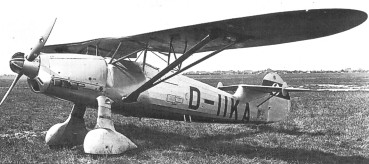
The Stosser (hawk) was the first Focke-Wulf design undertaken by Kurt Tank, and resulted for a German requirement for an advanced trainer with the As 100 engine. The resultant Fw 56 prototype that flew in November 1933 was a parasol-winged aeroplane of mixed construction with cantilever main landing gear units powered by a 179kW Argus As. 10C engine: two more prototypes followed. The V2 prototype had a modified undercarriage and metal wing. The V3 prototype had a further modified undercarriage, similar to the V1, first flying in 1934. Three Fw 56 A-0 were built with various modifications to the aerofoil. Two MT MG 17 of 7,92 m/m were fitted and provision for 3 bombs of 10 kg. In the summer of 1935 the Stosser was selected in preference to the Arado Ar 76 and Heinkel He 74, so three Fw 56A-0 pre-production and about 900 Fw 56A-1 production aircraft followed up to the end of production in 1940. These were extensively used as advanced trainers in fighter schools, though after trials that helped to validate the concept of dive-bombing the type was also used in dive-bomber schools. Austria ordered the type before its annexation by Germany, and 12 Stossers were also delivered to Hungary.
Fw 56 V1 Engine: Argus As 10C, 240 hp Prop: 2 blade fixed pitch Seats: 2 1 prototype
Fw 56 V2 1 prototype
Fw 56 V3 1 prototype
Fw 56 A-0 Armament: 2 MT MG 17 7,92 mm / 3 bombs 10 kg
Fw 56 A-1 Stosser Engine: Argus Aces 10c, 240 hp / 179kW Prop: two-bladed variable pitch Wingspan: 10,50 m (34ft 5.5 in) Length: 7,70 m (25ft3in). Height: 3,55 m Wingarea: 150.696 sq.ft / 14 sq.m Empty weight; 695 kg MTOW: 995 kg Max. payload weight : 145.5 lb / 66.0 kg Fuel capacity: 22 gal / 84 l Vmax: 173 mph / 278 kph @ SL Landing speed: 49 kt / 90 km/h Cruising speed : 132 kt / 245 km/h Take off distance: 551 ft / 168 m Initial climb rate : 1496.06 ft/min / 7.6 m/s Service ceiling : 20341 ft / 6200 m Range: 400 km / 249 miles Crew: 1 Armament: 1 or 2 Mg 17, 7,92mm plus provision for 3 x 10-kg (22-lb) bombs carried externally.
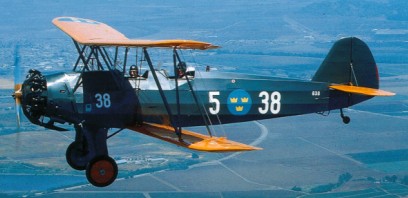
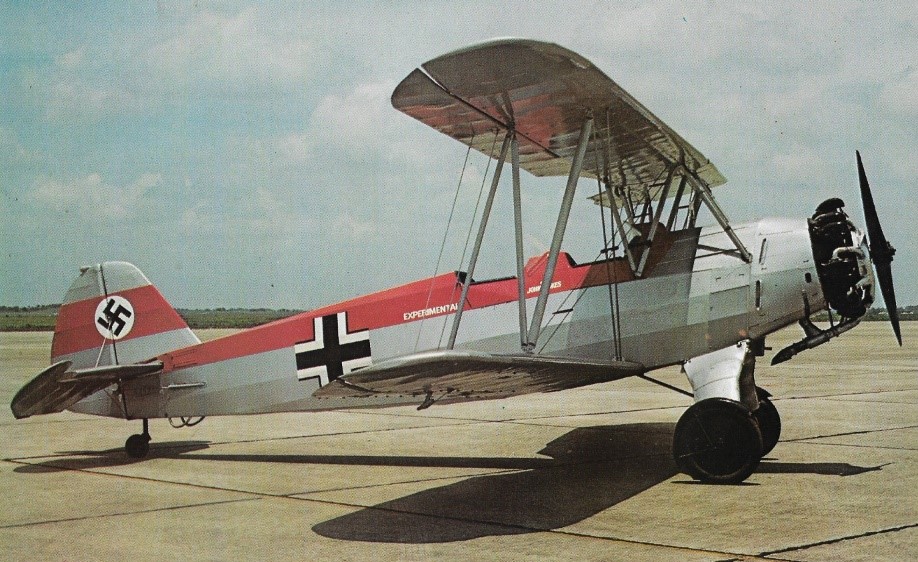
The development of the Fw.44 with the Focke-Wulf Flugzeugbau started in 1931, and the Fw 44A prototype first flew in the summer of 1932 powered by Argus As-8 in line engine which was replaced by the Siemens-Haiske Sh 14a radial engine in the production aircraft. Aerobatic champion Gerd Achgelis conducted the maiden flight of the Fw 44 Stieglitz (goldfinch) trainer late summer 1932.
In its basic form the type had severe handling problems, and these were eradicated by the newly arrived Kurt Tank in an intensive development programme that turned the Stieglitz into a superb aerobatic machine.
In addition to export orders from Bolivia, Chile, China, Czechoslovakia, Finland, Romania, Switzerland and Turkey, the Fw 44 was built under licence in Argentina, Austria, Brazil, Bulgaria and Sweden (85 designated Sk-12). The major operator was the Luftwaffe with the Fw 44B using the 109-kW (135-hp) Argus As 8 inline, followed by the Fw 44C that reverted to the Sh 144. Variants of the Fw 44C with detail improvements were the Fw 44D, F and Fw 44J. The Sk 12 Swedish license built Focke Wulf Fw 44J was first delivered to the Swedish Air Force Flying School in 1938.
Fw 44A Engine: Sh 144, 112kW (150hp) Span: 9m (29ft 6.25in) Length: 7.3m (23ft 11.5 in) Armament: none Max TO weight: 900 kg (1,984 lb) Max speed: 115 mph at sea level Operational range: 419 miles.
Fw 44B Engine: Argus As 8, 109-kW (135-hp)
Fw 44C Engine: Argus Aces 10C, 240 hp Prop: two-blade fixed pitch 2,80 m diameter Wimgspan: 17,76 m Length: 10,57 m Height: 3,04 m Wing area: 35,00sq.m Empty weight: 1065 kg MTOW: 1580 kg Fuel: 2 x 75 lt Vmax: 191 Kmh Vcruise: 175 km/h ROC: 1000 m in 4 min Ceiling: 5000 m Range: 640 km
Fw 44D Engine: Argus Ace 10D or E, 270 hp Prop: two-blade fixed pitch 2,80 m diameter Wingspan: 17,76 m Length: 10,57 m Height: 3,04 m Wingarea: 35,00 sq.m Empty weight: 1095 kg MTOW: 1475 kg Fuel: 2xX 75 lt
Fw 44E Engine: Argus Ace 10D or E, 270 hp Prop: two-blade fixed pitch 2,80 m diameter Wingspan: 17,76 m Length: 10,57 m Height: 3,04 m Wingarea: 35,00 sq.m Empty weight: 1095 kg MTOW: 1475 kg Fuel: 2xX 75 lt
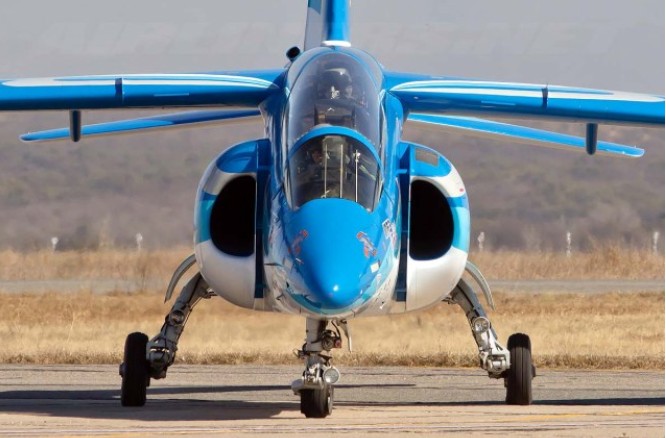
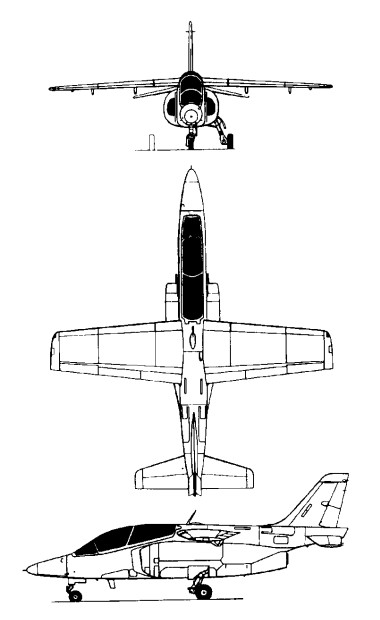
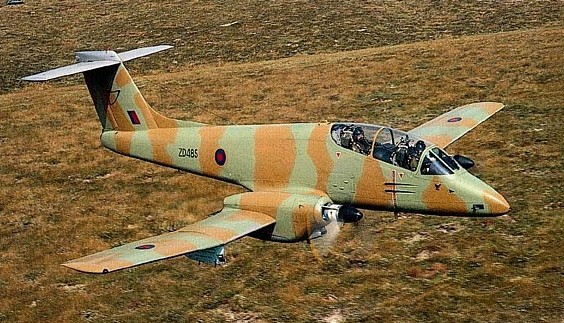
Work on the IA.63 began in 1979 by the Fabrica Militar de Aviones and by early 1980 a straight-wing configuration powered by a single TFE 731 had been decided upon. Dornier provided technical assistance in the design and development stages, and also in the construc¬tion of the wing and tail surfaces of the proto¬types. The first flight took place on October 6, 1984, and by March 1986 three prototypes were flying. Construction of three flying prototypes was initiated in March 1981 and the first IA-63 flew on 6 October 1984.
A cantilever shoulder-wing monoplane, the fuselage incorporates a tricycle landing gear, a single turbofan engine and a pressurised cockpit with tandem seats for the pupil and instructor on zero/zero ejection seats.
Argentine
Delive¬ries of 64 IA-63As to the Argentine air force began in May 1988. The FAA requirement was for 64 aircraft, The IA-63A can also be used for weapon training with a 30mm Defa cannon pod on the fuselage centreline, and other ordnance on four under¬wing pylons, though better capability in this and the light attack roles is offered by the IA-63B under development in the early 1990s with the 4,300-lb (1,950-kg) thrust TFE731-5 turbofan and a head-up display tied into a more capable nay/attack system.
Powered by a Garrett TFE 731 turbo-fan engine providing 3500 lbs thrust, the Pampa “is capable of carrying a large and varied weapons load and a HUD and Weapons Aiming Computer System are being incorporated in future deliveries to meet Argentine Air Forces requirements”. Pampa promotional material emphasises the type’s fuel endurance of around 2.8 hours at 300 knots and a STOL/grass strip capability. Maximum speed is listed at 400 knots. In 1990, FMA teamed with LTV to offer a version of the IA 63, designated Pampa 2000, to compete for the Joint Services Primary Aircraft Training System (JPATS) search for a common US trainer.
AT-63 Pampa Phase III
IA.63 Pampa Engine: 1 x Garrett TFE731-2-2N turbofan, 3,500lb st (15,75 kN). Installed thrust: 15.6 kN. Span: 9.69 m / 31 ft 9 in. Length: 10.93 m / 35 ft 10 in. Height: 4.29 m / 14 ft 1 in Wing area: 15.63 sq.m / 168.24 sq ft. Empty wt: 2627 kg / 6219 lb. MTOW: 5000 kg / 11023 lb Warload: 1160 kg. Max speed: 755 kph / 469 mph. Initial ROC: 1813 m / min. Ceiling: 12,900 m / 42300 ft. T/O run: 400 m. Ldg run: 515 m. Fuel internal: 980 lt (+400 lt). Range w/max.fuel: 1500 km / 932 miles. Hardpoints: 5. Crew: 2
IA-63A Pampa Engine: one 4300-lb thrust Garrett TFE731-2-2N turbofan. Maximum speed 509 mph (819 km/h) at 22,965 ft (7,000 m) Initial climb rate 5,950 ft (1,813 m) per minute Service ceiling 42,325 ft (12,900m) Radius 223 miles (360 km) on a hi-lo-hi mission with a 2,205-lb (1,000-kg) warload Empty weight 6,219 lb (2,821 kg) Maximum take-off 11.023 lb (5,000 kg). Wing span 31 ft 9.25 in (9.686 m) Length 35 ft 9.25 in (10.90 m) Height 14 ft 1 in (4.29 m) Wing area 168.2 sq ft (15.63 sq.m) Armament: provision for a 30-mm cannon pod and up to 2,866 lb (1,300 kg) of disposable stores.
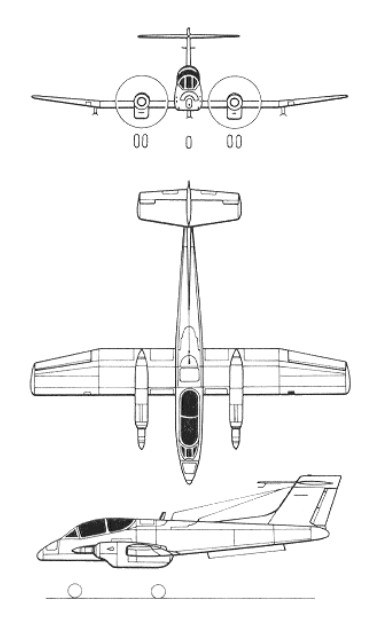
In the mid 1960s the Argentine government issued a requirement to Fabrica Militar de Aviones (FMA), for a new combat aircraft suitable for the COIN, CAS and recce roles. Development of the FMA IA 58 Pucara ground-attack aircraft began in August 1966 and led to the flight of an unpowered aerodynamic test vehicle on 26 December 1967. The first powered prototype, by then known as the AX-2 Delfin, and with two 674kW Garrett TPE3311/U-303 turboprop engines installed, was flown for the first time on 20 August 1969. Subsequent prototypes were powered by Turbo-meca Astazou XVIG engines and fitted to all production aircraft.
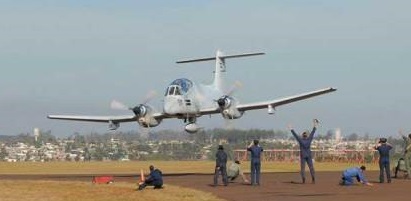
A cantilever low-wing monoplane of all-metal construction, the Pucara has a T-tail, a retractable tricycle landing gear, and accommodation for a pilot and copilot in tandem on Martin-Baker ejection seats beneath a large transparent canopy. It has narrow fuselage and tail section and a tandem seat cockpit with a steep sloping nose. Because of the steep nose the pilot has excellent forward visibility. Although heavily armed the weapons are unguided and visually aimed by the crew. The IA 58 only needs a minimum of ground support to operate, it is able to operate from unprepared rough terrains. More prototypes were produced and on 8 November 1974 the first of 60 IA 58A production aircraft for the Argentinian Air Force made its maiden flight. The initial production version, the IA 58A, flew for the first time on 8 November 1974 and first deliveries of 108 ordered for the Argentine air force began early in 1976 and continued until 1986. Six were also ordered for the air force of Uruguay. Forty improved IA 58B Pucara Bravos with advanced avionics and more powerful armament (30mm instead of 20mm cannon) were ordered for the Argentine air force in 1980 but were completed as IA 58As following the Falklands campaign. A single IA 66, a Pucara with more-powerful 746kW Garrett TPE331 engines, began its flight test programme in 1980 but did not proceed any further. Pucara production ended with a batch of 40 IA 58As built from 1986 onwards but no further sales were subsequently announced and they are believed to be in store as ‘white tails’.
Argentine IA58 Pucara
About 3 aircraft were captured by the United Kingdom during the Falkland War, they are now preserved by the RAF. First flown on December 30, 1985, the single-seat IA.58C is a developed version of the earlier IA.58A, in which the forward cockpit is replaced by a new nose section housing a 30mm Defa cannon with 270 rounds, in addition to the usual armament of two 20mm cannon and four 7.62mm machine-guns. The Astazou engines of the IA.58A are retained, but feature self-starters and modified exhausts to reduce their infrared signature. The IA.58C incorporates a complete avionics upgrade, including an Omega/VLF navigation system, Hud, IFF, and radar warning receiver, together with a Saab RGS-2 lead-computing sight for air-to-air or air-to-ground use. The IA 58A is also operated by Colombia, Sri Lanka and Uruguay but only in small numbers. In December 1989, Argentina delivered three Pucaras to Colombia on loan for use against drug manufacturers and smugglers.
IA.58A Engines: 2 x Turbomeca Astazou XVIG, 760kW / 988 shp Max take-off weight: 6800 kg / 14992 lb Empty weight: 4037 kg / 8900 lb Wingspan: 14.5 m / 47 ft 7 in Length: 14.3 m / 46 ft 11 in Height: 5.4 m / 17 ft 9 in Wing area: 30.3 sq.m / 326.15 sq ft Max. speed 3.000m (9,840 ft): Mach 0.48 / 500 km/h / 311 mph Cruise speed: 500 km/h / 311 mph Ceiling: 10000 m / 32800 ft Initial ROC: 1080 m / min. Range w/max.fuel: 3400 km / 2113 miles Combat radius hi-lo-hi: 350 km. T/O run: 300 m. Ldg run: 200 m. Fuel internal: 1280 lt. Air refuel: No. Warload: 1500 kg. Armament: two Hispano HS804 20mm cannons with 270 rounds per gun, four FN Browning 7.62mm guns with 900 rounds per gun; up tp 1500 kg (3,307 lb) of free fall load. Hard points: 3. Crew: 2
IA 66 Engines: 2 x 1,000-shp Garrett TPE331-11-601W turboprop Wingspan: 14.5 m / 47 ft 7 in Length: 14.3 m / 46 ft 11 in Height: 5.4 m / 17 ft 9 in Wing area: 30.3 sq.m / 326.15 sq ft Crew: 2
The first airplane designed by the Institute Aviation, and first counting on an Argentine engine. It flew for the first time the 8 of August of 1944 commanded by the Lieutenant First Osvaldo Rovere. Two series of 100 units each were ordered by the Commando of Military aviation; in 1946 the first series was completed and in 1950, the second. A monoplane of cantilever low-mounted wing, its construction was totally in native wood from the province of Missions. The fuselage was of semimonocoque structure of oval section. The stabilizer covered in wood and rudder in linen cloth. A conventional undercarriage retractable towards the center, operating electrically or manually, with hydraulic brakes. The cockpit with tandem seats, acrylic cover; the forward with a height restriction. The Ae 16 GAUCHO 9 cylinders radial offered 450 hp at 2200 r.p.m. with a mixed wood FMA prop initially, later a metal two-blade Hamilton Standard 2M-D30 of variable pitch. An Armstrong Siddeley Cheetah radial of 475 hp with a two-blade Rotol constant speed propeller was fitted to a version designated I.Ae.22-C. Initially used as an advanced trainer with dual controls, the armament included two fixed Madsen machine guns of 7.65 mm with 450 rounds each. An observation model has a movable machine gun in the rear position and carried three bombs of 50 kg and six rockets of 11 kg each.
Engine; 1 x 450hp Ae.16 Gaucho Wingspan; 12.60 m / 41 ft 4 in Length; 9.20 m / 30 ft 2 in Height; 2.84 m / 9 ft 4 in Wing area; 23.19 sq.m / 249.61 sq ft Max take-off weight; 2200 kg / 4850 lb Empty weight; 1520 kg / 3351 lb Max. speed; 290 km/h / 180 mph Cruise speed; 226 km/h / 140 mph Ceiling; 6000 m / 19700 ft Range; 1100 km / 684 miles Crew; 2
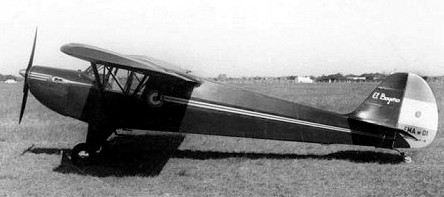
The two-seat El Boyero was designed by the Fabrica Militar de Aviones in 1939 and the first of two prototypes were flown on 2 November 1940.
The FMA’s preoccupation with the manufacture of military aircraft necessitated the transfer of production to SA Sfreddo y Paolini. However, the inability of the company to acquire the necessary materials resulted in production of El Boyero being shelved until 1949 when manufacture was undertaken by Petrolini Hermanos on behalf of the Direccion General de Aeronautica Civil, 130 being produced of which a number were delivered to the Air Force and Army for liaison and AOP tasks.
Whereas the prototypes were powered by the 50 hp Continental A-50 engine, the production model had 65 hp Continental A-65-8 engines.
The FMA.20-B has a 75 hp Continental A-75.
Petrolini took over production of the El Boyero two-seat light monoplane from the Instituto Aerotecnico in late 1940s, and built 160 to government contracts for flying clubs and schools.
Engine; 1 x 65hp Continental A-65-8 Wingspan; 11.50 m / 38 ft 9 in Length; 7.10 m / 23 ft 4 in Height; 1.80 m / 6 ft 11 in Wing area; 17.70 sq.m / 190.52 sq ft Max take-off weight; 500 kg / 1102 lb Empty weight; 225 kg / 496 lb Max. speed; 160 km/h / 99 mph Cruise speed; 145 km/h / 90 mph Ceiling; 4000 m / 13100 ft Range; 650 km / 404 miles Crew; 2
The Fleet 7 flew first in 1930, a total of 374 were built, including the Fleet 10 designed for the European market.
Forty-eight of the Fleet Model 7 version with Kinner B-5 engine were built, plus several converted from Model 2 by Fleet in Canada.
Fleet 7A
The Fleet Model 7B was a Canadian production version, as were the Fleet Model 7C with Armstrong Siddeley Civet engine and Fleet Model 7G with de Havilland Gipsy III engine.
One Model 7 with 100-hp Kinner R-370-1 (Kinner K5) engine was acquired by the US Army Air Corps for service tests as XPT-6. Ten YPT-6 followed, similar to the XPT-6, used by the US Army Air Corps for service tests and evaluation. The YPT-6A was a modified version of the Model 7 fitted with an enlarged cockpit. Used by the US Army Air Corps for service tests and evaluation.
Fleet F.7C Trainer
The Fleet F.7C Trainer was built in 1937.
The Fleet Model 8 was a three-seat version similar to Model 7 (seven built), and Fleet Model 9 was a refined version of the Model 8 (12 built).
Fleet 8
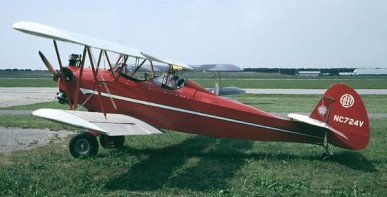
The Fleet Model 10 was a refined version of the Model 7 for export to Europe, replaced the 1928-origin “looped” landing gear radius rod of the Models 2 & 7 for their left mainwheel with a center-hinged design for both mainwheels, using a V-form transverse cabane strut to provide the hinge-point.
The Model 10A version had a 100 hp Kinner engine, Model 10B with 125 hp Kinner engine, and Model 10D a 160 hp Kinner engine. The Model 10-32D was generally similar to the Model 10D, but with an increased 4-ft 0-in (1.22-m) wingspan.
The Fleet Model 10E version was powered with a 125 hp Warner engine and Model 10F with a 145 hp Warner engine.
The Fleet Model 10G was built for the governments of Portugal and Romania, with about 70 built in Romania by ICAR as Fleet-IAR 10, sometimes listed simply as IAR-10, all powered with a de Havilland Gypsy Major engine.
The Fleet Model 10H was powered with a Menasco C-4S engine, and Fleet Model 11 with a Kinner R-5 engine. Some Model 11 were exported to Argentina, China and Mexico.
The Fleet Model 16, or Fleet Finch, was a strengthened Canadian production version with sliding canopy, powered by a 130 hp de Havilland Gipsy Major engine, about 600 were built. The Fleet Model 16B, or Fleet Finch Mk II, was a strengthened Canadian production version, powered by a Kinner B5 engine. The Model 16D was similar to the Model 16B, but fitted with a Kinner B5 engine.
The Fleet Model 16R, or Fleet Finch Mk I, was the designation of the Fleet 16D built in Canada for the RCAF.
Finch 16B
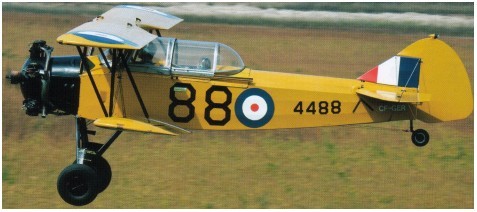
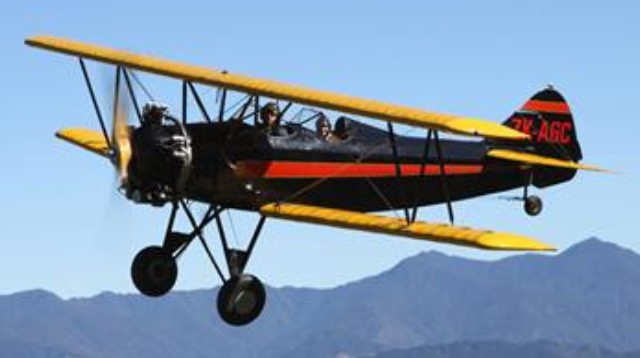
The Fleet 16B Finch II is a progressive development of the original Consolidated Fleet primary trainer, manufacture of which was commenced in Canada by Fleet Aircraft in 1930. The Fleet Finch Model 16 was developed specifically for the RCAF. In 1938 Fleet Aricraft was exporting Model 10s, when the RCAF examined a 10D for possible use as a primary trainer. The Air Force needed an aeroplane that could perform aerobatics with full military equipment; therefore, numerous modifications were made, and the aircraft built for the RCAF were designated Model 16s. The first Finch 16B for the RCAF flew in March 1940. The Fleet 16 first entered RCAF service with tandem open cockpits, but the severity of the Canadian winter necessitated the introduction of a sliding canopy at an early stage in the trainer’s service career.
The Fleet Model 16, or Fleet Finch, was a strengthened Canadian production version with sliding canopy, powered by a 130 hp de Havilland Gipsy Major engine, about 600 were built. The Fleet Model 16B, or Fleet Finch Mk II, was a strengthened Canadian production version, powered by a Kinner B5 engine. The Model 16D was similar to the Model 16B, but fitted with a Kinner B5 engine.
The Fleet Model 16R, or Fleet Finch Mk I, was the designation of the Fleet 16D built in Canada for the RCAF.
Fleet 16B
A total of 437 Fleet Finches were produced as Model 16s, the majority (430) for the RCAF. They were used as initial trainers in the BCATP at twelve EFTS’s across Canada in parallel with the Tiger Moth. They were replaced eventually by Fairchld PT-26 Cornells, and the last of the Model 16s stayed on RCAF inventory until 1947.
Fleet 16B
The Canadian manufacturing was a great success, with some 600 examples built for the Royal Canadian Air Force as the Fleet Fawn (Model 7) and Fleet Finch (Model 16).
United States manufacturing rights were eventually sold to Brewster Aeronautical Corporation, which intended to produce the Brewster B-1 based on the Canadian Model 16F prototype, built for Brewster.
Fleet Model 7 Engine: Kinner B-5 48 built, plus several converted from Model 2 by Fleet in Canada
Fleet Model 7A Engine: 125 hp Kinner B-5 or 100 hp Kinner K-5 Wingspan: 28 ft Wing area: 194 sq.ft Length: 21 ft 6 in Height: 7 ft 11.5 in Max speed: 115 mph Cruise: 90 mph ROC: 730 fpm Ceiling: 16,000 ft
Fleet Model 7B
Fleet F.7C Engine: Armstrong Siddeley Genet Major, 135 hp
Fleet Model 7G Engine: de Havilland Gipsy III
XPT-6 One Model 7 for US Army Air Corps for service tests. Engine: 100-hp Kinner R-370-1 (Kinner K5)
YPT-6 ten built
YPT-6A Model 7 fitted with enlarged cockpit.
Fleet Model 8 seven built Seats: 3
Fleet Model 9 12 built
Fleet Model 10
Fleet Model 10A Engine: 100 hp Kinner
Fleet Model 10B Engine: 125 hp Kinner
Fleet F 10 D Engine: Kinner K 5 radial, 160 hp
Fleet Model 10-32D increased 4-ft 0-in (1.22-m) wingspan
Fleet Model 10E Engine: 125 hp Warner
Fleet Model 10F Engine: 145 hp Warner
Fleet Model 10G Engine: de Havilland Gypsy Major
Fleet Model 10H Engine: Menasco C-4S
Fleet Model 11 Engine: Kinner R-5
Fleet Model 16 / Fleet Finch Engine: 130 hp de Havilland Gipsy Major
Fleet 16B Finch Mk II Engine: Kinner B-5 five cylinder radial, 125 hp Maximum speed: 113 mph Empty weight: 1,102 lb (500 kg) Loaded weight: 1,860 lb (844 kg) Span: 28 ft (8.5 m) Length: 21 ft 8 in (6.6 m) Height: 7 ft 9 in (2.4 m) Wing area: 194 sq ft (18 sq m) Seats: 2
Fleet Model 16D Engine: Kinner B5
Fleet Model 16F prototype for Brewster B-1
Fleet Model 16R / Fleet Finch Mk I Fleet 16D built in Canada for the RCAF
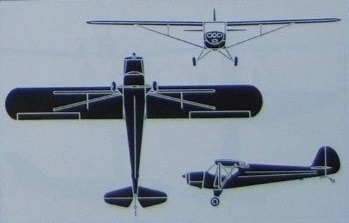
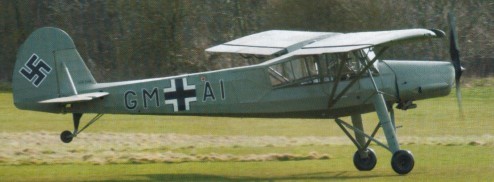
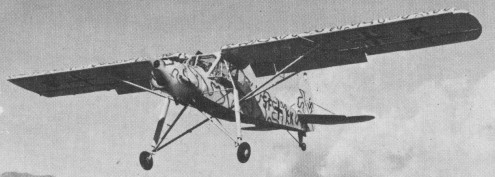
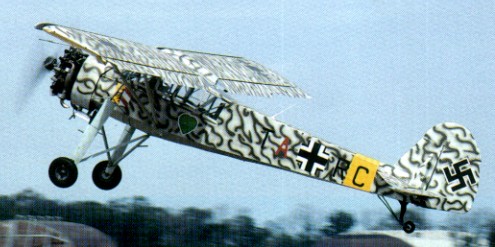
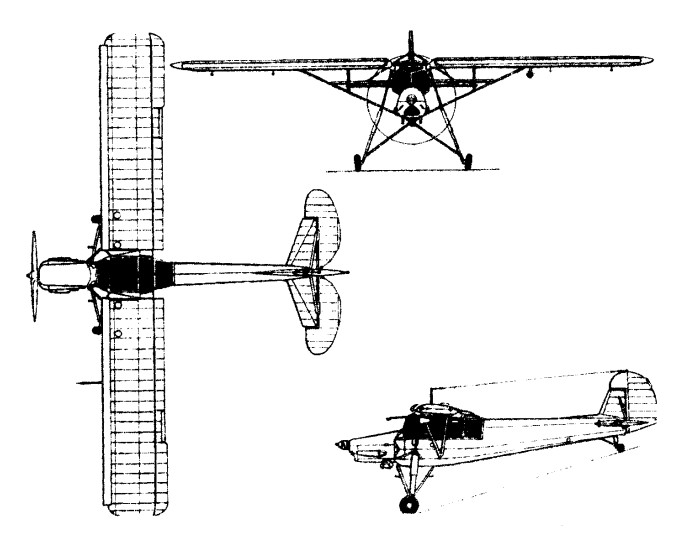
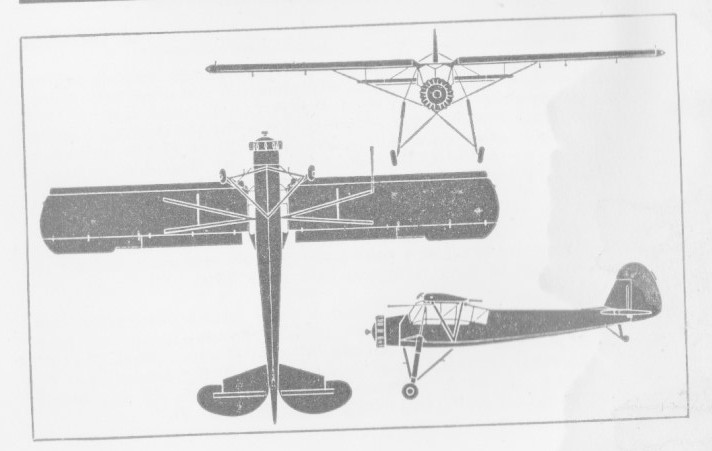
In the summer of 1935, Fiesler Chairman Gerhard Fieseler, Chief Designer Reinhold Mewes and Technical Director Erich Bachem designed a practical STOL aircraft, the Fieseler Fi 156. It was seen as fulfilling numerous roles both in civil life and for the recently resurgent Luftwaffe. The Fieseler Fi 156 Storch (Stork) was a STOL (short take-off and landing) aircraft, a three-seat extensively glazed cabin, high-winged machine with the wing liberally endowed with slats and flaps and a stalky landing gear arrangement, well suited to cushioning arrivals at unprecedentedly steep angles. The high-lift devices allowed a take¬off run of only about 60 m (200 ft) and it could land in about one-third of that distance. Fieseler’s chief designer, Reinhold Mewes, decided for ease of maintenance that the airplane should be completely conventional in its construction, and so utilized a steel tubing and fabric fuselage with wooden wings with a conventional braced tail unit and fixed tailskid landing gear. The wings were made of wood simply because they could be made in low grade factories using forced labour. The original wooden wings contained only 2 x 74 lt tanks. The engine was the then-common Argus As 10C inverted V-8 aircooled 240-hp model.
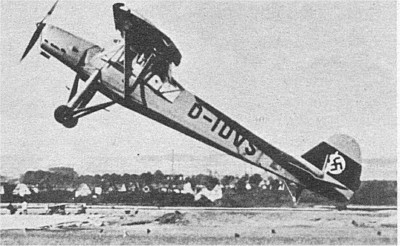
The big 46-foot wing had full-length fixed slats (projected movable slats never materialized), Fowler-type flaps that increased wing area by 18 percent, and ailerons that drooped with the flaps when they were extended past 20 degrees. The wings could be folded back along the fuselage, allowing it to be carried on a trailer or even towed slowly behind a vehicle. The long legs of the landing gear contained oil and spring shock absorbers that compressed about 450 mm (18 inches) on landing, allowing the plane to set down almost anywhere. In flight they hung down, giving the aircraft the appearance of a very long-legged, big-winged bird, hence its nickname, Storch. With its very low landing speed the Storch often landed “in place” or sometimes even backwards, if the wind was blowing strongly from directly ahead.
The Fieseler Fi 156 Storch (stork) V1 prototype was first flown during the early months of 1936. The Argus As 10C V8 engine gave the plane a top speed of only 175 km/h (109 mph), enabling the Storch to fly as slow as 50 km/h (32 mph), take off into a light wind in less than 45 m (150 ft), and land in 18 m (60 ft). In response to the prototype, in 1937 the RLM (Reichsluftfahrtministerium, Reich Aviation Ministry) put out a tender for a new Luftwaffe aircraft suitable for liaison, army co-operation – today called Forward Air Control – and medical evacuation to several companies.
V2 Prototype at the IV Internationales Flugmeeting, Zurich, 1937
Designs from from Messerschmitt (the Bf 163) and Siebel (the Si 201) and an auto gyro from Focke-Wulf (the Fw 186) based on Cierva technology were submitted, but the Fieseler entry was by far and away the most advanced in terms of STOL performance, needing a take-off run of only about 200 ft (60 m) and landing in about one-third of that distance. The first Fi 156 prototype was followed up by the second V2 prototype and then the third V3 prototype, the ski-equipped V4, plus one V5 and ten Fi 156A-0 pre-production aircraft. Flight testing of the first three prototypes (Fi 156 V1, V2 and V3) showed that the capability of this aircraft more than exceeded its STOL expectations, with little more than a light breeze blowing it could take off inonly a few feet. One of these prototypes was demonstrated publicly for the first time at an international flying meeting at the end of July 1937 in Zürich, by which time the general-purpose Fi 156A-1 was in production. The Storch repeatedly demonstrated full-load take-offs after a ground run of never more than 148 ft (45 m), and a fully controllable speed range of 32-108 mph (51-174 km/h). Service tests confirmed that Ger¬many’s armed forces had acquired a ‘go-anywhere aircraft, and for the re¬mainder of World War II the Storch was found virtually everywhere Ger¬man forces operated.
Fi-156EC2 Storch
It was immediately ordered into production by the Luftwaffe with an order for 16 planes, and the first Fi 156A-1 production aircraft entered service in mid-1937. Fieseler then offered the Fi 156B, which allowed for the retraction of the leading edge slats and had a number of minor aerodynamic cleanups, boosting the speed to 208 km/h (130 mph). The Luftwaffe didn’t consider such a small difference to be important, and Fieseler instead moved on to the main production version, the C.
The Fi 156C was essentially a “flexible” version of the A model. A small run of C-0s were followed by the C-1 three-seater liaison version, and the C-2 two-seat observation type carrying a single camera (which had a rear-mounted MG 15 machine gun for defense). Both models entered service in 1939. Some late examples of the Fi 156 C-2 were equipped to carry one stretcher for casualty evacuation.
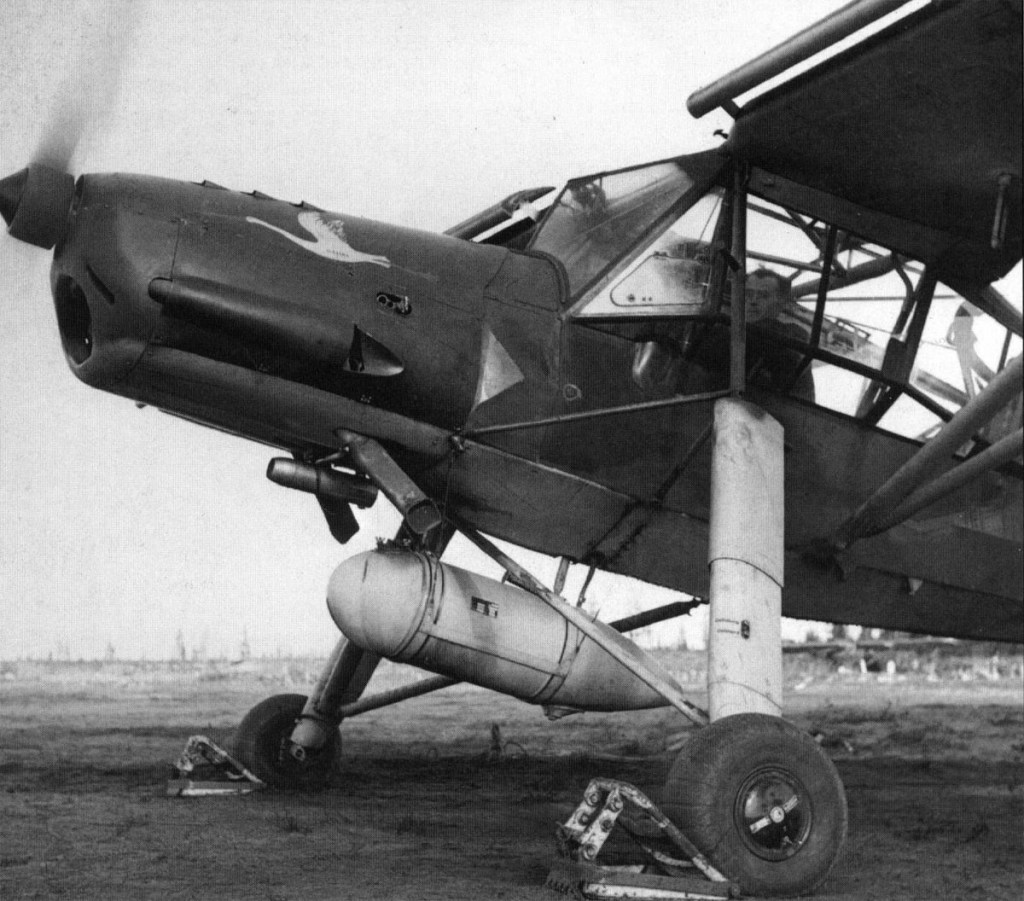
In 1941, both were replaced by the “universal cockpit” C-3. The Fl 156C-3 was the first to be a equipped for multi-purpose use, the majority of the type being powered by the Argus As 10P engine, which was also standard in the generally similar Fi 156C-5 which had provision to carry an under fuselage camera or jettisonable fuel tank. Last of the Cs, the C-5, a C-3 with a belly hardpoint for a camera pod or drop tank. Some were fitted with skis, rather than wheels, for operations on snow.
Other versions of the Fi 156 were the C-3/Trop, which was a tropicalised version of the Fi 156C-5, and the Fi 156D which was an air ambulance version. The first two Fi 156D models were the D-0 pre-production aircraft, and the D-1 production aircraft, powered by an Argus As 10P engine.
Ten unusual pre-production aircraft were built under the designation Fi 156E-0, intended for operation from rough terrain with the standard landing gear was replaced by main units that each incorporated two wheels in tandem, the wheels of each unit, being linked by pneumatic rubber track.
A total of about 2,900 Fi 156s, mostly Cs, were produced from 1937 to 1945. When the main Fieseler plant switched to building Bf 109s in 1943, Storch production was shifted to the Mráz factory in Choceň, Czechoslovakia as the Benes-Mráz J-65 ‘Èáp’.
During the occupation of France, the Fi 156 was built by the Morane-Saulnier company at its Puteaux factory as the Morane Ms.502, and post-war as the MS.505. A lot of Luftwafe parts were collected by Morane Saulnier and reused to build the MS.500 Criquet. The wings on the original were wood but Moraine Saulnier reproduced the wings, tail and controls in metal. While heavier, the wings contained additional fuel. The original wooden wings held 2 x 74 lt tanks, and the MS wings an additional 100 lt in each wing. Moraine Saulnier used the Argus engines until supplies dried up.
A large number were also built at the captured Morane-Saulnier factory in France, starting in April 1942, as the M.S.500 Criquet.
French production models included the MS-500 (Argus As 410C), the MS-501 (Renault 6Q), and the MS-502 (Salmson 9AB). In early 1964 a re-engined version, the MS-505 with a 300 hp Jacobs R-915A began trials.
Both factories continued to produce the planes after the war for local civilian markets (in Czechoslovakia it was made as K-65 Čáp, 138 were made by 1949). Licenced production was also started in Romainia in 1943 at the ICAR (Īntreprinderea de construcţii aeronautice româneşti) factory in Bucharest. Only 10 were built by the time Romania switched sides, with a further 70 aircraft being built by the Romanians before production ended in 1946. During the war at least 60 Storchs were captured by the Allies, one becoming the personal aircraft of Field Marshal Montgomery.
A total of 2,549 Fi 156s were built.
MS.505 Criquet
Tests against fighters appeared to confirm that, at around 34 mph (55 km/h), it was a very difficult target for fighters. There was almost trouble when Udet’s camera-gun film showed not one picture of the elusive Storch. Another Fi 156A-0 was tested with three SC-50 (50 kg/110 lbs) bombs, with aim marks painted on the Plexiglas windows, while another did successful trials against a U-boat with inert 298 lbs (135 kg) depth charges. Less unexpected were supply-dropping tests and trials with smoke apparatus.
Between 1940 and 1943, Germany exported 34 Fieseler Fi 156Cs to Romania. A further Storch was assigned for Marshall Ion Antonescu’s personal use. Further Fi 156s were received in 1944 and some were probably captured after August 23, 1944, from the retreating German forces. In the so called ‘People’s Democracy’ the remaining dozens of Storchs received civilian registrations and were relegated to AVIASAN, the Romanian national air ambulance service. The last ones were finally retired in the late 1960s.
The Ilmavoimat / Maavoimat / VL Team evaluated the aircraft and carried out a series of flight tests early in 1938. As expected, the Fi 156 rated highly, with the STOL performance in particular impressing the the test team. Excerpts from the Flight Test reports written at the time reveal some of the impressions that aircraft made on the Test Pilots:
“…..nothing could possibly convey its general ungainliness. It stands so high off the ground that an average man can barely see in the side windows…”
“…..once in the cockpit, the nose didn’t even begin to block my vision because I was sitting so high above it. The cockpit area is huge, big enough to stand up in, and it’s cluttered with cranks, wheels and levers, all labeled in German. The stick and rudder are where they should be, but the rudders are big cast-aluminum footprints with safety straps of their own and the stick resembles a telephone pole. The flaps are lowered by a crank, not a dainty little crank, but a man-sized Model “T” Ford type crank that sticks out of the left wall. By winding in the Aus direction, wing-size boards flop out of the trailing edges and the ailerons race to catch up. In the spar carry-through structure over the pilot’s head is a pointer that indicates how much flap is hanging out, and in this airplane, any flap at all is a lot……”
“….. I must have made at least 15 takeoffs and landings, all of them incredibly short and none of them where I wanted them to be. On takeoff, I found that even with the correct trim, I couldn’t pull back hard enough to come even close to stalling it. As soon as I had a minimum of 35 knots, I could pull back all I wanted and do nothing but climb. I had absolutely no head-wind component and my initial climb angle was nearly 45 degrees. This airplane really will leap off the ground. Taking off three-point in a headwind, I doubt that it would need more than 20 feet to get off, although I was using close to 100 most of the time……”
“……To make short-field landings on a chosen spot, you usually like to get the airplane slow enough so you have to use power to drag it in. I was constantly frustrated in the Storch, because I never got it slow enough to need power. Almost every landing was power-off, and eventually I was so exasperated that I was approaching at 25 knots indicated. At that speed, I needed power to soften the touchdown, but it still wasn’t slow enough to hang on the prop. …… the really hot-shot German Pilot that instructed us in the Fi 156 would come creeping in over the trees at practically zero airspeed, letting it fall on command and catching it at the last moment with a burst of power…..”
“….. I tried to stall it while at altitude and found that it not only refuses to stall, but as long as I had the slightest amount of power in to give it elevator effectiveness, I could easily fly the airplane where I wanted while holding the stick all the way back. Once you master that kind of approach, you could land backwards on an outhouse roof…..”
“……I had a lot of silly things happen while flying this airplane but the silliest was when I tried slipping it. I was high, per usual, so I figured I’d just use a max deflection slip. It works on other airplanes, why not? As I leaned the aileron into it and got on the opposite rudder everything was going just fine until I got about half rudder. At that point, the rudder pressure disappeared and the rudder pedal sank to the floor with no effort from me and stayed there. So, there I was, coming down final sideways with a rudder that was stuck to the floor of its own accord. That scared the living hell out of me! I had to practically stand on the other rudder to get things straighted out. I guess the aerodynamic balance on the rudder is so big that when enough of it catches the wind, it overpowers the surface and yanks it to full deflection……”
“….Maneuvering in the Storch is a real physical workout. The controls feel the way the airplane looks—gawky and loose. The stick forces are anything but light and to keep it completely coordinated, your feet have to thrash in and out as if you were working a treadle sewing machine….”
Fieseler Fi 156 Storch in Finland
Given the low cost of the Fieseler Fi 156, this was a feasible proposition and in August 1938, the Ilmavoimat announced twenty Fi 156’s were to be bought direct from Fiesler – delivery was rapid and these aircraft were shipped and arrived before the end of the year. Additionally, a manufacturing license was bought from Fiesler and the Finnish company Veljekset Karhumäki was awarded a contract to build an initial 100 aircraft (Veljekset Karhumäki were also advised that further orders would be placed, with the objective being to ensure that all Regimental Battle Groups were fully equipped). This was a large expansion in business for Veljekset Karhumäki and two additional factory buildings were acquired, one to construct the Argus engines and one to construct the aircraft. Setup moved as rapidly as possible with production starting towards the end of 1938 and the first Finnish-manufactured Fi 156 rolling out the doors in early February 1939. Delivery averaged six Fi 156’s per month through the first half of 1939, increasing to 2 per week from July on and in the event, some 70 Fiesler Fi 156’s had been delivered by Veljekset Karhumäki by the time the Winter War broke out.
Finland entered the Winter War with some forty Fw 189 aircraft in service, in addition to the ninety odd Fieseler Fi 156 Storch’s. When the Winter War broke out, it was obvious that despite the intensive manufacturing effort over the previous six months there were nowhere near enough of the aircraft, even with the older aircraft being utilised. Despite limited numbers of observation aircraft being bought abroad and continuous production from Veljekset Karhumäki (some 10 per month by January 1940), demand for the aircraft always exceeded the supply available throughout the Winter War.
The Ilmavoimat Fi 156 production variant was a two crew (Pilot and Observer / Controller) with an enlarged loading/unloading hatch for a single stretcher so as to allow for casualty evacuation. A more powerful engine was fitted and the aircraft could carry up to three passengers in addition to the crew of two. Given that the aircraft was expected to operate from rough terrain, the standard landing gear was replaced by main units that each incorporated two wheels in tandem. For Forward Air and Artillery Control, provision was made for additional Finnish-supplied radio equipment to be installed to allow for simultaneous communication with ground units, artillery and aircraft. Mountings for 30lb phosphorus “marker” bombs were also installed and a single machinegun was fitted.
The Finnish Fieseler Fi 156 Storchs remained in service until 1960.
The Storch could be found on every front throughout the European and North African theaters of operation in World War II. It will probably always be most famous for its role in Operation Eiche, the rescue of deposed Italian dictator Benito Mussolini from a boulder-strewn mountain top near the Gran Sasso, surrounded by Italian troops on 12 September 1943. German commando Otto Skorzeny dropped with 90 paratroopers onto the peak and quickly captured it, but the problem remained of how to get back off. A Focke Achgelis Fa 223 helicopter was sent, but it broke down en route. Instead, pilot Walter Gerlach flew in a Storch, landed in 30 m (100 ft), took aboard Mussolini and Skorzeny, and took off again in under 80 m (250 ft), even though the plane was overloaded.
Fieseler Fi 156 Storch Engine : Argus 10 E/1, 175 hp Length : 32.48 ft / 9.9 m Height : 10.007 ft / 3.05 m Wingspan : 46.752 ft / 14.25 m Wing area : 279.864 sqft / 26.0 sq.m Max take off weight : 2910.6 lb / 1320.0 kg Weight empty : 1896.3 lb / 860.0 kg Payload: 837.9 lb / 380.0 kg Max. speed : 94 kts / 175 km/h Initial climb rate : 1574.80 ft/min / 8.00 m/s Service ceiling : 17388 ft / 5300 m Wing load : 10.46 lb/sq.ft / 51.0 kg/sq.m Range : 324 nm / 600 km Endurance : 5 h Crew : 1+2
Fi 156A-1
Fi.156C-2 Engine: 1 x Argus As 10C-3, 179kW (240-hp) Max take-off weight: 1325 kg / 2921 lb Empty weight: 930 kg / 2050 lb Wingspan: 14.25 m / 46 ft 9 in Length: 9.9 m / 32 ft 6 in Height: 3.05 m / 10 ft 0 in Wing area: 26 sq.m / 279.86 sq ft Maximum speed 170 kmh (109 mph) at sea level Economical cruising speed 130 km/h (81 mph) Landing speed: 25 mph Slow cruise: 31 mph Service Ceiling: 4600 m / 15100 ft Range: 385 km / 239 miles Armament: one rear-firing 7.92-mm (031-in) machine-gun on trainable mount
Fi 156D-0 –
M.S.502 Engine: 230 hp Salmson 9AB Wingspan: 46 ft 9 in Wing area: 279.7 sq,ft Length: 31 ft 8 in Height: 10 ft Empty weight: 2100 lb Loaded weight: 3140 lb Max speed: 106 mph at SL Cruise: 85 mph Service ceiling: 14,100 ft Climb to 3280 ft: 5.5 min Range: 435 mi at 72 mph
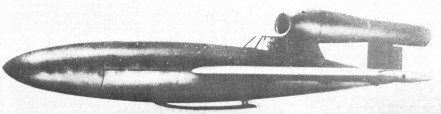
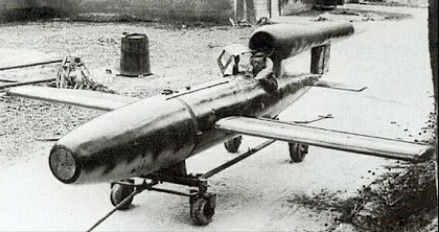
SS officer Otto Skorzeny is credited with the idea of a piloted version of the Argus pulsejet powered Fieseler Fi 103 V-1 flying bomb able to make precision attacks, and design began before the first unguided V-1s fell on London in June 1944. To study why many test V-1s crashed soon after launch an earlier piloted version was tested. Two pilots were injured before famed woman test pilot Hanna Reitsch confirmed that the engine noise was vibrating the airframe off course.
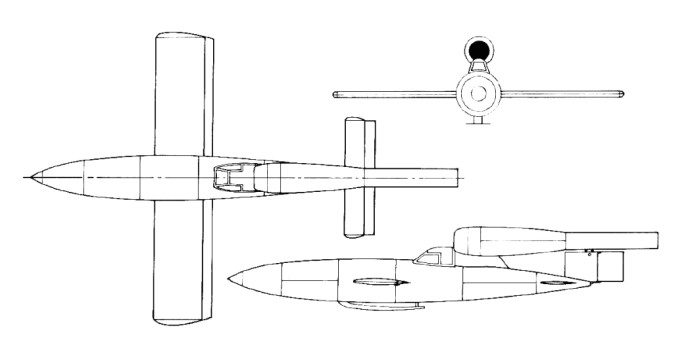
Proposals were made to launch the manned bomb from be¬neath a carrier aircraft. On operations the piloted flying bomb would have been carried and launched in pairs from modified Heinkel He 111 bombers. A total of about 175 piloted Fi 103Rs (Reichenberg being the oper¬ational codename covering the pro¬ject) were completed: the R-I, R II and R III were test and training versions, and the R IV was intended for oper-ational use. The Reichenberg IV had only basic instrumentation and could supposedly be flown after minimal training training. The cockpit had only four instruments. Testing was undertaken by Rechlin pilots but after two had crashed development flying was taken over by DFS test pilots Hanna Reitsch and Heinz Kensche. Handling in the air was fairly straightforward but landing was extremely tricky owing to the rudimentary control provided and the very high landing speed. The 100 volunteers who signed up to fly the bombs were known unofficially as ‘Selbstopfermaenner’ or ‘Self-sacrifice Men’ for special unit KG 200, but none were actually used operationally and development stopped in October 1944.
Fi 103R-IV Powerplant: one 350 kg (772 1b) thrust Argus 109 014 pulsejet. Max powered level speed 650 kph (404 mph) at sea level Endurance (limited by pulsejet life) 20 min. Weight: at launch 2180 kg (4,806 lb). Wing span: 5.715 m (18 ft 9 in) Length 8.00 m (26 ft 3 in) Height: 1.42 m / 4 ft 8 in Maximum fuselage diameter 0.838 m (2 ft 9 in) Warhead: 850 kg (1,874 lb).


 All Aero