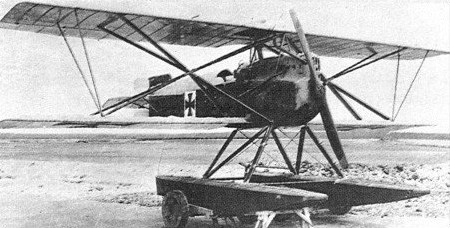
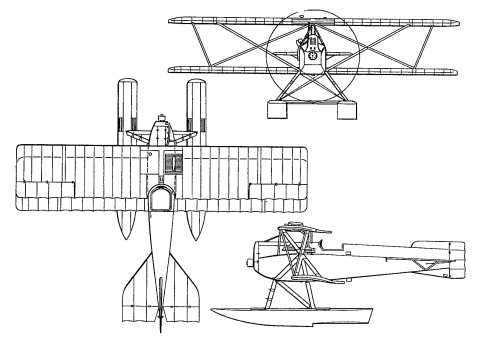
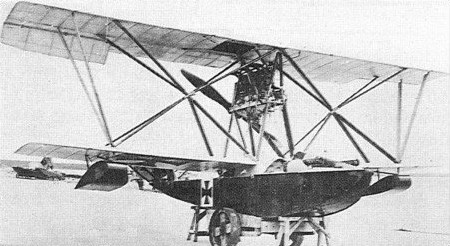
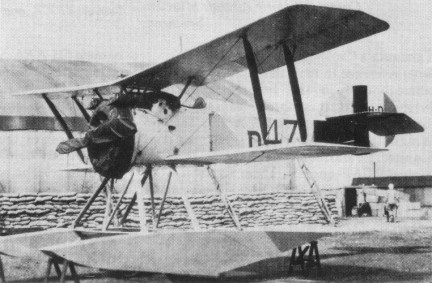
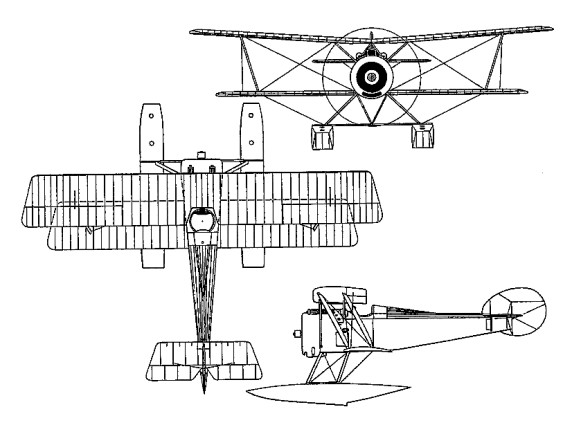
The KDW twin-float single-seat fighter seaplane was essentially a 1916 conversion of the land-based KD (D.I) to provide an interim aircraft for floatplane station defence. The only major change introduced on the prototype apart from provision of a twin-float chassis was some slight extension of the wings, but the fin area was later increased to compensate for the increased keel area resulting from the addition of the floats. The prototypes were fitted with the 150hp Benz Bz III six-cylinder water-cooled engine, but apart from a preproduction batch of 10 similarly-powered aircraft, all subsequent examples of the KDW had the 160hp Maybach Mb III six-cylinder water-cooled engine. The first production series was armed with a single synchronised 7.92mm LMG 08/15 machine gun mounted on the starboard side of the nose, but the final batch of 20 delivered between October 1917 and February 1918 had a gun mounted on each side of the cockpit and additional Vee-type interplane bracing struts. A total of 58 KDW float fighters was delivered.
KDW Engine: 1 x 160hp Maybach Mb.III Max take-off weight: 1039 kg / 2291 lb Empty weight: 759 kg / 1673 lb Wingspan: 9.30 m / 31 ft 6 in Length: 7.86 m / 26 ft 9 in Height: 3.35 m / 11 ft 0 in Wing area: 29.15sq.m / 313.77 sq ft Max. speed: 171 km/h / 106 mph Cruise speed: 154 km/h / 96 mph Ceiling: 3500 m / 11500 ft Rate of climb: 145 m/min / 500 ft/min Armament: 2 x 7.92mm Crew: 1
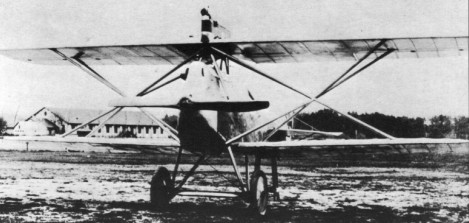
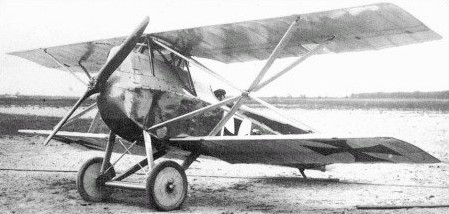
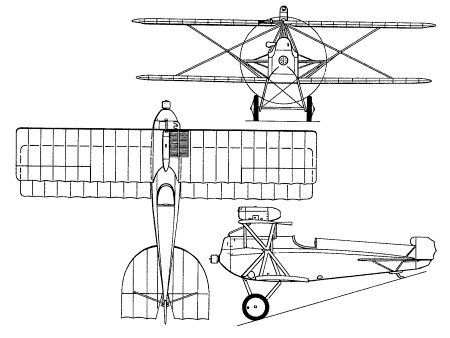
Designed by Ernst Heinkel for the Austrian army in 1916, the KD (Kampf Doppeldecker), later designated Hansa¬Brandenburg D.I, single seat fighter aircraft was known variously as the Spinne (spider) and ‘Star Strutter’. Each nickname referred to the unusual interplane strutting, comprised of four small V struts joined together in a star shape between each upper and lower wings. Flown as a prototype with the 160hp Mercedes D III six-cylinder water-cooled engine, the KD was manufactured in series as the D.I in two versions Series 28, with a 160 hp Austro Daimler engine, built by the Austrian firm of Phonix Flugzeugwerke; and Series 65, powered by a 185 hp Austro-Daimler, built by Ufag. Due to lack of a suitable synchronization gun gear, the D.I was armed with one machine gun in a ‘baby coffin’ housing above the upper wing centre section. Despite its shortcomings, the ‘Star Strutter’ was extensively flown in combat by most leading Austro Hungarian fighter pilots, who gained many victories in the type. Of wooden construction with fabric wing skinning, plywood fuselage skinning and having steel-tube interplane strutting, the D.I was armed with a single unsynchronised 8mm Schwarzlose machine gun which was enclosed by a fairing on top of the cabane and fired over the propeller. The D.I was reputedly difficult to fly, suffered inadequate directional stability owing to the rudder being blanketed by the deep fuselage, and had poor spin recovery characteristics. A number of Phonix-built Brandenburg D.Is survived World War I to serve briefly with the Deutschosterreichische Fliegertruppe.
Entering first line service in 1917, the D.I was found to have poor lateral control, and was difficult to land safely due to the pilot’s forward view being virtually obscured by the bulky engine installation. Such was the D.I’s high accident rate that it became nicknamed the Sarg (coffin) by front line pilots. Until its gradual replacement by Austrian built Albatros Ds and Berg D scouts in late 1917, however, the ‘Star Strutter’ bore a large burden of fighter combat. Austria’s leading fighter pilot, Godwin Brurnowski, commander of Fliegerkompagnie (Flik) 41J, had its Brandenburgs all doped in a red finish with a white skull on a black field as a unit mark.
Hansa-Brandenburg KD (D.I) Series 28 Engine: 160 hp Austro Daimler Span: 8.50 m (27 ft 10.5 in) Length: 6.35 m (20 ft 10 in) Wing area: 23.95 sq.m / 257.80 sq ft Max take-off weight: 920 kg / 2028 lb Empty weight: 672 kg /1482 lb Max. speed: 187 km/h / 116 mph Service ceiling: 5000 m (16400 ft)
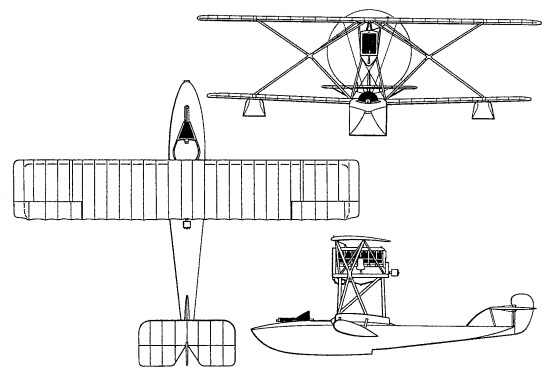
Intended primarily for use by the Austro-Hungarian Navy, the CC single-seat fighter flying boat (the designation was derived from the initials of Camillo Castiglioni, the financier of the Hansa- und Brandenburgische Flugzeug-Werke) was a single-bay biplane of wooden construction which appeared in prototype form in mid-1916. Retaining the “star” interplane bracing strut arrangement introduced by the KD (D.I), the CC was supplied to the Austro-Hungarian Navy with both the 160hp Austro-Daimler and 180hp Hiero six-cylinder water-cooled engines, armament consisting of a single 8mm Schwarzlose machine gun projecting through the windscreen. A total of 37 fighter flying boats of this type was delivered to the service. The CC was also adopted by the German Navy, which received a total of 36, with deliveries commencing in February 1917. These were powered by the 150hp Benz Bz III, the engines of some examples being semi-cowled. The CC initially carried an armament of one 7.92mm LMG 08/15 machine gun, but late production examples had two such weapons fixed to fire forward in the upper decking of the hull nose, and the hull was lengthened to improve flying characteristics. In July 1917, the German Navy grounded the CC until all aircraft were provided with extra (Vee-type) interplane bracing struts to dampen severe wing vibration. The CC was employed extensively and with considerable success over the Adriatic by the Austro-Hungarian Navy. One example was completed experimentally as a triplane, the extra wing being placed at the intersection of the “starstruts”. It was delivered to the Austro-Hungarian Navy for evaluation on 11 May 1917, but was written-off in a landing accident on the following 19 September. One CC was modified and tested in the summer of 1918 as the W 22, with broad sponsons replacing the outrigger stabilising floats. This experimental model, which crashed during testing, was intended solely to evaluate the sponson concept as part of the Staaken Rs IV development programme.
Max take-off weight: 1080 kg / 2381 lb Empty weight: 800 kg / 1764 lb Wingspan: 9.30 m / 31 ft 6 in Length: 7.69 m / 25 ft 3 in Height: 3.57 m / 12 ft 9 in Wing area: 26.52 sq.m / 285.46 sq ft Max. speed: 175 km/h / 109 mph Range: 500 km / 311 miles
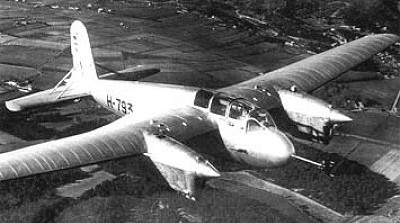
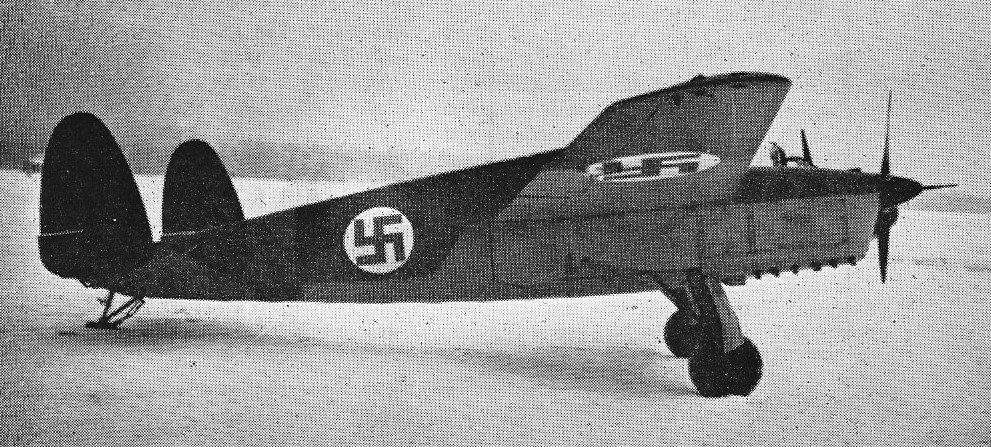
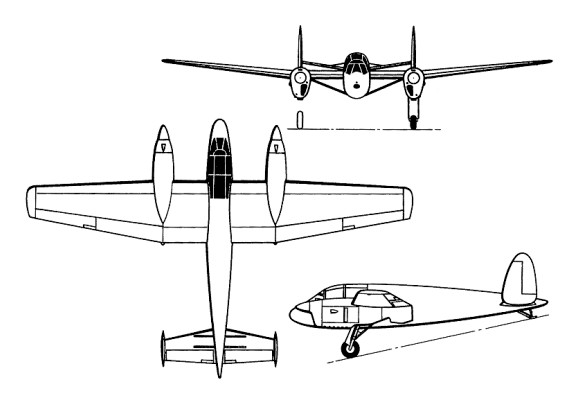
The H.230.01, service serial H.790, flew for the first time in June 1937. It was an advanced two-seat trainer which had a general resemblance to the H.220 but was of much lighter construction. Power was provided by two 127kW Salmson 6AF-00 engines and its configuration included a short crew canopy faired into the upper decking of the rear fuselage and a conventional . strut-braced tail unit, and the fixed main landing gear units incorporated spatted wheel fairings. During further tests it was decided to introduce considerable dihedral at the wingtips to improve stability, but the H.231.01 which followed in May 1938 had dihedral increased over the whole wing span, and the unusual wingtip arrangement of the modified H.230 was eliminated. Twin fins and rudders were introduced and power increased with 172kW Salmson 6AF engines. The Hanriot H.232.01 reverted to a single fin and rudder and had 164kW Renault 6 Q-o engines plus retractable landing gear. The H.232.02, first flown in August 1938, introduced a redesigned cockpit; it was tested officially between October 1938 and May 1939. The type was then given a twin fin and rudder tail assembly and was flown in this new configuration in December 1939, then redesignated H.232/2.01.
An order for 40 aircraft had already been received from the French air ministry, and this was increased to 57 examples shortly afterwards. By then known as the NC.232/2, they incorporated minor improvements including redesigned rudders and engine cowlings. Full navigational equipment was installed. Three reached Finland. Two were from Germany, and these were not taken into service until the Winter War 1939-40 with the Soviet Union was over. Deliveries to the Armee de I’Air started in February 1940, 35 being taken on charge up to the June 1940 Armistice. The NC.232/2s were,used by the training sections attached to the 51th and 54th Escadres, which were equipped with Breguet 691and 693 attack bombers. Twenty aircraft found on airfields when the German forces occupied Vichy, France, in 1942 were reduced to scrap.
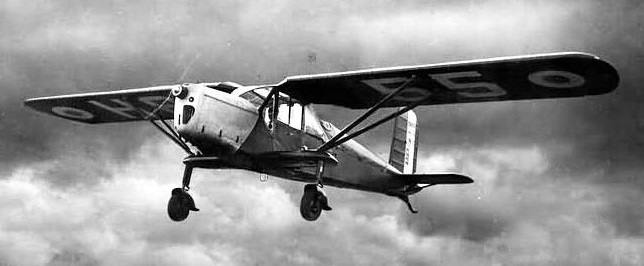
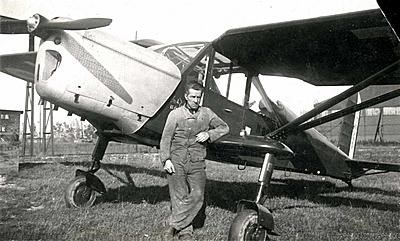
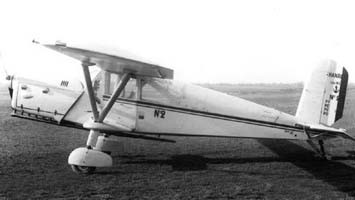
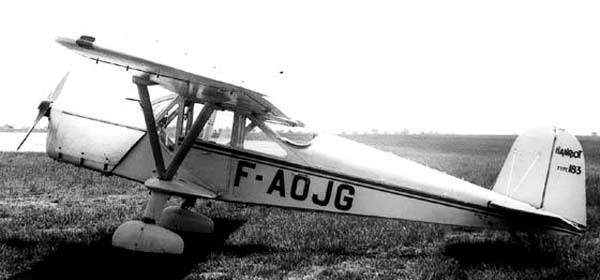
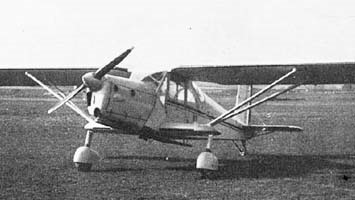
The Hanriot H.170, H.180, and H.190 were a family of light utility aircraft designed by Montlaur and produced in France in the 1930s. First flown in 1934 and all introduced in 1934, they appeared side-by-side at the Paris Air Show that year, the model numbers distinguishing between versions powered by Salmson, Renault, and Régnier engines respectively.
H.180
In basic construction, the different variants were otherwise almost identical, as largely conventional monoplanes with high, strut-braced wings and fixed, tailskid undercarriage. The pilot and one or two passengers sat in an extensively-glazed, enclosed cabin.
Although usually described as a monoplane, this family of aircraft all featured small, stub wings at the bottom of the fuselage. These carried the fuel tanks and served as a mounting point for the wing struts and undercarriage. An interesting feature was that the upper portion of the rear fuselage was a removable module, allowing it to be replaced with alternative modules for different roles, for example to carry a stretcher, or a second, open cockpit for pilot or gunnery training.
H.170/175
The H.182 was the major production version, accounting for 346 out of the total of 392 aircraft built. Most of these were produced as part of a government order for machines to equip the Cercles Aériens Régionaux reserve flying units, with 172 aircraft still operational at the Fall of France in 1940.
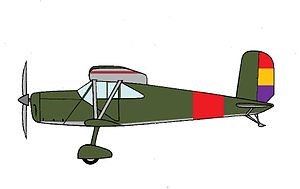
Ten more were purchased by the Second Spanish Republic for use in the Spanish Civil War, and 50 aircraft originally ordered by the French government were diverted to Turkey as part of a military aid agreement.
Variants: H.170 – two-seat military observation version with Salmson 6Te engine (1 built) H.171 – three-seat civil tourer version of H.170 (1 built) H.172 H.172B – two-seat trainer (1 built) H.172N – three-seat tourer (7 built) H.173 – aerobatic trainer version (1 built) H.174 – three-seat trainer (1 built) H.175 – liaison aircraft for French Navy (10 built) H.180 H.180T – three-seat tourer with Renault 4Pdi engine (1 built) H.180M – two-seat military observation version with Renault 4Pei engine (1 built) H.181 – air ambulance version of H.180T (1 built) H.182 – main production version as trainer aircraft for French reserve aviation units. H.183 – aerobatic trainer with Renault 438 engine (1 built) H.184 – trainer version with uprated version of Renault 4Pei engine (1 built) H.185 – two-seat liaison version for French navy (6 built) H.190 H.190M – two-seat observation aircraft with Régnier 60-01 engine (1 built) H.191 – three-seat tourer (1 built) H.192 H.192B – two-seat trainer (1 built) H.192N – two-seat civil trainer with Régnier 6Bo.1 engine (9 built) H.195 – two-seat liaison aircraft with Régnier 6Bo.1 engine (1 built)
Operators: French Air Force French Navy Spanish Republican Air Force Turkish Air Force
Specifications:
H.182 Engine: 1 × Renault 4Pei, 104 kW (140 hp) Wingspan: 12.00 m (39 ft 5 in) Length: 7.22 m (23 ft 8 in) Height: 3.15 m (10 ft 4 in) Wing area: 19.0 m2 (204 ft2) Empty weight: 604 kg (1,331 lb) Gross weight: 887 kg (1,955 lb) Maximum speed: 190 km/h (120 mph) Range: 600 km (370 miles) Service ceiling: 5,500 m (18,400 ft) Crew: Two, pilot and instructor
Hanriot H.182 trainer of the Spanish Republican Air Force
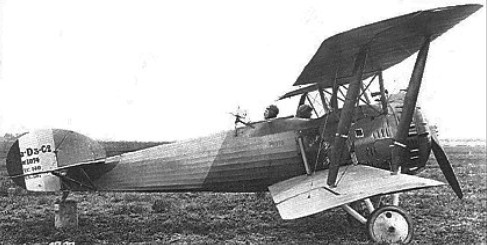
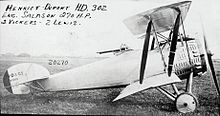
Design work on this two seat biplane was begun by Hanriot and Dupont in the autumn of 1917. The prototype had unequal span wings and was powered by a 260 hp Salmson (Canton Unnne) 9 Za radial engine and flew in June 1017. A double yoked pair of 0.303 in (7.7¬mm) Lewis guns were fitted in a ring mount¬ing in the rear cockpit.
A production order for 120 (later increased to 300 when it was also ordered for the Aviation maritime), to be desig¬nated HD.3 C2, was placed in April 1918. Main modifications included reduction of the upper wing span to that of the lower dimension, adoption of horn balanced ailerons, and improved covering for the forward top decking panels. These were faired over the ammunition feed equipment to twin and fixed and synchronized 0.303 in (7.7 mm) Vickers guns. The pilot and gunner sat in tandem, open cockpits and the main units of the fixed tailskid undercarriage were linked by a cross-axle. Short struts braced the fuselage sides to the lower wing.
First production machines appeared in September 1918, but the Armistice in November prevented comparison with the combat promise shown by the HD.3 C2. However, 75 had been built (s/n 1001 to 1075) for the Esc. HD 174 and other squadrons of the Aviation Militaire (army aviation) and at least 15 for the Aviation Maritime (naval aviation) before the Armistice halted production. HD 174 had been formed but never saw any action before the end.
A floatplane, to have been designated HD.4 in production form, was developed with varying types of floats and hydrovanes and a larger tailfin during 1918. The first really successful mode did not appear until December 4, 1918. By this time it was too late for combat service but some were used by the Aviation Maritime for a few years.
Work on a proposed night fighter variant, the HD.3bis CN2, also stop¬ped at the end of the war. This had mainplanes of thicker section, enlarged and balanced ailerons and rudder.
After the war, one of the navy’s machines was used for trials aboard the new aircraft carrier Béarn, while another was used for floatation tests at the Isle of Grain.
The 15 used by l’Aviation Maritime never entered service until 1919. They have variously been quoted as having serials starting from 2000 and up, but according to Lucien Morareau they were from the same series quoted above. The serial 2000 has also been quoted as the sole HD.4 prototype even though a photo clearly shows HD.3C2 on the tail. Few aircraft were completed in this serial range, highest number known is 2003.
At the end of 1917, a derivative of the HD.1 intended for use by France’s Aviation maritime as a single seat fighter float plane was tested as the HD.2. Possessing an essentially similar airframe to that of the HD.1, the HD.2 was powered by a 130 hp Clerget 9B rotary engine and carried an armament of twin synchronised Vickers machine guns. Two prototypes were tested with float undercarriages of differing lengths, and several HD.2s with wheel undercarriages were delivered to the Aviation maritime at Dunkirk for trials purposes, including trial operations from a 40 ft (12 m) platform mounted above a turret of the battleship Paris in the harbour at Toulon flown by Lieutenant Georges Guierre in October 1918. Later, in August and September 1918, similar trials were conducted at Saint Raphael with one of the HD.2 prototypes converted to landplane form and re engined with a 120 hp Le Rhone. Production exam¬ples, designated HD.2C, were fitted with 130 hp Clerget 9B engines, longer main floats, and a completely revised elliptical fin and rudder assembly. Armament comprised twin 0.303 in (7.7 mm) Vickers guns. Some HD.2Cs were in service with the French navy’s Centre Maritime at Dunkerque before the end of the First World War. The US purchased 26 HD.2s and Japan also bought a number. After the war, ten of the US batch were converted back to HD.1 landplanes by the naval aircraft factory, but continued to be used as trainers aboard at Langley Field, with flotation bags and hydrovanes attached in front of the main wheels. One was employed in August 1919 for trials from a platform mounted on the battleship USS Mississippi.
HD.2 – (float equipped) Max speed, 113 mph (183 km/h). Service ceiling, 15,750 ft (4800 m). Range, 186 mls (300 km). Empty weight, 1,091 lb (495 kg). Loaded weight, 1,594 lb (723 kg). Span, 28 ft 6.5 in (8,70 m). Span upper: 8.7 m (28 ft 6.5 in) Span lower: 7.4 m (24 ft 3.25 in) Length, 22 ft 11.5 in (7,00 m). Height, 10 ft 2 in (3,10 m). Wing area, 195.9 sq ft (18,20 sq.m).
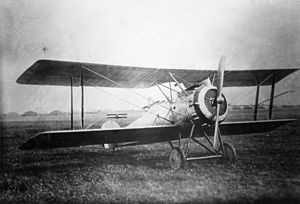
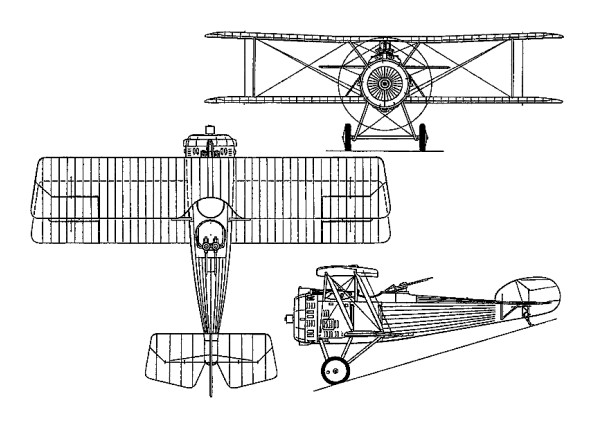
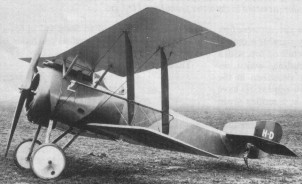
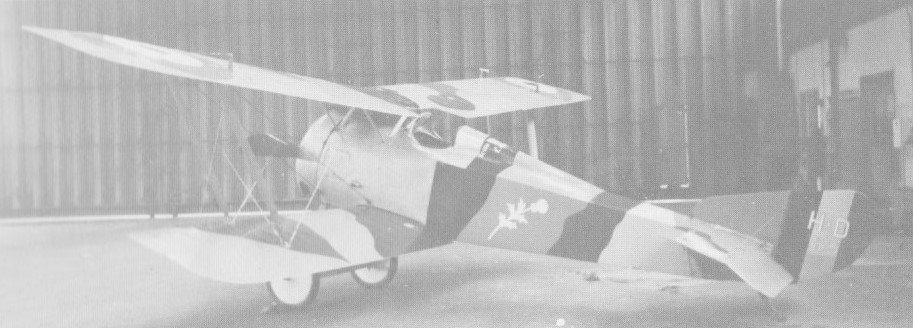
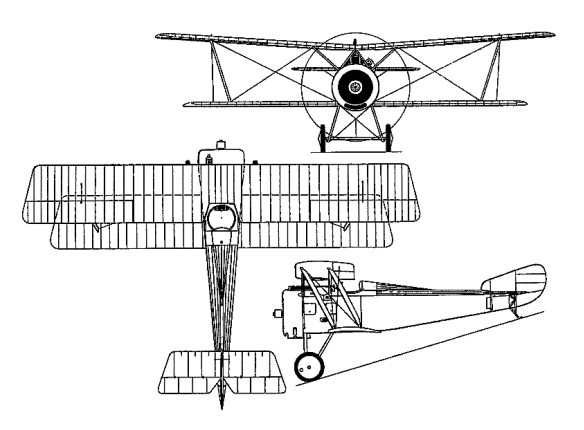
French single seat fighter biplane, prototype first flown 1916. It was designed by Pierre Dupont for the Sociote Anonyme des Appareils d’Aviation Hanriot and built by Hanriot at Billancourt, and was of sesquiplane configuration. The powerplant was a 110 hp Le Rhone 9 J rotary engine (120 hp Le Rhone 9 Jb on production aircraft) and carrying an armament of one synchronised 7,7 mm Vickers machine gun (although a few aircraft were later to be fitted with two Vickers guns). Tests proved it to be compact, manoeuvrable and with a good field of view. Although the HD.1 was accepted by the French government in early 1917, the huge contemporary production of the Spad 7 C1 precluded any production order for the French Aviation Militaire. Neither was the HD.1 considered to be a suitable replacement for the ageing Nieuport single seaters.
However, the HD.1 did impress the Italian and Belgian authorities. It was adopted by Italy as the main Nieuport replacement, and went into licence production by the Societa Nieuport Macchi at Varese. It seems that reports of 1700 being ordered from Nieuport-Macchi may have been exaggerated. Societa Nieuport Macchi delivered 125 to the Aeronautica del Regio Esercito in 1917, 706 in 1918, and a further 70 after the Armistice. 831 were received by the war’s end, the balance coming from French production.
The HD.1 entered Italian service in mid 1917, serving in the Austrian, Macedonian and Albanian theatres. During the latter stages of the war they equipped 16 of the Italian air arm’s 18 fighter squadrons, and some continued in service until 1925. Over nine-hundred were produced for the Italians and they used the type in greater numbers than any other fighter during the First World War.
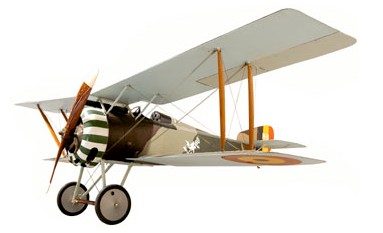
The HD.1 was also adopted by Belgium to which country Hanriot supplied 79 fighters of this type from August 1917. The HD.1 continued in service in both Italy and Belgium into the mid ‘twenties, and in 1921, Switzerland purchased 16 from Italian war surplus stocks and retained these in service until 1930.
Standard armament was a single 0.303 in (7.7 mm) Vickers gun, initially offset but later moved to a central position where the firepower was more effective, although the pilot’s view was slightly impaired. Belgian orders, for French built HD.1s, totalled 125, the first being delivered in August 1917. They were not instantly successful, but later gained popularity. One Belgian HD.1 was fitted with a single 11 mm (0.433 in) gun, which proved highly successful. Belgian HD.1s also served long after the war, some until 1926.
Small numbers were used by the French Aviation Maritime (naval air arm), with 130 hp Clerget 9 B engines and, on some, fin and rudder modifications similar to those of the HD.2. Switzerland purchased 16 HD.1s in 1921, and these remained in service until 1928.
HD 1 Engine: 120 hp Le Rhone 9Jb. Max speed, 115 mph (184 km/h) at sea level, 111 mph (178 km/h) at 6,560 ft (2 000 m). Time to 3,280 ft (1000 m), 2.97 min. Ceiling, 20,670 ft (6 000 m). Range, 224 mls (360 km). Empty weight, 983 lb (446 kg). Loaded weight, 1,437 lb (652kg). ROC: 894 fpm / 272 m/min Span: 8.70 m, (28 ft 6.5 in) upper Span: 7.40 m (24 ft 3.25 in) lower Length, 19 ft 2.25 in (5,85 m) Height, 9 ft 7.5 in (2,94 m) Wing area, 195.9 sq ft (18,20 sq.m) Seats: 1
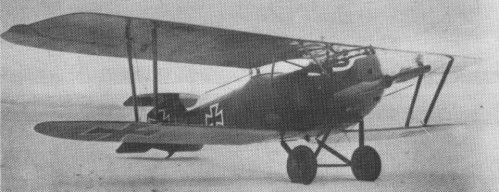
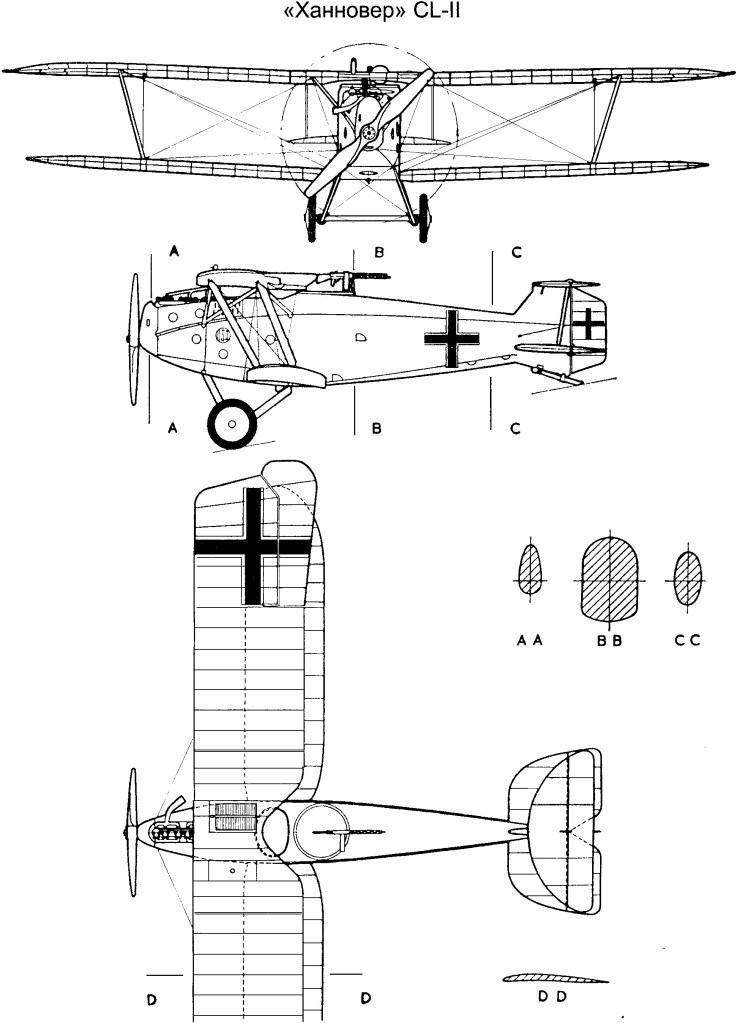
Designed by the Hannoversche Wag¬gonfabrik AG, the Hannover CL.II was produced in mid 1917 in response to an official requirement for a high performance two seat fighter for mainly low level tactical support of ground troops. The CL.II, which first went into operational service in late 1917, was unique for a single engined design in having a biplane tail assembly for greater field of fire by the observer/gunner and for a two seater was relatively small in overall dimensions. Its deep, ply covered fuselage gave the machine great strength, while the close set upper wing and narrow lower wings offered its crew an excellent field of vision both above and below.
A single-bay biplane, the two spar wooden wings were fabric covered. Both elevators, ailerons (on top wings only) and rudder were fabric covered steel tube structures.
In combat the Hannover proved itself as a formidable opponent to the Allied figh¬ters, able to manoeuvre with reasonable agil¬ity at most combat altitudes, and able to absorb battle damage to a high degree with¬out serious results.
A total of 439 Cl.II were built before production switched to an improved version, the CL.III, with a 160 hp Mercedes D.III engine, and incorpo¬rated modifications to the wingtips and ailerons, but only 80 machines were built due to the outstanding demands for Mercedes engines for single seat fighters.
Returning to the original 180 hp Argus engine, the next variant was designated CL.IIIa and saw large quantity production.
First production CL.IIs arrived on the Western Front in October 1917 and, along with the Halberstadt CL.II, became the backbone of the German Schutz¬staffeln (protection flights), escorting, the slower two seat reconnaissance machines. As such Hannovers were initially employed in a variety of roles, including artillery spot¬ting, reconnaissance, and photo sorties, apart from their nominal role of providing fighter cover for the older machines of the patrol flights. Though extremely well constructed, the CL.II was temporarily grounded in May June 1918 due to a rash of wing failures, but after the safety factors of the wing fitting had been improved to double their former figure.
A progressive development of the Cl II designed by Hermann Dorner, the Cl III was intended to offer improved altitude capability with the 160 hp Mercedes D III water cooled engine. Despite some airframe strengthening, the Cl III possessed a slightly reduced structural weight and marginally smaller overall dimensions. The Typenprufung was success¬fully passed on 23 February 1918, and an order placed for 200 aircraft with deliveries to commence in the following month. In the event, as a result of shortages of the Mercedes engine, only 80 Cl IIIs were delivered, the remainder of the order being completed with 180 hp Argus As III(O) licence built by Opel as the Cl IIIa. A total of 537 Argus-powered Cl.IIIa were built, with the biplane tailplane span reduced to give the rear gunner a better field of fire. This version was to remain in production until the end of hostilities, 573 being delivered.
Cl.IIIa
The designation Cl IIIb was allocated to the version that was to have been powered by the 185 hp NAG C III engine, and the Cl IIIc was a twin bay version built specifically as a test bed for the NAG engine. The Cl III and IIIa entered service in April 1918, serving primarily with the Schlachtstaffeln operating in the ground attack fighter role. Oddly, the Hannoversche Waggonfabrik completed a further 100 Cl IIIs and 38 Cl IIIa’s after the Armistice.
Hannovers continued to equip first line units throughout late 1918. A total of 293 CL.IIs and CL.IIIs were in service on September 1 of that year. The C.IV, the next development, did not go into production, but from it was evolved the CL.V. In mid 1918, the Idflieg prepared a specification calling for a Jagdzweisitzer a two seat fighter intended to engage the newer Allied single seaters on even terms, emphasising high speed, diving capability and manoeuvrability, and carrying a fixed forward firing armament of twin synchronised machine guns plus a third gun in the rear cockpit. To meet this requirement, which called for the aircraft to be tested to single¬ seat fighter load requirements, Hermann Dorner produced an extremely rugged and compact airframe. Designated Cl V, the prototype was powered by a 185 hp BMW IIIa engine and, tested against a similarly powered Fokker D VII, demonstrated comparable speed and climb. Twenty examples were ordered for operational evalu¬ation, but instead of being ordered into large production, Hannover’s chief designer, Her¬mann Dorner, was requested to develop the CL.V for a new category of two seat fighter (Jagdzweisitzer) specification. With the original biplane tail replaced by one of monoplane configuration, the Cl V was ordered into production, a contract for 100 aircraft being placed in September 1918, over 80 CL.Vs were thus built and tested to the new specification each armed with two forward and one rear firing machine guns although it is doubtful if any of the 46 completed before the end of hostilities reached the Front, a further 62 being completed after the Armistice. A stripped down example of the Cl V was to establish a world altitude record of 27,355 ft (8 340 m) on 22 November 1919. During 1923 24, the Kjeller Flyvernaskinsfabrik at Halden, Norway, built 14 Cl Vs under licence for the Norwegian Army as the F.F.7 Hauk (Hawk), these remaining in service until 1929.
Kjeller Flyvernaskinsfabrik F.F.7 Hauk (Hawk)
After the war Hannovers continued to be built, mainly as civil passenger machines or for export to other countries.
CL.II Engine: 180 hp Argus As III Seats: 2 Span: 11.70 m (38 ft 4.75 in) Length: 7.58 m (24 ft 10.5 in) Maximum speed: 166 km/h (103 mph) at 5000 m (16400 ft) Service ceiling: 7500 m (24 600 ft)
CL.III Engine: 160 hp Mercedes D.III
Cl. IIIa Engine: 180 hp Argus As III(O) Max speed, 103 mph (165 km/h) at 16,405 ft (5 000 m). Time to 3,280 ft (1000 m), 5.3 min. Endurance, 3 hrs. Empty weight, 1,653 lb (750 kg). Loaded weight, 2,447 lb (1110 kg). Span, 38 ft 4.5 in (11,70 m). Length, 24 ft 10.25 in (7,58 m). Height, 9 ft 2.25in (2,80 m). Wing area, 351.97 sq ft (32,70 sq.m).
CL IIIb Engine: 185 hp NAG C III
Cl. V Engine: 185 hp BMW IIIa Max speed, 109 mph (175 km/h) at 6,560 ft (2 000 m). Time to 9,840 ft (3 000 m). 12 min. Range, 211 mls (340 km). Empty weight. 1588 lb (720 kg). Loaded weight, 2,381 lb (1080 kg). Span, 34 ft 5 in (10,49 m). Length, 22 ft 11.5 in (7,00 m). Height, 9 ft 3.25 in (2,84 m). Wing area, 306.76 sq ft (28,50 sq.m). Seats: 2 Armament: 3 mg
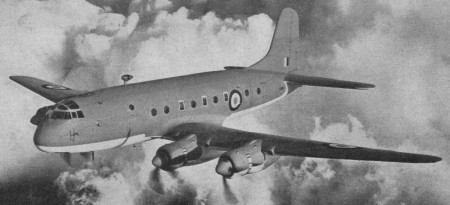
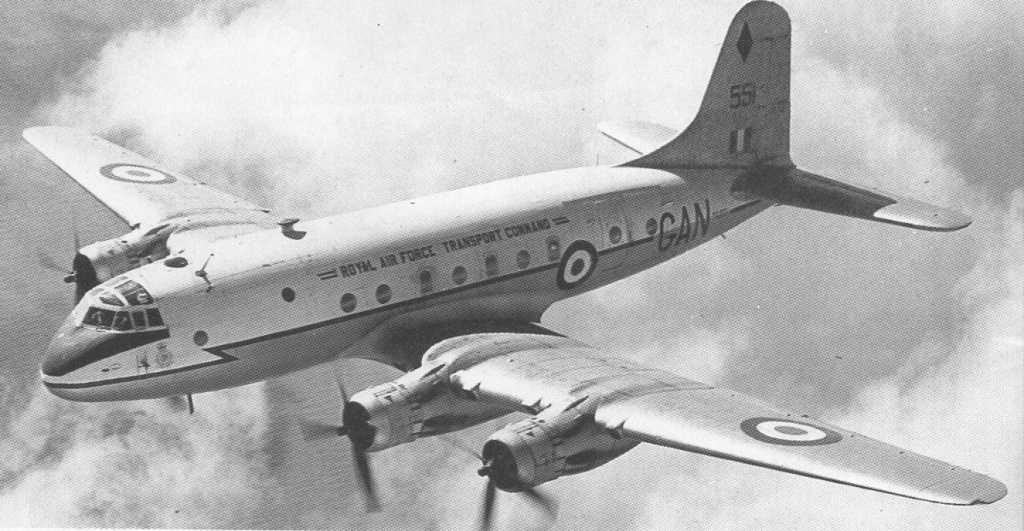
The Hastings was a general-purpose long-range transport flown by the RAF and RNZAF. Its roles included those of freighter, paratroop-transport, ambulance, troop-carrier, supply-dropper, jeep-carrier and glider-tug, first flown on May 7, 1946.
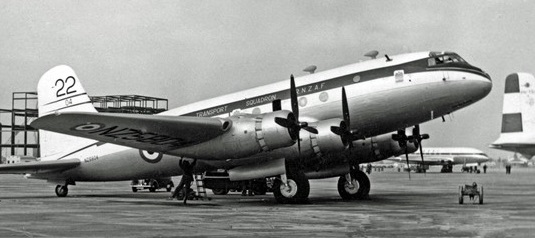
The initial production version was the C.1, first flown on 25 April 1947 and powered by four Bristol Hercules 101 engines. All C.1s were subsequently modified to Mk 2 standard and redesignated C.1As. The C.2 was powered by four Hercules 106 engines, had the tailplane lowered to the centreline of the fuselage and increased in area, extra fuel tanks, and the crew rest station replaced by an air-quartermaster post. The Hercules 737-powered C.3 was similar to the Mk 2 – and four were supplied to the RNZAF.
Hasting C.3
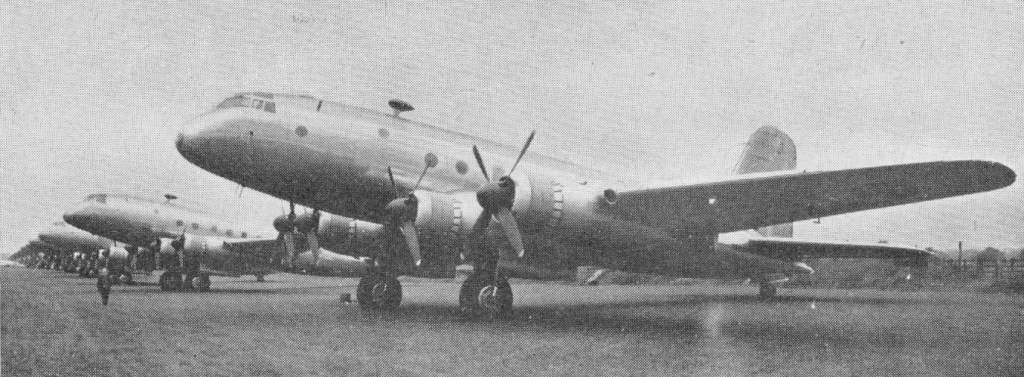
Two RAF squadrons of eight aircraft each went into service on the Berlin Airlift.
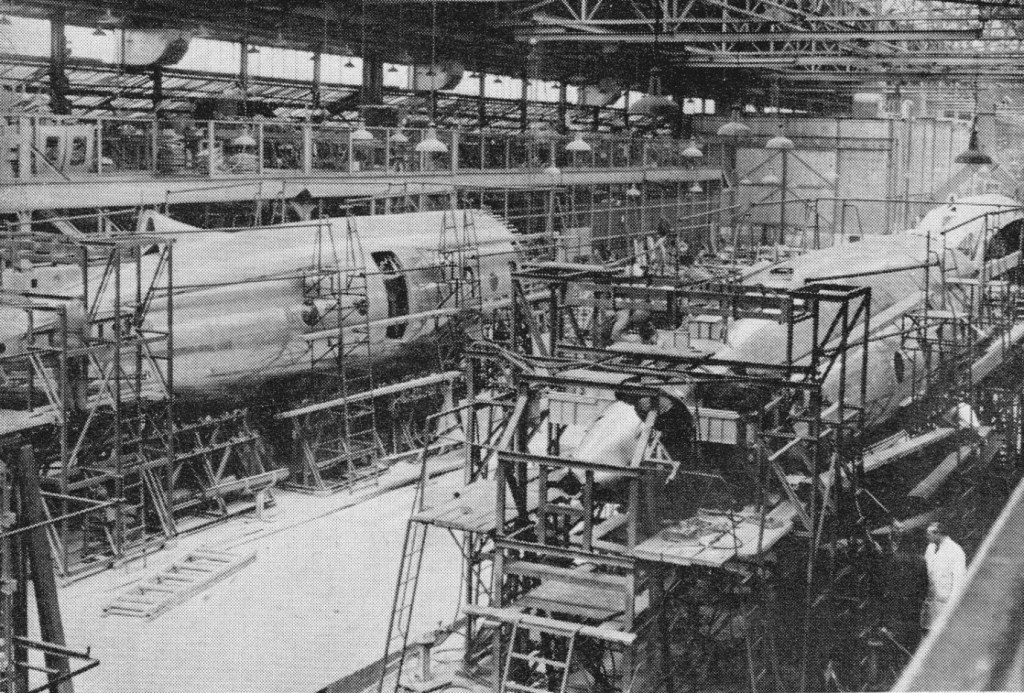
RAF Hastings assembled at Radlett in 1948
The final version was the C.4, a VIP version of the Mk 2 with accommodation for four VIPs and staff. Four were delivered to RAF Transport Command, bringing the total number of Hastings operated by the RAF up to 147. The last Hastings were withdrawn from service in 1968.
Hastings C.2 Engines: 4 x Bristol Hercules 106, 1249kW Max take-off weight: 36280 kg / 79984 lb Empty weight: 21960 kg / 48414 lb Wingspan: 34.44 m / 112 ft 12 in Length: 25.20 m / 82 ft 8 in Height: 6.86 m / 22 ft 6 in Wing area: 130.80 sq.m / 1407.92 sq ft Max. speed: 560 km/h / 348 mph Cruise speed: 486 km/h / 302 mph Ceiling: 8075 m / 26500 ft Range: 2720 km / 1690 miles
C.3 Engines: 4 x Bristol Hercules 737, 2040 hp. MAUW: 83,000 lbs. Max speed: 350 mph.


 All Aero