In the Dessau design office headed by Dipi Ing Emst Zindel, work had begun during 1922 on three new military types intended for production at Fili the J20 two seat low wing reconnaissance floatplane and the J21 two seat reconnaissance and J22 single seat fighter parasol wing aircraft.
On December 4, 1922 Jfa received an order from the Soviet government for a total of 100 aircraft 20 J20s, 50 J21s and 30 J22s. The first of these machines were being assembled during August 1923. The J21 was built in quantity at Fili.
Military
Junkers H.21
Negotiations by the new Soviet government for the production of Junkers aircraft in Russia were started in 1919; they resulted in German production in Russia of the A20, H 21 and H 22 single engined military aircraft between 1923 25, and assembly of the F.13 transport from German manufactured parts.
Junkers J.20 / A.20 / A.35 / A.40 / K.43 / K.45 / K.53 / R.02
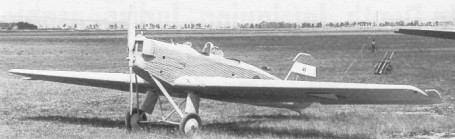
In the Dessau design office headed by Dipi Ing Emst Zindel, work had begun during 1922 on three new military types intended for production at Fili -the J20 two-seat low-wing reconnaissance floatplane and the J21 two-seat reconnaissance and J22 single-seat fighter parasol-wing aircraft.
A direct descendent from the J11 built in small numbers for the German Navy in 1918, the J20 was based on the same general layout, revised wings being the greatest change. The J11 in its turn was a float equipped derivation of the J10 two seat escort and ground attack fighter, which had been built in quantity during 1918 as the Junkers CL.I. The J8 was the prototype for this aircraft.
The J20 was a two seat low wing cantilever monoplane with a span of 15.35m. It was powered by a 160hp Mercedes DIIIa six cylinder in line engine with frontal radiator and the same ‘chimney’ type exhaust outlet as on the F13, driving a normal two blade propeller. The exhaust pipe was later redesigned to come out through the right¬hand side of the engine cowling. The centre section of the wing was built to form an integral part of the fuselage and the whole aircraft was built up in the usual Junkers manner. Nine duralumin tubes ran along the span of the wing and were arranged round the periphery of the wing section. These were tied together by diagonal bracing running fore and aft and transversely. The whole structure was then covered with corrugated skin, which made the deep cantilever wing very resistant to torsional deformation. The unbalanced ailerons, which measured about half the span of the wing, had rounded trailing edges in order to increase their area and effectiveness. The wing roots were of parallel chord and depth, but the outer wings were set at dihedral and taper in chord and thickness.
The fuselage, 8.3m long, consisted of three main parts; the front section with engine mounting, the mid section with the two cockpits and the tail section. The aft cockpit for the observer was designed with a turret for a rotating gun ring, but aircraft completed at Dessau were finished with two normal cockpits with windscreens and a turnover pylon between. The tailplane was rectangular and the elevators were unbalanced. The fin was triangular and the rudder, which extended below the bottom line of the fuselage, was balanced. When a wheel undercarriage was fitted later, a smaller unbalanced rudder was used instead. The twin floats were initially of the flat bottom single step type, constructed in the same way as the fuselage, and they were attached to the aircraft by a system of steel tube struts. The J20 was designed to take an armament consisting of one, later two, forward firing machine guns and a flexible single or twin gun in the rear cockpit.
In order to get the J20 approved by the Inter Allied Aeronautical Guarantee Committee, the 160hp engine was installed in the first aircraft built at Dessau. At Fili, 185hp BMW IIIa engines were to be used instead. It is not known exactly on which date the first prototype, the J20/1, first took to the air from the Ka seaplane station at Leopoldshafen, on the Elbe just north of Dessau, but it must have been in March or early April 1923. On April 6 it was flown by Wilhelm Zimmermann, the Jfa chief pilot. Zimmermann then took the second J20/2 on its premier flight on July 19.
At the beginning of August one of the prototypes showed up unannounced in the International Aviation Exhibition at Gothenburg. It bore no registration and was possibly not flown while in Sweden, although it collided with a launch one day, while travelling on the water. Later the same month, the Swedish Navy received an offer for the so called Junkers type ‘P’ two seat seaplane with 185hp BMW for $18,000. But the Heinkel S.1 had already been chosen by Marinens Flygvdsende and no order followed.
The Soviet fleet, after entering in the second-half of the 20’s in a period of restoration, decided to acquire shipborne aircraft. On December 4, 1922 Jfa received an order from the Soviet government for a total of 100 aircraft 20 J20s, 50 J21s and 30 J22s. The first of these machines were being assembled during August 1923. The first example was a J.20, accepted onboard the battleship “Commune of Paris”. This was the float equipped all-metal monoplane, built at Fili.
The J20 floatplanes, which became known as Ju 20s (10 20) in the USSR, were delivered during the winter of 1923-1924 to two Morskoye Razvedivatelnye Aviatsionnye Otryady (Naval Reconnaissance Squadrons). One was formally handed over to the Red Air Fleet in Leningrad on March 30, 1924 and christened Krasnyi Treugol’nik. Twelve days earlier, it had been exhibited outside the plant with the same name, where the 8,000 workers had collected the money for its purchase. This became a normal practice throughout the 1920s. A great number of aircraft were financed by (more or less) voluntary public subscriptions. One Ju 20 was tested with a ski undercarriage and in 1925 one was equipped with a 310hp Junkers L5 engine for tests.
At the end of 1925 17 Ju 20s remained in service with the Red Air Fleet. Except for some 60 second line aircraft, the only other first line equipment at this time was 31 Savoia S.16bis flying boats. Additional Ju 20s were purchased later, one in 1925 and 20 in 1926, but these were almost certainly built at Dessau, just assembled and finished at Fili. They were stationed in the Leningrad and Black Sea areas. The 1st Morskoi Razvedivatel’nyi Aviaotryad at Oranienbaum, not far from Leningrad which was headed by B G Chukhnovskii, was probably the first unit to receive the Junkers floatplane. In 1930 the Ju 20 was replaced by the MR 1, a floatplane version of the R-1, which was a copy of the de Havilland DH 9A At this time the first Heinkel HD55 and Savoia S.65 flying-boats were also delivered.
The Ju 20 was transferred to Dobrolet for civil utility work. At the end of 1930 only five unserviceable machines remained with the military. Late 1930, one aircraft (CCCP 225), was used in support of the fishing industry, searching for fish shoals in the Caspian Sea. This was an experiment, but the operation was considered successful. In 1931 three aircraft based at Moscow were used for photographic duties. A few also served with Komseverput’ until 1933 for ice observation over the White Sea. In August 1925 B G Chukhnovskii and 0 A Kal’vits flew two Ju 20s over a distance of some 2,000km (1,242 miles) from Leningrad via Arkhangelsk to Novaya Zemlya. They were sent there to aid a hydrographic expedition with ice reconnaissance and other observation flights.
Turkey became the next customer for the Junkers two seater. According to Turkish sources, the first order was placed in December 1923, with deliveries of 15 aircraft commencing late 1924 (Turkish serials 310 315). First Turkish units to convert to the A20 were the 4th and 6th Tayyare Bolugu (Aircraft Companies) at Gaziernir/Sinyma and Eskisehir respectively. Another ten aireraft arrived at Srnyma (Izmir) from Dessau by boat in April 1925 and were erected there. They were then transferred by air to Eskischir, where Jfa had organized a workshop with their own personnel for conversion of the aircraft to the military version. The observer’s cockpit was reconstructed and Madsen machine guns and bomb carriers were fitted.

In the summer of 1925 negotiations took place between the Turkish government and Ka about Junkers aircraft production in Turkey. At the same time, Junkers tried to establish himself in Turkish civil air transport. On August 15 an agreement was concluded with Hans Sachsenberg, the Ka representative: Jfa would ¬initiate an air transport service and would also build a plant in the ¬area of Kayseri for production of aircraft and spare engines, to be ¬called Turkische Flugzeug und Motoren AG (Tomtasch), with an eventual annual output of 250 machines. First type to be produced was the A20.
In September 1926 36 aircraft were finally ordered, of which 13 were to be financed by the Turkish Air Association. The Kayseri aircraft factory was then formally opened on October 5.
According to Turkish sources, 30 A20s (701 730) were assembled between August 1926 and September 1928. But a Jfa document on the Company’s aircraft sales, which was drawn up in 1929, credits Turkey with 20 A20s in 1925, 41 in 1926 (probably including one replacement for a machine which crashed in Srnyma the year before), two in 1927 and one in 1928.
Between 1928 and 1931 the 27th, 28th, 44th and 45th Tayyare Bolugu, all at Diyarbakir, were equipped with the Junkers A20. In August 1929 eight machines made a 4,700km (2,484 miles) long ¬distance flight around the whole of Turkey. But the Turks experienced trouble with the engines of the aircraft. From 1929 pilots were entitled to double flying pay when flying the A20. After 1930, the aircraft were barely flown at all. Three crashes in 1930 put an end to the type’s operational career. It was replaced by Breguet 19s and Letov S 16Ts.
During 1924 Junkers tried to find other markets for the J20, including a civil version advertised as the A20 ‘sport and courier aircraft’. In June and July an A20W on floats was exhibited at Prague and an A20L landplane was demonstrated in the air. D 403 (c/n 458) was flown to Constantinople and Ankara in July to promote Junkers interests in airline traffic in Turkey. This aircraft had a 230hp Junkers L2 and might have been the first one with that engine.
In the summer of 1924, a 185hp A20W, allegedly built at Fili, was sold to the Spanish Aviacion Militar. It was transferred to Melilla, Spanish Morocco, in August and used for liaison flights between the coastal cities during the war that was going on there. Sometime during the autumn it was damaged in a landing accident and sank. It was salvaged, but was written off as beyond economical repair. Jfa received notice of what had happened and offered to rebuild the aircraft, which was then taken to Tablada, Seville. It was finished in March 1925, fitted with a wheel undercarriage and flown to Cuatro Vientos to be demonstrated there. In 1925 another A20 was sold to Aviacion Militar. In March 1927, there was an A20W with a BMW IV at El Atalayon/Melilla with the Spanish serial K 1.
In December 1922 the first Junkers mission to South America arrived in Cuba with two F13s. A new sales team with five F13s, one K16 and one A20 was sent to Argentina in the summer of 1924. The A20, which had a 220hp engine, participated together with an F13 and two Fokker aircraft in an aviation contest at San Femando in October. In December both aircraft were flown from Buenos Aires across the Andes to Santiago de Chile. They were acquired by the Chilean Aviacion Militar, but the F13 crashed at the end of the year. Further orders were anticipated, also from Argentina, but did not materialize, Chile buying Vickers Vixens instead. The A20, serialled J7, was used as a photographic aircraft and was still in service in 1936.
An A20W, equipped with the new BMW IVa engine rated at 300hp, was registered to Ad Astra Aero in Switzerland in the autumn of 1924, in order to circumvent the Begriffsbestimmungen. CH 130 Switzerland took off for Persia on December 18 with the well known Swiss pilot Walter Mittelholzer at the controls. A wheel undercarriage was sent in advance to Smyrna, where the floats were to be exchanged. Mittelholzer arrived in Teheran at the end of January, after being held up in Turkey by bureaucratic hindrances for a whole month. For unknown reasons, the BMW IVa was exchanged for a BMW IIIa during March. In May the A20 was accepted by the Persian Air Force, which had also acquired three F 13s.
A second A20 (c/n 881) followed in October, delivered from Germany in Persian markings. This machine crashed in January 1928, but was repaired and fitted with a Junkers L2 in May. The other aircraft received an L5 during the following year and both were still in service in 1935. Ambitious offers for more aircraft and help with reorganization of the whole Persian Air Force were turned down and Russian R 1s were acquired instead.
Junkers also decided to show that the A20 really had a civil potential as a mail carrier. At a cruising speed of 140km/h it could carry 270kg of mail. Eight A20s were turned over to Junkers Luftverkehs AG (Rlag), for use on a new night mail route to Sweden. This service was inaugurated on August 18, 1924, when A20Ls started flying the Berlin Warnernunde section, with A20Ws taking over for the second part of the route via Karlshamn to Stockholm. During the winter, the service was closed, but it opened again in May 1925. At that time five new aircraft were transferred to Rag. flag was an enormous organization for its day and had a total of 51 F13s and eight A20s in service in October 1924. In August 1925 there were 14 A20s, 91 F13s and 12 G24s.
Ten of the Jlag A20s were taken over by Deutsche Luft Hansa AG (DLH) in January 1926, when Bag was absorbed by this new company, but the night mail service was not resumed. The A20s were used for various purposes, like aerial photography, and some were turned over to the Deutsche Verkehrsflieger Schule. D440 (c/n 461) was delivered free of cost together with two Albatros L73s to the Bulgarian Civil Aviation Board in October 1932 in connection with an air traffic agreement between Germany and Bulgaria. Three A20s remained with DLH until 1936.
Jfa built a total of approximately 140 A20s between 1923 and 1926, followed by 35 of the more powerful A35 between 1926 and 1927. Aircraft with different types of engines were assigned different suffixes to their designations. The Junkers L2 equipped aircraft were called A20a, while the A20be designation indicated minor changes in the airframe and a 300hp BMW 1Va. The A35, which was approved in Germany in May 1926 as soon as the Begriffsbestimmungen were repealed, had the 310hp Junkers L5. D–356 (c/n 886), flown for the first time on October 5, 1925, was the first of this version. The A35 also featured a redesigned fin and rudder and had balanced elevators and ailerons. Several A20s were modified to A35 standards. The A35b with slightly increased wing dihedral was powered by the same engine, but the A35a was fitted with the BMW IVa. There were a couple of projected improved versions, too: The A40 offered to Persia in 1927, the K43 (450hp Gnome Rhone Jupiter and redesigned undercarriage) and the K45 of 1928.
A couple of aircraft remained with Jfa for special purposes. One was used in aircraft towing trials. It was connected by wires to a Junkers G24 and dragged into the air with its engine idling. D 964 (c/n 1058) received a new 350/420hp Junkers L8 for flight testing in 1929. This engine was a development of the L5 and was to be used in the Junkers G38. A few A20s also served with the Jfa photographic department.
In 1925 Jfa succeeded in getting its first orders for the A20/A35 from the German government. The Reichsverkehrsministerilium (RVM) acquired 11 in 1925, 16 in 1926 and 5 in 1927. All but a few were divided between Deutsche Verkehrsflieger Schule (DVS). Deutsche Versuchsanstalt fur Luftfahrt (DVL), Reichsverband der deutschen Luftfahrtindustrie (RDL) and Severa GmbH. DVS, the German pilot school, opened in April 1925 and trained both civil and military pilots. It received a dozen A20s, which were used along with Junkers F13s, Heinkel HD32s and Udet U12 Flamingos, but many other types were soon taken on charge. Additional A20, arrived from DLH, but after 1932 only a few remained with DVS. Another dozen A20 and A35 aircraft were registered to DVL, the German Aeronautical Test Establishment, and more were received second hand. By 1935 most had been withdrawn. One A20 was handed over to the Aeronautical Observatory at Lindenberg and was used for scientific observation of clouds and similar tasks.
Two A20s were allotted, probably in 1925, to RDL, a cover organization for the military and naval aircraft test establishment, including the secret German base at Lipetsk in the USSR. One was at Lipetsk in September 1926 and one in October 1929 (c/n 878). One of DVL’s A35s was also used temporarily at Lipetsk. During the summer periods of 1928 and 1929, a secret emergency mobilization scheme for German aviation was evaluated at Lipetsk, involving arming of DLH’s transport aircraft. A35 D 987 (cn 1059) participated together with a Junkers G24, a Rohrbach Roland and an Albatros L76a. The A35 was used for pre trial practise ¬bombing. It probably went to Lipetsk again in 1930 when it was registered to RDL.
Severa was run by the German Navy. Its activities started with Friedrichshafen FF49 aircraft, but in 1926 ten Heinkel HEls. three Junkers F13s, two A20s, one A35 and one G24 were taken on charge for training and target towing. Already in February 1924 A20 D394 (c/n 457) was hired by the navy for a photographic inspection of smoke screen protection for coastal fortification, along the German coast. During the following spring, three A 20W, were detached to the navy at Kiel Holtenati for smoke screen laying in connection with artillery exercises. Severa’s D 826 (c/n 1044) participated in the German seaplane competition of 1926, coming off second best after the Heinkel HE5 in the technical performance section of the contest.
In 1932 aerial weather observation was transferred from DVS to the Reichsamt fur Flugsicherung and a total of eight A20/A35 aircraft were taken over by that authority during 1932 1934. The Luftpolizei, which according to the Paris agreement of 1926 was not allowed to own aircraft, acquired Udet U12s, Junkers A35s and A50s which were officially registered to DLE Six A35bs were delivered 1932 1933.
A few further exports were also effected from Dessau. The Hungarian Legugi Havatal (LuH), or Aviation Office, alias clandestine air force, decided in October 1925 to buy three A20 reconnaissance aircraft, soon reduced to only one due to financial restrictions. This machine (possibly c/n 1033) was delivered in the spring of 1926, but soon crashed while taking off from the small Szombatheli airfield. It was returned to Dessau and repaired, but had to be written off after a fire in 1928. LuH also acquired an A35. D 836 (c/n 1082) was delivered in April 1927, becoming H-¬MAIA, later HA AIA (s/n 11.01), and named Zala. It first served as a staff aircraft in LuH’s emergency bomber squadron, then as a trainer along with Junkers A50s at the seaplane flying school, at Siofok, Lake Balaton.
Imarn Yahia of Yemen was interested in new means of transport and invited Jfa to send aircraft for demonstrations and possible sale. An expedition consisting of an F13 and an A35, spare parts, engines, tools and personnel, was shipped from Rotterdam in July 1927. On August 20 A35 D 1171 (c/n 1090) was flown for the first time after arrival at Hodeidah. Three days later it was transferred to Sanaa, the capital of Yemen. The A35 crashed in October, but the F13 remained in service for several years.
Oesterreichische Luftverkehrs Gesellschaft (oLag), the Austrian airline company, bought D 908 (c/n 1030) in April 1929. It was
registered A 61 and carried out training and photographic duties, sometimes for the military, until 1935 when it was written off and sold to the army for use as a target.
Junkers had established yet another subsidiary at the beginning of 1925, as an instrument for circumvention of the restrictions placed on German aviation. At Limhamn, near Mahnd in the south of Sweden, AB Flygindustri (Afi) began to turn out aircraft assembled from parts pre fabricated at Dessau. Sub assemblies for a total of 20 A35 aircraft were sent to Limliamn between 1926 and 1928, where they were completed as R53s (later K53s). Finally, another ten A35b aircraft were built at Limlianin during 1929. Jfa first planned to convert A20 D 464, which was at Limhamn for repair, to a military version with a BMW IVa for demonstrations in Sweden and Finland, but as this aircraft belonged to Jlag, c/n 1012 (with Junkers L2) was sent instead. On March 20, 1926 the new machine was registered as S AAAZ with the designation R01 (military A20). The type was marketed as a fighter reconnaissance aircraft by Afi.
S AAAZ was demonstrated in Sweden and Finland, but had to make an emergency landing on the way home from Finland. After ¬repair it became an R53 with Junkers L5 and was registered S-72. In the meantime, c/n 1056 arrived as a replacement, receiving the marks S AABB (R53) in June 1926. But K G Lindner, Afi’s company pilot, wrecked this aircraft during a demonstration to the Dutch Navy in October. S AABD (c/n 1066, later re registered S¬71) came next. After a repeated tour to Finland, this machine was leased by Aero O/Y as K SALH, and flew a number of mail and photographic flights during the summer of 1928, whereupon it was returned to Afi.
S 72 went to Persia in September 1927, only to crash again at the end of the month. The pilot was killed, but the aircraft survived and was taken over by Jfa as D 1502 after repair. Negotiations with the Persian government led to an offer for 30 A35 or the same number of modified A40 aircraft, but possibly the fatal crash had deterred them, so no contract was concluded. An offer in 1929, including a complete transformation of the air force and delivery of 24 W33s for bombing and 32 K45s (another improvement of the K53) was also turned down.
K53s were also demonstrated in Sweden to visitors from Chile, Colombia, Denmark, Dutch East Indies, Norway, Spain and Turkey, but China finally became the first customer for K53s supplied from Limhamn. Because of an international embargo on arms to China, which was in force until 1929, exports of military aircraft to China was a complicated matter. In order to circumvent the embargo, Norway and Japan were quoted as consignees by Afi. One A35 and one F13 were first delivered from Dessau in 1926. In the spring of 1927 Yen Hsi shan, the warlord of the Shansi province, who had engaged a German pilot, also acquired one A35 and one F13 for his small air force. Six Afi K53s followed in August, possibly for Chiang Kai shek’s Central Government at Nanking. An additional four Afi assembled aircraft arrived in July 1928 together with one from Dessau.
Either this second A35 from Dessau or the one delivered in 1926 was destined for Tsinanfu in the Shantung province, where another warlord, Chang Tsung chang, ruled until May 1928. This machine was converted to K53 status locally by a Junkers engineer. It is also quite possible that all deliveries before 1929 were intended for Shantung, where Junkers, Udet and Potez aircraft were used during the 1926 1928 period. In April and May 1929 nine K53s arrived in Shanghai, with a tenth following a little later. They were ordered by the Central Government at Nanking and six of them were equipped with both floats and wheels. Two F13s and probably three W33s were also included in the same consignment, but these came from Dessau.
The Chinese crew of K53W c/n 1068 were killed when the aircraft crashed on April 25, soon after delivery. The local press stated that the pilot had caused the accident, as the aircraft had struck the mast of a junk while flying low over the harbour. According to Fritz Loose, the Jfa delivery pilot, the cause was faulty assembly. A replacement aircraft was delivered in 1930, which set total A35/K53 deliveries to China at 24. Eight K53s allegedly served with the 3rd Aviation Squadron of Chiang Kai¬shek’s Northern Expedition Army and nine with the so called Amphibian Squadron, later 5th Aviation Squadron. These numbers might, however, have included F13s and/or W33s. In July 1931 nine K53s, of which three were unserviceable, were in the possession of Chang Hsueh liang’s air force in Manchuria. These might have been ex Shantung, as the warlord of Shantung, Chang Tsung Ch’ang, was allied to Manchuria until being defeated by Chiang Kai shek’s troops in 1928.
A Japanese purchasing commission visited Limbarrin in 1929 and Junkers’ representative in Japan, the Mitsubishi company, who had earlier imported one Fl 3, now received a W33 and a K53 from Afi. The K53 (c/n 1093) was sold to the Japanese Army Air Force and was evaluated at the Kamigahara airfield, but apparently not found to be of any interest.
The Bundesministerium fur Handel and Verkehr (Ministry of Trade and Communications), which operated the small clandestine air force of Austria, was to resume military pilot training in 1930. It took delivery of A35b D 1592 (c/n 1098), which was finished as a K53, but without armament, in January of that year. This machine, registered A 75 (later serialled 29, OE FAJ allocated), served at Thalerhof and Aspern as a reconnaissance trainer and photographic aircraft. It went on to serve with several units and ended up as the personal aircraft of the Fliegertruppen inspector of the Osterreichische Luftstreikrafte, Oberst Yllam, in 1938. After the German Anschluss of March that year, the Austrian A35 found its way to Landesgruppe 17 of the National Sozialistische Fliegerkorps. The last six Afi built A35b aircraft were registered to DLH for the Luftpolizei (D 2199, 2241, 2242, 2472 and 2473 c/ns 1094 1097 and 1100) and to DVL (D 1962, c/n 1099).
By now a total of nearly two hundred A20, A35, R02 and K53 aircraft had been built for civil and military use in some 15 countries. With interchangeable wheel or float undercarriage, weather resistant all metal design, optional civil and military equipment etc, they were very flexible aircraft. But the corrugated skin, the thick wing and the flat frontal radiator created too much drag, and in consequence, the Junkers two seater was never used as a fighter.
The A 12 and A35 two seat postal and photography aircraft of 1926 had light bomber and reconnaissance fighter counterparts.
A20L
Engine: BMW IIIa, 185 hp.
Prop: 2 blade fixed pitch wooden.
Max speed: 112 mph.
Cruise speed: 93 mph.
Landing speed: 56 mph.
Ceiling: 16,400 ft.
Empty wt: 2153 lb.
Payload: 1177 lb.
MTOW: 3330 lb.
Span: 50 ft 4 in (15.34m).
Length: 27 ft 3 in (8.3m).
Height: 9 ft 8 in (2.95m).
Wing area: 302.466 sq.ft.
A20W
Engine: BMW IIIa, 185 hp.
Prop: 2 blade fixed pitch wooden.
Max speed: 106 mph.
Cruise speed: 90 mph.
Landing speed: 56 mph.
Ceiling: 14,760 ft.
Empty wt: 2486 lb.
Payload: 1066 lb.
MTOW: 3552 lb.
Span: 50 ft 4 in (15.34m).
Length: 30 ft 4 in (9.26m).
Height: 10 ft 6 in (3.21m).
Wing area: 302.466 sq.ft.
A35L
Engine: Junkers L5, 310hp.
Prop: 2 blade fixed pitch wooden.
Max speed: 126 mph.
Cruise speed: 106 mph.
Landing speed: 62 mph.
Ceiling: 19,680 ft.
Time to 3280ft (1000m): 3.5 min.
Range: 4.5 hr.
Empty wt: 2220 lb.
Payload: 1332 lb.
MTOW: 3552 lb.
Span: 52 ft 3 in (15.94m).
Length: 26 ft 11 in (8.22m).
Height: 10 ft 2 in (3.1m).
Wing area: 320.334 sq.ft.
Armament: 2 x fixed Madsen or Vickers mg, twin mg on Scarf in rear cockpit, + under wing bomb racks.
A35W
Engine: Junkers L5, 310hp.
Prop: 2 blade fixed pitch wooden.
Max speed: 119 mph.
Cruise speed: 99 mph.
Landing speed: 62 mph.
Ceiling: 18,040 ft.
Time to 3280ft (1000m): 4 min.
Range: 4.5 hr.
Empty wt: 2664 lb.
Payload: 11110 lb.
MTOW: 3774 lb.
Span: 52 ft 3 in (15.94m).
Length: 30 ft 4 in (9.26m).
Height: 11 ft 6 in (3.5m).
Wing area: 320.334 sq.ft.
Armament: 2 x fixed Madsen or Vickers mg, twin mg on Scarf in rear cockpit, + under wing bomb racks.
A53L
Engine: Junkers L5, 310hp.
Prop: 2 blade fixed pitch wooden.
Max speed: 126 mph.
Cruise speed: 106 mph.
Landing speed: 62 mph.
Ceiling: 19,680 ft.
Time to 3280ft (1000m): 3.5 min.
Range: 4.5 hr.
Empty wt: 2220 lb.
Payload: 1332 lb.
MTOW: 3552 lb.
Span: 52 ft 3 in (15.94m).
Length: 26 ft 11 in (8.22m).
Height: 10 ft 2 in (3.1m).
Wing area: 320.334 sq.ft.
Armament: 2 x fixed Madsen or Vickers mg, twin mg on Scarf in rear cockpit, + under wing bomb racks.
A53W
Engine: Junkers L5, 310hp.
Prop: 2 blade fixed pitch wooden.
Max speed: 119 mph.
Cruise speed: 99 mph.
Landing speed: 62 mph.
Ceiling: 18,040 ft.
Time to 3280ft (1000m): 4 min.
Range: 4.5 hr.
Empty wt: 2664 lb.
Payload: 11110 lb.
MTOW: 3774 lb.
Span: 52 ft 3 in (15.94m).
Length: 30 ft 4 in (9.26m).
Height: 11 ft 6 in (3.5m).
Wing area: 320.334 sq.ft.
Armament: 2 x fixed Madsen or Vickers mg, twin mg on Scarf in rear cockpit, + under wing bomb racks.
Junkers K.37
The K-37 twin-engined light bomber was flown in 1927 by Flygindustri AB
174 were built in Japan by Kawasaki and Mitsubishi.
Junkers J.10 / J.11 / CL.1
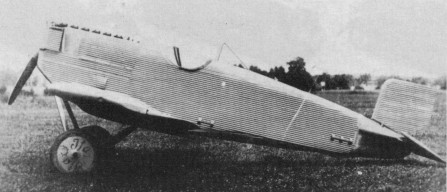
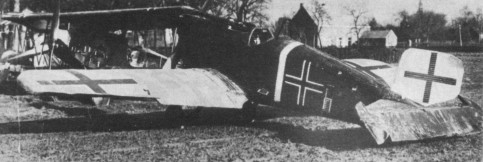
The J8/J10/J11 series were very much just two seat adaptations of the J7/J9 single seat fighters. All derived their origin from the innovative J1 of 1915. They were all metal low wing cantilever monoplanes, the J10/J11 was powered by a 185hp BMW or Benz engine. Typical for their appearance was the corrugated light duralumin skin and the flat radiator in front of the engine.
The J.11 was a float equipped derivation of the J10 two seat escort and ground attack fighter, which had been built in quantity during 1918 as the Junkers CL.I.
Junkers J.7 / J.9 / D.I
Junkers J.IV
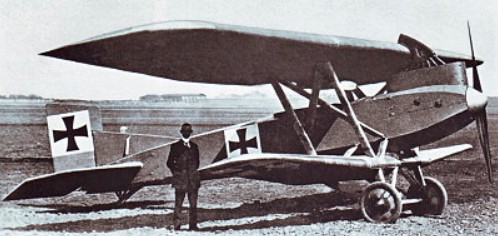
The Junkers J.IV, which flew for the first time early in 1917 and became operational at the beginning of 1918, was an all-metal biplane designed for close support and tactical reconnaissance.
When ordered for the German Army, Junkers was not geared for mass production. Junkers-Fokker-Werke was formed at Dessau on October 20,1917, with equal shares held by Junkers and Anthony Fokker. Manufacture was shared between the Junkers and Fokker factories, which produced a total of 227 aircraft between them.
Conflicts of personality caused Fokker and Junkers to separate in 1918, and the Junkers re-formed following April as Junkers FlugzeugwerkeAG.
A ground-attach and observation machine, the crew was protected by 5mm steel plating. Instead of radio equipment, early J.IVs carried two downward-firing Parabellum machine guns, but these were deleted because of problems with accurate aim.
Engine: 1 x 200hp Benz Bz.IV
Wingspan: 16.00 m / 52 ft 6 in
Length: 9.10 m / 29 ft 10 in
Height: 3.40 m / 11 ft 2 in
Max. speed: 155 km/h / 96 mph
Ceiling: 6000 m / 19700 ft
Range: 310 km / 193 miles
Armament: 3 x 7.62mm machine-guns
Crew: 2
Junkers J.I Blechesel / Tin Donkey
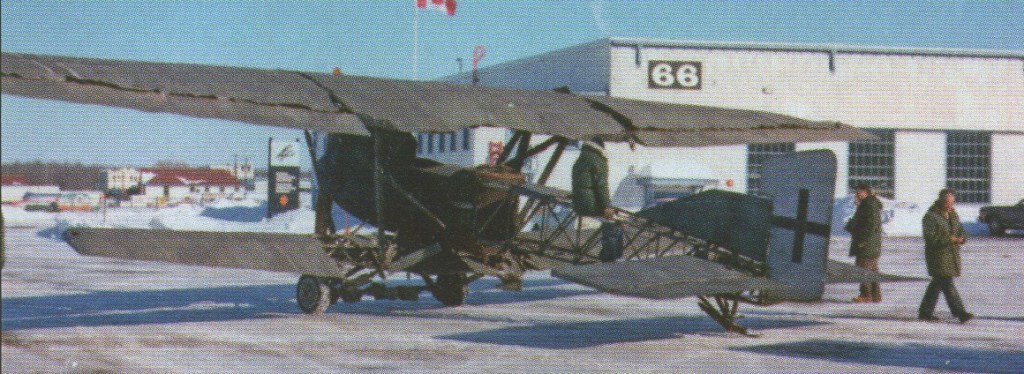
Professor Hugo Junkers (1859-1935) became convinced that all metal structure was the ultimate answer to successful aircraft design, he produced the experimental J.1 “Blechesel” (Tin Donkey) to exemplify his 1910 patent for a cantilever all-metal wing.
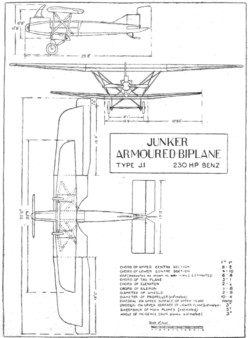
An all-metal semi-cantilever biplane, the multi-spar metal wings were covered with corrugated light alloy sheet. The entire forward part of the fuselage to the rear of the cockpits was made of 5 mm sheet steel armour. The front fuselage alone weighed 1030 lb. The rear fuselage was a light alloy tube structure, covered with fabric on most aircraft. Control surfaces were all metal, with ailerons on the top wing only.
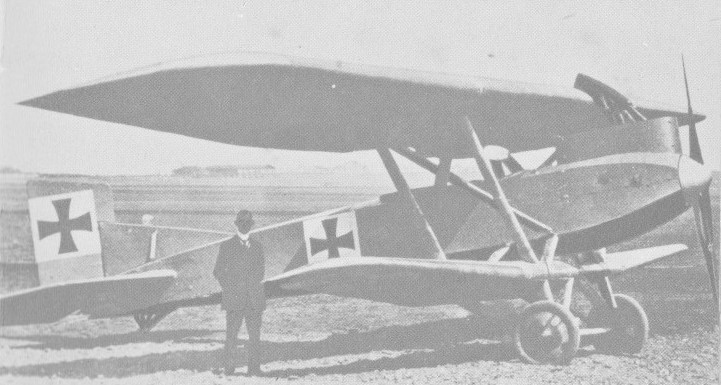
The J.1 first flew on December 12, 1915, giving unexpectedly stable performance.
Altogether, 227 J.1 were built, serving from late 1917 until the end of the war.
Engine: Benz Bz.IV, 200 hp
Wingspan: 52 ft 6 in
Wing area: 531.5 sq.ft
Length: 29 ft 10.5 in
Height: 11 ft 1.75 in
Empty weight: 3895 lb
MTOW: 4797 lb
Max speed: 97 mph at SL
Endurance: 2 hr
Armament: 1 x Parabellum mg
IVL Myrsky
Only one nationally-designed combat aircraft saw service in Second World War, the Myrsky single-seat monoplane fighter.
IAI Kfir

The next stage after the Nesher was to go into production with a substantially improved aircraft with a largely new propulsion system, modified air¬frame and totally replanned weapon aiming, navigation and other electronic systems. The selected engine was the General Electric J79, of modified GE 17 subtype, rated at 8120 kg (17900 lb) with maximum afterburning. This required larger inlet ducts, a modified engine bay with ram air inlet at the front of a new dorsal spine, and a wider but sharply cutback rear fuselage. Other changes visible externally include a completely new nose with enlarged and flattened underside, completely new cockpit, strengthened landing gear with increased oleo stroke, and rearranged external panels and hatches. Inside, the systems and equipment are considerably altered, the main changes being increased fuel capacity and totally dissimilar weapon control and aiming systems. Elta Electronics, an IAI subsidiary, has used a Singer-Kearfon licence, clearly indicative of an inertial system.
Following testing of J79 engines in an Israeli air force Mirage IIIB the first Kfir (Lion Cub) flew in 1974, and two were publicly shown at Lod airport in April 1975. Compared to the French Mirage III and Mirage 5 it has a more powerful engine, bigger engine air intakes, a longer nose, revised cockpit, Israeli avionics and systems and a fin air inlet located at the lower front end of the fin. The first production versions were designated Kfir-C1. Two Heyl Ha’Avir (Israeli air force) squadrons were equipped with this initial model, which retains the original armament of two 30 mm (1.18 in) DEFA cannon. Seven hardpoints can carry a wide range of external stores for interception, attack or reconnaissance missions, including Shafrir AAMs, Luz, Maverick or Hobos ASMs, Shrike antiradar missiles (ARMs), concrete dibber penetra¬tors, cluster bombs, ECM pods, multi sensor reconnaissance pods, or tanks.
A modestly successful fighter with ground-attack capability, 27 aircraft were built.
On July 20, 1976, at the Heyl Ha’Avir base at Hatzerim, Negev, IAI gave the first public display of the definitive production version, the Kfir-C2. Basically unchanged, this has three important aerodynamic improvements. A fixed canard surface, much larger than the ‘moustache’ retractable canards of the Mirage Milan, and slightly swept back, is fitted high on each inlet completely out of the pilot’s field of view. Along each side of the tip of the nose is a small strake, which induces a vortex at high angles of attack. At about 60% of the semispan is a dog tooth, the leading edge from there to the tip being extended in chord and drooped in a conical¬ camber arrangement. These changes are claimed to transform the flight capabilities to a new high level, with much tighter sustained turns, better handling (especially at overload weights), reduced low level gust response, flatter and slower approach, better takeoff, reduced field length and greater weapon ¬carrying capability. New avionics were introduced, including a new ranging radar, twin-computer flight control system, multi-mode navigation and weapons delivery system, central air data computer and HUD.
By mid 1978 about 150 Kfirs of all types had been built, with output still running at more than two per month. At least some of the early aircraft have been brought up to C2 standard. Ecuador’s attempt to buy 24 Kfirs was vetoed by the US Government, and IAI has since been seeking an alternative engine.
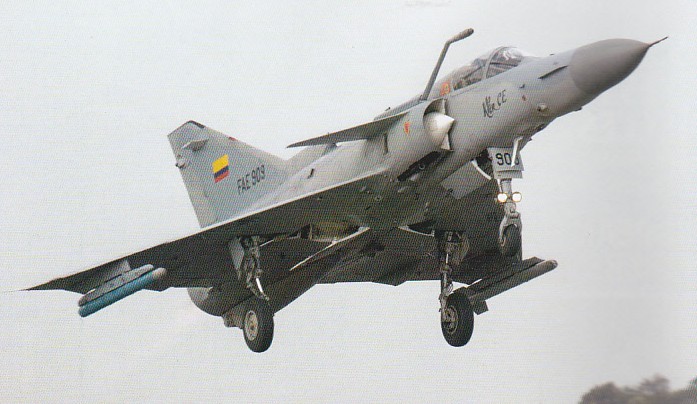
The two seat TC2 entered production in February 1981. Two-seat Kfir-TC2 trainers feature a lengthened and lowered nose for improved view. The longer nose houses the avionics displaced from the C2’s spine and is fitted with small vortex-generating strakes.
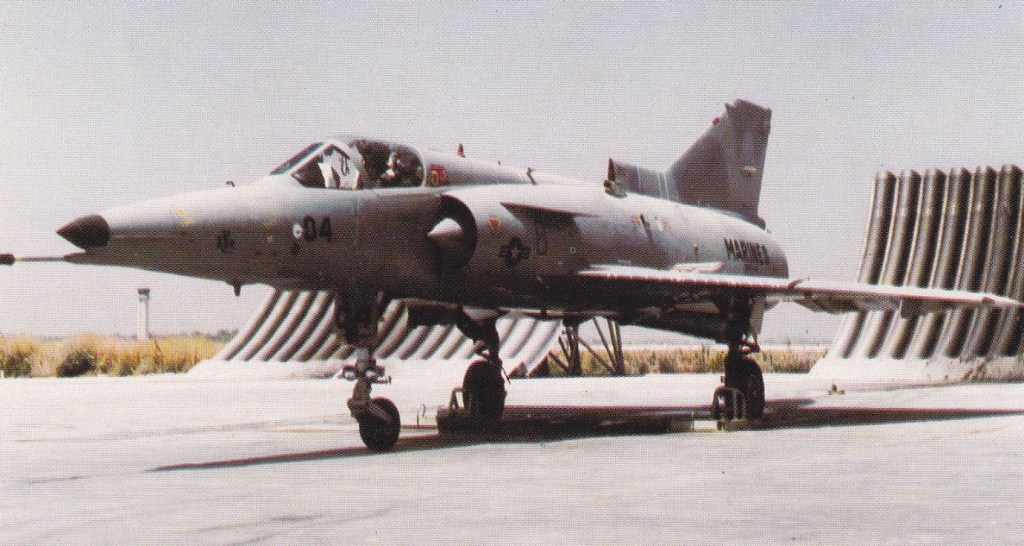
In 1985 the US Navy agreed a three-year lease of 12 Kfirs designated F-21As, for use as agressor aircraft pending the delivery of F-l6Ns. The USMC followed suit in 1986, with the lease of 13 Kfirs to fulfil a similar role. IAI is retrofit Kfirs from C2 to C7 standard. The C1s were modified adding narrow-span canard foreplanes above each air intake and a small rectangular strake either side of the nose behind the ranging radar. These additions greatly improved its combat manoeuvrability and slow speed handling.
Production of the latest Kfir-C7 advancd the two-seat TC7 began in 1983, and these are now the standard models. Externally similar to the earlier Kfir-C2, the C7 has an uprated J79-J1E engine giving a 4.4kN increase in augmented thrust, allowing a 1,540kg increase in maximum take-off weight. Thrust-to-weight ratio and combat radius are also improved. Avionics are upgraded with a new hands-on throttle-and-stick (Hotas) weapons delivery and navigation system, and a stores management/delivery system which is able to cope with smart weapons. The C7 has two additional hardpoints for the increased payload.
Kfir-C2/TC2 aircraft were upgraded to C7/TC7 standard. The C7 has a specially adapted version of the J79-GEJ1E with some 1,000 lb (454 kg) more afterburning thrust. The type has two extra hardpoints below the intake ducts and a number of advanced features including capability for the carriage and use of smart weapons, Elta EL/M-2021B pulse-Dopplar radar, a revised cockpit with more sophisticated electronics and HOTAS (Hands On Throttel And Stick) controls and provision for inflight-refueling. Maximum take-off weight is increased by 3,395 lb (1,540 kg), but combat radius and thrust-to-weight ratio are improved to a marked degree. The principal Electronic Countermeasures (ECM) system is the Elta EL/L-8202 advanced self-protection jammer.
The upgrade to Kfir-C10 standardwas developed for export. It features a new Elta EL/M-2032 multimode radar, capability to use a HMD (Helmet Mounted Display) and Python IV air-to-air missiles and two 127x177mm Multi-Function Displays produced by Astronautics.
IAI built 212 Kfirs, with 40 early Kfir-1s (many updated to Kfir-C1 spec), about 12 Kifr-TC2 trainers, and the rest Kfir-C2s.
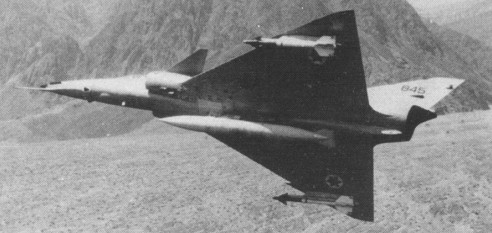
The principal users were Israel, Colombia, Ecuador, and USA.
As the F-21A, two types of Kfir served with USMC VMFT-401 “Agressor” Sqn, Yuma, Arizona, for dissimilar air combat maneuver training.
The Young Lion was deployed with a squadron of the Israeli Air Force in 1974 and 1975. Then, more aerial units were added to the Kfir. The jet shot down a Syrian MiG-21 in 1979 with an Israeli Shafrir 2 missile. That was the first Israeli home-built missile.
Meanwhile, the Israelis acquired the F-15 and F-16 fighters for aerial combat roles, and the Kfir was more aligned with the ground attack role.
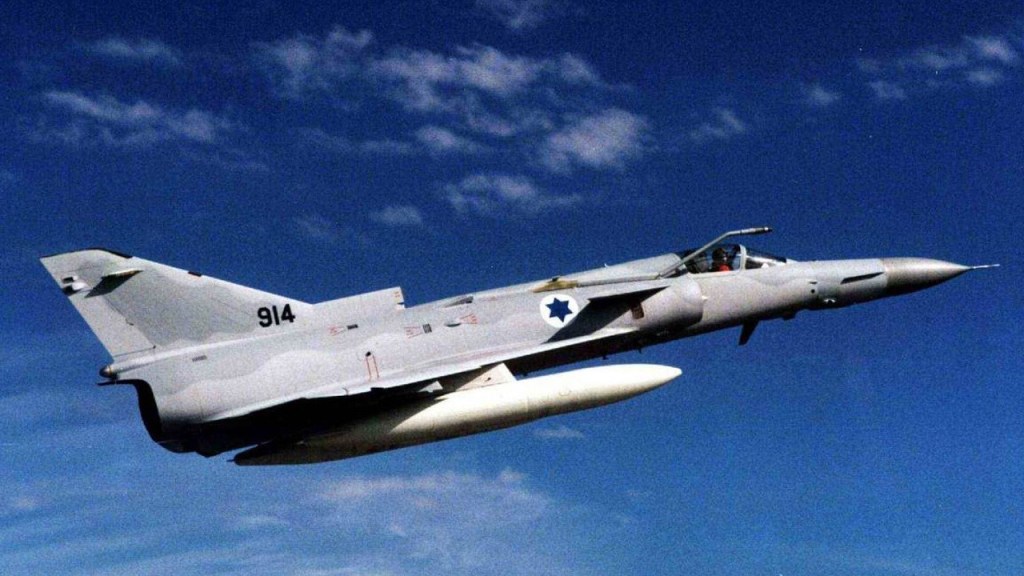
The Kfir was also exported to Ecuador, where the warbirds shot down three Peruvian airplanes in the 1990s.
Sri Lanka also used the Young Lion during its counterinsurgency against the Tamil Tigers. Five Kfirs are still in service with the Sri Lankan Air Force in 2025.
In Israel, the Young Lions were finally replaced by the F-16s and F-15s.
The Israelis have almost phased out all foreign support for Kfirs in Colombia. Final work with the Colombians will be completed in 2025. Israel had helped Sri Lanka update the Kfir in 2017 with new radars and Python air-to-air missiles.
Variants:
C1
C2
TC2
C7
TC7
C10
F-21A
Kfir C-2
Engine: 1 x General Electric J79-GE-J1E, 17,900 lb / 8119 kg thrust
Span: 8.22 m (27 ft)
Canard span: 12 ftt 3 in / 3.73 m
Length: 15.55 m (51 ft)
Height: 14 ft 11.25 in / 4.55 m
Wing area: 374.6 sq.ft / 34.80 sq.m
Canard area: 17.87 sq.ft / 1.66 sq.m
Empty weight: 16,060 lb / 7285 kg
Gross weight: 35,714 lb / 16,200 kg
Maximum speed: over 2335 km/h (1450 mph, Mach 2.2).
Range: 428 mi / 690 km
Ceiling: 58,000+ ft / 17,580+ m
T/O run: 1450 m.
Ldg run: 1280 m.
Armament: 2 x 30mm DEFA 552/553 cannon
Bombload: 12,731 lb / 5775 kg
Seats: 1
Kfir C-7
Engine: 1 x General Electric J79-J1E afterburning turbojet 83.40 kN (18,750 lb st)
Installed thrust (dry / reheat): 52.9 / 83.3 kN.
Span: 8.22m (26 ft 11½ in)
Length: 15.65m (51 ft 4.25¼ in)
Height: 4.55m (14 ft 11.25in)
Wing area: 34.46 sq.m / 392.47 sq.ft
Empty, equipped weight: 7285 kg (16,060 lb)
MTOW: 16,500 kg (36,376 lb)
Warload: 6085 kg / 13,415 lb
Max level speed at 10975m (36,000 ft): Mach 2.3 / 2440 km/h (1516 mph)
Time to height: 5min 10 sec to 15,000 m.
Service ceiling: 17680m (58,000 ft)
Combat radius hi-lo-hi: 1185 km.
Fuel internal: 3240 lt.
Air refuel: Yes.
Armament: 2 x 30 mm DEFA 553 / 140 rounds per gun, 6085 kg (13,415 lb) ordnance
Hard points: 9.
 All Aero