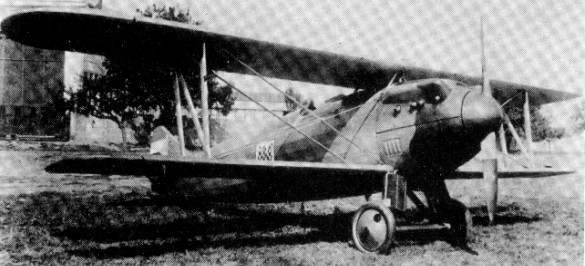
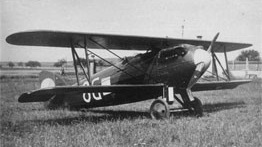
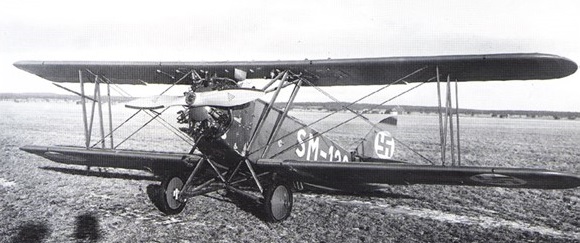
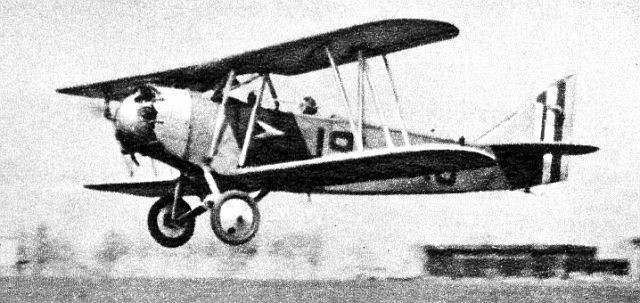
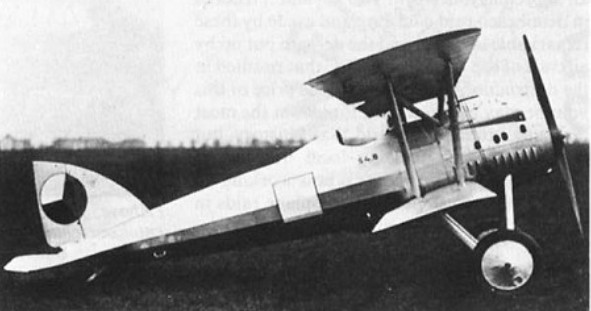
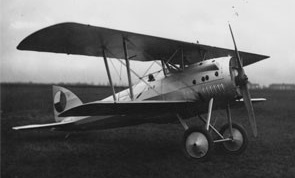
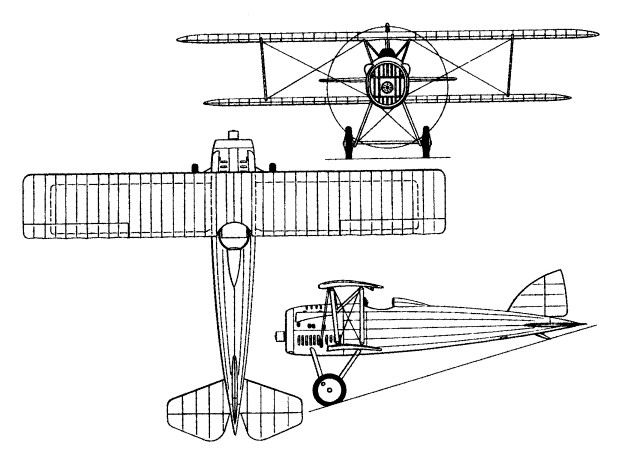
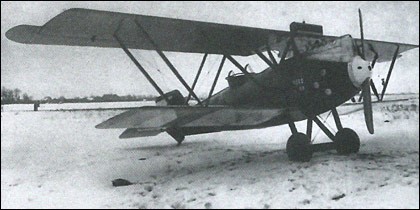
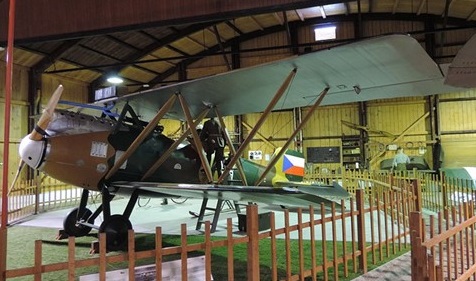
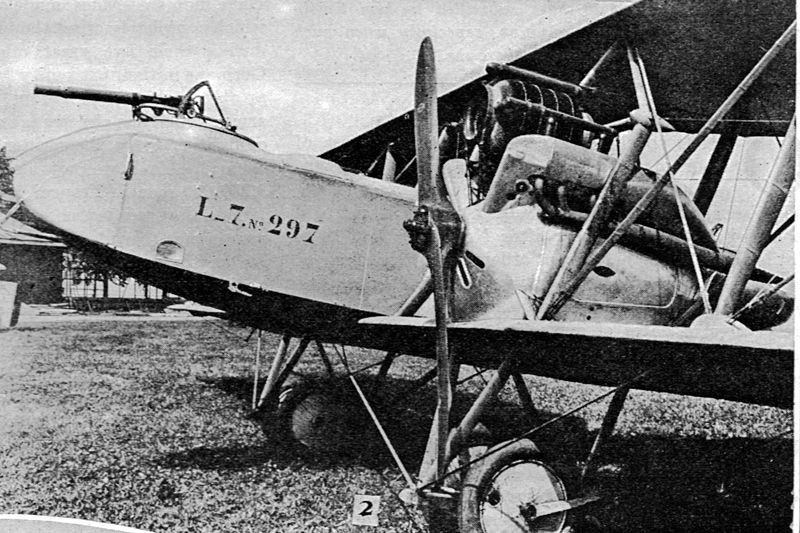
Flown in 1925, the S20 was an unequal-span single-bay biplane of mixed construction with a 300 hp Skoda HS 8Fb water-cooled engine with Lamblin strut-type radiators on the front undercarriage legs, armament comprising two synchro¬nised 7,7-mm Vickers machine guns.
Designed by Alois Smolik, the S-20 had a steel tube framed fuselage as well as fin , rudder and elevator fabric-covered. Wood-framed wings were covered by fabric, and a sheet metal plated cowling. Whereas the upper wing of the first prototype had no gap above the fuselage, the series model introduced a narrow gap and an inverted-vee cabane, the upper fuselage decking being recontoured to improve view from the cockpit.
In 1926, the Š 20 was the winning contender in a contest for a new fighter for the Czechoslovak Air Force, and a total of 105 was to be built for that service. The Š 20 took fourth place at the International Air Meeting in Zurich in 1927, the type serving with all three air regiments of the CzAF.
S-20 plane of the Olomouc Fighter Regiment
Ten examples were exported to the Latvian Air Force (as the Š 20L) with interchangable ski u/c in 1925, one experimental model was completed with a slimmer fuselage (as the Š 20R, also called S-20M). Another was fitted with a Walter¬built Bristol Jupiter air-cooled radial of 480 hp (as the Š 20J). This led to S-31 fighter. The Š 20J model attaining an altitude of 28,543 ft (8700 m).
S.20 Engine: Hispano Suiza 8 Fb, 300 hp Wingspan: 9.70 m Length 7.44 m Empty weight: 728 kg Maximum speed: 256 kph Service ceiling: 7200 m Range: 528 km
S.20 Engine: Skoda HS 8 Fb, 300 hp Wingspan: 9.70 m Length: 7.44 m Empty weight: 728 kg Climb to 5 00 m: 13 min 50 sec Service ceiling: 7200 m Range: 528 km
Š.20 Engine: 1 x 300 hp kW V-8 Skoda HS 8 Fb Max speed, 160 mph (257 km/h) Range, 328 mls (528 km) Empty weight, 1,631 lb (740 kg) Loaded weight, 2,315 lb (1 050 kg) Span, 31 ft 6 in (9,60 m) Length, 24 ft 4 9/10in (7,44 m) Height, 8 ft 4.75 in (2,56 m) Wing area, 198.06 sq.ft (l8,40 sq.m). Armament: two synchro¬nised 7,7-mm Vickers machine guns
Š.20J Engine: Walter¬built Bristol Jupiter, 480 hp Max altitude: 28,543 ft (8700 m)
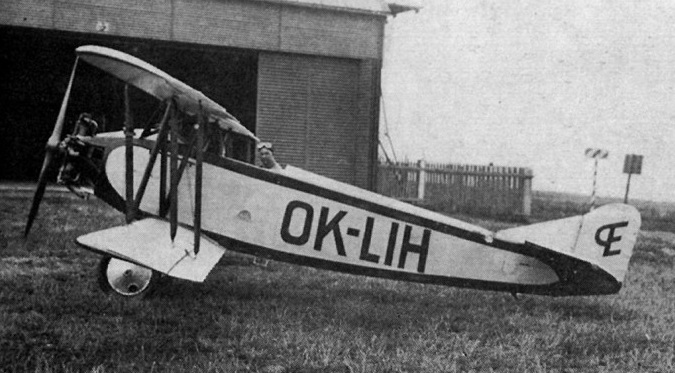
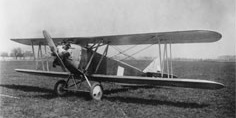
The Letov Š-18 was a Czechoslovak single-engined, two-seat biplane trainer. It was designed by Alois Smolík at Letov Kbely. Š-18 first flew in 1925.
The aircraft was quite successful and sold well both to private pilots and to flight clubs. Apart from the basic variant there was also the Š-118, which was equipped with a Walter NZ-85 engine (85 hp, 63 KW). Some machines were exported to Bulgaria. The Czechoslovakian Air Force used the type 1925 to 1930 as a beginner trainer aircraft.
S-118
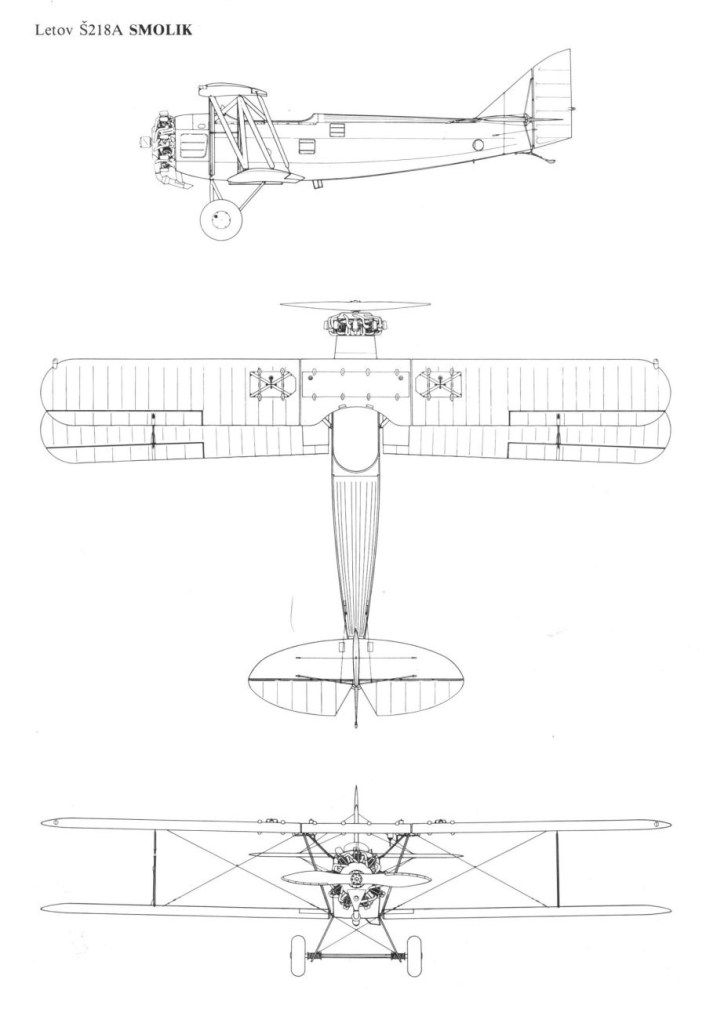
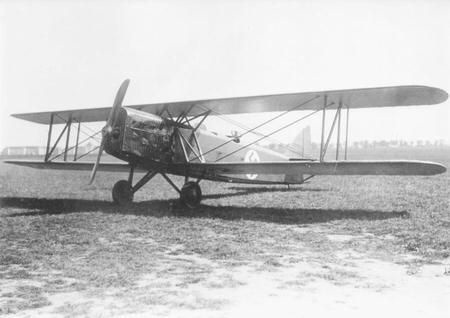
A complete reconstruction of the fuselage led to the Š-218, which had a steel tube frame, metal wing struts, and was equipped with a Walter NZ-120 engine (120 hp, 88 KW). The first flight of this type took place in 1926.
Letov Š-218
In 1929, one Š-218 Smolik was presented at Helsinki International Air Show. The Finnish Air Force showed interest in the type and purchased it in March, 1930, in order to test it. Nine more were soon ordered along with the manufacturing license. The nine aircraft ordered from Czechoslovakia arrived to Kauhava Aviation School in May–June, 1931. The Finnish State Aircraft Factory manufactured 29 slightly modified aircraft in three series. The first ten were ready in 1933, the second series of ten aircraft were ready in 1935, and nine more in 1936. The Finnish version, which was equipped with a Bramo radial engine of 145 hp (110 kW) could develop a maximum speed of 155 km/h (83 knots, 96 mph). The type was in service with the Finnish Air Force as a primary trainer between 1930 – 1945. One aircraft is still preserved at the Finnish Aviation museum in Vantaa and one replica is being built in Finland (as of 2005).
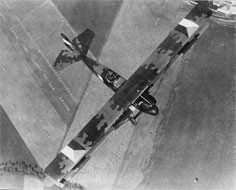
The Letov Š.6 two-seat biplane bomber, 1923, 1 x 255 kW 6-cyl Maybach IVa, 35 built (led to Š-16 and civil Š-19). An all metal- and welded steel-tube-airframe, fabric-covered, metal sheet plate cowling.
S-6
The Letov S-6 biplane began production in 1923.
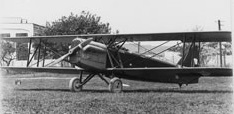
The S-16 was in production from 1926.
W/Cdr Jaroslav Skalka made a Tokyo-bound long-distance flight via Moscow, Kazan, Omsk, Chita and Hedzhu in 1927 in an S-16. Heading for Czechoslovakia, he and his flight mechanic Taufer crashed in Siberia and took the plane`s rudder home.
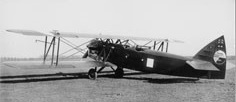
The Š.16 long-range reconnaissance and light bomber biplane, built from 1927 to 1929 for Czechoslavakia, Latvia and Turkey. Power was by a 450 hp W-12 Lorraine Dietrich 12E.
Variants included: Š.16B (or SB-16), bomber variant, lowered rear fuselage decking, 1928 Š.16L (22 for Latvia as the ‘C1’, HS 8Fb) Š.16J (floatplane version for Yugoslavia) Š.16T (16 for Turkey, to be followed by unrealized licenced S-616)
Š.116 bomber, 1928, 1 x 500 hp 6-cyl Skoda L, Handley-Page slots on wings Š.216 bomber, 1928, 1 x 480 hp 9-cyl Walter Jupiter (or Gnome-Rhone Jupiter VIII), 3 built Š.316 bomber, 1931, SB-16 conversions with 1 x V-12 Hispano Suiza 12Lb, 3 built Š.416 bomber, 1929, a S-16 conversion with 1 x 515 hp [?]-cyl Breitfeld & Danek DL Š.516 bomber, 1930, 1 x 800 hp W-12 Praga Asso 9-W, 2 built (failed competitior to Aero A-100, later record attempt aircraft with spats fitted) Š.616 bomber, 1 x 650 hp V-12 Hispano-Suiza 12Nbr (4-bladed propeller), 12 built Š.716 bomber Š.816 bomber, 1932, V-12 Praga ESV engine Š.916 attack aircraft
The Letov Š.17 was the third prototype S-16 fitted with a V-12 Breitfeld-Danek (Praga) BD-500 engine in 1929.
These aircraft were the first Latvian air force aircraft of metal construction, and some of them continued in service right up to the Soviet occupation. In September, 1939 the Letovs appeared on the rosters of the the 5th Recon Squadron (Riga) and the 7th Recon Squadron (Krustpils).
When the aircraft first arrived in Latvia they bore the manufacturer’s assigned numbers L1 – L22 (L16 was, mysteriously, skipped). The latvians renumbered them according to the air force serial number system. The aircraft were accepted, in Czechoslovakia, by Basko and Trejs, and they were sent in two batches – nine of them on Sept.10, 1927 and twelve on Jan.15, 1929. One of the first to fly the newly purchased aircraft was Sgt. Launics, who subsequently became a specialized instructor on this type of aircraft. When used as a light bomber, the S.16 was capable of carrying 300-600 kg of bombs. In 1930 parachutes come into use in the Latvian Air Force, but pilots flying the Letovs tend not to wear them because the cockpits did not easily accommodate the extra bulk. In 1935, when the Aviation Division tried to standardize the description of aircraft types by assigning codes according to their function, the Letovs were coded as “C1”. February 1, 1928 – one of the Letovs (pilot: Arvids Kibers) makes a forced landing near Krustpils. February 25, 1928 – one of the Letovs makes a forced landing near Dzerbene. During 1940 (Soviet occupation), the surviving Letovs (which had been evacuated to Ramava and Bisumuiza) are gathered together and stored at the Provodnik warehouse, where they remained throughout the first Soviet occupation and the German occupation as well. August 12, 1931 – fatal crash at Daugavpils (Janis Zeile, Nikolajs Ritenbergs) August 26, 1928 – fatal crash near Cesis. Three aviators (Arvids Kiberis, Sergejs Bloms, Julijs Metums) lost.
Latvian service:
17K (17)
Taken on charge in late 1927 or early 1928. Assigned to the 6th Squadron where it remained until at least Oct.1938, probably longer.
18K
Taken on charge in late 1927 or early 1928. Assigned to the 6th Squadron. Sept. 1929 – Participated in the goodwill flight to Lithuania and Poland. (Basko and Eglitis) 1936 – appears on the roster of the 7th Squadron. June 15, 1937 – crash 1938 – appears on the roster of the 5th Squadron.
19K (19)
Taken on charge in late 1927 or early 1928. June, 1930 – on the roster of the 7th (Long-range Reconnaissance) Squadron. November 26, 1936 – crash 1937, 1938 – appears on the roster of a training unit. June 1, 1940 – appears on the roster of the 2nd Squadron.
21
Taken on charge in late 1927 or early 1928. Dec.1936 – appears on the roster of the 4th Squadron. May 10, 1937 – undergoes repairs (5th Squadron) Dec.1937 – appears on the roster of the 5th Squadron.
23
Taken on charge in late 1927 or early 1928. 1930 – on the roster of the 7th (Long-range Reconnaissance) Squadron. 1936, 1937 and 1938 – appears on the roster of the 6th Squadron.
24
Taken on charge in late 1927 or early 1928.
25
Taken on charge in late 1927 or early 1928. April 1930 – on the roster of the 7th (Long-range Reconnaissance) Squadron. Jan – July 1937 – appears on the roster of a training unit, then returned to the 7th Squadron. Oct.1938 – appears on the roster of the 7th Squadron.
27
Taken on charge in late 1927 or early 1928. April 1930 – appears on the roster of a training unit. June 1934 – undergoes an overhaul. June 1935 – appears on the roster of a training unit. Dec. 1936 – appears on the roster of the 4th Squadron. May 1937 – appears on the roster of the 5th Squadron.
28
Taken on charge in late 1927 or early 1928. Jan.1936 – undergoes an overhaul. June 1937 – appears on the roster of the 5th Squadron. July, August 1937 – appears on the roster of a training unit.
42
Taken on charge in late 1927 or early 1928. May 1935 – undergoes an overhaul. April 1930 – on the roster of the 7th (Long-range Reconnaissance) Squadron. Dec.1936 – appears on the roster of the 7th Squadron.
48
Taken on charge in late 1927 or early 1928. July 18, 1929 – flown by Nikolajs Bulmanis. 1936, 1937 – appears on the roster of the 7th Squadron. June 1940 – appears on the 2nd Squadron roster.
51
Taken on charge in late 1927 or early 1928. March 1936 – appears on the roster of the 6th Squadron.
52
Taken on charge in late 1927 or early 1928. December 13, 1929 – fatal crash near Krustpils (Pauls Rucelis, Egons Jirgensons) In June of 1937 Letov #52 reappears, now on the roster of the 6th Squadron. Considering the total destruction in the 1929 crash this must be either a reporting error or the serial number was reassigned.
53
Taken on charge in late 1927 or early 1928. 1936, 1937, 1938 – appears on the roster of the 6th (Reconnaissance) Squadron.
54
Taken on charge in late 1927 or early 1928. Sept 11, 1937 – repaired Oct. 1938 – appears on the roster of the 5th (Reconnaissance) Squadron.
55K (55)
Taken on charge in late 1927 or early 1928. August 30 – Sept. 7, 1930 – Participated in the goodwill flight around Europe (Vilis Munters, Alfreds Linins) June 1937 – appears on the roster of the 5th Squadron. April, 1938 – undergoes an overhaul.
56
Taken on charge in late 1927 or early 1928. June 1937 – appears on the roster of the 5th Squadron. October 1938 – appears on the roster of the 5th (Reconnaissance) Squadron. March 1940 – appears on the roster of the 7th Squadron.
57 / #57K
Taken on charge in late 1927 or early 1928. Sept. 1929 – Participated in the goodwill flight to Lithuania and Poland. (Kandis and Ritenbergs) April 1930 – appears on the roster of the 7th (Long-Range Reconnaissance) Squadron. August 30 – Sept. 7, 1930 – Participated in the goodwill flight around Europe (Janis Pagrods, Nikolajs Kaneps) December 1936 – appears on the roster of the 6th Squadron. December 1937 – appears on the roster of the 5th Squadron March 1940 – appears on the roster of the 7th Squadron.
58 / #58K
Taken on charge in late 1927 or early 1928. April 1930 – appears on the roster of the 7th (Long-Range Reconnaissance) Squadron. 1936, 1937, 1938 – appears on the roster of the 7th Squadron. June 1940 – appears on the roster of the 2nd Squadron.
59 / #59K
Taken on charge in late 1927 or early 1928. Sept. 1929 – Participated in the goodwill flight to Lithuania and Poland. (Trejs and Jere) April 1930 – appears on the roster of the 7th (Long-Range Reconnaissance) Squadron. August 30 – Sept. 7, 1930 – Participated in the goodwill flight around Europe (Eriks Mellups, J.Indans) June 1937 – appears on the roster of the 7th Squadron. June 1940 – appears on the roster of the 2nd Squadron.
Specifications:
S-6 Engine: Maybach Mb-IV, 240 hp Wingspan: 15.69 m Length: 8.85 m Wing area: 42.97 sqm Maximum speed: 186 kph Climb to 5000m: 31 min 30 sec. Range: 780 km
S-16 Engine: Lorraine Dietrich, 450 hp Wingspan: 15.30 m Length: 10.22 m Empty weight: 1400 kg Max. speed: 230 kph Service ceiling: 6500 m Endurance: 5 hrs 30 min Armament: one synchronized and a twin-one firing rearwards for an observer. Payload: up to 1000 kg,
Š.16B (or SB-16)
Š.16J
Š.16L Engine: 450-hp Hispano Suiza HS 8Fb. Length: 10.22 m Wing Span: 15.3 m Height: Max Speed: 230 km/hr Range: 900 km Maximum Ceiling: 7,000 m Known Serial Numbers: 8, 8K, 10, 15K, 17K, 18K, 21, 23, 23K, 24, 25, 27, 28, 42, 47, 48, 51, 52, 53, 54, 57K, 58K, 59K (a total of 21 aircraft)
Š.16J Undercarriage: floats
Š.16T
Š.17 Engine: V-12 Breitfeld-Danek (Praga) BD-500
Š.116 Engine: 1 x 500 hp 6-cyl Skoda L
Š.216 Engine: 1 x 480 hp 9-cyl Walter Jupiter (or Gnome-Rhone Jupiter VIII)
Š.316 Engine: 1 x V-12 Hispano Suiza 12Lb
Š.416 Engine: 1 x 515 hp Breitfeld & Danek DL
Š.516 Engine: 1 x 800 hp W-12 Praga Asso 9-W
Š.616 Engine: 1 x 650 hp V-12 Hispano-Suiza 12Nbr Prop: 4-bladed
Intended as a successor to the Spad 7 and 13 in service with the newly-created Czechoslovak Air Force, and selected in preference to the Š 3 parasol monoplane, the Š 4, initially designated S HS. 1, was a single-bay unstaggered biplane of mixed construction with fabric-covered wooden wings and metal fuselage and tail.
Flown in 1922, the Š 4 was powered by a 220 hp Hispano-Suiza 8Ba engine and carried an armament of two synchronised 7,7-mm Vickers machine guns.
A series of S-4 fighters was ordered, but 20 of these were completed with the 180 hp HS 8Aa engine as Š 4a aerobatic trainers. As a result of low manufacturing standards a number of difficulties were experienced with the S4 which was grounded in 1927, the surviving aircraft being rebuilt in 1928 to Š 4a trainer standard.
Letov Š -4 / SHS-4 Engine: 1 x 220hp Hispano-Suiza 8Ba Max take-off weight: 980 kg / 2161 lb Empty weight: 673 kg / 1484 lb Wingspan: 8.00 m / 26 ft 3 in Length: 6.58 m / 21 ft 7 in Height: 2.62 m / 8 ft 7 1/8 in Wing area: 16.43 sq.m / 176.85 sq ft Max. speed: 232 km/h / 144 mph Cruise speed: 200 km/h / 124 mph Rate of climb: 323 m/min / 1050 ft/min Climb to 5000m: 21 min 50 sec Service ceiling: 5500 m Range: 500 km / 311 miles Armament: 2 x 7.7mm Crew: 1
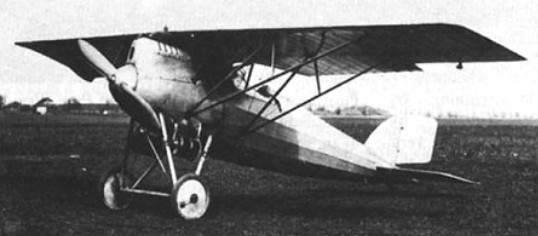
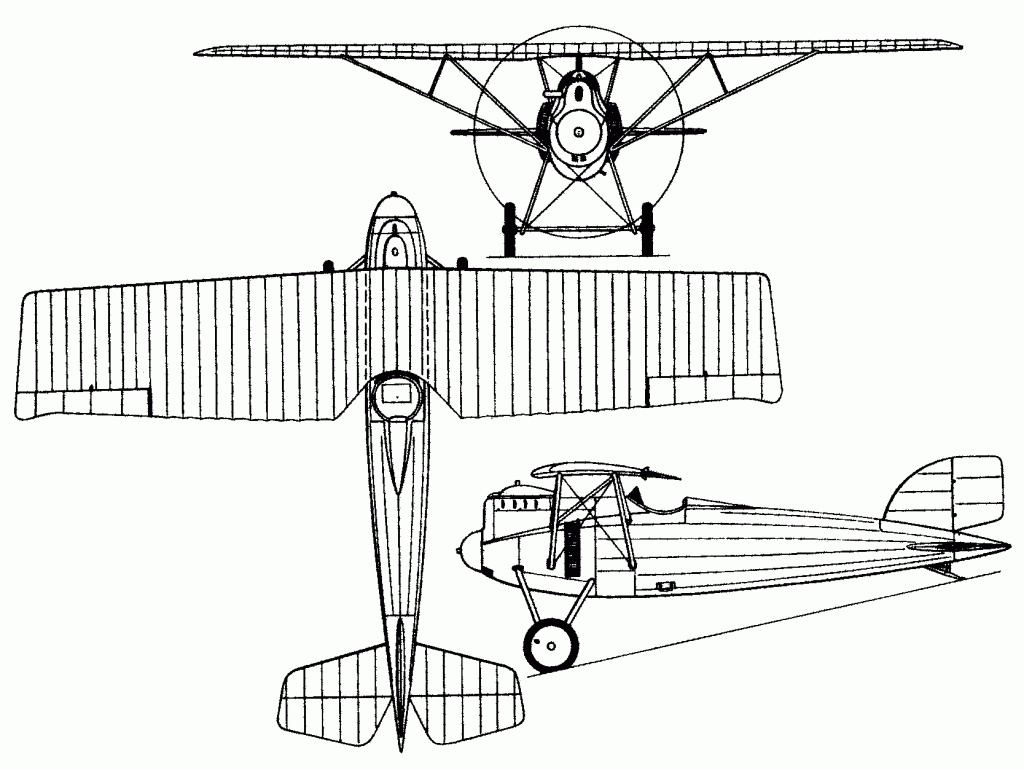
The first original fighter design to be produced by the Vojenská továrna na letadla (State Aircraft Works) “Letov”. The Š 3 was created by Ing Alois Smolik who had formerly worked for the Austro-Hungarian government Initially designated as S B.1, the original prototype was destroyed in a fire at the Prague-Letnany factory on 5 November 1921, but a second prototype entered flight test early in 1922.
A single-seat parasol monoplane powered by a 185 hp BMW l1la six-cylinder in-line engine and carrying an armament of two 7,7-mm Vickers machine guns, the Š 3 was of mixed construction with a wooden wing and metal fuselage and tail. The Š 3 participated in the International Meeting in Zurich in 1922, taking third place in the precision take-off and landing contest and seventh place in the aerobatic contest. Further development was discontinued in favour of the S 4.
Š.3 Crew: 1 Engine: 1 x 185hp BMW IIIa Max take-off weight: 928 kg / 2046 lb Empty weight: 662 kg / 1459 lb Wingspan: 10.13 m / 33 ft 3 in Length: 7.08 m / 23 ft 3 in Height: 3.04 m / 10 ft 12 in Wing area: 17.60 sq.m / 189.44 sq ft Max. speed: 225 km/h / 140 mph Cruise speed: 195 km/h / 121 mph Rate of climb: 508 m/min / 1650 ft/min Time to 9,840 ft (3000 m): 5.9 min Range: 472 km / 293 miles Armament: 2 x 7.7mm
Since the first controllable heavier-than-air flights had been made, the Austria-Hungarian administration did not intend to establish aeroplane manufacturing in Bohemian or Moravian Lands. An Aeroplane Repairs Works “Al-Ma” was set up by Dr. Martius, being of German origin, in the Prague district of Holešovice in 1916. Several days after the independent state of Czechoslovakia had come into existence on October 28, 1918 the Air Force Corps was founded and an order to move all the aeroplanes and air material to Prague was issued. On November 18, 1918 nine planes were seized by the Czechs and eight of them ferried from the town of Cheb to Prague situated near border on Germany so that the Germans were prevented from flying them into Germany. This unexpected raid was commanded by Cpt. Adamec [Addammaets] who was later appointed the Aeroplane Arsenal`s CO. The ninth Czech pilot had to land in Germany and his aircraft was confiscated.
Every plane was concentrated at the Prague Fair Facility until February 1919. A young P/O Alois Smolik was in charge of repairs. He used to be as an asistant to the Air Expert and Scholar Profesor Miess. The Sm-1 biplane designed by Alois Smolik and flight-tested in Apríl 1919 persuaded the Czechoslovak government to prefer the home-production aircraft to ones imported from France, though 115 French planes were presented them.
Originally built in 1910 as the SH-1 with 127 kW (230 hp) Hiero L engines, the SH-1 was later redesignated Š-1. 28 were built.
The Letov Š-1 was a single-engined, two-seat biplane surveillance aircraft. Designed by Alois Šmolík at Letov Kbely, it was first military aircraft built in Czechoslovakia.
The Š-1 first flew in 1920.
The SM-1 variant was powered by 194 kW (260 hp) Maybach Mb.IVa engines and later redesignated Š-2. 64 were built. This 2 seater was armed with one forward firing machine gun and had a twin movable machine gun in the rear. 28 were built.
Letov Š-2 (re-engined Š-1) at the Kbely museum
The Sm A 1 was a commercial variant with a canopy over the rear cockpit for 2 passengers.
The Letov Š-10 of 1921 was an Š-1 trainer variant with a 100 hp 6-cyl Breitfeld & Danek Blesk (Czech Mercedes DI) engine.
The Letov Š-5 was an Š-1 modified for evaporate cooling trials.
The primary user was the Czechoslovakian Air Force.
S-1
SH-1 / Š.1 Engine: 1 × Hiero 6L inline engine, 169 kW (230 hp) Wingspan: 13.23 m (43 ft 4.75 in) Length: 8.31 m / 27 ft 3 in Height: 3.10m / 10 ft 2 in Empty weight: 861 kg Max takeoff weight: 1,375 kg (3,031 lb) Maximum speed: 194 km/h (120 mph) Range: 715 km / 445 miles Climb to 5000 m: 52 min Service ceiling: 6,000 m / 19,685 ft Crew: 2 Armament: 1x fixed machine gun, 1x twin machine gun on swivel mount
SM-1 / Š.2 Engine: 1 x 260hp Maybach Mb.IVa Max take-off weight: 1492 kg / 3289 lb Empty weight: 970 kg / 2138 lb Wingspan: 13.02 m / 43 ft 9 in Length: 8.52 m / 28 ft 11 in Height: 3.31 m / 11 ft 10 in Wing area: 36.17 sq.m / 389.33 sq ft Max. speed: 198 km/h / 123 mph Cruise speed: 167 km/h / 104 mph Ceiling: 6500 m / 21350 ft Range: 667 km / 414 miles Armament: 3 x 7.7mm, 120kg of bombs Crew: 2
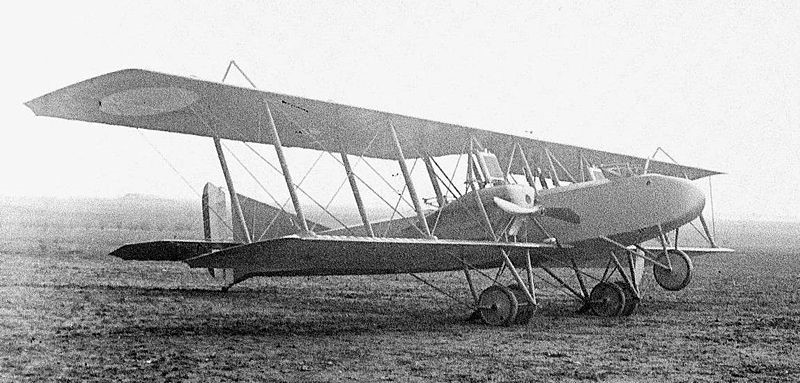
In early 1916 the contemporary reconnaissance aircraft of the Aéronautique Militaire, such as the Caudron G.6, Morane-Saulnier T and Salmson-Moineau SM.1 were proving to be less than sparkling in operations and testing. To provide a suitable replacement The STAé, its Director Colonel Dorand and Établissements Letord, formulated the A3 specification and co-operated in the design of the only respondent, the Letord Let.1.
In 1916, the Letord “Let”, in prototype form, recorded its first flight and this three-man, twin-engined platform was developed along the lines extended-range reconnaissance. To cover the distances required of the type, a multi-engine arrangement was used and this fitted to a relatively large airframe.
The aircraft relied on a traditional biplane wing arrangement for lift and control and the crew required to man its various systems numbered three. “Negative wing stagger” was present in the over-under wing arrangement where the lower planes were set well-forward of the upper sections, making the parallel struts angle rearwards.
Power was from 2 x engines of various makes and models throughout the service life of the aircraft and each was charged with driving two-bladed propellers. The engines were held outboard of the fuselage and atop the lower wing assembly. Each of the three crewmen sat in separate open-air cockpits so communication between them was limited. The undercarriage showcased double-wheeled main legs and a tail skid though a nose leg was usually added to prevent “nose-over” accidents when ground-running (common to larger aircraft of the war). The tail unit was marked by a single vertical fin and low-mounted horizontal planes.
Design of this aircraft was attributed to Emile Dorand.
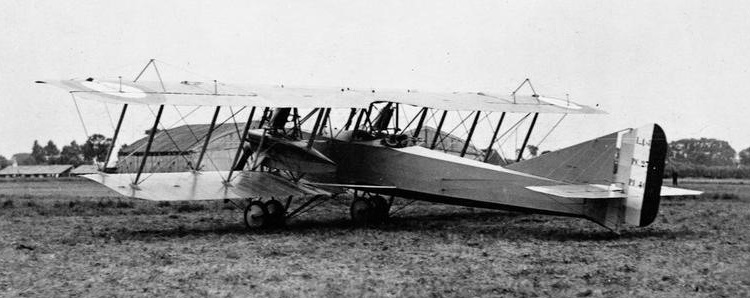
The Letord A3 reconnaissance bomber family, the Let.1 to Let.7, were essentially similar biplanes with, variously unequal span or equal span wings, with prominent and characteristic negative stagger on their wings, powered by two tractor engines in nacelles mounted short struts or directly on the lower wings and had a fixed tailskid undercarriage. Some aircraft were equipped with a strut-mounted nosewheel to protect the aircraft and its crew from “nosing-over” accidents while landing. The pilot sat in an open cockpit under the upper wing trailing edge, with a gunner in an open position immediately aft, and a third crew-member in an open position in the nose where he could act as gunner, observer, and bomb-aimer.
Let.4
Aircraft were completed, variously, with equal span 4-bay wings or unequal span 3-bay wings with longer span upper wings braced by an A-frame king-post and wires. All the Letord reconnaissance bombers shared similar plywood covered wooden structure fuselages and wooden structure wings and conventional tail-unit.
Of the 250-300 built, the Letord Let.5 was probably the most numerous of a family of 3-seat reconnaissance bombers, designed and built in France from 1916, originally to an A3 (reconnaissance aircraft 3-seat) specification from the STAé (Service Technique d’Aéronautique).
Let.7
The Letord reconnaissance bombers saw widespread service throughout the Aéronautique Militaire, from mid-1917, with 121 operational on the Western Front by November 1917. Most were no longer in front-line use by the Armistice in November 1918.
Variants:
A Letord Let.1
Let.1 A.3 initial reconnaissance version three bay wing. Engines: two 150 hp (110 kW) Hispano-Suiza 8A
Let.2 A.3 reconnaissance aircraft similar to Let.1 three bay wing. Engines: two 200 hp (150 kW) Hispano-Suiza 8Ba
Let.3 Bn.3 night bomber four bay wing. Engines: two 200 hp (150 kW) Hispano-Suiza 8Ba
Let.4 A.3 reconnaissance aircraft also used as a bomber three bay wing. Engines: two 160 hp (120 kW) Lorraine-Dietrich 8A
Let.5 A.3 reconnaissance aircraft three bay wing and missing the nosewheel. Engines: two 240 hp (180 kW) Lorraine-Dietrich 8B Propeller: 2-bladed wooden fixed-pitch Wingspan: 18.06 m (59 ft 3 in) Wing area: 62.3 sq.m (671 sq ft) Length: 11.17 m (36 ft 8 in) Height: 3.66 m (12 ft 0 in) Empty weight: 1,660 kg (3,660 lb) Gross weight: 2,445 kg (5,390 lb) Maximum speed: 170 km/h (110 mph, 92 kn) at 2,000 m (6,600 ft) Maximum speed: 152 km/h (94 mph; 82 kn) at 3,000 m (9,800 ft) Range: 455 km (283 mi, 246 nmi) Endurance: 3 hours Service ceiling: 4,900 m (16,100 ft) Time to altitude: 2,000 m (6,600 ft) in 10 minutes Time to altitude: 4,000 m (13,000 ft) in 20 minutes Armament: Up to 4 7.70 mm (0.303 in) Lewis machine-guns on single or double T.O.3 flexible mounts. Bombload: 130–150 kg (290–330 lb) Crew: 3
Let.6 Ca.3 fighter based on the Let.3 four bay wing. Engines: two 220 hp (160 kW) Hispano-Suiza 8Be Armament: 37 mm (1.5 in) cannon
Let.7 Bn.3 night bomber four bay wing of increased span. Engines: two 275 hp (205 kW) Lorraine-Dietrich 8B engines
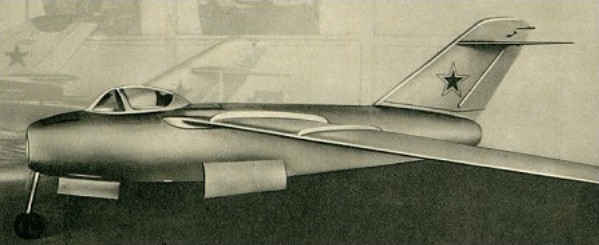
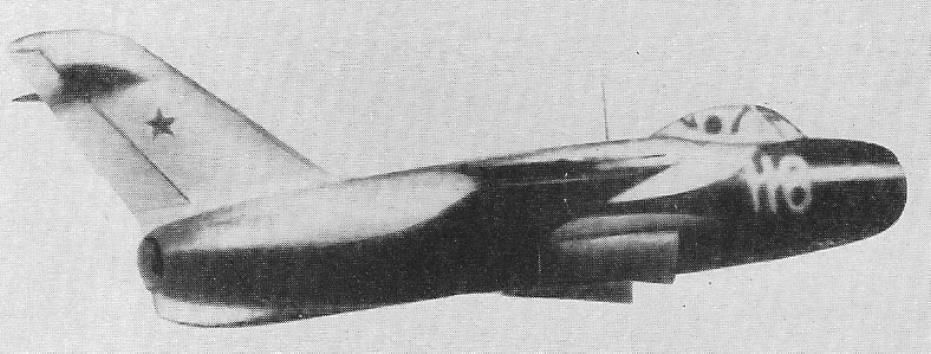
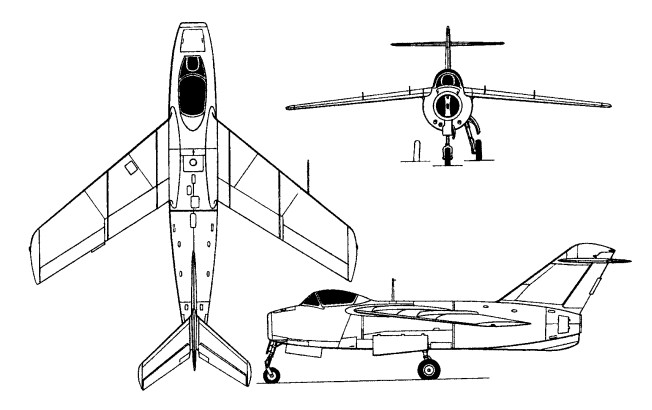
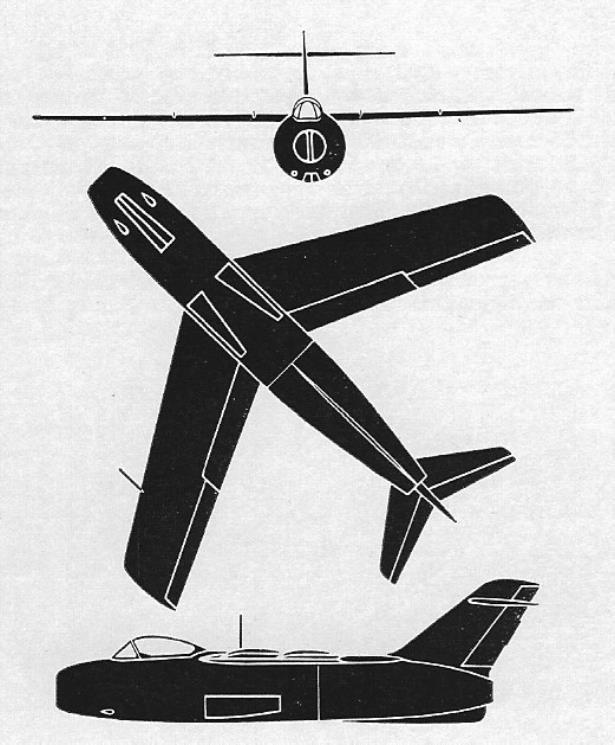
A replacement prototype for the La-172 was designated La-174D (the suffix signifying dubler, literally “replacement”), and entered flight test in August 1948. Lavochkin scaled down the basic La-174TK design to produce the La-174D tailored round the smaller Rolls-Royce Derwent turbojet. This differed in only minor respects from the preceding prototype, and series production was ordered during the same month as the La-15, armament being reduced from three to two 23mm NS-23 cannon, and 6 degrees of wing anhedral being added.
Type 21
The La-15 was powered by the RD-500 turbojet, the Soviet series version of the Derwent, deliveries to the VVS commencing in the late autumn of 1949.
Production plans for the La-15 were, in the event, scaled down because of difficulties experienced in manufacturing in sufficient quantity the numerous milled parts employed in the structure, but about 400 were produced, these remaining in VVS service until 1954.
A tandem two-seat conversion trainer version was evolved as the La-180, but only two examples of this variant were built.
La-15 Engine: RD-500 turbojet, 3527-lb (1600-kg) thrust Max take-off weight: 3850 kg / 8488 lb Empty weight: 2575 kg / 5677 lb Wingspan: 8.8 m / 28 ft 10 in Length: 9.0 m / 29 ft 6 in Wing area: 16.2 sq.m / 174.38 sq ft Max. speed: 1025 km/h / 637 mph Ceiling: 13000 m / 42650 ft Range: 1170 km / 727 miles
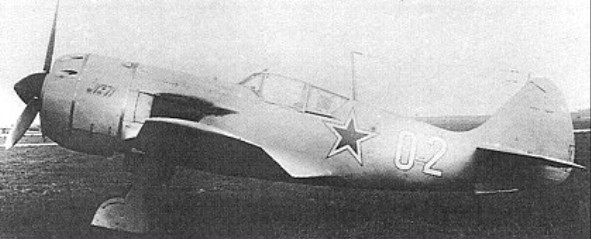
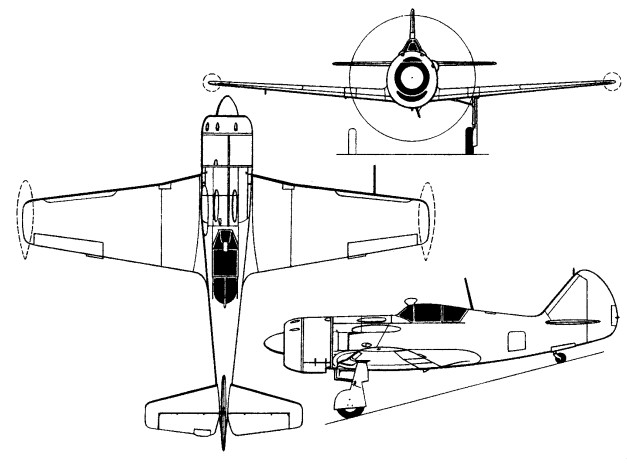
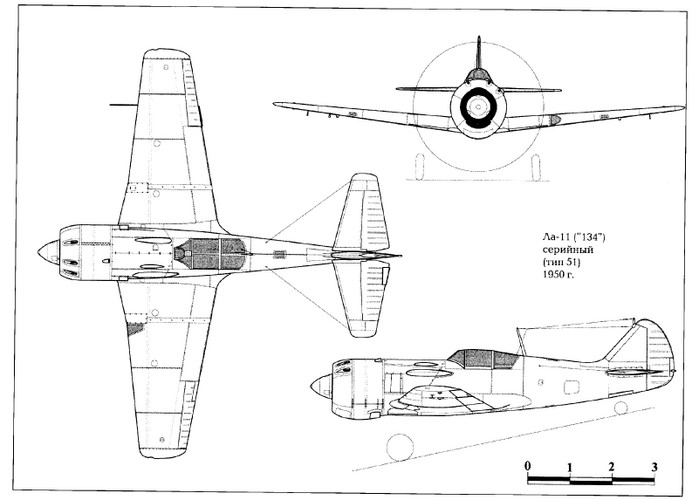
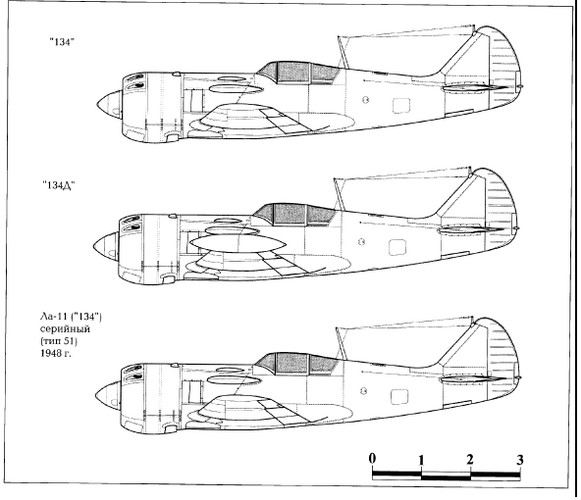
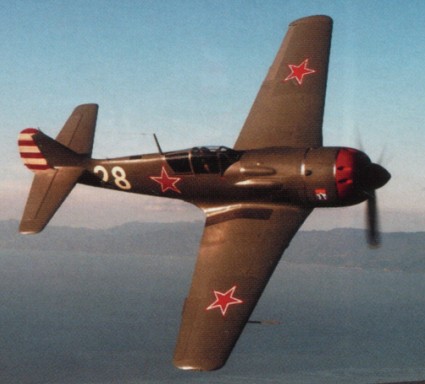
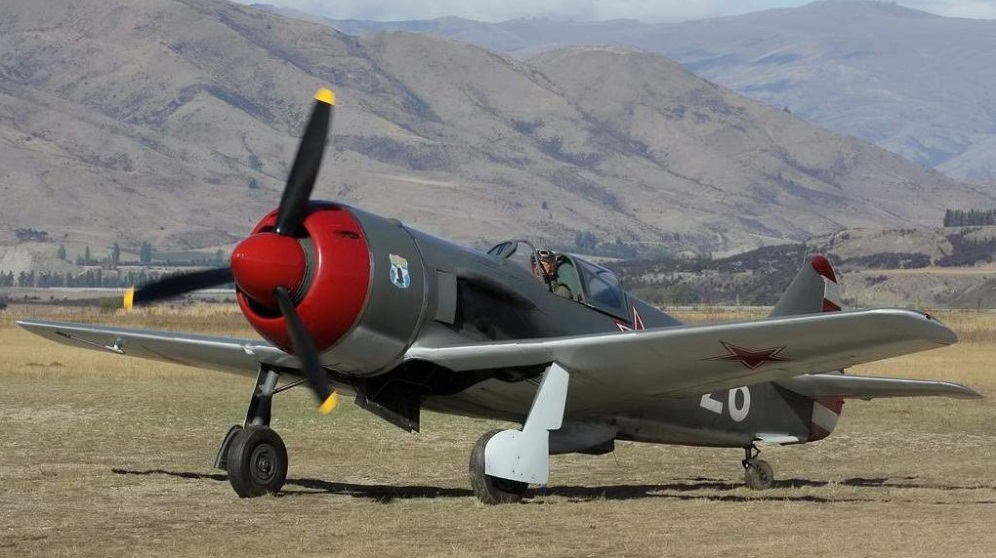
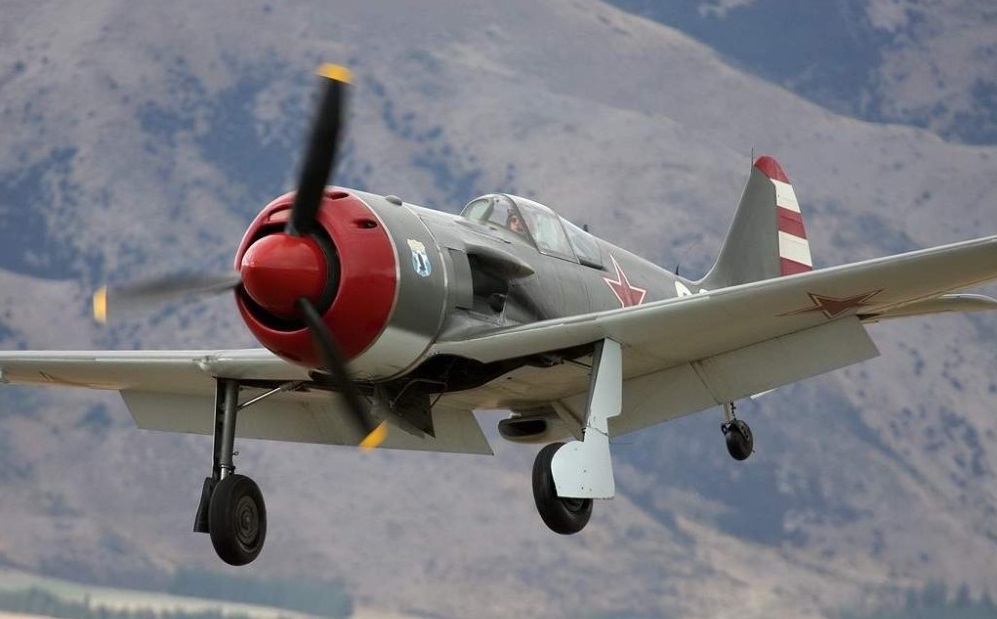
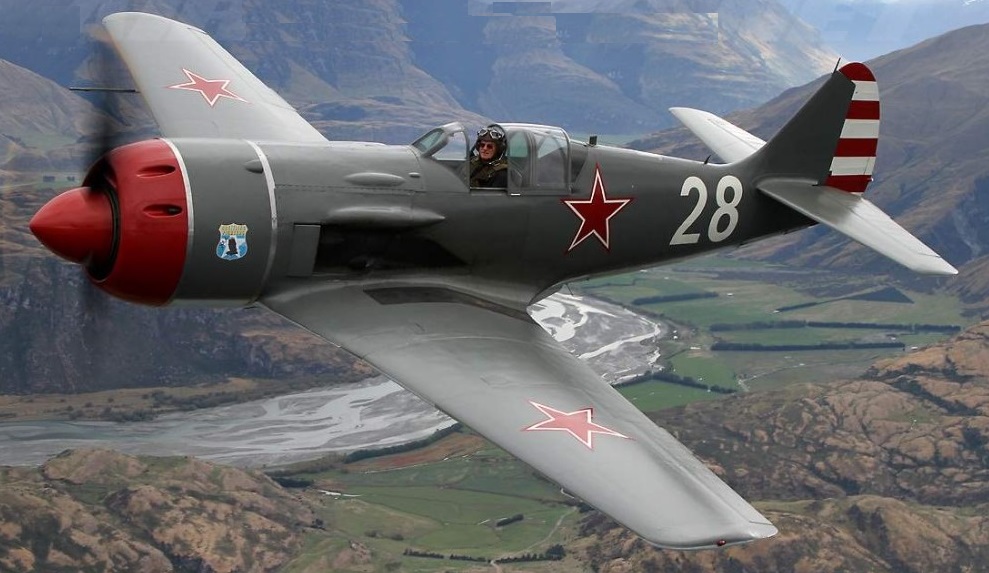
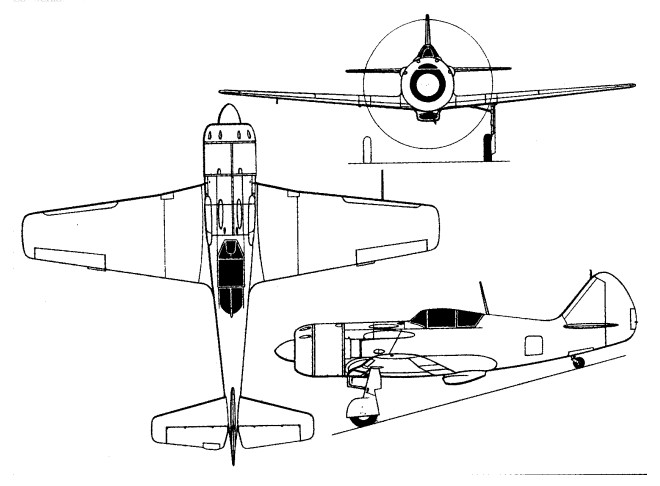
Evolved from the La-9 to meet a requirement for a fighter with sufficient range to fulfil the escort role, the La-11 was destined to be the last piston-engine fighter from the Lavochkin bureau. It had a wing fundamentally similar to that of the La-9 and retained the ASh-82FN engine, but provision was made to attach auxiliary fuel tanks at the wingtips, the ventral oil cooler was incorporated in the engine cowling and armament was reduced to three 23mm NS-23 cannon. The first prototype was flown in June 1947 under the design bureau designation La-134, and production (1947-51) at Gor’kiy was to total 1,182 aircraft. The La-11 was supplied in some numbers to both the Chinese and the North Korean air forces, and saw operational use during the Korean conflict. It was finally phased out of first line VVS service in the early 1950s.
Engine: Shvetsov Ash-82FNV, 1850 hp Max take-off weight: 3990 kg / 8796 lb Empty weight: 2770 kg / 6107 lb Wingspan: 9.8 m / 32 ft 2 in Length: 8.7 m / 28 ft 7 in Max. speed: 674 km/h / 419 mph Ceiling: 10250 m / 33650 ft Range w/max.fuel: 2550 km / 1585 miles
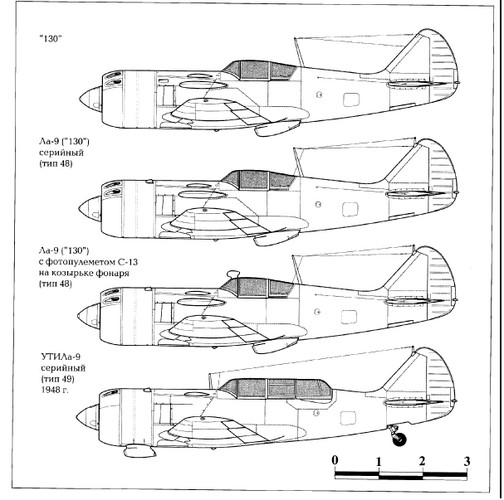
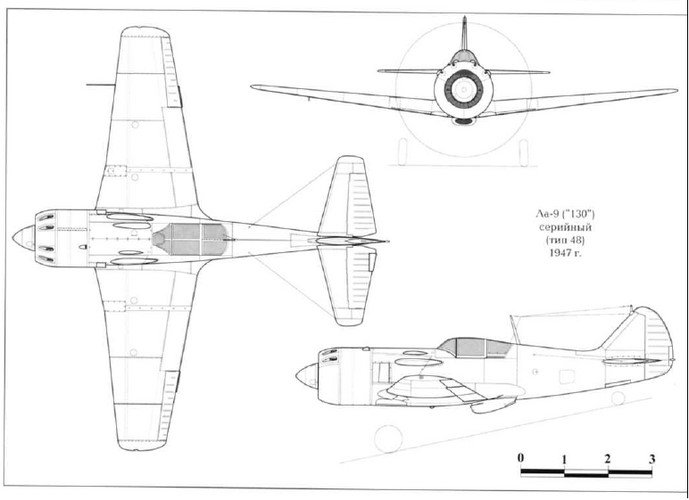
Closely related to the La-126, the La-130 – first flown on 16 June 1946 – encluded a number of refinements, both aerodynamic and structural, and featured a revised fuel system of increased capacity and a laminar flow symmetrical wing section. It retained the ASh-82FN radial of the preceding fighters, but provision was made for four 23mm NS-23 cannon.
The similarity to the famous Lavochkin La-7 was only superficial; the new fighter was all-metal and had laminar flow wings.
The aircraft’s strength decreased due to the removal of wood from the airframe largely allowing for the fuel and armament capacity of four guns. In combat it showed that the La-130 was equal to the La-7 but was inferior to the Yakovlev Yak-3 in horizontal and vertical maneuvers.
Series production was authorised in November 1946 as the La-9 (Russian: Лавочкин Ла-9), deliveries to the VVS commencing February 1947 from GAZ 21 at Gor’kiy.
A tandem two-seat training version, the La-9UTI, was flown in July 1947, and series production continued for three years, 1,630 single-seaters and 265 two-seaters being built.
One example, designated La-138, was fitted with two PVRD-430 ramjets of 300kg underwing, factory testing performed during March and April 1947, and increases in level speed of 107 to 112km/h were recorded in level flight. A small batch of aircraft was completed with underwing provision for RD-13 pulsating athodyds, or pulse-jets, as La-9RDs. These boosters were found to have a bad effects on the handling characteristics.
In 1950 China imported 129 La-9 aircraft. The last 5 La-9 fighters were retired in 1959. The Romanian Air Force imported 10 in 1950 (5 La-9 and 5 La-9 UTI), and the type was also operated by North Korea.
 All Aero