McDonnell FD-1 Phantom / FH-1 Phantom

By the beginning of 1943 Westinghouse had made considerable progress with the engines, and the next job was to design an efficient airframe. The US Navy’s Bureau of Aeronautics decided to call on the services of the McDonnell Aircraft Corporation, the resultant joint effort to be designated XFD-1.

McDonnell FD-1 Phantom / FH-1 Phantom Article

The designers set out to produce the smallest possible fighter that would satisfactorily carry a pilot, four 0.50-inch guns and their ammunition for a specified length of time. Weight, wing area and even engine power were treated as secondary consideration. Everything was to be kept as simple as possible with no “frills” or unnecessary gadgets to complicate production. Unorthodox ideas such as a tailless or tail-first layout (to keep the tail out of the way of the jet exhaust) or a prone position for the pilot were quickly put aside.

The McDonnell engineering team took just about a year to finalise the design of the XFD-1, although a preliminary mock-up inspection was held at St Louis at the end of May 1943. The release of drawings for structural work began on 25 January 1944 and construction of the prototype took a further year. By January, 1945, the last drawings had been finished, the last airframe parts made and assembled. On paper, the Westinghouse 19B was now promising a thrust of 1,500 lb (680 kg) in a version designated WE-19XB-2B for the prototypes of the XFD-1, but, in practice, engines reaching McDonnell were unable to produce this thrust and deliveries were lagging behind airframe availability.
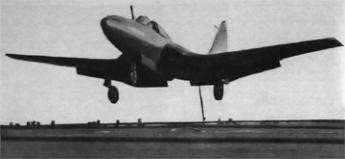
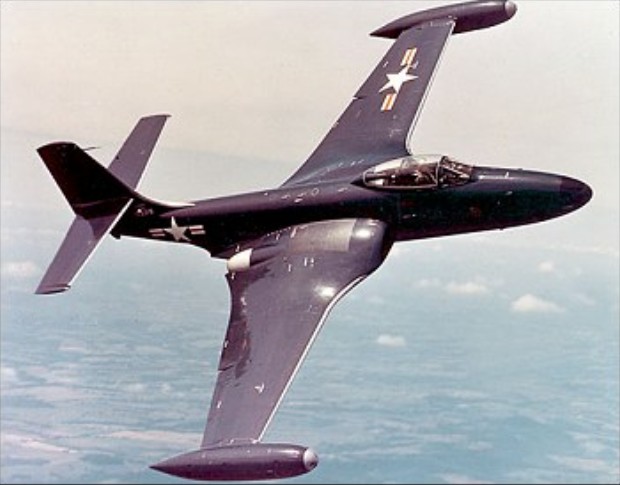
The first prototype McDonnell Phantom during deck-landing trials aboard U.S.S. Franklin D. Roosevelt.

In order to minimise the delay, taxy trials of the first XFD-1, by now named Phantom, began with only one engine installed, and ballast in the other engine bay, during January 1945. Although the 19B engine was producing only 1,325 lb at this stage, the company’s chief test pilot Woodward Burke felt confident enough to allow the aircraft to get airborne on 26 January 1945 in what has subsequently become widely re¬corded as the Phantom’s first flight. According to Kendall Perkins, though, this was only an “initial hop (rising a short way off the ground)”; the first real flight followed a few days later, after the second engine had been installed.

Satisfactory results were recorded in the first few weeks of flight testing, including a speed of 483 mph (778 km/h) at 20,000 ft (6 100 m), an initial rate of climb of 5,000 ft/min (25 m/sec) and a range of 750 mls (1 200 km). Consequently, the Navy was ready to initiate production of its first jet fighter, placing a contract for 100 FD-1s on 7 March 1945. They were to be powered by 1,600 lb st (726 kgp) Westinghouse J30-WE-20 turbojets, these being productionised WE-19s. The pro¬duction aircraft would closely resemble the prototypes, but would have increased internal fuel capacity, provision for a belly drop tank, a taller, square-tipped fin, slightly lengthened front fuselage and (on all but the first three production aircraft) dive brakes in the upper and lower surfaces of the outer wing panels.

Within a few months of production being launched, the war was over, first in Europe and then against Japan. VJ Day, on 2 September 1945, brought massive and immediate cuts in aircraft contracts in the US and that for the FD-1 was cut back to 30 aircraft, but later increased again to 60. Some considera¬tion was given to using an improved Model 19C version of the Westinghouse engine in the second batch of 30 aircraft, perhaps to have been designated FD-2s, but this did not materialise, and the entire production run was of the FD-1 configuration. After a first flight of a production FD-1 on 28 October 1946, deliveries were made from January 1947 to 29 May 1948, with the designation changing from FD-1 to FH-l halfway through the run, on 21 August 1947 (and then becoming retrospective for the Phantoms already in service).

First production aircraft designed by the company, the McDonnell FH-1 Phantom was notable in being also the first jet designed to operate from an aircraft-carrier. The US Navy placed the original letter of intent on 30 August 1943, and the first prototype made its initial flight from St Louis airport, Lambert Field, on 26 January 1945. The type was certainly not over-powered, because the final propulsion system, adopted after many studies of alterna¬tives, was two slim Westinghouse 19B engines buried in the wing roots. Later produced in small numbers as the J30, these were hardly enough for ade¬quate performance.

The first flight is thus all the more remarkable in that, at that time, Westinghouse had been able to deliver only one engine, and one of the wing-root engine bays was empty.

At that time McDonnell’s US Navy designator letter was D, the pro¬totype being the XFD-1, but because of confusion with Douglas (which also used letter D) McDonnell was assigned letter H, so that the 60 pro-duction Phantoms were designated FH-1, first flying on 28 October 1946. They were gentle and easy to fly, and on 21 July 1946 a prototype landed on and took off from USS Franklin D. Roosevelt. The production aircraft were delivered from December 1946 and served mainly with US Marine fighter squadron VMF-122. Their fault was lack of performance and lack of fire¬power, and the next-generation F2H Banshee was a vast improvement on both counts and after equipping one US Navy and two USMC squadrons, were withdrawn in 1950.

FH-1 Phantom
Powerplant: two 726-kg (1,600-lb) thrust Westinghouse J30-20 turbojets
Maximum speed 771 km/h (479 mph) at sea level / 813 km/h (505 mph) at high altitude
Cruising speed 215 kt / 399 km/h
Service ceiling 13000 m (43,000 ft)
Range 1110 km (690 miles) without belly drop tank.
Empty weight 3031 kg (6,683 lb)
Maximum take-off weight 5459 kg(12,035 lb)
Wing loading 43.67 lb/sq.ft / 213.0 kg/sq.m
Wingspan 12.42 m (40 ft 9 in)
Length 11.81 m (38 ft9 in)
Height 4.32 rn (14 ft2 in)
Wing area 25.64 sq.m (276 sq ft)
Armament: four 12.7 mm (0.5-in) machine-guns in upper part of nose
Crew: 1

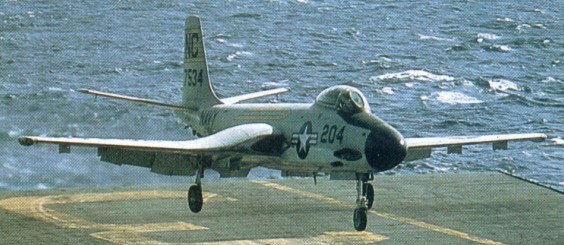
McDonnell FH Phantom

McDonnell F2H Banshee

F2H-3

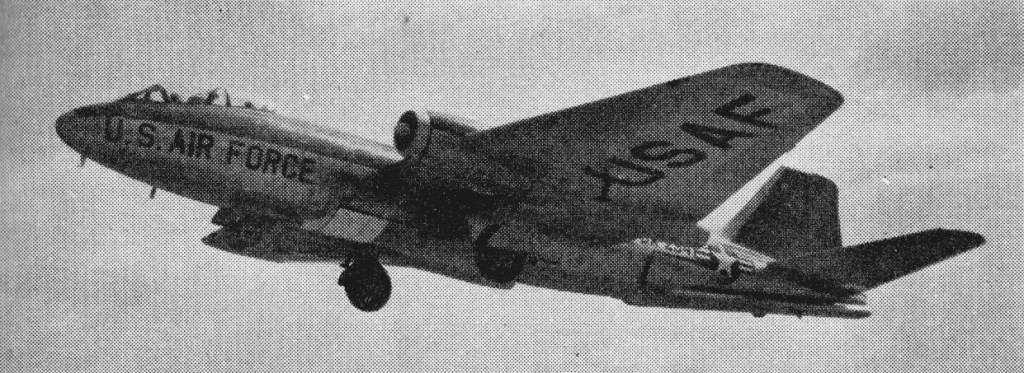
The McDonnell F2H Banshee began life even before the end of World War II when the US Navy requested an improved version of the FH-1 Phantom. Designed by a team headed by Herman D. Barkley, bearing a resemblance to the earlier type, the Banshee was of increased size, incorporating folding wings, and with a lengthened fuselage to house more fuel, and with similarly-mounted and more powerful Westinghouse turbojet engines. Conventional ailerons, elevators and rudder were fitted, and split trailing-edge flaps. Small air-brakes were in the top surface of the outer wings. A tricycle undercarriage, with a single wheel on each unit, has the mains retract outward into the wings, and the nose wheel retracts rearward. Fuel was in five tanks in the fuselage.

McDonnell F2H Banshee Article

Three prototypes being ordered on 22 March 1945, as XF2D-1s, these later gaining the name Banshee. First flying in prototype form from St Louis, Missouri, on 11 January 1947, by then redesignated XF2H-1.

Initial trials were successfully accomplished, McDonnell being rewarded in May 1947 by a contract for 56 production F2H-l fighters, which began to enter service with VF-171 of the Atlantic Fleet during March 1949.

Like the later Phantom II, the Banshee proved to be a versatile machine, satisfactorily undertaking day and night fighter tasks, all-weather interception, close air support and photographic reconnaissance.

Following on from the original F2H-1 came the F2H-2, which had slightly more powerful engines and a longer fuselage. Production of the basic F2H-2 totalled 364, some of which were later modified to F2H-2B standard for close support tasks.

F2H-2 Banshee

14 examples of the F2H-2N specialized night-fighter derivative were also completed, these incorporating airborne interception radar in a slightly longer nose.

For reconnaissance, 89 F2H-2P aircraft were completed as new, these being unarmed and featuring six cameras in an elongated nose section.

Production then switched to the F2H-3 (in 1962 redesignated F-2C), which was optimized for all-weather fighter duties, the first of 250 entering service during April 1952 and being easily recognizable by virtue of a fusel¬age- rather than fin-mounted tailplane, and was 8 ft longer than the -2, with more than double the internal fuel capacity and APQ-41 radar in the nose (250 built).

During the summer of 1949 the first US pilot to ever use an ejection seat escaped his F2H-1 Banshee while speeding over coastal South Carolina at 500 kts.

From November 1955, 39 ex-US Navy F2H-3s were transferred to the Royal Canadian Navy. That service’s first operational jet fighters, they were operated from HMCS Bonaventure until 12 September 1962, when the last examples were retired from service. They proved to be the last carrier-based fighters in Canadian service. Plans to acquire the F2H-3P for reconnaissance were abandoned.

The final production model was the F2H-4 (F-2D), which introduced improved APG-41 radar and more powerful engines, the 150th and last bringing production of the ‘Banjo’ to a close in August 1953.

The F2H was finally phased out of front line US Navy use on 30 September 1959, but remained with reserve units until the mid-‘sixties.

Contracts were to call eventually for a total of 892 production aircraft.

Gallery

XF2D-1 / XF2H-1
Engines: 2 x Westinghouse J34 turbojets
Number produced: 3

F2H-1 Banshee
Engines: 2 x Westinghouse J34-WE-22 turbojets, 3000 lbs.st.
Length 40 ft 2 in
Armament: 4 x 20 mm cannon.
Number produced: 56

F2H-2 Banshee
Engines: 2 x Westinghouse J34-WE-34 turbojets, 3250 lbs.st.
Length 40 ft 2 in
Armament: 4 x 20 mm cannon.
Number produced: 364

F2H-2B Banshee
Engines: 2 x Westinghouse J34-WE-22 turbojets, 3000 lbs.st.
Length 40 ft 2 in
Armament: 4 x 20 mm cannon, 2 x 500 lb bomb.

F2H-2N
Length 40 ft 2 in
Number produced: 14

F2H-2P Banshee
Armament: none
Number produced: 89

F2H-3 / F-2C
Engines: two 14.45kN (3,250-lb) thrust Westinghouse J34-WE-34 turbojets
Maximum speed 933 km/h (580 mph) at sea level
Service ceiling 14874 m (48,800 ft)
Max range 2374 km(1,475 miles)
Maximum speed 35,000 ft / 10,668 m: 532 mph / 856 kph
Empty weight 55056 kg (11,461 lb)
Maximum take-off 7802 kg (17,200 lb)
Wingspan 12.73 m (41 ft 9 in)
Length 14.68 m (48 ft 2 in)
Height 4.42 m (l4 ft 6 in)
Wing area 27.31 sq.m (294 sq.ft)
Armament: four 20-mm cannon, plus (Canadian aircraft only) two AIM-9 Sidewinder air-to-air missiles.
Crew: 1
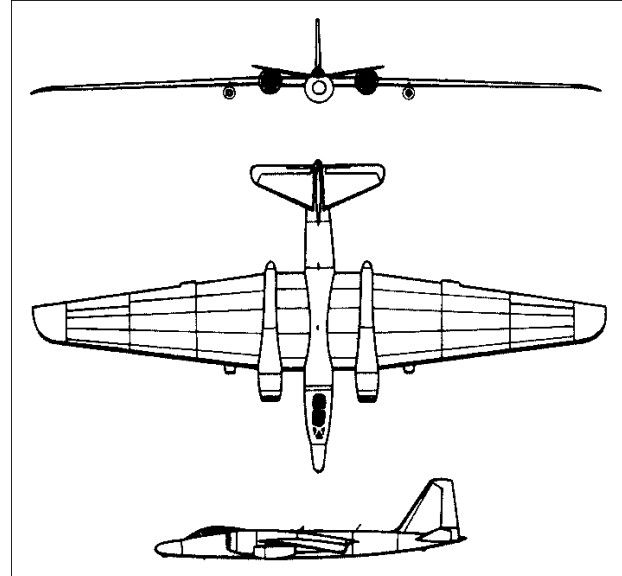
Number produced: 250

F2H-4 / F-2D
Engines: 2 x Westinghouse J34-WE-38 turbojets, 3600 lbs.st.
Wingspan: 44 ft. 11 in
Length: 47 ft. 6 in
Loaded weight: approx. 19,000 lb
Max speed: 610 m.p.h
Ceiling: 56,000 ft
Typical range: 2,000 miles at over 500 mph
Armament: 4 x 20 mm. cannon
Crew: 1
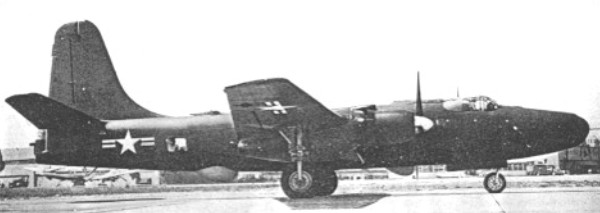
McDonnell F2H-4 Banshee

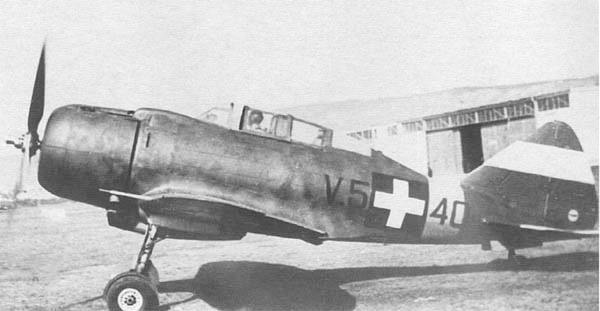
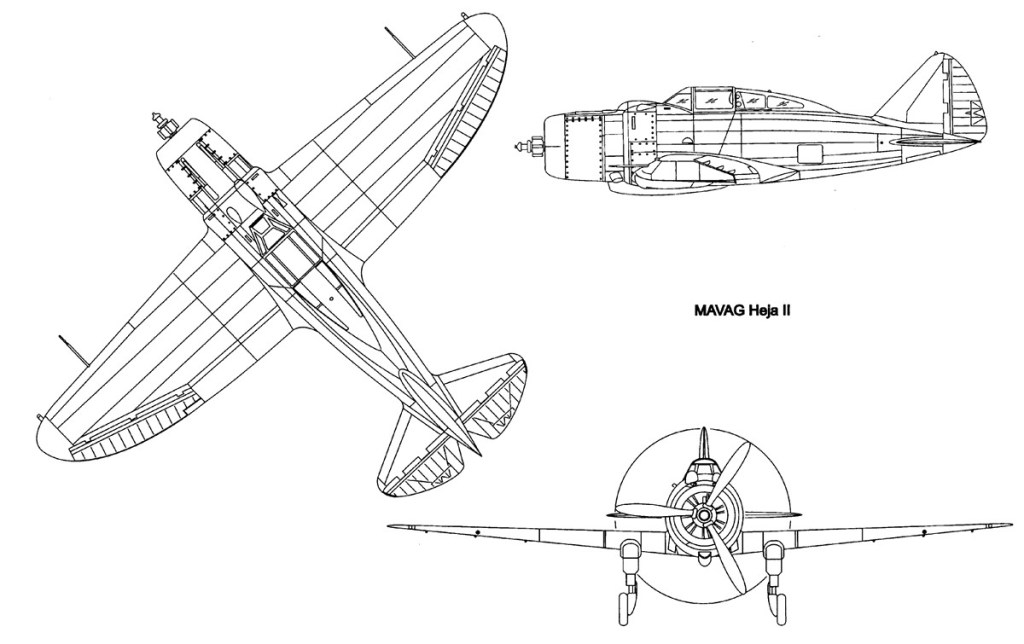
MAVAG Heja II

German leaders were reluctant to supply the Royal Hungarian Air Force (Magyar Királyi Honvéd Légierő), MKHL, which was seen to be focused on home defence and the possibility of conflict with Romania. Adolf Hitler expressed this in early 1942 when Hungary requested German-built fighters. “They would not use the single-seaters against the enemy but just for pleasure flights!… What the Hungarians have achieved in the aviation field to date is more than paltry. If I am going to give some aircraft, then rather to the Croats, who have proved they have an offensive spirit. To date, we have experienced only fiascos with the Hungarians.”

The MKHL consequently became a significant purchaser of Italian aircraft and was the main operator of the Re.2000. December 27, 1939 representatives of the company Reggiane and Head of the Air Force of the Hungarian Ministry of Defence signed a contract for delivery of 70 Re.2000 and agreed preconditions for the licensed production of the aircraft in Hungary producing a total of 200 aircraft, known as MÁVAG Héja (“Hawk”) II built between 1940 and 1942. According to other sources,170–203 aircraft were built.

In December 1939 seventy Reggiane Re.2000 fighters, purchased from Italy, were delivered to the Magyar Királyi Állami Vas-, Acél- és Gépgyárak, (“Royal Hungarian State Iron, Steel and Machine Works”), where they were modified into MÁVAG Héja I (“Goshawk I”) fighters.

The original Piaggio P.XI engines were replaced by the Hungarian-built Manfred Weiss WM K-14 driving Hamilton Standard three-bladed, constant-speed propellers. Using the WMK-14 allowed less dependence on spare parts from Italy. The WM K-14 was a licensed copy of the French Gnome-Rhône 14K engine that necessitated a 1-foot 3-inch (350 mm) lengthening of the fighters’ forward fuselage, to restore the center of gravity to a safe position. The Piaggio engine was itself also a copy of the Gnome-Rhône 14K, but less reliable than the original. On January 5, 1940 the Hungarians sent one WMK-14 to Italy to study, however, Reggiane did not want to make Re.2000 for Hungary with other than the original power plant.

In early 1940 the Hungarian delegation headed by engineer Tibor Takatsi was sent to Italy for the acquisition of the technical documentation for the license production of Re.2000. The Italians have provided all the necessary drawings by 11 October 1940.

The Hungarians at the same time held talks with Germany on the subject of joint construction of the Bf. 109. The interstate agreement to this effect was signed on June 6, 1941 however, the Hungarians could only count on 1943 to receive the Messerschmitt fighter for its air force. The Ministry of Defense was considering a draft MAVAG Hejja II as a transition to the 109.

Breda-Safat 12.7 mm machine guns were replaced by Hungarian Gebauer machine guns of the same calibre, with a rate of 1000 rounds per minute. Ammunition was a 300 round drum cartridge, under the hood. The modified Re.2000s had were named Hejja – Hungarian translation of the word Falco.

A decision was soon made to produce more Héja fighters under license in Hungary as the MÁVAG Héja II (Goshawk II). The new Héja II was entirely Hungarian with locally produced airframes, engines and armament. The new fighter differed from the Reggiane fighter in a number of ways. Armament was changed to twin 0.50 inch (12.7 mm) Gebauer fixed forward-firing guns in the upper nose with 300 rounds each. Length was 27 ft 6.25 inch (8.39 m), and maximum level speed was 301 mph (485 km/h) at 13,780 ft (4,200 m). Endurance was 2 hours and 30 minutes. Manfred Weiss originally planned to build 329 WMK-14B – 247 engines and 82 Hejja replacements. The project was completed by June 1941, and the first fighter Hejja II with the new motor was raised in the air the pilot Tasilo Seshenem (Taszilo Szechenyi). The first Re.2000, received new motor (V401), was successfully tested, and the Ministry of Defence ordered 100 aircraft, denoting them Hejja II. MAVAG planned to build two sets of 25, in the first (V4 + 71 – V4 + 95) and 75 in the second (V4 + 96 – V5 + 70).

The first MÁVAG Héja II took to the air on 30 October 1942, and in total MÁVAG built a further 203 Héjas for the Royal Hungarian Air Force. The last aircraft was completed on 1 August 1944 when production ceased. 98 were completed in 1943 and 72 in 1944 although the variant was regarded as no longer suitable for combat against the latest Soviet fighters. Hungary requested an additional 50–100 Re.2000 airframes made in Italy, as suitable engines and armament could be locally manufactured and other countries expressed interest, including Finland (100 examples), Portugal (50), Spain, Switzerland and Yugoslavia. However, no airframes were available.

After the first combat experience on the eastern front the Re.2000s were modernized. From August 1941 an 8 mm pilot armour was istalled, and an additional 100-liter self-sealing fuel tank istalled in the fuselage. The rear cabin windows were covered by sheet metal. The Ministry of Defence has also expressed the wish “… to MAVAG Hejja II was able to carry 250 or 500 kg bombs under the fuselage.” To do this it was necessary to completely revise the power circuit of the aircraft.

The first aircraft received from Italy were sent to Debrecen to strengthen home defences, as there was danger that the growing crisis over Transylvania could lead to a conflict with Romania. Conflict was avoided and the Hungarian Reggianes were used on the Eastern Front, in the war against the Soviet Union. The first seven Re.2000 were sent to the front on an experimental basis in autumn 1941. Flying alongside the Fiat CR.32s of 1/3 Fighter Company, the Reggiane pilots claimed eight kills, for one loss, during three months of combat, against Soviet Air Force.

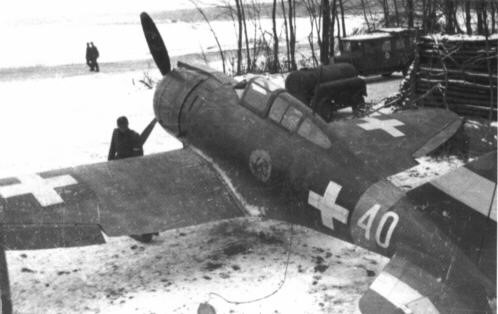
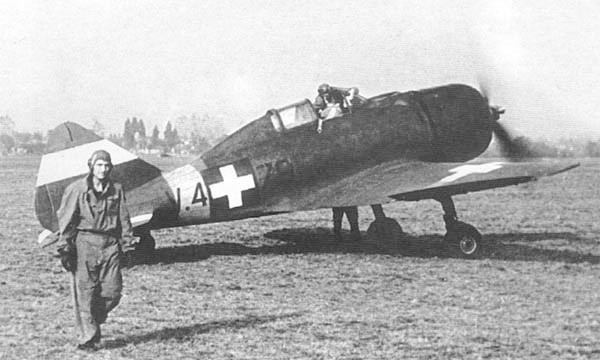
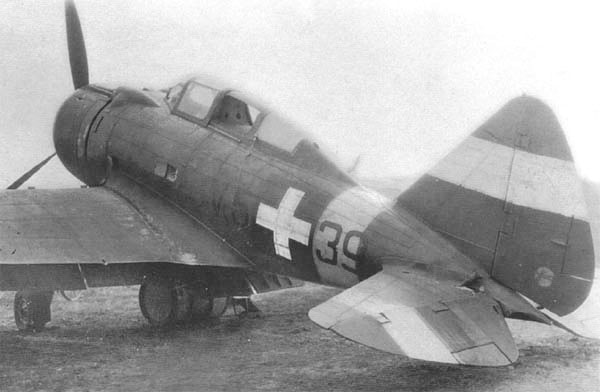
Héja-II

The first series of 25 aircraft was started in November 1941. Engine WMK-14B was fitted with a three-blade propeller Hungarian variable pitch. The engine had a slightly larger diameter (3.2 m) than the Italian Piaggio.

MAVAG finished the first series Hejja II at the beginning of July 1942. In the production it was found that the Italian glued fuel tanks had a large percentage of leaks. Chief Engineer Takatsi urgently developed smaller fuel tanks for replacement. Now the plane had 22 tanks in the central part of the wing, each with a capacity of 20 to 25 liters. After minor modifications of aircraft of the first series ended in October 1942, the Hungarian Ministry of Defence had ordered 100 more Hejja II on September 29 before starting the laying of the second series of 75 aircraft. The third series began with the construction in September 1943. Aircraft of the second series was completed March 7, 1944, the latter two have been modified in a dive bomber. They got the brake bars on the wings and the ability to carry up to 500 kg bombs. Later this version was rebuilt on another aircraft (V6 + 60).

By April 1944, the MKHL still deployed four Héja IIs in 1/1 Fighter squadron and four Hejas II in 1/2, all of them based in Szolnok for home defence duties, along with about 40 Bf 109s and Messerschmitt Me 210s. The last sortie for the licence-built Reggiane Re.2000 occurred on 2 April 1944. That day, 180 bombers from the USAAF 15th Air Force, escorted by 170 fighters, bombed the Danube Aircraft Works and other targets in Budapest. The Hungarian fighter control centre in the Géllert hill, near Budapest, scrambled one wing of Hejas from 1/1 Fighter squadron, along with 12 Bf 109G-4/G-6S and a couple of Messerschmitt Me 210Cas-1s from the Experimental Air Force Institute (RK1). The Hungarians reported 11 aerial victories, of which six were confirmed, while USAAF pilots claimed 27 MKHL aircraft shot down. However, later records showed only two Honvéd pilots were killed.

By March 1944, imports of various parts and tools from foreign contractors began to fade. British bombers on the night of 3 to 4 April 1944 destroyed plants for the production of aircraft and engines, burned most of the warehouses and the end of April production stopped. Manfred Weiss were bombed on 27 July completely disabling the motor plant, assembly plant, and warehouses. In a fire 25-30 still unfinished third series of aircraft were destroyed.

The last Hejja II (V6 + 87) flew on 11 October 1944. Four or five aircraft remained on the factory airfield waiting flight in late December 1944 when Soviet troops were in the vicinity. Hungarian engineers blasted them with hand grenades. Total produced 203 fighter Hejja II.

The Royal Hungarian Air Force (RHAP) did not use MAVAG Hejja II on the Eastern Front. Most of these fighters was used as a trainer aircraft, even though quite a few Hejja II took part in the defense of the airspace of Hungary by the Allied bombers.

In late 1942, it was planned to arm the night fighter squadron 5/1 eight Hejja II. These aircraft were to have a German radio equipment; however, it remained in the plans.

On March 19, 1944 German armed forces entered into Hungary to prevent the collapse of the Axis. The Germans forbade test flights of aircraft built. This ban remained in force until April 1, when the 15th US Army Air started regular bombing Hungarian goals. Despite the attacks, and a critical shortage of spare parts, the Hungarians had commissioned 30 MAVAG Hejja II during April. The lack of parts has reached a critical stage, many built aircraft could not get off the ground.

Héja-II

On April 13, 1944 Budapest was attacked by American bombers, accompanied by P-38s from the 1st Fighter Group, led by Lieutenant Alford (Alford). Pilots of the R-38s reported the downing of two Re.2001 to the west of Lake Balaton, which were actually MAVAG Hejja II. The Americans will only hit one of them.

Air Defense Forces raised eight Hejja II 1/2. squadron from Szolnok to cover the south of Budapest. Four Hejja bombers attacked the 454th Group, but was interrupted by the attack, stumbled upon a dense barrage fighters. Two Hejja were damaged, and one was forced to belly land. The remaining four Hungarian fighter bombers were unable to catch up, faced with a P-47 325th Fighter Group. American pilots had reported a downed Re.2001 and one damaged. Again there is an error in the identification. Lieutenant Eugene Emmons won the victory, and the lieutenant. George Novotny content damage the second fighter. These losses are confirmed by the Hungarian side.
In September, many of the half-Hejja II were still expecting different units and parts, compasses, variometers, and machine guns. Twenty fighters had no propellers, ten – without engines.

During the last months of 1944, 101/6 Training Squadron “Puma” has had six flying MAVAG Hejja II. The last official report, mentioning Hejja II was dated to February 22, 1945. It stated that Hejja II (V6 + 09) crashed during a training flight.

Héja-II

Gallery

Operators:

Royal Hungarian Air Force
2 Vadászszázad based at Szolnok
Század Héja
1/2.Század ‘Keresztes pók
2/1.Század ‘Keresztes pók
1/1.Vadászszázad
2/1.Vadászszázad
1/1.Század Dongó,Önálló Vadász Osztály (OVO)

Héja II
Engine: 1 × Manfred-Weiss 14kfs Mistral-Major, 694 kW (1030 hp)
Wingspan: 11.00 m (36 feet 1 inch)
Wing area: 20.40 sq.m
Length: 8.39 m (27 feet 6 inches)
Height: 3.10 m (10 feet 2 inches)
Empty weight: 2,070 kg (4,563 pounds)
Loaded weight: 2,520 kg (5,555 pounds)
Maximum speed: 485 km/h at 4,200 m (301 mph at 13,780 feet)
Range: 900 km (560 miles)
Service ceiling: 8,138 m (26,700 feet)
Max ceiling: 9400 m
Maximum rate of climb: 750 m / min
Endurance: 2 hr 30 min
Armament: Two fixed forward-firing 12.7 mm (0.50 inch) Gebauer machine guns
Crew: 1
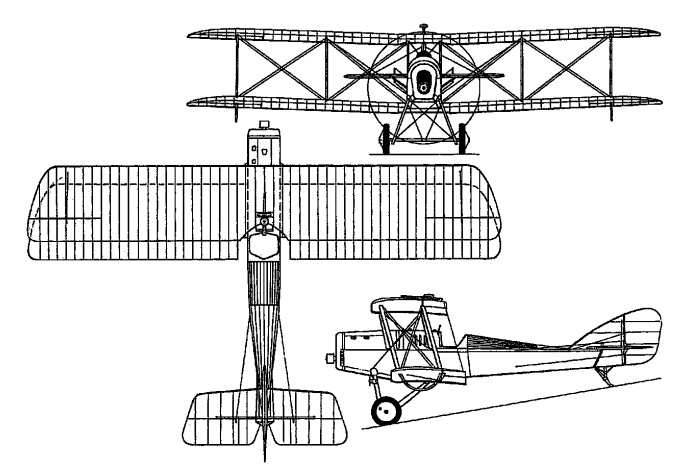
Martin & Handasyde F.4 Buzzard

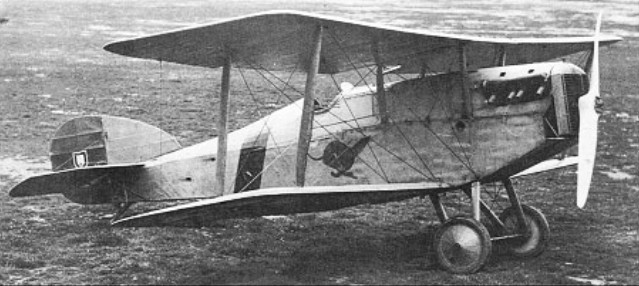
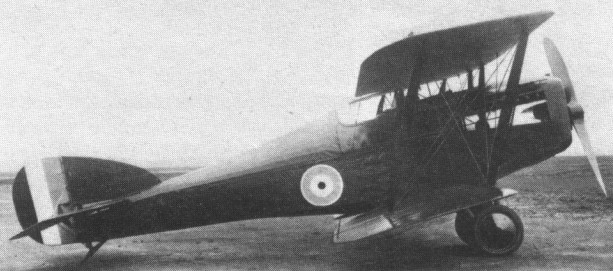
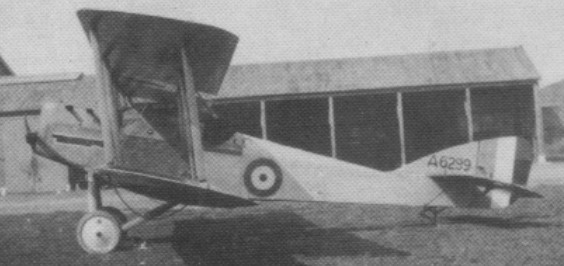
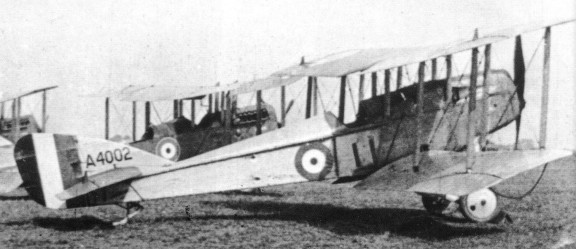
The Buzzard began life as a private venture design by G H Handasyde designated F.3. The, F.3 was powered by the 275hp Falcon III engine, but priorities in Falcon engine supplies enjoyed by the Bristol Fighter led to the reworking of the F.3 for the 300hp Hispano-Suiza 8Fb. With this it was redesignated F.4 and (from September 1918) officially named Buzzard. It is uncertain just how many of the original batch of 150 aircraft were completed as Falcon-engined F.3s, but most were certainly finished as HS 8Fb-engined F.4s, the first of the latter being tested at Martlesham Heath in June 1918.

Additional contracts for the F.4 were placed with the parent company (300), Boulton & Paul (500), Hooper (200) and Standard Motor (300). Armed with two synchronised 7.7mm Vickers guns, the F.4 differed from the F.3, apart from power plant, in having revised fuselage decking contours and more extensive plywood skinning. Belated engine deliveries and other factors delayed production, only seven having been handed over by November 1918, and, in the event, no RAF squadron was to be equipped with the type.

Contracts for some 2500 were cancelled after the Armistice, including 1500 which were to have been built in the US.

Production of the F.4 by the parent company continued for a time after the Armistice (no other contractor apparently producing any complete Buzzards) and more than 370 airframes were built, some being fitted with Falcon engines. A number of F.4 Buzzards was sold abroad by the Aircraft Disposal Company, the principal recipients being Finland (15), Portugal (4), Spain (20) and the USSR, the last-mentioned procuring 100 aircraft of this type. One 290-hp M-6 eight-cylinder water-cooled engine in Russian-built F.4s. One F.4, along with an S.E.5A, were supplied to the Imperial Japanese Navy in 1921 22 as examples of single seat fighters with stationary engines.

A two-seat variant, the F.4A, was produced in 1920, a much-modified derivative with two-bay wings of increased span appearing in the following year. This had a Lewis gun in the rear cockpit and several were supplied to Spain in June 1921, both single- and two-seat Buzzards being referred to as F.4As in Spanish service.

The Aircraft Disposal Company developed the F.4 into the less successful ADC 1.

Bruce Murdin
Email: murdin@btinternet.com
I have an original 1919 propeller from an F4 Buzzard that was owned by my father for the last 50+ years. If anyone is interested in buyimg it, please contact me on the above email address
March 2016

Engine: 300hp Hispano-Suiza 8Fb
Prop: Lang L.P.5270A or 5270B two-blade wooden, diameter 2690 mm (8 ft 9.9 in), pitch 2000 mm (6 ft 6.7 in), or Lang L.P.5420 two-blade wooden airscrew, diameter 2660mm (8 ft 8.7 in), pitch 1 980mm (6 ft 5.95 in); Wing span, upper, 32 ft 9.4 in (10,99 m), lower, 31 ft 2.4 in (10,51 m)
Length: 7.76 m / 25 ft 6 in
Height: 2.69 m / 8 ft 10 in
Wing area: 29.73 sq.m / 320.01 sq ft
Loaded weight: 2,398 lb (1 088 kg)
Empty weight: 821 kg / 1810 lb
Normal fuel capacity, (Buzzard Mk I, Hispano¬Suiza): petrol, 38 Imp gal (172,71); oil, 4 gal (18,21) later 75 gal (341); water 9 gal (40,91). Buzzard Mk Ia: petrol 56 gal (254,61), oil 75 gal (341).
Max speed, 132mph (212 km/h) at 15,000 ft (4 570 m)
Time to 10,000 ft (3 050 m), 7.9 min
Armament: Two fixed 0303-in (7,7-mm) Vickers Mark 1* machine-guns synchronized by Constantinesco C.C. Gear Type B with (ultimately) 770 rpg; 1 8-in (45,72-mm) Aldis optical sight and 5-in (127-mm) ring-and-bead sight.

Martinsyde F.4 Buzzard

Martin & Handasyde F.3 Buzzard

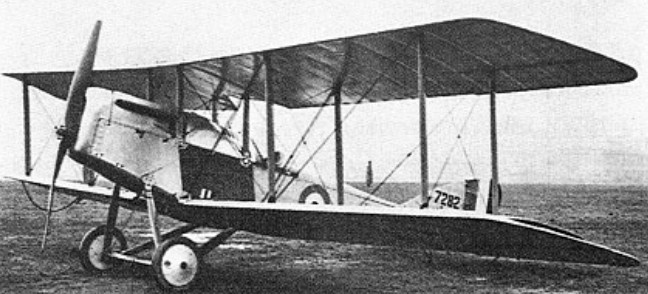
The Buzzard began life as a private venture design by G H Handasyde designated F.3. A single-bay staggered biplane of conventional wooden con¬struction with fabric skinning and powered by a Rolls-Royce Falcon engine of 285 hp.

The F.3 appeared in the autumn of 1917 and underwent its first official trials on 3 October, six further prototypes being ordered and a decision to manufac¬ture the F.3 in quantity being taken before the end of 1917.

The F.3 was powered by the 275 hp Falcon III engine, but priorities enjoyed by the Bristol Fighter in Falcon engine supplies led to the reworking of the fighter for the 300 hp Hispano-Suiza 8Fb with which it was redesignated F.4 and (from September 1918) officially named Buzzard. It is uncertain as to how many of the original batch of 150 aircraft were completed as Falcon-engined F.3s, but the bulk was certainly finished as HS 8Fb-engined F.4s.

An installation for the 240-hp Lorraine 8Bb eight-cylinder water-cooled engine was designed and may have been made.

On the F.3 the armament could be supplemented by one 0303-in (7,7-mm) Lewis machine-gun mounted on the rear spar of the centre section. The first Buzzard Mk 1a, H6540, at one time had two supplementary Lewis guns partly let into the upper surface of the lower mainplanes, one on each side.

Engine: One 285-hp Rolls-Royce Falcon experimental
Prop: Lang L.P.3770A two-blade wooden airscrew, diameter 2850 mm (9 ft 42 in), pitch 3 050 mm (10 ft)
Normal fuel capacity: petrol 32 Imp gal (145,5 lt), oil 3 gal (13,6 lt), water 6 gal (27,3 lt)
Span, upper, 32 ft l0in (11,0 m), lower 31 ft 6 in (10,6 m)
Length, 25 ft 8 in (7,8 m)
Height, 8 ft 8 in (2,85 m)
Wing area, 337 sq ft (31,34 sq.m)
Armament: Two fixed 0303-in (7,7-mm) Vickers Mark 1* machine-guns synchronized by Constantinesco C.C. Gear Type B with (ultimately) 770 rpg; 1 8-in (45,72-mm) Aldis optical sight and 5-in (127-mm) ring-and-bead sight.

Engine: one 275-hp Rolls-Royce Falcon III 12-cylinder water-cooled
Prop: Lang L.P.3770A two-blade wooden airscrew, diameter 2850 mm (9 ft 42 in), pitch 3 050 mm (10 ft)
Normal fuel capacity: (B1490), petrol 39 Imp gal (177,31), oil 435 gal (19,81)
Span, upper, 32 ft l0in (11,0 m), lower 31 ft 6 in (10,6 m)
Length 25 ft 6 in (7,8 m)
Height, 8 ft 8 in (2,85 m)
Wing area, 337 sq ft (31,34 sq.m)
Armament: Two fixed 0303-in (7,7-mm) Vickers Mark 1* machine-guns synchronized by Constantinesco C.C. Gear Type B with (ultimately) 770 rpg; 1 8-in (45,72-mm) Aldis optical sight and 5-in (127-mm) ring-and-bead sight.

Martin & Handasyde G.100 / G.102 Elephant

Martinsyde Elephant

An unusually large aircraft by contemporary standards for a single-seater, the Elephant two-bay equi-span staggered biplane was designed by A A Fletcher of the Martinsyde Company, a prototype powered by a 120 hp Austro-Daimler engine entering test in the autumn of 1915. The G.100 featured two spar wings and wooden fuselage. The entire airframe is fabric covered, except for plywood side panels on the fuselage between the wings. Conventional control surfaces with ailerons on all four wings.

The initial production version, the G.100, was powered by a 120 hp six cylinder Beardmore engine and was armed with a single 0.303-in (7,7-mm) Lewis gun mounted above the centre section (this later being augmented by a similar weapon bracket-mounted to port behind the cockpit), deliveries to the RFC commencing in 1916.

The G.100 was succeeded by the G.102 version which differed in having a 160 hp Beardmore engine doubling the bombload and replaced the lower-powered model progressively.

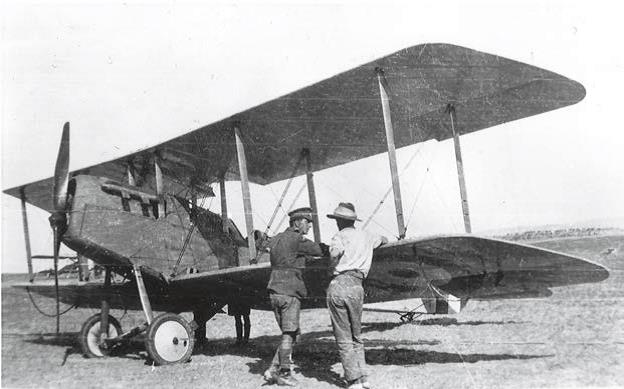
The G.100 and G.102 Elephant was used in both France and the Middle East, although only 27 Squadron RFC squadron was completely equipped with this type, a total of 271 being manufactured. They flew G.100/102s from March 1916 until December 1917 on operations in France, and the squadron’s unique equipment is per¬petuated today in 27 Squadron’s official badge motif of an elephant. Many other individual ‘Elephants’ saw active service in Palestine and Macedonia with 14, 30, 63, 67 and 72 Squadrons of the RFC. Larger than most contemporary single seaters, the ‘Elephant’ was renowned for good flying characteristics, while its endurance of approximately 4.5 hours, fully loaded, was considered excellent for what were then regarded as reconnaissance and bombing sorties. Although not particularly successful as a fighter owing to its poor agility by comparison with its smaller contemporaries, the Elephant performed a useful service as a bomber, carrying up to 230 lb (104 kg).

The Martinsyde G.100 was operated as bomber and escort machine by the Australian 1 AFC in the Middle East, and was the type flown by Lt F.H. McNamara when he was awarded the VC.

1 AFC in Palestine

Only a very few survived beyond 1918.

Gallery

G.100
Engine: Beardmore, 120 hp
Wingspan: 38 ft
Wingbarea: 410 sq.ft
Length: 26 ft 6 in
Height: 9 ft 8 in
Empty weight: 1759 lb
MTOW: 2424 lb
Max speed: 95 mph at 6000 ft
Service ceiling: 14,000 ft
Endurance: 5 hr 30 min
Armament: 2 x Lewis mg
Bombload: 112 lb

G. 102
Max speed, 103 mph (166 km/h) at sea level
Time to 3,000 ft (915 m), 3.5 min.
Endurance 4.5 hrs
Empty weight, 1,793 lb (813 kg)
Loaded weight, 2,458 lb (1115 kg)
Span, 38 ft 0 in (11,58 m)
Length, 26 ft 6 in (8,08 m)
Height, 9 ft 8 in (2,95 m)
Wing area, 410 sq ft (38,09 sq.m)
Armament: 2 machine-guns, 118kg of bombs

Martinsyde G.100 / G.102 Elephant

Martin 275 P6M Seamaster

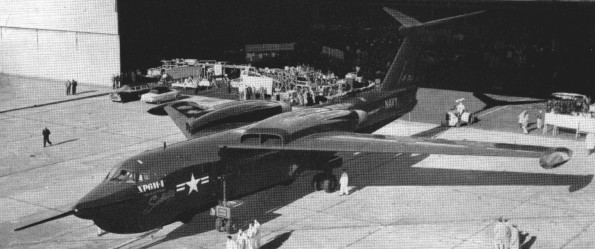
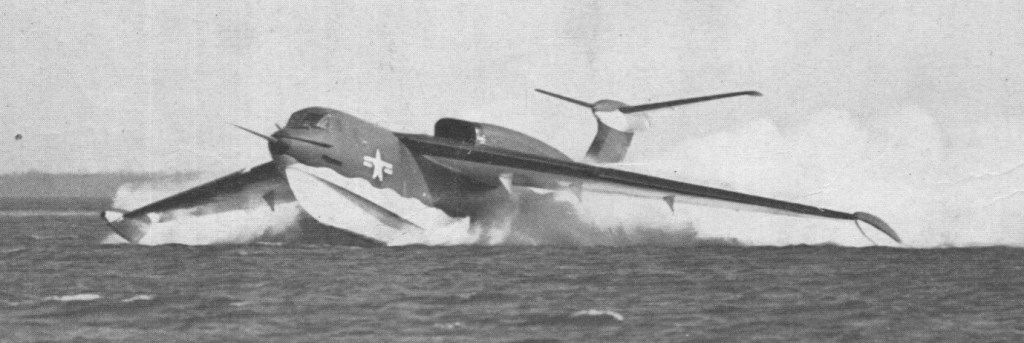
To meet a US Navy requirement for a high-performance multi-role flying-boat, Martin offered its Model 275 design. This had an all-metal hull of high length/beam ratio, mounting a cantilever high-set sharply-swept wing incorporating so much anhedral that the stabilising floats at the wing-tips could be attached permanently; the tail unit was of T-tail configuration with all-swept surfaces. Above the wing, to minimise spray ingestion, were mounted four Allison turbojet engines, and pressurised accommodation was provided for a crew of five. A beaching cradle allowed the SeaMaster to taxi in and out of the water under its own power. The P6M used a rotary bomb bay (as used on Martin’s licence-built Canberras and the XB-51). This permitted weapons release at high speeds without the drag of conventional bomb doors.

Martin P6M Seamaster Article

The first XP6M-1 prototype was flown on 14 July 1955, the second following on 18 May 1956. Ejection seats were fitted to the second and subsequent aircraft. These proved useful when the second SeaMaster pitched up, went into a loop and disintegrated. The original position of the engine exhausts caused stress on the rear fuselage which resulted in structural damage. The angle of the exhausts was adjusted after testing.

Martin received orders for six pre-production YP6M-1 boats powered by Allison J71 turbojets each developing a maximum 5897kg afterburning thrust. Successful flight testing led to an order for 24 production P6M-2 aircraft named SeaMaster, which differed primarily by having 7711kg thrust non-afterburning Pratt & Whitney J75-P-2 turbojet engines. The cockpit glazing was modified on later models to give a much better overhead and side view. However, the contract was cancelled on 21 August 1959 after only three had been built and these, together with the YP6M-1s, were scrapped at a later date. They were the fastest flying-boats ever built.

YP6M-1
Engines: 4 x J71 turbojet.
Speed: 600 mph.

P6M
Engines: 4 x Pratt & Whitney J75-P-2 turbojets, 7938kg
Wingspan: 30.48 m / 100 ft 0 in
Length: 40.84 m / 133 ft 12 in
Height: 9.45 m / 31 ft 0 in
Max take-off weight: 72575 kg / 160001 lb
Payload: 13600kg / 29983 lb
Max. speed: 965 km/h / 600 mph
Ceiling: 12200 m / 40050 ft
Range: 4830 km / 3001 miles
Armament: 6 x 12.7mm machine-guns, 1800kg of weapons
Crew: 4

Martin B-57 Canberra / General Dynamics WB-57F

The beginning of the Korean conflict on 25 June 1950 and the shortcomings of the Douglas B-26 / A-26, accounted for the urgent procurement of a light tactical bomber.

Martin B-57 Canberra Article

The new bomber had to be capable of operating from unimproved airfields, at night and in every kind of weather, with conventional or atomic weapons. High altitude reconnaissance was another must. For such purposes, the B-45 was too heavy; the Navy AJ-1, too slow; and the Martin experimental B-51’s range too short.

As a result of the outbreak in Korea, the Air Force reached a final decision. The desire for a night intruder was so strong that it took just a few days to set in motion the informal production endorsement of February 1951. Because of its experience with the XB-51, the Glenn L. Martin Company was recognized as the most qualified contractor to assume the domestic production of the British aircraft and to deal with the likely engineering difficulties involved in manufacturing a high-performance tactical bomber.

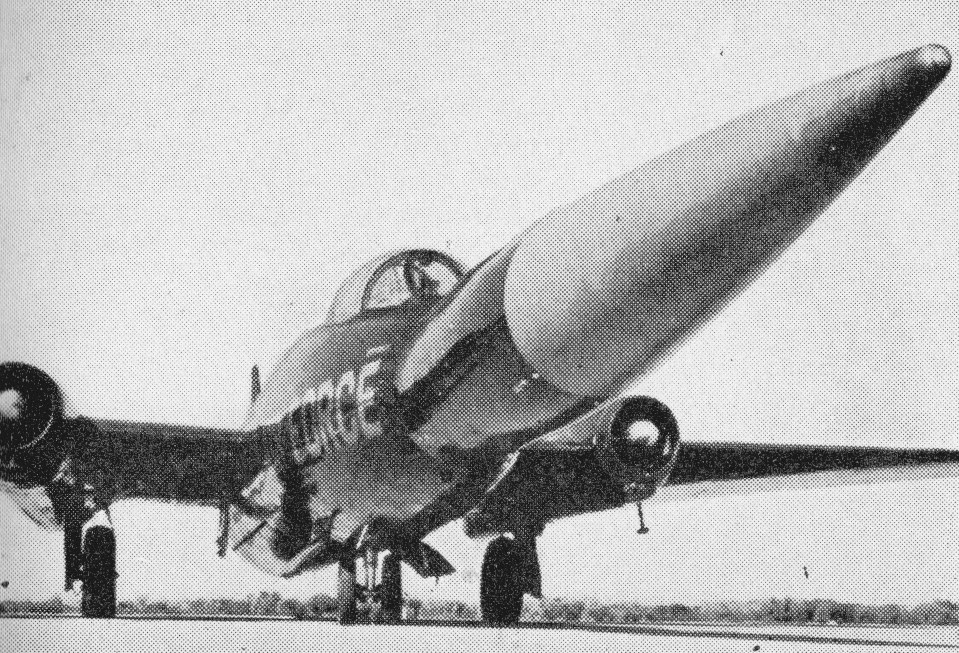
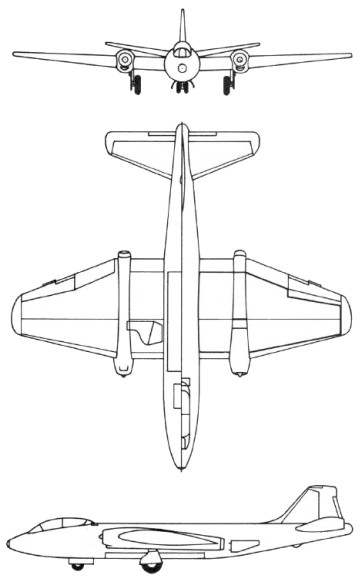
The new bomber became the Martin B-57, a by-product of the English Electric Canberra, the first British-built jet bomber, initially flown in 1949. Adaptation of a foreign-made aircraft to American mass production methods, as well as the use of different materials and tools, could present many difficulties. Another problem, perhaps more critical, centered on the Wright J65 turbojets, due to replace the Canberra’s two Rolls Royce Avon turbojet engines. The J65 was the U.S. version of the Sapphire, a British hand-tooled production currently scheduled for manufacturing by the U.S. Curtiss-Wright Corporation. The Air Force was fully aware of these potential pitfalls, but had no better option. It had an immediate requirement for a light jet bomber, with a 40,000-foot service ceiling, a 1,000-nautical mile range, and a maximum speed of 550 knots.

Testing of two imported Canberras revealed design faults that could affect the safety, utility, and maintenance of the future B-57. Then, one of the British planes crashed; Martin’s subcontractors could not meet their commitments; and the J65 prototype engines consistently failed to satisfy USAF requirements. In June 1952, further test flights had to be postponed for a year because of continuing engine and cockpit troubles. As a result, the Korea-bound B-57 did not fly before 20 July 1953, just 7 days before the conflict ended. Production of the crucial RB-57 was also delayed. The reconnaissance version entered service in mid-1954, after testing again confirmed that the more powerful J65 engines, added equipment, and other improvements had increased the aircraft’s weight, in turn reducing the speed, distance, and altitude of both the B-57 and the RB-57.

The program was reduced, but there was no talk of cancellation. In 1955, the B/RB-57s justified their costs when they served overseas pending the B/RB-66 deliveries which, as predicted, had fallen behind schedule. The first Martin B‑57A (the name Canberra was re­tained, though Night Intruder was also used) flew on 20 July 1953. In 1956, much-needed RB-57Ds joined the Strategic Air Command, and various configurations of this model satisfied important special purposes.

RB-57D

The main model (202 built) was the B 57B with a redesigned forward fuselage with a crew of only two seated in tandem under a giant rear hinged canopy. This attack version introduced a heavier bombload in a rotary door weapon bay, plus eight pylons under the outer wings and forward firing guns. The B 57B equipped two wings in Tactical Air Command and a wing of PACAF (Pacific Air Forces) but had mainly been passed to Air National Guard units by the early 1960s. Vietnam requirements then demanded aircraft in this class and all available B 57Bs (many had been re built into other models) were rushed to South Vietnam and used very success¬fully in the attack role and in particular as FAC (Forward Air Control) aircraft.

Martin B-57B

Delivered too late for combat in Korea, the RB-57 in May 1963 and the B-57 in February 1965 began to demonstrate under fire in Southeast Asia the basic qualities justifying the Canberra’s original selection.

RB-57 Reconnaissance Canberra Article

The original B-57A differed little externally from the English Canberra B2. The RB-57A was similar, with reconnaissance equipment.

The B-57B, with eight 0.50 in or four 20mm guns in the wings, bombs in an internal bomb bay, and underwing racks, served with the Chinese Nationalist and Pakistani air forces.

Variants include the RB-57D(A) and (B) with cameras, the RB-57D(C) and (D) electronics reconnaissance aircraft with radomes at the nose and tail and under the fuselage, and the RB-57(C) with wingtip radomes.

In 1970, other reactivated and newly equipped B-57s, known as Tropic Moon III B-57Gs, were deployed to Southeast Asia, where they made valuable contributions until April 1972. A total of 16 B 57Bs was rebuilt as B-57G (Tropic Moon) all weather and night attack aircraft with APQ 139 radar, a FLIR (forward looking infra-red), low light TV and laser ranger. The most capable aircraft of its day, the B 57G remained a mere study programme despite brilliant combat results.

B-57E

The last new-built version was the B 57E multi role attack/bomber and target tug, all 68 of which were later modified for other tasks.

Martin B-57 modified to test the Boeing Bomarc interceptor missile

Finally, WB-57Fs, either modified RB-57Fs or former B-57Bs, were still flying high-altitude radiation sampling missions in 1973. Concurrently, EB-57Es, and related adaptations of the versatile B-57, continued to play significant roles, with no immediate phaseout in sight.

RB-57F

403 were built under licence by Martin (in six variants) as the B-57 and served with the US Air Force from August 1953 until 1982 in various marks and guises. At a later date a number of these were converted by General Dynamics to serve as ultra high-altitude strategic reconnaissance aircraft. These were provided with a wing span of 37.19m, two 80kN Pratt & Whitney TF33-P-11 turbofan engines (replacing the conventional power plant), plus two 14.68kN Pratt & Whitney J60-P-9 turbojets in underwing pods, and many equipment and avionics changes to fit them for their specialised role. The B-57 saw combat over Vietnam beside other Canberras from Australia.

The USAF bought 21 WB-57F aircraft, which were built by General Dynamics from existing B-57Bs and RB-57Ds. The airplanes’ ability to reach altitudes over 65,000 feet, carry payloads in excess of 4,000 lbs, and its triple spar wings made it a very capable high-altitude platform. Missions included everything from weather reconnaissance for Apollo space launches to sampling radiation in nuclear weapon test plumes.

In the late 1960s and early 1970s the Air Force decided to ground the WB-57F and depend exclusively on the U-2 for high-altitude support. The mission of monitoring nuclear test bans was better done by the WB-57F than the U-2, however. That mission was important enough that three aircraft were given to NASA to keep that capability alive, which were designated N925N, N926NA, and N928NA.

When N925N was retired and put on display at Pima Air & Space Museum in Tucson, Arizona, it that left NASA with two WB-57Fs. Another airframe joined the fleet in 2011 after been taken out of the 309th Aerospace Maintenance and Regeneration Group, (AMARG), better known as the “Bone Yard,” at Davis-Monthan Air Force Base, Arizona. The aircraft, designated N927NA, began as a B-57B, and then was one of 21 aircraft rebuilt as an RB-57F in 1964. As an RB-57F the aircraft had its wingspan increased to 122 feet and the original Wright J65 turbojets were replaced by Pratt & Whitney TF-33 turbofans, doubling both the wingspan and thrust.

N927 had been retired in June 1972 and remained on “celebrity row” at the Bone Yard until May 2011 when it was dismantled and trucked to Sierra Nevada Corporation at Centennial Airport, Colorado. After being refurbished to flying condition it was flown to Ellington AFB in August 2013.

The aircraft had been in storage for over 40 years and made its first flight in 41 years in the summer of 2013, setting a record for the longest an aircraft had sat in the Bone Yard before returning to flying status.

NASA’s WB-57F

Based at Ellington Field near NASA’s Johnson Space Center in Houston, Texas, the WB-57F operates in NASA’s High Altitude Research Program. The aircraft provides unique, high-altitude (up to 70,000 feet MSL) airborne platforms to United States government agencies and other customers for scientific research, advanced technology development, and testing around the world.

Since 2000, the unique performance capabilities of the WB-57F aircraft and increasing costs associated with the ER-2 program have resulted in NASA allowing multiple customers to use the WB-57Fs for atmospheric and satellite sensor research. The DOD programs have gotten much broader, and N928 (and sometimes N926) have multiple customers asking us to help them develop satellite sensors.

Both aircraft were enjoying multiple customers. By June 2014, both aircraft were upgraded with global positioning satellite navigation systems, F-15 main landing gear and brakes, and the gross weight capability of both aircraft was certified from 63,000 pounds to 72,000 pounds. Ongoing upgrades to the aircraft include installation of the ACES II ejection seat system and installation of an improved, modern autopilot.

Gallery

B-57B
Night intruder bomber
Engines: 2 x Wright J65-W-3 Sapphire turbojets, 7,500lb thrust
Wingspan: 64 ft
Length: 65 ft. 6 in
Loaded weight: 46,000 lb.
Max speed: over 600 m.p.h.
Ceiling: over 45,000 ft.
Max range: 3,000 miles.
Armament: 8x.50 in. machine-guns
Bombload: 6,000 lb; 8×5-in. rockets
Hardpoints: 4
Crew: 2

B 57B
Engines: two 3,275 kg (7,220 lb) thrust Wright J65 W 5 turbojets.
Maximum speed 937 km/h (582 mph) at 12190 m (40,000 ft).
Service ceiling 14630 m (48,000 ft).
Range 3700 km (2,300 miles).
Weights: empty 11793 kg (26,000 lb)
Maximum take off 24948 kg (55,000 lb)
Wing span 19.51 m (64 ft 0 in)
Length 19.96 m (65 ft 6 in)
Height: 4.75 m (15 ft 7 in)
Wing area: 89.18 m (960 sq ft).
Armament: eight 12.7 mm (0, 5 in) or four 20 mm guns; up to 2722 kg (6,000 lb), 16 underwing rockets or mixed rocket/ bomb/napalm loads.

RB-57D
Engines: 2 x Pratt & Whitney J57C, 11,000 lb
Wingspan: 106 ft
Length: 65 ft 6 in
Height: 14 ft 10 in
Max speed: 632 mph at 40,000 ft
Service ceiling: 60,000 ft

RB 57F
Engines: 2 x Pratt & Whitney TF33 P 11 turbofan, 18,000 lb (8,165 kg) st, and 2 x P&W J60 P 9 auxiliary turbojets, 3,300 lb (1,500 kg) st.
Wing span: 122 ft 5 in (37.32 m)
Length: 69 ft 0 in (21.03 m).
Height: 5.8 m / 19 ft 0 in
Max take-off weight: 20360 kg / 44886 lb
Empty weight: 13600 kg / 29983 lb
Max. speed: 880 km/h / 547 mph
Ceiling: 25000 m / 82000 ft
Range w/max.fuel: 6440 km / 4002 miles
Typical endurance: Over 10 hr
Crew: 2
Armament: None

Martin B-57 Intruder
Martin RB-57D
Martin RB-57F

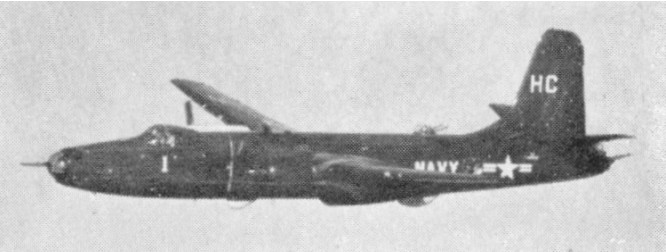
Martin 219 / P4M Mercator

The US Navy made several attempts to gain the benefit of high over-target performance combined with long range by introducing mixed powerplant. The Martin Model 219 patrol bomber represented one of the results of such a specification, two XP4M-1 prototypes being ordered on 6 July 1944. The first was flown on 20 September 1946 as a cantilever shoulder-wing monoplane with retractable tricycle landing gear. Its powerplant comprised two 2218kW Pratt & Whitney R-4360-4 Wasp Major radial engines, but each nacelle also incorporated a 17,350kg thrust Allison J33-A-17 turbojet. After a protracted development programme 19 P4M-1 production aircraft were built, the first being delivered to US Navy Squadron VP-21 on 28 June 1950, and all served with this unit. Most of them were converted into P4M-1Q Elint aircraft, one being shot down.

Martin P4M Mercator Article

P4M-1 Mercator

P4M-1
Engines: 2 x Pratt Whitney R-4360-20A piston engines, 2424kW + 2 x Allison J33-A-10A, 2087kg
Max take-off weight: 40000 kg / 88185 lb
Wingspan: 34.75 m / 114 ft 0 in
Length: 25.50 m / 83 ft 8 in
Height: 7.95 m / 26 ft 1 in
Wing area: 121.79 sq.m / 1310.94 sq ft
Max. speed: 660 km/h / 410 mph
Ceiling: 10545 m / 34600 ft
Range: 4570 km / 2840 miles
Armament: 2 x 20mm cannons, 4 x 12.7mm machine-guns, 2700kg of bombs

Martin XBTM-1 / AM-1 Mauler

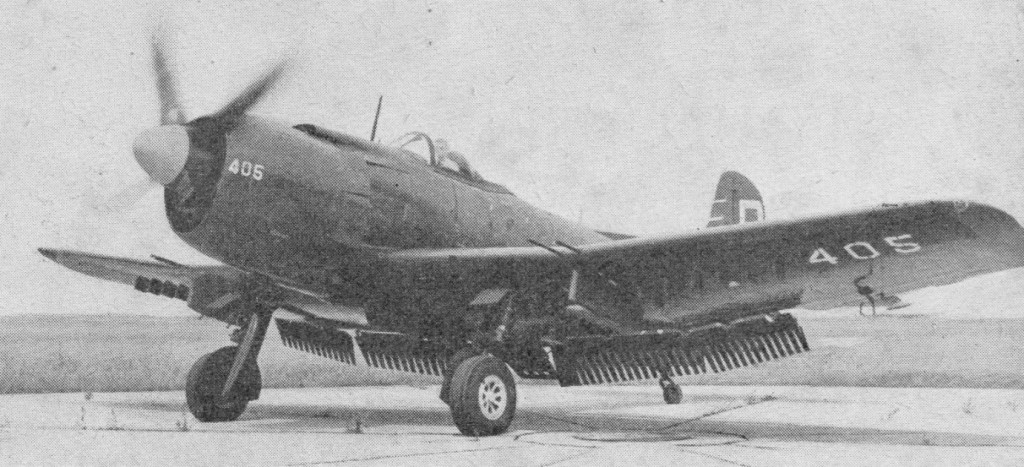
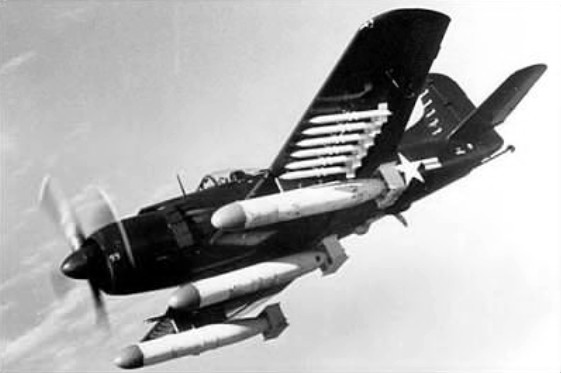
Benefiting from early combat experience in World War II, the US Navy drew up a specification for a new single-seat carrier-based attack aircraft. The Martin Model 210 design proposal gained a contract for two XBTM-1 prototypes, the first being flown initially on 26 August 1944.

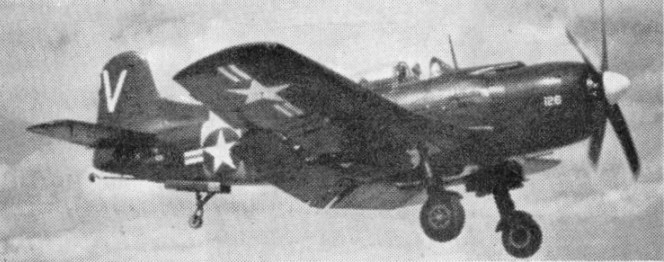
A cantilever low-wing monoplane with retractable tail-wheel landing gear, powered by a 2237kW Pratt & Whitney XR-4360-4 radial engine, the XBTM-1 was tested successfully and gained a contract for 750 BTM-1 series aircraft. By the time that the first of these was flown, on 16 December 1946, the designation had been changed to AM-1 and the name Mauler selected.

World War II had also ended, and instead of the planned procurement only 149 AM-1s (excluding prototypes) had been completed when production ended in October 1949.

Initial deliveries to an active unit went to Attack Squadron VA-17A on 1 March 1948, but these aircraft saw little first-line service, being transferred to US Navy Reserve squadrons when production ended by 1955.

1948

The total of 149 built included 17 AM-1Q aircraft completed as ECM (electronic counter-measures) aircraft.

Martin AM1 Mauler
Engine: Pratt&Whitney R-3350-4 Cyclone 18, 2934 hp / 2218kW
Length: 41.175 ft / 12.55 m
Height: 16.831 ft / 5.13 m
Wingspan: 50.0 ft / 15.24 m
Wing area: 496.005 sq.ft / 46.08 sq.m
Max take off weight: 23390.6 lb / 10608.0 kg
Weight empty: 14502.3 lb / 6577.0 kg
Max. speed: 319 kts / 591 km/h / 367 mph
Cruising speed: 164 kts / 304 km/h
Service ceiling: 30495 ft / 9295 m
Wing load: 47.15 lb/sq.ft / 230.0 kg/sq.m
Range: 1564 nm / 2897 km / 1802 miles
Crew: 1
Armament: 4x MG 20mm, 2041kg Bomb./Rockets

Martin AM-1 Mauler