Northrop F-5 Freedom Fighter / N-156F

F-5A

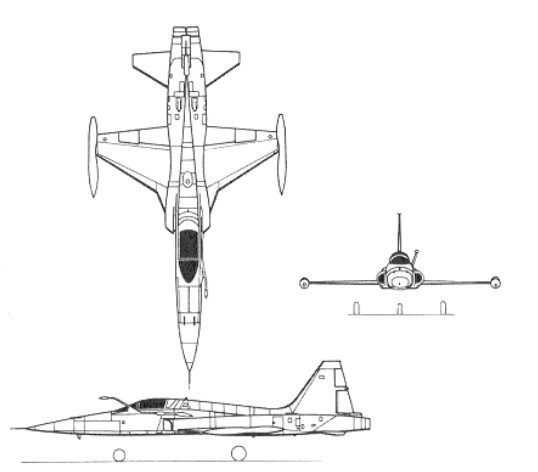
A team under Welko Gasich designed the N 156F in the mid 1950s as an economical, light fighter, cheaper to buy and operate than the large Mach 2 designs then being constructed. The Department of Defense showed little interest, but a two seat trainer version (at first for the Navy, later the USAF) bore fruit and was produced in quantity as the T 38 Talon. This provided an underpinning for the N 156F, which after various changes was released to manufacturing in late 1957, Northrop deciding to build three. The first, by this time called the Freedom Fighter, flew on July 30, 1959. The prototype had a Department of Defense (Air Force) serial number but no national markings. On April 25, 1962, the US government announced that it was ordering the aircraft into quantity production as the standard fighter to be supplied through the Military Assistance Program to Allied and friendly nations. Since then further contracts have followed, paid for by the recipient governments.
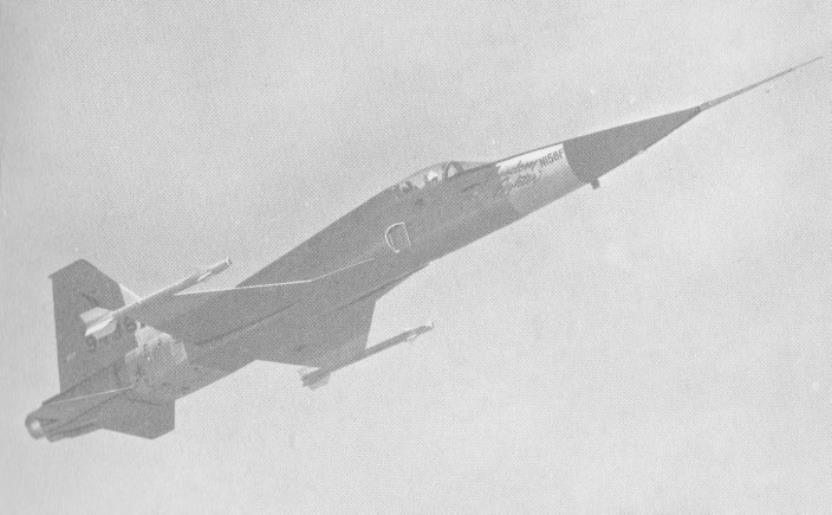
N-156F

The low wing is swept back 25 degrees, with ailerons at mid-span, and trailing-edge flaps inboard. Full span leading-edge flaps and a conventional rudder is fitted, and all-moving tailplane. Two air-brakes are under the centre of the area-ruled fuselage. The tricycle undercarriage has a single wheel on each unit. The mains retract inward into the fuselage and the nose wheel retracts forward.

Redesignated F 5A (single seat) and F 5B (tandem dual control version), the Freedom Fighter began to come off the production line in 1963. Powered initially by two General Electric J85 13 engines each rated at 1383 kg (3050 lb) static thrust with full afterburner, the F 5A was a simple machine with no radar other than a ranging set for the two 20 mm (0.79 in) Pontiac M 39 cannon mounted above the nose.
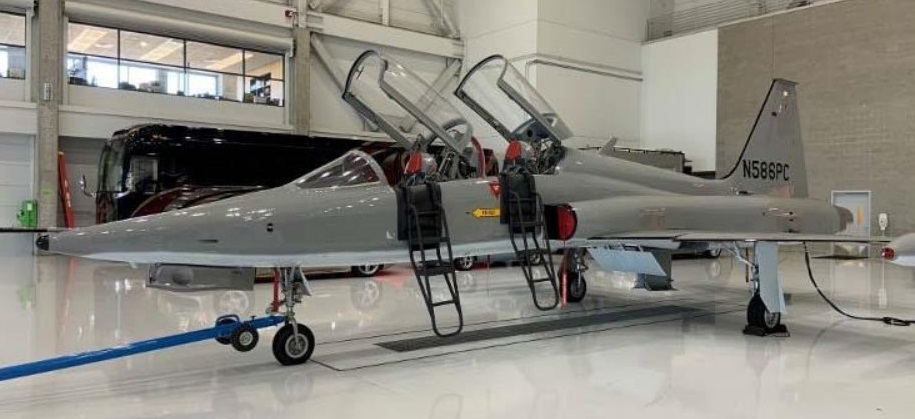
1966 Northrop F-5B

Northrop F-5 Article

Total internal tankage was 2200 litres (484 Imperial gal), and two Sidewinder air to air missiles could be carried on the wing tips in place of area ruled (Coke bottle shape) drop tanks. Early in development five further hard points were added for a total external load of 2000 kg (4410 lb), the total load of ordnance of all kinds, including guns and ammunition, being 2812 kg (6200 lb).

More than 1000 of this first generation F 5 series were produced, including more than 300 built under licence in Canada, Spain and Taiwan. Canadian aircraft, assembled by Canadair incorporated parts built in the Netherlands in a two nation production programme, with J85 CAN 15 engines built by Orenda. In all except the first production version, the 13 engines were rated at 1850 kg (4078 lb) thrust, except for the CF 5 (Cana¬dian) and NF 5 (Netherlands) versions in which the rating was 1950 kg (4299 lb).

Recipients of these F/CF/NF 5A, B, D and G aircraft included Brazil, Canada, Ethiopia, Greece, Iran, Jordan, South Korea, Libya, Malaysia, Morocco, the Netherlands, Norway, Pakistan, the Philippines, Saudi Arabia, Spain, Taiwan, Thailand, and South Vietnam. The USAF also bought a small number to equip a foreign customer training squadron at Williams Air Force Base, and in 1965 also bought one squadron of single seat F 5A aircraft for evaluation in South Vietnam. The equipment fitted was varied for richer customers, and eventually included inertial navigation for Saudi Arabia and various changes to improve short field performance including increased wing incidence, two-position nose gear, arrester hook, provision for ATO rockets and uprated engines. These customers options were specified by Canada, the Netherlands and, except for uprated engines, Norway.

In April 1964 it was reported Norway had confirmed it will purchase 64 F-5A, with option to buy 20 more. The initial order came to $75 million, including spares and training cost. Deliveries were to be made in 1966-67.

1966 Vietnam F-5

In 1969 the US government held a competition for a successor to the F 5 called IFA (International Fighter Aircraft). Northrop had already fitted an F 5 with two of the more powerful J85 GE 21 engines, each rated at 2227 kg (4910 lb) thrust, and fully investigated the improved performance envelope thus obtainable. It proposed an improved F 5, called F 5E Tiger II, as the IFA, and this won the competition in November 1970. The F 5E has a broader fuselage increasing fuel capacity and wing span a redesigned wing with leading edge manoeuvre flaps, based on an earlier flap fitted to the NF 5A and B, positioned by a switch on the pilot’s throttle working in conjunction with the landing flaps on the trailing edge. It also has large wing root leading edge extensions, Emerson APQ159 X band radar, hard points for a total external load of 3175 kg (7000 lb) and considerably altered and enhanced avionics. Provision is made for a detachable probe for inflight refuelling, and a further list of customer options includes ATO rockets, antiskid brakes (the arrester hook is standard), the ‘FR’ nose, chaff/ECM pods, improved ejection seats and a wide range of special target sensing or designations, weapon guidance and countermeasure kits. The first F-5E was flown in August 1972

By 1978 more than 1000 F 5Es and tandem seat F 5F Tiger IIs had been delivered, and orders had been placed for some 1500 from Brazil, Chile, Ethiopia (supplied by Iran after a US embargo), Iran, Jordan, Kenya, Malaysia, Morocco, Peru, Philippines, Saudi Arabia, Singapore, South Korea, Switzerland, Taiwan, Thailand, Tunisia and South Vietnam. In February 1978, the US government agreed to sell 50 (probably a mix of Es and Fs) to Egypt ‘as a reward for President Sadat’s peacemaking efforts’. Further aircraft had been supplied to the USAF and US Navy for use in DACT (Dissimilar Aircraft Combat Training), the F 5E taking the part of aggressor’ MiG 21 fighters which it resembles in size and to some degree in characteristics. The tandem seat F 5F, of which some 100 have been delivered, has a longer fuselage, a single gun and reduced gross weight.

Derived from the earlier F-5A/B Freedom Fighter, the F-5E/F, powered by two 22.24kN General Electric J85 turbojets, first flew on August 11, 1972. Its armament comprises twin 20mm cannon, two AIM-9 Sidewinder, plus up to 3,l75kg of stores on one under-wing and one under-fuselage hard-points. Development of a two-seater conversion trainer counterpart of the F-5E Tiger II was approved early in 1974, and the F-5F Tiger II (73-0889) first flew on 25 September of the same year. The airframe is basically that of the F-5E lengthened by 3 ft 6.5 in (1.08 m) to allow the insertion of a second ejector seat, displays, and controls under a lengthened canopy. Though one of the F-5E’s two 20-mm cannon is removed, the F-5F still has the F-5E’s fire-control system with APQ-157 multi-role radar, and retains all five hardpoints for full combat capability. Some aircraft have an inertial navigation system and provision for a laser designator pod. About 200 F-5Fs were produced, and such aircraft serve with most F-5E operators. Many aircraft are being updated in a series of programs concerned mostly with the F-5E.
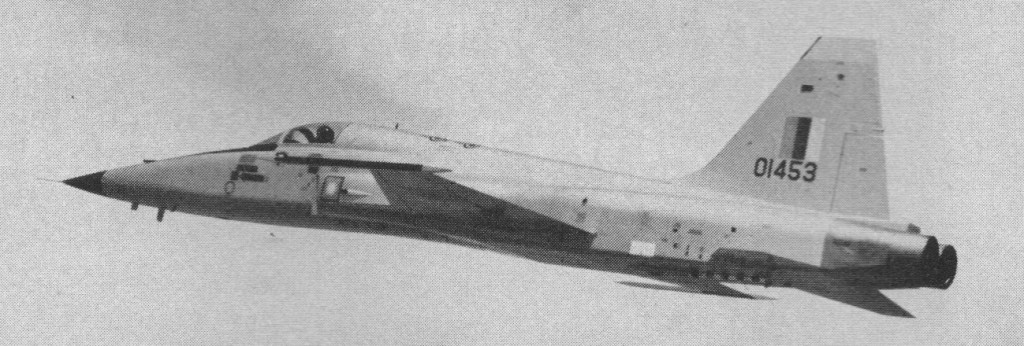
1975 delivery of F-5E to Royal Malaysian Air Force

The F-5E/F has also been produced under licence in South Korea, Switzerland, and Taiwan.

The Northrop F-5 Freedom Fighter/Tiger family has also been developed to perform photographic reconnaissance duties; approximately 100 examples of the RF-5A and RF-5E Tigereye have been built to 1984. The first and thus far most numerous reconnaissance model to appear was the RF-5A, 89 examples of which were constructed by the parent company between 1967-72. Featuring a nose-mounted battery of four KS-92A cameras, the RF-5A entered development in October 1963 in response to a US Air Force directive calling for a daylight tactical reconnaissance model of the Freedom Fighter for supply to friendly nations as part of military assistance and foreign military sales programmes. The RF-5A flew for the first time during May 1968, deliveries beginning during the following month with the initial aircraft going to Iran, which received 13 production examples as part of the military aid programme then in being, Subsequent customers comprised Turkey (20 aircraft), South Vietnam (10), Thailand (4), Greece (16), South Korea (8), Morocco (2) and Norway (16) before production of this model ceased in June 1972.

In addition to those aircraft produced by the parent company, the Freedom Fighter was also built under licence in Spain, 17 examples of the reconnaissance model known locally as the SRF-5A being completed by CASA. Many of the 89 CF-5As, 75 NF-5As and 2 seat CF-5Ds completed by Canadair for service with the armed forces of Canada, the Netherlands and Venezuela also featured latent reconnaissance capability, being fitted with camera noses. A total of 204 CF-5s were produced.

More recently, Northrop developed the RF-5E Tigereye for reconnaissance duties and this is a rather more sophisticated machine based on the F-5E Tiger II and using up to six cameras or infra-red scanners on quick-change pallets which can be inserted into the extended nose. Making its maiden flight on 29 January 1979, the RF-5E has thus far failed to find a ready market, the only customers being Malaysia, which took delivery of two during 1983, and Saudi Arabia, which has ordered 10. Malaysia operates two Northrop RF-5E Tigereyes on reconnaissance duties, equipped with Sidewinder air-to-air missiles on the winglips for protection. The type features an arrester hook in common with most US fighters.

Production of the F-5E/F light tactical fighter ended in 1986, and the last two aircraft were handed over to Bahrain on January 16, 1987. A total of 2,610 F-5s of all models were built over a 24-year period, includ-ing more than 1,400 F-5E/F Tiger IIs and RF-5E Tigereyes.

NASA employed a single F-5E airframe with a revised, deeper fuselage for experimentation in DARPA’s “Shaped Sonic Boom Demonstration” program. The airframe survived its testing and became a permanent fixture at the Valiant Air Command Museum in Florida.

A further development, the F-5G, became the Northrop F-20.

Gallery

N-156F
Engines: 2 x General Electric J85-GE-5, 3850 lb
Wingspan: 26 ft 5 in
Wing area: 171 sq.ft
Length: 43 ft 1 in
Height: 13 ft 1 in
Wheel track: 10 ft 10 in
MTOW: 16,110 lb
Internal fuel: 500 Imp.Gal
Max speed: 990 mph at 36,000 ft / M1.5
Cruise: 560 mph at 36,000 ft
Max ROC: 28,000 fpm
Max range: 2100 miles
Hardpoints: 5 + 2 wingtip

F-5A
Engines: 2 x GE J85 turbojet
Span: 7.70 m (25 ft 3 in)
Length: 14.38 m (47 ft 2 in)
Gross weight: 9379 kg (20 680 lb)
Maximum speed: 1489 km/h (925 mph)
External load: 2812 kg (6200 lb)
Seats: 1
Armament: 2 x 20mm cannon

RF-5A
Type: single-seat tactical reconnaissance aircraft
Powerplant: two General Electric J85-GE-13 turbojets, 1851 kg (4,080-1b) afterburning thrust
Maximum speed at 10975 m (36,000 ft) 1489 km/h (925 mph) or Mach 1.4
Combat ceiling 15240 m (50,000 ft)
Range w/max.payload: 592 km / 368 miles
Max range 2595 km (1,612 miles)
Empty weight 3667 kg (8,085 lb)
Maximum take-off weight 8952 kg (19,736 lb).
Span 7,70 m (25 ft 3 in)
Length 14.38 m (47 ft 2 in)
Height 4.01 m (13 ft 2 in)
Wing area 15.79 sq.m (170 sq ft)

F-5B
Span: 7.70 m (25 ft 3 in)
Length: 14.12 m (46 ft 4 in)
Gross weight: 9300 kg (20 500 lb)
Maximum speed: 1424 km/h (885 mph)
Seats: 2

F-5D
Span: 7.70 m (25 ft 3 in)
Length: 14.12 m (46 ft 4 in)
Gross weight: 9300 kg (20 500 lb)
Maximum speed: 1424 km/h (885 mph)

F-5E
Span: 8.13 m (26 ft 8 in)
Length: 14.73 m (48 ft 31 in)
Gross weight: 11192 kg (24675 lb)
Maximum speed: 1704 km/h (1060 mph)

F-5E Tiger II
Engines: 2 x J85 GE 21 reheat 44.5 kN
External load: 3175 kg (7000 lb)
Span: 8.1 m
Length: 14 m
Wing area: 17.3 sq.m
Empty wt: 4410 kg
MTOW: 11,215 kg
Warload: 3175 kg
Max speed: 1.64 Mach
Initial ROC: 10,515 m / min
Ceiling: 15,790 m
TO run: 610 m
Ldg run: 762 m
Combat radius lo-lo-lo: 220 km
Fuel internal: 2563 lt
Air refuel: Yes
Armament: 2 x AAM, 2 x 20 mm
Hard points: 5 + 2 wing tips

F-5F Tiger II
Engines: two 5,000-lb (2,268-kg) reheated thrust General Electric J85-GE-21 B turbojets
Maximum speed 1030 mph (1,658 km/h) or Mach 1.56 at 36090 ft (11000 m)
Initial climb rate 32900 ft (10030 m) per minute
Service ceiling 50800 ft (15485 m)
Radius 599 miles (964 km)
Empty weight 10,576 lb (4,797 kg)
Maximum take-off 25,152 lb (11,409 kg)
Wing span 26 ft 8 in (8.13 m)
Length 51 ft 4 in (15.65 m)
Height 13 ft 1.75 in (4.01 m)
Wing area 186.0 sq ft (17.29 sq.m)
Armament: one 20-mm cannon, and up to 7,000 lb (3,175 kg) of disposable stores

Canadair CF-5 Mk.2
Engine: 2 x General Electric/Orenda J-85-15, 4000 lb
Wing Span: 25ft 10in
Length: 47ft 2in
Height: 13ft 2in (4m)
Speed: 1,150 miles/hr – mach 1.3
Armament: two 20mm Cannons 6,200lbs bombs, rockets & missiles
Northrop T-38 Talon / N-156T

To meet a US government requirement for a high-performance lightweight fighter that would be suitable for supply to and operation by friendly nations via the Military Assistance Program, Northrop began the private-venture design of such an aircraft in the mid-1950s, identifying it as the Northrop N-156.

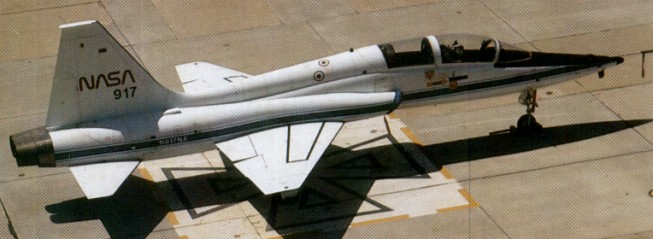
This initial design concept was to form the basis of a family of aircraft, including a supersonic trainer which had the company designation N-156T. Three YT-38 prototypes were ordered in December 1956, this number being increased to six in June 1958, and the first of them was flown on 10 April 1959.

Northrop T-38 Talon Article

Cantilever low wing monoplanes with slender area ruled fuselages, the first two prototypes were each powered by two 953kg thrust non-afterburning General Electric YJ85-GE-1 turbojets, but the remainder of this first batch had YJ85-GE-5 engines with an afterburning thrust of 1633kg. The first to receive the T 38, in 1962, was the 3560th UPT Wing at Webb AFB, Texas. Testing with these latter engines resulted in an initial contract for the T-38A Talon, the first of them entering service with the USAF’s 3510th Flying Training Wing, at Randolph AFB, on 17 March 1961, powered by two 3,850 lb thrust General Electric J85 GE 5 turbojet engines. The aircraft boasts a 720° per second roll rate.

The Talon, which seats instructor and pupil in tandem on ejection seats and has a fully powered control system, has gained one of the best safety records of any supersonic aircraft in USAF service. As a result, when production ended in early 1972 a total of 1,187 T-38s had been built for the USAF. The US Navy acquired five from the USAF, and three of these remained in service with the Test Pilots School at Patuxent River.

Also supplied through the USAF and operated by the German Luftwaffe were 46 used for pilot training in the US. Only export customer was Portugal who received two batches of six Sidewinder-equipped ex-USAF aircraft in 1977 and 1981 to replace F-86 Sabres used in the dedicated air defence role but doubling as advanced pilot trainers.

NASA also acquired a number from Northrop, using them as flight-readiness trainers for astronauts. Reported in 1965, fifteen were acquired, replacing Convair F-102 Delta Daggers.

The designations AT-38A and NT-38A were allocated to two T-38As following their conversion for evaluation as an attack trainer and research/ development aircraft respectively. Four of the US Navy’s T-38s converted to serve as drone directors were redesignated DT-38A.

The AT 38B is a lightly armed version serving in the Lead-in Fighter Training role at Holloman AFB, New Mexico. The T-38B has a gunsight and a centerline pylon which can be fitted with a gun pod or bombs. Some 700 of these aircraft remained in service in 1992.

The T-38 Talon were modernised to T-38C standard for redelivery from 1999 by Northrop Grumman. The T-38C employed new, electronic instrumentation.

Several T-38s have made their way back into the U.S. in private hands.

Gallery

T-38A Talon
Engines: 2 x General Electric J85 GE 5 turbojets, 2,500 lbs.t. (1134 kgp) and 3,850 lb (1746 kg) with afterburn
Span, 25 ft 3 in (7.7 m)
Length, 44 ft 2 in (13.46 m)
Height: 3.92 m / 12 ft 10 in
Wing area, 170 sq.ft (15.8 sq.m)
Empty weight, 7,340 lb (3329 kg)
Loaded weight, 11,700 lb (5307 kg)
Max speed, 838 mph (710 kt / 1348 kph) at 36,000 ft (10 973 m)
Cruise, 590 mph (949 kph)
Initial climb, 30,000 fpm (152.4 m/sec)
Service ceiling, 56,800 ft (17 312 m)
Range, 1,267 mls (2039 m)
Seats: 2
U/C & flap limit: 240 kt
Loading: +6.4 / -2.6G

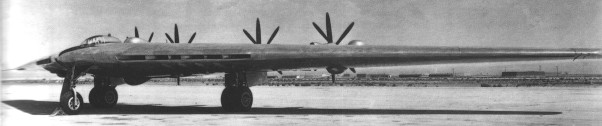
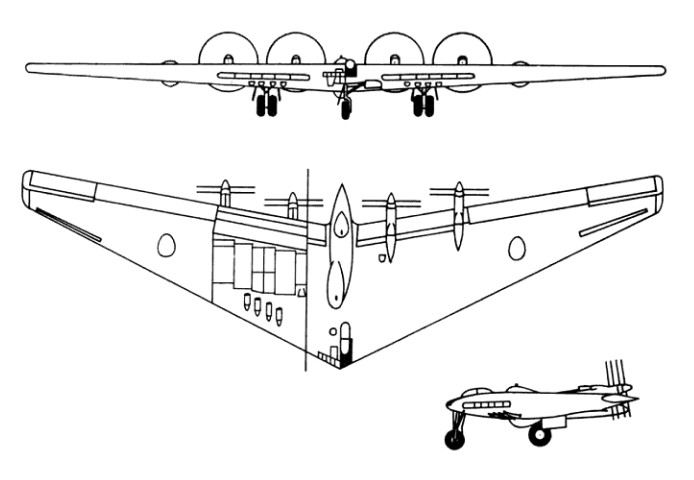
Northrop XB-35

In 1941 Northrop developed a flying wing design to compete with the Consolidated Model 37. Conceptually more advanced than the B-36, the Northrop XB-35 was a low-drag flying wing with four piston engines in the wings driving contra-rotating pusher propeller units. The type was ordered in prototype form as the XB-35 in November 1941. Powered by four 2237kW Pratt & Whitney R-4360 Wasp Major piston engines driving eight-bladed counter-rotating pusher propellers behind the trailing edges of the 172-ft (52.43m) span wing they could carry a maximum bombload of 56,000 lb (25,402 kg), or a 20,000-lb (9072-kg) bombload over a radius of only 2500 miles (4023 km). The XB-35 was faster than the XB-36 (especially at lower altitude), possessed a usefully higher service ceiling, and was also considerably more agile than the XB-36.

Northrop B-35 & YB-49 Article

There had been problems with the prototype, but these were concerned with factors such as the propeller gears stripped, blade pitch reversed in flight, propellers ‘ran away’, uncontrollable fires started, rather than the structure and flight characteristics of the basic airframe.

The first of 15 YB-35 aircraft ordered in early 1943, flew on 25 June 1946, followed by the second in the following year. With the B-36 slated for production, it was then decided to use the design for the evaluation of jet power in a strategic bomber the production contract was cancelled.

The second and third YB-35 pre-production prototypes were converted into YB-35B aircraft: their four 3250-hp (242 3-kW) Pratt & Whitney R4360 piston engines were replaced by eight 4000-lb (1814-kg) thrust Allison J35-A-5 turbojets, a quartet of the jets being grouped in each trailing edge and aspirated through the same arrangement of leading-edge inlets used to supply carburation and cooling air for the piston engines of the original aircraft.

The YB-35B was redesignated YB-49 while it was being rebuilt, and the first aeroplane flew in October 1947.

Engines: 4 x Pratt & Whitney R-4360 Wasp Major, 2624kW / 3250 hp
Max take-off weight: 76340 kg / 168302 lb
Wingspan: 52.4 m / 171 ft 11 in
Length: 16.2 m / 53 ft 2 in
Wing area: 372 sq.m / 4004.17 sq ft
Max. speed: 605 km/h / 376 mph
Range: 4023 km / 2500 miles
Bombload: 20,000 lb / 9072 kg
Crew: 9

Northrop XB-35

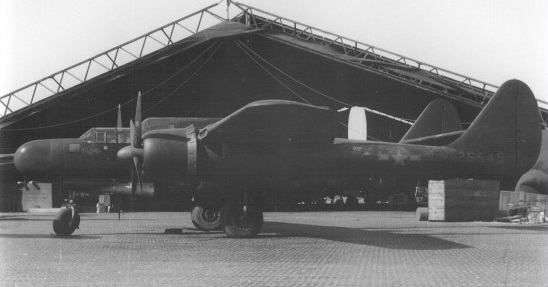
Northrop P-61 Black Widow

The Northrop P-61 Black Widow began in August 1940, at the height of the Blitz on London. During this time, the US air officer in London, Lt. Gen. Delos C. Emmons, underwent a briefing on British progress on radar. British scientists and engineers were at that time working on the early versions of AI (Airborne Interception) radar sets which could be carried aboard airplanes, enabling them to detect and intercept other airplanes in flight without having to rely on ground installations.

Northrop P-61 Black Widow Article

At the same time, the British Purchasing Commission that was shopping for aircraft in the USA announced that they urgently required a night fighter that would be capable of stopping the German bombers that were attacking London by night. Such a fighter would have to be able to stay on station above London all night, which meant at least an 8-hour loiter time. In addition, the night fighter needed to have sufficient combat altitude in order to take on the bombers when they showed up.

When General Emmons returned to the USA, he reported that the British had an urgent need for night fighter aircraft, and that American industry might be able to supply that need. A preliminary specification was drawn up by the Emmons Board and was passed on to Air Technical Service Command at Wright Field in late 1940. Because of the heavy weight of the early AI radar and because of the high loiter time required, a twin-engined aircraft was envisaged.

Northrop Chief of Research Vladimir H. Pavlecka happened to be at Wright Field at that time on an unrelated project, and was told of the Army’s need for night-fighters. However, he was told nothing about radar, only that there was a way to “see and distinguish other airplanes”. He returned to Northrop the next day. On October 22, Jack Northrop met with Pavlecka and was given the USAAC’s specification. At this time, no other company was known to be working on night fighters, although at about this time Douglas was starting work on their XA-26A night fighter and the AAC were considering the A-20B as an interim night fighter.

Northrop’s proposal was a twin-engined monoplane powered by a pair of Pratt & Whitney R-2800 Double Wasp air-cooled radial engines mounted in low-slung nacelles underneath the wings. The nacelles tapered back into twin tail booms which were connected to each other by a large horizontal stabilizer and elevator. The long fuselage housed a crew of three. The crew consisted of a pilot, a gunner for the nose turret, and a radar operator/rear turret gunner. Each turret housed four 0.50-inch machine guns. A tricycle landing gear was fitted. Estimated weights were 16,245 pounds empty, 22,654 pounds gross. Height was 13 feet 2 inches, length was 45 feet 6 inches, and wingspan was 66 feet. These dimensions and weights were more typical of a bomber than a fighter.

On November 14, Northrop presented this revised design to the USAAC. An additional gunner’s station was fitted. Nose and tail turrets of the original version were replaced by twin 0.50-in machine guns in the belly, and four 0.50-in machine guns in a dorsal turret. The crew was now up to four-a pilot, a radar operator, and two gunners. The airborne intercept radio was moved to the nose.

The design was revised still further on November 22. The belly turret was deleted, and the crew was changed back to three-pilot, gunner, and radar operator. The pilot sat up front, and the gunner sat immediately behind and above the pilot. The gunner was to operate the turret via remote control, using a special sight attached to a swiveling chair. A “stepped-up” canopy was used to provide a clear field of view for the gunner. The rear fuselage with its clear tail cone provided the radar operator with an excellent rearward view which enabled him to act as a tail gunner if the plane happened to be attacked from astern. Optionally, the dorsal turret guns could be “locked” into the forward-pointing position, so that they could be fired by the pilot. The belly guns were deleted, and four 20-mm cannon were to be fitted in the wings. This design was formalized into Northrop Specification 8A (or NS-8A), dated December 5, 1940.

Incorporated into the night fighter design was the Zap wing and Zap flap, named after Edward Zap, a Northrop engineer. These were attempts to increase the maximum lift coefficient and to decrease the landing speed by the use of improved lateral control and lifting devices

NS-8A was submitted to Wright Field. The Army was generally pleased with the design, but they suggested some changes. A letter of quotation prepared by Northrop for two experimental prototypes was presented to Materiel Command on December 17, 1940. Northrop signed the formal contract on January 11, 1941. A contract was let on January 30, 1941 for two prototypes and two wind-tunnel models. On March 10, 1941, a contract was issued for 13 YP-61 service test aircraft, plus one engineless static test airframe.

The mockup was ready for inspection in April of 1941. At that time, it was decided to move the four 20-mm cannon from the outboard portion of the wings to the belly. This was done to improve the ease of maintenance and to make the airflow over the wing smoother. The internal fuel capacity was increased from 540 gallons in two tanks to 646 gallons in four self-sealed tanks built into the wings.

In the meantime, development of the A/I radar had proceeded at a rapid pace. Radar development in the United States had been placed under the control of the National Defense Research Committee. The NDRC’s Microwave Committee in turn had established the Radiation Laboratory at the Massachusetts Institute of Technology. The Radiation Laboratory was to handle the development of the XP-61’s airborne interception (AI) radar. The designation of the radar was AI-10. The AI-10 radar was given the military designation SCR-520, where SCR stood for “Signal Corp Radio” (some references have this as standing for “Searchlight Control Radar”). The Western Electric corporation was assigned the responsibility of refining the design and undertaking the mass production of the radar.

In October 1941, a pedestal-type mount for the turret guns was substituted for the General Electric ring-type mount.

A letter of intent was initiated on December 24, 1941, which called for 100 P-61 production aircraft and spares. Fifty more were ordered on January 17, 1942. The order was increased to 410 aircraft on February 12, 1942, fifty of which were to be diverted to the RAF under Lend-Lease. The RAF order was eventually cancelled.
The XP-61 flew at Northrop Field for the first time on May 26, 1942, piloted by contract test pilot Vance Breese. It was powered by a pair of Pratt & Whitney R-2800-10 radials of 2000 hp each. In keeping with its nocturnal role, it was finished in black overall, befitting its popular name that was taken from the poisonous North American spider. Wingspan was 66 feet, length was 48 feet 10 inches, and height was 14 feet 2 inches. Weights were 19,245 pounds empty, 25,150 pounds gross, and 28,870 pounds maximum. The aircraft was equipped with only a mockup of the top turret, as General Electric had not yet been able to deliver the real thing because of the higher priority of other projects.

The XP-61 had a maximum speed of 370 mph at 29,900 feet, and an altitude of 20,000 feet could be attained in 9 minutes. Service ceiling was 33,100 feet, and maximum range was 1450 miles.

In mid-June 1942, a new horizontal tail was designed to complement the full-span flaps. Eventually, the Zap flaps were completely eliminated because of their high cost and complexity of manufacture, and spoilers were added to supplement the conventional ailerons. The spoilers were located in the rear one-third of the wing, and were one of the most successful innovations introduced during the entire Black Widow program. Operating in conjunction with the conventional ailerons, the spoilers provided the desired rolling moment at speeds even below the stalling speed. Although the spoilers were fully capable of providing all necessary lateral control on their own, the ailerons were nevertheless still left on the airplane if only to provide “warm fuzzies” to pilots who were used to conventional ailerons.

On May 25, 1942, an agreement was reached between Northrop and the USAAC to produce 1200 P-61s at a government facility in Denver, Colorado. By the end of July, that order had been cut down to 207 aircraft and it was decided that the Northrop facilities at Hawthorne were to be used after all.

The thirteen YP-61s were delivered during August and September of 1943. In order to reduce vibrations from firing the 0.50-inch turret machine guns, some YP-61s were fitted with only two turret guns. The assignments of the YP-61s were varied. Some stayed at Northrop for flight testing and factory training of maintenance personnel. Some went to Wright Field in Ohio for service testing. Others went to Florida where they underwent operational suitability testing.

The YP-61s initially did not have any airborne interception radar fitted, but the SCR-520, a preproduction version of the SCR-720 which was to go into the production P-61A, was installed.

Northrop P-61A-5NO 42-5549, 9th AF

It made its operational debut in the South Pacific in the summer of 1944 and was the standard USAAF night fighter at the end of the war. Unlike other USAAF fighters such as the P-47 Thunderbolt or P-51 Mustang, the Black Widow did not chalk up a particularly impressive number of kills, because by the time of its entry into service, the Allies had already established almost overwhelming air superiority over virtually all fronts, and enemy aircraft were rather few and far between, especially at night.

The F-15A two-seat strategic reconnaissance variant first flew in 1946.

A total of 706 aircraft were built.

Gallery

P-61A
Engines: 2 x Pratt & Whitney R-2800-10, 2000 hp
Wingspan: 66 ft / 20.12 m
Length: 48 ft 11 in / 14.92 m
Height: 14 ft 8 in / 4.49 m
Empty weight: 24,000 lb / 10,886 kg
Max loaded weight: 32,400 lb / 14,696 kg
Max speed: 366 mph / 590 kph
ROC: 2200 fpm / 670 m/min
Service ceiling: 33,000 ft / 10,060 m
Range max fuel: 500 mi
Armament: 4 x 20mm M-2 cannon (belly), plus in first 37 A: 4 x 0.5in dorsal

P-61B
Engines: 2 x Pratt & Whitney R-2800-65 Double Wasp, 1491kW / 2219 hp
Wingspan: 20.12 m / 66 ft 0 in
Length: 15.11 m / 49 ft 7 in
Height: 4.47 m / 14 ft 8 in
Wing area: 61.53 sq.m / 662.30 sq ft
Max take-off weight: 16420 kg / 36200 lb
Empty weight: 10637 kg / 23451 lb
Max. speed: 589 km/h / 366 mph
ROC: 2200 fpm / 670 m/min
Ceiling: 10090 m / 33100 ft
Range: 2173 km / 1350 miles
Range max fuel: 2800 mi / 4500 km
Bombload: 6400 lb
Armament: 4 x 20mm M-2 cannon (belly), plus in last 250 B: 4 x 0.5in dorsal
Crew: 3

P-61C
Engines: 2 x Pratt & Whitney R-2800-73, 2800 hp
Wingspan: 66 ft / 20.12 m
Length: 49 ft 7 in / 15.1 m
Height: 14 ft 8 in / 4.49 m
Empty weight: 24,000 lb / 10,886 kg
Max loaded weight: 40,300 lb / 18,280 kg
Max speed: 430 mph / 692 kph
ROC: 3000 fpm / 914 m/min
Service ceiling: 41,000 ft / 12,560 m
Range max fuel: 2800 mi / 4500 km
Bombload: 6400 lb
Armament: 4 x 20mm M-2 cannon (belly), 4 x 0.5in dorsal

F-15
2 seat strategic reconnaissance
Engines: 2 x Pratt & Whitney R-2800-73, 2800 hp
Wingspan: 66 ft / 20.12 m
Length: 50 ft 3 in / 15.3 m
Height: 14 ft 8 in / 4.49 m
Empty weight: 22,000 lb / 9979 kg
Max loaded weight: 28,000 lb / 12,700 kg
Max speed: 440 mph / 708 kph
ROC: 3000 fpm / 914 m/min
Service ceiling: 41,000 ft / 12,560 m
Range max fuel: 4000 mi / 6440 km
Armament: none

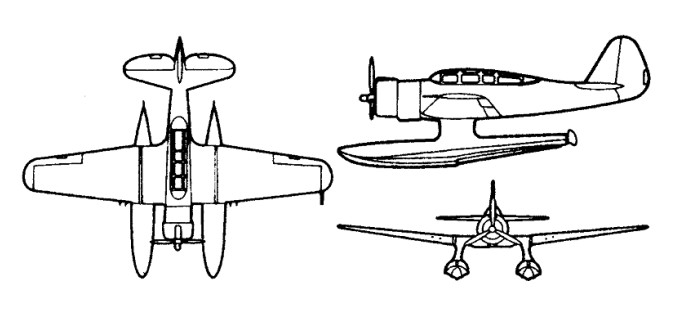
Northrop N-3PB

In 1940 Northrop received an order from a Norwegian Buying Commission for the design and construction of a single-engine monoplane patrol bomber with twin floats. The Norwegian order covered 24 aircraft, and in less than eight months the Northrop N-3PB prototype flew, on 1 November 1940, powered by an 895kW Wright Cyclone GR-1820 radial engine. It attained a speed of 414km/h and was then claimed to be the world’s fastest military seaplane.

Norway was invaded by the Germans shortly after the contract had been awarded, and the N-3PBs were delivered to a unit of the Royal Norwegian Naval Air Service, operating as an RAF unit from unimproved coastal sites in Iceland on anti-submarine patrol and convoy escort duties. All maintenance had to be performed in the open, often under extremely harsh environmental conditions, and during 19 months of 1941-42 several were lost during water landings in severe arctic weather, but there were no losses due to enemy action.

An aircraft was destroyed as late as 1965, in the collapse of a snow-laden hangar, but in the early 1980s an N-3PB was located and restored in Norwegian colours by the manufacturers.

Northrop Gamma 2C / Gamma 2F / A-13 / A-16 / A-17 / A-33 / Nomad / 8A / Douglas A-33

Northrop used the Gamma transport as the basis of a private-venture design for a light attack bomber, identifying this as the Northrop Gamma 2C which, powered by a 548kW Wright SR-1820F radial engine, was acquired for evaluation by the US Army Air Corps in June 1934 under the designation YA-13. Subsequently re-engined with a 708kW Pratt & Whitney R-1830 Twin Wasp, this aircraft was redesignated XA-16 (Northrop Gamma 2F).

Following tests of the YA-13 and XA-16, Northrop received $2 million contract for 110 attack bombers designated A-17, but because testing of the XA-16 had shown that the aircraft was over-powered, the Gamma 2.F was re-engined with a 559kW Pratt & Whitney R-1535 Twin Wasp Junior, serving as the prototype for the A-17. Following the incorporation of several other modifications, the first of 109 production A-17 aircraft was delivered in December 1935.

A contract was received in the same month for an improved A-17A, introducing retractable tailwheel landing gear and the 615kW Pratt & Whitney R-1535-13 engine. Some 129 were built, initially by Northrop, but in 1937 Douglas acquired the remaining 49% of Northrop Corporation’s stock, and it was the Douglas Company which completed production of these aircraft. Of the total, 93 served with the USAAC for only 18 months, then being returned to Douglas for sale to the UK and France. The Royal Air Force received 60, designating them Nomad Mk I, and all were transferred to the South African Air Force.

Northrop A-17А

An experiment with the Northrop A-17 aircraft in 1940 consisted in changing the way the air was taken to cool the engine to which the air is fed through special channels at the root of the wing.

Northrop A-17А

These air intakes, even supported by a special suction fan (hot air was emitted through special blinds from above), turned out to be completely inadequate to supply the required air volumes. Ground tests gave normal temperature only at idle speed and without load. Any attempt to increase the amount of power led to a rapid overheating of the engine.

Northrop A-17А

Douglas also built this aircraft for export under the designation Douglas Model 8A, supplying them to Argentina, Iraq, the Netherlands and Norway. In 1939 the first SAAB built 8A-1 was completed (as the B5).

Early in 1940, the Norwegian government ordered 36 8A-5s which not had been delivered before Norway was invaded by the Germans. Completed between October 1940 and January 1941, the aircraft were delivered to a training center in Canada that had been set up for the Norwegian government-in-exile, named “Little Norway” at Toronto Island Airport, Ontario.

The 8A-5 was powered by a 1,200 hp (895 kW) Wright R-1820-87 engine, with four wing mounted 0.30 in machine guns, two 0.50 in machine guns in pods below the wing, a rear-firing flexibly mounted 0.30 in gun, and the ability carry up to 2,000 lb of bombs.

A-33/Model 8A-5

After the loss of two aircraft and a reassessment of the training needs now met by the use of other aircraft, the remaining 34 Model 8A-5Ps were sold to Peru. However, 31 were repossessed by the Army Air Corps at the start of World War II. These aircraft, designated A-33, were used for training, target tug, and utility duties. Serial numbers: 42-13584/13601; 42-109007/109019

A-17A
Engine: 1 x Pratt & Whitney R-1535-13 radial, 615kW
Max take-off weight: 3421 kg/ 7542 lb
Empty weight: 2316 kg / 5106 lb
Wingspan: 48 ft 8.5 in
Length: 9.65 m / 31 ft 8 in
Height: 3.66 m / 12 ft 0 in
Wing area: 33.63 sq.m / 361.99 sq ft
Max. speed: 354 km/h / 220 mph
Ceiling: 5915 m / 19400 ft
Range: 1175 km / 730 miles
Armament: 5 x 7.62mm machine-guns, 4 x 45kg bombs

Douglas A-33
Powerplant: 1 × Wright GR-1820-G205A Cyclone, 1,200 hp (890 kW)
Propeller: 3-bladed variable-pitch propeller
Wingspan: 47 ft 9 in (14.55 m)
Airfoil: root: NACA 2215; tip: NACA 2209
Wing area: 363 sq ft (33.7 m2)
Length: 32 ft 6 in (9.91 m)
Height: 9 ft 4 in (2.84 m)
Empty weight: 5,510 lb (2,499 kg)
Gross weight: 8,600 lb (3,901 kg)
Max takeoff weight: 9,200 lb (4,173 kg)
Maximum speed: 248 mph (399 km/h, 216 kn) at 15,700 ft (4,800 m)
Service ceiling: 29,000 ft (8,800 m)
Time to altitude: 10,000 ft (3,000 m) in 5 minutes 48 seconds
Guns:
4 × forward-firing .30 cal (7.62mm) 1919 Browning machine guns, 500rpg
2 × forward-firing .50 cal M2 Brownings in gun pods, 200rpg
1 × .30 cal (7.62mm) 1919 Browning machine gun in rear cockpit, 1,000 rounds
Bombs: 2,000lb max load
Internal: Up to twenty 20 lb (9.1 kg) bombs in internal racks
External: Eight hardpoints under the fuselage, four outboard hardpoints can take 500 lb (230 kg) bombs, all eight can carry 100 lb (45 kg)
Crew: 2

North American T-28 Trojan / Fennec / NA-260 / Nomad / Pacific Airmotive Nomad

T-28C Trojan

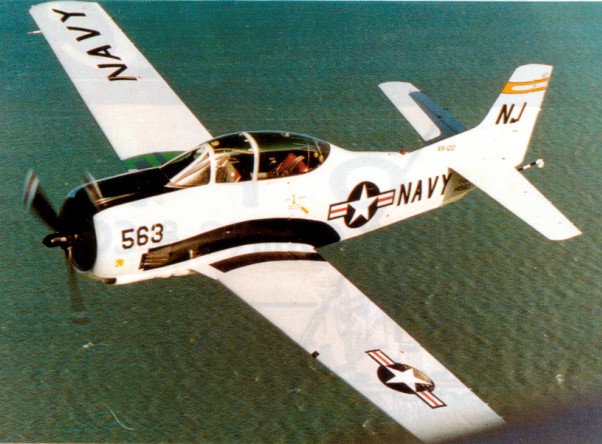
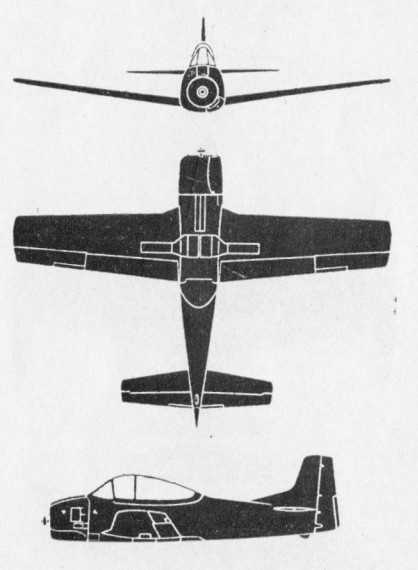
During and immediately following WWII, NAA developed the next generation, high performance, advanced trainer to serve as a successor to the NAA T-6/SNJ Texan. The result was the T-28 Trojan series.

First flown on 26 September 1949 as the XT 28A, the Trojan was put into production as the T-28A two-seat basic trainer for the USAF. Power was provided by a 596kW Wright R-1300-1 radial engine. 1,194 “A” models were built with the Aero Product 2-blade propeller. The Air Force used these aircraft for training and various other roles from 1950 to 1956. The “A” model also replaced the Mustang fighters in the reserve units until 1959.

North American T-28 Trojan Article

Ordered into production by the USAF in 1950 as the T-28A, the US Navy evaluated the T 28A in 1952 and decided that the Wright Cyclone R1300, with 800 hp and a two bladed propellor left the aircraft under-powered for carrier operations.

In 1952, the Navy contracted with NAA to build 489 T 28Bs, an improved version. The T-28B was the initial US Navy version fitted with a 1425 hp / 1,062kW Wright R-1820-86 engine, Hamilton Standard 3-blade propeller, belly mounted speed brake, and a two-piece sliding canopy (as fitted to late production T-28A). 489 “B” models were built and used from the middle 50’s to the middle 80’s.

T-28B

The T-28C was built for the Navy starting in 1955. The T-28C is equipped with a tail hook, a smaller diameter propeller, and other minor changes to allow aircraft carrier landings. 299 “C” models were manufactured with production ending in 1957.

In 1958 many T-28As were declared surplus and North American designed a modification scheme to convert the into two-seat utility aircraft, under the name Nomad. The main change involved replacing the original 800 hp Wright R-1300 engine with the more powerful R-1820. Supplementary modifications were drawn up to convert the Nomad into a military light strike-reconnaissance aircraft.

In 1959, several hundred surplus “A” models were shipped to France and were modified with the 1,062kW R-1820-56S engine, structural improvements, and armament for combat use, by Sud Aviation for the French Air Force. Sud-Aviation were given a contract for 135 conversions of ex-USAF T-28As under licence to PacAero, who had taken over the Nomad conversion programme from North American. These aircraft are commonly referred as Fennec, T-28S (Sud), or T-28F. After success in combat in Algeria in the early sixties, they continued to serve France and several other countries for many years.

Sud-Aviation Fennec

Similar to the FENNEC but converted by various contractors in the U.S., the T-28D-5 also started as a surplus “A” model. Almost 250 “D” models were supplied to U.S. and other forces fighting in Southeast Asia. Additionally, “B” & “C” models, known as the T-28D-10, were also modified and used in combat.

During the early 1960s the United States Tactical Air Command (TAC) was directed to develop a counter-insurgency (COIN) force tailored to train friendly air forces to fight in limited wars against guerrilla forces. As a result of this directive TAC began evaluating existing aircraft types to find an available and inexpensive aircraft that could be modified for use as a COIN aircraft.

This decision resulted in the T-28D which was basically a rebuilt T-28A with a more powerful engine, six underwing hardpoints, and strengthened wings. The T-28D was powered by a 1425hp Wright Cyclone R-1820-56S nine cylinder air cooled radial engine, driving a three blade Hamilton Standard propeller. To allow the T-28D to perform in its intended role of tactical fighter-bomber, the wings were strengthened to enable the aircraft to carry a variety of under wing stores up to 4,000 pounds.

Between early 1961 to late 1969, North America received a total of thirteen production contracts covering conversion of a total of 321 T-28As to the AT-28D configuration.

By December 1963 the USAF had converted 700 T-28B’s to counter-insurgency roles.

The first T-28Ds to see action were assigned to the 4400 Combat Crew Training Squadron (CCTS). In October 1961 President Kennedy authorised deployment of a detachment from the 4400 CCTS to Vietnam under the code name Farm Gate. The detachment was to train South Vietnamese pilots in the T-28 and was authorised to fly combat missions, providing there was a South Vietnamese national in the rear cockpit.

The South Vietnamese Air Force (VNAF) found the T-28D to be well suited to their needs. The short field performance and ease of maintenance made the Trojan ideally suited for forward basing in small detachments, allowing a rapid response to enemy activities. The T-28D served with the VNAF until the increasing anti-aircraft capabilities of the Viet Cong made it necessary to replace the Trojan with a more powerful and faster fighter bomber.

Despite modifications to strengthen wings to carry up to 4000 lb bombload, at least three T-28 crashes in strikes against Viet Cong may have resulted from structural failure. This contributed to T-28 withdrawals from Vietnam.

After its withdrawal from combat in Vietnam during 1964, T-28Ds continued to serve with the USAF in Thailand until 1972. T-28Ds were assigned to the 60th Special Operations Squadron (SOS), 56th Special Operations Wing in the fighter-bomber role flying missions over Laos and Cambodia. T-28Ds were also supplied to the air forces of Thailand, Cambodia and Laos.

The T-28D proved itself in combat to be an excellent gun and bomb platform, and was able to withstand a surprising amount of battle damage. The Trojan was well liked equally by its pilots and hard working ground crews. As in all previous T-28s, maintenance crews appreciated the fact that the T-28 was rugged, easy to maintain and required very few maintenance hours per flight hour.

In 1964 William Driver of Piqua, O., claimed an altitude jump record for spot parachutists by leaving a T-28 at 33,400 ft, landing 18 ft from his target on Boulder Airport.

Many T 28Ds were operated in the Congo and Vietnam, and have equipped the Thai Air Force, with the French as the Fennec as well as with the Argentine Navy. T 28Ds served with the air forces of Bolivia, Ethiopia, Kampuchea, South Korea, Laos, Taiwan, Thailand, the United States and Zaire.

In civilian use, the T-28 continues to gain in popularity. It looks, sounds, and performs comparable to a WWII fighter at a fraction of the cost. With its two roomy cockpits, tricycle landing gear, huge flaps, and superb flying characteristics, general aviation pilots can learn how to operate this aircraft. In addition, maintenance and parts availability remains reasonable with plenty of technical support available.

With 2,450 hp Lycoming T55 turboprop, underwing attachments for 4,000 lb. of weapons, and a long range fuel tank in place of the rear crew member’s position, the YAT 28E was a conversion of the T 28 piston engined basic trainer.

In 1958 North American modified one T-28, as NA-260 Nomad, to a general-purpose prototype plane. Pacific Airmotive Corp converted surplus North American T-28 to the general-purpose Nomad in 1958.

Pacific Airmotive Corp Nomad

Gallery

NAA T-28A
Engine: Wright R-1300-1, 7-cylinder radial, 800 hp
Propeller: Aero Products 10′ 2-blade, constant speed
Wing Span: 40′ 1″ (12.23 m)
Length: 32 ft (9.76 m)
Height: 12′ 8″
Wing area: 269.1 sq.ft / 25.0 sq.m
Empty, 5,111 lb (2318 kg)
Loaded weight, 7,463 lb (3642 kg)
Fuel capacity: 125 USgallon
G Loading: +4.5, -2
Normal cruise: 180 mph at 35 USgph
Max speed, 285 mph (458 kph) at 5,800 ft (1768 m)
Service ceiling: 36089 ft / 11000 m
Initial climb, 2,030 fpm (10.3 m/sec)
Range: 1,055 mls (1698 km)
Controls: Dual

T-28B
Engine: Wright Cyclone R-1820-¬86, 9-cylinder radial, 1425 hp / 1063kW
Propeller: Hamilton Standard Hydromatic 3-blade, constant speed
Wing Span: 40 ft 8 in (12.4m)
Length: 32′ 9″
Height: 12′ 7″
Wing area: 24.90 sq.m / 268.02 sq ft
Empty weight: 2914 kg / 6424 lb
Normal Gross Weight: 8600 lbs.
G Loading: +4.5, -2
Controls: Dual
Max. speed: 552 km/h / 343 mph
Ceiling: 10820 m / 35500 ft
Range: 1706 km / 1060 miles
Normal cruise: 235 mph at 50 Usgph
Fuel capacity: 177 USgallon
Endurance: 3 hr w/res
Rate of climb: 3000+ fpm
Crew: 2

T 28C
Engine: Wright Cyclone R-1820, 9-cylinder radial, 1425 hp
Propeller: Hamilton Standard Hydromatic 3-blade, constant speed
Wing Span: 40 ft 8 in (12.4m)
Length: 32′ 9″
Height: 12′ 7″
Normal Gross Weight: 8600 lbs.
Empty weight: 6400 lb
G Loading: +4.5, -2
Controls: Dual
Normal cruise: 235 mph at 50 Usgph
Fuel capacity: 177 USgallon
Endurance: 3 hr w/res
Rate of climb: 4,200 fpm
Ceiling: 35,000 ft
Maximum speed: 343 mph
Range: 1060 miles
Stall speed: 67 kts
Hard points: 6

T-28D Trojan
Engine: Wright R-1820-86A Cyclone 1,425hp
Propeller: Hamilton Standard Hydromatic three blade constant speed
Fuel: Aviation Gasoline 100 Octane
Wingspan: 40′ 1″ / 12.19 m
Length: 32′ 10″ / 10.0 m
Wing Area: 271.2 sq. ft / 25.19 sq. m
Height: 12′ 8″ / 3.86 m
Empty weight: 6,251 lbs / 2.811 kg
Normal Gross Weight: 8600 lbs.
Armament: Up to 4,000lb (1,813kg) of external stores including gun pods
Maximum Speed: 340 knots / 391 mph / 629 km/h
Cruise Speed: 200 knots / 230 mph / 370 km/h BAS
G Loading: +4.5, -2
Controls: Dual
Normal cruise: 235 mph at 50 Usgph
Fuel capacity: 177 USgallon
Endurance: 3 hr w/res
Rate of climb: 3000+ fpm
Armament: 2 x 0.5in mg
Hardpoints, wing: 6

Fennec
Engine: Wright Cyclone R-1820, 9-cylinder radial, 1425 hp
Propeller: Hamilton Standard Hydromatic 3-blade, constant speed
Wing Span: 40 ft 8 in (12.4m)
Length: 32′ 9″
Height: 12′ 7″
Wing area: 271 sq.ft
Empty weight: 6615 lb
Normal Gross Weight: 8600 lb
MTOW: 9370 lb
Fuel capacity: 177 USgallon
Max speed: 340 mph at 18,000 ft
Normal cruise: 235 mph at 50 USgph at 15,000 ft
Endurance: 3 hr w/res
Service ceiling: 36,480 ft
Rate of climb: 3000+ fpmI
Max range: 1180 mi
Hardpoints: 2
Bombload: 4 x 300 lb
G Loading: +4.5, -2
Controls: Dual

YAT 28E
Engine: 2,450 hp Lycoming T55 turboprop.

Pacific Airmotive Nomad Mk I
Engine: 1300hp Wright R-1820-56S
Prop: three-blade

Pacific Airmotive Nomad Mk II
Engine: 1425hp Wright R-1820-76A
Prop: three-blade
Wingspan: 40’1″
Length: 32’0″
Useful load: 1401 lb
Max speed: 381 mph
Cruise: 203 mph
Stall: 83 mph
Range: 1,180 mi
Ceiling: 36,480′

T-28B

North American F-100 Super Sabre

F-100F

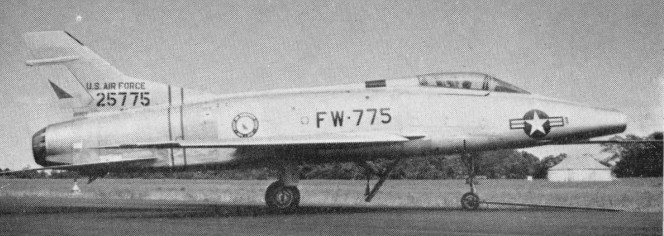
First of the “Century fighters”, the prototype F-100 flew on 25 May 1953 piloted by George Welch. Powered by a Pratt & WhitneyJ57 turbojet and augmented by an after¬burner, it flew faster than sound on its maiden flight.

North American F-100 Super Sabre Article

Two YF-100 were built, 52-5754 and 52-5755.

YF-100A

Originally known as the “Sabre 45”, because of its 45-degree swept wing, the F-100 is a completely new design and was the first U.S.A.F. operational aircraft to fly supersonic in level flight. In very large-scale production as standard U.S.A.F. day fighter in 1955. Established World Speed Record of 755.15 mph on 29 October 1953.

The whole F-100 structure is immensely strong and rigid; so much so that assembly jigs are rendered unnecessary, the parts being simply put together. The wing interior is largely taken up by huge forgings, machined into honeycombs or grids; some of the outer skins are machined from sheet of no less than 3in original thickness. There was talk of the aircraft being made by Commonwealth (Australia) and Canadair.

The F-100 has an all-moving tailplane and inset ailerons, each in two sections, and automatic leading-edge slats. Ailerons were located inboard and flaps were omitted. Flaps were on the F-100D and F only. An air-brake is under the centre fuselage. The tricycle undercarriage has single wheels on each main unit ad twin wheels on the nose unit. The mains retract inward into the fuselage and nose wheels retract rearward.

The initial production version was the F-100A, a single-seat day fighter powered by a 43.15kN J57-P-7 or P-39 engine. Armament comprised four 20mm M-39E cannon plus external stores on six under-wing hardpoints.

F-100A Super Sabre

By May 1954, the U.S.A.F. had accepted delivery of a fair number of F-100As, but some had already been damaged or written-off in accidents. The F-100A was grounded in November 1954 because of transonic control problems. The height of the rudder had been reduced by some 18in and a corresponding amount added to the fin. The F-100 lands at nearly 180 mph. There are no landing flaps, but the ventral airbrake can be used on the approach.

North American F-100A Super Sabre

The F-100A production model first flew on 29 October 1951. 203 of the F-100A and RF-100A were built, the last 35 having an 11,700 lb thrust J57-P. The RF-100A was a photo-reconnaissance conversion of the F-100A with a deeper camera-carrying front fuselage.

RF-100A 53-2600

The 1956 F-100B designation was not applied as it was extensively redesigned as the F-107.

The F-100C (NA-214, -217, -222) appeared as a single-seat fighter bomber with strengthened wings, up to 3,402kg of bombs on eight underwing hardpoints, in-flight refuelling capability and 75.62kN (with afterburning) Pratt & Whitney J57-P-21A turbojet engine. First flown on 17 Jnuary 1955, 476 were built. An F-100C set the first world speed record to exceed Mach 1 on 20 August 1955 at 822.135mph.

The TF-100C of 1956 was a planned two-place trainer version modified from F-100C 54-1960, which instead became a prototype for the F-100F. Only the one was built.

TF-100C 54-1960

The similar F-100D (NA-223, -224, -235, -245) introduced design refinements, including a taller fin, landing flaps; supersonic autopilot, low-level bombing system, and could be armed with four Sidewinder or two Bullpup missiles, or 3,402kg of external weapons in addition to its standard four 20mm cannon.

F-100D 55-2851

First flown on 24 January 1956, 1274 F-100D were built.

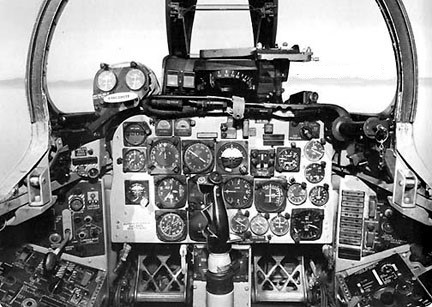
F-100D cockpit

The final version built was the F-100F (NA-234, -255, -261, -262), first flown on 1 March 1957. It was a lengthened tandem two-seat operational trainer and tactical attack aircraft, armed with two 20mm cannon and capable of carrying 2,722kg of external stores. A total of 339 were built.

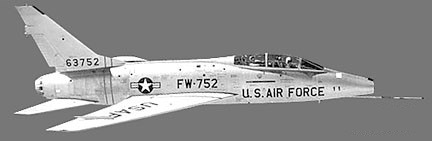
F-100F 56-3752

Operation Julius Caesar, involving the first flight by jet fighter aircraft over the North Pole, was conducted on 7 August 1959 with the landing of two USAF F-100F fighters at Eielson, Alaska AFB, southeast of Fairbanks, Alaska. The flight from Wethersfield, Essex, was completed in 9 hr 37 min.

Total production was 2294 aircraft when the line closed in October 1959.

After cancelling all airshows for two big summer months the Airforce Thunderbirds reverted back into F-100s in August 1965 to complete the season. They had started in Republic F-105s but a series of accidents throughout the Air Force grounded all Thunderchiefs.

NASA JF-100C Variable Stability Research Aircraft

Gallery

F-100
Engine: 1 x P+W J-57-P-21 turbo-jet, 66.7kN
Max take-off weight: 12700 kg / 27999 lb
Empty weight: 9500 kg / 20944 lb
Wingspan: 11.6 m / 38 ft 1 in
Length: 14.3 m / 46 ft 11 in
Height: 4.9 m / 16 ft 1 in
Wing area: 35.8 sq.m / 385.35 sq ft
Max. speed: 1216 km/h / 756 mph
Ceiling: 15250 m / 50050 ft
Range: 920 km / 572 miles
Armament: 4 x 20mm machine-guns, 2720kg of bombs and missiles
Crew: 1

North American F 100 Super Sabre
Engine: Pratt & Whitney J-57-P-21A, 75645 N
Length: 46.982 ft / 14.32 m
Height: 14.665 ft / 4.47 m
Wingspan: 38.747 ft / 11.81 m
Max take off weight: 34839.0 lb / 15800.0 kg
Max. speed: 751 kt / 1390 km/h
Service ceiling: 45013 ft / 13720 m
Range: 1304 nm / 2415 km
Crew: 1
Armament: 4 mg. 3402 kg bombs

F-100A Super Sabre
Engine: 10,000 lb. thrust Pratt & Whitney J57-P-7 turbojet, with afterburner.
Wingspan: 36 ft. 7 in
Length: 45 ft. 3 in
Loaded weight: approx. 27,000 lb.
Max. speed: over 760 m.p.h.
Ceiling: over 50,000 ft.
Range: over 1,000 miles.
Armament: 4×20 mm cannon,
Crew: 1.

F-100C
Engine: Pratt & Whitney J57-P-21A, 16,950 lb w/afterburner
Wingspan: 38 ft 9.25 in
Wing area: 385.2 sq.ft
Length: 54 ft 3 in
Height: 16 ft 2.25 in
Wheel track: 12 ft
Fuel capacity: 987 Imp.Gal
External fuel: 2 x 208 Imp.Gal + 2 x 187 Imp.Gal
Armament: 4 x 20mm cannon
Hardpoints: 6
External load: 6000 lb

F-100D
Engine: Pratt & Whitney J57-P-21A afterburning turbojet, 17,000 lb / 7711 kg
Wingspan: 38’10” / 11.82 m
Wing area: 385.0 sq.ft / 35.77 sq.m
Length: 47’2″ / 14.36 m
Height: 16 ft 3 in / 4.95 m
Wheel track: 12 ft
Empty weight: 21,000 lb / 9525 kg
MTOW: 34,832 lb / 15,800 kg
Fuel capacity: 987 Imp.Gal
External fuel: 2 x 208 Imp.Gal + 2 x 187 Imp.Gal
Max speed: 864 mph / 1390 kph / M1.3 at 35,000 ft / 10,670 m
Cruise speed: 565 mph
Initial ROC: 16,000 fpm / 4877 m/min
Range: 600 mi / 966 km
Service ceiling: 46,000 ft / 14,020 m
Armament: 4 x 20 mm cannon
Hardpoints: 6
Bombload: 7500 lb / 3402 kg

F-100F
Engine: Pratt & Whitney J57-P-21A, 16,950 lb w/afterburner
Wingspan: 38 ft 9.25 in
Wing area: 385.2 sq.ft
Length: 57 ft 3 in
Height: 16 ft 2.25 in
Wheel track: 12 ft
Fuel capacity: 987 Imp.Gal
External fuel: 2 x 208 Imp.Gal + 2 x 187 Imp.Gal
Armament: 2 x 20mm cannon
Hardpoints: 6
External load: 7500 lb
Seats: 2

North American F-82 Twin Mustang

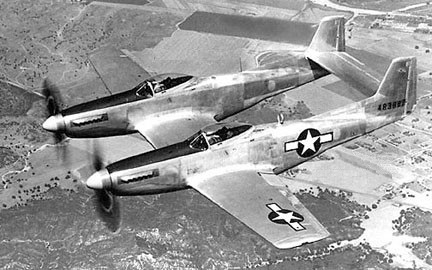
North American XP-82 44-83887

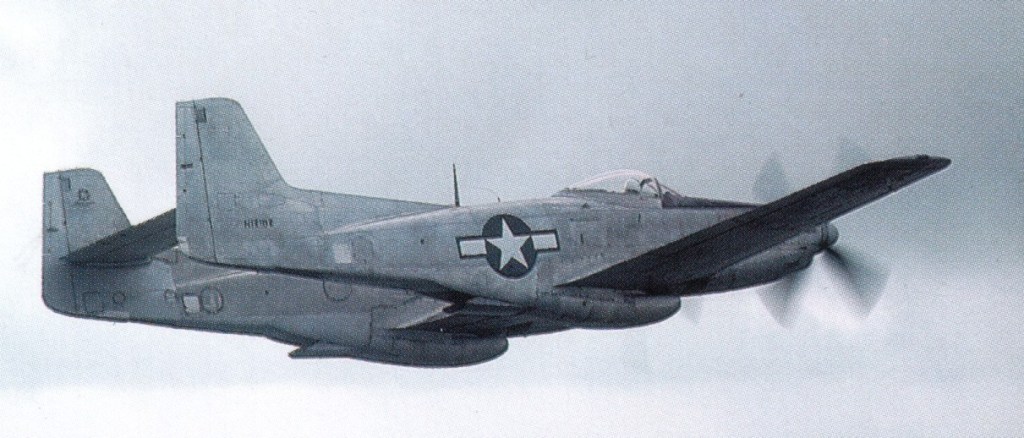
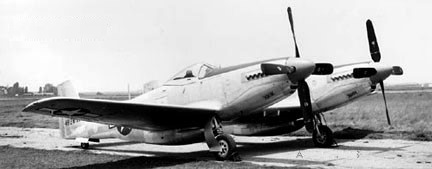
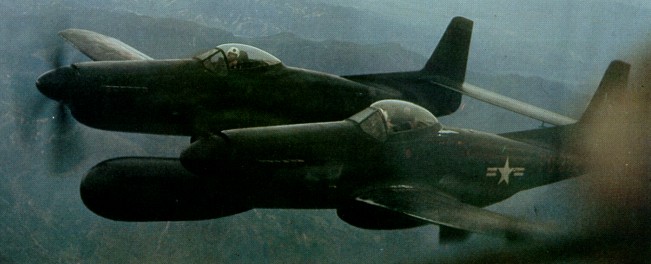
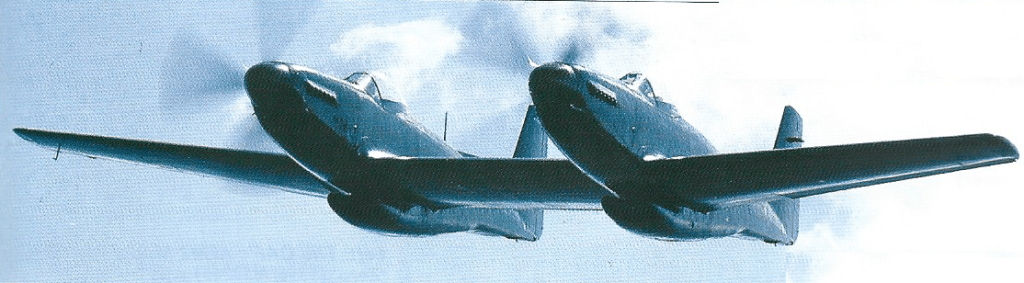
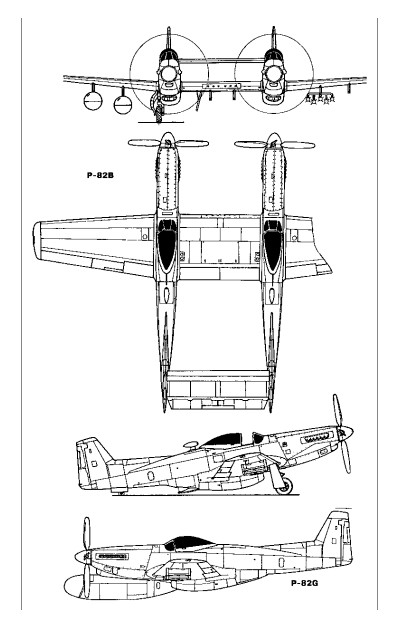
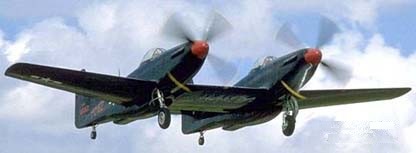
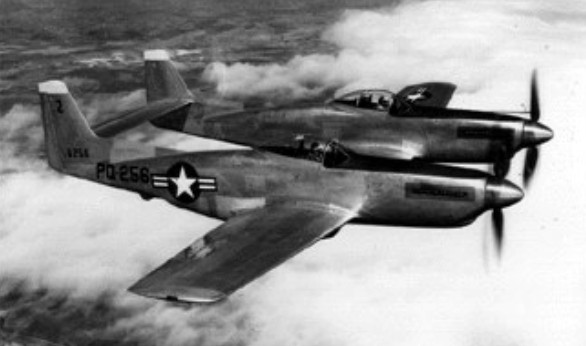
The long-range, high-altitude escort fighter, development of the P-51 Mustang, the Twin Mustang was formed by two fuselages joined by the wing and the horizontal stabilizer. The P-82 was a separate new design, not just a mating of P-51s, as commonly assumed. It was also the last prop-driven fighter to be ordered into production by USAF.

Two XP-82 (NA-120) prototypes were built (44-83886/83887) in 1945 powered by Packard-Merlin V-1650-23/25 with opposite rotating props. First flying at XP-82A on 15 April 1945.

With a pilot in each fuselage, it reduced the problem of pilot fatigue on ultra-long-range missions.

North American XP-82A 44-83888

One XP-82A (NA-120), 44-838881945, was built with Allison V-1710-119 engines.

The P-82B (NA-123) of 1945 was the initial production version. Twenty were built, 44-65160-65179.

North American P-82B
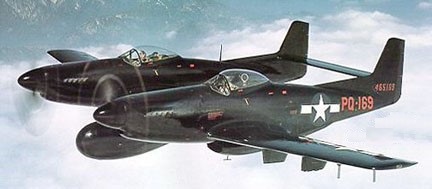
North American P-82C 44-65169

The NA-123 P-82C and -82D of 1946 were night fighter conversions of P-82Bs with a centre-section APS-4 radar pod.

North American P-82E 46-258

100 (46-255/354) of the P-82E / NA-144 escort fighter were built in 1946.

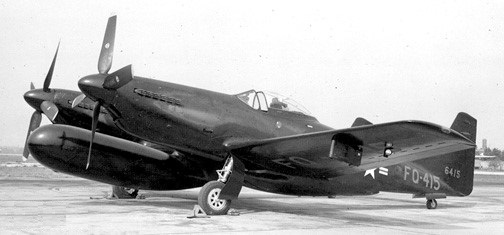
North American P-82F 46-415

The P-82F (NA-149) and G models carried a radar operator in the right cockpit instead of a co-pilot. 100 P-82F (46-405/495) night fighter were built in 1946. 45 P-82G / NA-150 (46-355/383, -389-404) all-weather night fighter with tracking radar were built in 1946, powered by Allison V-1710-143.

An F-82G was credited with downing the first enemy aircraft in the Korean War (p: Lt William Hudson), on 27 June 1950.

F-82G

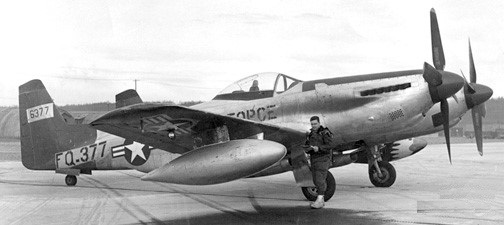
The P-82H of 1947 were Alaskan winterized conversions. Five were built from F-82F [46-384/388] and nine from F-82G [46-496/504].

North American P-82H 46-377

Re-designated F-82 in June 1948.

Although a few initial models had Merlin engines, the great majority were Allison powered and saw service in Korea.

P-82B. One of 20 initial production variants out of 500 ordered. Serialled 44-65162, restored as N12102

272 were built, the final delivery, an F-82G, in April 1949.

XP-82 / NA-120
Engines: 2 x Packard-Merlin V-1650-23/25
Props: Contra-rotating
No built: 2 [44-83886/83887]

XP-82A / NA-120
1945
Engines: Allison V-1710-119
1 built 44-83888

F-82
Engine: 2 x Allison V-1710-143/145, 2300 hp
Wingspan: 51 ft 3 in / 15.61 m
Height: 13 ft 10 in / 4.2 m
Armament: 6 x .50 mg
Bombload: 2 x 4000 lb

P-82B / NA-123

P-82C / NA-123
1946
Night fighter conversions of P-82B with centre-section APS-4 radar pod.
1 built 44-65169

P-82D / NA-123
1946
Night fighter conversions of P-82B with centre-section APS-4 radar pod.
1 built 44-65170

P-82E / NA-144
1946
Escort fighter
100 built 46-255-354
Length: 39 ft 1 in / 11.88 m
Height: 13 ft 10 in / 4.2 m
Empty weight: 14,350 lb / 6509 kg
Max loaded weight: 24,864 lb / 11,276 kg
Max speed: 465 mph / 750 kph
Range: 2504 mi
Armament: 6 x .50 mg
Bombload: 2 x 4000 lb

P-82F / NA-149
1946
Night fighter
100 built 46-405/495

P-82G / NA-150
Engine: 2 x Allison V-1710-143/145, 1600hp / 1193kW
Wingspan: 15.62 m / 51 ft 3 in
Length: 12.93 m / 42 ft 5 in
Height: 4.22 m / 13 ft 10 in
Wing area: 37.90 sq.m / 407.95 sq ft
Max take-off weight: 11608 kg / 25591 lb
Empty weight: 7256 kg / 15997 lb
Useful load: 9594 lb
Max. speed: 401 kt / 742 km/h / 461 mph
Cruise speed: 285-300 mph
Ceiling: 11855 m / 38900 ft
Range w/max.fuel: 3605 km / 2240 miles
Armament: 6 x 12.7mm machine-guns, 4x 454kg of bombs
Crew: 2
45 built (46-355/383, -389-404)

P-82H
1947
5 F-82F [46-384/388]
9 F-82G [46-496/504].

P 82 Twin Mustang
Engine: Merlin V-1650/11, 1240 hp @ 30,700 ft.

P 82 Twin Mustang
Engine: Allison 147/69R, 1250 hp @ 32,700 ft
Max speed: 480 mph

North American P-51 Mustang / A-36 Apache / P-78

P-51D, P-51C, P-51D

Early in 1940 J.H.Kindelberger, president of North American Aviation, and J.L.Atwood, executive vice-president of the company, were called into conference with the British Purchasing Commission in New York. The British requested they build the Curtiss P-40. Kindelberger suggested they could build a better airplane, and faster. The ‘go ahead’ was given.

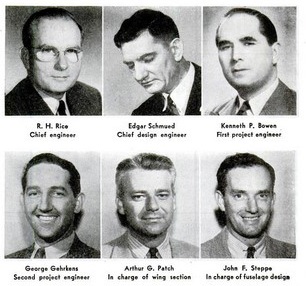
Kindelberger and Atwood conferred with Ray H. Rice, then chief engineer; Edgar Schmued, design engineer; E.J.Horkey, aerodynamicist, and others. The first conferences started on 5 April 1940 with Ken Bowen serving as project engineer. Others soon became involved.

Rice ordered a low-drag, high-lift wing. Horkey had what was then considered a radical idea on airfoils and went to work with his assistants.

The prototype was not built from production drawings but design layouts, so fast was the work done. It was ready to fly and awaiting the installation of its 1150 hp Allison engine just 100 days from the time the first drawings were made.

A month before the first flight, design for production was started. In September, Bowen was assigned the job of production engineer, assisted by George Gehrkens.

With certain unorthodox designs involving compound curves, flush shin joints for absolute smoothness, the job of tooling up for thousands of planes fabricated by unskilled workers became a problem.

As no production drawings had been made it became necessary for more than 100 men to devote themselves to this job. Each part had to be considered for re-design or simplification to make it adaptable to mass production methods. Those used in production of T-6 and B-25 were brought in. In all, 2990 design drawings were made. Others were used in making flight tests and wind tunnel tests.

Lieut.Gen. James Dolittle would call in and try out the experimental model. Immediately the throttle was moved closer to the pilot’s seat to make operation easier for short arms.

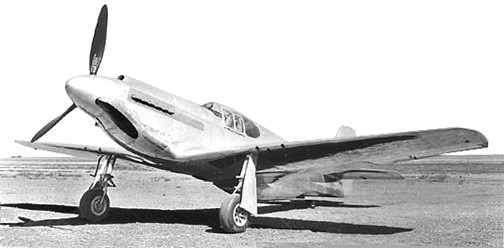
North American NA-73X NX19998

North American had designed and built the NA-73X prototype in 102 days. Late delivery of the Allison V-1710 engine delayed the first flight for another 20 days.

First flying on 26 October 1940, piloted by Vance Breese. Flights of the prototype revealed the need for many changes. Wind tunnel tests conducted by Horkey at California Institute of Technology revealed the need for more changes. For instance, flight tests showed that the air scoop intake had to be lowered to increase and alter air flow. Wind tunnel tests revealed to need to raise the carburettor air intake. A combination of tests showed that 50 pounds could be whittled off the flaps without any loss in aerodynamic efficiency. Flight test disclosed that a change in windshield design was in order.

P-51 Mustang Article

NAA hired Vance Breeze to make the first three test flights. Then NAA test pilot Paul Balfour took over. He selected and empty fuel tank, resulting in a forced landing.

NA-73X prototype

Nine months after design for production was started the first production airplane rolled off the line.
The X-73 had been built in accordance with United States Army specifications but without Army supervision, as the contract was with the British.

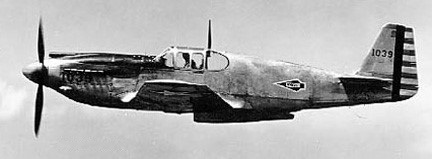
The first production NA-73 RAF Mustang I flew on 1 May 1941 and was delivered to the British in October 1941. The fifth and tenth off the production line went to the United States Army (41-038/039 for testing and experimentation. The next 150 were known as P-51’s.

Fitted with the same Allison V-1710 engine as the P 40, the Mustang proved to be a useful close support fighter and tactical reconnaissance aircraft. The aeroplane was soon ordered by the British and Americans as the Mustang and P-51 respectively.

North American XP-51 41-039

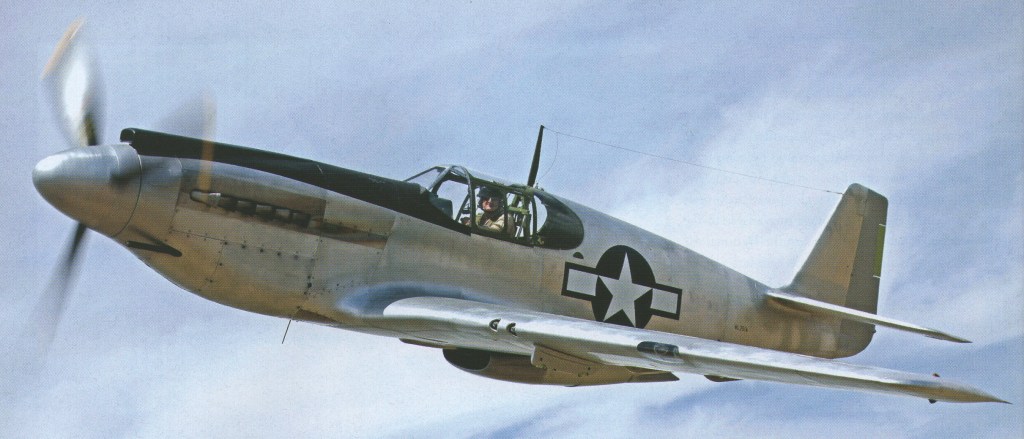
In June 1942 engineering on the A-36 began. It was equipped with dive brakes, bomb racks and six .50 calibre machine guns. It was found that it could dive and climb almost vertically, powered by a 1350 hp Allison. The A-36 order was the first from the United States Army. The first was tested in September 1942 and production was completed by March 1943.

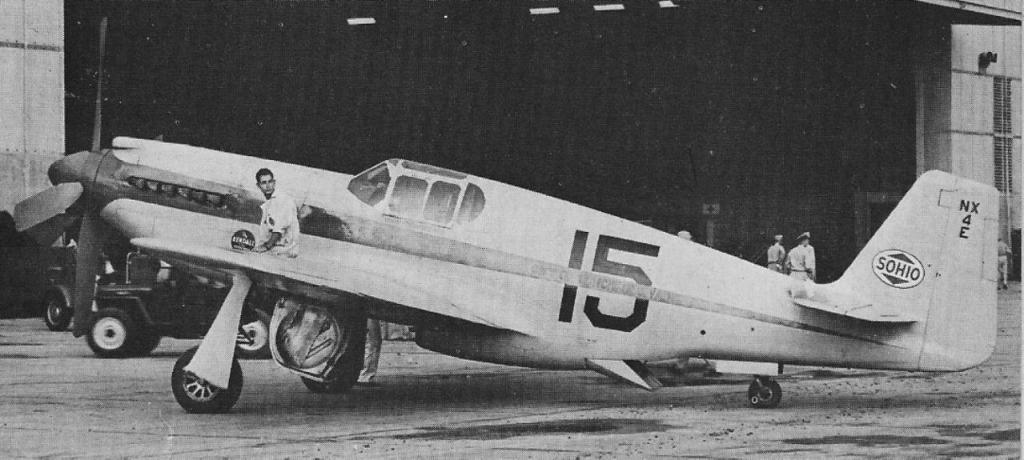
A-36 NX-4E owner/pilot Woody Edmundson, 1947 3rd in Kendall Trophy Race at 372.392mph
Destroyed in non-fatal crash during Thompson Trophy Race

Two Mustangs sank an Italian cruiser and another sank an Italian transport which had been one of the world’s greatest luxury liners.

In 1941 one hundred and forty eight P-51 NA-91 (41-37320-37351, 41-37353-37420, 41-37422-374690 were built, of which 2 became test beds for Packard V-1650 as XP-51B (XP-78), and of which many early models became A-36A, plus 650 NA-73/NA-83 for RAF as Mustang I/IA (many were converted in England to Rolls-Royce Merlin).

North American Mustang I

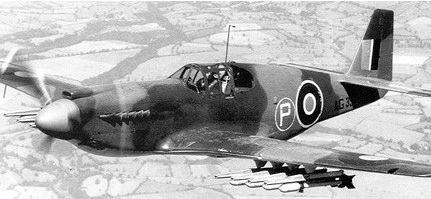
The design showed promise and AAF purchases of Allison-powered Mustangs began in 1941 primarily for photo recon and ground support use due to its limited high-altitude performance. A total of 310 P 51As were built. The 1942 P-51-1 armed recon adaptation with four wing cannon and two K-24 cameras was briefly designated F-6A at first, the unique final designation signified a batch of 57 withdrawn from an RAF Mustang I contract for USAAF duty. Fifty P 51As were allocated to the RAF as Mustang Mk IIs, while 35 were converted to F 6B tactical reconnaissance planes. Top speed was 390 mph.

P-51A

The initial P-51 and P-51A variants proved only moderately successful but in 1942, tests of P-51s using the British Rolls-Royce “Merlin” engine revealed much improved speed and service ceiling.

After some Allisom-powered P-51A were built, the Rolls-Royce Merlin, developing 1650 hp and equipped with two-stage, two-speed supercharger with a critical altitude of better than 30,000 ft, was in production and available to North American. The P-51B emerged with the Merlin and a four-blade propeller, the conversion first flying on 13 October 1942. It went into production in the late spring of 1943 with the first production aircraft flying in December 1942. The P-51B carried four .50 calibre machine guns and bomb racks. Dive brakes were eliminated. The radiator installation was redesigned and bubble canopy fitted. The plane was strengthened to carry the larger engine. New ailerons gave improved performance. The plane was cleaned up from spinner to rudder.

Wind tunnel model tests new tail fairing

Changes were being made daily, even while the planes flowed from the final assembly. Improved manufacturing methods resulted in each unit being produced with only 3300 man-hours.

P-51B

The first P-51B’s were delivered to a combat group early in November 1943. Seventeen days later, on 1 December, they conducted their first operation over enemy territory. Early in January, the group knocked down 18 German combat planes without a single loss, which was a record. A week later, the group accounted for 15 aircraft without loss. They netted a total of 103 German aircraft 83 days after starting operations, beating the Thunderbolt record of 100 planes in 85 days.

The P-51C was built in the newly constructed North American factory in Dallas, Texas, and was essentially the same as the P-51B.

In 1943 a bubble canopy was adopted for the P¬51D, which became the main version of the famous fighter and entered combat over Europe in March 1944.

The aircraft is stressed for aerobatics and is capable of most all maneuvers with the exception of sustained inverted flight, snap rolls, outside loops, and inverted spins.

There are a number of variables regarding engines. The basic engine is the Packard built V-1650-7. The V-1650-9 was also used and is interchangeable. This V-12 engine is designed with 2 removable Cylinder bank assemblies of 6 cylinders each. These are referred to as head and banks. There are a number of engines that have been fitted with the” Transport Heads.” “Transport Heads” refer to British built assemblies that were used on a commercial aircraft engine and were designed for long life.
The basic V-1650-7 engine lower end will have a TBO in civil use of about 600 hours. The V-1650-7 heads and banks will probably require some rework at about 300 hours. The transport heads will normally last to TBO and beyond.

The P-51D holds 184 US gallons. The military used drop tanks of a maximum capacity of 110 gallons each and had a 85 gallon rear fuselage tank. Most civil operators do not use drop tanks and have a rear jump seat in place of the fuselage tank. With a normal cruise fuel burn of 65 GPH, this gives a 2 2 hour endurance with a small reserve.

A steerable type system uses an interconnect from the rudder pedals to the tailwheel steering system. This allows the pilot to steer the aircraft by use of the rudder pedals. Full forward stick movement unlocks this system. When unlocked the tailwheel becomes full swivel and steering is accomplished by differential braking.

The aircraft uses a low-pressure 1000 psi hydraulic system. The pressure is controlled and maintained by a regulator. The pilot simply operates the flaps or the gear and it works automatically. The wheel brakes are non-boosted, hydraulically actuated from individual master cylinders. The aircraft use standard MIL-5060 (red) fluid.

The aircraft has a 24 Volt D.C. system with a 100-amp generator. Some aircraft have an alternator installed. Normal aircraft have no AC electrical devices installed. A standard battery is used to provide starting and back up power. The aircraft does not require a ground power cart for normal use.

The definitive P-51D variant amounted to 7,966 of the 15,469 Mustangs. Unit cost in 1945 $50,985.

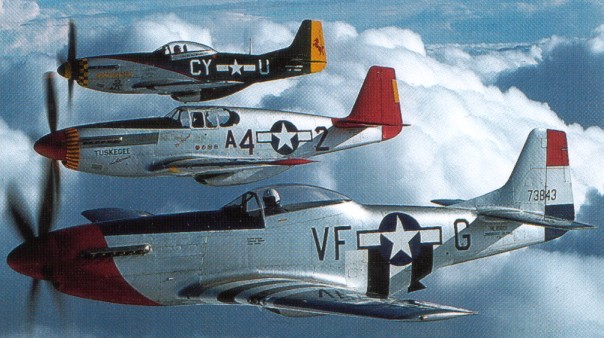
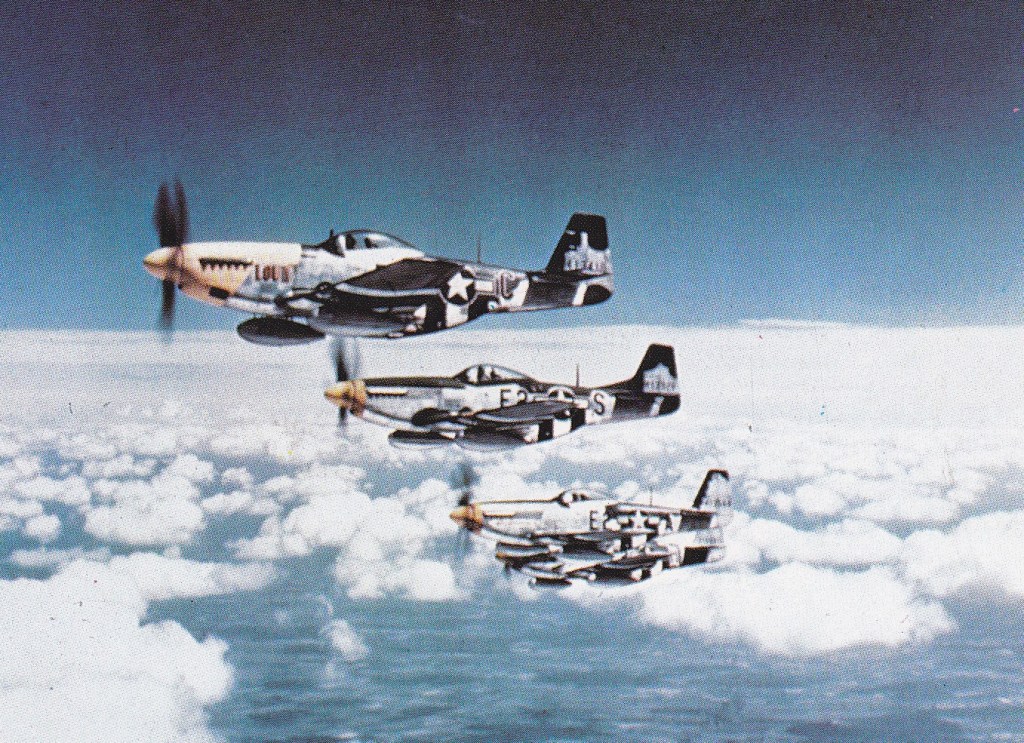
Four P-51D of the 8th Army Air Force’s 361st Fighter

The only AD on the P-51 is 81-13-01. The AD calls for inspection of the Hamilton Standard prop for corrosion. This AD starts out with an 18 month inspection interval and the interval lengthens to 60 months as the prop builds a history.

The RNZAF received 30 P-51Ds as NZ2401 to NZ2430 in late 1945 of what would have been 370 replacements for Corsairs. War’s end led to the cancellation of the remainder. The RNZAF operated P-51D until 1957.

Providing high-altitude escort to B-17s and B-24s, they scored heavily over German interceptors and by war’s end, P-51s had destroyed 4,950 enemy aircraft in the air, more than any other fighter in Europe.

North American P-51 Mustang & Republic P-47 Thunderbolt Article

Mustangs served in nearly every combat zone, including the Pacific where they escorted B-29s to Japan from Iwo Jima. Between 1941-5, the AAF ordered 14,855 Mustangs (including A-36A dive bomber and F-6 photo recon versions), of which 7,956 were P-51Ds.

On 4 October 1944 the US 8th Air Force Headquarters announced that for several days the German Luftwaffe had been using allied Mosquito and Mustang aircraft furnished with German national emblems. On 3 October 1944 a Mosquito flown by Germans was shot down near Aachen. Aerial combats had taken place over Holland between allied and German Mustang fighters. These machines in German hands were aircraft which had been forced to land behind German lines.

A-36 Apache

The final delivery, a P-51H, was made in November 1945. A total of 15386 aircraft were built including 500 A-36As and 120 P-51Ds assembled in Australia (CAC CA-17). 620 were exported to the RAF for a total to the USAAF/USAF of 14,365.

During the Korean War, P-51Ds were used primarily for close support of ground forces until withdrawn from combat in 1953.

The U.S. Military and the Royal Canadian Air Force made the largest surplus release of these aircraft in the late 50’s and early 60’s. A number of aircraft previously served with the forces of over seas countries. The aircraft sold as surplus in 1958 for prices ranging from $800-1500. The Mustang is probably the most recognized fighter of World War II and has proven to be a popular and widely used civilian Warbird.

Many people refer to the “Cavalier” Mustang as the ultimate conversion for civilian use. This conversion was performed by Trans Florida Aviation of Sarasota in the mid 60’s to the early 70’s. While this conversion was very nice at that time, most restorations done in the last 10-15 years are of superior quality. The Executive Mustang, or Cavalier, rebuild and conversion involved plush, soundproofed cockpit, IFR electronics, baggage compartments in former gun bays, 402-gal fuel tanks, and zero-time majored 1500hp Packard-Merlin V-1650-7 engine.

Cavalier P-51 Mustang Article

Successor to Trans-Florida Aviation, acquired during 1960s type certificate for North American F-51 Mustang, producing tandem two-seat business/sport conversions of F-51D as Cavalier 2000 series, and building new single-seat F-51Ds for the USAF counterinsurgency Military Assistance Program. Prototype of Mustang II, two-seat COIN patrol/attack version equipped with heavier armament, flew December 1967; prototype Turbo Mustang III (with Rolls-Royce Dart) in 1969. Second prototype flew in April 1971, equipped with Lycoming T55 engine, by which time the program had been sold to the Piper Aircraft Corporation, but then the company was dissolved.

Priced at $32,500 less radio 19 were reportedly under way by the end of 1959 (44-11558=N6175C, -72844=N5076K, -73027, -73260=N5075K, -73411=N550D, -73584=N51Q, -73656=N5073K, -73843=N351D, -74427, -74441, -74453, -74458/74459, -74469=N7723C, -74831, -74854, -84658=N7724C, 45-11381=N5471V, -11489=N5421V).

Executive Mustang / Cavalier variants:
Cavalier 750
1959
No tip tanks.

Cavalier 1200
1960
As 750
with two additional 45-gal internal wing tanks.

Cavalier 1500
1960
As 750, with two additional 63-gal internal wing tanks.

Cavalier 2000
1967
110-gal tip tanks.

Cavalier 2500
As 2000, with two additional 63-gal internal wing tanks.

Cavalier Mustang II
1967
F-51D modified for counter-insurgency duties
1760hp RR Merlin 620.
2 built.

Turbo Mustang III
1968 or 1971
Prototypical COIN design for production by Piper Co as PA-48 Enforcer.

The TF-51D was originally built by TEMCO aircraft and incorporated a full rear cockpit with Dual Controls. In the last several years this conversion has been produced by a California company and is very popular. It added about $250,000 to the price of a Mustang.

Bob Hoover’s P-51 Mustang had the wings rebuilt with thicker aluminium skins so that they would be strong enough to handle the extra weight of fuel.

P-51 Mustang Restorations

Gallery

Gallery II

Ultralight Replicas:
Loehle Aviation 5151
FK Lightplanes FK51 Mustang

Experimental Replicas:
Stewart S-51D
Papa 51 Inc Thunder Mustang
Thunder Builders Group Thunder Mustang
Titan Aircraft P-51
Falconair SAL Mustang P-51
Cameron & Sons P-51
Bonsall Mustang MkII

North American P-51 Mustang variant production history & performance

Production –

XP-51
Number built/Converted 2
Model NA-73; Developed for UK

P-51
Number built/Converted 150
Prod. model; 4 20mm cannon

P-51A
Number built/Converted 310
Fitted w/ bomb racks; 4 .50-cal. mgs

XP-51B
Number built/Converted 2
Imp. P-51; was XP-78

P-51B-NA
Number built/Converted 1988
Prod. model; Blks 1-15; Inglewood

P-51C-NT
Number built/Converted 1750
Dallas Plant; Blks 1-11

P-51D-NA
Number built/Converted 6502
Bubble Canopy; Blks 1-30

P-51D-NT
Number built/Converted 1454
Blks 5-30; 6 .50-cal. mgs.

TP-51D-NT
Number built/Converted 10
2-place trainer variant

P-51E
Number built/Converted 0
Model not assigned

XP-51F
Number built/Converted 3
Exp. lt. weight test model

XP-51G
Number built/Converted 2
Mod. XP-51F w/ new eng.

P-51H-NA
Number built/Converted 555
Prod. model; Blks 1-10

XP-51J
Number built/Converted 2
Mod. XP-51F w/ new eng.

P-51K-NT
Number built/Converted 1337
Imp. -D; Aeroprop; Blks 1-15

P-51L-NA
Number built/Converted 0
Imp. -H w/ new eng.

P-51M-NT
Number built/Converted 1
Imp. -H w/ new eng.

Specifications –

NA-73X
Engine: Allison V-1710, 1100 hp
Wingspan: 37’0″
Length: 32’2″
Useful load: 2250 lb
Max speed: 387 mph
Cruise speed: 307 mph
Stall: 120 mph
Range: 350 mi
Seats: 1

XP-51 / NA-73
Engine: Allison V-1710-39, 1100hp
Wing span: 37’0″
Length: 32’3″
Useful load: 1687 lb
Max speed: 382 mph
Cruise speed: 300 mph
Range: 625 mi
Ceiling: 30,800 ft

P-51
Engine: Allison V-1710-F3R, 1150 or -81, 1125 hp
Wingspan: 37 ft 0.5 in / 11.29 m
Length: 32 ft 2.5 in / 9.81 m
Height: 12 ft 2 in / 3.72 m
Empty weight: 6300 lb / 2858 kg
Max loaded weight: 8600 lb / 3901 kg
Max speed: 390 mph / 628 kph
ROC: 2600 fpm / 792 m/min
Service ceiling: 30,000 ft / 9144 m
Range: 450 mi
Armament: 4 x .20mm Hispano

P-51A / Mustang Mk.II
P-51A
Engine: Allison V-1710-F3R, 1150 or -81, 1125 hp
Wingspan: 37 ft 0.5 in / 11.29 m
Length: 32 ft 2.5 in / 9.81 m
Height: 12 ft 2 in / 3.72 m
Empty weight: 6300 lb / 2858 kg
Max loaded weight: 8600 lb / 3901 kg
Max speed: 394 mph @ 15,000 ft.
ROC: 2600 fpm / 792 m/min
Service ceiling: 30,000 ft / 9144 m
Range: 450 mi
Armament: 4 x .50 mg

P-51B
Engine: Packard Merlin V-1650-9, 1520 hp
Wingspan: 37 ft 0.5 in / 11.29 m
Length: 32 ft 2.5 in / 9.81 m
Height: 13 ft 8 in / 4.1 m
Empty weight: 6300 lb / 2858 kg
Max loaded weight: 8600 lb / 3901 kg
Max speed: 390 mph / 628 kph
ROC: 2600 fpm / 792 m/min
Service ceiling: 30,000 ft / 9144 m
Range: 450 mi
Max range: 1300 mph
Armament: 4 x .50 in Browning mg
Bomb load: 2 x 1000 lb

P-51C
Engine: Packard Merlin V-1650-9, 1520 hp
Wingspan: 37 ft 0.5 in / 11.29 m
Length: 32 ft 2.5 in / 9.81 m
Height: 13 ft 8 in / 4.1 m
Empty weight: 6300 lb / 2858 kg
Max loaded weight: 8600 lb / 3901 kg
Max speed: 390 mph / 628 kph
ROC: 2600 fpm / 792 m/min
Service ceiling: 30,000 ft / 9144 m
Range: 450 mi
Max range: 2700 miles
Armament: 4 x .50 in Browning mg
Armament: 6 x .50 Browning MG53-2 270 or 400 rds each
Bombload: 2 x 1000 lb / 454 kg

P-51D
Engine: Packard Merlin V-1650-7 or V-1650-9, 1450 hp / 1,695 hp
Propeller: Hamilton Standard 4-Blade 24D50, 134″
Span: 37 ft 0.25 in / 11.89 m
Length: 32 ft 3.25 in / 9.85 m
Height: 13 ft 8 in / 4.16 m
Wing area: 21.65 sq.m / 233.04 sq ft
Frontal Area: 13.4 sq.ft.
Max take-off weight: 5488 kg / 12099 lb
Normal Gross Weight: 9450 lb
Empty weight: 3232 kg / 7125 lb
Wing Loading: 49.2 lbs/sq.ft.
Power Loading: 7.78 lbs/hp
Drop tank maximum capacity: 2 x 110 USG
Rear fuselage tank capacity : 85 USG
Maximum speed: 703 km/h / 437 mph at 25,000 ft
Speed @ Sea Level: 326 kts (375 mph, 603 kph)
Normal cruise: 240 kt at 65 USgph at 8000 ft
Cruise Speed @ 75% Power: 250 kts (300 mph, 483 kph)
Range normal: 950 sm,
Range max: 1710 sm
Service Ceiling: 12770 m / 41,900 ft.
Rate of Climb @ gross: 2800 ft/min
Climb to 30,000 ft / 9,145 m: 13 minutes 0 seconds
Vx (best angle of climb): 87 kts
Vy (best rate of climb): 148 kts
Va (design maneuvering): 226 kts
Vfe (max flaps extended): 143 kts
Vle (max landing gear extended): 148 kts
Vne (never exceed): 439 kts
Vsl (stall, clean): 92 kts
Vso (stall, in landing config.): 88 kts
Best Glide: 152 kts
Armament: Six .50-cal. machine guns / 2,000 lb external
Design Limit Load Factor: +8g / -4g @ 8000 lbs / +5.5g / -2.5g @ 11600 lbs.
Crew: 1
Cost: $54,000

P-51H
P-51H
Engine: Packard Merlin V-1650-9, 2218 hp
Height: 13 ft 8 in / 4.1 m
Wingspan: 37 ft 0.5 in / 11.29 m
Length: 33 ft 4 in
Max speed: 487 mph @ 25,000 ft
Armament: 6 x .50 Browning MG53-2 270 or 400 rds each
Bombload: 2 x 1000 lb / 454 kg

P-51J
Engine: Allison 119/F32, 1700 hp @ 20,700 ft
Max speed: 492 mph @ 27,400 ft.

F-6A
Engine: Allison V-1710-F3R, 1150 or -81, 1125 hp
Wingspan: 37 ft 0.5 in / 11.29 m
Length: 32 ft 2.5 in / 9.81 m
Height: 12 ft 2 in / 3.72 m

F-6B
Engine: Allison, 1200 hp
Max speed: 390 mph.

RAF Mustang I
Armament: 4 x .303 mg / 4 x .50 mg

Mustang IA
Armament: 4 x .20mm Hispano

Mustang 4
Engine: 1,520 h.p. Packard Merlin V1650-3
Span: 37 ft
Weight: 10,000 lb
Max. Speed: 445 mph

A-36
Engine: Allison V-1710-F3R, 1150 or -81, 1125 hp
Wingspan: 37 ft 0.5 in / 11.29 m
Length: 32 ft 2.5 in / 9.81 m
Height: 12 ft 2 in / 3.72 m

A-36A
Armament: 6 x .50 mg
Bombload: 2 x 500 lb / 227 kg

North American P-51D Mustang