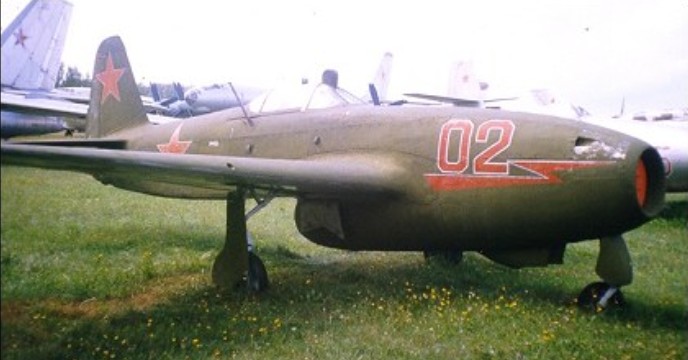
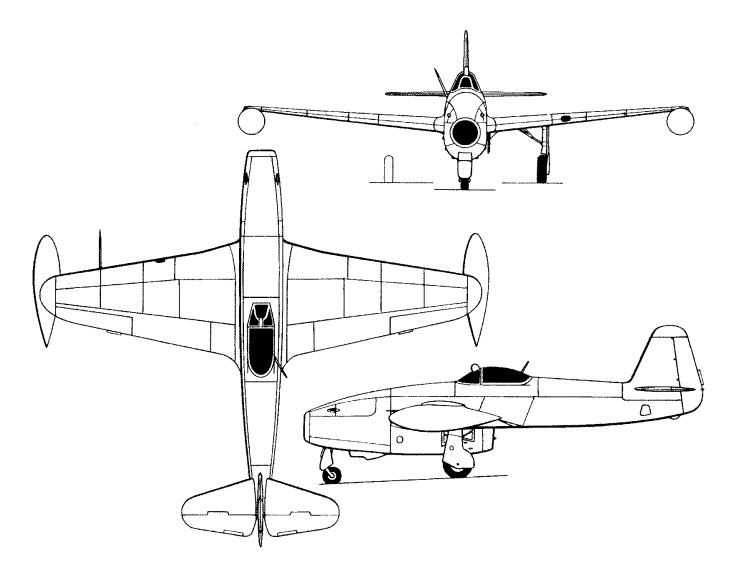
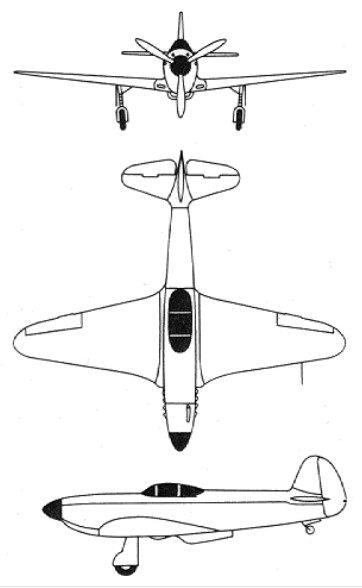
During the autumn of 1946, the Yakolev OKB initiated a relatively modest redesign of the Yak-15 which was initially referred to as the Yak-15U – Uluchshennyi (improved). The prototype, flown early in 1947, differed essentially in having a nosewheel rather than tailwheel undercarriage. Owing to the position of the engine, it was physically impossible to retract the nosewheel completely, and this was therefore partly enclosed by a fixed fairing. Introduction of a nosewheel demanded transfer of the main undercarriage members from the forward to the rear wing spar and dictated considerable structural redesign and a reduction in wing tankage. To compensate, a jettisonable 300-litre tank was added beneath each wing tip. Redesignated Yak-17, this fighter was restressed throughout and, in series form, was fitted with a redesigned vertical tail and an RD-10A engine rated at 1000kg. Armament remained two 23mm NS-23 cannon.
The Yak 17 was powered by the uprated RD 10A rated at 1000 kg (2205 lb) of thrust. The NATO code named Feather was slightly faster and lighter than its competitor, the La 150, and was substantially superior in range; rough field performance of the Yak 17 was very much better than that of the Lavochkin design, which had a heavy narrow track undercarriage. The La 150 was abandoned in April 1947 and the Yak 17 was ordered into production. A second cockpit was added in front of the existing position and a long sliding canopy was fitted; an enlarged fin was also adopted for both the Magnet and Feather. The Yak-17UTI entered flight test in April 1948, and about 150 were eventually built, 20 of these being exported to Poland and several to China.
Yak-17U
One Yak-17 fighter was delivered to Czechoslovakia for evaluation, where it received the designation S 100, and three were supplied to Poland. Poland acquired manufacturing licences in 1950 for both the Yak-17 and its RD-10A turbojet, which were to be built at Mielec and Rzeszow respectively. The Polish programme was terminated in the winter of 1950-51 before any aircraft had been built as the Yak-17 had been overtaken by better fighters, but 30 RD-10 A engines were completed at Rzeszow.
The Yak-17 and Yak-17UTI were phased out by the V-VS in 1951 and 1953 respectively, and the latter from the Polish air arm by 1955.
Production of the Yak-17 from late 1947 to August 1949 and totalled 430, including a proportion of tandem two-seat Yak-17UTI conversion trainers. The Yak 17UTI was the Soviet air force’s first specialist jet trainer and remained in service until replaced by the MiG-15UTI.
Gallery
Engine: RD 10 A, 9810 N / 1000 kp Max take-off weight: 3323 kg / 7326 lb Empty weight: 2430 kg / 5357 lb Wingspan: 9.20 m / 30 ft 2 in Length: 8.78 m / 28 ft 10 in Wing area: 14.85 sq.m / 159.84 sq ft Height: 9.514 ft / 2.9 m Max. speed: 750 km/h / 466 mph Cruise speed: 600 km/h / 373 mph Range: 717 km / 446 miles Service ceiling: 42651 ft / 13000 m Armament: 2x MK 23mm Crew: 1-2
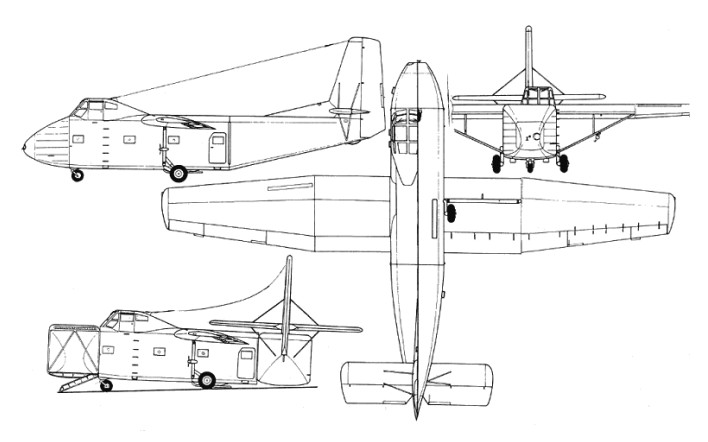
Max take-off weight: 6750 kg / 14881 lb Empty weight: 3000 kg / 6614 lb Wingspan: 26.2 m / 86 ft 11 in Length: 18.4 m / 60 ft 4 in Height: 7.5 m / 25 ft 7 in Max. speed: 300 km/h / 186 mph Crew: 1 Passengers: 5
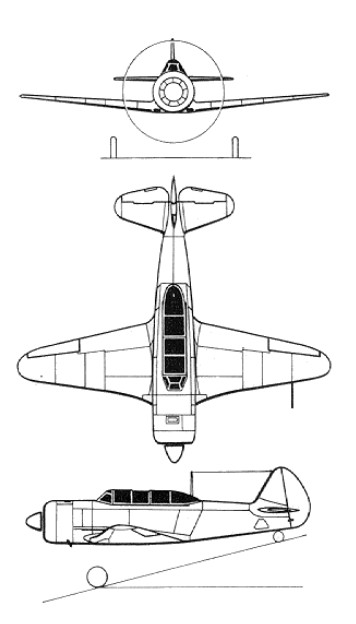
The Yak 11 began life as a radial engine tandem seat advanced fighter trainer variant of the Yak 3. A converted Yak 3 trainer flew in 1945 as the Yak-3UTI and in 1946 there appeared a second prototype with a number of refinements and using less Yak-3 components.
Trials were completed in 1946 and entering Soviet service in 1947. The Yak-11 has all-metal wings and a fuselage covered in plywood and fabric and has a retractable tailwheel landing gear.
NATO code name ‘Moose’. A total of 3859 being built until production ended in 1956 before moving on to a modified version featuring a nosewheel.
Also built under licence in Czechoslovakia as the LET C-11, production totalled 3859 in the USSR and, from 1953, 707 in Czechoslovakia,
In 1958 there appeared the Yak-11U (Czech C-11U) version with retractable tricycle landing gear.
Yak C.11
The Yak-11 was a two-seat intermediate trainer and became a standard type with the Soviet forces and those of a large number of other countries including Afghanistan, Albania, Angola, Bangladesh, Bulgaria, Cambodia, China, Czechoslovakia, East Germany, Hungary, Mongolia, Poland, Romania, Somalia, USSR, Vietnam, and Yemen.
Engine: 1 x Shvetsov ASh-21, 570 hp / 425 kW Wingspan: 9.4 m / 30 ft 10 in Length: 8.5 m / 27 ft 11 in Height: 3.3 m / 10 ft 10 in Wing area: 15.4 sq.m / 165.76 sq ft Empty weight: 1900 kg / 4189 lb Max take-off weight: 2418 kg / 5331 lb Max. speed: 456 km/h / 283 mph at 8200 ft / 2500 m Cruise speed: 400 km/h / 249 mph Service ceiling: 7100 m / 23,295 ft Range w/max.fuel: 1290 km / 802 miles Armament: 1 x 12.7mm or 2 x 7.62 mm machine-guns Bombload: 2 x 110 lb / 50 kg Crew: 2
A development of the experimental Yak-7DI fighter, the original Yakolev Yak-9 differed in having a revised rudder and wooden wings incorporating metal spars; the series version, which entered production in the summer of 1942, also introduced a retractable tail-wheel.
Deliveries to V-VS lAPs (fighter regiments) began in October 1942 and the type was soon engaged in the Battle of Stalingrad. By February 1943 production aircraft were being built with reduced-span wings that incorporated duralumin ribs and with the initial powerplant (an M105PF or M-105PF-1) being replaced by the 925kW M-105PF-3. The Yak- 9 operated with a wide variety of armament, including all types of aircraft cannon then in production in the Soviet Union, and during 1943 there appeared variants which developed the full potential of the Yak-9 for use in anti-tank, light bomber and long-range escort roles.
Yak-9D over Crimea 1944 – nearest Col Avdyeyev, 15 victories
The Yak-9D appeared in 1943, primarily intended for bomber escort duties, having a reduced armament and sufficient extra fuel to give a maximum range of 882 miles.
The second generation of Yak-9s began with the Yak-911 prototype of late 1943, which introduced a redesigned airframe, a new wing of increased span and area, and the more powerful VK-107 engine; to overcome resulting centre of gravity problems the wing was moved slightly forward.
The 1943 Yak-9T appeared in 1943 in two versions. The second version was armed with a single 75mm connon for anti-shipping duties.
Later variants, differing primarily in armament and equipment installations, included the Yak-9L and Yak-9M.
The Yak-9U, an improved and cleaner-looking model, was powered by a 1650 hp M-107A engine, had entered production before the war ended and, with the Yak-9P (the final version) equipped Soviet and satellite squadrons for many years afterwards.
Production of the Yak-9 ended in 1946 after a record 16,769 aircraft had been delivered. Main post-war operators, apart from the Soviet Union, were Bulgaria, Poland, French Normandie Squadron and Yugoslavia.
Some Yaks were fitted with either a 37 mm or 75 mm cannon for anti tank use.
2010: FOR SALE: Share in Yak-9V fighters syndicate. Based at Omaka, NZ, syndicate welcomes NZ and internationally based members in ownership consortium. Yak-9V is essentially a Yak-11 with V-12 power, offering full dual controls in a V-12 fighter
Yak 9 Engine: Klimov VK-105PF, 1260 hp Wingspan: 32 ft 9.75 in / 10 m Wing area: 17.1 sq.m / 184.06 sq ft Length: 28 ft 0.5 in / 8.54 m Height: 8 ft / 2.44 m Max take-off weight: 2873-3060 kg / 6334 – 6746 lb Max. speed: 595 km/h / 370 mph Service ceiling: 34,500 ft / 10,500 m ROC: 3795 fpm / 1150 m/min Range w/max.fuel: 1000 km / 621 miles Range w/max.payload: 850 km / 528 miles Armament: 1 x 20mm machine-guns, 1 x 12.7mm machine-guns Crew: 1
Yak 9D Engine One 1,260 h.p Klimov VK-105PF Wing span 32.75 ft. (9.96 m.) Length: 28 ft 0.5 in / 8.54 m Height: 8 ft / 2.44 m Weight empty 6,000 lb. (2,720 kg.) Max speed 360 m.p.h. (580 km.p.h.) Ceiling 36,000 ft. (11,000 m.) fully loaded ROC: 3795 fpm / 1150 m/min Range 880 miles (1,400 km.) Armament 1 x 20 mm. cannon and 1 x 12.7 mm. machine gun Seats: 1
Yak-9DD Range: 1367-2200 mi
Yak-9P Engine: Klimov VK-107A, 1650 hp Wingspan: 32 ft 9.75 in / 10 m Length: 28 ft 6.5 in / 8.70 m Height: 8 ft / 2.44 m Max speed: 416 mph / 670 kph ROC: 4920 fpm / 1500 m/min Service ceiling: 34,500 ft / 10,500 m Range: 520-550 mi Seats: 1
Yak-9T Length: 28 ft Span: 32 ft 9.75 in Max speed: 382 mph Armament: 1 x 30mm AT cannon, 1 x 12.7mm mg
Yak-9T Engine: Klimov M-105PF, 1260 hp Wingspan: 32 ft 9.75 in / 10 m Length: 28 ft 0.5 in / 8.54 m Height: 8 ft / 2.44 m Empty weight: 6063 lb / 2750 kg MTOW: 7055 lb / 3200 kg Max speed: 363 mph at 16,400 ft ROC: 3795 fpm / 1150 m/min Service ceiling: 34,500 ft / 10,500 m Range: 520-550 mi Armament: 1 x 30mm Nudelman cannon, 1 x 12.7mm Beresin mg Seats: 1
Yak-9U Engine: Klimov VK-107A, 1650 hp Wingspan: 32 ft 9.75 in / 10 m Length: 28 ft 6.5 in / 8.70 m Height: 8 ft / 2.44 m Empty weight: 5100 lb / 2313 kg MTOW: 6988 lb / 3170 kg Max speed: 435 mph / 700 kph ROC: 4920 fpm / 1500 m/min Service ceiling: 34,500 ft / 10,500 m Range: 520-550 mi Seats: 1
In parallel with the I-26 (or Ya-26), the Yakolev design bureau developed a two-seat version under the designation Yakolev Ya-27. One pre-production I-26 was completed to this configuration. It was intended to serve not only as a dual-control fighter trainer, but also as a liaison and unit support aircraft. Compared with the I-26, the Ya-27 was simplified and of reduced weight, the tandem cockpits being enclosed by an extended glazed canopy. The resulting Yak-7 aircraft entered production in May 1941 and was soon found to have better flying qualities than those displayed by series Yak-1s. This performance, combined with the urgent need for more fighters, led to production of a single-seat version of which the first was flown in June 1941; in the following month the fighter was officially designated Yak-7A and the two-seater Yak-7V.
By the end of 1941 a new single-seater, the Yak-7B, had replaced the Yak-7A. In late 1941 the rear fuselage was lowred to produced the Yak-7B which in early 1942 supplanted the Yak-1 in production.
Total delivery of all versions of the Yak-7 was 6,399 aircraft, production terminating in early 1943; of this number, some 1,500 were Yakolev Yak-7Vs.
Yak-7A
Engine: 1 x VK-105PF, 870kW Max take-off weight: 3050 kg / 6724 lb Empty weight: 2330 kg / 5137 lb Wingspan: 10.0 m / 33 ft 10 in Length: 8.5 m / 28 ft 11 in Height: 1.7 m / 6 ft 7 in Wing area: 17.2 sq.m / 185.14 sq ft Max. speed: 520 km/h / 323 mph Ceiling: 10000 m / 32800 ft Range: 600 km / 373 miles Armament: 1 x 20mm machine-guns, 2 x 12.7mm machine-guns Crew: 1
Design began at the end of 1941 of a single-seat fighter using the new VK-107 engine, requiring the least-possible drag, smallest dimensions and weight consistent with a manoeuvrable and tough machine. Due to delays with the new engine and pressure to build the maximum number of aircraft already on the production lines, this new Yak-3 programme was shelved.
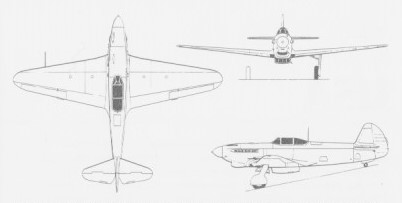
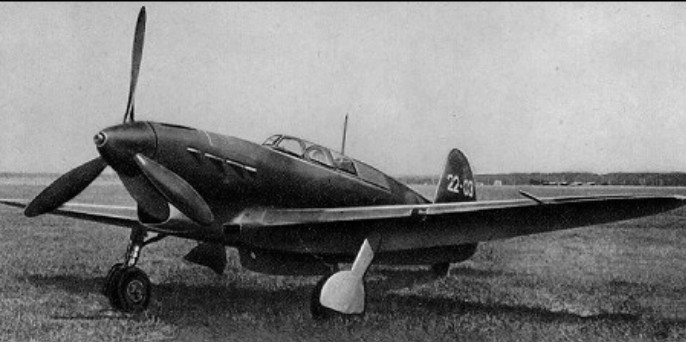
A new small wing was developed and tested along with other changes on a Yak-1M in late 1942, and the first Yak-3 prototype was flown in late 1943. Although evaluation aircraft flew in combat, the first series Yak-3s did not enter operation with the 91st IAP until July 1944. The wings have metal spar, wood ribs with plywood cover and fabric overcoat. The fuselage is welded steek tubing with wood shell cover and fabric over.
The first all metal steel spar wings with light alloy stressed skinned wings and fuselage the production Yak 3U rolled out in late autumn 1944 and deliveries were just being made to front line squadrons when the war ended. The fastest of all Yakolev production piston engined fighters, the Yak 3U was comparable with the Spitfire XIV and XVIII.
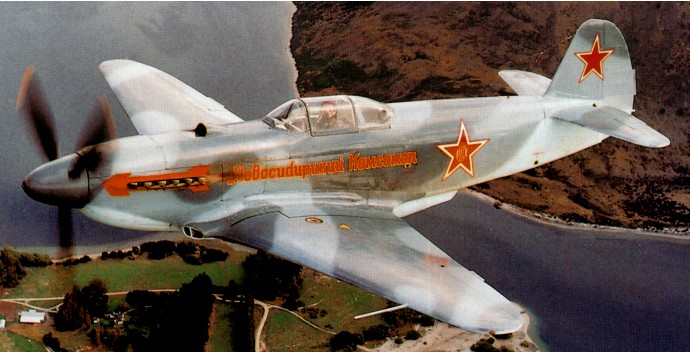
Initial non-availability of the VK-107 engine forced reliance to be placed on the VK-105PF-2 that had powered earlier Yaks. The Russian fighter achieved a maximum speed of 447 mph at 19,685 feet when fitted with the VK 107A of 1700 hp as from August 1944, easily outpacing the latest marks of Bf 109 and FW 190. Built to a total of 4,848, the Yak-3 achieved fame and a very high score rate against German aircraft in 1944-45. The Yak-3 equipped the famous Free French ‘Normandie-Niemen’ unit, and achieved its peak of perfection when the VK-107A engine of 1268kW became available in limited numbers from August 1944, the type’s maximum speed then improving to 720km/h at 6000m.
Armed with an engine mounted 20 mm ShVAK cannon and two synchronised 12.7 (0,5 inch) UBS machine guns mounted in the upper decking of the forward fuselage.
Designed specifically for low altitude combat and army co operation the Yak 3 fighter usually operated at altitudes below 8-10,000 ft. where it was markedly superior to the German Bf 109G and Fw 190A and was extensively used for ground strafing.
A Yak-3 airframe was modified to produce the Yak-15 jet fighter in 1945, developed subsequently as the Yak-17.
After discussions with interested American groups in 1991, the Yakolev Design Bureau used the original drawings and some of the original jigs to recommence production for the international warbird market. This resulted in the Yak-3M. The 1993 brand new Yak 3 differs only from the original Red Air Force examples in the engine department, a World War 2 Allison V 1710 99 providing more reliability than the now ex¬tremely rare Klimov VIKA05PF and modern avionics. Modifications to accept the Allison were made by the Yakolev engineers, an in house re engining. The Yakolev factory personnel simply opened the bottom drawer, took out the 1944 plans, blew off the dust, and went to work on a new production batch. The production line was simply restarted. A number of the original jigs were in existence to facilitate the work.
Yak-3UPW
Five Yak-3UPW were built in Romania in 1994. They were powered by Pratt & Whitney R-1834 Twin Wasp with a new Hamilton Standard three blade prop.
Yak-3 Engine: VK-107, 1310 hp Wingspan: 30.18 ft Length: 27.88 ft Speed: 342 mph at 16,400 ft Gross weight: 4848 lb Armament: 1 x 20mm cannon, 2 x 12.7mm mg
Yak-3U Engine: 1 x Klimov VK-105PF, 870kW / 1,200 hp Max take-off weight: 2650 kg / 5842 lb Wingspan: 9.2 m / 30 ft 2 in Length: 8.5 m / 28 ft 11 in Height: 2.4 m / 8 ft 10 in Wing area: 14.8 sq.m / 159.31 sq ft Max. speed: 660 km/h / 410 mph Cruise speed: 560 km/h / 348 mph Ceiling: 10700 m / 35100 ft Range: 900 km / 559 miles Armament: 1 x 20mm machine-guns, 2 x 12.7mm machine-guns, Crew: 1
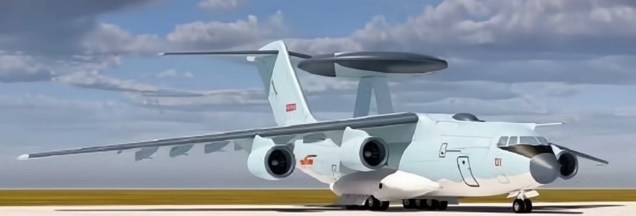
China has not officially confirmed the first flight of the KJ-3000 aircraft, which will significantly enhance its early warning capabilities. The KJ-3000 is based on the People’s Liberation Army Air Force (PLAAF) Y-20 transport aircraft and is the latest addition to China’s “eye in the sky” arsenal of early warning aircraft.
The rotodome is a discus-shaped rotating radome that allows the detection and tracking of targets by providing 360-degree coverage. Some experts speculate that the bulge on the tail may be related to the integration of some advanced communication systems.
The aircraft is powered by the domestically-produced WS-20 high-bypass turbofan engine, like the Y-20B transport aircraft that it is based on. It is anticipated to generate approximately 31,000 pounds of thrust. As per some unconfirmed claims, the aircraft would have a detection range exceeding 360-500 km.
The KJ-3000 can carry more payload—up to 66 tons— 16 tons more than the KJ-2000. Moreover, the WS-20 engines provide more thrust and fuel efficiency, enabling longer flight operations.
The aircraft could operate as a complete command center since it integrates C4ISR (Command, Control, Communications, Computers, Intelligence, Surveillance, and Reconnaissance) technologies, allowing for better coordination between the land, sea, and air domains.
Two major Chinese aviation companies, Shaanxi Aircraft Corporation and Xi’an Aircraft Corporation, expressed interest to develop the Y-20 aircraft, but Xi’an was announced as the manufacturer of Y-20 in 2007.
Developed by Xi’an Aircraft Industrial Corporation and was officially launched in 2006 the Xi’an Y-20 (Chinese: 运-20; pinyin: Yùn-20; literally: “transport-20”) is a large military transport aircraft. The official codename of the aircraft is Kunpeng (Chinese: 鲲鹏), after the mythical bird that can fly for thousands of miles described in the ancient Chinese Taoist classic Zhuangzi. However, within the Chinese aviation industry itself, the aircraft is more commonly known by its nickname Chubby Girl (Chinese: 胖妞), because its wide fuselage in comparison to other Chinese aircraft previously developed in China.
The aircraft was primarily designed and developed in China by Xi’an Aircraft Industrial Corporation under Tang Changhong. Certain parts of the wing such as the triple-slotted trailing-edge flaps were developed by the Ukrainian Antonov Design Bureau. The Y-20 uses components made of composite materials. The composites are produced in China, whereas in the past they had to be imported. The Y-20’s cabin incorporates flame-retardant composites developed by the 703 Institute of the China Aerospace Science and Technology Corporation (CASC). The 703 Institute was created in March 2009 with development taking three years. The performance of the composites is reportedly comparable to those that fulfill FAR Part 25.835. The 703 Institute achieved another milestone by establishing a comprehensive Chinese evaluation and certification system for aircraft composite materials based on international standards.
The Y-20 is the first cargo aircraft to use 3D printing technology to speed up its development and to lower its manufacturing cost. Model-based definition (MBD) is also used, and it’s the third aircraft to utilize MBD technology in the world, after Airbus A380 (2000) and Boeing 787 (2005). A project team to implement MBD for Y-20 program was formally formed in October 2009, and after the initial success in application on the main landing gear, MBD application was expanded to the entire aircraft and became mandatory for all contractors and sub contractors of the Y-20 program. The implementation of MBD was initially met with strong resistance, with only a third of suppliers agreeing to implement MBD. However, the general designer of Y-20 declared that those who refused to implement MBD will be banned from participating in the Y-20 program, thus forcing everyone to comply, resulting in increases in productivity. The implementation of MBD greatly shortened the time required, for example, without MBD, installation of wings takes a month or two, but with MBD adopted, the time is drastically shortened to just a few hours, and in general, the design work reduced by 40%, preparation for production reduced by 75%, and manufacturing cycle reduced by 30%. In addition to 3D printing, Y-20 is also the first aircraft in China adopting associative design technology (ADT) in its development. Headed by the deputy general designer of structural design, Mr. Feng Jun (冯军), the initial attempt to implement ADT actually failed after two months spent on application on the nose section. It was only after the second attempt that took another three months on the application on wings did ADT became successful. The adaptation of ADT greatly shortened the development time by at least eight months, and modification of wing design that previously took a week is shortened to half a day.
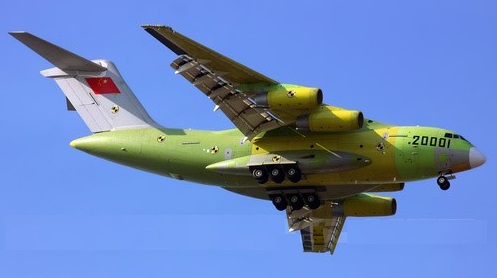
The Y-20 airlifter has a glass cockpit, which accommodates three crew members. Cargo is loaded through a large aft ramp that accommodates rolling stock. The Y-20 incorporates a shoulder wing, T-tail, rear cargo-loading assembly and heavy-duty retractable landing gear, consists of three rows, with a pair of wheels for each row, totalling six wheels for each side. The structural test was completed in 194 days as opposed to the 300 days originally planned, thanks to the successful development and application of an automated structural strength analysis system. According to the deputy general designer, the shortest take-off distance of Y-20 is 600 to 700 meters. Y-20 incorporates a total of four LCD EFIS, and the development of EFIS for Y-20 utilizes virtual reality via helmet mounted display. Eight types of different relays used on Y-20 are developed by Guilin Aerospace Co., Ltd. a wholly own subsidiary of China Tri-River Aerospace Group Co., Ltd.(中国三江航天集团), which is also known as the 9th Academy of China Aerospace Science and Industry Corporation (CASIC).
It was reported that the Y-20 started ground testing from December 2012, including runway taxi tests. The aircraft made its maiden flight lasting one hour on January 26, 2013 at Shaanxi Yanliang Aviation Base. During landing in first flight, it was reported that the Y-20 prototype bounced once before finally settling on runway due to high landing speed. In December 2013, a new Y-20 prototype took to the sky.
The Y-20 is powered by four 12-ton thrust Soloviev D-30KP-2 engines, and all early production units are likely to be similarly powered. The Chinese intend to replace the D-30 with the 14-ton thrust WS-20, which is required for the Y-20 to achieve its maximum cargo capacity of 66 tons. The Shenyang WS-20 is derived from the core of the Shenyang WS-10A, an indigenous Chinese turbofan engine for fighter aircraft.
In 2013, Shenyang Engine Design and Research Institute was reportedly developing the SF-A, a 28700-pound thrust engine, for the Y-20 and the Comac C919. The SF-A is derived from the core of the WS-15. Compared to the WS-20, the SF-A is a conservative design that does not seek to match the technology of more modern engines.
In late 2017, it is revealed that domestic Chinese turbofan WS-18 has begun flight test on Y-20. Compared with Russian Soloviev D-30, WS-18 is 300 kg lighter, weighing at 2000 kg; with thrust increased from 12.5 ton of D-30 to 13.2 ton; and fuel consumption of WS-18 is also reduced in comparison to D-30, and the mean time between overhaul of WS-18 is 3000 hours. However, because the increase in thrust is not significant in comparison to D-30, WS-18 is like to be a stopgap measure before WS-20 is ready. The production aircraft are equipped with WS-20 engines.
The aircraft is equipped with a retractable landing gear comprising two main landing gear units and a nose unit. Each of the two main units on either side of under-fuselage features six wheels, which are arranged in a two-two-two layout from front-to back. The steerable nose gear includes a standard twin-wheel leg unit. The landing gear allows take-offs and landings on rough airfields or unpaved runways.
In 2014 the PLA National Defence University’s Center for Economic Research recommended the purchase of up to 400 Y-20s, comparing the PLAAF’s needs with the existing airlifter fleets of the United States and Russia. In June 2016 Jane’s reported that up to 1,000 Y-20s are being requested by the Chinese military.
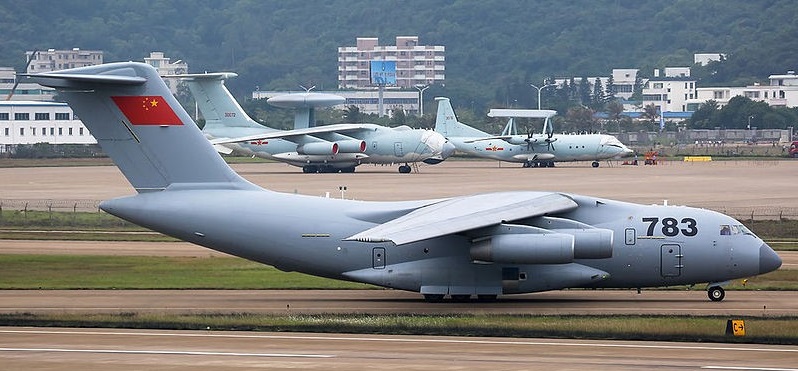
On 6 February 2016 the Y-20 was flown for the first time and pictures of the fifth prototype (serial number 788) in flight appeared on Chinese military webpages. Other known prototypes carry identification numbers 781, 783 and 785. On 27 January 2016, former Chinese test pilot Xu Yongling had reported in a Xinhua article that Chinese aviation industry officials had stated that the Y-20 “completed development” at the end of 2015. In June 2016, the first two Xian Y-20 aircraft were delivered to the People’s Liberation Army Air Force (PLAAF).
On 6 July 2016 the first serial Y-20 (serial number 11051) was handed over to the PLAAF in a ceremony. The second aircraft serialed 11052 followed soon after – it is assigned to the 12th Regiment of the 4th Transport Division at Qionglai, Chengdu. On 8 May 2018, it was announced by PLAAF’s spokeperson Shen Jinke that Y-20 had “recently conducted its first joint airdrop training with the country’s airborne troops”.
At least two aircraft stationed at Qionglai Air Base since July 2016. Commercial satellite imagery captured on 9 December 2017 suggests that at least three more Xian Aircraft Corporation Y-20 Kunpeng transport aircraft have entered service with China’s People’s Liberation Army Air Force (PLAAF). In these images there are a total of 5 Xi’an Y-20’s lined up at Qionglai Airbase near Chengdu in China’s southwestern Sichuan Province.
The YY-20A tanker, bearing the serial number 20646, was spotted in February 2025.
YY-20A
Derived from the Xi’an Y-20 strategic transport, the YY-20A tanker variant can haul up to 90 tons of fuel, tripling the capacity of the aging H-6U tankers it’s replacing.
2023 analysis pointed to the YY-20B’s “hot and high” takeoff capability—enabled by the WS-20 engines—as a game-changer, allowing operations from rugged, high-altitude bases that could support a Taiwan contingency.
The base Y-20A transport, powered initially by Russian D-30KP-2 engines, boasts a 66-ton payload and a range of up to 7,800 kilometers when fully loaded, capable of carrying everything from ZTZ-99 tanks to medical supplies.
The YY-20A tanker variant, introduced in 2022, swaps cargo for fuel pallets, featuring two underwing refueling pods and a centerline drogue for large aircraft like the H-6N bomber or KJ-500A AEW&C platform, monitored by IIR/TV cameras for precision.
The Y-20B, rolled out by 2023, upgrades to four Shenyang WS-20 high-bypass turbofans, boosting thrust to 31,000 pounds per engine and enhancing the range and short-field performance. A YY-20B tanker sub-variant, spotted in late 2023, likely builds on this, though some speculate the Y-20B’s modular design allows any unit to double as a tanker with minimal reconfiguration.
Advanced avionics, a glass cockpit with heads-up displays, and composite materials round out a platform that’s as modern as it is massive, with a 50-meter wingspan and 47-meter length.
Analysts see a niche for the Y-20E export variant, powered by WS-20s.
In 2025 production capacity was ramping up and a civilian Y-20F-100 variant pitched for commercial use.
Specifications (estimated) Engines: 4 × Soloviev D-30KP-2 turbofans Wingspan: 45 m (147 ft ~ 164 ft) Wing area: 330 m² (3550 ft²) Length: 47 m (154.2 ft) Height: 15 m (49.2 ft) Empty weight: 100,000 kg (220,400 lb) Max takeoff weight: 220,000 kg (485,000 lb) Payload: 66 tonnes (145,505 lb) Max wing loading: 710 kg/m² (145 lb/ft²) Cruise speed: Mach 0.75 Range max payload: 4,500 km Range 40 ton payload: 7,800 km Service ceiling: 13,000 m (42,700 ft) Crew: 3: pilot, copilot & load master
In 1970, Xian Aircraft Factory proposed an upgraded four-engined version of their H-6 Tu-16 copy. The proposal was approved, while the PLAAF issued an extra requirement of capabilities against sea targets two years into development. To test their plans, Xian re-engined an H-6 with four Rolls-Royce Spey turbofans – two in the wing roots and two under the wings. Designated the H-6I, the prototype took flight in 1978. Performance gains were impressive – climb rate increased by 40%, and range increased by a third. Payload was also increased significantly. While Xian’s proposed H-8 was to use revised Spey engines mounted in underwing pylons to reduce maintenance costs, the program fell victim to downsizing efforts in 1980.
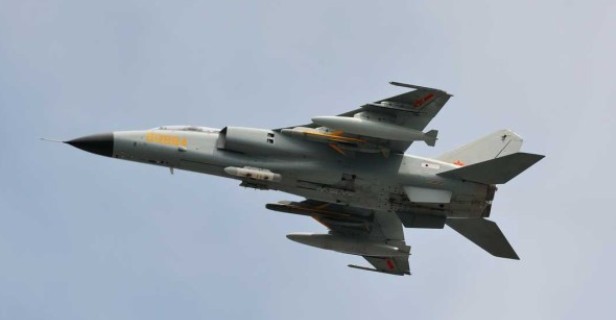
In the early 1970s, China was looking for a fighter-bomber to replace the H-5 (Il-28) and Q-5. Initially, China looked abroad for joint solutions, but when these efforts fell through, a program was started to develop a domestic design. Requirements soon emerged from the PLAAF and PLANAF requesting separate configurations. The PLAAF wanted side-by-side seating, terrain-following radar, and an extensive ECM suite, while the PLANAF requested tandem seating, all-weather performance, and reconnaissance capabilities. The PLAAF variant would be dropped fairly early on and by the end of 1988, Xian had developed a two-seat design with a shoulder mounted wing, powered by two Rolls-Royce Spey engines. While it was equipped with a powerful radar capable of tracking both aircraft and ships, the original design lacked any significant air-to-air capabilities. The aircraft was not without its teething issues. Flight testing was filled with major (often near catastrophic) malfunctions. The first flight ended early when violent vibrations shook off the majority of the cockpit instrumentation, and later tests ended when massive fuel leaks almost caused the aircraft to run out of fuel in flight. When the aircraft began operational evaluations, one aircraft lost its entire rudder in flight, making a successful emergency landing. Despite all of the issues, the PLAAF soon requested its own variant of the JH-7. Designated the JH-7A, the new aircraft was to have a stronger airframe and higher payload than the JH-7 and the capability to deploy various precision-guided weapons.
JH-7
After extensive testing and redesigns, JH-7s began to enter service with the PLANAF and PLAAF in 2004. Over 200 have entered service, providing the Chinese with a fairly capable replacement to their MiG-19-derived Q-5s. JH-7As continue to be upgraded with systems such as a newly developed helmet-mounted sight. Meanwhile, the Chinese are working on a more extensive upgrade to the design, designated the JH-7B. The JH-7B is to feature upgraded avionics, a reduced frontal RCS, aerial refueling capabilities, and upgraded engines producing 15% more thrust. Plans called for the JH-7B to enter production in 2015.
Xian JH-7A
China revealed a 20-year-old fighter/bomber at the Air Show China ‘98, held at Zhuhai. The aircraft, the FBC-1 Flying Leopard, is an export version of the JH-7 twin-seat strike fighter and actually flew in 1989, though its development programme dates back to the 1970s. This was the first time the aircraft has been flown in public. The aircraft was developed by the Xian Aircraft Design and Research Institute (ADRT) and is capable of Mach 1.7, and has a range of 890 nm.















 All Aero