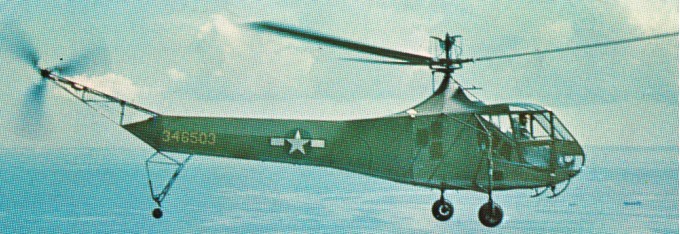
Sikorsky VS-316A / S-47 / R-4 Hoverfly / HNS / H-4

R-4B

In 1941, the Vought Sikorsky Division of United Air¬craft was awarded a development contract for an experimental helicopter, designated XR 4. With an uncovered fuselage, it featured the first tail rotor configuration.

Sikorsky VS-316A / S-47 / R-4 Hoverfly Article

Designed by Igor Sikorsky and Michael Gluhareff, the prototype VS-316A first flew on 14 January 1942. The sole prototype (41-18874) was the first helicopter built expressly for military service (USAAF).

Sikorsky XR-4 41-18874

The XR-4 was delivered by air with Sikorsky along as a passenger. During the trip, they hovered low to read highway signs and once asked an astonished motorist for directions to the Army airfield. It arrived at Wright Field, Ohio, on 18 May 1942, having completed, in stages, the 1225km trip from Bridgeport, Connecticut, in 16 hr 10 min flying time.

It became XR-4C in 1943.
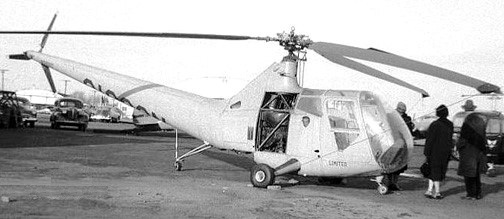
Sikorsky VS-316 NX28996

The Sikorsky R-4, or VS-316A, was a definitive development of Igor Sikorsky’s successful pre-war VS-300. Like the VS-300, it had a framework of heavy-gauge steel tube, and all but the extreme rear end of the fuselage was fabric-covered, as were the 10.97m diameter main rotor blades. It retained the single three-¬blade rotor and anti torque rotor of the VS 300, driven through transmission shafts and gearboxes. A completely new feature was the fully-enclosed cabin, with side-by-side seating and dual controls for the 2-man crew.
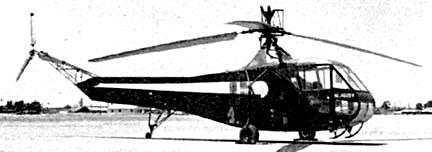
Sikorsky VS-316A

Les Morris, was the Chief Test Pilot on the Sikorsky VS-300 starting in March, 1941 (and on the XR-4, XR-5 and XR-6 which followed).

An experimental R-4 was fitted with a tilting tail rotor.

Later in 1942 an order was placed for three service test YR-4A’s (42-107234 to 107236) with 180hp R-550-1 engines and main rotors of 11.58m diameter, and similar changes were made to the XR-4 in 1943, after which it was redesignated XR-4C.

These were generally similar to the XR-4 except for an enlarged cabin, and were used inter alia for winterisation and tropical trials in Alaska and Burma. The first helicopter in the history of warfare were used during Operation Thursday, Burma, in 1944. They were Sikorsky R-4Bs. With a range of about 75 miles and cruise of 75 mph, they were used to transport wounded Chindits out of the stronghold.

Other 1943 developments included the first-ever landing by a helicopter on a ship at sea (by Colonel Frank Gregory on 7 May 1943) on the tanker Bunker Hill in Long Island Sound, USA, and the production of twenty-seven pre-series YR-4B’s for further evaluation by the USAAF, the U.S. Navy (three), U.S. Coast Guard (three) and the RAF (seven). The Navy designation was HNS.
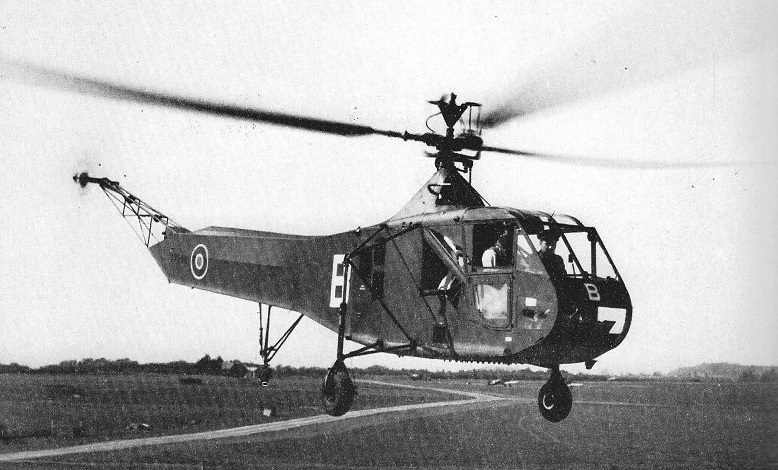
RAF R-4 1945

Thirty production machines (YR-4As and YR-4Bs) were ordered in total.

In 1944 the R-4 became the first helicopter in the world to be placed in series production.

Twenty-seven YR-4B were produced, 42-107237/107248, 43-28223/28235, -28247, -47953, of which 3 to USCG and 7 to Great Britain as Hoverfly I. Additionally, 15 were produced for USN as HNS-1. They were fitted with bomb racks for anti-sub duty.

Three YR-4Bs and 22 R-4Bs were transferred from the USAAF as HNS-1 (39033 to 39052, 46445, 46699 to 46700, and 75727 to 75728).
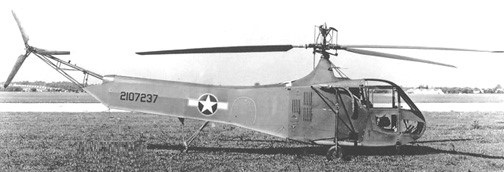
Sikorsky YR-4B 42-107237

One hundred production R-4B’s were built, 43-46500 to 46599, similar to the YR-4B except for a more powerful engine; thirty-five were delivered to the USAAF for observation and liaison duties, and twenty to the U.S. Navy as HNS-1 reconnaissance and air/sea rescue aircraft. Twenty or twenty-two went to USCG as HNS-1 and 45 to RAF. The US Navy established its first helicopter squadron, VX-3, at Floyd Bennett Field NAS.

The YR-4B were redesignated as YH-4B in 1948.
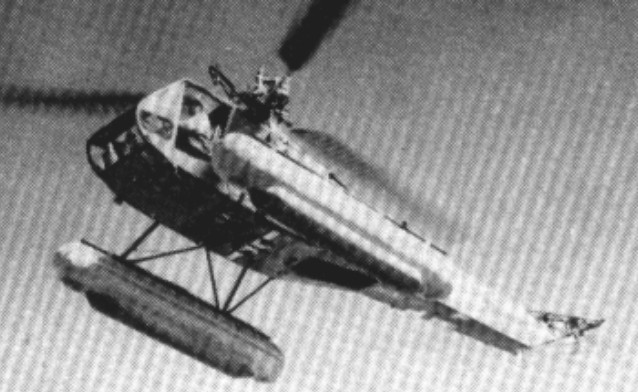
HNS-1

The remaining forty-five were supplied to Great Britain under Lend-Lease, most of them going to the Royal Navy. The R-4B was known in British service as the Hoverfly I. In the RAF the Hoverfly I replaced the Rota (Cierva C.30A) autogiros of No.529 Squadron from August 1944, and some were supplied to the Helicopter Training School at Andover early in 1945. By the end of the year the type had passed out of RAF service, some aircraft being allocated for radar calibration work with the Telecommunications Research Establishment; others undertook snow and flood reporting duties, and one was allocated to the King’s Flight to carry mail and freight. The Joint Experimental Helicopter Unit, established in 1954, was equipped initially with R-4B and R-6A helicopters handed on from the Royal Air Force and Fleet Air Arm.

A U.S. Navy HNS-1 was flown by the Coast Guard, which was given responsibility for Navy helicopter development and operations during World War II. A float-equipped HNS-1 operated the icebreaker Northwind (AG-89) during Rear Admiral Richard E. Byrd’s 1947 expedition to the Antarctic.

USCG Northwind March 1947 Wellington New Zealand – Grumman J2F-6 Duck & Sikorsky HNS-1 BuNo 39043, the first helicopter to fly in New Zealand

It was not long before Sikorsky’s predictions about the lifesaving capabilities of the helicopter came true. U.S. Coast Guard Cdr. Frank Erickson flew the R-4 on the first helicopter mercy mission in January 1944, delivering blood plasma for injured sailors after an explosion occurred aboard a U.S. Navy destroyer outside of New York City’s harbor.

The first helicopter rescue during combat occurred in March 1944. Army Air Corps Lt. Carter Harman flew an R4 in Burma to rescue four men from behind enemy lines.

A Navy-Coast Guard HNS-1 was “stuffed” into a C-54 transport of the Air Transport Command at the Coast Guard air station in Brooklyn, N.Y. The helicopter was flown 1,000 miles on 29 April 1945, to Goose Bay, Labrador. It was then reassembled and rescued 11 Canadian airmen from two separate crashes in rugged territory, carrying them to safety one man per flight.

The first civilian helicopter rescue took place in November 1945, in Long Island Sound near Fairfield, Conn. An Army R-5 flown by Sikorsky pilot Viner rescued two men from an oil barge during a storm.
The R-4 did not enjoy a long service career, either in Britain or the United States, being supplanted in the early post-war years by the Sikorsky S-51 and its British-built equivalent, the Westland Dragonfly. Those still in American service were redesignated H-4B in 1948.

By the time production switched to the improved R-5/S-51 series, a total of 130 Sikorsky R-4s had been built.

VS-316A / XR-4
Engine: 165hp Warner R-500-3
Main rotor: 36’0″
Length: 35’5″
Max speed: 102 mph
Cruise: 85 mph

XR-4C
Engine: 180hp R-550-1

YR-4A
Engine: 180hp R-550-1
Main rotor: 38’0″
Length: 35’5″
Max speed: 75 mph

YR-4B / YH-4B 1943
Engine: 180hp R-550-1
Main rotor: 38’0″
Length: 48’2″
Useful load: 515 lb
Max speed: 75 mph
Range: 130 mi
Ceiling: 8,000′

R-4B / H-4B
Engine: Warner R.550-3, 180 hp / 134kW
Rotor dia: 38 ft (11.58 m)
Fuselage length: 10.35 m
Length: 48 ft 2 in (14.68 m)
Height: 12 ft 5 in (3.78 m)
Empty weight: 952kg
Max TO wt: 2535 lb (1150 kg)
Max level speed: 75 mph (121 kph)
Max speed @ 1150 kg: 65 kts
Rate of climb: 3.3m/s
Seats: 2

HNS
Engine 180hp Warner R-550-3
Main rotor: 38’0″
Length: 35’5″
Max speed: 77 mph
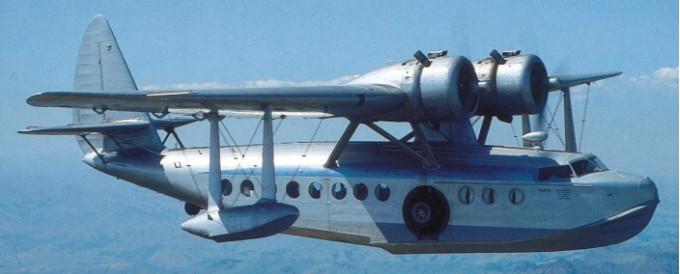
Sikorsky S-43 / JRS / OA-8 / OA-11

S-43H

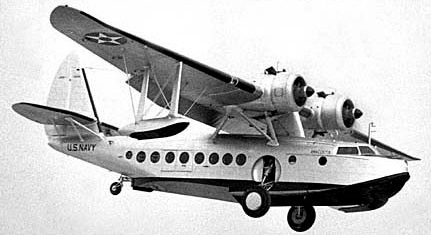
The S-43 was originally designed for a Pan American requirement for a twin-engined amphibian for secondary Latin American routes.

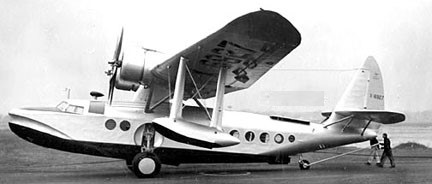
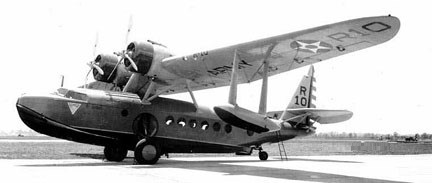
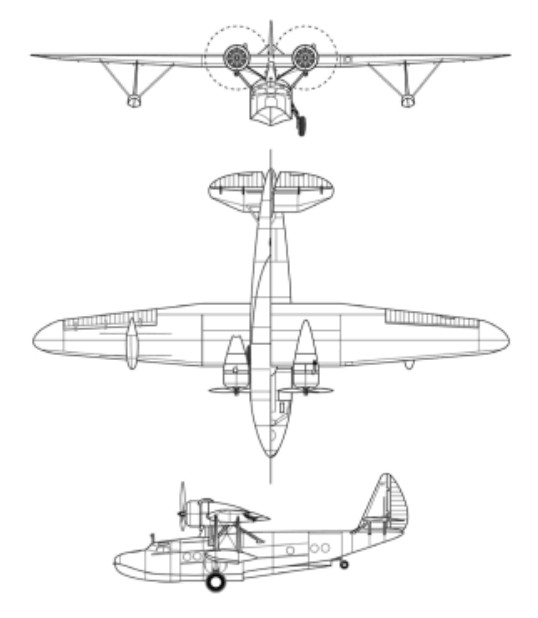
Essentially a scaled-down version of the S-42, the S-43 employed a single-step hull and a single tail group. The wing rested on a central pylon, supported on either side by N-struts. Wing flaps covering 48% of the span reduced the stall speed to 65 mph.

The S-42 had twin vertical tails. Many of the S-43s had the same arrangement, but some had a single tail. Biggest difference other than size and the S-43’s amphibious capabilities (although some S-43s were built as flying boats) were the powerplants, only two 750hp Pratt & Whitney Hornets on the S-43. The smaller airplane had a gross weight of 19,5001b (8,845kg) and could seat 16 to 24, depending on the legroom. Both transports were certificated in 1935.

After the first flight on 5 June 1935 (piloted by Boris Sergievsky), the first of fourteen S-43s delivered to Pan American (ATC 593) entered Latin American service in April 1936, though most were subsequently turned over to Panair do Brasil and other subsidiary operations.

Sikorsky Aircraft built 53 S-43 twin engined amphibians in the mid 1930s.

In 1938 Pan American used one of its S-43s on survey flights for planned route extensions to Alaska.

Additionally, four were sold Inter-Islan Airways Airways (later renamed Hawaiian, Airlines) in the Hawaiian Islands, four to Aeromaritime – an Air France affiliate, in West Africa, KLM’s Netherlands East Indies associate, and one to DNL-Norwegian Airlines.

Twenty-two amphibians were delivered as S-43s (NC15061-15068, NC16925, NC16928, NC16934, and NC20698), plus one S-43-A and three S-43-Bs (NC16926-16927, and NC16931-16933) with minor detail changes.

Sikorsky S-43-B NX16927

Three delivered in 1937-8 for inter-island operations in the Phillipines were registered as S-43-W’s (ATC 623) with a one-foot fuselage extension and Cyclone engines, plus one as the S-43-WB witthout amphibious landing gear (NC16929-16930, and PK-AFT, PK-AFU). Two S-43s were custom built in 1937 as personal transports, one to Howard Hughes and another to Harold Vanderbuilt.

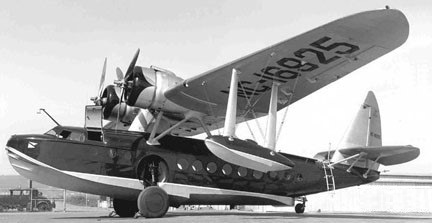
Sikorsky S-43 Harold Vanderbilt 1938 flying yacht NC16925

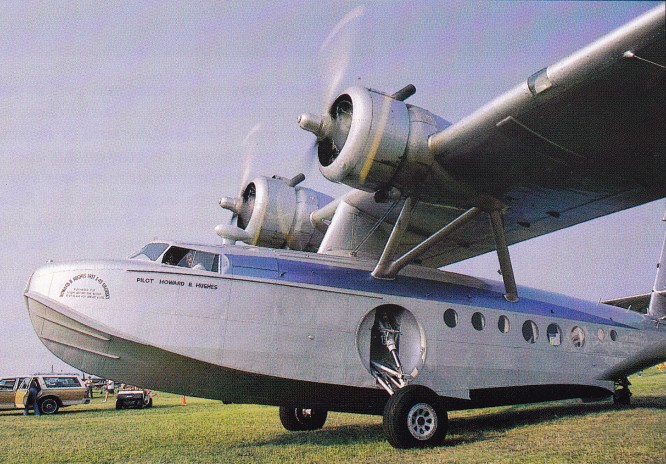
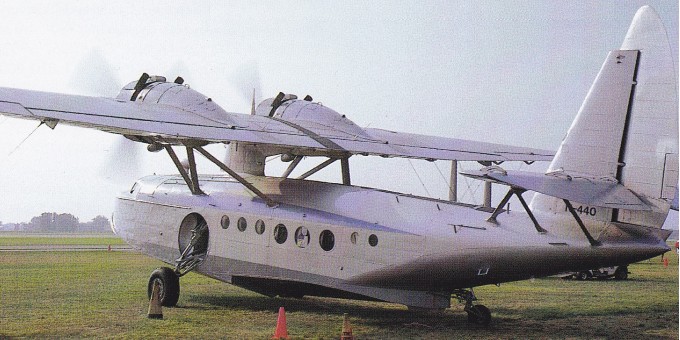
One ‘Baby Clipper’ was ordered in 1937 by Howard Hughes especially equipped for a proposed 1938 around the world flight. Registered NR440, it was fitted with larger 900hp Wright GR-1820 Cyclone radials and additional fuel tanks in the cabin. However, it proved too slow and Hughes made his flight in a Lockheed 14.

Hughes had a mishap with his S-43H, modified with twin tails in 1941, flying NC440 into Lake Mead, Nevada, in May 1943 while practicing alightings in preparation for flying the HK4 Hercules flying boat. Raised by a US Navy diving team, the airplane was rebuilt as a S-43W with a single tail, fitted out as a ten-seat executive transport. Manufacturer’s serial number 4327 served only briefly in this capacity and spent most of its time in storage at Hughes Tool Co in Houston TX until 1977.

Ronald Van Kregten, an acquaintance of both Hughes and lgor Sikorsky, purchased the S-43 from the Hughes estate in 1977 and restored it essentially to its executive configuration, obtaining certification. The airplane was based at Houston. Van Kregten planned to flying it occasionally to air shows.

Between 1937 and 1939 the Navy acquired seventeen S-43s that entered service under the designation JSR-1 (0504-0506, 1054-1063, and 1191-1194), two being assigned to the Marine Corp.

Sikorsky JRS-1 0505

During the same time, five were delivered to the US Army Air Corp as the Y10A-8, 37-370 to -374, and in 1942, a commercial S-43, after being re-equipped with 875 hp R-1690-S2C engines, was impressed into the USAAF as OA-11 serial 42-01 VIP transport.

Sikorsky Y1OA-8

Military craft remained in service throught World War II. One S-43 was sold to the Soviet Union and several ex-Pan American examples were used in Brazil along the rubber river routes. Reeve Aleution Airways acquired an S-43 which it operated in Alaska and Catalina Island until the early 1960s.

One (a JRS) was in storage at the National Air & Space Museum’s facility at Silver Hill, Maryland.

Gallery

S-43
Engine: 2 x 750hp Pratt-Whitney R-1680-52 Hornet
Props: 3 blade variable pitch, metal
Wingspan: 26.21 m / 86 ft 0 in
Length: 15.60 m / 51 ft 2 in
Height: 5.38 m / 18 ft 8 in
Wing area: 781 sq.ft
Empty weight: 12,750 lb
Max take-off weight: 8662 kg / 19097 lb
Max. speed: 306 km/h / 190 mph
Cruise speed: 167 mph
Ceiling: 6310 m / 20700 ft
Range: 1247 km / 775 miles
Crew: 3-4
Passengers: 15

S-43
Engine: two 750hp P&W Hornet
Wingspan: 86’0″
Length: 51’2″
Useful load: 6750 lb
Max speed: 194 mph
Cruise: 167 mph
Stall: 65 mph
Range: 775 mi
Ceiling: 17,500′
Passengers: 16-25

S-43-A
Engine: two 750hp P&W Hornet
Wingspan: 86’0″
Length: 51’2″
Useful load: 6750 lb
Max speed: 194 mph
Cruise: 167 mph
Stall: 65 mph
Range: 775 mi
Ceiling: 17,500′
Passengers: 16-25

S-43-B
Engine: two 750hp P&W Hornet
Wingspan: 86’0″
Length: 51’2″
Useful load: 6750 lb
Max speed: 194 mph
Cruise: 167 mph
Stall: 65 mph
Range: 775 mi
Ceiling: 17,500′
Passengers: 16-25

S-43-H
Engine: two 750hp P&W Hornet
Wingspan: 86’0″
Length: 51’2″
Useful load: 6750 lb
Max speed: 194 mph
Cruise: 167 mph
Stall: 65 mph
Range: 775 mi
Ceiling: 17,500′
Passengers: 16-25

S-43-W
Engines: two 760hp Wright Cyclone
Wingspan: 86’0″
Length: 52’3″
Useful load: 6040 lb
Max speed: 186 mph
Cruise: 177 mph
Stall: 65 mph
Range: 775 mi
Passengers: 19-25

S-4-WB
Engines: two 760hp Wright Cyclone
Wingspan: 86’0″
Length: 52’3″
Useful load: 6040 lb
Max speed: 186 mph
Cruise: 177 mph
Stall: 65 mph
Range: 775 mi
Passengers: 19-25

JRS-1
Engines: 2 x P&W R-1690-23, 750 hp
Wingspan: 86’0″
Length: 52’1″
Max speed: 185 mph
Ceiling: 20,700′
Seats: 2-12

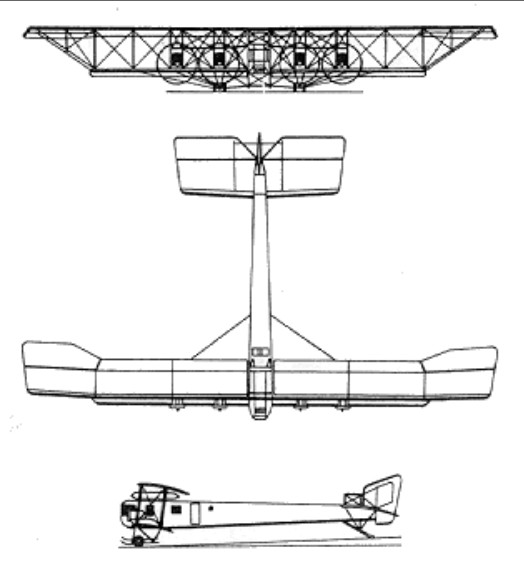
Sikorsky S-22 Ilya Mourometz

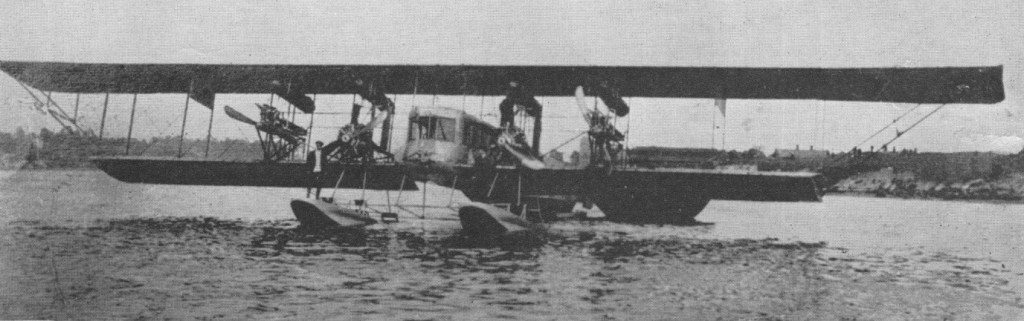
In August 1913 a military Voisin biplane broke up in the air over the airfield and its engine fell onto the Grand. Sikorsky subsequently redesigned the aircraft as the Ilya Muromets which was even bigger. Its wing span was 10 ft greater than that of Le Grand and it weighed 10,000 lb.

A four bay biplane with braced extensions of upper wings. With two spar wooden wings and wooden fuselage, all fabric covered, ailerons were fitted to the top wings.

The first flight of Ilya Mourometz No. 1, in January 1914, was made with a skid undercarriage. On 11 February 1914 this machine set a new world record by carrying aloft 16 people and a dog. A familiar picture of it shows the big biplane landing with two fur-coated passengers taking a stroll along its fuselage top promenade. Five months after the first flight, it flew several times as a seaplane.

With the threatened outbreak of hostilities ten were purchased by the Russian Army for military trials.

The Ilya Muromets went into production as a heavy bomber for the Imperial Russian Air Service Eskadra Vozdushnykh Korablei (Squadron of Flying Ships) built at the Russo-Baltic Wagon Works. Seventy three were built, and few of these production aircraft were identical, improvement and developing being continuous, and short engines meant they were flown with a variety of powerplant which, in some cases, involved a mix of engines on one aircraft.

The first version used in combat was the Type B, with Salmson engines of 135-200 hp and an armament of only two machine guns. The largest of the series was the Type IMYe2, with a wingspan of 34.50m and a gross weight of 7,000kg.

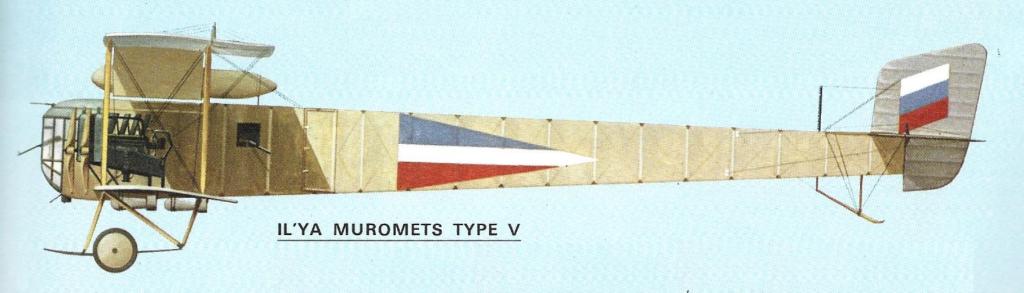
After experimenting with various types of armament and bomb racks it was found to be too slow and with limited altitude for offensive purposes. Sikorsky designed a lighter version, the Il’ya Muromets Type V, and deliveries of these began in early 1915.

Ilya Muromets E

Sikorsky S-22 Il’ya Murometz Article

They were so effective on more than 400 bombing raids against Germany and Lithua¬nia in 1915 that Great Britain and France sought permission from Czar Nicholas II to produce the design under licence, though nothing came of the scheme before the 1917 Russian Revolution sent Sikorsky fleeing to the United States.

They made 400 successful raids for the loss of only one aircraft, shot down by German fighters after it destroyed three of the enemy aircraft.

Engines: 4 x Argus, 100 hp
Wingspan: 30.9/22.0 m / 101 ft 5 in / 72 ft 2 in
Length: 17.1 m / 56 ft 1 in
Wing area: 148.0 sq.m / 1593.06 sq ft
Max take-off weight: 5100 kg / 11244 lb
Max. speed: 110 km/h / 68 mph
Range: 600 km / 373 miles
Armament: 8 machine-guns, bombs
Crew: 10

Ilya Muromets E
Engines: 4 x Renault, 200 hp
Props: 2 blade
Wingspan: 102 ft 8 in
Wing area: 20050 sq.ft
Length: 59 ft 8 in
Empty weight: 10,600 lb
MTOW: 17,600 lb
Max speed: 85 mph at 5000 ft’
Endurance: 4 hr
Armament: up to 7 mg
Bombload: 1000-1500 lb

Sikorsky IM-W Ilya Muromet
Engine: 4 x Argus, 138 hp
Length: 56.102 ft / 17.1 m
Wingspan: 97.769 ft / 29.8 m
Wing area: 1345.5 sq.ft / 125.0 sq.m
Max take off weight: 9812.3 lb / 4450.0 kg
Max. speed: 67 kts / 125 km/h
Service ceiling: 12139 ft / 3700 m
Wing loading: 7.38 lb/sq.ft / 36.00 kg/sq.m
Endurance: 5 h
Crew: 5
Armament: 3-7x MG, 700kg Bomb.

Sikorsky S-22 Ilya Muromet

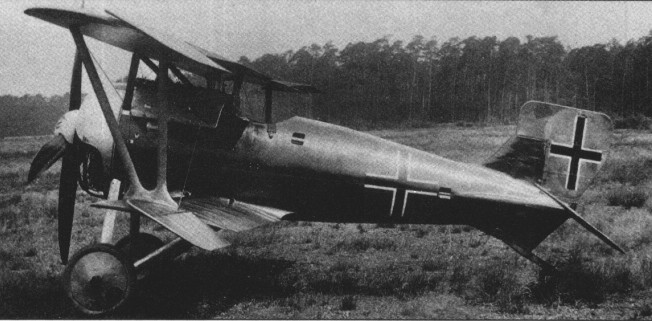
Siemen Schkukert D-IV

The D III was followed by the D IV, which introduced much aerodynamic refinement for slightly higher speed and still better climb rate. A total of 280 were ordered, but less than 140 D IVs were completed, most entering service after August 1918.

D IV
Engine: l x Siemens-Halske Sh.IIIa, 119kW (l60hp)
Span: 8.35m (27ft 4.75in)
Length: 5.7m (18ft 8.5 in)
Max TO weight: 735 kg (1,620 lb)
Max speed: 119 mph
Operational endurance: 2 hr
Armament: 2 x 7.92-mm (0.312-in) LMG 08/15 mg

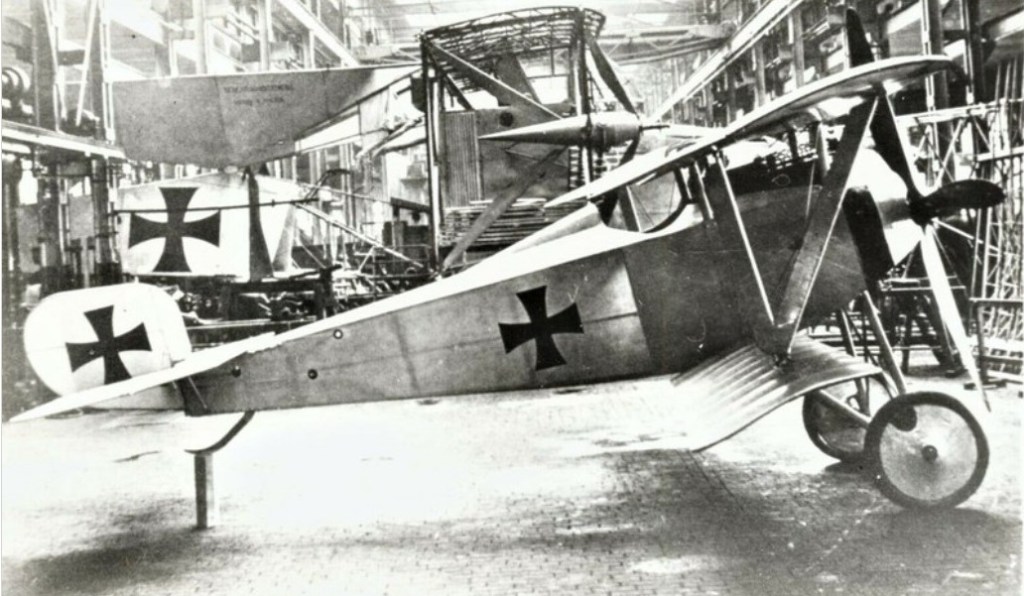
Siemen Schkukert D-II / D-III

Via the D II prototype Siemens-Schuckert then moved to a completely German design, ordered late in 1917 as the D III equal-span biplane with the 119-kW (160-hp) Siemens-Halske Sh.III rotary engine whose diameter dictated the circular section of the compact fuselage that tapered sharply into the empennage with its large tailplane and angular vertical surfaces. After the teething problems of this engine had been cured, the 50 D IIIs matured as extremely fast-climbing interceptors whose other performance figures were low.

Siemens-Schuckert D-III Article

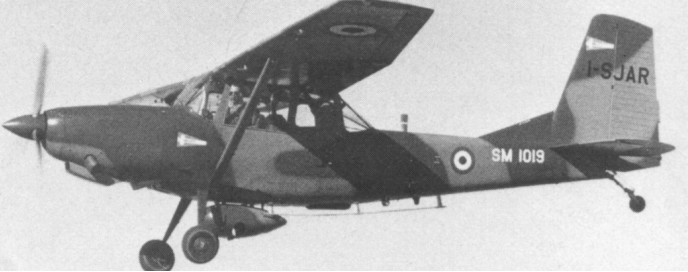
Savoia-Marchetti SM.1019

SM.1019

The Cessna O-1 provided the basis for the Italian development of a turboprop version. A two-seat STOL light monoplane powered by a 298kW Allison 250-B17 turboprop engine, the prototype first flew on 24 May 1969.

Savoia-Marchetti SM.1019 Article

The SM 1019 was evaluated by the Italian Army Light Aviation, which ordered 80 SM.1019E1s, under the designation AL-2. Optional armament or equipment is carried on two underwing hardpoints.

Engine: Allison 250-B15G, 317 shp
Wingspan: 10.97 m / 36 ft 0 in
Max. speed: 280 km/h / 174 mph

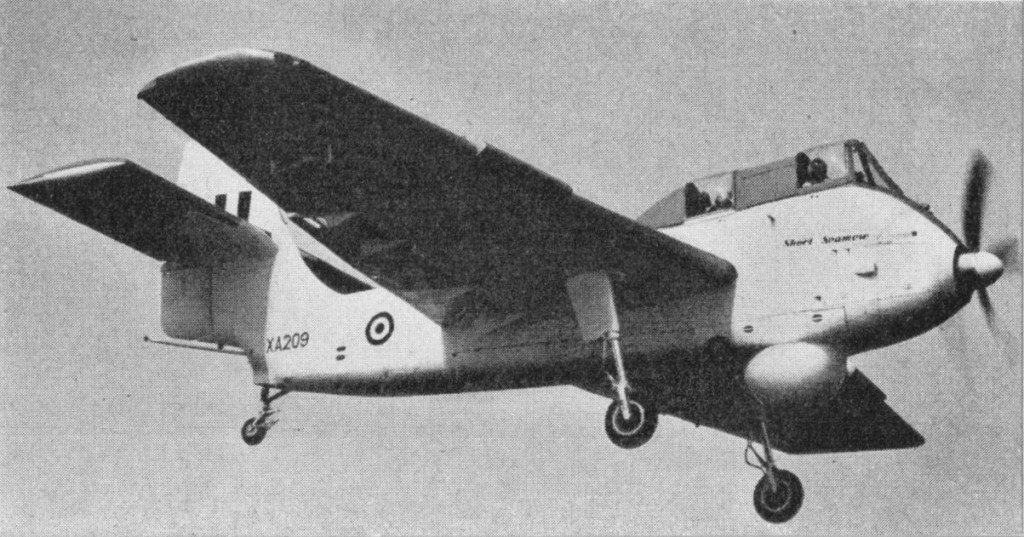
Short S.B.6 Seamew

The Seamew was conceived as a cheap, rugged anti-submarine aircraft able to operate from small carriers used by the UK and some other allied nations. To this end it was built with a fixed landing gear and a strong structure. The fixed undercarriage legs could be jettisoned in the event of a ditching at sea. The need to house a large search radar under the belly led to the adoption of a tailwheel undercarriage layout. Despite this, the prototype was badly damaged on its first landing, although it was repaired in time for the Farnborough Air Show.

The Mamba powered anti submarine Short Seamew with 1,590 s.h.p. underwent intensive development with two prototypes. The higher lift characteristics at slow speeds for operation from escort type carriers have been improved by the installation of fixed slats at the mid span of each wing, while the slat under the inner tailplane leading edge was replaced by a vented fillet. The Seamew can power fold its wings and extended them.

In handling terms the Seamew was described as having some ‘vicious tendencies’. It was capable of aerobatics, but the chief test pilot seemed to be the only one able to wring the full manoeuvrability out of the Seamew – until he stalled the prototype Mk.2 during a display and was killed.

Production began for RAF Coastal Command and the Royal Navy, but the RAF order was cancelled in 1956 and the Navy’s was a victim of the defence cuts of the following year. The Mk 2 was a version for Coastal Command with larger wheels and manual wing folding. It was cancelled after rwo were completed.

Short SB-6 Seamew AS1

S.B.6 Seamew
Engine: 1 x 1780hp Armstrong Siddeley Mamba turboprop
Max take-off weight: 6804 kg / 15000 lb
Wingspan: 16.75 m / 55 ft 11 in
Length: 12.50 m / 41 ft 0 in
Max. speed: 378 km/h / 235 mph
Crew: 2

Short S.29 Stirling

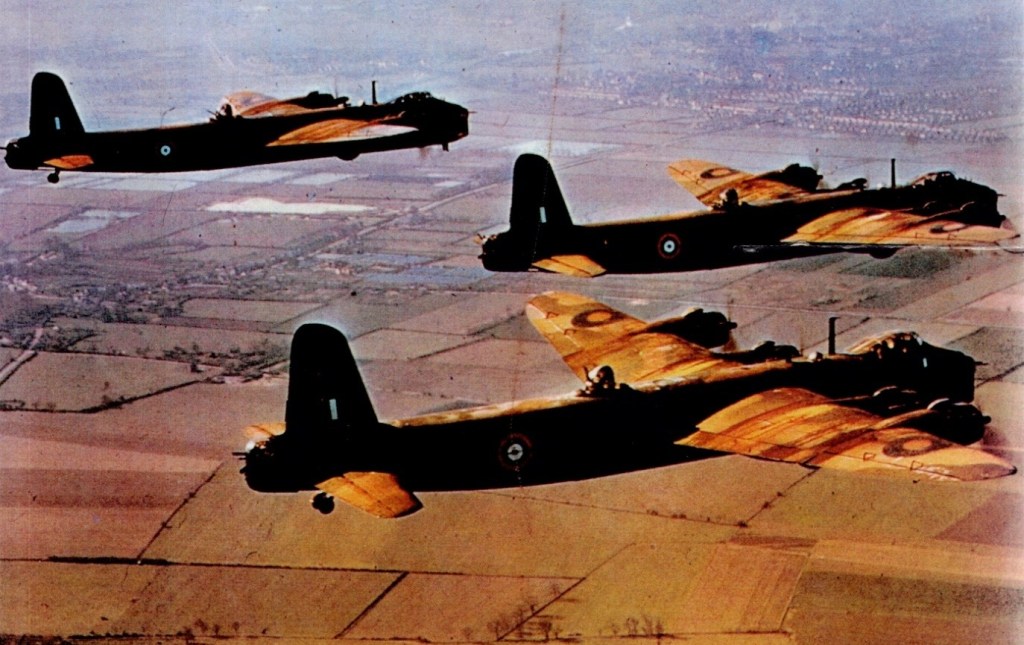
Stirling III

In 1936 the RAF also decided to investigate the feasibility of the four-engined bomber. The Air Ministry Specification B.12/36 had several requirements. The bomb load was to be a maximum of 14,000 lb (6,350 kg) carried to a range of 2,000 miles (3218 km) or a lesser payload of 8,000 lb (3,629 kg) to 3,000 miles (4,800 km) (incredibly demanding for the era). It had to cruise at 230 or more mph at 15,000 ft (4,600 m) and have three gun turrets (in nose, amidships and rear) for defence. The aircraft should also be able to be used as a troop transport for 24 soldiers, and be able to use catapult assistance for takeoff. The idea was that it would fly troops to far corners of the British Empire and then support them with bombing. To help with this task as well as ease production, it needed to be able to be broken down into parts, for transport by train. Since it could be operating from limited “back country” airfields, it needed to lift off from a 500 ft (150 m) runway and able to clear 50 ft (15 m) trees at the end, a specification most small aircraft would have a problem with today.

Short Stirling Article

Initially left out of those asked to tender designs, Shorts were included because they already had similar designs in hand and they had ample design staff and production facilities. Shorts were producing several four-engined flying boat designs of the required size and created their S.29 by removing the lower deck and boat hull of the S.25 Sunderland. The new S.29 design was largely identical otherwise: the wings and controls were the same, construction was identical and it even retained the slight upward bend at the rear of the fuselage, originally intended to keep the Sunderland’s tail clear of sea spray.

In October 1936, the S.29 was low down on the shortlist of designs considered and the Supermarine Type 317 was ordered in prototype form in January 1937. However it was decided that an alternative design to Supermarine was needed for insurance and that Shorts should build it as they had experience with four-engined aircraft. The original design had been criticized when considered and in February 1937 the Air Ministry suggested modifications to the original Short design, including considering the use of the Bristol Hercules engine as an alternative to the Napier Dagger, increasing service ceiling (28,000 ft) and reducing the wingspan. Shorts accepted this large amount of redesign. The project had added importance due to the death of Supermarine’s designer causing doubt in the Air Ministry. The S.29 used the Sunderland’s 114 ft (35 m) wing and it had to be reduced to less than 100 ft (30 m), the same limit as that imposed on the P.13/36 designs (Handley Page Halifax and Avro Manchester). In order to get the needed lift from a shorter span and excess weight, the redesigned wing was thickened and reshaped. It is often said that the wingspan was limited to 100 ft so the aircraft would fit into existing hangars. “The wing span was limited by the Air Ministry to 100 ft” but the maximum hangar opening was 112 ft (34 m) and the specification required outdoor servicing. The limitation was to force the designer to keep overall weight down.

The original layout of the bomber was tried out by the construction of a half-scale model S.31 fitted with four 97kW Pobjoy engines. Flying trials with this proved the feasibility of the design. Short had originally decided on an incidence of 3° giving the best possible cruise performance, but the RAF asked that the incidence be increased to 6.5°, being more concerned with improving take-off performance than the cruising speed. In order to accommodate the RAF request for increased wing incidence a major re-design of the central fuselage would have normally be undertaken, but because of time restraints, Short decided on a “quick fix” by lengthening the main landing gear legs to give a higher ground angle.

At the end of 1938, this change was incorporated on the Short S.31 prototype.

While testing with the S31/M4, construction began on two full size prototypes now officially known as the Stirling MkI/P1. Shortly after construction of the prototypes began, the Air Ministry decided to order the Stirling into production with a contract of 100 Stirling MkI’s as the second string for the Supermarine 316 and formally ordered in October. 1938. The prototype S29 was rolled out of the company’s Rochester factory on 13 May 1939.

Given the RAF serial number L7600, the prototype made its maiden flight on 14 May 1939 (with four Bristol Hercules II engines). After a graceful takeoff and short test flight it suffered an undercarriage failure on landing and was damaged beyond repair. The failure was traced to the light alloy undercarriage back arch braces which were replaced on succeeding aircraft by stronger tubular steel units.

The second prototype (L7605) was fitted with the strengthened undercarriage and made its maiden flight on 3 December 1939. For this flight the gear was left down, but happily for both Short and the RAF, the revised undercarriage held up when put to the tests of retraction, lowering and landing. During the spring of 1940, the prototype spent four months undergoing service tests at Boscombe Down.

Deliveries of production aircraft to the RAF began in August 1940. It was built initially by the parent firm at Rochester and by Short and Harland at Belfast, where the Air Transport Auxiliary (ATA) opened No.8 Ferry Pool (FP) to clear them.

The first production version for the RAF was the Stirling I powered by four 1185kW Bristol Hercules XI radial engines and without a dorsal turret fitted. First in action in February 1941, the Stirling carried 7 tons of bombs for 590 miles, and was armed with eight machine guns. It went into service with 7 Squadron at Leeming in August 1940, and remained in production throughout the war. Prior to its first operational sortie, ATA is recorded as having ferried 12.

Both the factories were bombed in the summer of 1940, after which production was further distributed to the Austin Motors shadow factory at Longbridge, Birmingham, and to a new Shorts factory at South Marston, Swindon.

The Stirling II, only a few of which were completed, was a conversion of the Mk I with Wright R-2600-A5B Cyclone engines. The Mk III had four 1,230kW Bristol Hercules XVI engines and featured a mid-upper turret.

In order to train pilots on the new aircraft, each Stirling squadron formed its own conversion flight and in December 1941, a training unit was created at Thruxton with the specific purpose of training ATA pilots who would have to ferry them. This unit moved to Hullavington in May 1942, to Marharn in August and to Stradishall in October.

When by 1943 the output of heavy bombers had risen to over 400 a month, more ATA four-engined rated pilots were urgently needed to move them. When in February 1943 an ATA Halifax training unit, which had been opened at Pocklington stood down, to fill the gap in four-engined training, ATA reverted to a previous arrangement for its pilots to be given conversion courses with 1647 Stirling Conversion Unit at Stradishall.

From 1943, when the Stirling was no longer a suitable bomber, unlike the Mk III, the Stirling IV was produced from new as a long-range troop transport and glider tug (Horsa glider), the nose and upper turrets being removed and replaced by fairings, although the four-gun tail turret was retained. Up to 24 paratroops or 34 airborne troops could be carried. The final version of the Stirling was the Mk V, an unarmed military transport and freighter with a redesigned nose.

Total production of the Stirling – the Mk III of which was the major variant – was about 2,380.

On the night of 7-8 April 1945, RAF Stirlings of 38th Group dropped two battalions of French parachutists, including both regular soldiers and members of the French Resistance, into Holland south of Groningen. The aim was to support the advance of the Canadian Second Division.

Gallery

Stirling I
Max speed: 260 mph
Range: 1930 miles
Crew: 7/8
Armament: 8 x .303 Browing mg
Bombload: 14,000 lb

Stirling Mk III
Engines: 4 x Bristol Hercules XVI, 1230kW / 1627 hp
Max take-off weight: 31751 kg / 69999 lb
Empty weight: 19595 kg / 43200 lb
Wingspan: 30.2 m / 99 ft 1 in
Length: 26.59 m / 87 ft 3 in
Height: 6.93 m / 23 ft 9 in
Wing area: 135.63 sq.m / 1459.91 sq ft
Max. speed: 235 kt / 435 km/h / 270 mph
Cruising Speed: 200mph (323kmh)
Service ceiling: 5180 m / 17000 ft
Max range: 1747 nm / 3235 km
Range w/max.payload: 950 km / 590 miles
Range: 2,010 miles (3,242km) with 3,500lb (1,589kg) bombload
Armament: 8 x .303in / 7.7mm machine-guns
Max. bomb load: 14,000 lb / 6,350 kg
Crew: 7-8

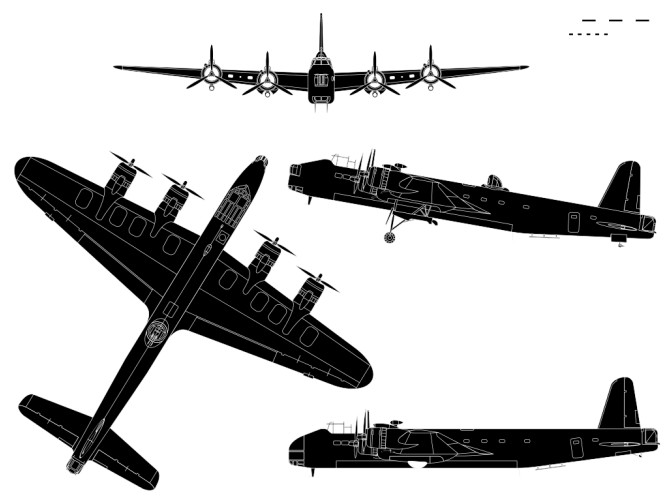
Short S.29 Stirling