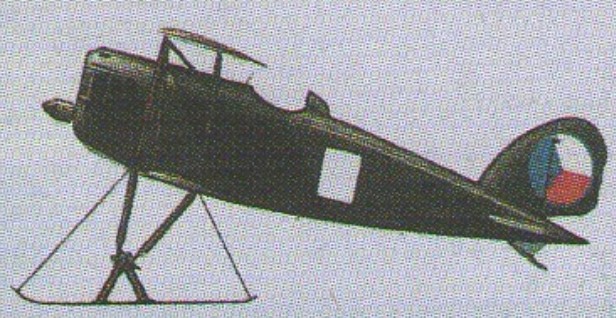
First Czech fighter in service.
Operated in the Czech fighter school in 1930.
First Czech fighter in service.
Operated in the Czech fighter school in 1930.
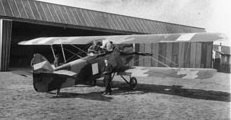
The Aero A-11 type came into existence by fitting a 240 hp Walter W-IV engine in the Aero 12 airframe. This aircraft was being built until 1930 year and used by the Czechoslovak Air Force in recce-, training- ground attack- and bomber versions. Observer armed by one rearward-firing machine gun and pilot by a fixed synchronized one.
The Aero A.11 was for the Czech Army Air Force in the interwar years between World War One and World War Two. The A.11 was designed from the outset as a multi-purpose airframe and would see no fewer than 20 different variant types since first flying in 1923.
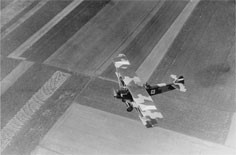
The A.11 pilot and gunner sat in tandem along the box-type fuselage. The biplane wing structure was fitted just in front and around the pilot’s position with the single liquid-cooled engine mounted forward. A single .303 caliber machine gun was fitted for self defence.
The Aero A.11 was seen in its typically reconnaissance platforms but was adept to day or night bombing. Other notable variants would go on to include a target tug (in the form of the A.29) and several day and night bombers of similar design.
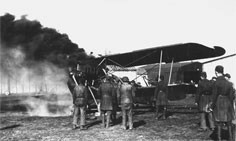
The A.29 target-tug variant would also form the basis for the first Czech sea-operating float plane.
440 were built.
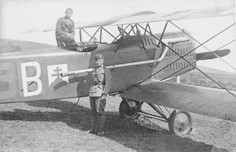
Aero A.11
Engine: 1 x Walter W.IV 8-cylinder liquid-cooled, 240hp
Length: 26.90 ft (8.2 m)
Span: 41.90 ft (12.77 m)
Height: 10.17 ft (3.10 m)
Empty Weight: 3,263 lbs (1,480 kg)
Maximum Speed: 133 mph (214 kmh; 116 kts)
Maximum Range: 466 miles (750 km)
Service Ceiling: 23,600 ft (7,193 m)
Range: 750 km
Armament: 1 x 7.62 mm machine gun
Accommodation: 2
Aero A.12
Engine: Maybach Mb-IV, 240 hp
Span: 12.80 m
Length: 8.34 m
Empty weight: 1080 kg
Maximum speed: 200 kph
Service ceiling: 7500 m
Range: 760 km
Armament : A fixed synchronized machine gun and one firing rearward
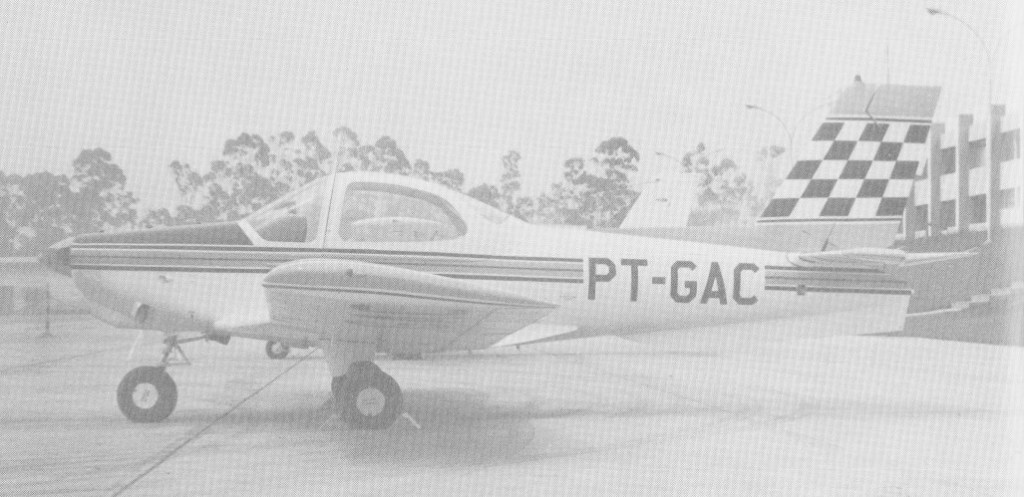
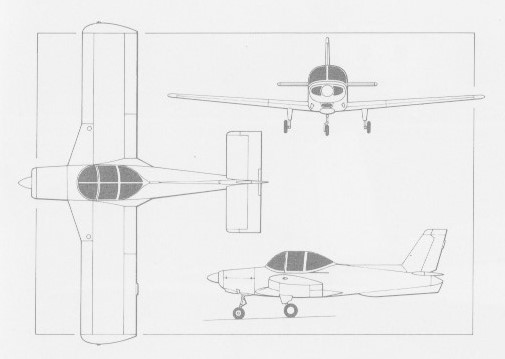
The Aerotec A-122 Uirapuru 2 seat Brazilian military trainer aircraft first flew on 2 June 1965, powered by a 108 hp Lycoming O-235-C1 engine. A second followed powered by a 150 hp Lycoming O-320-a and was offered to the Brazilian Air Force as a replacement for its locally built Fokker S.11 and S.12 basic trainers. Thirty Uirapurus were ordered for this purpose early in 1968 under the military designation T-23. 40 more were ordered in 1969. They have a 160 hp Lycoming O-320-B2B and differ from the civilian model in having fully-adjustable seats, stick controls, a nose wheel the same size as the mains, and a modified cockpit canopy in which only the centre portion slides rearward.
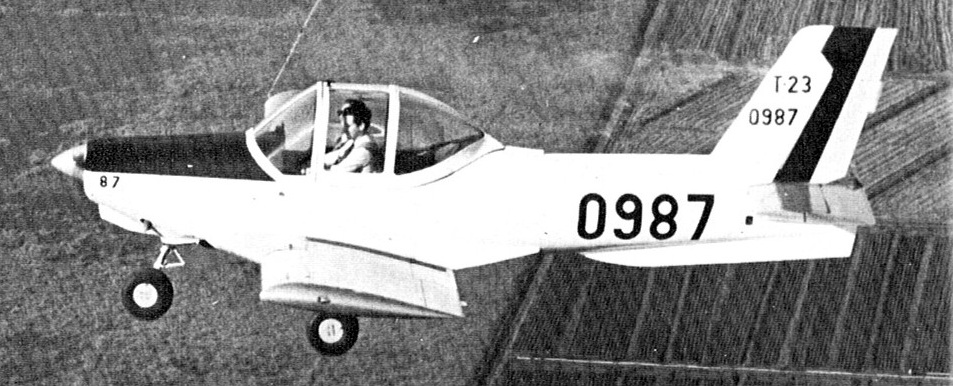
Following the loss of the first production T-23 in 1968, a small ventral fin was added to improve spin recovery.
They were used by Brazilian, Bolivian & Paraguayan Air Forces.
Engine: Lycoming: O-320-B2B, 160 hp
Wingspan: 27 ft 10.75 in / 8.50 m
Length: 21 ft 8 in / 6.60 m
Empty weight: 1191 lb / 540 kg
MTOW: 1825 lb / 840 kg
Max cruise 5000ft / 1525m: 100 kt / 115 mph 185 kph
Service ceiling: 14,760 ft / 4500m
Max range: 700 nm / 805 mi / 1300 km
Max endurance: 6 hr 30 min
Seats: 2
Baggage capacity: 66 lb / 30 kg
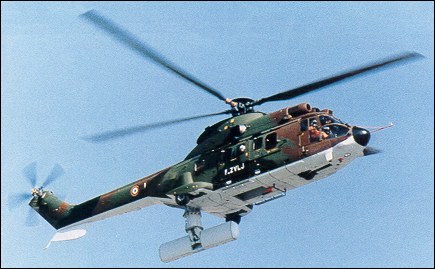
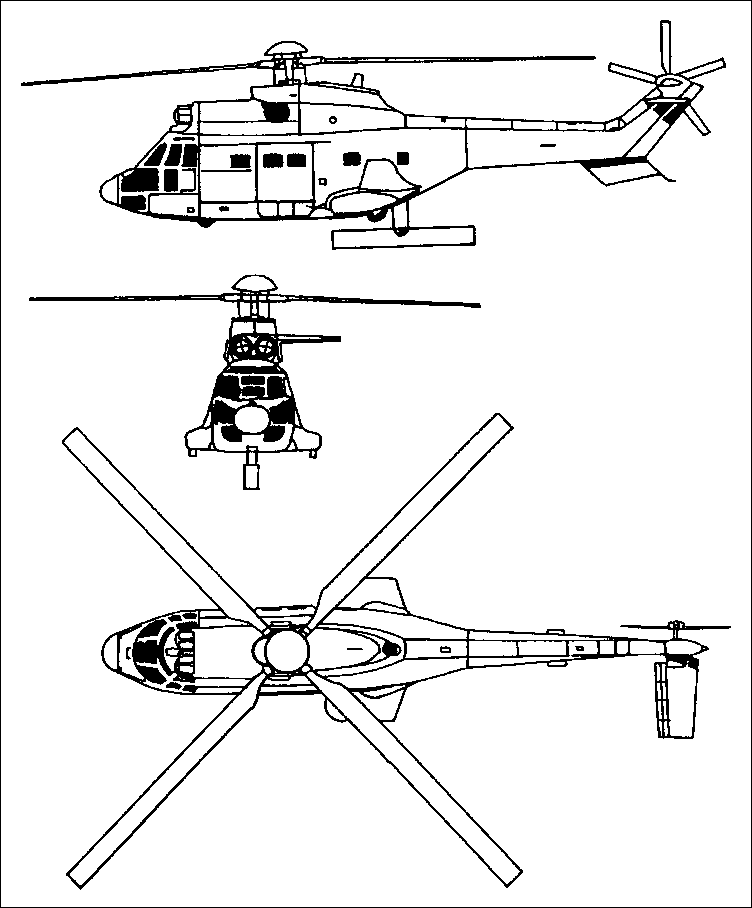
Beginning in 1990, Super Pumas were separated in their civilian and militarized forms by the latter taking on the production designation of AS 532 “Cougar” (civilian models still retained their AS 332 designations). The Cougar family now consists of the AS 532MC Mk I (note the “Mk I” mark designation was retroactively applied to previous Super Puma forms) as a Search & Rescue (SAR) platform, the AS 532SC Mk I as a short-fuselage anti-submarine variant, the AS 532U2 Mk II as an unarmed base model, the AS 532A2 Mk II as another Search & Rescue form, the AS 532L2 Mk II featuring a lengthened fuselage for extra seating and extended main rotor blades, and the simplified AS 532 “Cougar 100” with fixed landing gear. Militarized Super Puma/Cougar aircraft can display a broad range of armaments including 7.62mm general purpose cabin-door machine guns (on pintle mountings), 7.62mm gun pods, rocket pods, anti-ship missiles and various makes of air-to-surface missiles.
The AS 532U2 Cougar Mk.2 incorporated new main and tail rotors, a lengthened rear fuselage and four-tube EFIS cockpit display and digital autopilot. Powered by two 1,877 shp (1400 kW) Turbomeca Makila turboshafts, the standard military AS 532M1 can carry 25 troops while the civil AS 332L1 seats up to 24 passengers.
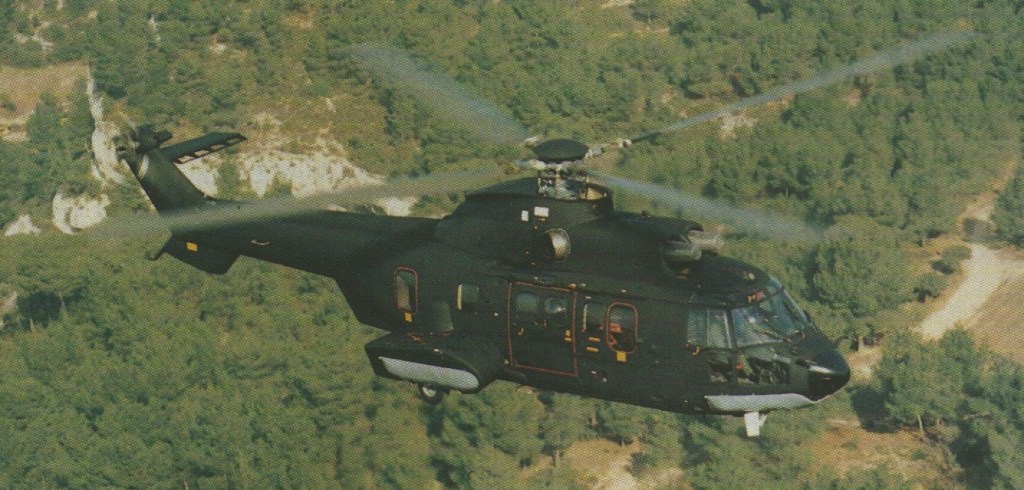
Versions include the AS.532SC, navalised; AS.532UC, tactical transport; AS.532AC, armed with pod mounted cannon; AS.532UL, tactical transport; and AS.532AL, armed with pod mounted cannon or side firing cannon.
The Horizon system, Helicoptere d’Observation Radar et d’Investigation sur Zone, includes a Cougar AS 532 UL twin-engine helicopter with radar and electronic countermeasures and a ground station. The helicopter surveillance system was originally developed to counter any possible threat by tank fleets of the Warsaw Pact countries. The French Ministry of Defence awarded a development contract to Eurocopter in 1992 initially for two then four AS 532 UL Horizon systems. The first flight of the Horizon Cougar helicopter with the full radar system took place in late 1992. The first AS 532 Horizon was delivered to the French Army in July 1996.
The Swiss Air Force, ordered 27.
The unarmed AS 532 UL is equipped with a long range multi-mode retractable pulse Doppler radar with a rotating antenna carried beneath the fuselage. The radar range is 200km with the helicopter operating at an altitude of 4000m and a cruise speed of 180 km per hour. The radar scans a ground area of 20,000 sq.km over a depth of 200km in 10 seconds and the data is transmitted to a ground station. For moving targets the radar provides a speed resolution of the target of 2 m/second. The cockpit is night vision goggle compatible and a weather radar is fitted. The navigation equipment includes a Decca navigator and flight log with an SFIM model 155 autopilot, inertial navigation and global positioning system.
The engine is fitted with jet efflux diluters and the crew are armour protected. The helicopter is equipped with anti-icing systems.
The AS 532 UL Cougar helicopter is equipped with two Turbomeca Makila 1A1 turboshaft engines with the air intakes protected from debris with a grille. Centrisep multipurpose air intakes are provided for operations in high dust/particulate or desert conditions. Six flexible self-sealing fuel tanks have a capacity of 2,020 litres.
AS.532SC Cougar
Engine: 2 x Turbomeca Makila 1A1
Instant pwr: 1400 kW
MTOW: 9000 kg
Payload: 4500 kg
Max speed: 135 kts
Max range: 800 km
HIGE: 9156 ft
HOGE: 5413 ft
Crew: 2
Pax: 2
AS.532U2 Cougar Mk.2
Engines: 2 x Turbomeca Makila 1A2 turboshaft, 1,845shp
Instant pwr: 1570 kW
Length: 51.02ft (15.55m)
Width: 60.01ft (18.29m)
Height: 16.11ft (4.91m)
Empty Weight: 10,902lbs (4,945kg)
Maximum Take-Off Weight: 21,493lbs (9,749kg)
Maximum Speed: 170mph (273kmh; 147kts)
Maximum Range: 494miles (795km)
Rate-of-Climb: 1,260ft/min (384m/min)
Service Ceiling: 13,448ft (4,099m)
HIGE: 8525 ft
HOGE: 4921 ft
Accommodation: 3 + 19
Hardpoints: 2
AS.532UC/AC Cougar
Engine: 2 x Turbomeca Makila 1A1
Instant pwr: 1400 kW
MTOW: 9350 kg
Payload: 4670 kg
Max speed: 140 kts
Max range: 845 km
HIGE: 9196 ft
HOGE: 5413 ft
Crew: 2
Pax: 21
AS.532UL/AL Cougar
Engine: 2 x Turbomeca Makila 1A1
Instant pwr: 1400 kW
MTOW: 9350 kg
Payload: 4500 kg
Max speed: 140 kts
Max range: 1245 km
HIGE: 9196 ft
HOGE: 5415 ft
Crew: 2
Pax: 25
AS.532 Cougar AEW
Main rotor diameter: 15.60 m
Fuselage length: 15.53 m
Height: 4.92m
MTOW: 9000 kg
Cruising speed: 262km/h
HOGE: 2300 m
Range: 910 km
Crew: 4-5
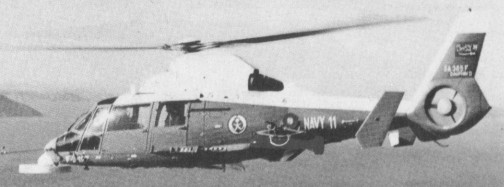
Developed from the turbine powered SA 360 Dauphin, Aerospatiale’s SA 365 introduced twin turbines and became named Dauphin 2 to indicate this. Aerospatiale flew the prototype (F-WVKE) of the SA 365 Dauphin on 24 January 1975. Certificated by the French Government for VFR, the Dauphin 2 should carry 3,478 pounds of payload at a cruise speed of 143 knots.
Flown on 24 January 1975, the first SA 365C was powered by two 492 kW (660 shp) Turbormeca Arriel engines.
Sud Aviation SA365 Dauphin Article
From the SA.365C model, the AS.365N variant was developed; it looked similar to its predecessor but in fact had 90 per cent new or improved parts. Modifications included extensive use of composite materials for the structure, rotor blades with a different profile, a modified fuselage and a retractable tricycle landing gear.
The SA.366G version was developed at the same time as the AS.365N. Designed in response to an order from the US Coast Guard, it differed primarily in using 590 hp (440 kW) American Avco Lycoming LTS-101 engines. An SA 366 Dauphin prototype first flew on 28 January 1975. For the search and rescue missions for which it is intended, the aircraft has sophisticated avionics equipment by Collins. It has two sliding doors, a rescue hoist and can take three stretchers and four assistants. One of the first civil models set a world speed record on 9 February 1980 by flying non-stop from Paris (heliport) to London at an average of over 294km/h, beating this two days later by a direct flight from Paris (Issy-les-Moulineaux) to London at 321.9km/h.
In 1979 the US Coast Guard ordered 90 SA365G-1s (HH 65A Dolphin) for short range recovery tasks which, though not requiring offensive capabilities means the aircraft must have the latest maritime search and surveillance equipment. These all feature the retractable undercarriage and other new features that distinguish the Dauphin IIN from the original SA 365 Dauphin II.
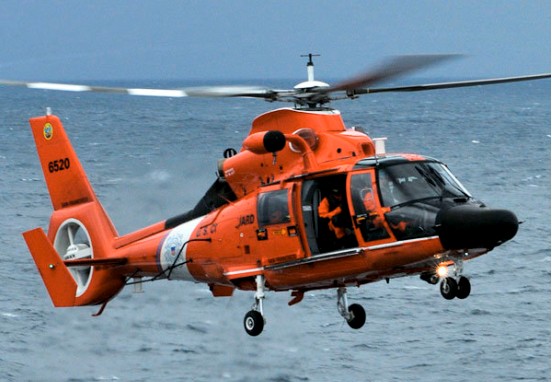
The HH-65 is based on the Eurocopter Dauphin (AS 365N) but despite its origins in the French-made Aerospatiale/Eurocopter system, the HH-65 Dolphin is produced in the United States by American Eurocopter, Textron Lycoming (turboshaft engines) and Rockwell Collins (electronics). First flight was achieved in 1980 and the system was introduce in whole by 1985. In service in the USCG with some 102 total Dolphins making up the Coast Guard HH-65 force.
The HH-65 design in characterized by her low-set forward cockpit showcasing a smallish pointed nose assembly and a shrouded Fenestron tail section. The undercarriage is fully retractable and is made up of two single-wheeled main landing gears and a double-wheeled nose gear. Engines are mounted hit and above the crew cabin about midway on the design. The body integrates smoothly into a finely contoured empennage that fits a single vertical tail fin (above the Fenestron shroud) and a horizontal tailpane situated.
Power is derived from twin Turbomeca Arriel 2C2-CG turboshaft engines delivering up to 934 shaft horsepower and driving a corrosion-resistant composite four-bladed main rotor. Maximum speed tops 184 miles per hour with a range of 409 miles and a service ceiling of 15,000 feet. The Dolphin sports an empty weight of approximately 6,333lbs and a maximum take-off weight of up to 9,480lbs. Like the main rotor blades, the fuselage and rotor head are both constructed of corrosion-resistant materials for operations over the salty ocean. In fact, this type of composite construction makes up some 75% of the helicopter design.
Crew accommodations onboard a typical HH-65 model include the pilot, co-pilot, flight mechanic/flight engineer and rescue swimmer. Visibility is rated an excellent thanks to heavy use of glazing in the forward, side and top portions of the cockpit. The flight mechanic is afforded a chair which can slide on rails from one cabin side to the other as needed. The original Dolphin paint design featured a red, white and black scheme but this has since been changed to an overall red (still maintaining the black nose and exhaust sections) for easy visual marking from icebreaker vessels. The change in color has also cut off three days to the overhaul time needed for the aircraft.
The Dolphin maintains a distinct operating capability that allows its autopilot system to bring the aircraft to a hover or fly a designated flight pattern without the need for pilot intervention. This obviously frees up the pilots to other mission matters, particularly when having to visibly scan the surface of the ocean for persons or vessels. Deployment for Dolphins usually originates at land bases but Coast Guard Cutters are designed to take on the type.
The HH-65 has since been spawned into four major versions. The initial production model entered service in 1985 as the HH-65A, fitting twin LTS101-750B-2 series turboshaft engines of 735 shaft horsepower each. This was followed in 2001 by the upgraded HH-65B model with its revised avionics suite, twin global positioning integrated systems and two cockpit-mounted multi-function flat displays. If there was a drawback to the Dolphin system up to now, it lay in her Lycoming-brand engines, forcing the USCG to look through other powerplant options available.
The HH-65C’s were essentially A and B production models fitted with twin the French-made Turbomeca Arriel 2C2-CG turboshaft engines of 934 shaft horsepower each. These powerplants were already proven components of the Eurocopter EC155 series and marked an improvement in both efficiency and reliability over the original set of American-made Lycoming (Honeywell) LTS101-750B-2 turboshafts. Other changes to this model included new gearboxes for main rotor and tail, an 11-blade Fenestron tail rotor, an increase to its MTOW (Maximum Take-Off Weight) and a lengthened nose of new equipment. The first post-conversion C-models were made available in late 2004. A- and B-model Dolphins were retrofitted with the new Turbomeca Arriel 2C2-CG turboshafts and brought up to C-model standard, taking on the designation of HH-65C as well.
The MH-65C is a derivative of the HH-61C with an improved transmission, digital autopilot, revised avionics, increase fuel capacity, increased MTOW and a new 10-bladed tail rotor featuring noise reduction. The MH-65C has been used by the US Coast Guard’s Helicopter Interdiction Tactical Squadron (HITRON) “Force from Above” armed helicopters. Based out of Jacksonville and operating with the Department of Homeland Security, these Dolphins are armed aircraft charged with conducting “Airborne Use of Force” sorties in high drug trafficking areas as well as to counter general security threats in American waters. To compliment this new-found role, the MH-65C’s utilized by HITRON field a 7.62mm M240B general purpose machine gun and a 12.7mm Barrett M107CQ anti-materiel rifle. HITRON Dolphins are also used to guide their accompanying “Over The Horizon Cutter Boats” (OTHCB) to the scene of a given crime for possible interception and/or apprehension. MH-65C “HITRON” Dolphins began operations in 2008.
The HH-65 Dolphin replaced the Sikorsky HH-52A Sea Guards then in service with the United States Coast Guard (USCG).
Israel purchased two HH-65s, and in trials operated them from the navy’s fleet of fast patrol craft, plus two HH-65s were used by the US Navy test centre at Patuxent River, Maryland.
Powered by two Avco Lycoming LTS101 engines of 507 kW (680 shp) one was a prototype; two of the first five production aircraft were SA 365Gs, one of which was been flying in France with a production-standard 680 shp Avco-Lycoming LTS101-750AA turboshafts while the other was at the Aerospatiale Helicopter Corp, Grand Prairie, Texas, facility for installation and flight testing of the Rockwell-Collins avionics.
An even bigger contract gained in 1980 by France, was the vast ‘Sawari’ order for military equipment for Saudi Arabia. Part of this comprised 24 SA 365F Dauphin 2 maritime versions, the final 20 being equipped with four AS.15TT anti ship missiles. This anti ship Dauphin, which is in¬tended to compete with the already existing Lynx with Sea Skua missiles, was developed with Saudi funds and has a Thornson CSI` Agrion radar which provides guidance for the AS.15TT, which itself was financed by this contract.
The SA 365K differs considerably by being almost 75 per cent of composite construction, such as Kevlar, The
Nomex and carbonfibre.
A Dauphin AS 365X set a speed record in March 1991 flying a 3km course.
These earlier versions were super¬seded by the standard civilian variant, the SA 365N Dauphin 2 first flying in March 1979, and first seen at the 1979 Paris Air Show and its derivatives, which have a new structure making extensive use of composite materials such as glass¬fibre, Nomex, Kevlar and Rohacell, and with carbon fibre composite in the spars of the rotor blades. The SA 365N also features fully retractable tricycle landing gear, and is one of the fastest of all helicopters, having set many world point to point speed re¬cords including Paris London in 63 mi¬nutes at an average of just over 322 kph (200 mph). The standard AS 365N can accommodate up to 13 passengers. Powerplants are two Turbomecca Arriel 1C1 turboshafts, each rated at 724 shp (540 kW). A naval variant, designated AS 565F, was in production in 1990. Arriel powered military versions of the Dauphin include the AS.15TT-equipped SA.365F for the Saudi Navy, with either an Omera ORB-32 of Thomson-CSF Agrion radar, and the similar but unarmed SA.365F for the Irish Air Corps, fitted with Bendix RDR-L500 search radar and a Crouzet ONS-200A long-range navigation system.
A military development of the Dauphin is the multirole SA.365M Panther. A production standard Panther was demonstrated in April 1986, and was planned to be available for delivery in 1988, followed in 1992 by a further-refined version with full day and night combat capability. The SA.365M has a Turbomeca TM333-1M powerplant, and is based on the standard SA.365N airframe, but makes extensive use of composite materials, in addition to having military features such as armoured crew seats, self-sealing fuel tanks, and cable cutters. Engine exhausts are designed for reduced infrared signature, and armament options include 20mm gun pods, rocket pods, Matra Mistral AAMs, and HOT anti-tank missiles with an associated Viviane roof-mounted sight. In the assault transport role eight to ten troops may be carried.
French certification (VFR, day and night, category A and B) was awarded to the Aerospatiale SA 365N Dauphin IIN on 9 April 1981.
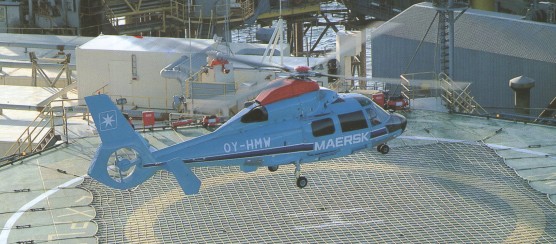
The AS.365N3 with wide 12-passenger fuselage, five-blade main rotor and improved avionics suite, first flew in prototype form on 16 June 1997. It was later redesignated EC-155. Commercial and military sales of the AS 365 Dauphin 2 exceeded 500 aircraft for operators in some 44 countries by 1990. The total also includes production in China as the Harbin Z-9/Z9A, an initial batch of 50 having been due for completion in 1989.
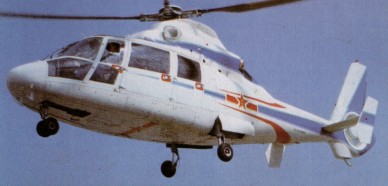
The Harbin Z-9 (Chinese name: Zhishengji-9 / Vertical take-off aircraft 9) are licence-built AS 365N Dauphin 2. A licence agreement (Aerospatiale/CATIC) was signed on 2 July 1980 and the first (French-built) example made the initial acceptance flight in China on 6 February 1982. Chinese parts manufacture began in 1986 for the initial agreed batch of 50, the last of which was delivered in January 1992. The transmission was manufactured by Dongan Engine Manufacturing Company at Harbin, and hubs and tail rotor blades by Baoding Propeller Factory. Production continued under a May 1988 domestic contract. Plans to introduce the Arriel 2C were announced in mid-2001, following delivery of two of these engines in April. The first flight was achieved in September 2001.
A total of 110 (all versions) were reportedly built by mid-2001 and eight H410As were ordered mid-2002 by Far Eastern Leasing Company, China State Oceanic Administration and Zhoushan Civil Aviation Development Company. Most early production was for Chinese armed services (People’s Navy Aviation and Army Aviation each at least 25) and People’s Armed Police (four delivered 12 September 2001). The type entered service with two PLA army groups in January and February 1988 (Beijing and Shenyang Military Regions respectively). The People’s Navy Aviation was believed to use Z-9A for commando transport as well as shipboard communications. Ten were based at the former Royal Air Force airfield at Sek Kong in the third quarter of 1997, following the 1 July handover of Hong Kong by UK. The first export was made in late 2000 (two to Mali Air Force).
Civil models were used for various duties including offshore oil rig support and air ambulance (four stretchers/two seats or two stretchers/five seats). In 1992, Flying Dragon Aviation received two (late production Z-9s, augmenting an Aerospatiale Dauphin) which are operated on behalf of the Ministry of Forestry. Five civil Z-9s ordered by Shenzhen Financial Leasing Company (SFLC) in 2001. One Z-9A was deployed to Arctic regions in mid-1999, on a scientific survey ship.
The multi-role SA 565UA Panther is a military development of the twin-engined SA 365 Dauphin first flown on 29 February 1984. Based on the standard SA.365N1 airframe, the primary changes include more composite materials and armoured crew seats to maximize survivability in combat zones, the introduction of Turbomeca TM333-1M turboshafts with a continuous rating of 751shp, and the provision of equipment to permit the use of armament and to allow for night operations. Fuselage-mounted outriggers can carry air-to-ground weapons such as rocket or gun pods and/or air-to-air Matra Mistral missiles. For the assault role, up to ten troops can be carried, or external freight up to 3,515 lb (1 600 kg). First customer was the Brazilian Army, which had ordered 42.
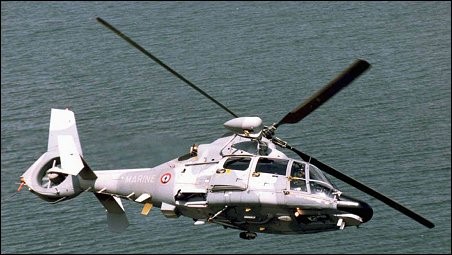
The SA575-SA is a navalised derivative of the Panther light military helicopter, itself a derivative of the Dauphin.
The AA version can be equipped with pod mounted cannon etc, the MA is a SAR version, and the SA is armed for anti-ship or ASW.
Chile operates four AS 565 MAs fitted with radar warning and Exocet missiles and Saudi Arabia uses AS 565s equipped with the AS.15TT short-range anti-ship missile.
Also licence built by Harbin as the Z-9.
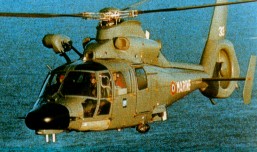
Principal versions:
SA.365 Dauphin 2
SA.360 fitted with two 650shp Turbomeca Arriel 1A turboshafts Prot. F-WVKE FF 24 Jan. 1975. Second prot. F-WVKD used for testing retractable u/c.
SA.365C Dauphin 2
Civil production version of SA.365 with 3382kg TOGW.
SA.365C1 Dauphin 2
SA.365C with 667shp Arriel 1A1 turboshafts.
SA.365C2 Dauphin 2
SA.365C with 670shp Arriel 1A2 turboshafts, 3480kg TOGW and modified transmission system.
SA.365N Dauphin 2
SA.365C with retractable tricycle u/c, lengthened cabin with max 11 pax separated from crew, pointed nose, composite rotors new air intakes and redesigned under-floor fuel tanks. 710shp Turbomeca Arriel IC turboshaft, 3977kg TOGW. FF 31 Mar. 1979. Prot. F-WZJD.
SA.365N1 Dauphin 2
SA.365 with 724shp Arriel 1C1 turboshafts, 4076kg TOGW and recontoured lower tail section eliminating ventral fin.
AS.365N2 Dauphin 2
SA-365N with two 763shp Turbomeca Arriel 1C2 turboshafts, new gearbox, 4226kg TOGW.
AS.365N3 Dauphin 2
AS.365N with quiet tail rotor and two Arriel 2C turboshafts. Prot. FF Oct. 1996.
AS.365N4
AS.365N3 with wide 12-passenger fuselage, five-blade main rotor and improved avionics suite. Prot. FF 16 Jun. 1997. Redesignated EC-155.
SA.365F Dauphin 2
Navalised SA.365N for Saudi Arabia etc. With pointed radar nose and either under-nose radar dish or antisubmarine missile system and 700shp Arriel 1M turboshafts. Prot. F-WZJD FF in this form 22 Feb. 1982.
SA.365M Dauphin 2
Army light tactical version of SA.365N1 with 12-troop capacity. Powered by two 913shp Turbomeca TM.333-1M turboshafts. 4077kg TOGW. Prot. F-WZJV FF 29 Feb. 1984. Later named Panther.
Harbin Z-9
Initial Chinese version, equivalent to French AS 365N1 and assembled from French-built kits: 28 completed.
Harbin Z-9A
Follow-on kit-built version, to AS 365N2 standard. Final 22 of first 50 were of this version.
Harbin Z-9A-100
Effectively, prototypes for domestic licence-built version, with WZ8A engines and much increased local manufacture (72.2% of airframe and 91% of engine). Two built; first flight 16 January 1992; flight test programme completed 20 November 1992 after almost 200 flight hours (408 flights); Chinese type approval received 30 December 1992.
Harbin Z-9B
First indigenous production version, based on Z-9A-100. Modified Fenestron with 11 wider-chord, all-composites blades instead of 13 metal blades as in AS 365N1. Principal unarmed PLA version for SAR, artillery direction, EW, troop transport (accommodates eight), communications and other utility duties. Certified also for domestic commercial operations 19 April 2001.
Harbin Z-9C
Version for PLA Naval Air Force, for deployment aboard certain classes of destroyers and frigates; in service by late 2000. Believed to be equivalent to Arriel 2-engined Eurocopter AS 565 Panther, but equipped with Thales HS-12 dipping sonar and KLC-11/J-band (Chinese version of Agrion 15) surface search radar; armament includes two Yu-7 torpedoes or TV-guided C-701 anti-surface vessel missiles.
Harbin WZ-9
Armed (wuzliuang) version (also reported as Z-9W); eight Norinco HJ-8 (Hongjian: Red Arrow) wire-guided anti-tank missiles, twin 12.7mm machine gun or 23mm cannon pods, or twin 57 or 90mm rocket pods, and gyro stabilised, roof-mounted optical sight. First flight thought to have been in early 1989; in production. Export designation Z-9G, available with or without roof-mounted sight.
Harbin H410A
Version with 635kW Arriel 2C (WZ8C) turboshafts for improved ‘hot-and-high’ performance. (Designation signifies 4.10 tonne MTOW.) First flight September 2001; CAAC certification 10 July 2002. Initial orders for eight.
Harbin H425
VIP version of H410A (thus 4.25 tonne MTOW); improvements to rotor system, fuel system and structure (crashworthiness), avionics and interior layout.
AS.365K Panther
SA.365M with 748shp Arriel 1M1 turboshafts. Redesignated AS.565.
X.380 Dauphin
SA.365N with combined composite rotor hub/mast, 5-blade rotor with swept tips, and 837shp Turbomeca Arriel IX turboshafts.
AS.366G / HH-65A Dolphin
Three-seat SA.365N for US Coast Guard short-range recovery tasks with internal stretcher fittings, rescue hoist, pop-out flotation bags etc. 4027kg TOGW. Powered by two 680shp Textron-Lycoming LTS.101-750A-1 turboshafts. Prot. USCG.4101 FF 23 Jul. 1980. Four built.
AS.366G1 Dolphin
Production AS.366G with LTS.101-750B-2 turboshafts and 4036kg TOGW. 92 built.
Specifications:
AS365 Dauphin 2
Engine: 2 x Turbomeca Arriel turboshafts, 650 hp (485 kW)
AS365C Dauphin 2
Engine: 2 x Turbomeca Arriel 1A, 651 / 670 shp
TBO: 2000 hrs
Main rotor: 39.1 ft / 11.68m
Seats: 14
Length: 44.2 ft / 13.29m
Height: 13.2 ft / 3.5m
Max ramp weight: 8490 lb
Max takeoff weight: 8490 lb
Standard empty weight: 4314 lb
Max useful load: 4176 lb
Max landing weight: 8490 lb
Max sling load: 3748 lb
Disc loading: 7.1 lb/sq.ft
Power loading: 6.1 lb/hp
Max usable fuel: 2336 lb
Max rate of climb: 1515 fpm
Service ceiling: 15,000 ft
HIGE: 3445 ft
HOGE: 3445 ft
Max speed: 165 kt
Normal cruise @ 3000 ft: 150 kts
Fuel flow normal cruise: 648 pph
Endurance normal cruise: 3.4 hr
Pax seats: 13
SA 365F Dauphin 2
Engines: 2 x Turbomeca Arriel turboshafts, 710 shp (529 kW)
Max cruise SL (clean): 252 km/h (156 mph)
Max cruise alt. (clean): 259 km/h (161 mph)
Max speed: 280 kph
Fuel cap: 1140 lt
Range (max fuel, SL): 898 km (558 miles)
Endurance (max fuel): 4 hrs 25 min
Endurance (two missiles): 3 hrs 45 min
Endurance (four missiles): 2 hr 45 min
Empty weight: 2141 kg (4,720 lb)
MTOW: 3900 kg (8,598 lb)
No. Blades: 4
Main rotor diameter: 11.93 m (39 ft 1¾ in)
Fuselage length: 12.11 m (39 ft 8¾ in)
Height: 3.99 m (13 ft 1 in)
Main rotor disc area: 111.7 sq.m (1,202.4 sq.ft)
Crew: 2
Pax: 9
Armament: four Aerospatiale AS.15TT radar guided missiles.
SA 366 Dauphin
Engines: 2 x Avco Lycoming LTS 101 turboshafts, 590 hp (440 kW)
SA.366G-l / HH 65A Dolphin
Engine: Lycoming LTS-101
Aerospatiale / Eurocopter HH-65C Dolphin
Engines: 2 x Turbomeca Arriel 2C2 turboshaft, 853shp
Length: 44.29ft (13.5m)
Height: 12.80ft (3.90m)
Maximum Speed: 137mph (220kmh; 119kts)
Maximum Range: 345miles (555km)
Service Ceiling: 7,510ft (2,289m)
Armament HITRON Dolphins:
1 x 7.62mm M240B General Purpose Machine Gun
1 x 12.7mm M107CQ Anti-Materiel Rifle
Accommodation: 4
Empty Weight: 6,173lbs (2,800kg)
Maximum Take-Off Weight: 20,900lbs (9,480kg)
SA.365N2 Dauphin II
Engine: 2 x Turbomeca Arriel 1C2 or 2 x Turbomeca 1M1
Instant pwr: 550 or 570 kW
Rotor dia: 11.9 m
MTOW: 4250 kg
Useful load: 1970 kg
Max cruise: 150 kts
Max range: 880 km
HIGE: 8365 ft
HOGE: 5905 ft
Seats: 14
Aérospatiale SA 365 M Panther
Engine: 2 x Turbomeca TM 333-1M, 672 shp
Length: 39.698 ft / 12.1 m
Height: 13.123 ft / 4.0 m
Rotor diameter: 39.042 ft / 11.9 m
Max take off weight: 9040.5 lb / 4100.0 kg
Weight empty: 5071.5 lb / 2300.0 kg
Max. speed: 148 kt / 275 km/h
Cruising speed: 138 kt / 255 km/h
Initial climb rate: 1574.8 ft/min / 8.0 m/s
Service ceiling: 15420 ft / 4700 m
Range: 421 nm / 780 km
Fuel capacity: 300 gal / 1135 lt
Crew: 2
Payload: 8-10 pax
Harbin Z-9A
Engine: 2 x South Aeroengine Co WZ8A
Instant pwr: 527 kW
Rotor dia: 11.9 m
MTOW: 4100 kg
Empty weight equipped: 2050kg
Payload: 1660 kg
Useful load: 2038 kg
Fuel capacity 1,140 lt / opt. 180 litre aux
Max speed: 159 kts / 315km/h
Max cruise sea level: 153 kts / 280km/h
Max range at 250km/h, standard tanks: 860 km
HIGE: 8530 ft / 2150m
HOGE: 5900 ft / 1150m
Service ceiling: 19,685 ft / 6000m
Max vertical rate of climb: 252m/min
Max forward rate of climb: 396m/min
Crew: 2
Pax: 12
Harbin H410A
Engine: 2 x South Aeroengine Co WZ8C
AS.565 Panther
Engine: 2 x Turbomeca TM333-1M turboshaft, 670kW take-off
Main rotor diameter: 11.94m
Fuselage length: 12.07m
Height: 4.07m
Take-off weight: 4100kg
Cruising speed: 275km/h
HOGE: 2500m
Range: 740km
Crew: 2
AS.565AA Panther
Engine: 2 x Turbomeca Arriel 1M1
Instant pwr: 570 kW
MTOW: 4250 kg
Payload: 1600 kg
Max speed: 147 kts
Max range: 860 km
HIGE: 6726 ft
HOGE: 4101 ft
Crew: 2
Pax: 10
AS.565MA/SA Panther
Engine: 2 x Turbomeca Arriel 1M1
Instant pwr: 558 kW
MTOW: 4250 kg
Payload: 1600 kg
Max speed: 147 kts
Max range: 875 km
HIGE: 2726 ft
HOGE: 4101 ft
Crew: 2
Pax: 10
AS.565SB Panther
Length: 12m
Max speed: 155 kts
ROC: 1338 fpm
Range: 430+ nm
Capacity: 10 pax
Crew: 2
AS.565UA Panther
Engine: 2 x Turbomeca Arriel 1M1
Instant pwr: 570 kW
MTOW: 4255 kg
Payload: 1600 kg
Max speed: 147 kts
Max range: 858 km
HIGE: 6726 ft
HOGE: 4101 ft
Crew: 1
Pax: 10
Eurocopter Panther 800
Engine: 2 x LHTEC T800-800
Instant pwr: 657 kW
MTOW: 4250 kg
Max speed: 143 kts
Max range: 778 km
HOGE: 6500 ft
Crew: 2
Pax: 10
EC-155
Engines: 2 x Arriel 2C.
EC155B 1

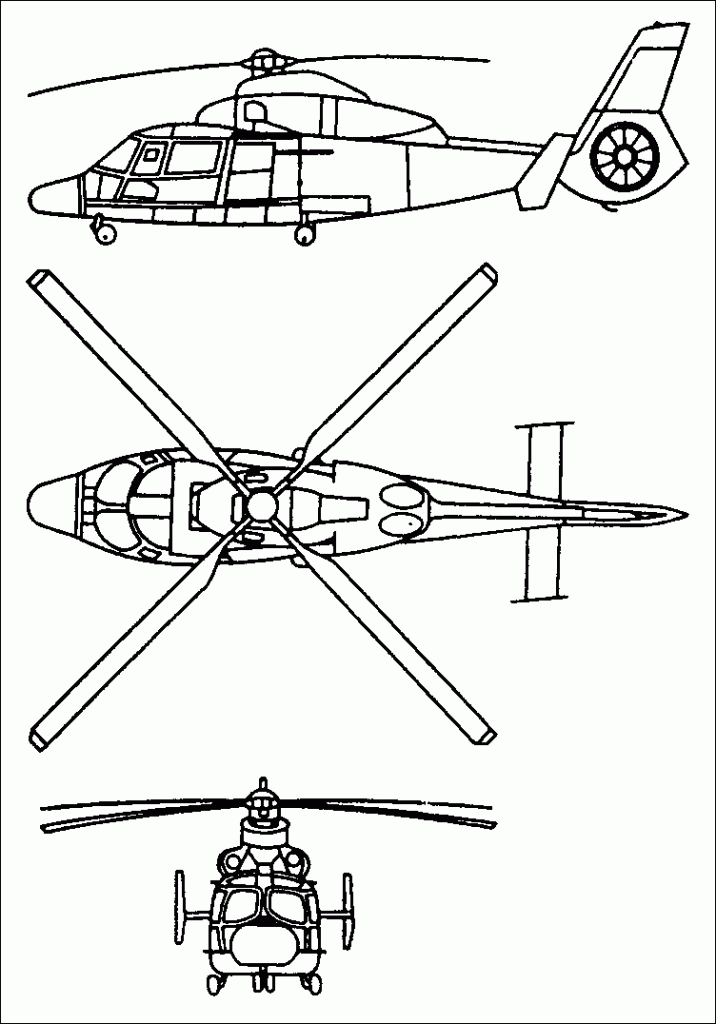
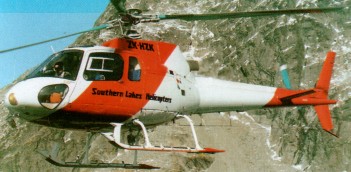
Aerospatiale flew the first prototype (F-WVKH) of the AS 350 Ecureuil (squirrel) five/six-seat light general purpose helicopter on 24 June 1974 and introduced a new simplified rotor and an all-new streamlined fuselage with room for five or six persons. Built from composites/fibre-glass, the rotor head was designed without the need for conventional mechanical hinging. It used the inherent flexibility of laminated composites for movement. The AS.350 uses many automobile parts such as a cooling fan from a normal Citroen car and an oil radiator by another automobile manufacturer. The cabin is made of thermoformed polycarbonate semi-monocoque sections with ultrasonic welding. The bearings usually found in rotor hubs have been replaced by elastomeric ball joints which need no lubrication. The first prototype was powered by a Lycoming LTS engine, and the second with a Turbomeca Arriel 1A engine. The first flight of the second example (F-WVKI) was on 14 February 1975.
Aerospatiale AS350 Ecureuil Article
The first production version was the AS 350B powered by 478kW Arriel IB and certified 27 October 1977.
Delivery of the 2,000th AS 350/550 (F-WWPZ, later ZJ270 of UK Defence Helicopter Flying School) took place in July 1997.
Production of the AS350B started in July 1978 after eight pre-production models had been built. By the end of December of that year, the company had 459 orders.
The AS350 B2 is an uprated Squirrel variant powered by a 732shp Turbomeca Arriel engine. It was being marketing in the USA as the SuperStar to replace the SA315B Lama in the heavy lifting role.
The AS350B3 is equiped with basically a glass cockpit, a six axis auto-pilot, an AS355 swash plate, rotor head and dual hydraulics. This helicopter is IFR certified.
The conversion from a B model to an AS.350BA consists mainly of fitting the AS355 rotor head and blades and replaced the AS 350B during 1992. French VFR certification was received in 1991, UK and US certifications in 1992, and Japanese in 1993. Production of AS 350BA ended in 1998. All AS 350B1, 350BA and 350B versions can be upgraded to 350B2.
The Aerospatiale AS.350C AStar six-place helicopter received U.S. certification in 1978. The helicopter is powered by a 615 shp Lycoming LTS101 turbine driving all fiberglass rotor blades and sold only in USA.
The AS350D Astar of 1976 differs solely in having an American Lycoming LTS101 engine.
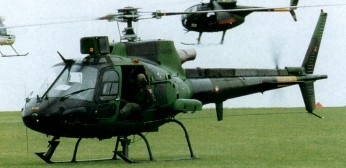
Sales of the single- (AS 350) and twin-engined (AS 355) versions of the Ecureuil (Squirrel) exceeded 1,300 by 1990.
In February 2001, delivery took place of the 3,000th of Ecureuil family (including AS 355/555), which also was first EC 130 upgraded version. There were a total 10,986,000 Ecureuil flying hours by January 2001.
Also built under licence by Helibras in Brazil as the Esquilo.
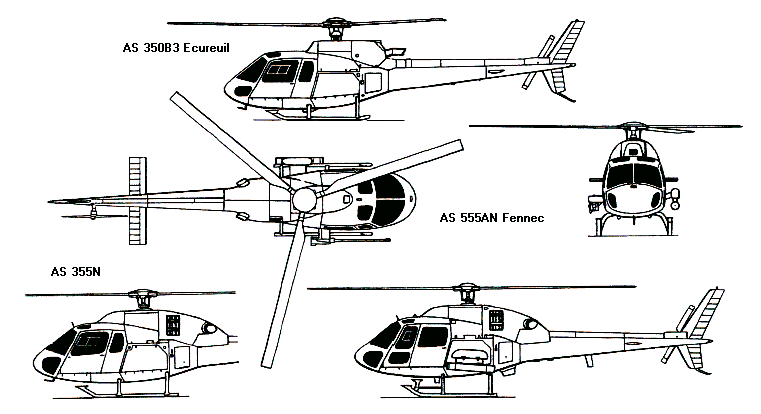
The AS.550 Fennec is a military version of the Eurocopter AS.350 Squirrel powered by a single full FADEC controlled Turbomeca Aniel B2 engine, ordered by the French and Danish Armies.
In 1992 the RoSAF took delivery of 10 utility and training AS.550 A2 models and a further ten AS.550 C2 models, which were equipped with a with a roof mounted sight and can be armed with GIAT 20mm cannon pods, BAE Systems CRV 7 unguided rockets and Hughes HeliTOW anti armour guided missiles.
The A2 is a battlefield version, and can carry weapons.
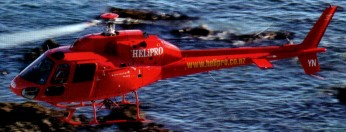
Development of the twin-engined AS.355 version of the Squirrel started in 1978 and it is essentially similar to earlier models with the added attraction of twin-engined reliability specified by some op¬erators in the rescue, police and night flying roles. The first Twin Squirrel (F-WZLA), with 420shp 250-C20F Allison turboshafts and the Starflex rotor system made its maiden flight on 28 September 1979 followed by the second prototype on 13 November. The twin-engined version is known as the Twinstar in the USA and Ecureuil 2 everywhere else.
After 122 hours of flight testing, production went ahead at a rate of between five and seven helicopters a month, rising to 20-24 in 1981.
Production of the AS 355F was superseded by the AS 355F1 in January 1984. Conversion from an AS355F to AS355F1 enables a higher gross weight.
After several modifications the civilian AS.355F2 is fitted with twin Allison turbines developing around 315kW and new wider composite blades and remoulded engine intakes for anti-icing protection. The AS 355F2 was certified 10 December 1985.
Three military versions of the Ecureuil light helicopter; the single-turbine AS.350L-1, the twin-turbine AS.355M for the French Air Force, and the similar AS.355M-2 for export. All have strengthened airframes, reinforced landing gear, and increased instru¬mentation. Other armament options include the 20mm GIAT M621 cannon, 7.62mm machine-gun pods, and unguided rockets.
A naval variant, the AS 555MN, is equipped with a chin-mounted radar, but is unarmed.
The Aerospatiale AS 555UN Fennec, powered by paired Turbomeca TM 319 turboshafts is the military version of the AS 355 Ecureuil.
An enlarged engine casing above and behind the five-seat cabin identifies the twin-engined AS 355/555 version. The AS.555SR engines are 420 shp (313 kW) Allison 250-C20F turboshafts which are replaced in the North American-marketed TwinStar by 450 shp (335.6 kW) Allison units. 1990 military versions were designated AS 555s and users include Brazil (built by Helibras and designated CH-55 and VH-55 for the Brazilian air force) and France. Armament can comprise GIAT 20-mm cannon and HOT or TOW anti-tank missiles. For naval use two torpedoes can be carried.
The MN is a naval version for sea survey, the SN an ASW version. The AN can have axial weapons.
A total 3,028 AS 350s, AS 355s and EC 130s had been ordered by at least 70 countries by January 2001, of which 2,675 were then in service; 1,948 single-engined Ecureuils were in service at May 2000.
Military customers include Singapore armed forces (10 AS 550B2 and 10 AS 550C2); Australia (RAAF 18 for training; RAN six utility); Danish Army (12 AS 550C2 with ESCO HeliTOW system ordered 1987, delivered 1990); French Army ALAT (originally expressed need for up to 100 to replace Alouette III); French CEV (flight test centre), and FBS Ltd, which ordered 38 AS 350BBs, with deliveries beginning November 1996 and service entry in April 1997. Of these, 26 are Squirrel HT. Mk Is with Defence Helicopter Flying School at Shawbury and 12 are NVG-compatible HT. Mk 2s with 670 Squadron, Army Air Corps, at Middle Wallop; by June 2001 the fleet had amassed 100,000 hours. Other orders include 11 for Brazilian Navy fox liaison and patrol work; 30 for Brazilian Air Force for training; 36 for Brazilian Army (16 for liaison and 20 for training and firefighting); six AS 350B3 for Chilean Army; eight for China (see also CHAIC Z-11) and 40 AS 350B2 options for US Customs Service (augmenting five B2s delivered from 21 October 1998 to supplement 19 earlier AStars); six AS 550C3; 13 AS 350B3 ordered by United Arab Emirates in 2000; and four AS 350B3 for the South African Police Air Wing, of which last two delivered in January 2002. Orders in 1997-2002 were 102, 73, 95, 137, 103 and 132. Deliveries in 2002 were 163.
In 2003 an AS 350B3 cost US$1.4 million.
The AS350 features Starflex bearingless glass fibre main rotor head with the main rotor turning at 394 rpm, and tail rotor at 2,086 rpm. Flying controls are single fully powered, with accumulators to delay manual reversion following hydraulic failure until airspeed can be reduced, and inverted aerofoil tailplane to adjust pitch attitude in climb, cruise and descent. In the military AS 550versions fuel is held in a self-sealing composites tank with capacity of 540 litres. An option is a 475 litre auxiliary tank in the cabin.
Engines include: AS 350B2 powered by one 546kW Turbomeca Arriel 1D1 with transmission rated at 440kW for T-O; AS 350B3/AS 550C3 powered by one 632kW Turbomeca Arriel 2B turbine engine controlled by FADEC, with transmission rated at 500kW for T-O; AS 350D powered by AlliedSignal LTS101 sold only in USA.
Soloy offers conversion using Rolls-Royce 250-C30M turboshaft.
Two individual bucket seats in the front and a four-place rear bench are standard,with a large forward-hinged door on each side of versions for civil use. Sliding doors are standard on military the versions. There is a baggage compartment aft of the cabin, with full-width upward-hinged door on the starboard side. The top of the baggage compartment is reinforced to provide a work platform on each side.
Hydraulic system includes four single-body servo units, operating at 40 bar pressure, and accumulators to delay reversion to manual control; electrical system includes a 4.5kW engine-driven starter/ generator, a 24V 16Ah Ni/Cd battery and a ground power receptacle.
Options include A 907kg capacity cargo sling (1,160 kg for AS 350B2/550, 1,400 kg on AS 350B3), AND A 135kg capacity electric hoist (optional 204kg on AS 350B3).
The need for a light twin-turbine helicopter, particularly in America, led Aerospatiale to develop a bigger version of the Ecureuil — Ecureuil II (or Twinstar) — powered by two 420shp Allison 250-C20F. It made its first flight on 27 September 1979 (F-WZLA) followed by the second prototype on 13 November. After 122 hours’ flight testing, production went ahead at a rate of between five and seven helicopters a month, rising to 20-24 in 1981.
Similar to the AS 350, the AS355/AS555 has the Starflex main rotor with the two engine shafts driving into a combiner gearbox containing freewheels. The main rotor turns at 394 rpm and tail rotor at 2,086 rpm as does the AS350.
Flying controls are powered, with full dual flying controls without manual reversion, trim by adjustable stick friction, and inverted aerofoil tailplane.
Engines are two Turbomeca Arrius 1A turboshafts, each rated at 357kW for take-off and 302kW maximum continuous; 388kW 30 minutes OEI emergency; 407kW 2.5 minutes OEI emergency; full authority digital engine control (FADEC) allows automatic sequenced starting of both engines, automatic top temperature and torque limiting and preselection of lower limits for practice OEI operation. Transmission rating 511kW for T-O. Two integral fuel tanks, with total usable capacity of 730 litres, in body structure. Optional 475 litre auxiliary tank in cabin.
The AS 355/555 is equipped with two hydraulic pumps, reservoirs and tandem powered flying control units and electric generators, with a 204kg capacity winch available. A cargo hook is optional; capacity 1,134kg.
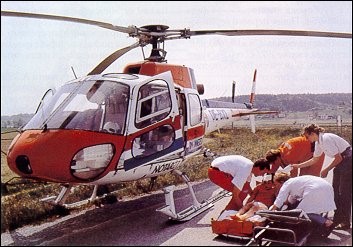
AS 355F superseded by AS 355F1 in January 1984. The AS 355F2 certified 10 December 1985. The AS.355F2 civilian variant is fitted with twin Allison turbines developing around 315kW and new wider composite blades and remoulded engine intakes for anti-icing protection.
AS 355N powered by two Turbomeca TM 319 Arrius 1A certified in France in 1989, UK and USA in 1992; deliveries of this version began early 1992.
Customers for the AS355/AS555 totaled 592 twin-engined Ecureuils in service at May 2000.
The French Air Force ordered 52 Fennecs, first eight as AS 355F1s powered by Rolls-Royce 250; flown by 67e Escadre d’Helicopteres at Villacoublay and other units for communications and, with side-mounted Giat M61 20mm gun pod, by ETOM 68 in Guyana; delivery of the remaining 44 (AS 555AN powered by Arrius) began 19 January 1990; from 24th onwards, provision for centrally mounted 20mm cannon and T-100 sight, plus Mistral missiles.
The French Army ordered 18 AS 555UNs for TFR training (delivery from February 1992). The French Air Force operate the AS.355N in the surveillance role and later models are fitted with Turbomeca TM319 turbines. A naval variant, the AS 555MN, is equipped with a chin-mounted radar, but is unarmed.
The Brazilian Air Force has 13 AS 555s: 11 with armament, designated CH-55, and two VIP transports, designated VH-55. The Brazilian Navy acquired 11 UH-12Bs; Brazilian AS 555s assembled by Helibras in Brazil; four more navies ordered eight AS 555s in 1992, two in 1993, four in 1994 and one in 1995.
Two AS 333F1s, leased from OSS of Hayes, UK, supplied to the RAF’s No. 32 (The Royal) Squadron at Northolt on 1 April 1996 for VIP transport; third subsequently added.
Total of six AS 3555Ns ordered by Malaysian Navy on 13 October 2001 with deliveries at end 2003.
Orders in 1997-2001 totalled nine, 20, 10, 13 and 17. About 750 Ecureuils and Astars have been delivered to operators in 19 nations.
In May 2005 a Eurocopter AS 350B3 Squirrel set a new world record for the highest take-off and landing when it touched down on the peak of Mount Everest at a height of 29,035 ft / 8850 m. To be recognised as a record, the Squirrel had to remain on the ground for two minutes before departing.
VERSIONS:
AS 350B2 Ecureuil
Uprated engine and transmission; wide-chord new section main and tail rotor blades originally developed for AS 355 twin; certified 26 April 1989; known as SuperStar in North America; supplied to UK Ministry of Defence as AS 350BB, designated Squirrel HT. Mk 1 with normal instrumentation and Squirrel HT. Mk 2 with provision for pilot’s NVGs.
AS 350B3 Ecureuil
632kW Arriel 2B and wide-chord tail rotor; optimised for high-altitude operation; uprated transmission and digital engine control. First flight (F-WWPB) 4 March 1997; French VFR certification December 1997 after 150 hour test programme; first delivery, to Osterman Helicopter, January 1998; Australian and New Zealand certification achieved late 1998. By 1 June 2001, 180 AS 350B3s were in service with 120 customers, in 25 countries; 100th AS 350B3 delivered 14 December 1999 to Japanese customer.
AS 350BA Ecureuil
Powered by 478kW Turbomeca Arriel 1B and fitted with large main rotor blades of AS 350B2; maximum T-O weight increased by 150kg.
AS 350D AStar
Version of 350B for North American market; improved LTS101 engine, with 6% more power, offered early 1999.
AS 350 Firefighter
Conair system able to pick up water load in 30 seconds while hovering over water; demonstrated 1986; Isolair system certified September 1995.
AS 550ÑÇ Fennec
Light anti-tank version armed with four TOW missiles; has same power plant as AS 550A3 and 2 hour 45 minute endurance.
AS 550A3 Fennec
Light attack version of AS 350B2 with 3-hour endurance; powered by 632kW, Arriel 2B; standard features include taller landing gear, sliding doors; NVG-compatible cockpit; reinforced airframe; provision for armoured seats and engine cowlings; can be armed with single 20mm cannon or two rocket launchers.
AS 550U3 Fennec
Military utility version with Arriel 2B power plant; capable of performing observation, commando and transport duties.
AS 355N Ecureuil 2 / Twinstar
Civil production version, adaptable for passengers, cargo, police, ambulance, slung loads, carrying harbour pilots, working on high-tension cables and other missions; Category A OEI performance; known as TwinStar in USA.
AS 555UN Fennec
Military utility version and French Army ALAT IFR pilot trainer.
AS 555AN Fennec
Armed version; later machines adapted for centreline-mounted 20mm gun and pylon-mounted rockets.
AS 555MN Fennec
Naval unarmed version. Can carry a 360 degree chin-mounted radar.
AS 555SN Fennec
Armed naval version for ASW and over-the-horizon targeting, operating from ships of 600 tonnes upwards; armament includes one lightweight homing torpedo or the cannon and rockets of land-based versions; avionics include Honeywell RDR-1500B 360° chin-mounted radar, Thales Nadir 10 navigation system, Thales RDN 85 Doppler and SFIM 85 T31 three-axis autopilot.
AS.350 Ecureuil
Engine: Turboméca Arriel II, 632 shp
Length: 35.794 ft / 10.91 m
Rotor diameter: 35.072 ft / 10.69 m
Fuselage length: 10.9m
Height: 3.15m
MTOW: 4630.5 lb / 2100.0 kg
Weight empty: 2348.3 lb / 1065.0 kg
Max. speed: 147 kts / 272 km/h
Cruising speed: 125 kts / 232 km/h
Initial climb rate: 1555.12 ft/min / 7.9 m/s
Service ceiling: 4750m
HIGE: 2500m
H OGE: 1860m
Range: 378 nm / 700 km
Crew: 2
Payload: 6 pax
AS.350B Ecureuil
Engine: Turbomeca Arriel 1D1, 614 shp
TBO: 2000 hrs
Main rotor: 35.1 ft
Seats: 6
Length: 42.6 ft / 12.99 m
Height: 10.3 ft / 3.5 m
Width: 10.69 m
Max ramp wt: 4300 lb
MTOW: 4300 lb
Std empty wt: 2363 lb
Max useful load: 1937 lb
Max landing wt: 4300 lb
Max sling load: 2000 lb
Disc loading: 4.4 lb/sq.ft
Power loading: 6.7 lb/hp
Max usable fuel: 983 lb
Max ROC: 1555 fpm
Max speed: 147 kts
Service ceiling: 15,600 ft
HIGE: 9675 ft
HOGE: 7380 ft
Normal cruise @ 3000 ft: 123 kts
Fuel flow @ normal cruise: 301 pph
Endurance @ normal cruise: 2.9 hr
AS.350B2 / SuperStar
Engine: 1 x Turbomeca Arriel 1D1
Instant pwr: 545 kW
Rotor dia: 10.7 m
Length: 12.99 m
Height: 3.5 m
Width: 10.69 m
MTOW: 2250 kg
Useful load: 1090 kg
Max cruise: 135 kts
Max range: 670 km
HOGE: 8350 ft
Service ceiling: 15,750 ft
Crew: 2
Pax: 4
Seats: 6/7
AS.350B3
Engine: 1 x Turbomeca Arriel 2B, 847 shp
Max cont pwr: 728 shp
Empty wt: 1202 kg
MAUW: 2250 kg
Height: 3.5 m
Width: 10.69 m
Length: 12.99 m
ROC @ 2250 kg: 1979 fpm
Cruise: 120-130 kt
Max cruise: 147 kt
Vne: 155 kt
MAUW external load: 2800 kg
AS.350BA
Engine: 1 x Turbomeca Arriel 1B
Instant pwr: 475 kW
Rotor dia: 10.7 m
Length: 12.99 m
Height: 3.5 m
Width: 10.69 m
MTOW: 2100 kg
Useful load: 945 kg
Max cruise: 126 kts
Max range: 730 km
HOGE: 6500 ft
Service ceiling: 15,750 ft
Crew: 2
Pax: 4
Seats: 6/7
AS.350C AStar
Engine: 1 x Lycoming, 615 shp
Seats: 6
AS.350D AStar
Engine: 1 x Lycoming LTS101-600A2, 615 shp
TBO: 2400 hrs
Main rotor: 35.1 ft
Seats: 6
Length: 42.6 ft
Height: 10.3 ft
Max ramp wt: 4300 lb
MTOW: 4300 lb
Std empty wt: 2360 lb
Max useful load: 1940 lb
Max landing wt: 4300 lb
Max sling load: 2000 lbs
Disc loading: 4.4 lb/sq.ft
Power loading: 9.37 lbs/hp
Max usable fuel: 938 lb
Max ROC: 1760 fpm
Service ceiling: 15,000 ft
HIGE: 8800 ft
HOGE: 5400 ft
Max speed: 147 kts
Normal cruise @ 3000 ft: 122 kts
Fuel flow @ normal cruise: 293 pph
Endurance @ cruise: 3 hr
AS.350L Ecureil
Engine: 1 x Turbomeca Arriel
Installed pwr: 480 kW
Rotor dia: 10.7 m
Fuselage length: 10.9 m
No. Blades: 3
Empty wt: 1065 kg
MTOW: 2200 kg
Payload: 900 kg
Max speed: 270 kph
ROC: 480 m/min
Ceiling: 4575 m
HIGE: 2950 m
HOGE: 2250 m
Fuel cap (+aux): 530 lt (475 lt)
Range: 700 km
Crew: 1
Pax: 5
AS.355 Ecureuil 2 / Twinstar
Engine: 2 x Allison 250-C20F, 309 shp
Length: 35.761 ft / 10.9 m
Height: 10.171 ft / 3.15 m
Rotor diameter: 35.105 ft / 10.69 m
Fuselage length: 10.9m
MTOW: 5600.7 lb / 2540.0 kg
Weight empty: 2877.5 lb / 1305.0 kg
Max. speed: 121 kts / 224 km/h
Cruising speed: 108 kts / 200 km/h
Initial climb rate: 1279.53 ft/min / 6.5 m/s
Service ceiling: 11155 ft / / 3400 m
HIGE: 2000m
HOGE: 1500m
Range: 378 nm / 700 km
Fuel capacity: 193 USG / 730 lt
Crew: 1
Payload: 5 pax
AS.355F TwinStar
Engine: 2 x Allison 250-C20F, 420 shp
TBO: 3500 hrs
Main rotor: 35.1 ft
Seats: 6
Length: 42.6 ft
Height: 10.3 ft
Max ramp weight: 5070 lb
MTOW: 5070 lb
Standard empty weight: 2807 lb
Max useful load: 2263 lb
Max landing weight: 5070 lb
Max sling load: 2300 lb
Disc loading: 5.2 lb/sq.ft
Power loading: 6 lb/hp
Max usable fuel: 1293 lb
Max rate of climb: 1614 fpm
Service ceiling: 14,800 ft
Hover in ground effect: 6900 ft
Max speed: 147 kts
HOGE: 7900 ft
Normal cruise @ 3000 ft: 128 kts
Fuel flow @ normal cruise: 435 pph
Endurance @ normal cruise: 2.8 hr
AS.355F1 Ecureuil II
Engine: 2 x Allison 250-C20F
AS.355F2 Ecureuil II
Engine: 2 x Allison 250-C20F
Instant pwr: 315 kW
Rotor dia: 10.7 m
MTOW: 2540 kg
Useful load: 1185 kg
Max cruise: 120 kts
Max range: 705 km
Seats: 6/7
AS.355N Ecureuil II
Engine: 2 x Turbomeca Arrius 1A
Instant pwr: 355 kW
Rotor dia: 10.7 m
MTOW: 2540 kg
Useful load: 1135 kg
Max cruise: 120 kts
Max range: 720 km
HIGE: 8530 ft
HOGE: 5085 ft
Seats: 6/7
AS.550A2/C2 Fennec
Engine: 1 x Turbomeca Arriel 1D1
Instant pwr: 545 kW
MTOW: 2500 kg
Payload: 1160 kg
Max speed: 130 kts
Max range: 654 km
HIGE: 9850 ft
HOGE: 7850 ft
Crew: 1
Pax: 5
AS.550U2 Fennec
Engine: 1 x Turbomeca Arriel 1D1
Instant pwr: 545 kW
MTOW: 2500 kg
Payload: 1160 kg
Max speed: 130 kts
Max range: 654 km
HIGE: 9850 ft
HOGE: 7550 ft
Crew: 1
Pax: 5
AS.555MN/SN Fennec
Engines: 2 x Turbomeca Arrius TM3191A1
Instant pwr: 340 kW
MTOW: 2600 kg
Payload: 1134 kg
Max speed: 121 kts
Max range: 722 km
HIGE: 8530 ft
HOGE: 5085 ft
Crew: 1
Pax: 5
AS.555SR
Engines: 2 x Allison 250-C20F, 420 shp (313 kW)
AS.555AN Fennec
Engine: 2 x Turbomeca Arrius TM3191A1
Instant pwr: 390 kW
MTOW: 2600 kg
Payload: 1135 kg
Max speed: 118 kts
Max range: 659 km
HIGE: 8530 ft
HOGE: 5080 ft
Crew: 1
Pax: 5
AS.555UN Fennec
Engine: 2 x Turbomeca Arrius TM3191A1
Instant pwr: 390 kW
MTOW: 2600 kg
Payload: 1135 kg
Max speed: 118 kts
Max range: 695 km
HIGE: 8530 ft
HOGE: 5080 ft
Crew: 1
Pax: 5
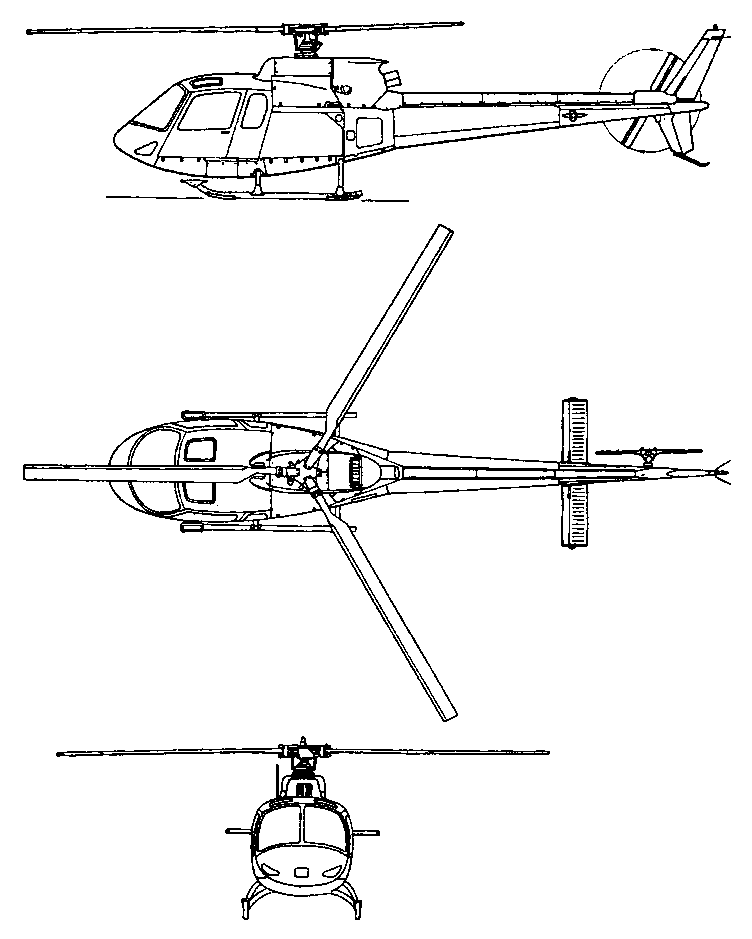
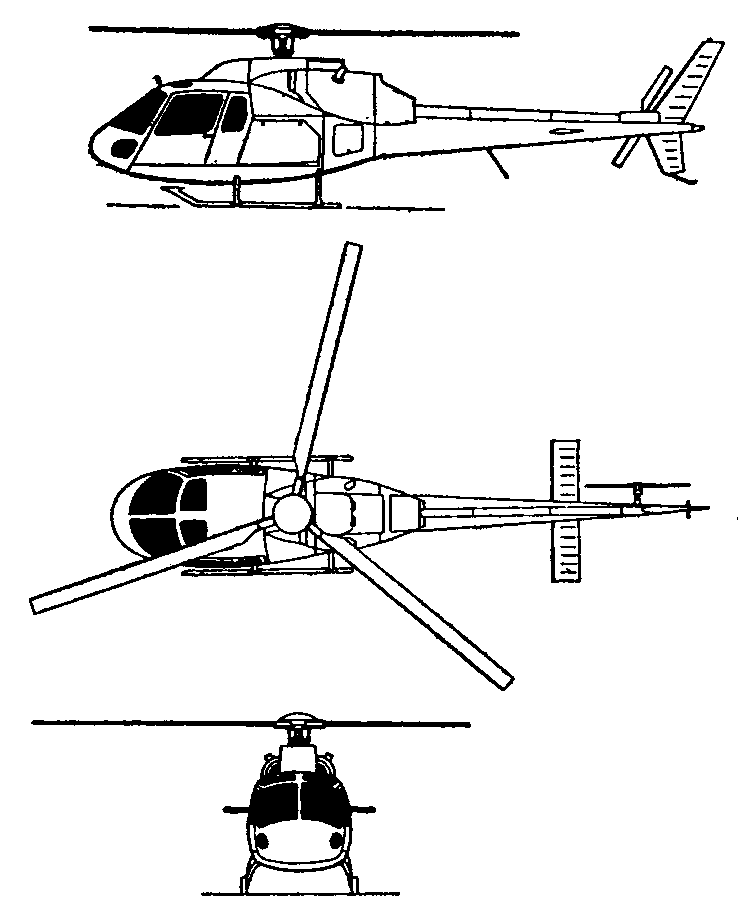
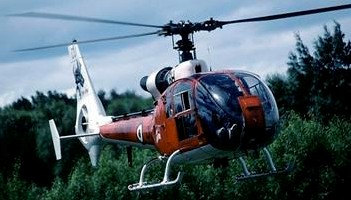
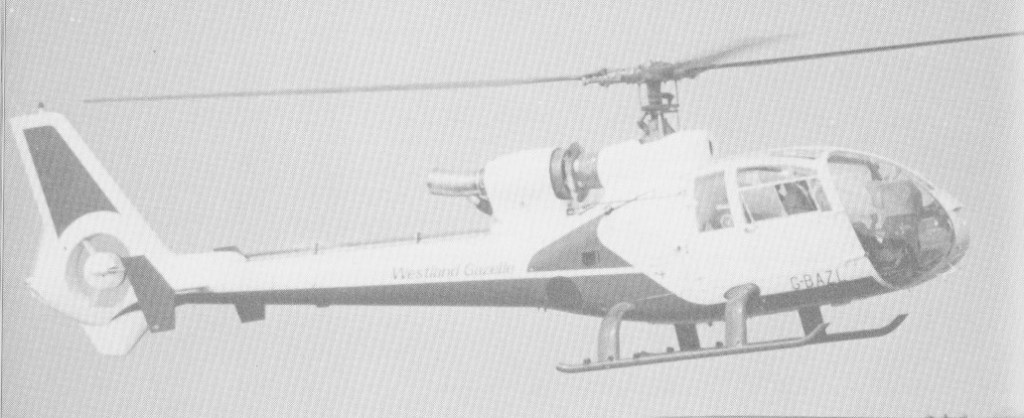
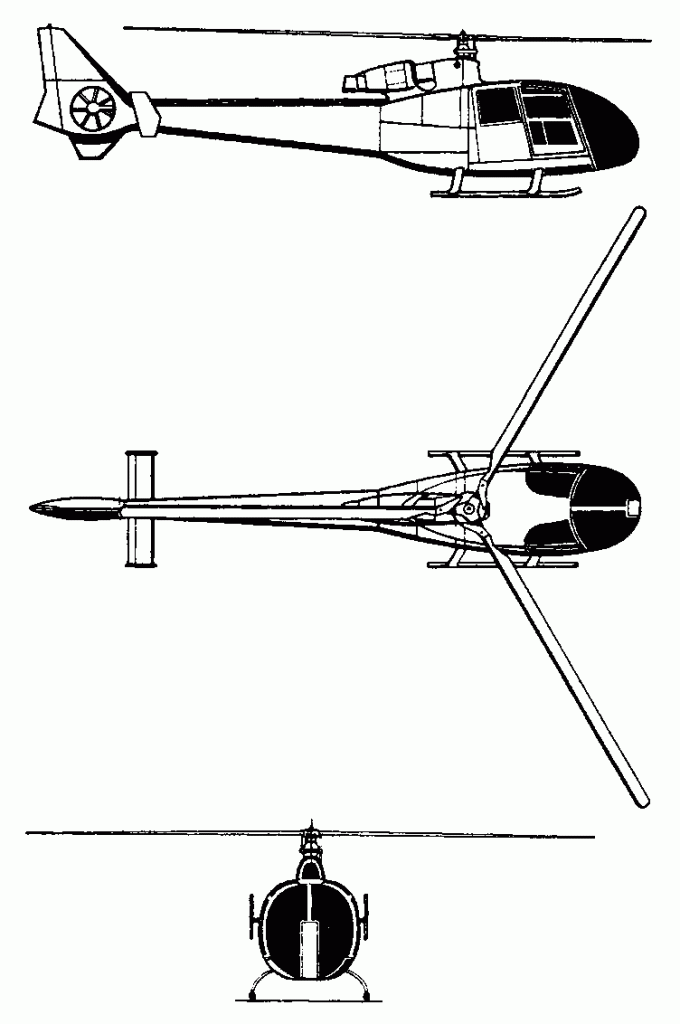
The SA 341 Gazelle all-purpose lightweight helicopter began as a proposal for a new observation helicopter for the French army. It was re-named the SA 340 soon afterwards. The Gazelle features a fully enclosed fuselage structure and, while it can be flown by a single pilot, has provision for two pilots with side-by-side seating.
The SA.340 prototype F-WOFH flew for the first time on 7 April 1967, with an Astazou UN turbine and the same transmission, landing skids, anti-torque rotor and tail plane as the Alouette. Following the first flight, development continued throughout 1967 at Sud-Aviation’s factory at Marignane, near Marseille. This first aircraft utilises the tail rotor and skid of the Alouette II and the engine and transmission system of the Alouette II Astazou, but the second prototype (F-ZWRA, first flown on 17 April 1968) was representative of production SA.341’s in having the Astazou IIN2 and a ‘solid’ vertical fin with a circular cut-out in its centre, within which its small 13-blade tail rotor rotates. The main rotor blades, made of laminated glassfibre, are of the type developed by Bolkow of Germany in collaboration with Sud-Aviation. In 1967 while still in the final design stages, Westland joined a production-sharing agreement signed on 22 February 1967 and officially confirmed on 2 April 1968, and performed final assembly of the first British military version in 1970.
Aerospatiale SA340 / SA341 / SA342 Gazelle Article
The first prototype, designated SA 340.001, was flown on 7 April 1967, and the second on 12 April 1968. The first French Gazelle had a longer cabin than its predecessors, an enlarged tail unit and an uprated Astazou IIIA engine. These were followed by four pre-production SA 341 Gazelles (first flown on 2 August 1968), of which the third was equipped to British Army requirements, assembled in France, and then re-assembled by Westland in the UK as the prototype Gazelle AH.1. It was first flown on 28 April 1970.
The initial Westland-assembled Gazelles followed early in 1972 (first flown on 31 January 1972).
Westland Helicopters Ltd of Weston-Super Mare in Somerset delivered 32 Gazelles to the Royal Air Force. Others served with the Army Air Corps and Fleet Air Arm.
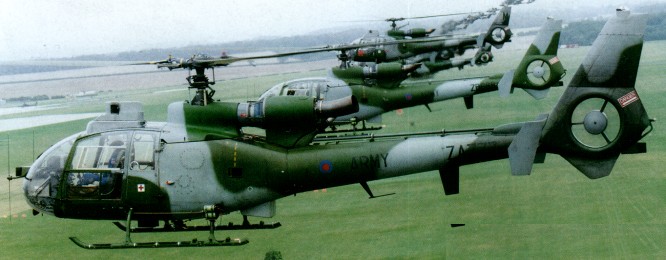
On 14 May 1970 the first Aerospatiale-built SA 341 pre-production aircraft, in slightly modified form, established three new speed records for helicopters of its class.
Manufacture of the Gazelle began with a civil-registered aircraft on 6 August 1971.The upgraded SA 342 first flew in 1976.
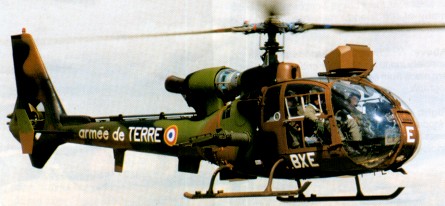
Two military models are; the SA.342L-1 for export customers, and the similar SA.342M for the French Army. Armament options include four or six HOT anti-tank missiles, a GIAT M621 20mm cannon, and machine-gun or rocket pods.
Armament which can be carried by the military versions includes machineguns, rockets and reconnaissance flares, plus a variety of missiles, including the anti tank HOT missile (High subsonic Optically guided Tube¬launched).
The Gazelle has been built under licence by Egypt and Yugoslavia where the Serbs used Yugoslav-built Gazelles in the Balkan civil war during the 1990s.
Variants:
SA 341B Gazelle AH.1
British Army version; Astazou IIIN engine; Nightsun searchlight, Decca Doppler 80 radar and automatic chart display; first Westland-assembled example flown on 31. January 1972; entered operational service on 6 July 1974 (total 158)
SA 341C Gazelle HT.2
Fleet Air Arm training versions; Astazou IIIN engine; stability-augmentation system and a hoist incorporated; first flown on 6 July 1972 and first entered service on 10 December 1974 (total 30)
SA 341D Gazelle HT.3
RAF training version; Astazou IIIN engine; stability-augmentation system; Schermuly flares installation; first deliveries to service on 16 July 1973 (total 14)
SA 341E Gazelle HCC.4
RAF communications version; Astazou IIIN engine (total 1)
SA 341F Gazelle
Basic French army version; Astazou IIIC engine (total 166)
SA 341G Gazelle
Civil commercial version; Astazou IIIA engine; officially certificated for passenger service on 7 June 1972; subsequently became the first helicopter to obtain US approval for operations under IFR Cat.1 conditions with a single pilot; also developed into a so-called ‘Stretched Gazelle’, with rear section of the cabin modified to provide additional 20cm legroom for the rear passengers
SA 341H Gazelle
Military export version; Astazou IIIB engine; subject to licence-production agreement signed on 1 October 1971 with SOKO in Yugoslavia (total 112)
SA 342J Gazelle
Civil version of SA 342L; 649kW Astazou XIV engine, improved fenestron tail rotor, increased take-off weight; approved for service on 24 April 1976; deliveries commenced in 1977
SA 342K Gazelle
Military export version for ‘hot and dry’ areas; 649kW Astazou XIVH engine with momentum-separation shrouds over air intakes; first flown on 11 May 1973; initial sales to Kuwait.
SA 342L Gazelle
Military counterpart of SA 342J; 649kW Astazou XIV engine; adaptable for wide range of armaments and equipment, including six Euromissile HOT anti-tank missiles
SA 342M Gazelle
French army antitank version with four Euromissile HOT missiles, SFIM APX M397 stabilised sight
Aérospatiale SA 341 Gazelle
Engine: Turboméca Astazou III N, 584 shp
Length: 31.234 ft / 9.52 m
Overall length: 11.97 m
Height: 9.711 ft / 2.96 m
Rotor diameter: 34.449 ft / 10.5 m
Empty weight: 908 kg
MTOW: 3748.5 lb / 1700.0 kg
Max. speed: 143 kts / 265 km/h
Service ceiling: 16732 ft / 5100 m
Range: 351 nm / 650 km
Crew: 1+4
Armament: ext.
Aerosatiale SA 341G Gazelle
Engines: Turbomeca Astazou IIIA, 590 hp
Disc loading: 4.26 lb/sq.ft
Main rotor dia: 34 ft 5.5 in / 10.05m
Fuselage length: 31 ft 2 in / 9.53m
Cabin length: 7 ft 2 in / 2.20m
Cabin max width: 4 ft 4 in / 1.32m
Cabin max height: 3 ft 11.5 in / 1.21m
Cabin volume: 63.7 cu.ft / 1.80 cu.m
Baggage hold volume: 15.9 cu.ft / 0.45 cu.m
Pwr loading: 6.7 lb/hp
Max TO wt: 3970 lb / 1800 kg
Empty wt: 2022 lb / 917 kg
Equipped useful load: 1796 lb
Payload max fuel: 845 lb
Range max fuel/ cruise: 318 nm/ 2.2 hr
Range max fuel / range: 361 nm / 416 mi / 670 km / 2.6 hr
Range 1102 lb / 500 kg payload: 193 nm / 223 mi / 360 km
Service ceiling: 16,400 ft / 5000 m
Max cruise SL: 142 kt / 164 mph / 264 kph
Max range cruise: 125 kt
ROC SL: 1770 fpm / 540 m/min
HIGE: 9180 ft
HOGE: 6890 ft
Max sling load: 1540 lb
Fuel cap: 794/951 lb
Seats: 5
HT.Mk.3
Rotor dia: 34ft 5.5 in (10.5 m)
Max cruise: 164 mph (264 km/h)
AS.342L Gazelle
Engine: 1 x Turbomeca Astazou XIVM turboshaft: 640kW
Fuselage Length: 31.27 ft (9.53m)
Height: 10.43 ft (3.18m)
Rotor dia: 10.5 m
Main rotor: three blade
Empty Weight: 2,202lbs (999kg)
Maximum Take-Off Weight: 4,409lbs (2,000kg)
Fuel cap (+aux): 240 lt (80 lt)
Maximum Speed: 165mph (265kmh; 143kts)
Maximum Range: 441miles (710km)
Rate-of-Climb: 2,400ft/min (732m/min)
Ceiling: 4300 m
HIGE: 2315 m
HOGE: 1770 m
Accommodation: 2 + 3
Hardpoints: 2 (with wing stubs)
AS.342L1 Gazelle
Engine: 1 x Turbomeca Astazou X1VM
Instant pwr: 600 kW
MTOW: 2000 kg
Payload: 700 kg
Max speed: 260 kts
Max range: 710 km
Crew: 1
Pax: 4
AS.342M Gazelle

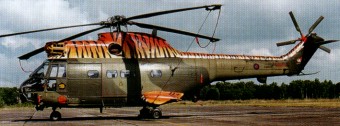
The design of the AS.332 commenced in 1974 and the definitive prototype was preceded by a modified Puma, the AS.331, which flew in September 1977 with an uprated transmission driven by two Turbomeca Makila turboshafts. The first AS.332 flew on 13 September 1978 (the prototype designated as the AS 331) and introduced additional changes to improve payload, performance and survivability, and to reduce maintenance.
Changes included a new energy-absorbing landing gear with increased wheel base and track, a lengthened nose section, more efficient fiberglass main and tail rotors, greater fuel capacity, and revised fin and tail plane contours to improve handling. In 1980 a fourth prototype introduced a cabin stretch of 0.76m with two additional windows and up to three more passengers.
Aerospatiale SA330 Puma Article
When development of the SA.330 (then called Alouette IV) and the production of seven test aircraft (two prototypes and five pre-series machines) was authorised by the STAe in June 1963 (the War Ministry allocated 20 million francs), Turmo III free turbines of the same rating were selected in preference to the Bastan powerplant. A full-size mock-up, seen at the Paris Air Show that year, was similar to the final version apart from the shape of the nose. The evaluation aircraft were registered F-ZWWN to F-ZFWT, and the first of them made its maiden flight on 15 April 1965; all of these, plus a sixth pre-series aircraft, were flying by mid-1968, the last on 30 July 1968.
Beginning with the AS 331 prototype, this produced the AS 332A commercial pre-production models followed by the first commercial production examples designated as the AS 332C. Military pre-production models became the AS 332B followed by the initial militarized forms in the AS 332B1. The AS 332 C1 was a dedicated Search & Rescue (SAR) example equipped with six cabin stretchers and a surface search radar. The AS 332F became a militarized anti-submarine and anti-ship variant while the AS 332F1 was a base navalized Super Puma modified to contend with the rigors of the salty ocean environment.
The sixth pre-production aircraft had a different nose, which was standardized on the production aircraft. As a result of the trials programme the SA330 won the approval of the French Army, which ordered 130 (designated SA.330H).
After several trial examples were built the production of the Puma was started in 1968 powered by twin 1115kW Turbomeca Turmo IVC turboshafts and carrying sixteen combat troops at 260kph for a range of 555km. The first deliveries of fifty-four SA 330Bs to the French army took place in 1969, the type becoming operational the following year and the first of forty-eight Westland-built Pumas joining the RAF in 1971.
Thirty of the SA.330B, which is the version for the French ALAT (Army Air Corps), were built from spring 1969.
The SA.330C export version also went into production in 1969.
The SA.330 may carry a 2500kg external sling load or 20 troops and is equipped with a hoist capable of lifting a 175kg load. The SA.330 carries a crew of 2. The main rotor blades fold back for stowage, and all landing wheels retract, but protrude slightly. The fully-articulated main rotor had four extruded aluminum bladesand the anti-torque rotor five-blades.
The last pre-production Puma was modified by Westland for the RAF and after promising tests, a joint production agreement was reached (concluded on 2 April 1968) and Westland Helicopters built 48 SA 330E as the Puma HC.Mk I.
Those which are in British and French military service are powered by two 1,185 shp Turbomeca Turmo IIIC4 turboshaft engines. They can carry a wide variety of cannon, machine‑guns, and missiles, or be used to transport up to 20 troops or cargo.
The RAF’s SA.330E Puma HC Mk.1s built by Westland in 1970-71, were assigned to No.33 and 230 Squadrons.
The SA.330F civil version flew in September 1969 powered by 1290shp Turmo lVA engines. It was superseded by the SA.330J, introduced in 1976, and the SA.330L for military use. Both have 1580shp Turmo IVC engines and composite material main rotor blades. The SA.330J has been certified for all-weather operation and has an anti-icing system on both the rotor blades and air intakes.
The SA 330J provides for a standard crew of two on the flight deck, with a toilet and baggage compartment at the rear of the cabin. Equipped with thermal de-icing of the main rotor blades, thermal anti-icing of the tail rotor blades, special intakes and weather radar, the SA 330J, on 25 April 1978, received certification for all-weather operations, including flight in icing conditions.
Aerospatiale went on to build 686 (some sources claim 697) SA 330s (before switching production to the Super Puma in 1981) in successively improved versions for numerous export customers. These included civil operators, especially those in the oilfield support industry once the all-weather capability was available in the SA 330J and L. Between 1970 and 1984, Aerospatiale sold 126 civil models in all.
The SA330 was also assembled in Romania as the CNIAR-330, the first IAR-330H Puma flying on 22 October 1975. In 1977 a licence was granted for the Puma to be built in Romania.
Romania became the sole manufacturer of the Puma helicopter, and had completed 112 by mid-1985, mostly for military use. Romania exported a number of Puma, the military customers included Sudan, which received 12 in 1985. By 1994 IAR had built over 200 and production of the IAR-330L. Despite being a COMECON and Warsaw Pact member, Romania strove for some measure of independence from the USSR. Instead of buying popular Soviet designs, Romania bought a licence to manufacture the French Aérospatiale SA 330 Puma on 30 July 1974. The first licensed helicopter was flown on 22 October 1975 under the designation IAR-330L. Production was at the Industria Aeronautică Română plant at Ghimbav near Brașov.
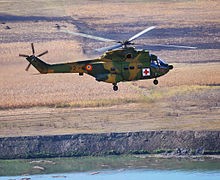
At least 163 of these helicopters have been built, out of which 104 were assigned to Romania’s military, 2 were retained by the manufacturer and 57 were produced for export (Pakistan, Ivory Coast, United Arab Emirates, Sudan, Ecuador). There is also a search and rescue (SAR) version, fitted with inflatable floats for emergency landing at sea, which has been built in a small batch.
The fuselage of the SA 330 Puma is a conventional all-metal semi-monocoque structure, with the engines mounted externally on top of the fuselage shell and forward of the main rotor assembly. The rotor is driven via a main gearbox, with twin free-wheeling spur gears to combine the outputs of the two turboshaft engines to a single main drive shaft. Should both engines fail the auto-rotating main rotor continues to drive the auxiliary take-offs for the shaft-driven tail rotor, alternator, dual hydraulic pumps, and ventilation fan. The tail boom, which carries the flapping-hinge five-blade tail rotor on the starboard side and a horizontal stabiliser on the port side, is a monocoque continuation of the aft fuselage. Early main rotor blades were of light alloy construction, but those fitted since 1976 are composite units of glassfibre, carbon fibre and honeycomb construction, with anti-abrasion leading edges of stainless steel. The landing gear is of the semi-retracting tricycle type, with twin wheels on each unit, all of which are partly exposed when retracted.
The first SA 330Bs for the French army and air force, and the SA 330Es for the Royal Air Force, were powered by Turmo III C4 turboshaft engines with a take-off rating of 990kW; and the SA330C/H military export versions, first flown in September 1968, had originally 1044kW Turmo IVBs, but from the end of 1973 SA 330H aircraft were equipped with 1174kW Turmo IVC engines which include anti-icing of the engine air intakes. The first SA 330F/G civil versions had Turmo IVA engines of 1070kW as first flown on 26 September 1969 and delivered from the end of 1970; but the SA 330G acquired Turmo IVC engines from the end of 1973; and this is also installed on the SA 330J (civil) and SA 330L (military) helicopters of 1976.
Features:
A four-blade main rotor, with a fully articulated hub and integral rotor brake. Attachment of each blade to its sleeve is by two quick-disconnect pins enabling the blades to be folded back manually. The five-blade tail rotor on the starboard side of the tailboom has flapping hinges only, with mechanical shaft and gear drive. The main gearbox is on top of cabin behind engines, and has two separate inputs from the engines and five reduction stages. Drive to the tail rotor is via shaft and an intermediate angle gearbox, and a right-angle tail rotor gearbox. The hydraulically controlled rotor brake, on the main gearbox, allows the rotor to be stoped 15 seconds after engine shutdown.
Each of the moulded blades is made up of a fibreglass roving spar, a composite fibreglass and carbonfibre fabric skin, with Moltoprene/honeycomb filler. The leading-edge is covered with a stainless steel protective section. The fuselage is an all-metal semi-monocoque structure. Titanium alloy is used under the engines, which are outside the main fuselage shell. The monocoque tailboom supports the tail rotor and a horizontal stabiliser on the port side.
The Messier-Hispano-Bugatti semi-retractable tricycle type landing gear, with twin wheels on each unit retract upward hydraulically into fairings on sides of fuselage and a self-centring nose unit retracts rearward. The wheels have hydraulic differential disc brakes, controlled by foot pedals, and a lever-operated park brake.
The two Turbomeca Turmo IVC turboshaft engines are mounted side by side above cabin forward of the main rotor assembly and separated by a firewall. They are coupled to the main rotor transmission box, with shaft drive to the tail rotor, and form a completely independent system from the fuel tanks up to the main gearbox inputs. Fuel is in four flexible tanks and one auxiliary tank beneath the cargo compartment floor, with a total capacity of 1,544 litres. There is provision for an additional 1,900 litres in four auxiliary ferry tanks to be installed in the cabin. External auxiliary tanks (two of 350 litres each) can be fitted. For long-range missions one or two extra internal tanks of 215 litres each can be fitted in the cabin. Each engine is supplied by a pair of interconnected primary tanks, the lower halves of which have self-sealing walls for protection against small calibre projectiles.
Crew can be one, or two side by side on anti-crash seats on the flight deck, with a jump-seat for third crew member if required. Doors feature on each side of flight deck on later versions. An internal doorway connects the flight deck with folding seat in the doorway for an extra crew member or cargo supervisor. Dual controls standard. Accommodation in main cabin for 16 individually equipped troops (20 in the high-density version), six stretchers and six seated patients, or equivalent freight. The floor is strengthened for cargo-carrying, with lashing points. The main cabin can have jettisonable sliding door on each side or a port-side door with built-in steps and starboard-side door in VIP or airline configuration. A hatch in the floor below the centreline of the main rotor is provided for carrying loads of up to 3,200kg on an internally mounted cargo sling. A fixed or retractable rescue hoist (capacity 275kg) can be mounted externally on the starboard side of the fuselage. The cabin can have a baggage compartment and/or toilet facilities in the rear of cabin.
Two independent hydraulic systems, each 172 bars, are supplied by self-regulating pumps driven by the main gearbox. Three-phase 200V AC electrical power is supplied by two 15 kVA 400Hz alternators driven by the port side intermediate shaft from the main gearbox and available on the ground under the same conditions as the hydraulic ancillary systems. 28.5V 10kW DC power is provided from the AC system by two transformer-rectifiers. A main aircraft battery is used for self-starting and emergency power in flight. De-icing of engines and engine air intakes is by warm air bled from compressor.
The search and rescue version has nose-mounted Bendix RDR 1400 or RCA Primus 40 or 50 search radar, Doppler, and Decca self-contained navigation system, including navigation computer, polar indicator, roller-map display, hover indicator, route mileage indicator and groundspeed and drift indicator.
A wide range of armament can be carried, including side-firing 20mm cannon, axial-firing 7.62mm machine guns, missiles and rockets.
The design of the AS.332 commenced in 1974 and the definitive prototype was preceded by a modified Puma, the AS.331, which flew in September 1977 with an uprated transmission driven by two Turbomeca Makila turboshafts. The first AS.332 flew on 13 September 1978 (the prototype designated as the AS 331) and introduced additional changes to improve payload, performance and survivability, and to reduce maintenance.
Changes included a new energy-absorbing landing gear with increased wheel base and track, a lengthened nose section, more efficient fiberglass main and tail rotors, greater fuel capacity, and revised fin and tail plane contours to improve handling. In 1980 a fourth prototype introduced a cabin stretch of 0.76m with two additional windows and up to three more passengers.
Production began in France in 1981, and is also undertaken by IPTN in Indonesia under license from Aérospatiale. Samco assembling 17 AS.332Ms under licence for the Republic of Singapore Air Force, and CASA planed to assemble 12 AS.332Bs for the Spanish Army in 1988/89, both joining fleets of French-built helicopters. A total of 197 military Super Pumas had been ordered by May 1987.
There are versions of the Super Puma based on short and long fuselage variants.
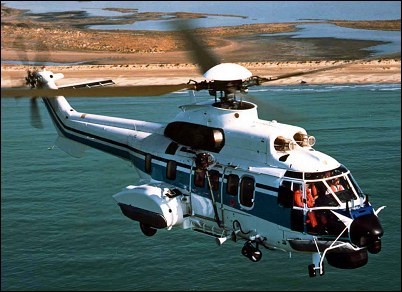
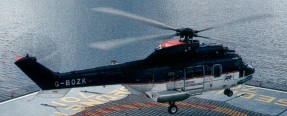
The short fuselage AS.332B is the standard 23-seat tactical transport military version and the short fuselage AS.332F is a naval variant. The AS.332F features a folding tail-rotor pylon, a deck-landing assistance device, additional corrosion protection, a nose mounted Omera 360 deg scan search radar, and sonar equipment. Anti-ship armament comprises two AM.39 Exocets, six AS.15TT, or a mix of one Exocet and three AS.15TT. The AS.332F can also be configured for search and rescue. The civil equivalent of the AS.332B and F is the AS.332C.
There is a stretched AS.332M 25-seat military transport.
The stretched AS.332L civil version of the AS.332M is in wide use with 34 with Bristow Helicopters, redesignated Tigers to signify equipment differences from the standard AS.332L.
Aérospatiale was devel¬oping the AS.332 Mk.II incorporating advanced rotor systems, including lengthened blades with parabolic tips, an uprated gearbox to allow increased power transmission, and upgraded avionics and equipment. Performance and manoeuvrability improvements over the standard AS.332 are significant, and uprated engines give a better hot/high capability. The first Super Puma Mk.II flew on February 6, 1987.
The 2002 build Eurocopter AS.332L2, a modified Super Puma, had the latest glass cockpit technology with a four¬ axis coupled autopilot for IFR, day/night approaches and SAR search modes. HIF, VHF/FM, UHF and homing devices make up the extra avionics, whilst an Ultraforce 11 FLIR camera is under the nose, a 30 million candela Nitesun on the lower starboard fuselage and a Skyshout system is also installed. A comprehensive set of medical equipment is carried, including a heart monitor and defibrillator.
Externally, the Super Puma shares many of its characteristics with the preceding Puma design. Its engines are mounted forward and high atop the fuselage exhausting outwards above the crew cabin. The engines power a four-bladed composite construction main rotor and five-bladed tail rotor mounted to starboard. The pilot and co-pilot are fitted into a glazed forward-mounted canopy with excellent views in all vital directions. Each pilot is afforded an automobile-style door for easy entry and exit. The fuselage sides are dominated by two large cabin doors (one door to a side) with cabin windows. The undercarriage is full retractable and features two main landing gears (single-wheeled) recessing into low-mounted fuselage side sponsons as well as a nose gear fitting two wheels recessing behind and under the cockpit floor. Like the Puma series before it, the Super Puma features an elevated empennage with a single vertical tail fin and a horizontal tailplane jutting out of the portside of the fin.
The AS 332L first flew on October 10th, 1980, appeared as a new civilian production model and sported a lengthened fuselage for an increase in its cabin space and fuel capacity as well as uprated turboshaft engines. Operations of the type were certified in 1983. The AS 332L1 was a similar model featuring an even more lengthened fuselage containing an airliner-type interior and uprated Makila 1A1 turboshaft engines and made its operational appearance in 1986. The AS 332M became a militarized version of the AS 332L model while the AS 332M1 was a similar militarized AS 332L with a lengthened fuselage.
Indonesian Aerospace (formally IPTN) has license-produced the Super Puma as the NAS 332L1 of which at least 7 were sold to Iran in a 1996 deal.
The AS 332L2 “Super Puma Mk II” was a further civilian-based transport development of the type beginning service in 1993 and featuring a long-fuselage for an extra row of seats. These Super Pumas were also given a spheriflex rotor head with EFIS flight instrumentation as well as longer main rotor blades with parabolic tips and a four-axis Automatic Flight-Control System (AFCS). The cockpit was updated to include four large multi-function LCD screens. Passenger seating is between 19 and 24 persons. A 15-passenger VIP model (Super Puma Mk II VIP) is also available complete with galley and toilet.
The AS 332L1 utilized twin Turbomeca Makila 1A1-series turboshaft engines running at 1,742 shaft horsepower each while the AS 332L2 fitted twin Turbomeca 1A2-series turboshaft engines rated at 1,819 shaft horsepower each. Top speed for the AS 332L1 was 278 kilometers-per-hour with a range of 841 kilometers and a service ceiling of 20,000 feet. Rate-of-climb was listed at 1,618 feet-per-minute. Comparatively, the AS 332L2 operated at a top speed of 278 kilometers-per-hour, a range of 831 kilometers, a service ceiling of 23,622 feet and a rate-of-climb of 1,614 feet-per-minute.
The AS 332L has seen extensive production and use during its run. These are now being replaced by the newer AS 332L2 Super Puma MK II series. Bristow Helicopters acquired no fewer than 31 custom AS 332L’s for its North Sea-based offshore oil rig work. Customizations included folding cabin seats, life rafts, jettisonable cabin doors, IFR instrumentation, de-icing equipment, baggage compartments and North Sea-related navigational aid equipment. These came under the designation of “Tiger” (sometimes called “Super Tigers”).
Following on from the Alpha XH-1 research, Denel comimssioned two Puma helicopters to develop the systems required for the Rooivalk. Puma J1 first flew in 1986 and was the primary avionics, weapons and flight control systems’ test bed. Puma J2 flew shortly afterwards, its primary task being to develop the weapons systems and integrate them with the aircraft and the other on hoard systems. Concurrently two missile tests were conducted: the first studied the effect of missile blast on the tail boom and the other studied the accuracy of the weapons and associated systems.
From the J model Pumas the Rooivalk started to take shape in the form of the initial experimental development model (XDM).
Production of the original Puma totalled over 686.
The Airbus Helicopters H215 (formerly Eurocopter AS332 Super Puma) is a four-bladed, twin-engined, medium-sized, utility helicopter developed and initially produced by French aerospace company Aérospatiale.
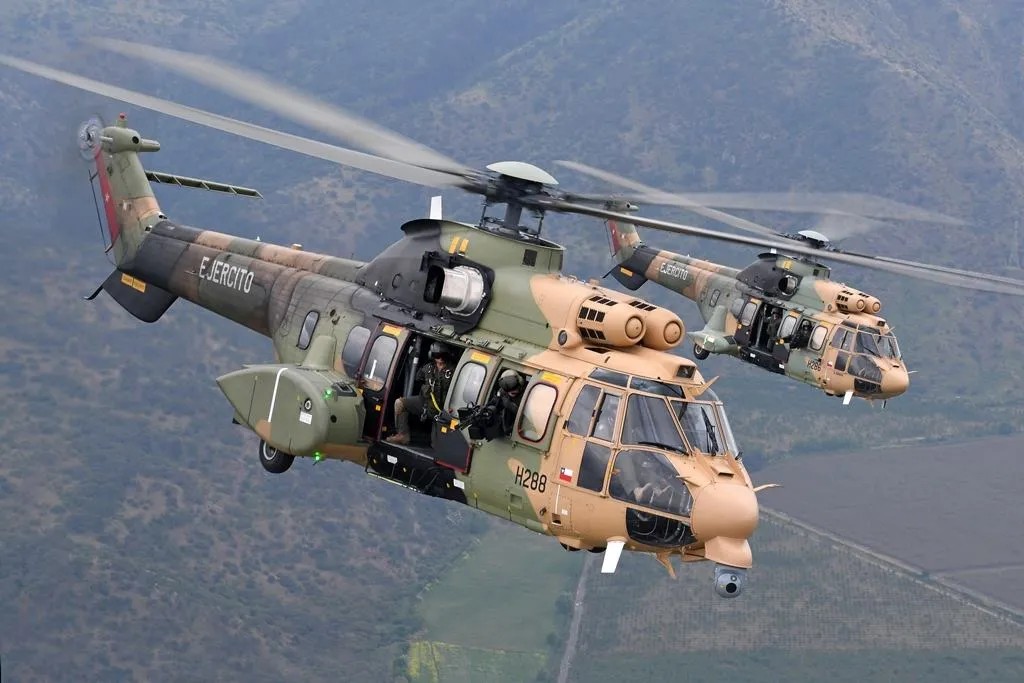
Versions:
SA.330 Puma / Alouette IV
Medium-lift 20-troop military helicopter with retractable tricycle u/c and four-blade main rotor driven by two 1320shp Turbomeca Turmo III.C4 turboshafts positioned in housing above main cabin. Prot. F-ZWWN FF 14 Apr. 1965. Jointly built by Aerospatiale and Westland. Originally named Alouette IV.
SA.330B
Initial military production version; delivered to ALAT (French Army Air Corps) from 1969; two 984kW Turmo IIIC-4 turboshaft engines. First flown January 1969.
SA 330B Orchidee
Prototype for battlefield surveillance version, fitted with ESB Orchidee 360° radar and datalink system.
SA.330C Puma
Military export version; similar to SA 330B with provision for fixed or retractable undercarriage; some fitted with surveillance radar and flotation gear.
SA 330E / Puma HC.1
Westland-built version for Royal Air Force, designated HC Mk 1. Forty built.
SA.330F
First civil version with 1,070kW Turmo IVA engines. First flown 26 September 1969; French certification 12 October 1970; FAA IFR certification 23 June 1971.
SA 330G
Uprated SA.330F model for civil and military markets; two 1,174kW Turmo IVC engines; composite main rotor blades.
SA.330H
Export version of Puma SA.330G for ALAT and military customers.
SA.330J
Puma SA.330G with composite main rotor blades and higher weights introduced in 1976. Some assembled by IPTN in Indonesia.
SA.330L
Puma SA.330H with composite main rotor blades and higher weights introduced in 1976.
SA.330S Puma
Portuguese SA.330C modified by OGMA with composite main rotor and two 1700shp Turbomeca Makila I turboshafts.
SA.330Z
Puma SA.330 fitted with experimental tail fenestron. Prot F-ZWRR.
IAR.330L Puma
Puma Licence-built in Romania by IAR Brasov with 1588shp Turbomeca Turmo IV-CA turboshafts.
SA.330R / SA.331
Stretched Puma SA.330 used as development aircraft for SA.332 Super Puma with two 1755shp Turbomeca Makila turboshafts and redesigned rotor head. Also known as SA.330R. F-ZWWO First flown on 5 Sept. 1977.
Oryx
Upgraded Puma by Denel (Atlas Aviation) in South Africa. Atlas has conducted the development and production of a variant of the SA 330 Puma helicopter as the Oryx, and development of a modular weapon suite for the Puma helicopter to convert it into a gunship.
Aérospatiale SA 330 Puma
Engine: 2 x Turboméca Turmo III C4, 1302 shp
Length: 46.129 ft / 14.06 m
Height: 13.714 ft / 4.18 m
Rotor diameter: 49.213 ft / 15.0 m
MTOW: 14112.0 lb / 6400.0 kg
Max. speed: 151 kt / 280 km/h
Service ceiling: 15748 ft / 4800 m
Range: 756 nm / 1400 km
Crew: 2+20
SA 330B Puma
Rotor dia: 49 ft 2.5 in /15 m
Max cruise: 169 mph / 272 km/h
SA 330E Puma / HC.1
Engines: 2 x Turbomeca Turmo TS, 1185shp
Rotor dia: 49 ft 2.5 in / 15 m
Length: 59 ft 6.5 in / 18.15 m
Height: 16 ft 10.5 in / 5.14 m
Max TO wt: 14,770 lb / 6700 kg
Max level speed: 169 mph / 272 kph
SA330J Puma
Engines: 2 x Turbomeca Turmo IVC, 1558 shp
TBO: 2000 hrs
Main rotor: 49.5 ft
Seats: 16/22
Length: 59.8 ft
Height: 16.9 ft
Max ramp wt: 16,315 lb
Width: 5.14 m
Standard empty weight: 8358 lb
MTOW: 16,315 lb
Max landing weight: 16,315 lb
Max useful load: 7957 lb
Max sling load: 7715 lb
Disc loading: 8.5 lb/sq.ft
Power loading: 5.2 lb/hp
Max usable fuel: 2734 lb
Max rate of climb: 1200 fpm
Service ceiling: 15,750 ft
Hover in ground effect: 7545 ft
Hover out ground effect: 5580 ft
Max speed: 142 kts
Normal cruise/3000 ft: 128 kt
Fuel flow normal cruise: 1269 pph
Endurance normal cruise: 2 hr
IAR-330H
IAR-330L
Powerplant: 2 × Turboméca Turmo IVC, 1,175 kW (1,576 hp) each
Main rotor diameter: 15.00 m (49 ft 3 in)
Main rotor area: 176.7 m2 (1,902 sq ft)
Length: 18.15 m (59 ft 7 in) (overall), 14.06 m (46 ft 2 in)
Height: 5.14 m (16 ft 10 in)
Empty weight: 3,615 kg (7,970 lb)
Max takeoff weight: 7,400 kg (16,314 lb)
Never exceed speed: 294 km/h (183 mph, 159 kn)
Cruise speed: 271 km/h (168 mph, 146 kn) (max cruise)
Range: 572 km (355 mi, 309 nmi)
Service ceiling: 6,000 m (20,000 ft)
Rate of climb: 9.2 m/s (1,810 ft/min)
Crew: 1–3
Capacity: 16 fully equipped troops
AS 332 Super Puma
Engine: 2 x Turboméca Makila 1A, 1701 shp
Length: 61.45 ft / 18.73 m
Rotor diameter: 49.475 ft / 15.08 m
MTOW: 18411.8 lbs / 8350.0 kg
Range: 342 nm / 634 km
Crew: 2
Payload: 24 Pax / 2722 kg int. / 4500 kg ext.
AS.332B Super Puma
Engine: 2 x Turbomeca Makila 1A1, 1380kW
Installed pwr: 2370 kW
Rotor dia: 15.6 m
Fuselage length: 15.5 m
Height: 4.92m
No. Blades: 4
Empty wt: 4290 kg
MTOW: 9000 kg
Max internal payload: 2722kg
Max external payload: 4500kg
Max speed: 295 kph
Cruising speed: 262km/h
ROC: 530 m/min
Ceiling: 4600 m
HIGE: 2700 m
HOGE: 1600 m
Fuel cap (+aux): 2060 lt (1900 lt)
Range: 635 km
Crew: 2-3
Pax: 20
AS332C Super Puma
Engine: Turbomeca Makila, 1755 shp
TBO: 2000 hrs
Main rotor: 51.1 ft
Seats: 21
Length: 61.4 ft
Height: 16.1 ft
Max ramp weight: 18,080 lb
Max takeoff weight: 18,080 lb
Standard empty weight: 9115 lb
Max useful load: 8965 lb
Max landing weight: 18,080 lb
Max sling load: 9920 lb
Disc loading: 8.8 lb/sq.ft
Power loading: 5.2 lb/hp
Max usable fuel: 4576 lb
Max rate of climb: 1810 fpm
Service ceiling: 15,580 ft
Hover in ground effect: 9840 ft
Max speed: 160 kts
HOGE: 7545 ft
Normal cruise @ 3000 ft: 135 kt
Fuel flow @ normal cruise: 1030 pph
Endurance @ normal cruise: 4.2 hr
First built: 1979
AS.332L1 Super Puma Mk.2
Engine: 2 x Turbomeca Makila 1A1
Instant pwr: 1400 kW
Rotor dia: 15.6 m
MTOW: 8600 kg
Useful load: 4140 kg
Max cruise: 140 kts
Max range: 1216 km
HIGE: 10,170 ft
HOGE: 7545 ft
Service ceiling: 13,450 ft
Seats: 22/26
AS.332L2 Super Puma Mk.2
Engine: 2 x Turbomeca Makila 1A2
Instant pwr: 1573 kW
Rotor dia: 16.2 m
MTOW: 9150 kg
Useful load: 4490 kg
Max cruise: 150 kts
Max range: 1215 km
HIGE: 9414 ft
HOGE: 7382 ft
Seats: 22/28
Oryx Gunship
Engine: 2 x Turbomeca Turmo IV C.
Instant pwr: 1115 kW.
Rotor dia: 15 m.
MTOW: 7400 kg.
Max speed: 140 kts.
Max cruise: 136 kts.
Max range: 348 km.
HOGE: 12,000 ft.
Crew: 2.
Airbus H215
Engine type: 2 x Safran Makila 1A1 Turboshaft
Takeoff power: 1,357 kW / 1,819 shp
One engine inoperative (OEI 2 min 30s): 1,400 kW / 1,877 shp
Hover ceiling IGE: 3.250 m
Hover ceiling OGE: 2,300 m
Recommended cruise speed: 252 Km/hr
Max range with standard fuel tanks at SL: 642 km / 866 km
Max endurance with standard fuel tanks: 772 km / 1,241 km
Max endurance with standard fuel tanks: 3 hr, 19 min / 4 hr, 25 min
Max endurance with SL Aux fuel tanks: 4 hr, 02 min / 6 hr, 35 min
Rotor diameter: 15.60 m
Cabin Internal volume: 11.4 cu.m / 13.4 cu.m
Crew + passengers / troops: 1 or 2 + 17/20 – 1 or 2 +19/22
Max takeoff weight (MTOW): 8,600 kg
Max takeoff with external load: 9,350 kg
Useful load: 4,038 kg / 3,889 kg
Max External load: 4,500 kg
Standard fuel tank capacity: 1,228 kg / 1,613 kg
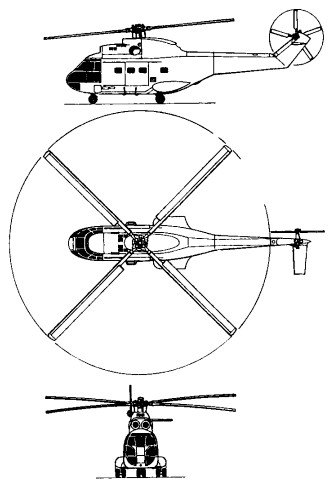
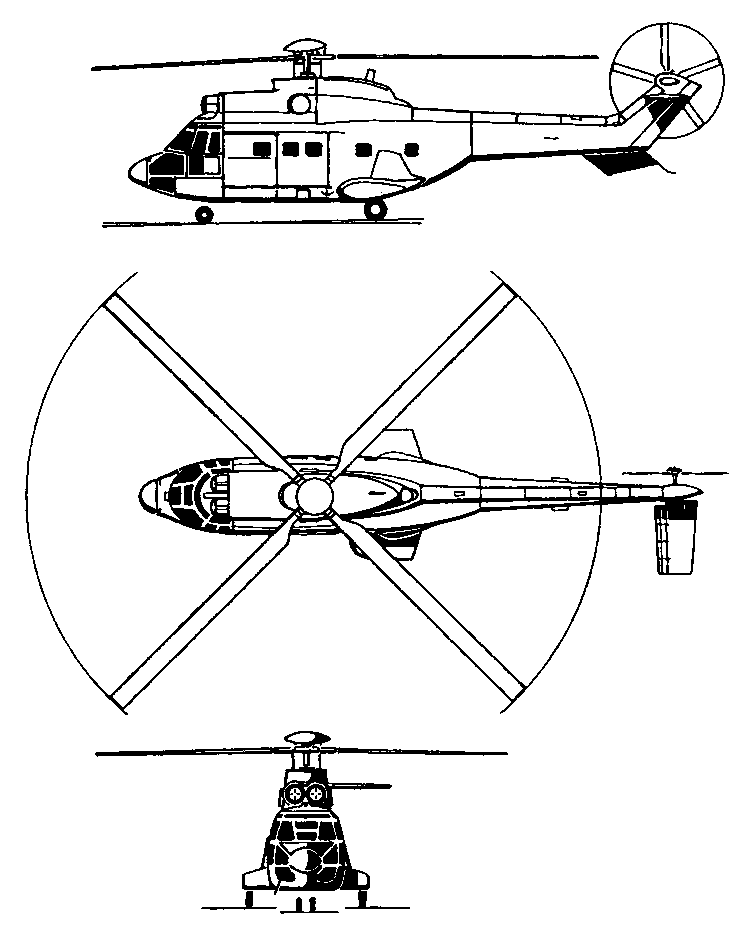
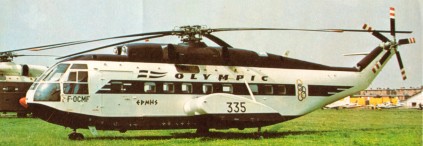
SA 321 Super Frelon development stemmed from the prototype – but not accepted for production – SA 3200 Frelon built to a French military specification. In a joint effort between Sud Aviation and Sikorsky, the base SA 3200 Frelon was developed into the “Super Frelon” (with Frelon translating into “Hornet”). The result was a rather large troop transport version that would go onto to be produced into three different variants.
At the end of the fifties, the French armed forces issued a specification for a heavy helicopter for troop transport and Sud-Aviation initiated the SA.3200 Frelon project. Sud-Aviation was formed on 1 March 1957 from the Sud-Ouest and Sud-Est Aviation companies. One of its first major projects was the Frelon, a large helicopter of conventional layout powered by three Turbomeca Turmo III turboshaft engines mounted above its cabin. Two are side-by-side in front of the rotor shaft and, the third behind the rotor shaft. Each engine supplied independent drive to the rotor head, thus ensuring twin-engined capability if one unit should fail. The first SE.3200 prototype flew on 10 June 1959. All fuel is carried externally in two tanks mounted to each side of the cabin.
Both the main and tail rotors are four-bladed and there is a variable-incidence tail control surface on each side of the rear fuselage. Standard equipment includes dual controls, radio and full night-flying equipment, with provision for an automatic pilot.
The Frelon cabin is ventilated and sound-proofed and measures 7m in length, with a width of 1.90m, and head-room of 1.83m. The entire tail assembly swings to the right to permit direct loading into the cabin. Normal entry is via large sliding doors on each side of the fuselage. Trials of the SA.3200 were suspended in 1963 in favour of the SA.3210 Super Frelon programme.

The planned production version was the SA.3210 powered by three 932kW Turmo IIIC engines. Development of the Frelon lapsed in favour of the SA.3210 (now SA.321) Super Frelon.
The SA321 was designed as an improved version of the SA 3200 Frelon (hornet) with the suport of Sikorsky, who were largely responsible for the rotor system.
Fiat, in Italy, were responsible for producing the main gearbox and transmission. Prototypes were produced as land-based troop transport accommodating up to 30 troops, and as naval anti-submarine type forming the basis of the SA 321G initial production model.
The basic structure of the Super Frelon was no different from the original model but for the US-built rotor system with six blades folded back automatically with the extreme rear of the tailboom, the watertight boat-type hull with a rear-loading ramp, and the three turbines were located side-by-side above the fuselage and the landing gear was of the fixed tricycle type. The two prototypes were followed by two pre-production models with Turmo III turbines and other variants with civil registrations.
The first prototype of the Super Frelon (originally designated SA 3210-01 (F-ZWWE) flew on 7 December 1962, powered by three 985kW Turmo IIIG-2 engines, represented the troop transport version and (with a modified fuselage and retractable landing gear) in July 1963 set up three speed records: 341.23km/h over 3km; 350.47km/h over 15/25km (unbeaten until 1967); 334.28km/h over 100km. The second prototype, flown on 28 May 1963, was representative of the naval version, with stabilising floats on the main landing gear supports incorporating search radar, dipping sonar and other anti-submarine equipment.
The cabin of the Super Frelon in the military transport version is 7m long and can take two jeeps or two DCA 20mm cannon. For casualty evacuation it can take 15 stretcher cases with two medical attendants. The rear loading ramp is hydraulically operated and can remain open even in flight. In 1962 the tri-turbine SA 3210 Super Frelon set three international records: 211.12 mph over 3 km; 217.53 mph on 15 to 25 km dash; and 197.41 mph for 100 km.
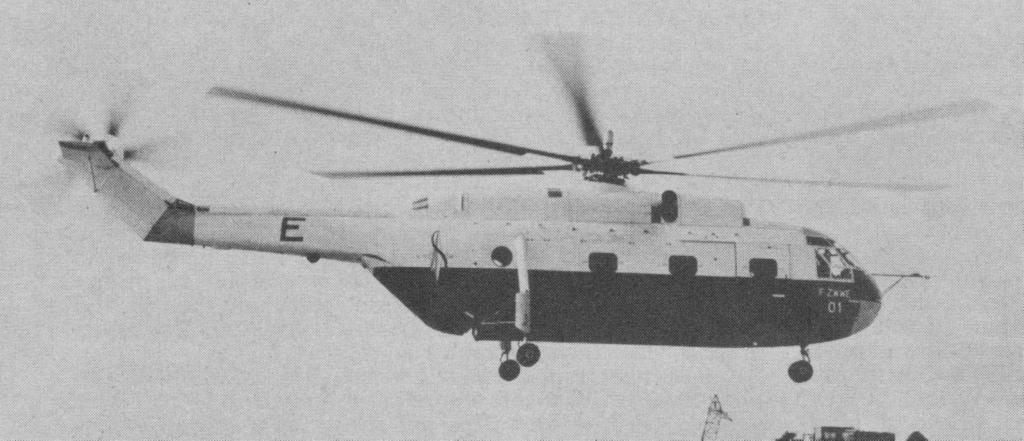
Four pre-production aircraft followed, and the French Government ordered an initial production series of 17, designated SA (AS) 321G, in October 1965, which entered service in 1966. The first flight of the first production machine was on 30 November 1965. By mid-1967, twenty-five were in service. These are a mixture of SA.321G’s, which can carry four homing torpedoes or other antisubmarine stores, or gear for mine-sweeping, minelaying or ship towing and were equipped with two Sylphe radars, all-weather navigation systems, an automatic stabilization system; and pure-transport versions capable of airlifting up to 30 troops, 18 casualty litters or 4000kg of cargo over 200km stage lengths. Five SA.321 transports have also been supplied to the Heil Avir le Israel, and delivery of sixteen Super Frelons to the South African Air Force began in July 1967.
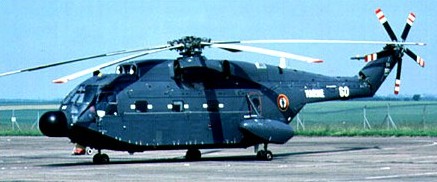
Carrying weapons in addition to search radar and sonar, the SA 321Gs were used to patrol the seaward approaches to the French navy’s nuclear submarine base at Brest. Some were later modified with nose-mounted radar and Exocet missiles for anti-ship attack, and the SA 321Ga was delivered for utility transport duties. In French naval service the Frelon equiped three units: 33F and 20S at St Mandrier and 32F based at Lanveoc.
The French Navy utilized the SA 321G, which was fitted in a maritime configuration with a dunking sonar system, torpedoes and other anti-submarine warfare equipment. These specialized versions would later be relegated to search and rescue roles in the navy capacity.
Only 24 SA 321Gs were built, but the production total was boosted by small-scale production of other variants, including the SA 321K assault transport for Israel (12 helicopters) and the SA 321J/ L/M transport exported to China, South Africa, and Libya. Israel re-engined eight of its Super Frelons and sold them to Argentina.
Iraq used Super Frelons, equipped with Omera radar and AM39 Exocet missiles, in anti-shipping strikes against Iran.
A commercial ‘air utility’ version, the SA.321J, was in production, eighteen were completed up to the end of September 1967. This can be used as a 27-seat passenger transport, as a freighter with a 2500kg payload, or for firefighting, flying crane or other duties; at least one is acting as a supply transport to offshore oil drilling operations. Certificated on 20 October 1967, the SA.321J is powered by Turmo IIIC5 engines. On 7 April 1967, the prototype SA.321F (F-WMHC) made its first flight. This is an enlarged passenger version with a 19.4m fuselage seating up to 37 occupants, a gross weight of 12,000kg, and large sponson-type fairings amidships which act as baggage holds. The one-off SA.321F commercial transport version, test-flown in 1968, is powered by three 1400shp Turmo IIIC3 shaft turbines. It had an air-conditioned, soundproofed cabin, a sliding door on the starboard side and a rotor head fairing. The two stub wings at the sides of the fuselage were used as baggage holds, and airline-style seating provided for 34-37 passengers.
The SA 321 has six-blade main rotor and five-blade anti-torque tail rotor, with rearward folding of all six main rotor blades of SA 321G accomplished automatically by hydraulic jacks, simultaneously with automatic folding of the tail rotor pylon. The rotor can be stopped within 40 seconds by a boosted disc-type rotor brake fitted to this shaft.
The main rotor blades of all-metal construction, with D-section main spar forming leading-edge. The tail rotor is of similar construction to main rotor. The boat-hull fuselage is of conventional metal semi-monocoque construction, with watertight compartments inside planing bottom. On the SA 321G, there is a small stabilising float attached to the rear landing gear support structure on each side. The tail section of the SA 321G folds for stowage. Small fixed stabilisers on starboard side of tail rotor pylon on all versions. The SA 321F has large external fairings on each side of the centre-fuselage which serve a similar purpose to stabilising floats and also act as baggage containers.
The landing gear is of non-retractable tricycle type, by Messier-Hispano-Bugatti, with twin magnesium alloy wheels on each unit. Hydraulic disc brakes are on the mainwheels and the nosewheel unit is steerable and self-centring. Fuel is in flexible tanks under the floor of the centre-fuselage, with a total standard capacity of 3,975 litres in SA 321G/H and 3,900 litres in SA 321Ja. Optional auxiliary fuel tankage comprises two 500 litre external tanks on all models, two 500 litre internal tanks in the SA 321G, and three 666 litre tanks in the 321H/Ja.
The military version has a crew of two on the flight deck, with dual controls and advanced all-weather equipment. The SA 321G carries three other flight crew, and has provision for 27 passengers. SA 321H transport accommodates 27-30 troops, 5,000kg of internal or external cargo, or 15 stretchers and two medical attendants.
The SA 321F has airliner seats for up to 37 passengers (34 if toilets are installed) in three-abreast rows with centre aisle, while the SA 321Ja has seating for up to 27 passengers in the personnel transport role. As a cargo transport, external loads of up to 5,000kg can be suspended from the cargo sling. Loading of internal cargo (up to 5,000kg) is via rear ramp doors, with the assistance of a Tirefor hand winch.
The ASW SA 321G operates normally in tactical formations of three or four aircraft, each helicopter carrying the full range of detection, tracking and attack equipment, including a self-contained navigation system associated with a Doppler radar, a 360° radar with transponder and display console, and dipping sonar. Four homing torpedoes can be carried in pairs on each side of the main cabin. Both the SA 321G and H can be fitted with an anti-surface vessel weapon system, consisting of two Exocet missiles and launch installation associated with an Omera-Segid Heracles ORB 31D or ORB 32 radar for target designation. Other equipment is provided for secondary duties such as towing and minesweeping. Rescue hoist of 275kg capacity standard.
Argentina received several SA 321 from Israel. Argentine versions were Israeli-owned and refitted with the General Electric GE T58 powerplants. South African versions were noted for not being the full amphibious versions of the Super Frelon type.
The triple-turbine-powered Changhe Z-8 (Zhishengji-8 / Vertical take-off aircraft 8) design work began in 1976, but was suspended from 1979 to mid-1984. Chinese equivalent of Aerospatiale Super Frelon, of which 16 supplied to PLA Navy in 1977-78. The Z-8 features a six-blade main rotor and five-blade tail rotor: boat-hull fuselage with watertight compartments inside planing bottom; stabilising float at rear each side, attached to small stub-wing; small, strut-braced fixed horizontal stabiliser on starboard side of tail rotor pylon. Search radar in nose ‘thimble’ on SAR version.
Pitch control fitting at root of each main rotor blade; drag and flapping hinges for each blade mounted on rotor head starplates; each main blade also has a hydraulic drag damper. Fully redundant flight control system, with Dong Fang KJ-8 autopilot.
Stressed skin metal fuselage, with riveted watertight compartments; gearboxes manufactured by Zhungnaii Transmission Machinery Factory.
A non-retractable tricycle undercarriage, with twin wheels and low-pressure oleo-pneumatic shock-absorber on each unit. Small tripod tailskid under rear of tailboom. Boat hull and side floats permit emergency water landings and take-offs.
Power is from three Changzhou (CLXMW) WZ6 turboshafts, each with maximum emergency rating of 1,156kW and 20% power reserve at S/L, ISA. Two engines side by side in front of main rotor shaft and one aft of shaft. Transmission rated at 3,072kW.
Standard internal fuel capacity 3,900 litres, in flexible tanks under floor of centre-fuselage. Auxiliary fuel tanks can be carried inside cabin for extended-range or self-ferry missions, increasing total capacity to 5,800 litres.
Crew of two or three on flight deck. Accommodation in main cabin for up to 27 fully armed troops, or 39 without equipment; up to 15 stretchers and a medical attendant in ambulance configuration; a BJ-212 Jeep-type vehicle and its crew; or other configurations according to mission. Entire accommodation heated, ventilated, soundproofed and vibration-proofed. Forward-opening crew door on each side of flight deck. Rearward-sliding door at front of cabin on starboard side. Hydraulically actuated rear-loading ramp/door.
First flown on 11 December 1985, a second prototype flew in October 1987. Domestic type approval was awarded on 8 April 1989 and the first Z-8 was handed over to FLA Naval Air Force for service trials on 5 August 1989. Initial production was approved and the final design approval granted on 12 November 1994.
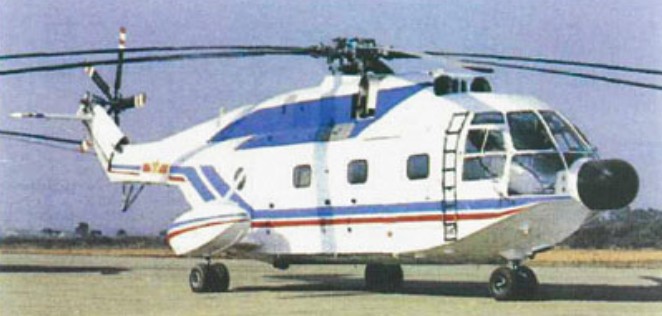
Up to 20 were delivered to PLA Navy by the end of 1999. There was no firm evidence of production status since then, but the type was still being promoted by CATIC in 2002. The sole operating naval unit was Shipborne Helicopter Group within East Sea Fleet at Dachang (Shanghai).
Principal versions:
SE.3210 / SA.321 Super Frelon
Larger development of SA.320 with boat hull and outrigger floats, rear loading doors, boom tail, six-blade main rotor driven by three 1320shp Turbomeca Turmo IIIC turboshafts. Prot. F-ZWWE FF 7 Dec. 1962.
SA 321B
Standard French Air Force/Army Super Frelon.
SA 321D
Standard French Navy Super Frelon.
SA 321F
Commercial airliner with streamlined external sponsons, designed to carry 34-37 passengers. The prototype was designed in accordance with US FAR Pt 29 regulations and flew for the first time on 7 April 1967. Type certification was granted by the SGAC on 27 June 1968 and by the FAA on 29 August 1968.
SA 321G
Anti-submarine helicopter able to carry 27 passen¬gers or freight in its alternative transport role. First version to enter production. The first SA 321G flew on 30 November 1965 and deliveries began in early 1966. Twenty-four built.
SA 321H
Simplified military version for air force and army service, without stabilising floats or external fairings on each side of lower fuselage. Turmo IIIE_6 engines instead of Turmo IIIC_6 in other versions. No de-icing equipment fitted.
SA 321Ja
Utility and public transport version, intended to fulfil the main roles of personnel and cargo transport. Designed to carry a maximum of 27 passengers or 11,023 lb/5,000 kg of freight. External loads of up to 5,000kg can be suspended from the cargo sling. The SA 321Ja prototype flew for the first time on 6 July 1967. A French certificate of airworthiness was granted in December 1971.
SA 321K
Israeli assault transport, later re-engined with Gen¬eral Electric T58 turboshafts
SA 321L
Develop¬ment of the SA 321K for other export markets
SA 321M
Libyan version of the SA 321L
Changhe Z-8
Standard Chinese development
Changhe Z-8A
Reported designation of upgraded version, with Turbomeca Makila 2A engines matched to Turmo gearbox. Pratt & Whitney Canada also a candidate for any re-engining programme. Two Z-8As reportedly delivered to PLA Army Aviation for evaluation in 2001, camouflaged; lack nose radome and side-mounted floats.
Changhe Z-8F
Improved and more powerful version, for which the 1,380kW P&WC PT6B-67A turhoshaft was selected in November 2002. Additional 671kW of power expected to enhance ‘hot-and-high’ performance, including increase in service ceiling to 4,700m at MTOW and increased payload capacity. Other improvements said to include new (composites) main rotor blades, with anti-icing; new avionics and mission equipment. Duties envisaged are search and rescue, general utility missions and logistics support.
Specifications
S.E.3200 Frelon
Engines: 3 x Turmo IIIB turboshaft, 750/800shp
Main rotor diameter: 15.0 m
Length, blades folded: 14.9 m
Width, blades folded: 5.2 m
Height: 4.7 m
Weight empty: 4500 kg
Max useful load: 3500 kg
Normal loaded weight: 7500 kg
Max loaded weight: 8000 kg
Max ferrying range: 1300 km
SA 321 Super Frelon
Engine: 3 x Turboméca Turmo III C 6, 1529 shp / 1156kW
Length: 63.648 ft / 19.4 m
Length with rotors: 23.03 m
Height: 21.85 ft / 6.66 m
Width: 5.2 m
Rotor diameter: 62.008 ft / 18.9 m
Max takeoff weight: 27562.5 lb / 12500.0 kg
Weight empty: 14420.7 lb / 6540.0 kg
Max. speed: 130 kt / 240 km/h
Cruising speed: 124 kt / 230 km/h
Service ceiling: 11647 ft / 3550 m
Maximum range: 583 nm / 1080 km
Range (max. weight): 351 nm / 650 km
Rate of climb: 12.0 m/s
Hovering ceiling: 2170 m
Crew: 2
Payload: 30 Pax / 4500kg
Fuel: 3975 kg
SA321G Super Frelon
Engines: 3 x Turbomeca Turmo 111C6 turboshafts, l,570-shp / 1,171-kW
Maximum speed: 154 mph (248 kph) at SL
Initial climb rate: 984 fpm (300 m/min)
Service ceiling: 10,170 ft (3,100 m)
Cruising speed: 248 km/h (154 mph)
Endurance in ASW role: 4 hr
MTOW: 28,660 lb (13,000 kg)
Empty weight: 15,130 lb (6,863 kg)
Height: 22 ft 2 in (6.76 m)
Main rotor diameter: 62 ft (18.9 m)
Main rotor disc area: 3,019.94 sq ft (280.55 sq.m)
Length overall, rotors turning: 75 ft 6.75 in (23.03 m)
Range 3500 kg (7,716 ¬lb) load: 1020 km (633 miles)
Armament: up to four homing anti¬submarine torpedoes or two AS.39 Ex¬ocet anti ship missiles.
SA321H
Engines: 3 x Turbomeca Turmo IIIE-6 turboshaft
Changhe Z-8
Engine: 3 x Changzhou WZ6, 1,156kW
Instant pwr: 1156 kW
Main rotor diameter: 18.90m
Tail rotor diameter: 4.00m
Length overall, rotors turning: 23.035m
Height overall, rotors turning: 6.66m
Width over main gear sponsons: 5.20m
Empty weight equipped: 7550kg
Max take-off weight, standard fuel: 10592kg
Max take-off weight, with auxiliary fuel: 13000kg
Max cargo payload (internal): 4000kg
Max cargo payload (external sling): 5000kg
Never-exceed speed: 315km/h
Max cruising speed: 266km/h
Econ cruising speed: 255km/h
Rate of climb: 690m/min
HIGE: 18,045 ft / 5500m
HOGE: 14,435 ft / 4400m
Service ceiling: 19,685 ft / 6000m
Max range: 880 km
Range max fuel / TOW 9000kg: 430km
Endurance max fuel: 2 h 31 min
Crew: 2
Pax: 27
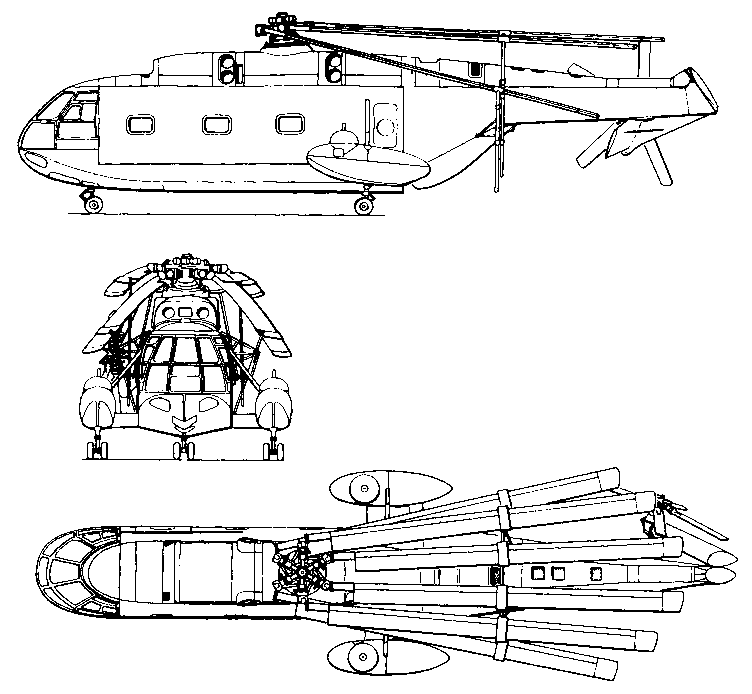
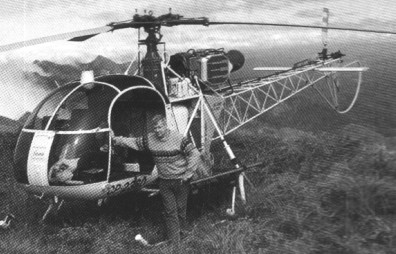
When production of the Alouette II ended, after more than 1,300 airframes had been completed, Sud (which later became part of Aerospatiale) concentrated on building the Lama. Initially evolved to meet an Indian armed forces requirement of 1968 and intended primarily for operations in ‘hot-and-high’ conditions, the basic design of the Aerospatiale SA 315B Lama combines a reinforced Alouette II airframe with SA 316B Alouette III dynamic components, including its Artouste power-plant and rotor system. The SA 315 prototype was first flown on 17 March 1969, received the French Certificate of Airworthiness on 30 September 1970, and given the name Lama in July 1971. Able to lift one tonne on the hook and excellent lifting properties have been put into good effect throughout the world. Although used throughout the world, the Lama was not produced in large quantities, with fewer than 400 built from 1970 to 1982.
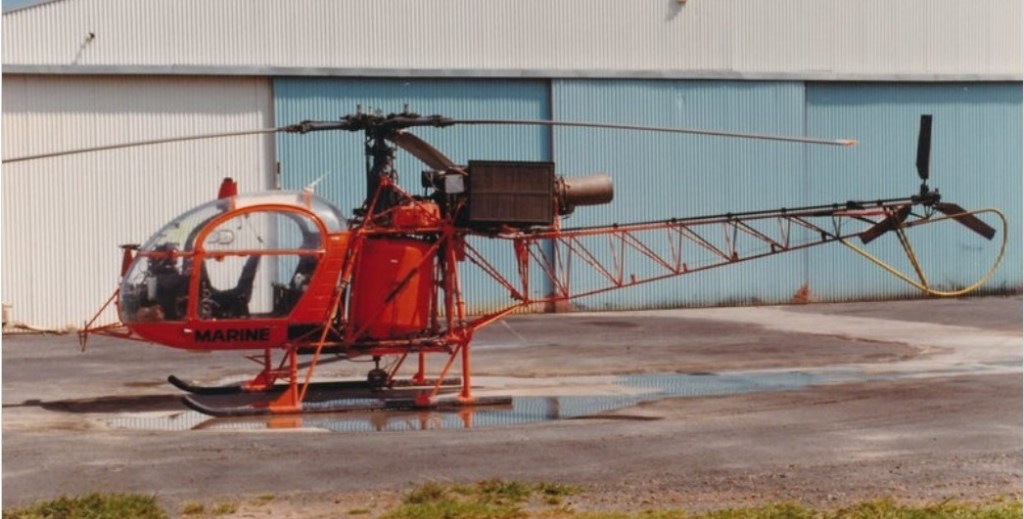
From the outset the SA 315B excelled in load-to-altitude performance. In 1971 arrangements were completed for licence production of the SA 315B by HAL at Bangalore in India. The first Indian-assembled Lama flew on 6 October 1972, with deliveries commencing in December 1973. The HAL-produced Lama is renamed Chetak.
On 21 June 1972 a Lama, with just a pilot on board, set an absolute height record for helicopters of 12442m / 40,814 ft.
The SA315B was available with either the Turbomeca Artouste IIIB of 858 shp or the Artouste IIA of 550 shp.
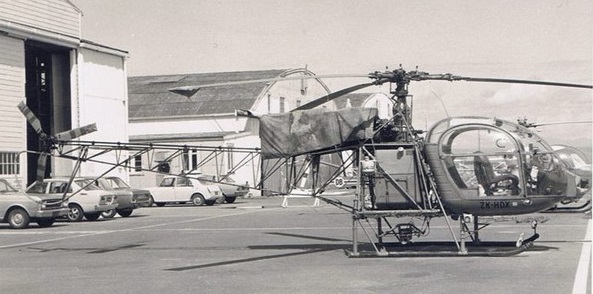
The SA 315B Lama can be fitted out for various commercial roles, such as a light passenger transport or for agricultural tasks, while the military variants include conversions for liaison, observation, photography, air/sea rescue (hoist capacity 160kg), transport (maximum external load 1135kg), ambulance (two stretchers and one medical attendant), and other tasks. Its altitude performance makes the SA 315B particularly suited for mountainous districts: the production Lama can transport underslung external loads of up to 1000kg at an altitude of 2500m. Another factor is its universal landing gear consisting of skids with removable wheels for ground handling, provision for floats for normal operations from water and emergency flotation gear, inflatable in the air.
In 1978 agreement was reached between Aerospatiale and Helibras in Brazil for the assembly of SA 315B Lama helicopters, leading to full licence production as the Gaviao, using French components.
SA-315B Lama
Engine: Turbomeca Artouste IIIB, 858 shp
TBO: 2500 hrs
Rotor diameter: 36.155 ft / 11.02 m
Seats: 5
Length: 42.388 ft / 12.92 m
Height: 10.1 ft / 3.09m
Fuselage length: 10.26m
Underslung load: 1135kg
Max ramp weight: 4300 lb
MTOW: 4300 lb / 1950.0 kg
Standard empty weight: 2244.7 lb / 1018.0 kg
Max useful load: 2034 lb
Max landing weight: 4300 lb
Max sling load: 2500 lb
Disc loading: 4.2 lb/sq.ft
Power loading: 5 lb/hp
Max rate of climb: 1083 fpm
Max usable fuel: 1018 lb
Service ceiling: 17,720 ft
Hover in ground effect: 16,565 ft
Max speed: 113 kts / 210 km/h
HOGE: 15,100 ft
Normal cruise @ 3000 ft: 103 kts / 190 km/h
Fuel flow normal cruise: 369 pph
Range: 275 nm / 510 km
Endurance normal cruise: 2.6 hr
Crew: 1
Passengers: 4
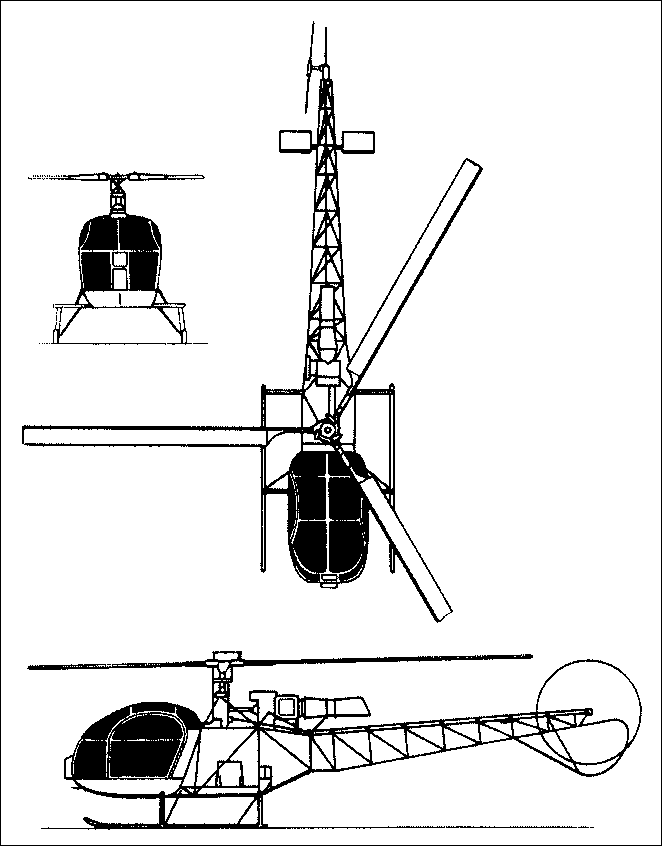
 All Aero